Question types

MODEL PAPER 2 question types

49 questions across 6 question groups — pick any mix to generate a Science paper with step-by-step answer keys.

49
Questions
6
Question groups
5
Question types
Sample Questions

MODEL PAPER 2 questions

One sample from each question group in this chapter. Select any group above to see the full set with answer keys.

Q 1M.C.Q1 Mark
Assertion (A): The second trophic level of a food chain operating in a grassland is mostly occupied by a carnivore
Reason (R): Carnivores feed upon herbivores and are secondary consumers.
  • A
    Both A and R are true and R is the correct explanation of A
  • B
    Both A and R are true but R is not the correct explanation of A.
  • C
    A is true but R is false.
  • A is false but R is true.

Answer: D.

View full solution
Q 2M.C.Q1 Mark
Assertion (A): Two bar magnets attract when they are brought near to each other with the same pole.
Reason (R): Unlike poles will attract each other.
  • A
    Both A and R are true and R is the correct explanation of A
  • B
    Both A and R are true but R is not the correct explanation of A.
  • C
    A is true but R is false.
  • A is false but R is true.

Answer: D.

View full solution
Q 3M.C.Q1 Mark
Assertion (A): Regeneration is getting a full organism back from its body parts.
Reason (R): In grafting, the stock is placed over the scion.
  • A
    Both A and R are true and R is the correct explanation of A
  • Both A and R are true but R is not the correct explanation of A.
  • C
    A is true but R is false.
  • D
    A is false but R is true.

Answer: B.

View full solution
Q 4M.C.Q1 Mark
Assertion (A): The colour of aqueous solution of copper sulphate turns colourless when a piece of lead is added to it.
Reason (R): Lead is more reactive than copper, and hence displaces copper from its salt solution
  • Both A and R are true and R is the correct explanation of A
  • B
    Both A and R are true but R is not the correct explanation of A.
  • C
    A is true but R is false.
  • D
    A is false but R is true.

Answer: A.

View full solution
Q 5M.C.Q1 Mark
Which of the following groups contain only biodegradable items?
a. Grass, flowers and leather
b. Grass, wood and plastic
c. Fruit peels, cake and lime-juice
d. Cake, wood and grass
  • Groups (a), (c) and (d)
  • B
    Groups (a), (b) and ©
  • C
    Groups (a), (b) and (d)
  • D
    Groups (b), (c) and (d)

Answer: A.

View full solution
Assertion (A): The colour of aqueous solution of copper sulphate turns colourless when a piece of lead is added to it.
Reason (R): Lead is more reactive than copper, and hence displaces copper from its salt solution
View full solution
An object is placed at a distance of 30 cm from a concave lens of focal length 15 cm. List four characteristics (nature, position, etc.) of the image formed by the lens.
View full solution
$a.$ What is the heating effect of electric current?
$b.$ Write an expression for the amount of heat produced in a resistor when an electric current is passed through it stating the meanings of the symbols used.
$c.$ Name two appliances based on heating effect of electric current.
View full solution
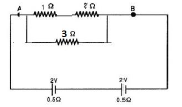
Given in fig. is the circuit diagram in which three resistors of 12, 22 and 32 are connected to cell of e.m.f. 2V and internal resistance 0.5 Ω.
i. Calculate the total resistance of the circuit.
ii. What is the reading of ammeter and What will be ammeter reading if an exactly similar cell is connected in series with the given cell?
Image
View full solution
i. In humans, if gene B gives brown eyes and gene b gives blue eyes, what will be the colour of eyes of the persons having the following combination of genes? (a) Bb (b) bb (c) BB
ii. What do you class this trait of eye colour in human? Explain.
View full solution
i. What is meant by power of a lens? Define its Sl unit.
ii. You have two lenses A and B of focal lengths +10 cm and - 10 cm, respectively. State the nature and power of each lens. Which of the two lenses will from a virtual and magnified image of an object placed 8 cm from the lens? Draw a ray diagram to justify your answer.
View full solution
An object is placed at a distance of $30 \ cm$ from a concave lens of focal length $30 \ cm.$
$i.$ Use lens formula to determine the distance of the image from the lens.
$ii.$ List four characteristics of the image $($nature position, size, erect/inverted$)$ in this case.
$iii.$ Draw a labelled diagram to justify your answer of part $(ii)$
View full solution
Give reason for the following:
a. During reproduction inheritance of different proteins will lead to altered body designs.
b. Fertilization cannot take place in flowers if pollination does not occur.
c. All multicellular organisins cannot give rise to new individuals through fragmentation or regeneration.
d. Vegetative propagation is practised for growing only some type of plants.
e. The parents and off-springs of organisms reproducing sexually have the same number of chromosomes.
View full solution
What are detergents chemically? List two merits and two demerits of using detergents for cleansing. State the reason for the suitability of detergents for washing, even in the case of water having calcium and magnesium ions.
View full solution
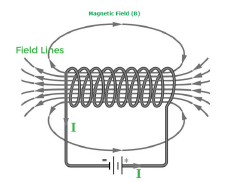
An insulated copper wire wound on a cylindrical cardboard tube such that its length is greater than its diameter is called a solenoid. When an electric current is passed through the solenoid, it produces a magnetic field around it. The magnetic field produced by a current-carrying solenoid is similar to the magnetic field produced by a bar magnet. The field lines inside the solenoid are in the form of parallel straight lines. The strong magnetic field produced inside a current-carrying solenoid can be used to magnetize a piece of a magnetic material like soft iron when placed inside the solenoid. The strength of the magnetic field produced by a current-carrying solenoid is directly proportional to the number of turns and strength of the current in the solenoid.
Image
(a) What would be the strength of the magnetic field inside a long current-carrying straight solenoid?
(b) Which end is north and which end is south pole when current flows through a solenoid?
(c) A long solenoid carrying a current produces a magnetic field B along its axis. If the current is double and the number of turns per cm is halved, then what will be the new value of the magnetic field?
OR
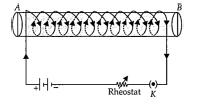
A soft iron bar is enclosed by a coil of insulated copper wire as shown in the figure. When the plug of the key is closed, then where would the face B of the iron bar be marked?
Image
View full solution
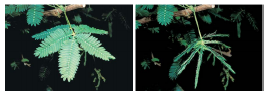
Animals have a nervous system for controlling and coordinating the activities of the body. But plants have neither a nervous system nor muscles. So, how do they respond to stimuli? When we touch the leaves of a chui- mui (the 'sensitive' or 'touch-me-not' plant of the Mimosa family), they begin to fold up and droop. When a seed germinates, the root goes down, the stem comes up into the air. What happens? Firstly, the leaves of the sensitive plant move very quickly in response to touch.
There is no growth involved in this movement. On the other hand, the directional movement of a seedling is caused by growth. If it is prevented from growing, it will not show any movement.
Image
(a) Write the types of movement.
(b) Give an example of a plant hormone that promotes growth.
(c) What is the function of the nervous system?
OR
How is the movement of leaves of the sensitive plant different from the movement of a shoot towards light?
View full solution
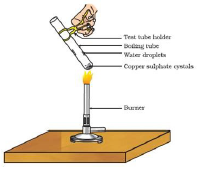
Copper sulphate crystal contains water of crystallisation when the crystal is heated the water is removed and salt turns white. The crystal can be moistened again with water. The water of crystallisation is the fixed number of water molecules present in 1 formula unit of copper sulphate. On heating gypsum at 373K, it loses water molecules and became calcium sulphate hemihydrate.
Image
(a) If the crystal is moistened with water, then which colour of the crystal reappears?
(b) What is the commercial name of calcium sulphate hemihydrate?
OR
How many water molecules are present in one formula unit of copper sulphate?
View full solution

Generate a MODEL PAPER 2 paper free

Pick question groups from the list above, set marks and difficulty, and export a branded PDF with step-by-step answer keys. First 3 chapters free — no signup.

Download App