Questions

case /data -based (4 Marks)

🎯

Test yourself on this topic

3 questions · timed · auto-graded

Question 14 Marks
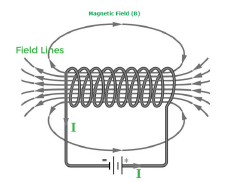
An insulated copper wire wound on a cylindrical cardboard tube such that its length is greater than its diameter is called a solenoid. When an electric current is passed through the solenoid, it produces a magnetic field around it. The magnetic field produced by a current-carrying solenoid is similar to the magnetic field produced by a bar magnet. The field lines inside the solenoid are in the form of parallel straight lines. The strong magnetic field produced inside a current-carrying solenoid can be used to magnetize a piece of a magnetic material like soft iron when placed inside the solenoid. The strength of the magnetic field produced by a current-carrying solenoid is directly proportional to the number of turns and strength of the current in the solenoid.
Image
(a) What would be the strength of the magnetic field inside a long current-carrying straight solenoid?
(b) Which end is north and which end is south pole when current flows through a solenoid?
(c) A long solenoid carrying a current produces a magnetic field B along its axis. If the current is double and the number of turns per cm is halved, then what will be the new value of the magnetic field?
OR
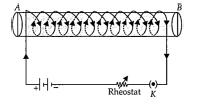
A soft iron bar is enclosed by a coil of insulated copper wire as shown in the figure. When the plug of the key is closed, then where would the face B of the iron bar be marked?
Image
Answer
An insulated copper wire wound on a cylindrical cardboard tube such that its length is greater than its diameter is called a solenoid. When an electric current is passed through the solenoid, it produces a magnetic field around it. The magnetic field produced by a current-carrying solenoid is similar to the magnetic field produced by a bar magnet. The field lines inside the solenoid are in the form of parallel straight lines. The strong magnetic field produced inside a current-carrying solenoid can be used to magnetize a piece of a magnetic material like soft iron when placed inside the solenoid. The strength of the magnetic field produced by a current-carrying solenoid is directly proportional to the number of turns and strength of the current in the solenoid.
Image

(i) Magnetic field inside the infinite solenoid is uniform. Hence it is the same at all points.
(ii) The end of the current carrying solenoid at which the current flows anti-clockwise behaves as a north pole while that end at which the direction of current clockwise behaves as a south pole and this is according to clock wise.
(iii) For a long solenoid, magnetic field B∝ In; where I is the flowing current and n is number of turns per unit length in the solenoid. Therefore, in the given case magnetic field will remain unchanged.
OR
For a solenoid, if we imagine gripping the solenoid with your right hand so that your curl fingers follow the direction of the current then your thumb will point towards the north end of the electromagnet.
View full question & answer
Question 24 Marks
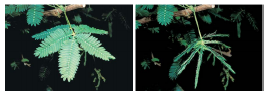
Animals have a nervous system for controlling and coordinating the activities of the body. But plants have neither a nervous system nor muscles. So, how do they respond to stimuli? When we touch the leaves of a chui- mui (the 'sensitive' or 'touch-me-not' plant of the Mimosa family), they begin to fold up and droop. When a seed germinates, the root goes down, the stem comes up into the air. What happens? Firstly, the leaves of the sensitive plant move very quickly in response to touch.
There is no growth involved in this movement. On the other hand, the directional movement of a seedling is caused by growth. If it is prevented from growing, it will not show any movement.
Image
(a) Write the types of movement.
(b) Give an example of a plant hormone that promotes growth.
(c) What is the function of the nervous system?
OR
How is the movement of leaves of the sensitive plant different from the movement of a shoot towards light?
Answer
Animals have a nervous system for controlling and coordinating the activities of the body. But plants have neither a nervous system nor muscles. So, how do they respond to stimuli? When we touch the leaves of a chui-mui (the 'sensitive' or 'touch-me- not' plant of the Mimosa family), they begin to fold up and droop. When a seed germinates, the root goes down, the stem comes up into the air. What happens? Firstly, the leaves of the sensitive plant move very quickly in response to touch.
There is no growth involved in this movement. On the other hand, the directional movement of a seedling is caused by growth. If it is prevented from growing, it will not show any movement.
Image

(i) There are two types of movement:
a. dependent on growth
b. independent on growth.
(ii) Auxin is a plant hormone that promotes growth.
(iii)The function of the nervous system is to control and coordinate the activities of the body.
OR
The movements of the leaves of the sensitive plant are touch sensitive and independent of growth while the movement of the shoot towards light is growth related and known as phototropism.
View full question & answer
Question 34 Marks
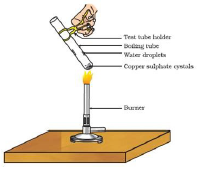
Copper sulphate crystal contains water of crystallisation when the crystal is heated the water is removed and salt turns white. The crystal can be moistened again with water. The water of crystallisation is the fixed number of water molecules present in 1 formula unit of copper sulphate. On heating gypsum at 373K, it loses water molecules and became calcium sulphate hemihydrate.
Image
(a) If the crystal is moistened with water, then which colour of the crystal reappears?
(b) What is the commercial name of calcium sulphate hemihydrate?
OR
How many water molecules are present in one formula unit of copper sulphate?
Answer
Copper sulphate crystal contains water of crystallisation when the crystal is heated the water is removed and salt turns white. The crystal can be moistened again with water. The water of crystallisation is the fixed number of water molecules present in 1 formula unit of copper sulphate. On heating gypsum at 373K, it loses water molecules and became calcium sulphate hemihydrate.
Image
(i) If the crystal is moistened with water, then the blue colour of the crystal reappears.
(ii) The commercial name of calcium sulphate hemihydrate is Plaster of Paris.
OR
Five water molecules are present in one formula unit of copper sulphate.
View full question & answer
case /data -based (4 Marks) - Science STD 10 Questions - Vidyadip