Questions

[3 Mark Questions]

🎯

Test yourself on this topic

8 questions · timed · auto-graded

Question 13 Marks
An electric geyser rated at $1500 W, 250 V$ is connected to a $250 V$ line mains. Solve
$i.$ the electric current drawn by it. and the energy consumed by it in $50 h.$
$ii.$ cost of energy consumed if each unit costs $Rs.6.$
Answer
Given, power, $P =1500 W$, voltage, $V =230 V$
$i.\ \therefore$ Electric down drawn,
$I=\frac{P}{V}=\frac{1500}{250}=6 A$
$ii.\ \therefore$ Energy consumed, $E =$ power $\times$ Time
$=1500 \times 50$
$=75000\ Wh$
$=75\ kWh[\therefore 1\ kW=1000 W]$
$=75 \text { unit }[\therefore 1 \text { unit }=1 kWh]$
$iii.\ \therefore$ Cost of energy consumed $=75 \times 6$
$ =Rs. 450.$
View full question & answer
Question 23 Marks
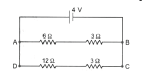
For the circuit shown in the given diagram:
Image
What is the value of
$i. $current through $6\Omega $ resistor?
$ii.$ potential difference across $12\Omega$ resistor?
Answer
Let the current through the circuit be I which is divided into $I_1$ and $I_2$ in the arms $AB$ and $CD$ respectively, then we have
$I=I_1+I_2$
In the arm $AB ,$ the total resistance is
$R_1=6 \Omega+3 \Omega=9 \Omega$
and the total resistance in the arm $CD$ is
$R_2=12 \Omega+3 \Omega=15 \Omega$
$i.$ Then current in the $6Q$ resistor i.e.,
$I_1=\frac{V}{R_1}$
$=\frac{4}{9}$
$=0.44 A$
$ii.$ Now the current through $CD$ is
$I_2=\frac{V}{R_2}$
$=\frac{4}{15}$
$=0.27 A$
The potential difference across $12 \Omega$, resistor is
$V_1=I_2 \times 12 \Omega$
$V_1=0.27 \times 12$
$=3.23 V$
View full question & answer
Question 33 Marks
Sudha finds out that the sharp image of window pane of her science laboratory is formed at a distance of $15 \ cm$ from the lens. She now tries to focus the building visible of her outside the window instead of the window pane without disturbing the lens. In which direction will she move the screen to obtain a sharp image of the building? What is the approximate focal length of this lens?
Answer
Let us assume that the window pane is between $F_2$ and infinity from this lens and this is a convex lens. We know that when the object is between infinity and $F_2,$ its inverted and real images is formed between $2F$ and $2F_2$ Now$,$ the distant building is at infinity from the lens. Its image would be formed at $2F$. So$,$ the screen needs to be moved towards the lens in order to get a sharp image. Its approximate focal length is 1$0 \ cm ($less than image distance in earlier case$).$
View full question & answer
Question 43 Marks
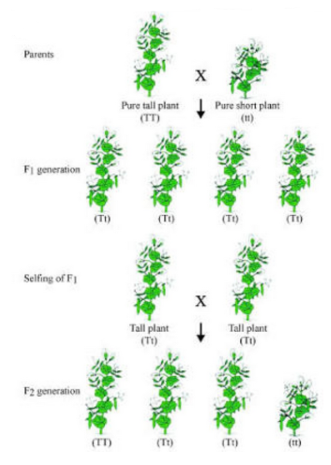
Name the plant Mendel used for his experiment. What type of progeny was obtained by Mendel in $F_1$ and $F_2$ generations when he crossed the tall and short plants? Write the ratio he obtained in $F_2$ generation plants.
Answer
$i.$ Plant used by Mendal is Garden Pea Plant $($Pisum sativum$).$
$ii. F_1-$ All tall; $ F_2 -$ Tall and short
$iii.$ The ratio in $F_2$ progeny is $3:1.$​​​​​​​
Image
View full question & answer
Question 53 Marks
Explain the process of digestion of food in mouth, stomach and small intestine in human body.
Answer
Digestion of food occurs in the following steps:
i. Mouth (Buccal cavity): The mouth contains teeth, which crush the food into small particles. Salivary glands present in the mouth secrete saliva, which moistens the food. It also contains enzyme salivary amylase which gets mix with food and form bolus. From here, food travels to the esophagus or swallowing tube. The esophagus is a muscular tube extending from the pharynx to the stomach.
ii. Stomach- The stomach is a sac-like organ with strong muscular walls which acts like mixer and grinder. Gastric glands are present in the wall of the stomach which release following secretions:
a. Hydrochloric acid To make the medium acidic for the action of enzyme pepsin.
b. Mucus To protect the inner lining of the stomach from the action of an acid.
c. Pepsin A protein-digesting enzyme.
iii. Small intestine is made up of three segments, the duodenum, jejunum, and ileum. The small intestine is a long tube loosely
coiled in the abdomen It is the site of complete digestion of carbohydrates, proteins, and fats. It receives secretions from liver and pancreas.
a. Bile juice It is secreted by the liver and performs the following functions:
It makes the medium alkaline for the pancreatic enzymes to act. It also breaks down large fat globules into smaller
globules.
b. Pancreatic juice It is secreted by the pancreas. It contains enzymes like amylase for digesting starch, trypsin for digesting proteins and lipase for breaking down emulsified fats.
c. Intestinal juice It is secreted by the walls of the small intestine. It contains a number of enzymes such as maltase, lipase etc., for complete digestion
Colon - The final stage of the digestive system is the colon (large intestine) which absorbs water and salts before the remains are passed out of the rectum as faeces. The colon can also help to absorb remaining carbohydrate and some fats.
View full question & answer
Question 63 Marks
Explain the following
$a.$ Reactivity of Al decreases if it is dipped in $HNO_3$
$b.$ Carbon cannot reduce the oxides of Na or Mg
$c.$ NaCl is not a conductor of electricity in solid state whereas it does conduct electricity in aqueous solution as well as in molten state
$d.$ Iron articles are galvanised.
$e.$ Metals like $\text{Na ,K, Ca}$ and $\text{Mg}$ are never found in their free state in nature.
Answer
$a. $When aluminium $(Al)$ is placed in nitric acid $(HNO_3)$, a layer of aluminium oxide is formed on the metal. This happens because nitric acid is a strong oxidizing agent. The layer of aluminium oxide prevents further reaction of aluminium. This is
the reason why the reactivity of aluminium decreases.
$b.$ Sodium and magnesium have a tendency to react with oxygen rather than carbon because these are highly reactive metals. Hence$,$ carbon cannot reduce the oxides of Na or Mg.
$c.$ Ionic compounds do not conduct electricity in the solid$-$state but they conduct electricity in aqueous solution and in the molten state due to high concentration of free electrons. This property is shown by sodium chloride as it is an ionic compound.
$d.$ Iron articles are galvanized to prevent them from rusting. After galvanization$,$ the layer of zinc works as a protective layer. The most common type is hot$-$dip galvanizing. In this process$,$ iron parts are submerged in a bath of molten zinc.
$e.$ Metals such as $\text{Na, K, Ca}$ and $\text{Mg}$ are highly reactive metals and hence they are not found in their free state in nature.
View full question & answer
Question 73 Marks
Give reasons for the following:
i. Ionic compounds have higher melting and boiling points.
ii. Sodium is kept immersed in kerosene.
iii. Reaction of calcium with water is less violent.
iv. Prior to reduction the metal sulphides and carbonates must be converted into metal oxides for extracting metals.
Answer
i. Ionic compounds have high melting point and boiling point because in the ionic compounds the oppositely charged ions are
held together by strong ionic bonds which require a lot of heat to break these bonds.
ii. Sodium is kept in kerosene because Sodium is highly reactive metal and it will instantly burn in the air so kerosene cuts off the contact of sodium with air.
iii. The reaction of Calcium with water is less violent because the heat evolved in this reaction is insufficient to burn hydrogen gas evolved during reaction.
iv. Metal Sulphides and carbonates must be converted to oxides prior to reduction because it is easier to reduce oxides than sulphides or carbonates.
View full question & answer
Question 83 Marks
Answer
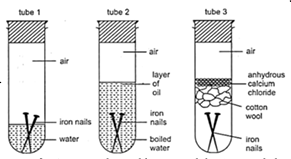
Image
Test tube 1: Iron nails would get rusted that is corroded as they are exposed to moisture and air.
Test tube 2: Iron nails won't get rusted as they are exposed to water that is devoid of oxygen due to boiling and further the layer of oil is not letting oxygen come into contact with the water in which nails are immersed.
Test tube 3: Iron nails won't get rusted or corroded because they are not exposed to moisture and air.
View full question & answer
[3 Mark Questions] - Science STD 10 Questions - Vidyadip