Questions

case /data -based (4 Marks)

🎯

Test yourself on this topic

3 questions · timed · auto-graded

Question 14 Marks
A student fixes a sheet of white paper on a drawing board using some adhesive materials. She places a bar magnet in the centre of it and sprinkles some iron filings uniformly around the bar magnet using a salt sprinkler.
On tapping the board gently, she observes that the iron filings have arranged themselves in a particular pattern.
(a) What makes iron filings arrange in a definite pattern?
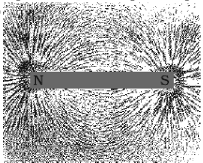
(b) Draw a diagram to show this pattern of iron filings.
(c) How is the direction of magnetic field at a point determined using the field lines? Why do two magnetic
field lines not cross each other?
OR
How are the magnetic field lines of a bar magnet drawn using a small compass needle? Draw one magnetic field line each on both sides of the magnet.
Answer
A student fixes a sheet of white paper on a drawing board using some adhesive materials. She places a bar magnet in the centre of it and sprinkles some iron filings uniformly around the bar magnet using a salt sprinkler. On tapping the board gently, she observes that the iron filings have arranged themselves in a particular pattern.
(i) The bar magnet kept at the centre of board has its magnetic field around it. The iron filings sprinkled on the board
experience a force on them due to the magnetic field of bar magnet. So, when the student taps the board the iron filings align themselves according to the magnetic field lines of the bar magnet.
(ii)Image
(iii)The direction of a magnetic field at a point is determined by placing a small compass needle. The N - pole of compass
indicates the direction of magnetic field at that point.
Two magnetic field lines do not intersect each other because if there was point of intersection, The compass needle would point towards 2 directions.
OR
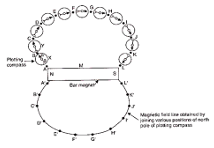
Image
View full question & answer
Question 24 Marks
We have seen that the different parts of our body have specific functions. Our mouth waters when we see the food we like without our meaning to. Our heart's beat without our thinking about it. In fact, we cannot control these actions easily by thinking about them even if we wanted to. So, in between the simple reflex actions like change in the size of the pupil, and the thought out actions such as moving a chair, there is another set of muscle movements over which we do not have any thinking control. Many of these involuntary actions are controlled by the mid-brain and hind-brain. All these involuntary actions including blood pressure, salivation and vomiting are controlled by the medulla in the hind-brain. Think about activities like walking in a straight line, riding a bicycle, picking up a pencil. These are possible due to a part of the hind-brain called the cerebellum. It is responsible for the precision of voluntary actions and maintaining the posture and balance of the body. Imagine what would happen if each of these events failed to take place if we were not thinking about it.
Image
(a) Identify the part of the nervous system which controls the reflex action.
(b) Does reflex action involve all parts of the voluntary nervous system?
(c) Identify the part of the autonomic nervous system which controls involuntary actions.
OR
Beating of heart muscles, which type of action is this? Out of voluntary and involuntary action which is slower?
Answer
We have seen that the different parts of our body have specific functions. Our mouth waters when we see the food we like without our meaning to. Our heart's beat without our thinking about it. In fact, we cannot control these actions easily by thinking about them even if we wanted to. So, in between the simple reflex actions like change in the size of the pupil, and the thought out actions such as moving a chair, there is another set of muscle movements over which we do not have any thinking control. Many of these involuntary actions are controlled by the mid-brain and hind-brain. All these involuntary actions including blood pressure, salivation and vomiting are controlled by the medulla in the hind-brain. Think about activities like walking in a straight line, riding a bicycle, picking up a pencil. These are possible due to a part of the hind-brain called the cerebellum. It is responsible for the precision of voluntary actions and maintaining the posture and balance of the body. Imagine what would happen if each of these events failed to take place if we were not thinking about it
Image
(i) Reflex Action is an unconscious, automatic and involuntary response of efforts, i.e., muscles and glands, to a stimulus, which is monitored through the spinal cord. Reflex action is controlled by the spinal cord.
(ii) Yes, reflex action involves all parts of the voluntary nervous system.
(iii)The part of the autonomic nervous system that controls involuntary actions are controlled or regulated by medulla (hindbrain).
OR
'Beating of heart muscle' is an example of involuntary action. Involuntary actions are slower than reflex actions.
View full question & answer
Question 34 Marks
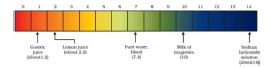
The strength of acid and base depends on the number of $H^+$ and the number of $OH-$ respectively. If we take hydrochloric acid and acetic acid of the same concentration, say one molar, then these produce different amounts of hydrogen ions. Acids that give rise to more $H+$ ions are said to be strong acids, and acids that give less $H+$ ions are said to be weak acids. Can you now say what weak and strong bases are?
$(a)$ Fresh milk has a $pH$ of $6$. How do you think the $pH$ will change as it turns into curd?
$(b)$ Is Gastric juice a weak acid?
OR
Milk of magnesia is an acid or base? For what purpose it can be used?
Answer
The strength of acid and base depends on the number of $H^+$ and the number of $OH^-$ respectively. If we take hydrochloric acid and acetic acid of the same concentration, say one molar, then these produce different amounts of hydrogen ions. Acids that give rise to more $H^+$ ions are said to be strong acids, and acids that give less $H^+$ ions are said to be weak acids. Can you now say what weak and strong bases are?
Image
$(i)$ The $pH$ of milk is $6$. As it changes to curd, the $pH$ will reduce because curd is acidic in nature. The acids present in it decrease the $pH.$
$(ii)$ No$,$ gastric juice is a strong acid.
OR
Milk of magnesia is a base and it can be used as an antacid.
View full question & answer