Question 15 Marks
i. Define principal axis of a lens. Draw a ray diagram to show what happens when a ray of light parallel to the principal axis of a concave lens passes through it.
ii. The focal length of a concave lens is 20 cm . At what distance from the lens should a 5 cm tall object be placed so that its image is formed at a distance of 15 cm from the lens? Also calculate the size of the image formed.
ii. The focal length of a concave lens is 20 cm . At what distance from the lens should a 5 cm tall object be placed so that its image is formed at a distance of 15 cm from the lens? Also calculate the size of the image formed.
Answer
View full question & answer→i. Principal axis: It is an imaginary line passing through the two centres of curvatures of a lens.
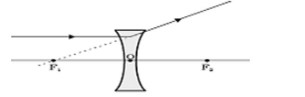
ii. $\mathrm{f}=-20 \mathrm{~cm} ; \mathrm{h}=5 \mathrm{~cm} ; \mathrm{v}=-15 \mathrm{~cm}$
$\frac{1}{u}=\frac{1}{v}-\frac{1}{f}=\frac{1}{(-15)}-\frac{1}{(-20)}$
$=\frac{-1}{60 \mathrm{~cm}}$
or $u=-60 \mathrm{~cm}$ object is at a distance of 60 cm from the lens
Size of the image(magnification): $\mathrm{m}=\frac{h^{\prime}}{h}=\frac{v}{u}$
$h^{\prime}=\frac{V}{u} \times h=\frac{(-15)}{(-60)} \times 5=1.25 \mathrm{~cm}$
ii. $\mathrm{f}=-20 \mathrm{~cm} ; \mathrm{h}=5 \mathrm{~cm} ; \mathrm{v}=-15 \mathrm{~cm}$
$\frac{1}{u}=\frac{1}{v}-\frac{1}{f}=\frac{1}{(-15)}-\frac{1}{(-20)}$
$=\frac{-1}{60 \mathrm{~cm}}$
or $u=-60 \mathrm{~cm}$ object is at a distance of 60 cm from the lens
Size of the image(magnification): $\mathrm{m}=\frac{h^{\prime}}{h}=\frac{v}{u}$
$h^{\prime}=\frac{V}{u} \times h=\frac{(-15)}{(-60)} \times 5=1.25 \mathrm{~cm}$