Question types

MODEL PAPER - 6 [2026] question types

46 questions across 17 question groups — pick any mix to generate a Science paper with step-by-step answer keys.

46
Questions
17
Question groups
5
Question types
Sample Questions

MODEL PAPER - 6 [2026] questions

One sample from each question group in this chapter. Select any group above to see the full set with answer keys.

Q 2M.C.Q1 Mark
Identify the food chain in which the organisms of the second trophic level are missing:
  • Tiger, grass, snake, frog
  • B
    Grasshopper, grass, snake, frog, eagle
  • C
    Grass, goat, lion
  • D
    Zooplankton, Phytoplankton, small fish, large fish

Answer: A.

View full solution
Q 3M.C.Q1 Mark
One of the events that does not occur during photosynthesis is:
  • A
    Chlorophyll absorbs solar energy.
  • Carbon dioxide is released during the process.
  • C
    Carbon dioxide is absorbed during the process.
  • D
    Oxygen is released during the process.

Answer: B.

View full solution
Q 4M.C.Q1 Mark
A food chain will be more advantageous in terms of energy if it has
  • A
    3 trophic levels
  • 2 trophic levels
  • C
    5 trophic levels
  • D
    4 trophic levels

Answer: B.

View full solution
Q 5M.C.Q1 Mark
In plants the role of cytokinin is:
  • A
    Promote the opening of stomatal pore.
  • B
    Help in the growth of stem.
  • C
    Wilting of leaves.
  • Promote cell division.

Answer: D.

View full solution
An aqueous solution $\mathbf{A}$ turns phenolphthalein solution pink. On addition of an aqueous solution $\mathbf{B}$ to $\mathbf{A}$, the pink colour disappears. The following statement is true for solution $\mathbf{A}$ and $\mathbf{B}$.
  • A has pH greater than 7 and B has pH less
  • B
    A is strongly basic and B is a weak base. than 7.
  • C
    A is strongly acidic and B is a weak acid.
  • D
    A has pH less than 7 and B has pH greater than 7.

Answer: A.

View full solution
You want to test for hardness of water but hard water is not available in the laboratory. Which of the following compounds may be dissolved in pure water to make it hard?
i. Hydrogen Carbonate of Sodium
ii. Sulphate of Magnesium
iii. Chloride of Calcium
iv. Carbonate of Sodium
  • A
    (i) and (ii)
  • B
    (ii) and (iii)
  • (i) and (iv)
  • D
    (iii) and (iv)

Answer: C.

View full solution
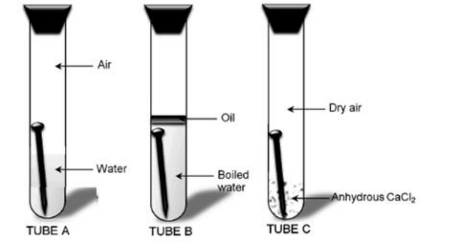
Take three boiling tubes A, B and C. Pour some water in test tube A Put iron nails in it and cork it. Pour boiled distilled water in another test tube B and put iron nails in it. Add 1 ml of oil over it such that oil floats over it and prevents the air from entering. Take some iron nails in test tube C and put some anhydrous calcium chloride in it and cork it.
Leave all the three test tubes for one day and then observe.
Image
In which test tube nail is rusted?
  • Tube A
  • B
    Tube B and C
  • C
    Tube A and C
  • D
    Tube B

Answer: A.

View full solution
Q 10M.C.Q-[Che-1M]1 Mark
Match the following with the correct response:
Column AColumn B
(i) Welding(a) Ethyl alcohol
(ii) Fuel in a spirit lamp(b) Ester
(iii) Lime water turns milky(c) Carbon dioxide
(iv) Fruity smell(d) Ethyne and oxygen
  • A
    (i) - (c), (ii) - (b), (iii) - (d), (iv) - (a)
  • B
    (i) - (a), (ii) - (c), (iii) - (b), (iv) - (d)
  • C
    (i) - (b), (ii) - (d), (iii) - (a), (iv) - (c)
  • (i) - (d), (ii) - (a), (iii) - (c), (iv) - (b)

Answer: D.

View full solution
a. Write the percentage of (i) solar energy captured by the autotrophs and (ii) energy transferred from autotrophs to the next level in a food chain.
b. What are trophic levels? Why do different food chains in an ecosystem not have more than four to five trophic levels? Give reason.
View full solution
Kedar heated a few crystals of copper sulphate in a dry boiling tube.
a. What will be the color of the copper sulphate after heating?
b. Will you notice water droplets in the boiling tube?
c. Where have these come from?
View full solution
a. Name the two types of gametes produced by men.
b. Does a male child inherit X chromosome from his father? Justify.
c. How many types of gametes are produced by a human female?
View full solution
Nikita took $\mathrm{Zn}, \mathrm{Al}, \mathrm{Cu}, \mathrm{Fe}, \mathrm{Mg}$ and Na metal and put each metal in cold water and then hot water. She reacted the metal with steam
(i) Name the metal which reacts with cold water.
(ii) Which of the above metals react with steam?
(iii) Name the metal which reacts with hot water.
(iv) Arrange these metals in order of increasing reactivity.
View full solution
State one characteristic each of the chemical reaction which takes place when:
i. Dilute hydrochloric acid is added to sodium carbonate.
ii. Lemon juice is added gradually to potassium permanganate solution.
iii. Dilute sulphuric acid is added to the barium chloride solution.
iv. Quick lime is treated with water.
v. Wax is burned in the form of a candle.
View full solution
2g of silver chloride is taken in a china dish and the china dish is placed in sunlight for some time. What will be your observation in this case ? Write the chemical reaction involved in the form of a balanced chemical equation. Identify the type of chemical reaction.
View full solution
i. What are tropic movements? Give an example of a plant hormone which (1) inhibits growth and (2) promotes cell division.
ii. Explain directional movement of a tendril in pea plant in response to touch. Name the hormone responsible for this movement.
View full solution
i. Use of a condom is beneficial for both the sexes involved in a sexual act. Justify this statement giving two reasons.
ii. How do oral contraceptive help in avoiding pregnancies?
iii. What is sex selective abortion? How does it affect a healthy society? (State any one consequence)
View full solution
Carbon is a versatile element that forms the basis of all living organisms and many of the things we use. A large variety of compounds is formed because of its tetravalency. Compounds of carbon are formed with oxygen, hydrogen, nitrogen, sulphur, chlorine and many other elements.
Answer the following questions:
a. What are hydrocarbons?
b. List two properties by virtue of which carbon can form a large number of compounds.
c. Write the formula of the functional group present in (1) aldehydes, and (2) ketones. Write chemical equation for the reaction that occurs between ethanoic acid and ethanol in the presence of a catalyst.
OR
What are structural isomers? Write the structures of two isomers of butane $\left(\mathrm{C}_{4} \mathrm{H}_{10}\right)$.
View full solution
As neutral atom carbon has electronic configuration $\underset{2,}{K} \underset{4}{L}$. To gain inert gas configuration carbon can either donate 4 valence electrons (helium gas configuration) or gain 4 electrons (neon gas configuration), but it cannot do so. To acquire inert gas configuration carbon can only share its 4 valence electrons with other atoms forming covalent bonds. A covalent bond can be defined as a chemical bond formed between two atoms by mutual sharing of valence electrons so that each atom acquires the stable electronic configuration of the nearest noble gas. The concept of covalent bonds was given by Langmuir and Lewis to explain bonding in non-ionic compounds. The covalent bonds are of three types. If each atom contributes one electron, the covalent bond formed is called a single covalent bond and is represented by a single line (-) and if each atom contributes two electrons, the covalent bond formed is called a double bond and is represented by a double line ( $=$ ) and if each atom contributes three electrons, the covalent bond formed is called a triple bond and is represented by a triple line ( $\equiv$ ).
i. Define Catenation.
ii. What are name given for carbon atoms linked with single, double, triple bond?
iii. Define Valency and write two examples of molecules containing double bond.
OR
Draw the electron dot structure for $\mathrm{Cl}_{2}$ molecule.
View full solution
An acid $\mathbf{X}$ present in tamarind when mixed with $\mathbf{Y}$, produces a mixture $\mathbf{Z} . \mathbf{Z}$ on addition to a dough when heated makes cakes soft and spongy. $\mathbf{Y}$ is prepared from common salt and helps in faster cooking.
i. Write the common names of $\mathbf{X}, \mathbf{Y}$ and $\mathbf{Z}$, and the chemical formula of $\mathbf{Y}$.
ii. How is $\mathbf{Y}$ prepared and how does it help in making cakes soft and spongy? Illustrate the reaction with suitable chemical equation.
iii. Write the name and chemical formula of a mild base other than $\mathbf{Y}$ used as an antacid.
View full solution
i. Define water of crystallisation.
ii. Write the chemical name and formula of a compound having water of crystallisation in its molecule and appears blue.
iii. Write the chemical formula of bleaching powder. Write a balanced chemical equation of the reaction involved in its preparation. List its three uses.
View full solution
Q 29M.C.Q-[Phy-1M]1 Mark
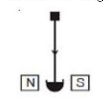
One end of a wire carrying current in the downward direction is placed in a trough containing mercury (so that the direction of force experienced by it is clearly visible). Two pole pieces N and S are placed on each side as shown in the diagram (so as to provide uniform magnetic field).
Image
What is the direction of force experienced by the wire?
  • A
    Away from the observer
  • B
    Constant position
  • C
    Upward from the observer
  • Towards the observer

Answer: D.

View full solution
Assertion (A): The refractive index of diamond is $\sqrt{6}$ and refractive index of liquid is $\sqrt{3}$. If the light travels from the diamond to the liquid, it will initially be reflected when the angle of incidence is $30^{\circ}$.
Reason (R): $\mu=\frac{1}{\sin C}$, where $\mu$ is the refractive index of diamond with respect to liquid.
View full solution
a. Draw the pattern of magnetic field lines around a bar magnet. Mark the position of North Pole, South Pole and the places where the magnetic field is strongest.
b. Why do the magnetic field lines not intersect each other?
View full solution
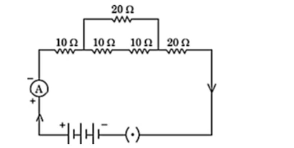
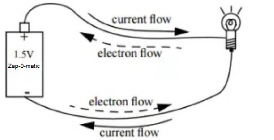
The rate of flow of charge is called electric current. The SI unit of electric current is Ampere (A). The direction of flow of current is always opposite to the direction of flow of electrons in the current.
Image
The electric potential is defined as the amount of work done in bringing a unit-positive test charge from infinity to a point in the electric field. The amount of work done in bringing a unit positive test charge from one point to another point in an electric field is defined as potential difference.
$V_{A B}=V_{B}-V_{A}=\frac{W_{B A}}{q}$
The SI unit of potential and potential difference is volt.
i. Write the formula of voltage in terms of work done, current, time and charge.
ii. What is the number of electrons flowing per second in a conductor if 1 A current is passing through it?
iii. What would be the potential difference between the two terminals of a battery, if 100 joules of work is required to transfer 20 coulombs of charge from one terminal of the battery to other?
OR
The 2 C of charge is flowing through a conductor in 100 ms , then what would be the current in the circuit?
View full solution
i. Define principal axis of a lens. Draw a ray diagram to show what happens when a ray of light parallel to the principal axis of a concave lens passes through it.
ii. The focal length of a concave lens is 20 cm . At what distance from the lens should a 5 cm tall object be placed so that its image is formed at a distance of 15 cm from the lens? Also calculate the size of the image formed.
View full solution
a. List four characteristics of the image formed by a convex lens when an object is placed between its optical centre and principal focus.
b. Size of the image of an object by a concave lens of focal length 20 cm is observed to be reduced to $\frac{1}{3} \mathrm{rd}$ of its size. Find the distance of the object from the lens.
View full solution

Generate a MODEL PAPER - 6 [2026] paper free

Pick question groups from the list above, set marks and difficulty, and export a branded PDF with step-by-step answer keys. First 3 chapters free — no signup.
Download App