Questions

[5 marks Questions]

🎯

Test yourself on this topic

6 questions · timed · auto-graded

Question 15 Marks
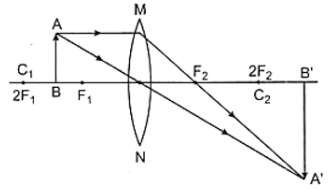
An object of height $4.0 \ cm$ is placed at a distance of $30 \ cm$ from optical centre $O$ of a concave lens of focal length $20 \ cm.$ Draw a ray diagram to find the position and size of the image formed. Mark optical centre $O$ and principal focus $F$ on the diagram. Also, find the approximate ratio of size of the image to the size of the object.
Answer
Given: focal length $f = +20 \ cm,$
object distance $u = -30 \ cm,$
height of object $h_0=4 \ cm.$
We know that, $\frac{1}{f}=\frac{1}{v}-\frac{1}{u}$
$\frac{1}{20}=\frac{1}{v}-\frac{1}{-30}$
$\frac{1}{v}=\frac{1}{60}$
$\Rightarrow v =60 \ cm$
So, $\frac{h_i}{h_0}=\frac{v}{u}$
$\frac{h_i}{h_0}=\frac{60}{-30}$
$\Rightarrow- t _{ i }=-8 \ cm$
Thus, the height or size of the image is $8 \ cm.$
The minus sign shows that this height is in the downward direction, that is, the image is formed below the axis.
Ratio of size of image to object $= -2$
So image is enlarged beyond $2 F_2$​​​​​​​

Image

Object between $F _1$ and $2 F_1$
Image is formed beyond $2 F_2$ real, inverted.
.
View full question & answer
Question 25 Marks
Rishi went to a palmist to show his palm. The palmist used a special lens for this purpose.
i. State the nature of the lens and the reason for its use.
ii. Where should the palmist place/hold the lens so as to have a real and magnified image of an object?
iii. If the focal length of this lens is 10 cm and the lens is held at a distance of 5 cm from the palm, use lens formula to find the position and size of the image.
Answer
i. Palmists use a convex lens because it shows an enlarged, virtual and erect image when the object is between F and O of a convex lens.
ii. If the palmist wants a real and magnified image, he should put an object between $F _1$ and $F _2$ or on F. But in that case, he will have to use a screen to see the image. So, for convenience, palmists.
iii. Given, f = 10 cm, u = -5 cm
$\frac{1}{v}-\frac{1}{u}=\frac{1}{f}$
Or $\frac{1}{v}+\frac{1}{5}=\frac{1}{10}$
Or, $\frac{1}{v}=\frac{1}{10}-\frac{1}{5}$
Or $\frac{1}{v}=\frac{1-2}{10}=-\frac{1}{10}$
Or, $v=-10 cm$
The image is formed at 10 cm on the same side of the lens. It is erect and virtual.
Image size $=\frac{v}{u}=\frac{10}{5}=2$
Image is twice as big as object.
View full question & answer
Question 35 Marks
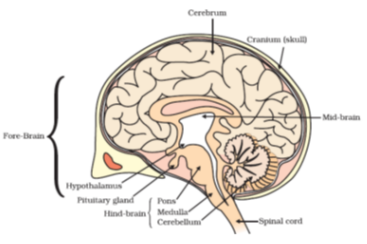
Given below is a labelled diagram of the human brain.

Image

Using the given diagram, answer the following questions:
i. Which part of the brain controls reflex movements of the head, neck, and trunk?
ii. Name the part of the human brain which contains a vital centre for controlling blood pressure.
iii. Which part of the hindbrain regulates respiration?
iv. How is the brain protected from injuries and shock?
v. Which part of the human brain is the main thinking region?
Answer
i. The midbrain controls the reflex movements of the head, neck, and trunk in response to visual and auditory stimuli.
ii. The medulla contains a vital centre for controlling blood pressure, respiration, swallowing, salivation, vomiting, sneezing, and coughing.
iii. Pons regulates respiration.
iv. The brain is protected by a bony box called cranium, within that three layers of fluid-filled membranes called meninges are present for absorbing shock.
v. The forebrain is the largest part of the brain and is the main thinking region.
View full question & answer
Question 45 Marks
Explain natural vegetative propagation by roots in plants.
Answer
A number of herbaceous and woody perennial plants propagate vegetatively in nature. The common structures that take part in natural vegetative propagation are roots, stems, leaves and buds.
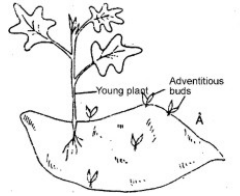
Vegetative propagation by roots. Roots of some plants like radish, carrot, asparagus, tapioca, Dahlia and sweet potato etc. are tuberous and store abundant food material.

Image

These roots when planted in specially prepared beds (soil), develop adventitious buds which grow into leafy shoots called "slips". As the root tubers in sweet potato store large amounts of food, each produces several "slips" the young "slips" are detached from the parent plant and grown separately.
View full question & answer
Question 55 Marks
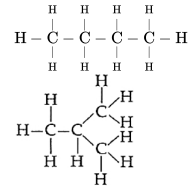
i. Draw two structural isomers of butane.
ii. Draw the structures of propanol and propanone.
iii. Name the third homologue of: a. alcohols
b. aldehydes
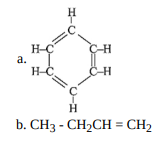
iv. Name the following:

Image
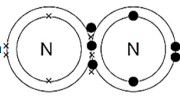
v. Show the covalent bond formation in nitrogen molecule.
Answer
i. The two isomers of butane, C4H10 are as follows:

Image

ii. Structure of propanal and propanone are as follows: Image

iii. a. Propanol, which has the chemical formula $C _3 H _7 OH$, is the third homologue of an alcohol. It has a three-carbon straight chain with a hydroxyl (-OH) group joined to the second carbon.
b. Propanal, which has the chemical formula $C _3 H _6 O$, is an aldehyde's third homologue. Having a carbonyl group (C=O) attached to the second carbon, it consists of a straight chain of three carbon atoms.
iv. a. Benzene
b. But-1-ene
v. Covalent bond formation of nitrogen
Image
View full question & answer
Question 65 Marks
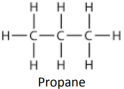
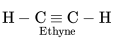
a. What is a hydrocarbon? Give its one example.
b. Give the structural difference between saturated and unsaturated hydrocarbons with two examples each.
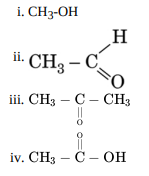
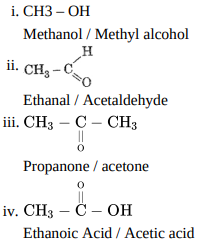
c. Name the following compounds:

Image
Answer
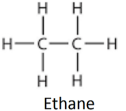
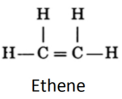
a. Carbon compounds containing only carbon and hydrogen ore called hydrocarbons
Example: Alkane / Alkene / Alkyne / any other
b.
Saturated HydrocarbonsUnsaturated Hydrocarbons
Consists of Only Single BondsConsists of Double and Triple bonds
ImageImage
ImageImage
c. i. CH3 – OH
Methanol / Methyl alcohol

Image

View full question & answer
[5 marks Questions] - Science STD 10 Questions - Vidyadip