Question
Explain natural vegetative propagation by roots in plants.

Answer

A number of herbaceous and woody perennial plants propagate vegetatively in nature. The common structures that take part in natural vegetative propagation are roots, stems, leaves and buds.
Vegetative propagation by roots. Roots of some plants like radish, carrot, asparagus, tapioca, Dahlia and sweet potato etc. are tuberous and store abundant food material.
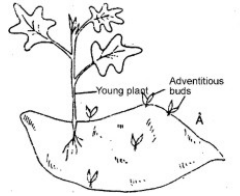
Image

These roots when planted in specially prepared beds (soil), develop adventitious buds which grow into leafy shoots called "slips". As the root tubers in sweet potato store large amounts of food, each produces several "slips" the young "slips" are detached from the parent plant and grown separately.

Need a full question paper?

Generate a complete, print-ready paper with questions like this in minutes — across 16+ boards, with answer keys.

Start Generating Free

Similar questions

Name five stimuli which act on plants. Name the type of tropism produced by each one of these stimuli.
Give the difference between acquired and inherited traits with an example. How will you explain organic evolution?
Describe the structure of graphite with the help of a labelled diagram.
  1. The modern periodic table has been evolved through the early attempts of Dobereiner, Newland and Mendeleev. List one advantage and one limitation of all the three attempts.
  2. Name the scientist who first of all showed that atomic number of an element is a more fundamental property than its atomic mass.
  3. State Modern periodic law.
Why do we need to manage our natural resources?
When the branches of a plant growing in the field are pulled towards the ground and a part of them is covered with moist soil (leaving the tips of the branches exposed above the ground), then after some time new roots develop from the parts of branches buried in the soil. On cutting these branches from the parent plant, new plants are produced from the cut parts of branches which had developed roots.
  1. What is this method of propagation of plants known as?
  2. What type of branches should a plant have to be able to be propagated by this method?
  3. Name any two plants which are grown for their flowers and propagated by this method.
  4. Name any two plants which are grown for their fruits and propagated by this method.
  5. Name one plant which gets propagated by this method naturally by forming runners (soft horizontal stems running above the ground).
  1. Name the human male reproductive organ that produces sperms and also secretes a hormone. Write the functions of the secreted hormone.
  2. Name the parts of the human female reproductive system where:
  1. fertilisation takes place,
  2. implantation of the fertilised egg occurs.
Explain how the embryo gets nourishment inside the mother's body.
Distinguish between photosynthesis and respiration.
What is short-sightedness? State the two causes of short-sightedness (or myopia). With the help of ray diagrams, show:
  1. The eye-defect short-sightedness.
  2. Correction of short-sightedness by using a lens.
Explain the principle of working of a thermal power plant. Draw a labelled diagram to illustrate your answer.