Questions · Page 1 of 4

M.C.Q

🎯

Test yourself on this topic

50 questions · timed · auto-graded

MCQ 11 Mark
Assertion: Biodegradable substances result in the formation of compost and natural replenishment.
Reason: It is due to breakdown of complex inorganic substances into simple organic substances.
  • A
    Both A and R are true, and R is the correct explanation of A.
  • B
    Both A and R are true, and R is not the correct explanation of A
  • A is true but R is false.
  • D
    A is false but R is true.
Answer
Correct option: C.
A is true but R is false.
(C) A is true but R is false.
View full question & answer
MCQ 21 Mark
Which of the following features relates to biodegradable substances?
  • Broken down by biological processes
  • B
    Remain inert
  • C
    Persist in environment for long time
  • D
    May harm the ecosystem
Answer
Correct option: A.
Broken down by biological processes
(A) Broken down by biological processes
View full question & answer
MCQ 31 Mark
In 1987, an agreement was formulated by the United Nations Environment Programme (UNEP) to freeze the production of " $X$ " to prevent depletion of " $Y$ ". " $X$ " and " $Y$ " respectively referred here are:
  • A
    Ozone; CFCs
  • B
    CFCs; rays UV
  • CFCs; Ozone
  • D
    UV rays; Diatomic oxygen
Answer
Correct option: C.
CFCs; Ozone
(C) CFCs; Ozone
View full question & answer
MCQ 41 Mark
A decrease in the grass population will most immediately decrease the available energy for the :
  • Mouse
  • B
    Snake
  • C
    Hawk
  • D
    Frog
Answer
Correct option: A.
Mouse
From the above food web, we can infer that out of the options given above, a mouse is the primary consumer of grass.
If the population of grass decreases, the available energy will decrease for a mouse.
View full question & answer
MCQ 51 Mark
The use of one of the following will pollute the environment. This one is :
  • A
    Paper carry bags.
  • B
    Cotton cloth carry bags.
  • Nylon cloth carry bags.
  • D
    Jute carry bags.
Answer
Correct option: C.
Nylon cloth carry bags.
Nylon cloth is non $-$ biodegradable and pollutes the environment.
View full question & answer
MCQ 61 Mark
Organisms of a higher trophic level which feed on several types of organisms belonging to a number of lower trophic levels constitute the :
  • A
    Ecosystem.
  • Food web.
  • C
    Ecological pyramid.
  • D
    Food chain.
Answer
Correct option: B.
Food web.
Organisms of a higher trophic level that feed on several types of organisms belonging to a number of lower trophic levels constitute a food web.
View full question & answer
MCQ 71 Mark
The flow of energy in an ecosystem is always :
  • Unidirectional.
  • B
    Bidirectional.
  • C
    Cyclic.
  • D
    Multidirectional.
Answer
Correct option: A.
Unidirectional.
Energy always flows in one direction in an ecosystem, from a lower trophic level to a higher trophic level.
View full question & answer
MCQ 81 Mark
In an ecosystem, primary consumers are :
  • A
    Carnivores
  • Herbivores
  • C
    Decomposers
  • D
    Producers
Answer
Correct option: B.
Herbivores
In an ecosystem, green plants are the producers. Herbivores are primary consumers. They feed on producers. Carnivores are secondary consumers. They feed on primary consumers. Decomposers aid in the decomposition of dead remains of producers and consumers.
View full question & answer
MCQ 91 Mark
Which of the following shows maximum biomagnification in an aquatic ecosystem?
  • A
    Fish
  • Birds
  • C
    Zooplanktons
  • D
    Phytoplanktons
Answer
Correct option: B.
Birds
Biomagnification refers to an increase in the concentration of toxic chemicals at successive trophic levels.
This happens because a toxic substance accumulated by an organism cannot be metabolized or excreted, and it is passed on to the next higher trophic level.
In an aquatic ecosystem, birds are at the highest trophic level.
View full question & answer
MCQ 101 Mark
Trophic levels are formed by :
  • Organisms linked in a food chain
  • B
    Only plants
  • C
    Only animals
  • D
    Only microorganisms
Answer
Correct option: A.
Organisms linked in a food chain
Food chain is the sequence of organisms through which food and energy is passed in an ecosystem with the members of trophic level. Trophic level is the hierarchical levels in an ecosystem which consists organism.
View full question & answer
MCQ 111 Mark
Which of the following is the best method to dispose of biological wastes from hospitals?
  • A
    Landfill.
  • B
    Recycling.
  • Incineration.
  • D
    Composting.
Answer
Correct option: C.
Incineration.
Incineration, which means burning harmful wastes into ashes, is the best method to dispose of biological wastes from hospitals.
View full question & answer
MCQ 121 Mark
The transfer of energy through a terrestrial ecosystem is depicted by energy pyramids. Which of the following statements is true?
  • A
    About $10\%$ of the energy from one trophic level is incorporated into biomass of the next level.
  • B
    Only $25\%$ of the energy in one trophic level is passed onto the next level.
  • The energy lost as heat or in cellular respiration is $10\%$ of the available energy of each trophic level.
  • D
    Ecological efficiency is highest for top consumers.
Answer
Correct option: C.
The energy lost as heat or in cellular respiration is $10\%$ of the available energy of each trophic level.
A pyramid of energy represents how much energy, initially from the sun, is retained or stored in the form of new biomass at each trophic level in an ecosystem. Typically, about $10\%$ of the energy is transferred from one trophic level to the next, thus preventing a large number of trophic levels.
View full question & answer
MCQ 131 Mark
$\text{UNEP}$ stands for :
  • A
    United Nations Ecotype Programme
  • B
    United Nations Ecological Programme
  • C
    United Nations Education Programme
  • United Nations Environment Programme
Answer
Correct option: D.
United Nations Environment Programme
$\text{UNEP}$ stands for United Nations Environment Programme is an agency of United Nations and coordinates its environmental activities, assisting developing countries in implementing environmentally sound policies and practices.
So, the correct answer is 'United Nations Environment Programme'.
View full question & answer
MCQ 141 Mark
In addition to wheat plants, a crop field ecosystem has organisms such as snake, peacock, eagle and mice. If the wheat plants are sprayed with pesticides periodically, which of the following will have the minimum concentration of pesticides in the body?
  • A
    Snake.
  • B
    Eagle.
  • Mice.
  • D
    Peacock.
Answer
Correct option: C.
Mice.
As mice are in the lowest trophic level, they will have the minimum concentration of pesticides in their body.
View full question & answer
MCQ 151 Mark
Depletion of ozone is mainly due to :
  • Chlorofluorocarbon compounds.
  • B
    Carbon monoxide.
  • C
    Methane.
  • D
    Pesticides.
Answer
Correct option: A.
Chlorofluorocarbon compounds.
Depletion of ozone is mainly due to chlorofluorocarbons $\ce{(CFCs)}.$
All other substances except chlorofluorocarbon compounds do not contribute to the depletion of ozone.
View full question & answer
MCQ 161 Mark
Which is the best example of interaction of biotic and abiotic factors of ecosystem?
  • A
    Sunlight
  • B
    Water
  • C
    Land
  • Forests
Answer
Correct option: D.
Forests
View full question & answer
MCQ 171 Mark
Which group of organisms are not constituents of a food chain?
  1. Grass, lion, rabbit, wolf.
  2. Plankton, man, fish, grasshopper.
  3. Wolf, grass, snake, tiger.
  4. Frog, snake, eagle, grass, grasshopper.
  • A
    $(i)$ and $(iii).$
  • B
    $(iii)$ and $(iv).$
  • $(ii)$ and $(iii).$
  • D
    $(i)$ and $(iv)$.
Answer
Correct option: C.
$(ii)$ and $(iii).$
In option $(ii)$ grasshopper does not eat plankton. In option $(iii)$ none of the animals eats grass.
View full question & answer
MCQ 181 Mark
Which of the following describes a food chain?
  • A
    Large number of animals competing for a source of food.
  • Transfer of food energy from the green plants through a series of consumer organisms.
  • C
    Transfer of chemicals from one trophic level to another.
  • D
    None of the above
Answer
Correct option: B.
Transfer of food energy from the green plants through a series of consumer organisms.
A food chain is defined as a linear network of links in a food web starting from producer organisms and ending at an apex predator species, or decomposer species.
Green plants are known as producers as they trap energy from the sun and then pass it to all the consumers occupying successive trophic levels.
View full question & answer
MCQ 191 Mark
Which rays strike on earth due to depletion of layer?
  • A
    Visible light.
  • B
    Microwaves.
  • C
    Infrared.
  • Ultraviolet.
Answer
Correct option: D.
Ultraviolet.
Ultraviolet $\ce{(UV)}$ is electromagnetic emission with a wavelength of $10\ \ce{nm}$ to $400\ \ce{nm},$ which is smaller than that of visible light but are longer than $X-$ rays. $\ce{UV}$ emission is widespread in sunlight which constitutes about $10\%$ of the total brightness of the Sun.
View full question & answer
MCQ 201 Mark
A correct food chain is :
  • A
    Producers $\rightarrow $ Carnivores $\rightarrow $ Herbivores.
  • Producers $\rightarrow $ Herbivores $\rightarrow $ Carnivores.
  • C
    Herbivores $\rightarrow $ Producers $\rightarrow $ Carnivores.
  • D
    Herbivores $\rightarrow $ Carnivores $\rightarrow $ Producers.
Answer
Correct option: B.
Producers $\rightarrow $ Herbivores $\rightarrow $ Carnivores.
This type of food chain starts from the living green plants goes to grazing herbivores, and on to carnivores. Ecosystems with such type of food chain are directly dependent on an influx of solar radiation.
View full question & answer
MCQ 211 Mark
An ecosystem includes :
  • A
    All living organisms.
  • B
    Non $-$ living objects.
  • Both living organisms and non $-$ living objects.
  • D
    All living organisms and input of sun's energy.
Answer
Correct option: C.
Both living organisms and non $-$ living objects.
Both living organisms and non $-$ living objects are components of an ecosystem.
View full question & answer
MCQ 221 Mark
If a grasshopper is eaten by a frog, then the energy transfer will be from :
  • A
    Producer to decomposer.
  • B
    Producer to primary consumer.
  • Primary consumer to secondary consumer.
  • D
    Secondary consumer to tertiary consumer.
Answer
Correct option: C.
Primary consumer to secondary consumer.
A grasshopper eats grass; hence, the grasshopper is the primary consumer. A frog eats the grasshopper, so the frog becomes the secondary consumer. The energy transfer is from the primary consumer to the secondary consumer, i.e., from the grasshopper to the frog.
View full question & answer
MCQ 231 Mark
In the following groups of materials, which group/ groups contain only non $-$ biodegradable materials?
  1. Wood, paper, leather.
  2. Polythene, detergent $,\text{PVC}.$
  3. Plastic, detergent, grass.
  4. Plastic, bakelite $,\text{DDT}.$
  • A
    $(iii)$
  • B
    $(iv)$
  • C
    $(i)$ and $(iii)$
  • $(ii)$ and $(iv)$
Answer
Correct option: D.
$(ii)$ and $(iv)$
These materials cannot be degraded by micro $-$ organisms and hence are non $-$ biodegradable.
View full question & answer
MCQ 241 Mark
Excessive exposure of humans to $\text{UV}-$ rays results in:
  1. Damage to immune system.
  2. Damage to lungs.
  3. Skin cancer.
  4. Peptic ulcers.
  • A
    $(i)$ and $(ii).$
  • B
    $(ii)$ and $(iv).$
  • $(i)$ and $(iii)$.
  • D
    $(iii)$ and $(iv).$
Answer
Correct option: C.
$(i)$ and $(iii)$.
$\text{UV}$ rays effect the cells of outer parts of our body. Sometimes, cells are damaged causing skin cancer which further lead to damage of our immune system.
View full question & answer
MCQ 251 Mark
Which of the following constitutes a food chain?
  • A
    Grass, Wheat and Mango.
  • Grass, Goat and Human.
  • C
    Goat, Cow and Elephant.
  • D
    Grass, Fish and Goat.
Answer
Correct option: B.
Grass, Goat and Human.
Grass is eaten by goats, and goats are eaten by humans.
View full question & answer
MCQ 261 Mark
The two basic processes that operate in an ecosystem are :
  • A
    Material cycling, energy flows.
  • B
    Material cycling, energy stores.
  • Energy flows, energy stores.
  • D
    Photosynthesis and material cycling.
Answer
Correct option: C.
Energy flows, energy stores.
Two basic kinds of processes must occur in the ecosystems : a cycling of chemical elements and a flow of energy.
View full question & answer
MCQ 271 Mark
The second trophic level of a food chain is occupied by herbivores that feed on plants or producers that are present in first trophic level.
Assertion : The second trophic level of a food chain operating in a grassland is mostly occupied by a carnivore.
Reason : Carnivores feed upon herbivores and are secondary consumers.
  • A
    Both $A$ and $R$ are true, and $R$ is correct explanation of the assertion.
  • B
    Both $A$ and $R$ are true, but $R$ is not the correct explanation of the assertion.
  • C
    $A$ is true, but $R$ is false.
  • $A$ is false, but $R$ is true. 
Answer
Correct option: D.
$A$ is false, but $R$ is true. 
For two statements are given $-$ one labelled Assertion $(A)$ and the other labelled Reason $(R)$. Select the correct answer to these questions from the codes $\ce{(a), (b), (c)}$ and $(d)$ as given below:
View full question & answer
MCQ 281 Mark
What would happen if all the oxygen present in the environment is converted to ozone?
  • A
    We will still be able to breathe
  • It will be poisonous and will kill living forms.
  • C
    Ozone is not stable, hence it will be toxic.
  • D
    It will help harmful sun radiations to reach earth and damage many life forms.
Answer
Correct option: B.
It will be poisonous and will kill living forms.
Ozone is a deadly poison and if all the oxygen were to get converted to ozone, no life on the earth would survive.
View full question & answer
MCQ 291 Mark
Which of the following does not have a negative impact on the environment?
  • A
    Radioactive wastes
  • B
    Aluminium cans
  • C
    $\text{DDT}$
  • Cattle dung
Answer
Correct option: D.
Cattle dung
Biodegradable substances are substances that are easily decomposed by natural decomposers and therefore, they do not cause harm to the environment.
Examples : human and animal excreta, plant wastes. Whereas, non $-$ biodegradable substances are those substances that cannot be decomposed by natural decomposers. They harm the environment.
Examples : radioactive wastes, chemical wastes like $\text{DDT},$ aluminium cans, plastics, etc.
View full question & answer
MCQ 301 Mark
What will happen if deer is missing in the food chain given below? Grass $\rightarrow $ Deer $\rightarrow $ Tiger
  • A
    The population of tigers increases.
  • B
    The population of grass decreases.
  • C
    Tigers will start eating grass.
  • The population of tigers decreases and the population of grass increases.
Answer
Correct option: D.
The population of tigers decreases and the population of grass increases.
If deer are removed from the given food chain, the population of tigers will decrease as they will not have deer for their food and will starve to death. The density of grass will increase as there is no organism to consume it as food.
View full question & answer
MCQ 311 Mark
Which of the following gets the minimum energy through the food chain in an ecosystem?
  • A
    Carnivore.
  • Large carnivore.
  • C
    Producer.
  • D
    Herbivore.
Answer
Correct option: B.
Large carnivore.
As large carnivores are at the upper trophic levels, they get the minimum energy through the food chain, according to the $10$ per cent law.
View full question & answer
MCQ 321 Mark
The transfer of energy from one organism to another organism in a natural community establishes :
  • Food chain
  • B
    Biological magnification
  • C
    Natural selection
  • D
    All of the above
Answer
Correct option: A.
Food chain
A food chain is defined as the linear sequence of transfer of matter and energy in the form of food from one organism to another in an ecosystem.
View full question & answer
MCQ 331 Mark
What percentage of sun's energy falling on the leaves of green plants is utilised by the plants in the process of photosynthesis and stored as chemical energy of food?
  • A
    $99$ per cent.
  • B
    $10$ per cent.
  • $1$ per cent.
  • D
    $20$ per cent.
Answer
Correct option: C.
$1$ per cent.
Only one per cent of the sun's energy falling on the leaves of green plants is utilised by the plants in the process of photosynthesis and stored as the chemical energy of food.
View full question & answer
MCQ 341 Mark
A plant is eaten by a herbivorous animal which, in turn, is eaten by a carnivorous animal. This chain is called :
  • Food chain
  • B
    Plant chain
  • C
    Animal chain
  • D
    Consumer chain
Answer
Correct option: A.
Food chain
The food chain is a series of organisms in which one organism is dependent on the other for food. In a typical food chain, green plants are the producers; they are eaten by herbivores, which are in turn eaten by carnivores.
View full question & answer
MCQ 351 Mark
Consider the following food chain in the same lake : Aquaticplant $\rightarrow $ Smallfish $\rightarrow $ Bigfish $\rightarrow $ Birds : Which of the above organisms is likely to show a minimum amount of pesticide concentration in them?
  • Aquatic plants
  • B
    Small fish
  • C
    Big fish
  • D
    Birds
Answer
Correct option: A.
Aquatic plants
View full question & answer
MCQ 361 Mark
Which of the following set represents primary consumers?
  • A
    Deers, giraffes, cows
  • B
    Goats, rabbits, horses
  • C
    Insects, snails
  • All of the above
Answer
Correct option: D.
All of the above
Deers, giraffes, cows, goats, rabbits, horses, insects and snails, all consume the producers and hence are primary consumers.
View full question & answer
MCQ 371 Mark
The loss of energy as one proceeds from one trophic level to the next higher level is approximately :
  • A
    $30 - 35\%.$
  • B
    $40 - 45\%.$
  • C
    $60 - 65\%.$
  • $90 - 95\%.$
Answer
Correct option: D.
$90 - 95\%.$
According to $10\%$ law, during the transfer of energy from one trophic level to the next higher level, about $10\%$ of the energy from organic matter is saved and the remaining is lost as heat or broken down in respiration. Therefore, it can also be said that $90 - 95\%$ energy is lost while transfer from one level to the higher level.
View full question & answer
MCQ 381 Mark
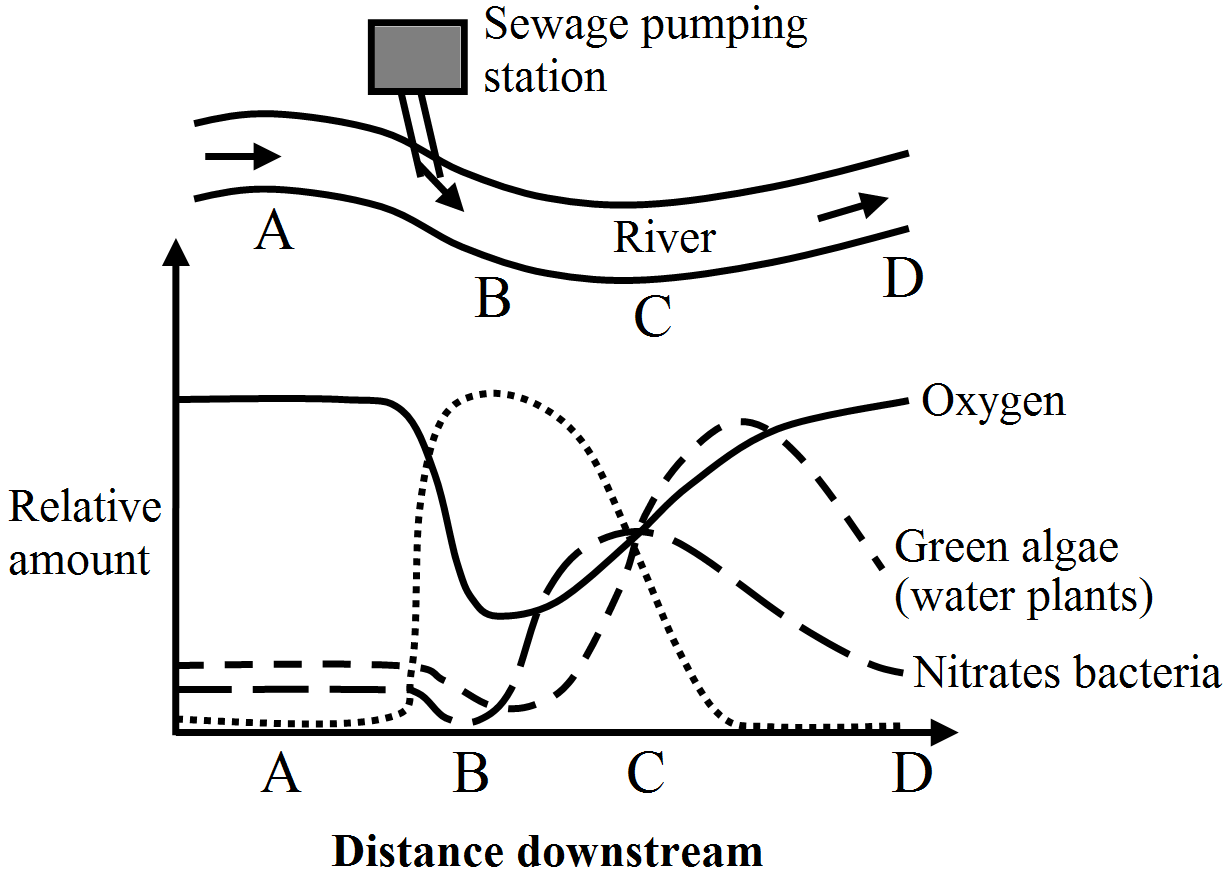
The diagram shows part of a river into which sewage is being pumped. Some of the effects of adding sewage to the river are shown in the graph. At which point in the river are decomposers most active?
  • $D$
  • B
    $C$
  • C
    $B$
  • D
    $A$
Answer
Correct option: A.
$D$
At $B$ the concentration of blue green algae is high, they take up the atmospheric oxygen and then the nitrated bacteria convert it into ammonia, so that it can be used by aquatic environment. In this way they release nutrients back into the environment for other organisms to use.
Also because of high concentration of Oxygen at $B$ point, helps them to use oxygen to gain energy and drive their own life processes. They will again make the water fresh and clear.
View full question & answer
MCQ 391 Mark
Which of the statement is incorrect?
  • A
    All green plants and blue green algae are producers.
  • Green plants get their food from organic compounds.
  • C
    Producers prepare their own food from inorganic compounds.
  • D
    Plants convert solar energy into chemical energy.
Answer
Correct option: B.
Green plants get their food from organic compounds.
Producers use solar energy to make carbohydrates from water and carbon dioxides. Water and carbon dioxide are inorganic compounds.
View full question & answer
MCQ 401 Mark
The source of energy in an ecosystem is :
  • A
    Heat from the soil
  • B
    Heat reflected by leaves
  • C
    Burning of sugar
  • Sunlight received by leaves
Answer
Correct option: D.
Sunlight received by leaves
The autotrophs capture the energy present in sunlight through leaves and convert it into chemicalenergy. This energy supports all the activities of the living world. From autotrophs, the energy goes to the heterotrophs and decomposers.
Thus, the source of energy in an ecosystem is the sunlight received by the leaves.
View full question & answer
MCQ 411 Mark
Which of the following is an artificial ecosystem?
  • Rice $-$ field
  • B
    Forest
  • C
    Grassland
  • D
    Lake
Answer
Correct option: A.
Rice $-$ field
Rice $-$ field is an artificial ecosystem because the fields are grown by men for agricultural needs. They do not occur naturally that is why it an artificial ecosystem.
View full question & answer
MCQ 421 Mark
Fertilizers are used on farmlands to increase the nutritive quality of soil and thus, the crop productivity. However, they greatly impact our environment in negative ways. A fertilizer Industry is planning to release nitrate free or reduced nitrate containing fertilizer to make it more environment friendly. This control of nitrate rich fertilizers is necessary because.
  • A
    Nitrates cause acid rain, killing trees and fishes when released in the environment.
  • B
    They decrease the natural fertility of the soil.
  • Nitrates may lead to excessive growth of water plants.
  • D
    It poisons different crop plants.
Answer
Correct option: C.
Nitrates may lead to excessive growth of water plants.
As nitrogen is an essential element for plant growth and development; however, due to environmental pollution, high nitrate concentrations accumulate in the edible parts of these leafy vegetables, particularly if excessive nitrogen fertilizer has been applied. Consuming these crops can harm human health.
View full question & answer
MCQ 431 Mark
Living things interact with $ .......... $ constantly :
  • A
    Other organisms
  • B
    Environment
  • C
    Non-living things
  • All of the above
Answer
Correct option: D.
All of the above
The living things interact with other organisms, while they have constant interaction with their surrounding, that is the environment as well as the non $-$ living aspect of it.
View full question & answer
MCQ 441 Mark
Which of the following does not help in protecting our environment?
  • Deforestation.
  • B
    Intensive cropping.
  • C
    Rotation of crops.
  • D
    Treatment of sewage.
Answer
Correct option: A.
Deforestation.
Deforestation means cutting down the trees to a large extent be it forests, any barren land or trees we see on our way to school every day. Natural forests are being destructed to use the land for cultivation, building houses, factories, logging, making space for cattle grazing, extraction of oil, mining, construction of dams or to obtain wood for making furniture and using it as fuel.
View full question & answer
MCQ 451 Mark
Most of the water surface of a lake is covered with algae. This algae is part of the food chain which also includes small fish, bird, larvae and big fish. Which of the following will obtain the maximum energy?
  • A
    Big fish.
  • B
    Bird.
  • Larvae.
  • D
    Small fish.
Answer
Correct option: C.
Larvae.
Larvae feed on algae for their nutrition, so they get the energy they require directly from the producers. Thus, they get the maximum energy among all the consumers.
View full question & answer
MCQ 461 Mark
The trophic level of a bamboo plant growing in a forest is at level :
  • First
  • B
    Second
  • C
    Third
  • D
    Fourth
Answer
Correct option: A.
First
Trophic levels are divisions or steps in the food chain defined by the way of obtaining food.
In a food chain, producers are the initial trophic level.
The first trophic level will be occupied by the bamboo plant, which is a producer.
View full question & answer
MCQ 471 Mark
The decomposers in an ecosystem :
  • A
    Convert inorganic material, to simpler forms.
  • Convert organic material to inorganic forms.
  • C
    Convert inorganic materials into organic compounds.
  • D
    Do not breakdown organic compounds.
Answer
Correct option: B.
Convert organic material to inorganic forms.
The microorganisms that break $-$ down the complex organic substances into simple inorganic substances those goes into the soil and are used up once more by the plants.
View full question & answer
MCQ 481 Mark
Which pollutant released into the air during refrigeration and airconditioning is the greatest contributor to the depletion of ozone layer?
  • A
    $\ce{BHC}.$
  • B
    $\ce{DDT}.$
  • $\ce{CFC}.$
  • D
    $\ce{UNEP}.$
Answer
Correct option: C.
$\ce{CFC}.$
Chlorofluorocarbons $\ce{(CFCs)}$ are released into the air during refrigeration and air conditioning and are the greatest contributor to the depletion of the ozone layer.
View full question & answer
MCQ 491 Mark
Food chain starts with :
  • A
    Nitrogen fixation
  • B
    Excretion
  • Photosynthesis
  • D
    Respiration
Answer
Correct option: C.
Photosynthesis
Green plants are known as autotrophs. They prepare their own food in the presence of sunlight, with the help of a pigment called chlorophyll. The process, in which they take away carbon dioxide from air and water from the soil and give out oxygen to prepare food is called photosynthesis.
So we can say the process of photosynthesis is the initiator of food chain as the food and energy produced by plants is consumed further by consumers.
View full question & answer
MCQ 501 Mark
Organisms of a higher trophic level which feed on several types of organisms belonging to a lower trophic level constitute the :
  • A
    Food web.
  • Ecological pyramid.
  • C
    Ecosystem.
  • D
    Food chain.
Answer
Correct option: B.
Ecological pyramid.
In ecological pyramid, number of organisms at higher tropic level is always less than number of organisms at lower trophic level. An organism at higher trophic level usually feeds on more than one type of organisms. For example, consumers are always less than producers.
View full question & answer