Questions · Page 2 of 4

M.C.Q

MCQ 511 Mark
Biomagnification is highest in an.
  • A
    Producer.
  • B
    Primary consumer.
  • Secondary consumer.
  • D
    decomposer.
Answer
Correct option: C.
Secondary consumer.
Biomagnification is the increasing concentration of a substance, such as a toxic chemical, in the tissues of tolerant organisms at successively higher levels in a food chain. Humans acquire the maximum of it, as ultimately we are the biggest consumer of every product.
View full question & answer
MCQ 521 Mark
If the energy transferred to a tertiary consumer in a food chain is $10J,$ how much energy was available to the primary consumer?
  • A
    $100J.$
  • B
    $500J.$
  • $1000J.$
  • D
    $5000J.$
Answer
Correct option: C.
$1000J.$
According to the $10$ per cent law, only $10$ per cent of the energy available in one trophic level is transferred to the next trophic level.
View full question & answer
MCQ 531 Mark
One of the following is not a consumer. This one is :
  • A
    Giraffe.
  • B
    Antelope.
  • Algae.
  • D
    Alligator.
Answer
Correct option: C.
Algae.
Algae are producers, which prepare their food themselves through photosynthesis. They are not consumers.
View full question & answer
MCQ 541 Mark
Disposable plastic plates should not be used because :
  • They are made up of light weight materials.
  • B
    They are made up of toxic materials.
  • C
    They are made up of biodegradable materials.
  • D
    They are made up of non $-$ biodegradable materials.
Answer
Correct option: A.
They are made up of light weight materials.
Certain items cannot be acted upon by decomposers and hence, these item are called non $-$ biodegradable, e.g. $-$ plastics, chemicals like $\ce{DDT},$ etc. When items like disposable plastic plates are used, they persist in the environment because they cannot be degraded and may cause hazardous effects on the other biotic components of the ecosystem.
View full question & answer
MCQ 551 Mark
The harmful chemical which is accumulating in human beings through food chain is :
  • A
    Benzenehexachloride.
  • Dichlorodiphenyltrichloroethane.
  • C
    Chlorofluorocarbon.
  • D
    Abscisic acid.
Answer
Correct option: B.
Dichlorodiphenyltrichloroethane.
The harmful pesticide that accumulates in the bodies of human beings through the food chain, through a process known as biomagnification, is dichlorodiphenyltrichloroethane $\text{(DDT)}.$
View full question & answer
MCQ 561 Mark
Which of the following statements is related to biological magnification?
  • A
    There is a progressive increase in biological activities through trophic levels.
  • There is a progressive increase in the level of harmful substances through trophic levels.
  • C
    There is a progressive increase in the body weight through trophic levels.
  • D
    There is a progressive increase in the number of organisms through trophic levels.
Answer
Correct option: B.
There is a progressive increase in the level of harmful substances through trophic levels.
The toxic substances which cannot be metabolized get accumulated at a particular trophic level. This leads to an increase in the concentration of the toxicant at successive trophic levels. This phenomenon is called biological magnification and is well $-$ known for mercury and $\text{DDT}$. The higher the trophic level of an organism in the food chain greater will be the magnification of toxic chemicals.
View full question & answer
MCQ 571 Mark
Which is not a natural ecosystem?
  • A
    Desert
  • Aquarium
  • C
    Forest
  • D
    All of the above
Answer
Correct option: B.
Aquarium
Natural ecosystems are those which are not man $-$ made, self $-$ sustaining, and result from a spontaneous natural reaction, while artificial ecosystems require the assistance of humans. Aquarium is not a natural ecosystem as it is a man $-$ made ecosystem.
View full question & answer
MCQ 581 Mark
Out of these, which group has biodegradable wastes?
  • A
    $\text{DDT},$ Mercury, lead
  • B
    Plastic, polyethene, $\text{DDT}$
  • Leather, paper, cloth
  • D
    Synthetic fibres, aluminium cans, wood
Answer
Correct option: C.
Leather, paper, cloth
Biodegradable is the waste which can be degraded by the activity of microbes. The leather is obtained from the skin of the animals which is degradable. Paper is made from the wood and contains the cellulose which can be degraded by the microbes producing cellulase. Cloth contains cellulosic fibres which can be broken down by the microbes.
View full question & answer
MCQ 591 Mark
Which trophic level will be at the third position if producers are kept at the count of zero?
  • A
    Scavenger
  • B
    Tertiary producer
  • Tertiary consumer
  • D
    Secondary consumer
Answer
Correct option: C.
Tertiary consumer
$0$. Producers $\rightarrow \ 1$. Primary consumers $\rightarrow \ 2$. Secondary consumers $\rightarrow \ 3.$ Tertiary consumers
One of the examples of a tertiary consumer is a snake.
Plant $\rightarrow $ grasshopper $\rightarrow $ Frog $\rightarrow $ Snake
View full question & answer
MCQ 601 Mark
Which of the following represents a possible food chain found in a pond :
  • A
     
    Primary producers
    Primary consumers
    Secondary consumers
    $a.$
    green algae
    fish
    mosquito larvae
  • B
    $b.$
    fish
    green algae
    mosquito larvae
  • C
    $c.$
    mosquito larvae
    fish
    green algae
  • $d.$
    green algae
    mosquito larvae
    fish
Answer
Correct option: D.
$d.$
green algae
mosquito larvae
fish
In a pond, green algae are the primary producers. Green algae are consumed by mosquito larvae, which therefore become the primary consumers. Mosquito larvae are consumed by fish, which then become the secondary consumers.
View full question & answer
MCQ 611 Mark
The Great Barrier Reef along east coast of Australia is :
  • A
    A population
  • B
    A community
  • C
    A biome
  • An ecosystem
Answer
Correct option: D.
An ecosystem
The Great Barrier Reef is home to numerous plants and animals, specially corals. The organisms form various food chains and web and all together, they form an ecosystem.
View full question & answer
MCQ 621 Mark
An aquatic food chain comprises of the organisms like tadpoles, weeds, fish and water beetles. The organism which gets the minimum energy through this food chain is :
  • A
    Water beetles.
  • B
    Tadpoles.
  • C
    Weeds.
  • Fish.
Answer
Correct option: D.
Fish.
As fish are in the top trophic level in an aquatic food chain, they get the minimum energy, according to the $10$ per cent law.
View full question & answer
MCQ 631 Mark
The decomposers in an ecosystem :
  • A
    Convert inorganic material to simpler forms.
  • Convert organic material to inorganic forms.
  • C
    Convert inorganic material into organic compounds.
  • D
    Do not break down organic compounds.
Answer
Correct option: B.
Convert organic material to inorganic forms.
Decomposers convert the organic matter present in the bodies of dead organisms into inorganic forms and mix them with the soil.
View full question & answer
MCQ 641 Mark
Which of these is not a natural ecosystem ?
  • A
    Desert
  • B
    Grassland
  • Town
  • D
    Tree
Answer
Correct option: C.
Town
An ecosystem is an organization of biotic and abiotic components where the two interact with each other and maintain an energy balance.
Examples of ecosystems are deserts, grasslands, aquatic and tree ecosystems.
Crop fields, aquariums, and cities or towns are man-made ecosystems that are not naturally maintained and are either created or maintained by humans.
View full question & answer
MCQ 651 Mark
The animal which eats both plants and other animals is called $ ........... :$
  • A
    Autotrophic
  • B
    Herbivorous
  • C
    Carnivorous
  • Omnivorous
Answer
Correct option: D.
Omnivorous
View full question & answer
MCQ 661 Mark
$ ......... $ are the cause of depletion of the atmospheric ozone layer :
  • Chlorofluorocarbons
  • B
    $\mathrm{CO}_2$
  • C
    $\mathrm{SO}_2$
  • D
    None of the above
Answer
Correct option: A.
Chlorofluorocarbons
Chlorofluorocarbons are the cause of depletion of the atmospheric ozone layer.
View full question & answer
MCQ 671 Mark
In the given food chain, suppose the amount of energy at fourth trophic level is $5kJ,$ what will be the energy available at the producer level? Grass $\rightarrow $ Grasshopper $\rightarrow $ Frog $\rightarrow $ Snake $\rightarrow $ Hawk
  • A
    $5\ kJ.$
  • B
    $50\ kJ.$
  • C
    $500\ kJ.$
  • $5000\ kJ.$
Answer
Correct option: D.
$5000\ kJ.$
Energy level available at a particular trophic level is $10$ times the energy level at the next trophic level. Hence, third trophic level has $50 \mathrm{~kJ}, 2^{\text {nd }}$ has $500 kJ$ and $1^{\text {st }}$ has $5000\ kJ.$
View full question & answer
MCQ 681 Mark
Which one of the following animals is an omnivore?
  • A
    Goat
  • B
    Rabbit
  • Dog
  • D
    Wolf
Answer
Correct option: C.
Dog
c. Dog
Explanation:
Organisms which feeds on both plants and animals is an omnivore. Dog is an omnivore as it feeds on milk, biscuits, meat, etc. Goats and rabbits are herbivores that feed on plants. Wolf is a carnivore that feeds on herbivores.


View full question & answer
MCQ 691 Mark
The ozone layer in our atmosphere protects us from the bad effects of :
  • A
    Carbon dioxide
  • B
    $\ce{CFC\ 's}$
  • The sun's ultraviolet rays
  • D
    All of the above
Answer
Correct option: C.
The sun's ultraviolet rays
The ozone layer acts as a filter for the shorter wavelength and highly hazardous ultraviolet radiation $\ce{(UVR)}$ from the sun, protecting life on Earth from its potentially harmful effects. When the sky is clear, there is an inverse relationship between stratospheric ozone and solar $\ce{UVR}$ measured at the Earth’s surface. That is,the lower the ozone levels, the higher the solar $\ce{UVR}.$
View full question & answer
MCQ 701 Mark
The percentage of solar radiation absorbed by all the green plants for the process of photosynthesis is about :
  • $1\%$
  • B
    $5\%$
  • C
    $8\%$
  • D
    $10\%$
Answer
Correct option: A.
$1\%$
The green plants in a terrestrial ecosystem capture about $1\%$ of the energy of sunlight that falls on their leaves and convert it into food energy.
View full question & answer
MCQ 711 Mark
Which one of the following is an example of biotic component of environment?
  • A
    Water.
  • B
    Temperature.
  • C
    Wind.
  • Vegetation.
Answer
Correct option: D.
Vegetation.
Abiotic factors are the non $-$ living parts of the environment that can often have a major influence on living organisms. Abiotic factors include water, sunlight, oxygen, soil and temperature.
Water $\left(\mathrm{H}_2 \mathrm{O}\right)$ is a very important abiotic factor $-$ it is often said that “water is life.”
View full question & answer
MCQ 721 Mark
In a food chain, the initial organism is usually :
  • photosynthetic.
  • B
    herbivore.
  • C
    saprophytic.
  • D
    parasitic.
Answer
Correct option: A.
photosynthetic.
The initial organism of a food chain is the producer, which produces food through photosynthesis.
View full question & answer
MCQ 731 Mark
Materials that cannot be broken down by decomposers are $ .......... :$
  • A
    Biodegradable
  • Non $-$ biodegradable
  • C
    Non $-$ living things
  • D
    All of the above
Answer
Correct option: B.
Non $-$ biodegradable
Non $-$ biodegradable substances are those substances that cannot be broken down by biological means $($decomposers$).$ They persist in the environment for a long time, as they are not degraded by decomposers.
View full question & answer
MCQ 741 Mark
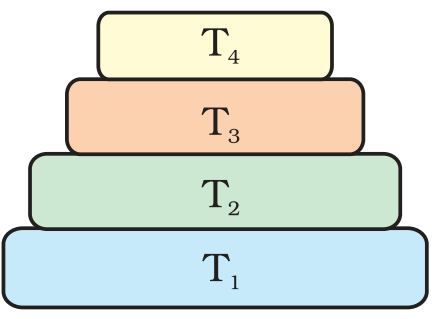
In the figure given alongside, the various trophic levels are shown in the form of a pyramid. At which trophic level the maximum energy is available?
  • A
    $\mathrm{T}_4$
  • B
    $\mathrm{T}_2$
  • $\mathrm{T}_1$
  • D
    $\mathrm{T}_3$
Answer
Correct option: C.
$\mathrm{T}_1$
At $\mathrm{T}_1$, producers, which make food, are present, and hence they are at the bottom of the trophic levels. As they get energy directly from the sun, they have the maximum energy. This energy keeps on reducing as it is passed on to the next trophic levels.
View full question & answer
MCQ 751 Mark
Depletion of ozone layer is noticed on :
  • A
    America
  • B
    Asia
  • C
    Australia
  • All over the earth
Answer
Correct option: D.
All over the earth
Depletion of ozone layer is noticed all over the earth.
Ozone is destroyed by collisions with other atoms and molecules.
View full question & answer
MCQ 761 Mark
If the energy available at the producer level in a food chain is $150J,$ how much energy will be transferred to : tertiary consumer?
  • A
    $15J.$
  • B
    $10J.$
  • C
    $1.50J.$
  • $0.15J.$
Answer
Correct option: D.
$0.15J.$
According to the $10$ per cent law, only $10$ per cent of the energy available in one trophic level is transferred to the next trophic level.
View full question & answer
MCQ 771 Mark
The $10\%$ law for energy transfer in food chain was given by.
  • A
    Stanley.
  • B
    Tansley.
  • Lindemannd.
  • D
    Weismann.
Answer
Correct option: C.
Lindemannd.
The Ten percent law for the transfer of energy from one trophic level to the next was introduced by Lindemann $(1942)$. According to this law, during the transfer of energy from organic food from one trophic level to the next, only about ten percent of the of energy from organic matter is stored as flesh.
View full question & answer
MCQ 781 Mark
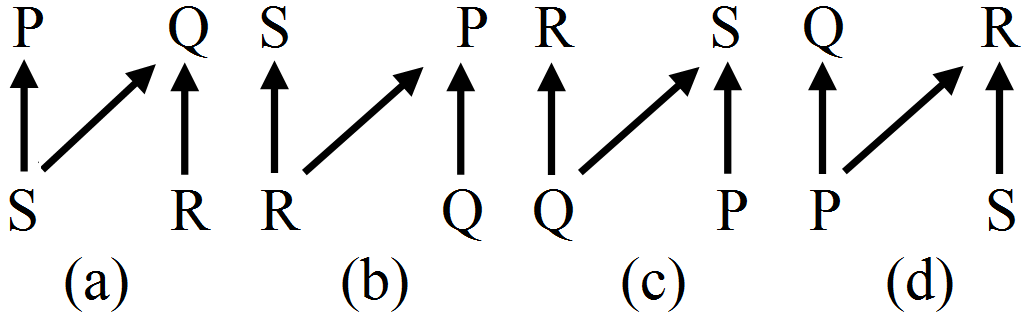
The diagram shows the organisms in a habitat.

Which of the following indicates the feeding relationships of these organisms?
  • A
    $(a)$
  • B
    $(b)$
  • $(c)$
  • D
    $(d)$
Answer
Correct option: C.
$(c)$
$R$ are the primary consumers which feed on plant $Q$. Decomposers are the organisms which feed on dead and decaying matter $S$. Then these decaying matters help in the growth of plants by providing nutrients to feed then from soil.
View full question & answer
MCQ 791 Mark
One of the following is not a biodegradable material. This one is :
  • A
    Cotton.
  • B
    Animal bones.
  • Aluminium foil.
  • D
    Wood.
Answer
Correct option: C.
Aluminium foil.
Aluminium foil cannot be degraded by the action of micro-organisms and hence is non $-$ biodegradable.
View full question & answer
MCQ 801 Mark
When we destroy a forest, we destroy :
  • An ecosystem
  • B
    Only the food for the wildlife
  • C
    Only trees
  • D
    Only wildlife
Answer
Correct option: A.
An ecosystem
A forest ecosystem comprises trees, wildlife, and abiotic components. Both plants and animals are dependent on each other for their survival. There are many species that form an integral part of the forest food chain. Trees provide food and shelter whereas, some animals help in the pollination and dispersal of seeds. Thus, when forests are destroyed, it wipes out the entire forest ecosystem.
View full question & answer
MCQ 811 Mark
One of the following is a micro $-$ consumer. This one is :
  • A
    Ant.
  • B
    Lice.
  • Fungi.
  • D
    Mosquito.
Answer
Correct option: C.
Fungi.
Fungi are micro $-$ consumers, which consume micro $-$ producers.
View full question & answer
MCQ 821 Mark
Which of the following constitute a food $-$ chain?
  • A
    Grass, wheat and mango.
  • Grass, goat and human.
  • C
    Goat, cow and elephant.
  • D
    Grass, fish and goat.
Answer
Correct option: B.
Grass, goat and human.
View full question & answer
MCQ 831 Mark
Which of the following group of organisms are not constituents of a food chain?
  1. Grass, lion, rabbit, wolf.
  2. Plankton, man, fish, grasshopper.
  3. Wolf, grass, snake, tiger.
  4. Frog, snake, eagle, grass, grasshopper.
  • A
    $(i)$ and $(iii)$
  • B
    $(iii)$ and $(iv)$
  • $(ii)$ and $(iii)$
  • D
    $(i)$ and $(iv)$
Answer
Correct option: C.
$(ii)$ and $(iii)$
A food chain is a sequence of living organisms in a community or ecosystem, in which one organism is consumed the other. The organisms given in options $(i)$ and $(iii)$ cannot comprise a food chain.
View full question & answer
MCQ 841 Mark
Organisms which synthesise carbohydrates from inorganic compounds by using radiant energy are called :
  • A
    Decomposers.
  • Producers.
  • C
    Herbivores.
  • D
    Carnivores.
Answer
Correct option: B.
Producers.
Green plants are producers that prepare carbohydrates as food from inorganic compounds, such as carbon dioxide and water, by using sunlight as the radiant energy.
View full question & answer
MCQ 851 Mark
Flow of energy in an ecosystem is always :
  • Unidirectional.
  • B
    Bidirectional.
  • C
    Multi directional.
  • D
    No specific direction.
Answer
Correct option: A.
Unidirectional.
The flow of energy in the ecosystem is unidirectional. The energy enters the plants $($from the sun$)$ through photosynthesis during the making of food. This energy is then passed on from one organism to another in a food chain.
The energy given out by the organisms as heat is lost to the environment, it does not return to be used by the plants again. This makes the flow of energy in ecosystem 'unidirectional'.
View full question & answer
MCQ 861 Mark
The scientists who study ecosystems are called :
  • Ecologists
  • B
    Economists
  • C
    Engineers
  • D
    Doctors
Answer
Correct option: A.
Ecologists
The study of the ecosystem is called 'ecology'. The scientists who study the ecosystem are called 'ecologists'.
View full question & answer
MCQ 871 Mark
The total biomass in a terrestrial ecosystem will be greatest for which trophic level ?
  • Herbivores.
  • B
    Producers.
  • C
    Primary consumers.
  • D
    Secondary consumers.
Answer
Correct option: A.
Herbivores.
Terrestrial biomass generally decreases markedly at each higher trophic level $($plants, herbivores, carnivores$).$ Examples of terrestrial producers are grasses, trees and shrubs.
View full question & answer
MCQ 881 Mark
Which of the following is the most stable ecosystem?
  • A
    Mountain.
  • B
    Desert.
  • C
    Forest.
  • Oceans.
Answer
Correct option: D.
Oceans.
oceanic biome or ecosystem occupies more than two-thirds of the earth's surface. This is the most stable ecosystem.
View full question & answer
MCQ 891 Mark
UV radiation increases the chances of $ ............ : $
  • Skin cancer
  • B
    Lung cancer
  • C
    Both $A$ and $B$
  • D
    None of the above
Answer
Correct option: A.
Skin cancer
$\ce{UV}$ is radiation increases the chances of skin cancer, which is why ozone layer is very important as it shields the surface of earth from these $\ce{UV}$ radiations of the sun.
View full question & answer
MCQ 901 Mark
Which of the following groups contain only biodegradable items?
  • A
    Grass, flowers and leather.
  • B
    Cake, wood and grass.
  • C
    Fruit-peels, cake and lime-juice.
  • (B) and (C) both
Answer
Correct option: D.
(B) and (C) both
(B).  Cake, wood and grass.
(C).  Fruit-peels, cake and lime-juice and,
View full question & answer
MCQ 911 Mark
A food chain comprises of cat, seed $-$ eating bird, plants, and dog. The organism which will have the maximum concentration of harmful pesticides coming through the food chain is most likely to be :
  • A
    Cat.
  • B
    Plants.
  • Dog.
  • D
    Seed-eating bird.
Answer
Correct option: C.
Dog.
The concentration of harmful pesticides in the bodies of birds and animals increases at each trophic level, and hence the dog in the given food chain will have the maximum concentration of harmful pesticides.
View full question & answer
MCQ 921 Mark
If a grass hopper is eaten by a frog, then the energy transfer will be from :
  • A
    Producer to decomposer.
  • B
    Producer to primary consumer.
  • Primary consumer to secondary consumer.
  • D
    Secondary consumer to primary consumer.
Answer
Correct option: C.
Primary consumer to secondary consumer.
Grasshopper feeds on grass and hence is a primary consumer. Frogs feed on insects and hence are secondary consumers.
View full question & answer
MCQ 931 Mark
Waste must be separated into $ ........... $ and $ ............. :$
  • Dry and wet
  • B
    Organic and inorganic
  • C
    Dry and organic
  • D
    Wet and inorganic
Answer
Correct option: A.
Dry and wet
Solid waste that are generated must be segregated as dry waste and wet waste. This would help in better treatment and disposal of waste.
View full question & answer
MCQ 941 Mark
$\mathrm{O}_2$ is converted into $\mathrm{O}_3$ by the action of :
  • A
    Infrared radiations.
  • Ultraviolet radiations.
  • C
    Gamma radiations.
  • D
    Cosmic radiations.
Answer
Correct option: B.
Ultraviolet radiations.
Oxygen is converted into ozone by ultraviolet radiations.
View full question & answer
MCQ 951 Mark
The ten per cent law is associated with :
  • A
    Transfer of energy from various trophic levels to decomposers in a food chain.
  • B
    Transfer of $\text{ATP}$ energy into muscular energy.
  • Transfer of chemical energy from one organism to another.
  • D
    Transfer of sun's energy to the organisms called producers.
Answer
Correct option: C.
Transfer of chemical energy from one organism to another.
The $10$ per cent law is associated with the transfer of chemical energy from one organism to another.
View full question & answer
MCQ 961 Mark
$A$ is false, but $R$ is true.
Assertion : Most of the solid waste in urban areas is disposed off in landfills.
Reason : Landfills are high lying areas of the ground.
  • A
    Both $A$ and $R$ are true, and $R$ is correct explanation of the assertion.
  • B
    Both $A$ and $R$ are true, but $R$ is not the correct explanation of the assertion.
  • $A$ is true, but $R$ is false.
  • D
    $A$ is false, but $R$ is true
Answer
Correct option: C.
$A$ is true, but $R$ is false.
Landfills are low $-$ lying areas of ground where waste is dumped and covered with soil to the level of ground.
For two statements are given $-$ one labelled Assertion $(A)$ and the other labelled Reason $(R)$. Select the correct answer to these questions from the codes $\ce{(a), (b), (c)}$ and $(d)$ as given below :
View full question & answer
MCQ 971 Mark
An ecosystem comprising of producers, herbivores and carnivores is an incomplete ecosystem if it does not include.
  • A
    Secondary consumers.
  • Decomposers.
  • C
    Top carnivores.
  • D
    Secondary and tertiary consumers.
Answer
Correct option: B.
Decomposers.
An ecosystem comprising of producers, herbivores carnivores is an incomplete ecosystem. It does not include decomposers.
View full question & answer
MCQ 981 Mark
$ .......... $ feed on dead and decaying matter :
  • A
    Autotrophs
  • B
    Herbivores
  • Decomposers
  • D
    Carnivores
Answer
Correct option: C.
Decomposers
Autotrophs are organisms that can synthesize their own food some They are called producers.
Herbivores are those organisms that feed on producers. They are called primary consumers.
Carnivores are those organisms that feed on herbivores. They are called secondary consumers.
Decomposers are organisms that feed on dead and decaying matter. They break down the organic matter and release essential nutrients back into the environment.
View full question & answer
MCQ 991 Mark
Which of the following is not a non $-$ biodegradable material?
  • A
    Nylon socks.
  • B
    Plastic school bag.
  • Jute carry bag.
  • D
    Polyester clothes.
Answer
Correct option: C.
Jute carry bag.
A jute carry bag is made from jute, which is a plant fibre. Hence, it is biodegradable.
View full question & answer
MCQ 1001 Mark
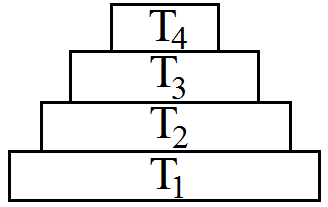
In the given Figure the various trophic levels are shown in a pyramid. At which trophic level is maximum energy available?
  • A
    $\mathrm{T}_4$
  • B
    $\mathrm{T}_2$
  • $\mathrm{T}_1$
  • D
    $\mathrm{T}_3$
Answer
Correct option: C.
$\mathrm{T}_1$
Maximum energy is available at the producer’s level. Only $10\%$ of the energy consumed by an organism at a particular trophic level is available for the organism at next trophic level. $T_1 > T_2 > T_3 > T_4$.
View full question & answer
M.C.Q - Page 2 - Science STD 10 Questions - Vidyadip