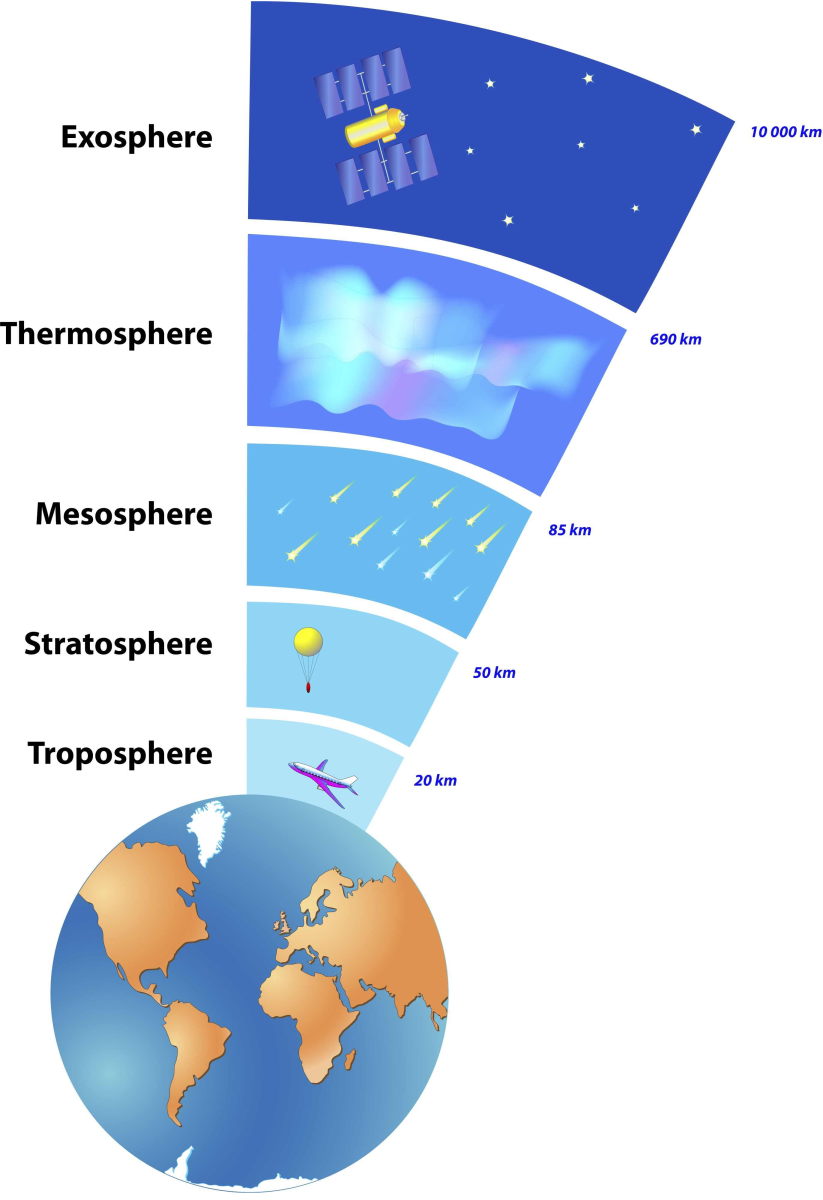
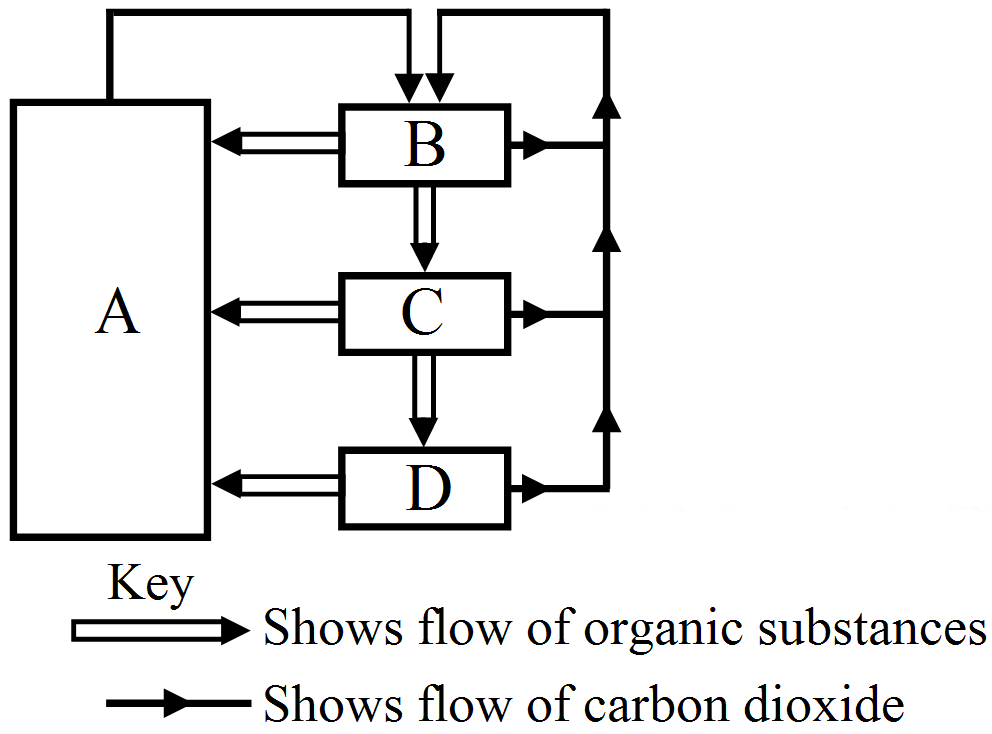
In the Earth's lower atmosphere, near ground level, ozone is formed when pollutants emitted by cars, power plants, industrial boilers, refineries, chemical plants, and other sources react chemically in the presence of sunlight. Ozone at ground level is a harmful air pollutant.
In the following groups of materials, which group $(s)$ contains only non-biodegradable items?
Wood, paper, leather.
Polythene, detergent $,\text{PVC}.$
Plastic, detergent, grass.
Plastic, bakelite $,\text{DDT}.$
A
$(iii).$
B
$(iv).$
C
$(i)$ and $(iii).$
✓
$(ii)$ and $(iv).$
Answer
Correct option: D.
$(ii)$ and $(iv).$
The substances which can’t be decayed by the action of microbes are non-biodegradable substances e.g. polythene, Bakelite $,\text{PVC},$ detergent $,\text{DDT},$ plastic etc.
Substances which can be decayed by microbes are called biodegradable substances i.e. Wood, paper, grass etc.
What will happen if deer is missing in the food chain given below? Grass $\rightarrow $ Deer $\rightarrow $ Tiger
A
The population of tiger increases.
B
The population of grass decreases.
C
Tiger will start eating grass.
✓
The population of tiger decreases and the population of grass increases.
Answer
Correct option: D.
The population of tiger decreases and the population of grass increases.
If deer is missing in the food chain then there will be no herbivore to consume grass, so population of grass will increase.
Tiger will start to die of hunger, so the population of tiger will decrease.
Accumulation of non $-$ biodegradable pesticides in the food chain in increasing amount at each higher trophic level is known as :
A
Eutrophication.
B
Pollution.
✓
Biomagnification.
D
Accumulation.
Answer
Correct option: C.
Biomagnification.
The accumulation of non $-$ biodegradable pesticides in the food chain in an increasing amount at each higher trophic level is known as biomagnifications.
In a food chain, spider, lizard, crow belongs to higher tropic levels. These are generally carnivores.
However, honeybees feed on pollen and nectar. Hence they are primary consumers and occupy a different level in the food chain.
If the primary producers are absent from any ecosystem, which of the following will occur?
A
Herbivores will not be able to survive.
B
Carnivores will not be able to survive.
✓
Both herbivores and carnivores will not be able to survive because of the absence of food.
D
No change will take place.
Answer
Correct option: C.
Both herbivores and carnivores will not be able to survive because of the absence of food.
All consumers are directly or indirectly dependent on producers for food.
For example, herbivores eat plants. If plants are removed, then herbivores will not survive as their source of food will be absent. If herbivores will not survive then carnivores $($that eat herbivores$)$ will also not survive.
An ecosystem is a segment of the biosphere consisting of a community of living beings and the abiotic or physical environment interacting and exchanging materials between them.
A community is a group of potentially interacting species living in the same region.