Questions · Page 3 of 4

M.C.Q

MCQ 1011 Mark
Which of the following is an artificial ecosystem?
  • A
    Pond.
  • Crop field.
  • C
    Lake.
  • D
    Forest.
Answer
Correct option: B.
Crop field.
A crop field is an artificial ecosystem, because it is made by man.
View full question & answer
MCQ 1021 Mark
The ultimate source of energy is :
  • A
    Plants
  • B
    Producers
  • C
    Universe
  • Sun
Answer
Correct option: D.
Sun
The sun is considered the primary energy source since it is the source of nearly all the earth’s energy.
Plants produce food using sunlight, and the food we get from plants and animals also has its primary sunlight source.
The fossil fuels we use in our everyday lives come from dead plants and animals that have their origins as solar energy again.
View full question & answer
MCQ 1031 Mark
Which of the following are environment $-$ friendly practices?
  • A
    Carrying cloth-bags to put purchases in while shopping.
  • B
    Switching off unnecessary lights and fans.
  • C
    Walking to school instead of getting your mother to drop you on her scooter.
  • All of the above.
Answer
Correct option: D.
All of the above.
View full question & answer
MCQ 1041 Mark
In an ecosystem, the $10\%$ of energy available for transfer from one trophic level to the next is in the form of :
  • A
    Heat energy.
  • B
    Light energy.
  • Chemical energy.
  • D
    Mechanical energy.
Answer
Correct option: C.
Chemical energy.
The $10\%$ of energy available for transfer from one trophic level to the next in an ecosystem is in the form of chemical energy. The producers capture the energy present in sunlight and convert it into chemical energy which is passed into onto other trophic levels.
View full question & answer
MCQ 1051 Mark
Which of the following act as decomposers in an ecosystem?
  • A
    Lactobacillus bacteria.
  • B
    Cyanobacteria.
  • Putrefying bacteria.
  • D
    Rhizobium bacteria.
Answer
Correct option: C.
Putrefying bacteria.
Putrefying bacteria decompose dead organisms, and hence act as decomposers in an ecosystem.
View full question & answer
MCQ 1061 Mark
The first link in any food chain is always a green plant, because :
  • A
    They are widely distributed.
  • B
    They are firmly fixed to the soil.
  • They alone have a capacity to fix atmospheric $\mathrm{CO}_2$​ in the presence of sunlight.
  • D
    All of the above.
Answer
Correct option: C.
They alone have a capacity to fix atmospheric $\mathrm{CO}_2$​ in the presence of sunlight.
In all the ecosystems, the sun is the ultimate source of energy. Green plants trap solar energy and convert it into a usable form, which can be used by other organisms at successive trophic levels.
View full question & answer
MCQ 1071 Mark
Each successive trophic level has :
  • Less total energy
  • B
    More total energy
  • C
    Increased total energy
  • D
    Non $-$ estimated energy contents
Answer
Correct option: A.
Less total energy
View full question & answer
MCQ 1081 Mark
In a food chain, lions occupy which trophic level?
  • A
    First
  • B
    Second
  • Third
  • D
    Both $B$ and $C$
Answer
Correct option: C.
Third
In a grassland food chain, plants are the producers. Primary consumers like deer eat these plants. Secondary consumers like lions eat the primary consumers. So, a lion occupies the third level in a food chain.
View full question & answer
MCQ 1091 Mark
$A$ is false, but $R$ is true.
Assertion : The burning of substances at higher temperature to form ash is called incineration.
Reason : Incineration greatly reduces the volume of waste.
  • A
    Both $A$ and $R$ are true, and $R$ is correct explanation of the assertion.
  • Both $A$ and $R$ are true, but $R$ is not the correct explanation of the assertion.
  • C
    $A$ is true, but $R$ is false.
  • D
    $A$ is false, but $R$ is true
Answer
Correct option: B.
Both $A$ and $R$ are true, but $R$ is not the correct explanation of the assertion.
For two statements are given $-$ one labelled Assertion $(A)$ and the other labelled Reason $(R)$. Select the correct answer to these questions from the codes $\ce{(a), (b), (c)}$ and $(d)$ as given below :
View full question & answer
MCQ 1101 Mark
An ecosystem includes :
  • A
    All living organisms.
  • B
    Non $-$ living objects.
  • Both living organisms and non $-$ living objects.
  • D
    Sometimes living organisms and sometimes non $-$ living objects.
Answer
Correct option: C.
Both living organisms and non $-$ living objects.
Both biotic and abiotic factors are present in an ecosystem.
View full question & answer
MCQ 1111 Mark
Concentration of $\ce{DDT}$ is highest in :
  • A
    Primary consumer
  • B
    Producers
  • Top consumer
  • D
    Decomposers
Answer
Correct option: C.
Top consumer
The concentration of $\ce{DDT}$ is highest in top consumers due to a phenomenon known as Biomagnification.
Biomagnification refers to an increase in the concentration of toxic chemicals at successive trophic levels. This happens because a toxic substance accumulated by an organism cannot be metabolised or excreted, and is thus passed on to the next higher trophic level. This phenomenon is well known for mercury and $\ce{DDT}.$
View full question & answer
MCQ 1121 Mark
In an ecosystem, the ten per cent energy available for transfer from one trophic level to the next is in the form of :
  • A
    Heat energy.
  • B
    Light energy.
  • Chemical energy.
  • D
    Mechanical energy.
Answer
Correct option: C.
Chemical energy.
The food prepared by plants is in the form of chemical energy, which is passed on to the next trophic level in an ecosystem.
View full question & answer
MCQ 1131 Mark
Large carnivores which feed on primary carnivores are known as :
  • Tertiary Consumers
  • B
    Primary consumers
  • C
    Omnivores
  • D
    Herbivores
Answer
Correct option: A.
Tertiary Consumers
Herbivores are called primary consumers, as they feed on autotrophs.
Secondary consumers feed on these primary consumers and are called so.
Large carnivores feed on these secondary consumers and hence are called tertiary consumers.
View full question & answer
MCQ 1141 Mark
Disposable plastic plates should not be used because :
  • A
    They are made of materials with light weight.
  • B
    They are made of toxic materials.
  • C
    They are made of biodegradable materials.
  • They are made of non-biodegradable materials.
Answer
Correct option: D.
They are made of non-biodegradable materials.
Because of their non $-$ biodegradable nature, plastic keeps on accumulating in the environment.
View full question & answer
MCQ 1151 Mark
Name one non $-$ biodegradable waste which may pollute the earth to dangerous levels of toxicity, not handled properly.
  • A
    $\text{DDT}$
  • B
    $\text{PAN}$
  • C
    $\text{CFC}$
  • Radioactive substances.
Answer
Correct option: D.
Radioactive substances.
Radioactive substances however are not biodegradable, and some parts take hundreds of thousands of years to become harmless. And we just keep producing them.
View full question & answer
MCQ 1161 Mark
Which of the following is not a fossil source of energy?
  • A
    Kerosene oil.
  • Cow $-$ dung cakes.
  • C
    $\text{CNG}.$
  • D
    Coal.
Answer
Correct option: B.
Cow $-$ dung cakes.
Fossil fuels take thousands of years to form deep under the earth. Cow dung does not come under this category of fuels.
View full question & answer
MCQ 1171 Mark
The excessive exposure of humans to ultraviolet rays results in :
  1. Damage to immune system.
  2. Damage to lungs.
  3. Skin cancer.
  4. Peptic ulcers.
  • A
    $(i)$ and $(ii)$
  • B
    $(ii)$ and $(iv)$
  • $(i)$ and $(iii)$
  • D
    $(iii)$ and $(iv)$
Answer
Correct option: C.
$(i)$ and $(iii)$
Excessive exposure of humans to ultraviolet rays results in skin cancer and damage to the immune system.
View full question & answer
MCQ 1181 Mark
Which one is not dangerous?
  • A
    Bio $-$ pollutants
  • Ozone layer
  • C
    Nuclear blast
  • D
    Deforestation
Answer
Correct option: B.
Ozone layer
The ozone layer is found in the upper part of the atmosphere called the stratosphere, and it acts as a shield absorbing ultraviolet radiation from the sun.
$\text{UV}$ rays are highly injurious to living organisms and cause various diseases such as skin cancer, cataract, etc.
Bio $-$ pollutants, nuclear blast, deforestation cause pollution, and thus damage the environment.

 
View full question & answer
MCQ 1191 Mark
Which of the following is an example of man $-$ made ecosystem?
  • A
    Herbarium.
  • Aquarium.
  • C
    Tissue culture.
  • D
    Forest.
Answer
Correct option: B.
Aquarium.
Examples of man made ecosystem includes agriculture based systems like a garden, orchards; products of land development like a lake, canals, park; products of observation and lively requirements like an aquarium, a building, and a city.
View full question & answer
MCQ 1201 Mark
Ozone hole means :
  • A
    Hole in the stratosphere
  • B
    Same concentration of ozone
  • Decrease in the concentration of ozone
  • D
    Increase in the concentration of ozone
Answer
Correct option: C.
Decrease in the concentration of ozone
Due to the depletion of stratospheric ozone, a seasonal hole in the ozone layer at polar regions is formed in the atmosphere. This is known as the ozone hole.
The depletion of ozone causes harmful $\ce{UV}$ rays to reach the earth. $\ce{UV}$ radiations are responsible for causing skin cancers and various diseases in humans.
View full question & answer
MCQ 1211 Mark
Which of the following statement is incorrect?
  • A
    All green plants and blue green algae are producers.
  • Green plants get their food from readymade organic compounds.
  • C
    Producers prepare their own food from inorganic compounds.
  • D
    Plants convert solar energy into chemical energy.
Answer
Correct option: B.
Green plants get their food from readymade organic compounds.
This is an incorrect statement as green plants prepare their food themselves; they do not get readymade organic compounds as their food.
View full question & answer
MCQ 1221 Mark
In the food chain given below, if the amount of energy available at fourth trophic level is $5kJ,$ what was the energy available at the producer level? Grass $\rightarrow $ Grasshopper $\rightarrow $ Frog $\rightarrow $ Snake $\rightarrow $ Hawk
  • A
    $500kJ.$
  • B
    $50kJ.$
  • $5000kJ.$
  • D
    $5kJ.$
Answer
Correct option: C.
$5000kJ.$
According to the $10$ per cent law, only $10$ per cent of the energy available in a trophic level is passed on to the next level. Hence, if the amount of energy available at the fourth trophic level is $5kJ,$ the energy available at the producer level will be $5,000kJ : 5 \rightarrow 50 \rightarrow 500 \rightarrow 5,000.$
View full question & answer
MCQ 1231 Mark
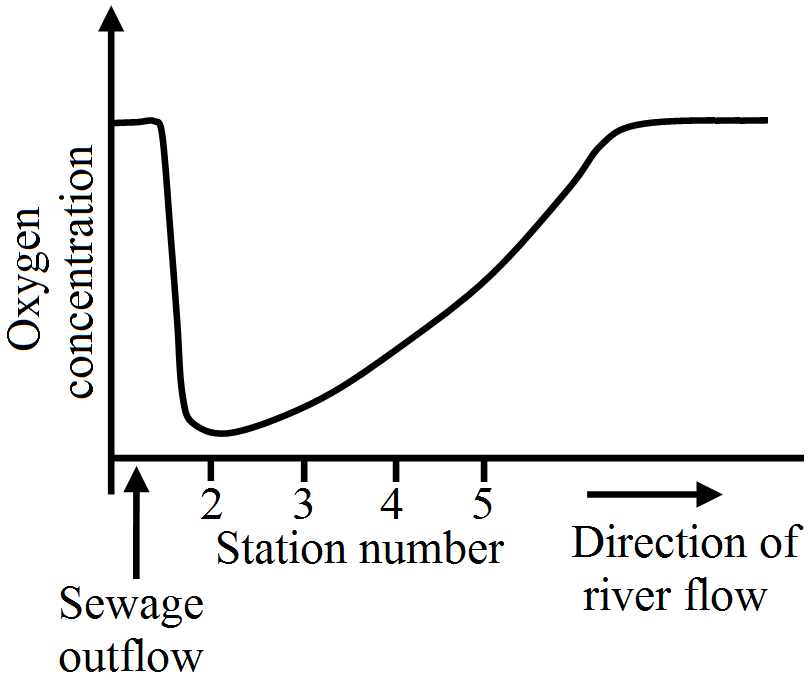
The following graph shows the concentration of oxygen in a river, measured at stations $1.5,$ each $100\ m$ apart. A sewage outflow is observed just after station $1$. At which stations will the concentration of organic matter be lowest?
  • $1$ and $5$
  • B
    $2$ and $3$
  • C
    $3$ and $4$
  • D
    $4$ and $5$
Answer
Correct option: A.
$1$ and $5$
At $1$ and $5$ the concentration of organic matter will be lowest because there were no decomposers. Whereas in $2, 3$ and $4$ the decomposers were using the high amount of oxygen to decompose the organic material from sewage.
View full question & answer
MCQ 1241 Mark
Which of the following limits the number of trophic levels in a food chain?
  • A
    Insufficient food supply from producer level.
  • Decrease in energy at higher trophic levels.
  • C
    Increase in the number of organisms at higher trophic levels.
  • D
    Accumulation of harmful chemicals at higher trophic levels.
Answer
Correct option: B.
Decrease in energy at higher trophic levels.
According to the $10$ per cent law, the amount of energy decreases in each trophic level, and hence the number of trophic levels in a food chain is limited.
View full question & answer
MCQ 1251 Mark
Choose the correct sequence with respect to food chain :
  • Producer $\rightarrow $ Consumer $\rightarrow $ Decomposer
  • B
    Decomposer $\rightarrow $ Consumer $\rightarrow $ Producer
  • C
    Producer $\rightarrow $ Decomposer $\rightarrow $ Consumer
  • D
    Consumer $\rightarrow $ Producer $\rightarrow $ Decomposer
Answer
Correct option: A.
Producer $\rightarrow $ Consumer $\rightarrow $ Decomposer
A food chain is a linear sequence of organisms through which nutrients and energy pass as one organism eats another.
Producers prepare food for themselves through the process of photosynthesis. Consumers eat producers. Consumers are themselves eaten by other higher consumers. Finally, when consumers die, the decomposers decompose their bodies to convert them into organic matter. The nutrients from the organic matter are taken up by producers.
View full question & answer
MCQ 1261 Mark
One of the following helps in the recycling of materials in an ecosystem. This one is :
  • A
    Autotrophs.
  • Saprotrophs.
  • C
    Omnivores.
  • D
    Carnivores.
Answer
Correct option: B.
Saprotrophs.
Saprotrophs such as bacteria and fungi recycle the organic matter present in the bodies of dead organisms by mixing it with the soil.
View full question & answer
MCQ 1271 Mark
The depletion of ozone layer in the upper atmosphere is mainly due to the emission of :
  • A
    Unburnt hydrocarbons.
  • Chlorofluorocarbons.
  • C
    Greenhouse gases.
  • D
    Ultraviolet radiations.
Answer
Correct option: B.
Chlorofluorocarbons.
Chlorofluorocarbons emitted by air $-$ conditioners, refrigerators and jet planes cause the depletion of the ozone layer.
View full question & answer
MCQ 1281 Mark
Which of the following set represents primary consumers?
  • A
    Deers, giraffes, cows
  • B
    Goats, rabbits, horses
  • C
    Insects, snails
  • All of the above
Answer
Correct option: D.
All of the above
Deers, giraffes, cows, goats, rabbits, horses, insects and snails, all consume the producers and hence are primary consumers.
View full question & answer
MCQ 1291 Mark
Which of the following limits the number of trophic levels in a food chain?
  • Decrease in energy at higher trophic levels.
  • B
    Dufficient food supply.
  • C
    Polluted air.
  • D
    Water.
Answer
Correct option: A.
Decrease in energy at higher trophic levels.
There is a loss of energy as we go from one trophic level to the next, this limits the number of trophic levels in a food $-$ chain.
View full question & answer
MCQ 1301 Mark
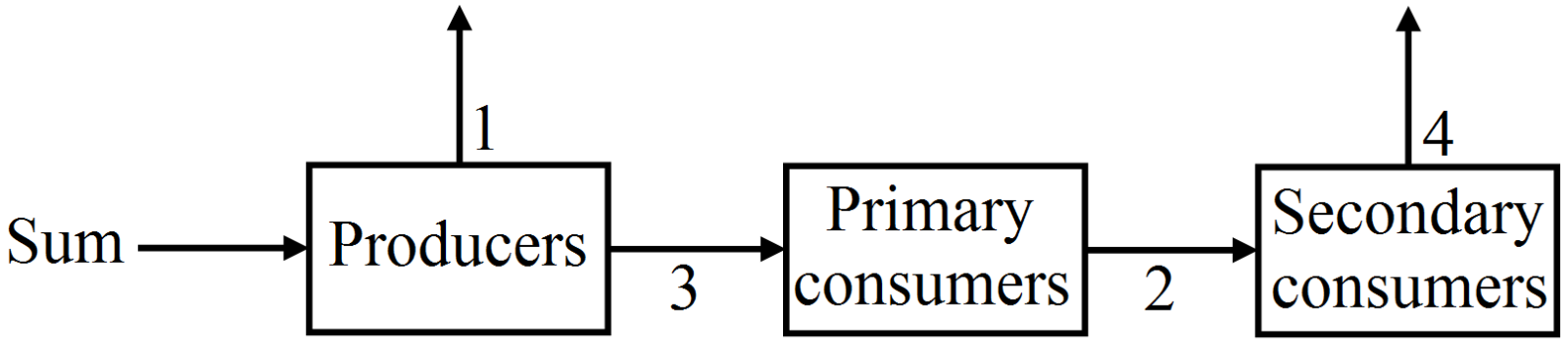
The diagram shots the flow of energy through an ecosystem.

The smallest amount of energy transferred between organisms and the largest amount of energy lost to the ecosystem is represented by which arrows?
  Smallest energy loss Largest energy loss
$(a)$ $4$ $3$
$(b)$ $2$ $1$
$(c)$ $2$ $3$
$(d)$ $1$ $4$
  • $(a)$
  • B
    $(b)$
  • C
    $(c)$
  • D
    $(d)$
Answer
Correct option: A.
$(a)$
The smallest amount of energy transferred between organisms is shown by arrow number $4$. Because as we go above in a food chain the amount of energy transferred is reduced by $10\%$. And the largest amount of energy loss to the ecosystem is in the form of heat. It is shown by arrow number $3$. This is because producers $($plants$)$ take energy from sunlight and only $1\%$ of it is used to prepare food rest other is lost is the form of heat.
View full question & answer
MCQ 1311 Mark
What provides the energy which then flows through a food chain?
  • A
    Glucose.
  • B
    Oxygen.
  • C
    Respiration.
  • Sunlight.
Answer
Correct option: D.
Sunlight.
Sunlight provides energy to plants for preparing food, and this energy is then passed on to the next trophic levels through a food chain.
View full question & answer
MCQ 1321 Mark
The presence of which of the following gases in air checks the ultraviolet rays from sunlight?
  • A
    $\mathrm{SO}_2$​
  • B
    $\mathrm{CO}_2$​
  • C
    $\ce{NO}$
  • $\mathrm{O}_3$​
Answer
Correct option: D.
$\mathrm{O}_3$​
At the higher levels of the atmosphere, ozone $(\mathrm{O}_3​)$ performs an essential function. It shields the surface of the Earth from ultraviolet $\ce{(UV)}$ radiation from the sun. This radiation is highly damaging to organisms, for example, it is known to cause skin cancer in human beings.
View full question & answer
MCQ 1331 Mark
Each ecosystem consists of $.......$ main components :
  • A
    Three
  • Two
  • C
    Four
  • D
    Five
Answer
Correct option: B.
Two
An ecosystem is made up of two components $-$ biotic and abiotic. It includes the interaction of the living things which are the biotic components in a given area with the non living environment which are the abiotic factors such as weather, earth, sun, soil, climate and atmosphere.
View full question & answer
MCQ 1341 Mark
First link in any food system is a green plant because :
  • Green plants can synthesize food.
  • B
    They consume the food produced by other organisms.
  • C
    They are fixed at one place.
  • D
    None of the above.
Answer
Correct option: A.
Green plants can synthesize food.
Green plants are photosynthetic organisms. They trap solar energy and use it to synthesize carbohydrates. The carbohydrates are the useful form of energy. All the other organisms depend on plants either directly or indirectly.
View full question & answer
MCQ 1351 Mark
Which of the following is not a producer?
  • A
    Grass.
  • Zooplankton.
  • C
    Phytoplankton.
  • D
    Paddy.
Answer
Correct option: B.
Zooplankton.
Zooplanktons are herbivorous micro $-$ organisms such as protozoa that are found in water bodies. They depend upon producers for food and hence are not producers.
View full question & answer
MCQ 1361 Mark
Which of the following chemicals is/ are depleting ozone layer?
  • A
    $\ce{CFC\ 's}$ and compounds of chlorine fume or halogen gas
  • B
    Carbon dioxide and carbon monoxide
  • C
    Hydrofluorocarbons
  • Both $A$ and $C$
Answer
Correct option: D.
Both $A$ and $C$
View full question & answer
MCQ 1371 Mark
$\text{DDT}$ was accidently added to the water of a lake. All the organisms in it would be affected by $\text{DDT}$. Which of the organisms would be affected the most?
  • A
    Man.
  • B
    Birds living near the lake.
  • Fish living in the lake.
  • D
    Aquatic plants living in the lake.
Answer
Correct option: C.
Fish living in the lake.
$\text{DDT}$ was accidently added to the water of a lake. All the organisms in it would be $\text{DDT}$. Fish living in the lake.
View full question & answer
MCQ 1381 Mark
Which of the following cannot be added in a composting pit to prepare compost?
  • A
    Sunflower plants.
  • B
    Fruit and vegetable peels.
  • Flowers of plastic.
  • D
    Red worms.
Answer
Correct option: C.
Flowers of plastic.
Plastic is a non $-$ biodegradable substance, and hence it cannot be decomposed by composting.
View full question & answer
MCQ 1391 Mark
What are the advantages of cloth bags over plastic bags during shopping?
  • A
    Cloth bags are capable of carrying more things.
  • B
    Cloth bags made of biodegradable material do not pollute our environment.
  • C
    Cloth bags can be reused.
  • All of the above.
Answer
Correct option: D.
All of the above.
Cloth bags have following advantages over plastic bags:
Cloth bags are biodegradable so they do not pollute the environment.
Cloth bags are capable of carrying more things.
They can be reused over and over again
View full question & answer
MCQ 1401 Mark
The importance of an ecosystem lies in :
  • A
    Flow of energy
  • B
    Cycling of nutrients
  • Both $(A)$ and $(B)$
  • D
    None of the above
Answer
Correct option: C.
Both $(A)$ and $(B)$
The ecosystem is responsible for the flow of energy as the autotrophs convert the light energy provided by the sun to chemical energy which is further consumed by heterotrophs. In this way energy transferred from plants to herbivores and from them to carnivores.
When the complex organisms die, they are consumed by the bacteria and fungi, which are the decomposers, which break down the complex substances into simple inorganic forms. Thus, the cycling of nutrients takes place.
View full question & answer
MCQ 1411 Mark
Out of the given options, which one has the maximum quantity of energy, after producers :
  • A
    Decomposers
  • B
    Carnivores
  • Herbivores
  • D
    None of the above
Answer
Correct option: C.
Herbivores
According to the $10\%$ law, the transfer of energy from one tropic level to another tropic level is only $10\%$. It means, the energy level decreases going up in the ecological pyramid. Therefore, the highest energy occurs in the herbivores as they obtain energy directly from the autotrophs $($plants$).$
View full question & answer
MCQ 1421 Mark
Sahara Desert was formed over a period of time due to one of the following uncontrolled activities of man :
  • A
    Excessive cutting down of forest plants and trees.
  • B
    Excessive killing of large herbivores.
  • Excessive killing of large carnivores.
  • D
    Excessive use of poisonous chemicals herbicides.
Answer
Correct option: C.
Excessive killing of large carnivores.
Excessive killing of lions resulted in an increase in the number of herbivores, which in turn consumed all the vegetation. Hence, the Sahara Desert was formed.
View full question & answer
MCQ 1431 Mark
Nowaday, which type of cups are being generally trains for serving tea, coffee, soup, etc. on daily basis?
  • A
    Disposable cups made of clay.
  • B
    Washable plastic cups.
  • C
    Washable glass cups.
  • Disposable paper cups.
Answer
Correct option: D.
Disposable paper cups.
Nowaday, which type of cups are being generally trains for serving tea, coffee, soup, etc. Disposable paper cups.
View full question & answer
Question 1441 Mark
Which of the following are decomposers of dead organisms?
 
Bacteria
Fungi
Viruses
(a)
no
yes
yes
(b)
yes
no
yes
(c)
yes
yes
no
(d)
yes
yes
yes
Answer
  Bactaria Fungi Viruses
(C) Yes Yes No
Explanation:

Bacteria and fungi are decomposers of dead organisms.
View full question & answer
MCQ 1451 Mark
Disposable plastic plates should not be used because :
  • A
    They are made of light weight materials.
  • B
    They are made of toxic materials.
  • C
    They are made of biodegradable materials.
  • They are made of non $-$ biodegradable materials.
Answer
Correct option: D.
They are made of non $-$ biodegradable materials.
Disposable plastic plates cannot be degraded by micro $-$ organisms and hence should not be used. They will remain as such in the environment and pollute it.
View full question & answer
MCQ 1461 Mark
In the food chain comprising of a snake, grass, insect, and frog, the secondary consumer is :
  • A
    Insect.
  • B
    Snake.
  • Frog.
  • D
    Grass.
Answer
Correct option: C.
Frog.
The grass is eaten by the insect, which is eaten by the frog, which is eaten by the snake. Hence, the grass is the producer, the insect is the primary consumer, the frog is the secondary consumer and the snake is the tertiary consumer.
View full question & answer
MCQ 1471 Mark
In a food chain, the third trophic level is always occupied by :
  • Carnivores.
  • B
    Herbivores.
  • C
    Decomposers.
  • D
    Producers.
Answer
Correct option: A.
Carnivores.
The third trophic level is always occupied by carnivores. The first trophic level is occupied by producers, the second by herbivores and the fourth by decomposers.
View full question & answer
MCQ 1481 Mark
In an ecosystem :
  1. The flow of energy is unidirectional.
  2. The flow of materials is unidirectional.
  3. The flow of materials is cyclic.
  4. The flow of energy is cyclic.
  • A
    $(i)$ and $(ii)$
  • B
    $(ii)$ and $(iii)$
  • C
    $(i)$ and $(iv)$
  • $(i)$ and $(iii)$
Answer
Correct option: D.
$(i)$ and $(iii)$
In an ecosystem, the flow of energy is unidirectional and the flow of materials is cyclic.
View full question & answer
MCQ 1491 Mark
In an ecosystem :
  • A
    Cycling of energy and nutrients is a coupled process.
  • B
    Cycling of energy is an independent process.
  • Movement of energy is unidirectional.
  • D
    Movement of energy is bidirectional.
Answer
Correct option: C.
Movement of energy is unidirectional.
The flow of energy is unidirectional. The energy that is captured by the autotrophs does not revert back to the solar input and the energy which passes to the herbivores does not come back to autotrophs. As it moves progressively through the various trophic levels it is no longer available to the previous level.
View full question & answer
MCQ 1501 Mark
Biotic factors are :
  • A
    Chemical factors of soil which affect life
  • B
    Physical factors of soil which affect life
  • All living organisms which influence other organisms
  • D
    Living organisms which get eaten by other organisms
Answer
Correct option: C.
All living organisms which influence other organisms
Living organisms have effect on other living organisms and these constitute biotic factors or living factors.
View full question & answer
M.C.Q - Page 3 - Science STD 10 Questions - Vidyadip