Questions

[5 marks Questions]

🎯

Test yourself on this topic

19 questions · timed · auto-graded

Question 15 Marks
Some hunters are roaming in the plush green forest of Africa. They spot a deer and kill it. They decide to roast the deer there and then and eat it. When the hunters had just finished enjoying the feast of roasted deer, a lion attacks them. The lion kills one of the hunters and eats his flesh.
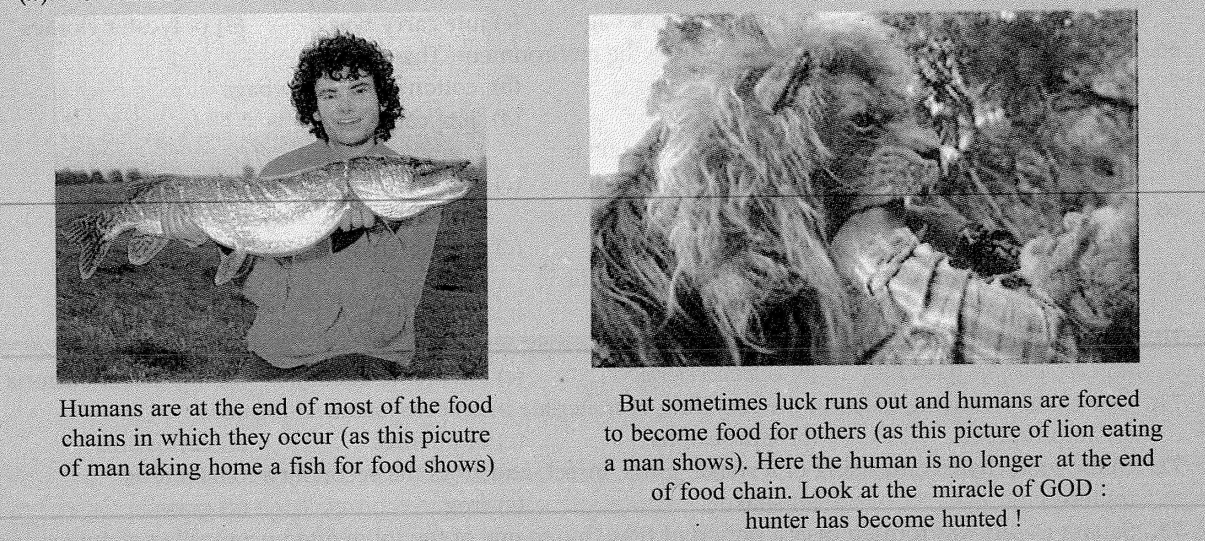
  1. Write a food chain which provides food to lion in this case.
  2. Which animal (other than deer) the lion could look for food if he did not get the hunter as prey?
  3. Which other animal in the forest could have been in place of lion?
  4. How does the above food chain differ form the food chain such as: plants → goat → man?
Answer
  1. The following is the food chain that provides food to the lion in the given case:
    Plants → Deer → Man → Lion
  2. The lion could have looked for a herbivore, such a wild buffalo or a zebra, if it he had not got the hunter as prey.
  3. Any top consumer, such as a tiger or a python, could have been in the place of the lion in the forest.
  4. In the food chain,
    Plants → Goat → Man
    man is the top consumer whereas, in the food cha
    Plants → Deer → Man → Lion,
    the top consumer is lion.in,
View full question & answer
Question 25 Marks
How does a biodegradable waste differ from a non-biodegradable waste? Give two examples of non- biodegradable wastes which pollute our environment.
Answer
Bioderghradable Wastes:
  • Those waste materials which can be broken down to non-poisonous substances in nature by the action of microorganisms (like bacteria) are called biodegradable wastes.
  • They get recycled and therefore do not require dumping sites.
  • They do not cause any pollution to the soil.
Example: Paper, Wood, etc.
Non-Biodegradable Wastes:
  • Those waste materials which cannot be broken down to non-poisonous substances in nature are called non-biodergradable wastes.
  • They cannot be recycled easily and therefore are to be dumped which requires lot of space. This cause wastage of land.
  • The harmful chemical leach out of these wastes when they are dumped in soil. This leads to soil pollution.
Example: DDT, Plastic and Polythene bags.
View full question & answer
Question 35 Marks
How much energy will be available to hawks in the food chain comprising hawk, snake, paddy and mice, if 10,000 J of energy is available to paddy from the sun?
Answer
  1. Small algae can trap only 1% of the sun’s energy falling on them. 1% of 10,000 J is 100 J, so the small algae have 100 J of energy available.
  2. Small algae are eaten up by zooplankton. According to the 10% law, 10% of 100 J is 10 J of energy which is available in zooplankton.
  3. The zooplankton will transfer 10% of its 10 J energy to the fish. Thus, the food energy available to the fish will be 10% of 10 J, which is 1 J.
  4. 10% of 1 J will be transferred to big fish which will be 0.1 J. The above result can be clearly shown as:
$\ \ \ \ \ \ \ \ \ \ \ \ \ \ \ \ \ \ \ \ \ \ \ \ \ \ \text{sun}\\^{10000\text{J}}\ ^{(1\%\text{absorbed)}}\Bigg\downarrow\\ \ \ \ \ \ \ \ \ \ \ \ \ \ \ \ \ \text{Small Algae}\ \xrightarrow{\ \ 10\%\ \text{Of}\ 100\text{J}\ \ \ }\ \text{Zooplankton}\ \xrightarrow{\ \ 10\%\ \text{Of }\ 10\text{J}\ \ }\ \text{Fish}\ \xrightarrow{\ \ 10\%\ \text{Of}\ 1\text{J}\ \ }\ \text{Big fish}\\ \ \ \ \ \ \ \ \ \ \ \ \ \ \ \ \ \ \ \ \ \ \ 100\text{J}\ \ \ \ \ \ \ \ \ \ \ \ \ \ \ \ \ \ \ \ \ \ \ \ \ \ \ \ \ \ \ \ \ \ \ \ \ \ \ 10\text{J}\ \ \ \ \ \ \ \ \ \ \ \ \ \ \ \ \ \ \ \ \ \ \ \ \ \ \ \ \ \ \ \ \ \ 1\text{J}\ \ \ \ \ \ \ \ \ \ \ \ \ \ \ \ \ \ \ \ \ \ \ \ \ \ 0.1\text{J}$
View full question & answer
Question 45 Marks
A food chain occurring in the sea which provides food for many people can be written as:
phytoplankton → zooplankton → X → Y
  1. Name one phytoplankton.
  2. Name two zooplanktons.
  3. What could be X?
  4. Name the organism which Y could be.
  5. Which organism in the above food chain is a (i) primary consumer, and (ii) tertiary consumer?
Answer
  1. Algae are phytoplankton.
  2. Jelly fish and copepods are examples of zooplankton.
  3. X is a small fish.
  4. Y could be a big fish.
  5. (i) Zooplankton are primary consumers, and (ii) big fish are tertiary consumers.
View full question & answer
Question 55 Marks
  1. Match the terms given in column I with the terms given in column II and column III having the same meaning:
  Column I Column II Column III
(i)
Secondary consumer
Herbivore
$1^{\text {st }}$ trophic level
(ii)
Primary consumer
Autotroph
$3^{\text {rd }}$ trophic level
(iii)
Producer
Carnivore
$4^{\text {th }}$ trophic level
(iv)
Tertiary consumer
Large carnivore
$2^{\text {nd }}$ trophic level
  1. Give one example of a food chain having four organisms. Below each organism write the three appropriate terms from the part (a) above which you think it represents.
Answer
  1.  
  Columnm I Column II Column III
(i)
Secondary consumer
Carnivore
$3^{\text {rd }}$ trophic level
(ii)
Primary consumer
Harbivore
$2^{\text {nd }}$ trophic level
(iii)
Producer
Autotrop
$1^{\text {st }}$ trophic level
(iv)
Tertiary consumer
Large carnivore
$4^{\text {th }}$ trophic level
  1. $\text{Grass}\ \ \ \ \ \ \xrightarrow{\ \ \ \ \ \ \ \ \ \ }\ \ \ \ \ \ \text{Grasshopper}\ \ \ \ \ \ \ \ \xrightarrow{\ \ \ \ \ \ \ }\ \ \ \ \ \ \ \ \ \ \ \text{Frog}\ \ \ \ \ \ \ \ \ \ \ \ \ \ \xrightarrow{\ \ \ \ \ \ \ \ \ }\ \ \ \ \ \ \ \ \ \ \ \text{Bird}\\{^\text{Producer}}\ \ \ \ \ \ \ \ \ \ \ \ \ \ \ \ \ \ \ \ \ \ {^\text{Primary consumer}}\ \ \ \ \ \ \ \ \ \ \ \ \ \ \ \ \ \ \ \ \ {^\text{Secondary consumer}}\ \ \ \ \ \ \ \ \ \ \ \ \ \ \ \ \ \ \ {^\text{Tertiary consumer}}\\ ^\text{Autotroph}\ \ \ \ \ \ \ \ \ \ \ \ \ \ \ \ \ \ \ \ \ \ \ \ \ ^\text{Herbivore}\ \ \ \ \ \ \ \ \ \ \ \ \ \ \ \ \ \ \ \ \ \ \ \ \ \ \ \ \ \ \ \ ^\text{Carnivore}\ \ \ \ \ \ \ \ \ \ \ \ \ \ \ \ \ \ \ \ \ \ \ \ \ \ \ \ \ ^\text{Large carnivore}\\^{\text{1}^\text{st}\text{ trophic level}}\ \ \ \ \ \ \ \ \ \ \ \ \ \ \ ^{\text{2}^\text{nd}\text{ trophic level}}\ \ \ \ \ \ \ \ \ \ \ \ \ \ \ \ \ \ \ \ \ \ \ \ \ \ \ ^{3{^\text{rd} \text{trophic level}}}\ \ \ \ \ \ \ \ \ \ \ \ \ \ \ \ \ \ \ \ \ \ \ \ ^{4{^\text{th}\text{ trophic level}}}$
View full question & answer
Question 65 Marks
A food chain consists of fish, larvae, phytoplanktons and birds. The level of pesticides in water in which the fish, larvae and phytoplanktons live is quite high.
  1. In which organisms the pesticides enter from the polluted water? What is this level of organisms known as?
  2. Which organism will have the maximum amount of pesticides accumulated through the food chain? What is this process known as?
  3. Write the food chain comprising all the organisms mentioned above.
  4. Which other organism you could write in place of bird in the above food chain?
Answer
  1. The pesticides enter the phytoplankton from the polluted water. This level of organisms is known as producers.
  2. The birds will have the maximum amount of pesticides accumulated in them through the food chain. This process is known as biomagnification.
  3. Phytoplankton → Larvae → Fish → Birds
  4. Humans also consume fish, and hence they can replace the birds in the above food chain.
View full question & answer
Question 75 Marks
What is meant by biological magnification? With the help of a food chain, explain how biological magnification of harmful chemicals can occur.
Answer
The increase in concentration of harmful chemical substances like pesticides in the body of living organisms at each trophic level of a food chain is called biological magnification. The organism which occurs at the highest trophic level (on the extreme right side) in the food chain will have the maximum concentration of harmful concentration of harmful chemicals in its body. In this case grass is eaten by grasshopper; grasshopper is eaten by frog; frog is eaten by snake and finally snake is eaten by peacock. So, the food chain will be:
$\text{Grass}\ \ \ \ \rightarrow\ \ \ \ \text{Grasshopper}\ \ \ \ \rightarrow\ \ \ \ \text{Frog}\ \ \ \ \rightarrow\ \ \ \ \text{Snake}\ \ \ \ \rightarrow\ \ \ \ \text{Peacock}$
Since the peacock occurs at the highest trophic level (on the extreme right side) in this food chain, it will have the maximum concentration of harmful chemicals in its body.
View full question & answer
Question 85 Marks
Explain how harmful chemicals enter our bodies.
Answer
Pesticides are poisonous chemical substances which are sprayed over crop plants to protect them from pests (harmful small animals) and diseases. These chemical pesticides mix up with soil and water. From soil and water, these pesticides are absorbed by the growing plants alongwith water and other minerals. When herbivorous animals eat plant food, then these poisonous chemical pesticides go into their bodies through the food chain. And when the carnivore animals eat herbivores, then the pesticides get transferred to their bodies. Man being an omnivore; eat plant food as well as herbivores. So the pesticides present in plant food and herbivores also get transferred to the man’s body through food. Thus, pesticides enter the food chain at the producer level (plant level) and in the process of transfer of food through food chains these harmful chemicals get concentrated at each trophic level.
View full question & answer
Question 95 Marks
At which trophic level a person is feeding when he is eating:
  • Roasted chicken.
  • Bread.
  • Eggs.
  • Apple.
  • Fish.
Answer
  • Third trophic level.
  • Second trophic level.
  • Third trophic level.
  • Second trophic level.
  • Fourth trophic level.
View full question & answer
Question 105 Marks
Write one or two words for each of the following statements/ definitions:
  • Each level of food chain where transfer of energy takes place.
  • The physical factors like temperature, rainfall, light, soil, air and water of an ecosystem.
  • Organisms which depend on the producers for food either directly or indirectly.
  • The physical and biological world where we live in.
  • Selfcontained unit of living things and their non-living environment needing only sunlight for its functioning.
Answer
  • Trophic Level.
  • Abiotic components.
  • Consumers.
  • Environment.
  • Ecosystem.
View full question & answer
Question 115 Marks
Calculate the amount of energy that will be available to big fish in the following food chain, if 10,000 J of energy is available to small algae from the sun:
Small algae —> Zooplankton —> Fish —> Big fish
Answer
  1. Small algae can trap only 1% of the sun’s energy falling on them. 1% of 10,000 J is 100 J, so the small algae have 100 J of energy available.
  2. Small algae are eaten up by zooplankton. According to the 10% law, 10% of 100 J is 10 J of energy which is available in zooplankton.
  3. The zooplankton will transfer 10% of its 10 J energy to the fish. Thus, the food energy available to the fish will be 10% of 10 J, which is 1 J.
  4. 10% of 1 J will be transferred to big fish which will be 0.1 J. The above result can be clearly shown as:
$\ \ \ \ \ \ \ \ \ \ \ \ \ \ \ \ \ \ \ \ \ \ \ \ \ \ \text{sun}\\^{10000\text{J}}\ ^{(1\%\text{absorbed)}}\Bigg\downarrow\\ \ \ \ \ \ \ \ \ \ \ \ \ \ \ \ \ \text{Small Algae}\ \xrightarrow{\ \ 10\%\ \text{Of}\ 100\text{J}\ \ \ }\ \text{Zooplankton}\ \xrightarrow{\ \ 10\%\ \text{Of }\ 10\text{J}\ \ }\ \text{Fish}\ \xrightarrow{\ \ 10\%\ \text{Of}\ 1\text{J}\ \ }\ \text{Big fish}\\ \ \ \ \ \ \ \ \ \ \ \ \ \ \ \ \ \ \ \ \ \ \ 100\text{J}\ \ \ \ \ \ \ \ \ \ \ \ \ \ \ \ \ \ \ \ \ \ \ \ \ \ \ \ \ \ \ \ \ \ \ \ \ \ \ 10\text{J}\ \ \ \ \ \ \ \ \ \ \ \ \ \ \ \ \ \ \ \ \ \ \ \ \ \ \ \ \ \ \ \ \ \ 1\text{J}\ \ \ \ \ \ \ \ \ \ \ \ \ \ \ \ \ \ \ \ \ \ \ \ \ \ 0.1\text{J}$
View full question & answer
Question 125 Marks
The surface of water in a lake appears green due to a layer of tiny free-floating organisms X on its surface. The lake water also contains organisms like water beetle, fish and tadpole. The sun shines over the lake water and provides energy for the functioning of this lake ecosystem.
  1. What could organisms X be?
  2. Write a food chain comprising of all the four organisms mentioned.
  3. What is the general name of the food chains like the one written above?
  4. Name (i) secondary consumer (ii) producer (iii) tertiary consumer, and (iv) primary consumer, in the above food chain.
  5. If the tertiary consumer gets 0.2 J of energy from the secondary consumer, then how much energy was radiated by the sun to the producer?
Answer
  1. X could be phytoplankton.
  2. Phytoplankton → Tadpole → Water beetle → Fish
  3. 'Aquatic food chain' is the general name of food chains such as the one described above.
  4. (i) In the given food chain, the water beetle is the secondary consumer.
    (ii) The phytoplankton is the producer.
    (iii) The fish is the tertiary consumer.
    (iv) The tadpole is the primary consumer.
  5. Sun → Phytoplankton → Tadpole → Water beetle → Fish
    20,000 J → 200 J → 20 J → 2 J → 0.2 J
View full question & answer
Question 135 Marks
Every household produces a lot of material A daily. In one of the methods of disposal B, material A is burned at a very high temperature of about 1000°C in a structure called C. During this process, the organic matter present is removed as D and E whereas F is left behind (which can be dumped in a landfill site).
  1. What is material A?
  2. Name the method of disposal B.
  3. What is structure C known as?
  4. What are (i) D (ii) E, and (iii) F?
  5. This method is especially suitable for the disposal of materials produced by certain institutions. Name such institutions.
Answer
  1. Material A is garbage.
  2. Incineration is the name of the method of waste disposal named B.
  3. Structure C is known as an incinerator.
  4.  
  1. D is carbon dioxide.
  2. E is water vapour.
  3. F is ash.
  1. ​​​​​​The method of disposing of wastes by burning them is especially suitable for the disposal of hospital wastes.
View full question & answer
Question 145 Marks
The sea water contains water beetles, tadpole, fish and weeds.
  1. Write a food chain comprising all the given organisms?
  2. Which organisms in the food chain are (i) herbivore, and (ii) carnivores?
  3. Which organisms are (i) predators, and (ii) prey?
  4. Which organisms can trap solar energy to make food?
  5. Which organism is a secondary consumer?
Answer
  1. Weeds → Tadpole → Water beetle → Fish
  2. (i) The tadpole is a herbivore, and (ii) the water beetle and the fish are carnivores.
  3. (i) The water beetle and the fish are predators, and (ii) the tadpole and the water beetle are prey.
  4. Weeds can trap solar energy to make food.
  5. The water beetle is the secondary consumer in the given food chain.
View full question & answer
Question 155 Marks
What is ten per cent law? Explain with an example.
Answer
Ten PerCent Law – According to ten per cent law, only 10 per cent of the energy entering a particular trophic level of organisms is available for transfer to the next higher trophic level.Example – Suppose 1000 Joules of light energy emitted by the sun falls on the plants. Consider a food chain:$\text{Plants}\ \ \ \rightarrow\ \ \ \text{Deer}\ \ \ \rightarrow\ \ \ \text{Lion}\\{^\text{(Producer)}}\ \ \ \ \ \ \ {^\text{(Harbivore)}}\ \ \ \ \ \ {^\text{(Carnivore)}}$
The plants or first trophic level has 10 joules of energy in it. Now according to 10 percent law, only 10% of 10 joules of energy (which is 1 joule) will be available for transfer to the next trophic level, so that the herbivore will have only 1 joule of energy stored as food at the second trophic level. 10% of the remaining 1 joule will be transferred to third trophic level of carnivore. So, the energy available in the lion as food will be only 0.1 joule.
View full question & answer
Question 165 Marks
A forest ecosystem having a lot of green plants has some foxes, lions and rabbits in it.
  1. Write a food chain comprising all the four organisms mentioned above.
  2. Name (i) one herbivore, and (ii) two carnivores, in this food chain.
  3. Name the link which is a predator as well as a prey.
  4. Name (i) second trophic level, and (ii) third trophic level.
  5. Which link of this food chain can feed on second trophic level as well as third trophic level, independently?
  6. If the sun provides 1000 J of energy to the plants, then how much energy will be transferred to fox through the food chain.
Answer
  1. Green plants → Rabbit → Fox → Lion
  2. (i) The rabbit is the herbivore and (ii) the fox and the lion are the two carnivores in the food chain.
  3. The fox is both a predator of the rabbit and a prey of the lion.
  4. (i) The rabbit forms the second trophic level, and (ii) the fox forms the third trophic level.
  5. The lion can feed on both the rabbit and the fox independently. Hence, it can feed on animals in both the second and third trophic levels.
  6. The energy available at the trophic level of the fox is 0.1 J.
    Sun → Green plants → Rabbit → Fox → Lion
1,000 J → 10 J → 1 J → 0.1 J → 0.01 J
View full question & answer
Question 175 Marks
The gas $A$ is used by most of the animals to obtain energy from food by the process of respiration. When $A$ is acted upon by radiation $X$, it gets converted into another gas $B$ which is an allotrope of $A$ but poisonous when inhaled. B forms a kind of layer C in the upper atmosphere which absorbs radiations X coming from a source Y and prevent them from reaching the earth. Some chemicals $Z$ released from the various devices on the earth are destroying the layer C slowly. In fact, a hole has already been formed in layer $C$ over the area D of the earth.
a. What are gases (i) A, and (ii) B? Write their molecular formulae.
b. Name the layer C.
c. What are (i) $X$, (ii) $Y$, and (iii) $Z$ ?
d. Name the area D.
e. Name any two human ailments which may be caused by X .
Answer
a. (i) A is oxygen $\left( O _2\right)$, and (ii) B is ozone $\left( O _3\right)$.
b. C is the ozone layer.
c. (i) X is ultraviolet (UV) radiations.(ii) Y is the sun.(iii) Z is chlorofluorocarbons (CFCs).
d. D is Antarctica.
e. Skin cancer and cataract are two human ailments that may be caused by X (ultraviolet radiations).
View full question & answer
Question 185 Marks
The following is a food chain that ends with human:
plants → bee → human
  1. Explain how plants provide food for bees.
  2. How do bees provide food for humans?
  3. How does this food chain differ form a usual food chain involving human such as : plants → goat → human?
  4. Do you think that the food chain given in this question can really be regarded as a food chain? Explain your answer.
Answer
  1. The nectar present in the flowers of plants serves as food for bees. Bees suck nectar from flowers.
  2. Humans obtain honey made by bees and consume it as food.
  3. This food chain differs from an usual one, as humans, here, consume honey made by bees, whereas, goats directly.
  4. usually, the food chain resembles Plants → Goats → Humans, in which humans consume the meat of No, it cannot be regarded as a food chain, as humans do not consume bees directly but only consume the food made by them.
View full question & answer
Question 195 Marks
Consider the following food chains:
  1. Plants → Mice → Snakes → Hawks
  2. Plants → Mice → Hawks
If energy available at the producer level in both the food chains is 100J, in which case will hawks get more energy as food and by how much? Justify your answer.
Answer
(i) The producer level in the food chain are plants, so 100J of energy is available in plants as food. Applying the 10% law to the above food chain:
  1. According to the 10% law, 10% of energy of plants will be available as food in mice. Thus, the energy available to mice will be 10% of 100J, which is 10J.
  2. The energy available to snakes will be 10% of 10J, which is 1J.
  3. The energy available to hawks will be 10% of 1J, which is 0.1J.
$\text{Plants}\ \ \ \xrightarrow{10\%}\ \ \ \text{Mice}\ \ \ \xrightarrow{10\%}\ \ \ \text{Snakes}\ \ \ \xrightarrow{10\%}\ \ \ \text{Hawk}\\100\text{J}\ \ \ \ \ \ \ \ \ \ \ \ \ \ \ \ \ \ \ 10\text{J}\ \ \ \ \ \ \ \ \ \ \ \ \ \ \ \ \ \ \ \ \ 1\text{J}\ \ \ \ \ \ \ \ \ \ \ \ \ \ \ \ \ \ \ \ \ 0.1\text{J}$
(ii) The producer level in the food chain is plants, so 100J of energy is available in plants as food. Applying the 10% law to the above food chain:
  1. According to the 10% law, 10% of energy of plants will be available as food in mice. Thus, the energy available to mice will be 10% of 100J, which is 10J.
  2. The energy available to hawks will be 10% of 10J, which is 1J.
$\text{Plants}\ \ \ \xrightarrow{10\%}\ \ \ \text{Mice}\ \ \ \xrightarrow{10\%}\ \ \ \text{Hawk}\\100\text{J}\ \ \ \ \ \ \ \ \ \ \ \ \ \ \ \ \ \ \ 10\text{J}\ \ \ \ \ \ \ \ \ \ \ \ \ \ \ \ \ \ \ \ 1\text{J}$
Hawks will get more energy in food chain.
  1. Because in this food chain there are three trophic levels so the energy available will be more as compared to food chain.
  2. Which has four trophic levels.
View full question & answer
[5 marks Questions] - Science STD 10 Questions - Vidyadip