Question
How does a biodegradable waste differ from a non-biodegradable waste? Give two examples of non- biodegradable wastes which pollute our environment.

Answer

Bioderghradable Wastes:
  • Those waste materials which can be broken down to non-poisonous substances in nature by the action of microorganisms (like bacteria) are called biodegradable wastes.
  • They get recycled and therefore do not require dumping sites.
  • They do not cause any pollution to the soil.
Example: Paper, Wood, etc.
Non-Biodegradable Wastes:
  • Those waste materials which cannot be broken down to non-poisonous substances in nature are called non-biodergradable wastes.
  • They cannot be recycled easily and therefore are to be dumped which requires lot of space. This cause wastage of land.
  • The harmful chemical leach out of these wastes when they are dumped in soil. This leads to soil pollution.
Example: DDT, Plastic and Polythene bags.

Need a full question paper?

Generate a complete, print-ready paper with questions like this in minutes — across 16+ boards, with answer keys.
Start Generating Free

Similar questions

With the help of an activity; demonstrate how do we know that a chemical reaction has taken place?
An object is placed at a distance of 10cm from a concave mirror of focal length 20cm.
  1. Draw a ray diagram for the formation of image.
  2. Calculate the image distance.
  3. State two characteristics of the image formed.
A salt X is formed and a gas is evolved when ethanoic acid reacts with sodium hydrogencarbonate. Name the salt X and the gas evolved. Describe an activity and draw the diagram of the apparatus to prove that the evolved gas is the one which you have named. Also, write chemical equation of the reaction involved.
Four metals P, Q, R and S are all obtained by the reduction of their oxides with carbon. Metal P is used to form a thin layer over the sheets of metal S to prevent its corrosion. Metal Q is used for electroplating tiffin boxes made of metal S whereas metal R is used in making car batteries. Metals Q and R form an alloy called solder. What are metals P, Q, R and S? How have you arrived at this conclusion?
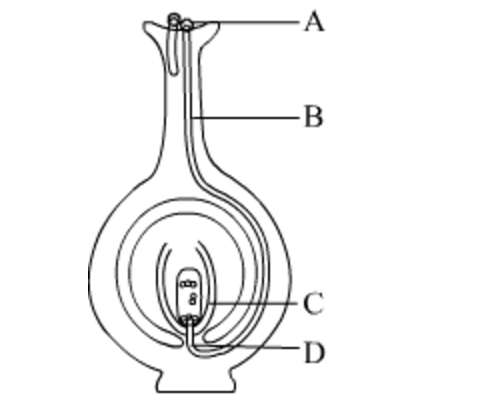
  1. Name the parts labelled as A, B, C and D in the diagram given below:
  1. What is pollination? State its significance.
  2. How does fertilisation occur in flowers? Name the parts of the flower that develop into (i) seed, and (ii) fruit after fertilisation.
No chemical reaction takes place when granules of a rusty-brown solid A are mixed with the powder of another solid B. However, when the mixture is heated, a reaction takes place between its components. One of the products C is a metal and settles down in the molten state while the other product D floats over it. It was observed that the reaction is highly exothermic.
  1. What could the solids A and B be?
  2. What are the products C and D most likely to be?
  3. Write the chemical equation for the reaction between A and B leading to the formation of C.and D. Mention the physical sates of all the reactants and products in this equation and indicate the heat change which takes place.
  4. What is the special name of such a reaction? State one use of such a reaction.
  5. Name any two types of chemical reactions under which the above reaction can beclassified.
How will you conclude that the same potential difference (voltage) exists across three resistors connected in a parallel arrangement to a battery?
A metal X forms a salt $XSO _4$. The salt $XSO _4$ forms a clear solution in water which reacts with sodium hydroxide solution to form a blue precipitate Y . Metal X is used in making electric wire and alloys like brass.
a. What do you think metal $X$ could be?
b. Write the name, formula and colour of salt $XSO _4$.
c. What is the blue precipitate Y ?
d. Write a chemical equation of the reaction which takes place when salt $XSO _4$ reacts with sodium hydroxide solution. Give the state symbols of all the reactants and products which occur in the above equation.
An object is placed (a) 20cm, (b) 4cm, in front of a concave mirror of focal length 12cm. Find the nature and position of the image formed in each case.
  1. Name the following:
  1. Metal that can be cut by knife.
  2. Lustrous non-metal.
  3. Metal that exists in liquid state at room temperature.
  4. Most malleable and ductile metal.
  5. Metal that is best conductor of electricity.
  6. Non-metal that can exist in different forms.
  1. How are alloys better than metals? Give composition of solder and amalgam.