Questions

[3 Mark Questions]

🎯

Test yourself on this topic

45 questions · timed · auto-graded

Question 13 Marks
A diverging mirror of radius of curvature 40cm forms an image which is half the height of the object. Find the object and image positions.
Answer
R = 40cm $\text{f}=\frac{\text{R}}{2}=\frac{40}{2}=20\text{cm}$ Image is half the height of the object. $\text{i.e.}\ \text{m}=-\frac{\text{v}}{\text{u}}=\frac{\text{h}_2}{\text{h}_1}$ $\Rightarrow \text{u}=-2\text{v}$ know, $\frac{1}{\text{v}}+\frac{1}{\text{u}}=\frac{1}{\text{f}}$ $\Rightarrow\frac{1}{\text{v}}+\frac{1}{(-2\text{v})}=\frac{1}{20}$ $\Rightarrow\frac{1}{\text{v}}-\frac{1}{2\text{v}}=\frac{1}{20}$$\Rightarrow\frac{1}{2\text{v}}=\frac{1}{20}$
$\therefore \text{v}=10\text{cm}$ $\text{u}=-2\text{v}=-2\times10=-20\text{cm}$So, the object is palced 20cm in front of the mirror and the image is formed 10cm the mirror.
View full question & answer
Question 23 Marks
The radius of curvature of a convex mirror used as a rear view mirror in a moving car is 2.0m. A truck is coming from behind it at a distance of 3.5m. Calculate (a) position, and (b) size, of the image relative to the size of the truck. What will be the nature of the image?
Answer
R = 2m,
$\text{f}=\frac{\text{R}}{2}=1\text{m}$
u = -3.5m
We konw that
  1. $\frac{1}{\text{v}}+\frac{1}{\text{u}}=\frac{1}{\text{f}}$
$\Rightarrow\frac{1}{\text{v}}+\frac{1}{(-3.5)}=\frac{1}{1}$

$\Rightarrow\frac{1}{\text{v}}=1+\frac{1}{3.5}=1+\frac{10}{30}=1+\frac{2}{7}=\frac{9}{7}$

$\therefore \text{v}=\frac{7}{9}=0.77\text{m}$

$\text{u}=-2\text{v}=-2\times10=-20\text{cm}$

So, the image is fomed 0.77m in behind the mirror.
  1. Now, $\text{m}=\frac{\text{v}}{\text{u}}=\frac{0.77}{(-3.5)}=\frac{\frac{7}{9}}{3.5}=\frac{1}{4.5}$
AS m is positive, so image formed is virtual and efect.
View full question & answer
Question 33 Marks
Which of the following are concave mirrors and which convex mirrors?
Shaving mirrors, Car headlight mirror, Searchlight mirror, Driving mirror, Dentist’s inspection mirror, Torch mirror, Staircase mirror in a double-decker bus, Make-up mirror, Solar furnace mirror, Satellite TV dish, Shop security mirror.
Answer
Shaving mirror: Concave mirror.
Car headlight mirror: Concave mirror.
Searchlight mirror: Concave mirror.
Driving mirror: Convex mirror.
Dentist’s inspection mirror: Concave mirror.
Torch mirror: Concave mirror.
Staircase mirror in a double-decker bus: Convex mirror.
Make-up mirror: Concave mirror.
Solar furnace mirror: Concave mirror.
Satellite TV dish: Concave mirror.
Shop security mirror: Convex mirror.
View full question & answer
Question 43 Marks
What is a spherical mirror? Distinguish between a concave mirror and a convex mirror.
Answer
A spherical mirror is that mirror whose reflecting surface is the part of a hollow sphere of glass. The spherical mirrors are of two types:
  • Concave mirrors and convex mirrors.
  • Difference between concave mirror and convex mirror.
A concave mirror is that spherical mirror in which the reflection of light takes place at concave surface (or bent-in surface), whereas a convex mirror is that spherical miror in which the reflection of light takes place at the convex surface (or bulging out surface). Concave mirror converges the parallel rays of light that fall on it, whereas convex mirror diverges the parallel rays of light that fall on it.
View full question & answer
Question 53 Marks
A man holds a spherical shaving mirror of radius of curvature 60cm, and focal length 30cm, at a distance of 15cm, from his nose. Find the position of image, and calculate the magnification.
Answer
Radius of curvature, R = -60cm (concave mirror)
f = -30cm, u = -15cm
We have
$\frac{1}{\text{v}}+\frac{1}{\text{u}}=\frac{1}{\text{f}}$
$\frac{1}{\text{v}}=\frac{1}{15}+\frac{1}{-30}$
$\frac{1}{\text{v}}=\frac{1}{30}$
$\text{v}=30\text{cm}$
$\text{m}=-\frac{\text{v}}{\text{u}}$
$\text{m}=-\frac{30}{-15}$
$\text{m}=2$
So, the iamge is formed 30cm behinf the mirrior and the magnification is +2.
View full question & answer
Question 63 Marks
When an object is placed at a distance of 50cm from a concave spherical mirror, the magnification produced is,$-\frac{1}{2}$ Where should the object be placed to get a magnification of, $-\frac{1}{5}?$
Answer
Case 1: $\text{u}= -50\text{cm},$$\text{m}=-\frac{1}{2}$
$\text{m}=-\frac{\text{v}}{\text{u}}$ $-\frac{1}{2}=\frac{\text{v}}{-50}$ $\text{v}=-25\text{cm}$ We know $\frac{1}{\text{v}}+\frac{1}{\text{u}}=\frac{1}{\text{f}}$ $\Rightarrow\frac{1}{-25}+\frac{1}{-50}=\frac{1}{\text{f}}$ $\Rightarrow\frac{-3}{-50}=-\frac{1}{\text{f}}$ $\Rightarrow\text{f}=\frac{-50}{3}\text{cm}$Case 2:
$\text{m}=\frac{1}{2}$
$\text{f}=\frac{-50}{3}$ $\text{m}=-\frac{1}{5}=-\frac{\text{v}}{\text{u}}$ $\text{v}=-\frac{\text{u}}{5}$ Now, $\frac{1}{\text{v}}+\frac{1}{\text{u}}=\frac{1}{\text{f}}$ $\frac{5}{\text{u}}+\frac{1}{\text{u}}=\frac{-3}{50}$ $\frac{6}{\text{u}}=-\frac{-3}{50}$ $\text{u}=\frac{600}{-3}=-100\text{cm}$
View full question & answer
Question 73 Marks
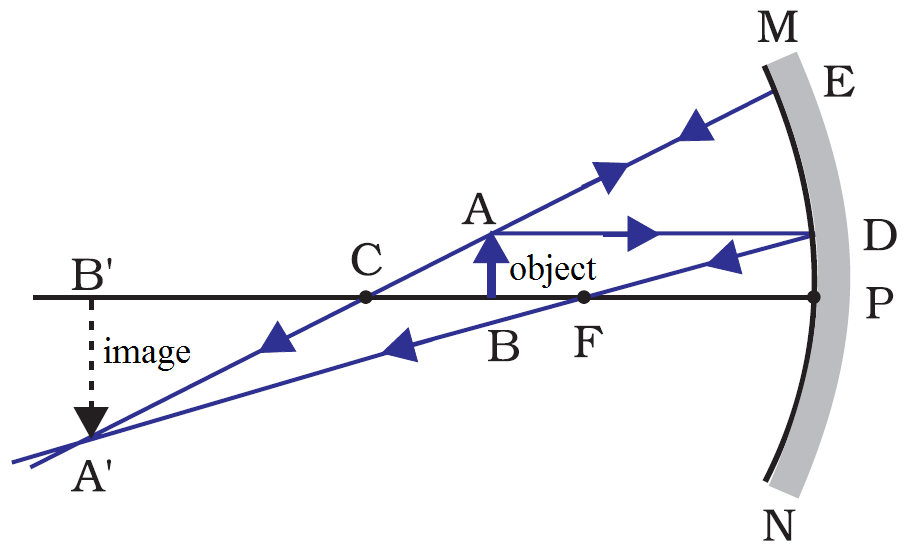
Draw ray-diagrams to show the formation of images when the object is placed in front of a concave mirror (converging mirror):
  1. Between its pole and focus.
  2. Between its centre of curvature and focus Describe the nature, size and position of the image formed in each case.
Answer
  1. When the object is palced between the pole and focus of a concave mirror a mangnified image is formed.
  1. When the object is palced between the focus and the centre of the curvature of a concave mirror a mangnified image is formed.
​​​​​​​​​​​​​​
View full question & answer
Question 83 Marks
A man sits in an optician's chair looking into plane mirror which is 2m away from him and views the image of a chart which faces the mirror and is 50cm behind his head. How far away from his eyes does the chart appear to be?
Answer
Distance between the man and the mirror = 2cm.
Distance between man and chart = 50cm. = 0.5m.
Distance between chart and mirror = 0.5m. + 2m. = 2.5m.
Distance between mirror and the image of the chart = 2.5m.
Distance between man and the image of chart = Distance between man and the mirror +
Distance between mirror and the image of the chart = 2m. + 2.5m. = 4.5m.
View full question & answer
Question 93 Marks
Describe the New Cartesian Sign Convention used in optics. Draw a labelled diagram to illustrate this sign convention.
Answer
According to the New Cartesian Sign Convention:
  1. All the distances are measured from pole of the mirror as origin.
  2. Distances measured in the same direction as that of incident light are taken as positive.
  3. Distances measured against the direction of incident light are taken as negative.
  4. Distances measured upward and perpendicular to the principal axis are taken as positive.
  5. Distance measured downward and perpendicular to the principal axis are taken as negative.
View full question & answer
Question 103 Marks
Give two uses of concave mirrors. Explain why you would choose concave mirrors for these uses.
Answer
Uses of concave mirror.
  1. Concave mirrors are used as shaving mirrors. This is because when the face is placed close to a concave mirror (so that the face is within its focus) the concave mirror produces a magnified and erect image of the face. Since a large image of the face is seen in the concave mirror, it becomes easier to make a smooth shave.
  2. Concave mirrors are used by dentists to see the large images of the teeth of patients. This is because when a tooth is within the focus of a concave mirror, then an enlarged image of the tooth is seen in the mirror. Due to this, it becomes easier to locate the defect in the tooth.
View full question & answer
Question 113 Marks
A concave mirror produces three times enlarged virtual image of an object placed at 10cm in front of it. Calculate the radius of curvature of the mirror.
Answer
m = 3 (virtual image)
u = -10cm
R = ?
We know that
$\text{m}=-\frac{\text{v}}{\text{u}}$
$3=-\frac{\text{-v}}{(-10)}$
$\text{v}=30\text{cm}$
and
$\frac{1}{\text{v}}+\frac{1}{\text{u}}=\frac{1}{\text{f}}$
$\frac{1}{30}+\frac{1}{(-10)}=\frac{1}{\text{f}}$
$\frac{-20}{300}=\frac{1}{\text{f}}$
$\frac{1}{\text{f}}=-15\text{cm}$
Radius of ourvature=R=2f
$=2\times(-15)=-30\text{cm}$
View full question & answer
Question 123 Marks
What can you see in a completely dark room? If you switch on an electric bulb in this dark room as a light source, explain how you could now see:
  1. The electric bulb.
  2. A piece of white paper.
Answer
When we see in a completely dark room, we are not able to see anything because there is no light in the dark room.
  1. We can see bulb due to the light emitted by the bulb.
  2. We can see a piece of white paper because it reflects the light from the bulb falling on it.
View full question & answer
Question 133 Marks
An arrow 2.5cm high is placed at a distance of 25cm from a diverging mirror of focal length 20cm. Find the nature, position and size of the image formed.
Answer
h1 = 2.5cm, u = -25cm, f = 20cm
We know that
$\frac{1}{\text{v}}+\frac{1}{\text{u}}=\frac{1}{\text{f}}$
$\Rightarrow\frac{1}{\text{v}}+\frac{1}{-25}=\frac{1}{20}$
$\therefore\text{v}=\frac{9}{100}\text{cm}=11.1\text{cm}$
The image is formed 11.1cm behind the convex mirror.
Now,
$\text{m}=\frac{\text{v}}{\text{u}}=\frac{\text{h}_2}{\text{h}_1}$
$\Rightarrow -\frac{11.1}{(-25)}=\frac{\text{h}_2}{2.5}$
${\text{h}_2}=\frac{11.1\times2.5}{25}=1.11\text{cm}$
The image is virtual, erect and 1.11cm tall.
View full question & answer
Question 143 Marks
What is the difference between regular reflection of light and diffuse reflection of light? What type of reflection of light takes place from:
  1. A cinema screen.
  2. A plane mirror.
  3. A cardboard.
  4. Still water surface of a lake
Answer
In regular reflection, a parallel beam of incident light is reflected as a parallel beam in one direction; while in diffuse reflection, a parallel beam of incident light is reflected in different directions.
  1. Regular reflection.
  2. Regular reflection.
  3. Diffuse reflection.
  4. Regular reflection.
View full question & answer
Question 153 Marks
What would your image look like if you stood dose to a large:
  1. Convex mirror?
  2. Concave mirror?
Give reasons for your answer.
Answer
  1. Our image will be diminished, virtual and erect. This is because when the object lies anywhere between the pole and inifinity, the concave mirror forms a diminished, virtual and erect image.
  2. Our image will be enlarged, virtual and erect. This is because when the object lies within the focus of a concave mirror, it forms an enlarged, virtual and erect image.
View full question & answer
Question 163 Marks
Giving reasons, state the ‘signs’ (positive or negative) which can be given to the following:
  1. Object distance (u) for a concave mirror or convex mirror.
  2. Image distances (v) for a concave mirror.
  3. Image distances (v) for a convex mirror.
Answer
  1. Object distance (u) for a concave mirror or convex mirror is always negative because an object is always placed to the left side of the mirror and the distances towards the left of the mirror are always negative.
  2. In case of a concave mirror, if the image is formed on the left side of the mirror, then the image distance (v) will be negative and if the image is formed on the right side of the mirror, then the image distance (v) will be positive. This is because distances measured to the left of the mirror are negative and to the right of the mirror is positive.
  3. Image distances (v) for a convex mirror is always positive because the image is always formed behind the mirror.
View full question & answer
Question 173 Marks
A mirror forms an image which is 30cm from an object and twice its height.
  1. Where must the mirror be situated?
  2. What is the radius of curvature?
  3. Is the mirror convex or concave?
Answer
Let the image formed is virtual and erect.v - u = 30cm
m = 2
  1. $\text{m}=-\frac{\text{v}}{\text{u}}$
$2=-\frac{\text{v}}{\text{u}}$
$\Rightarrow{\text{v}}=2{\text{u}}$
$2\text{u}-\text{u}=30\text{cm}$
$\text{u}=-10\text{cm}$
  1. $\text{v}=-2\text{u}=20\text{cm}$
$\frac{1}{\text{v}}+\frac{1}{\text{u}}=\frac{1}{\text{f}}$
$\frac{1}{\text{f}}=\frac{-1}{20}$
$\text{f}=-20\text{cm}$
$\text{R}=2\text{f}=-40\text{cm}$
  1. Concave mirror.
View full question & answer
Question 183 Marks
An object 3cm high is placed at a distance of 10cm in front of a converging mirror of focal length 20cm. Find the position, nature and size of the image formed.
Answer
Given: $h _1=3 cm, u =-10 cm, f =-20 cm$
We know that $\frac{1}{\text{v}}+\frac{1}{\text{u}}=\frac{1}{\text{f}}$ $\frac{1}{\text{v}}=\frac{1}{\text{f}}-\frac{1}{\text{u}}=\frac{1}{(-20)}-\frac{1}{(-10)}$ $\frac{1}{20}+\frac{1}{10}=\frac{-1+2}{20}=\frac{1}{20}$$\therefore\text{v}=20\text{cm}$
The image is formed at a distance of 20cm behind the mirror. $\text{m}=-\frac{\text{v}}{\text{u}}=\frac{\text{h}_2}{\text{h}_1}$ $\Rightarrow-\frac{(20)}{(-10)}=\frac{\text{h}_2}{3}$ $\Rightarrow\text{h}_2=6\text{cm}$ Image is 6cm in size, virtual and erect.
View full question & answer
Question 193 Marks
At what distance from a concave mirror of focal length 10cm should an object 2cm long be placed in order to get an erect image 6cm tall?
Answer
$f=-10 cm, h_1=2 cm, h_2=6 cm$ (erect image) u = ? We know that: $\text{m}=\frac{\text{h}_2}{\text{h}_1}=\frac{6}{2}=3$and
$\text{m}=-\frac{\text{v}}{\text{u}}=3$ $\Rightarrow3\text{u}=-\text{v}$ $\Rightarrow\text{v}=-3\text{u}\ ....\text{(A)}$ We have, $\frac{1}{\text{v}}+\frac{1}{\text{u}}=\frac{1}{\text{f}}$ $\frac{1}{(-3\text{u})}+\frac{1}{\text{u}}=\frac{1}{10}$ $\Rightarrow\frac{1}{\text{u}}-\frac{1}{\text{3u}}=-\frac{1}{10}$ $\Rightarrow\frac{2}{\text{3u}}=-\frac{1}{10}$ $\Rightarrow\text{u}=-\frac{20}{3}= 6.66\text{cm}$ The object should be palced at a distance of 6.66cm on the left side of the mirror.
View full question & answer
Question 203 Marks
A concave mirror has a focal length of 4cm and an object 2cm tall is placed 9cm away from it. Find the nature, position and size of the image formed.
Answer
Given: $h _1=2 cm, u =-9 cm, f =-4 cm$We know that $\frac{1}{\text{v}}+\frac{1}{\text{u}}=\frac{1}{\text{f}}$ $\frac{1}{\text{v}}=\frac{1}{\text{f}}-\frac{1}{\text{u}}=\frac{1}{(-4)}-\frac{1}{(-9)}$ $\frac{1}{4}+\frac{1}{9}=\frac{-9+4}{36}=\frac{5}{36}$$\text{v}=-7.2\text{cm}$
The image is formed at a distance of 7.2cm in front of the mirror. Again $\text{m}=-\frac{\text{v}}{\text{u}}=-\frac{(-7.2)}{-9}=-0.8$ $\Rightarrow\text{m}=\frac{\text{h}_2}{\text{h}_1}=-0.8$ $\Rightarrow\frac{\text{h}_2}{2}=\text{h}_2=-1.6\text{cm}$$$$$So, Image is 1.6cm in size, real and inverted.
View full question & answer
Question 213 Marks
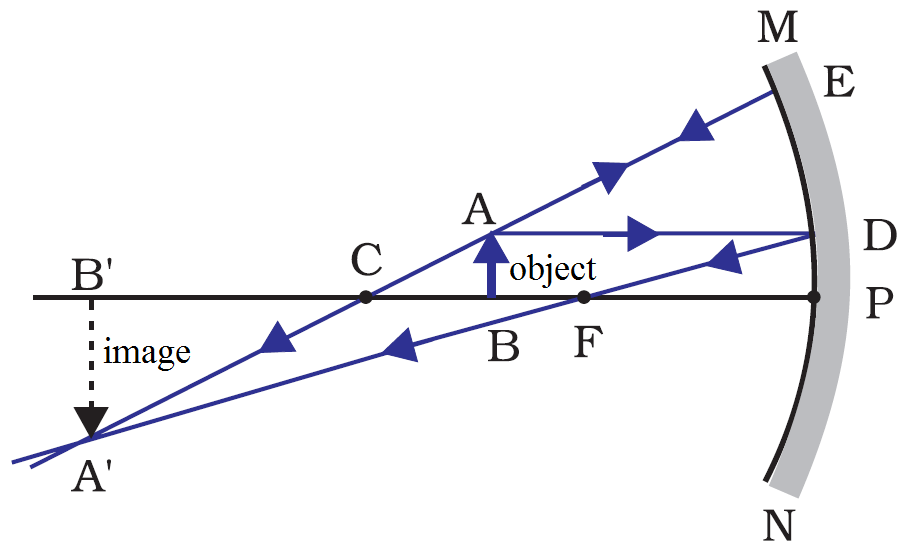
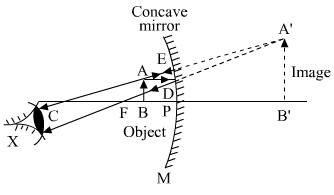
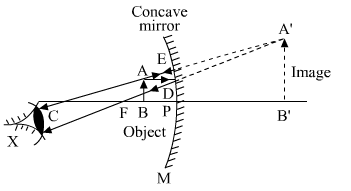
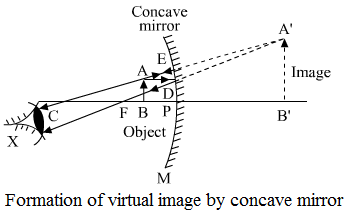
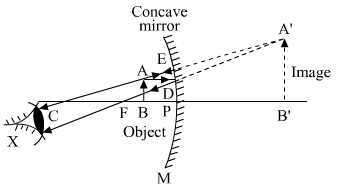
What is the minimum number of rays required for locating the image formed by a concave mirror for an object? Draw a ray diagram to show the formation of a virtual image by a concave mirror.
Answer
Minimum two rays are required for locating the image formed by a concave mirror for an object.
Ray diagram for the formation of a virtual image by a concave mirror:
View full question & answer
Question 223 Marks
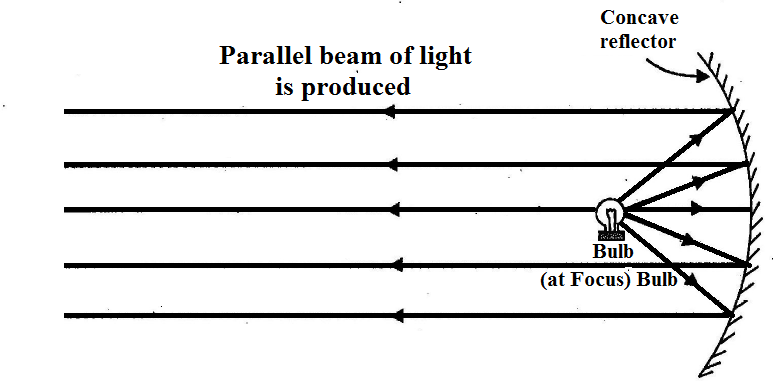
Which mirror is used as a torch reflector? Draw a labelled diagram to show how a torch reflector can be used to produce a parallel beam of light. Where is the bulb placed in relation to the torch reflector?
Answer
Concave mirror is used for a torch reflector.
Bulb is placed at the focus of the torch reflector.
View full question & answer
Question 233 Marks
Between which two points of concave mirror should an object be placed to obtain a magnification of:
  1. −3
  2. +25
  3. −0.4
Answer
  1. Between focus and centre of curvature.
  2. Between pole and focus.
  3. Beyond the centre of curvature
View full question & answer
Question 243 Marks
A shop security mirror 5.0m from certain items displayed in the shop produces one-tenth magnification.
  1. What is the type of mirror?
  2. What is the radius of curvature of the mirror?
Answer
  1. It is a convex mirror, as it has a wide area of view.
  2. Given,
Distance of the object (u) = -5 m

Magnification (m) = $\frac{1}{10}$

We have to find the position of the image (v), radius of curvature (R) and the focal length of the mirror (f).

Using the magnification formula, we get

$\text{m}=\frac{\text{-v}}{\text{u}}$

$\text{m}=\frac{\text{-v}}{-5}$

$\frac{1}{10}=\frac{\text{-v}}{-5}$

$\frac{1}{10}=\frac{\text{v}}{5}$

$\text{v}=0.5\text{m}$

Now, using the mirror formula, we get

$\frac{1}{\text{f}}=\frac{1}{\text{u}}+\frac{1}{\text{v}}$

$\frac{1}{\text{f}}=\frac{1}{-5}+\frac{1}{0.5}$

$\frac{1}{\text{f}}=\frac{1}{-5}+\frac{10}{5}$

$\frac{1}{\text{f}}=-\frac{1}{5}+\frac{10}{5}$

$\frac{1}{\text{f}}=-\frac{9}{5}$

$\text{f}=\frac{5}{9}$

$\text{R}=2\text{f}$

or $\text{R}=1.1$

Therefore, the radius of curvature of the mirror (R) is 1.1m.
View full question & answer
Question 253 Marks
A converging mirror forms a real image of height 4cm of an object of height 1cm placed 20cm away from the mirror:
  1. Calculate the image distance.
  2. What is the focal length of the mirror?
Answer
$h_2$= -4cm (real image)
$h_1$= 1cm
u = -20cm
  1. v = ?
$\text{m}=\frac{\text{h}_2}{\text{h}_1}=-\frac{\text{v}}{\text{u}}$

$\Rightarrow\frac{-4}{1}=-\frac{\text{v}}{-20}$

$\Rightarrow\text{v}=-80\text{cm}$

Image forms in front of the concave mirror.
  1. f = ?
$\frac{1}{\text{v}}+\frac{1}{\text{u}}=\frac{1}{\text{f}}$

$\frac{1}{-80}+\frac{1}{-20}=\frac{1}{\text{f}}$

$\frac{1}{\text{f}}=-\frac{1}{80}-\frac{1}{20}=\frac{1-4}{80}=-\frac{5}{80}$

$\therefore\text{f}=-16\text{cm}$
View full question & answer
Question 263 Marks
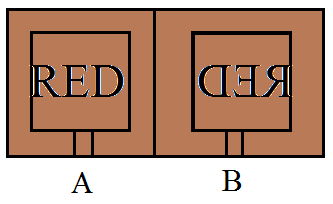
What is lateral inversion? Explain by giving a suitable example.
Answer
When an object is placed in front of a plane mirror, then the right side of the object appears to become the left side of the image; and the left side of the object appears to become right side of the image. This change of the sides of an object and its mirror image is called lateral inversion.
Example: When we hold a placard having the word RED written on it, as given in fig A, in the front of a plane mirror, the image of the word RED will be as given in fig B.
View full question & answer
Question 273 Marks
An object is 24cm away from a concave mirror and its image is 16cm from the mirror. Find the focal length and radius of curvature of the mirror, and the magnification of the image.
Answer
u = -24cm
v = -16cm
f = ?, m = ?
We know that
$\frac{1}{\text{v}}+\frac{1}{\text{u}}=\frac{1}{\text{f}}$
$\frac{1}{-16}+\frac{1}{-24}=\frac{1}{\text{f}}$
$\frac{-5}{48}=\frac{1}{\text{f}}$
$\text{R}=2\text{f}$
$=2\times-9.6=-19.2\text{cm}$
$\text{m}=-\frac{\text{v}}{\text{u}}$
$\text{m}=-\frac{-16}{-24}$
$\text{m}=-0.666$
View full question & answer
Question 283 Marks
State where an object must be placed so that the image formed by a concave mirror is:
  1. Erect and virtual.
  2. At infinity.
  3. The same size as the object.
Answer
  1. Between pole and focus of the mirror.
  2. At the focus of the mirror.
  3. At the centre of curvature of the mirror.
View full question & answer
Question 293 Marks
An object 20cm from a spherical mirror gives rise to a virtual image 15cm behind the mirror. Determine the magnification of the image and the type of mirror used.
Answer
Given,
The distance of the object 'u' = -20cm
Distance of the virtual image 'v' = 15cm
We have to find the magnification 'm'. Using the magnification formula, we get
We konw that
$\text{m}=-\frac{\text{v}}{\text{u}}=-\frac{15}{(-20)}=0.75$
Thus, the image is virtual, erect and smaller in size.
The mirror used here is convex, as it forms a smaller virtual image.
View full question & answer
Question 303 Marks
If an object of 10cm height is placed at a distance of 36cm from a concave mirror of focal length 12cm, find the position, nature and height of the image.
Answer
$h_1=10 cm, u=-36 cm, f =-12 cmWe$ know that
$\frac{1}{\text{v}}+\frac{1}{\text{u}}=\frac{1}{\text{f}}$
$\Rightarrow\frac{1}{\text{v}}+\frac{1}{(-36)}=\frac{1}{(-12)}$
$\Rightarrow\frac{1}{\text{v}}=\frac{1}{36}-\frac{1}{12}=\frac{1-3}{36}=-\frac{2}{36}=-\frac{1}{18}$
$\text{v}=-18\text{cm}$
$\therefore$ The position of the image is 18cm in front of the mirror.
Magnification, $\text{m}=\frac{\text{h}_2}{\text{h}_1}=-\frac{\text{v}}{\text{u}}$
$\Rightarrow\frac{\text{h}_2}{10}=-\frac{(-18)}{(-36)}$
$\Rightarrow\text{h}_2=-5\text{cm}$
The image formed is real and inverted.
View full question & answer
Question 313 Marks
A concave mirror produces a real image 1cm tall of an object 2.5mm tall placed 5cm from the mirror. Find the position of the image and the focal length of the mirror.
Answer
$h_2=1 cm=10 mm$ (real image), $h _1=2.5 mm, u =-5 cm=-50 mm$,
$\text{m}=-\frac{10}{2.5}$
$\text{m}=-4$
and we know that
$\text{m}=-\frac{\text{v}}{\text{u}}$
$-4=-\frac{\text{v}}{(-50)}$
$\text{v}=200\text{mm}$
$\text{v}=200\text{cm}$
The image is formed 20cm in front of the mirror.
And
$\frac{1}{\text{v}}+\frac{1}{\text{u}}=\frac{1}{\text{f}}$
$\frac{1}{-20}+\frac{1}{-5}=\frac{1}{\text{f}}$
$\frac{1}{\text{f}}=\frac{-25}{100}$
$\text{f }=-4\text{cm}$
View full question & answer
Question 323 Marks
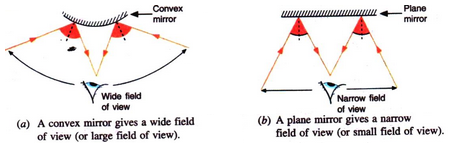
What is the advantage of using a convex mirror as a rear-view mirror in vehicles as compared to a plane mirror? Illustrate your answer with the help of labelled diagrams.
Answer
The advantage of using a converx mirror as a rear-view mirror in vechicles as compared to as compared to a plane mirror is that convex mirror has a wider field of viwe as compared to plane mirror. this enbles driver to view much larger area of the traffic behind him.
View full question & answer
Question 333 Marks
An object of 5.0cm size is placed at a distance of 20.0cm from a converging mirror of focal length 15.0cm. At what distance from the mirror should a screen be placed to get the sharp image? Also calculate the size of the image.
Answer
$h_1=5.0 cm, u=-20 cm, f =15 cm, v =?, h_2=?$
We know that
$\frac{1}{\text{v}}+\frac{1}{\text{u}}=\frac{1}{\text{f}}$
$\frac{1}{\text{v}}+\frac{1}{(-20)}=\frac{1}{(-15)}$
$\frac{1}{\text{v}}=\frac{1}{20}-\frac{1}{15}$
$\frac{1}{\text{v}}=\frac{-5}{300}$
$\text{v}=-60\text{cm}$
The screen should be palced 60cm in front of the mirror.
And
$\text{m}=\frac{\text{h}_2}{\text{h}_1}=-\frac{\text{v}}{\text{u}}$
$\frac{\text{h}_2}{\text{h}_1}=\frac{(-60)}{(-20)}$
$\text{h}_2=-15\text{cm}$
Height of image = 15cm.
View full question & answer
Question 343 Marks
Give two circumstances in which a concave mirror can form a magnified image of an object placed in
front of it. Illustrate your answer by drawing labelled ray diagrams for both.
Answer
  1. When the object is placed between the pole and focus of a concave mirror a magnified image is formed.


Flg.formation of image by concave mirror whrn the object is palced between its pole and focus.
  1. When the object is palced between the focus and the centre of curvature of a concave mirror a mangnified image is formed.
View full question & answer
Question 353 Marks
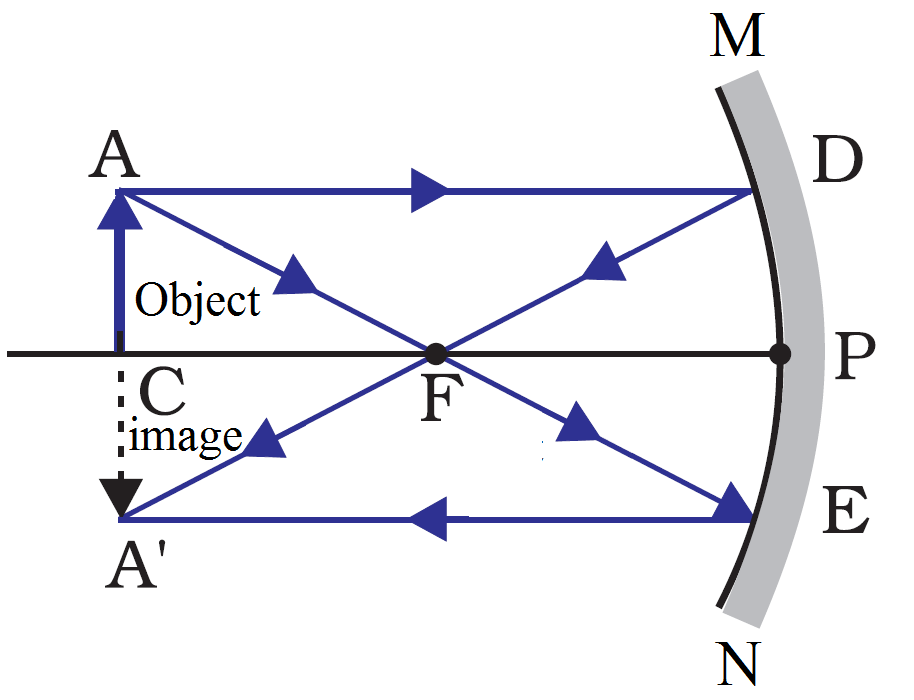
Make labelled ray diagrams to illustrate the formation of:
  1. A real image by a converging mirror.
  2. A virtual image by a converging mirror.
Mark clearly the pole, focus, centre of curvature and position of object in each case.
Answer
  1.  
View full question & answer
Question 363 Marks
An object is kept at a distance of 5cm in front of a convex mirror of focal length 10cm. Calculate the position and magnification of the image and state its nature.
Answer
u = -5cm, f = 10cm
We know that
$\frac{1}{\text{v}}+\frac{1}{\text{u}}=\frac{1}{\text{f}}$
$\frac{1}{\text{v}}+\frac{1}{-5}=\frac{1}{10}$
$\frac{1}{\text{v}}=\frac{1}{10}+\frac{1}{5}=\frac{3}{10}$
$\therefore \text{v}=\frac{10}{3}\text{cm}=3.33\text{cm}$
The position of the image is 3.33cm behind the convex mirror.
Magnification, $\text{m}=-\frac{\text{v}}{\text{u}}\frac{-3.33}{5}=0.66$
The image is virtual and erect.
View full question & answer
Question 373 Marks
An object of size 7.0cm is placed at 27cm in front of a concave mirror of focal length 18cm. At what distance from the mirror should a screen be placed so that a sharp focussed image can be obtained? Find the size and nature of image.
[Hint. Find the value of image distance (v) first. The screen should be placed from the mirror at a distance equal to image distance.]
Answer
Given: $h _1=7 cm, u =-27 cm, f =18 cm$ We know that $\frac{1}{\text{v}}+\frac{1}{\text{u}}=\frac{1}{\text{f}}$ $\frac{1}{\text{v}}=\frac{1}{\text{f}}-\frac{1}{\text{u}}=\frac{1}{(-18)}-\frac{1}{(-27)}$ $\frac{1}{18}+\frac{1}{27}=\frac{-3+2}{54}=\frac{1}{54}$$\therefore\text{v}=-54\text{cm}$
The screen shoud be palce at a distance of 54cm in front of the concave mirror. $\text{m}=-\frac{\text{v}}{\text{u}}=\frac{\text{h}_2}{\text{h}_1}$ $-\frac{(-54)}{(-27)}=\frac{\text{h}_2}{7}$ $\text{h}_2=-14\text{cm}$ Image is 14cm in size, real and inverted.
View full question & answer
Question 383 Marks
A man standing in front of a special mirror finds his image having a very small head, a fat body and legs of normal size. What is the shape of:
  1. Top part of the mirror?
  2. Middle part of the mirror?
  3. Bottom part of the mirror?
Give reasons for your choice.
Answer
A man standing extremely close in front of a special mirror finds his image having a very small head, a fat body but legs of similar size. Hence,
  1. The top part of the mirror is convex, as it forms virtual, erect and small-sized image.
  2. The middle of the mirror is concave, as it forms virtual, erect and large-sized image.
  3. The bottom of the mirror is a plane mirror, as it forms virtual, erect and image of the same size as the object.
View full question & answer
Question 393 Marks
The shiny outer surface of a hollow sphere of aluminium of radius 50cm is to be used as a mirror:
  1. What will be the focal length of this mirror?
  2. Which type of spherical mirror will it provide?
  3. State whether this spherical mirror will diverge or converge light rays.
Answer
  1. R = 50cm
f = ?

We know that

$\text{f}=\frac{\text{R}}{2}=\frac{50}{2}=25\text{cm}$
  1. Convex mirror
  2. It will diverge light rays.
View full question & answer
Question 403 Marks
A man stands 10m in front of a large plane mirror. How far must the walk before he is 5m away from his image?
Answer
Man should walk 7.5m towards the mirror.
The reason being, the image formed by a plane mirror is the same distance behind the mirror as it is between the object and the mirror. A distance of 5m between man and his image means that the distance between him and the mirror $=\frac{5}{2}\ = 2.5\text{m}$
Thus, the distance he should walk = 10 - 2.5 = 7.5m.
View full question & answer
Question 413 Marks
How far should an object be placed from the pole of a converging mirror of focal length 20cm to form a real image of the size exactly$\frac{1}{4}$ th the size of the object?
Answer
f = -20cm, $\text{m}=-\frac{1}{4}$ (real image)
$\text{m}=-\frac{\text{v}}{\text{u}}$
$-\frac{1}{4}=-\frac{\text{v}}{\text{u}}$
$\text{u}=4\text{v}$
so
$\frac{1}{\text{v}}+\frac{1}{\text{u}}=\frac{1}{\text{f}}$
$\frac{1}{\text{v}}+\frac{1}{\text{4v}}=\frac{1}{(-20)}$
$\frac{5}{\text{4v}}=-\frac{1}{20}$
$\frac{1}{\text{v}}=\frac{100}{4}=25\text{cm}$
$\therefore\text{u}=4\text{v}$
$\text{u}=4(-25)$
$=-100\text{cm}$
The object should be palced 100cm to the left of the mirror.
View full question & answer
Question 423 Marks
When an object is placed 20cm from a concave mirror, a real image magnified three times is formed. Find:
  1. The focal length of the mirror.
  2. Where must the object be placed to give a virtual image three times the height of the object?
Answer
Given:u = -20cm, m = -3cm, for the real image
  1. We know that
$\text{m}=-\frac{\text{m}}{\text{u}}$
$\therefore \text{m}=-3=-\frac{\text{v}}{(-20)}$
$\Rightarrow\text{v}= -60\text{cm}$
We have
$\frac{1}{\text{v}}+\frac{1}{\text{u}}=\frac{1}{\text{f}}$
$\Rightarrow \frac{1}{(-60)}+\frac{1}{(-20)}=\frac{1}{\text{f}}$
$\frac{1}{\text{f}}=-\frac{1}{60}-\frac{1}{20}=\frac{-1-3}{60}=\frac{1}{15}$
$\text{f}=-15\text{cm}$
  1. For virtual image m = 3 , and f = 15cm
$\text{m}=-\frac{\text{v}}{\text{u}}$
$\therefore \text{m}=-3=-\frac{\text{v}}{(-20)}\Rightarrow \text{v}=-3\text{u}$
We have
$\frac{1}{\text{v}}+\frac{1}{\text{u}}=\frac{1}{\text{f}}$
$\Rightarrow \frac{1}{\text{(3u)}}+\frac{1}{\text{u}}=\frac{1}{(-15)}$
$\Rightarrow \frac{-1+3}{\text{3u}}=-\frac{1}{15}$
$\Rightarrow \text{u}=-\frac{2\times15}{3}=-10\text{cm}$
So object should be placed 10cm from the concave mirror.
View full question & answer
Question 433 Marks
An object placed 20cm in front of a mirror is found to have an image 15cm.
  1. In front of it,
  2. Behind the mirror.
Find the focal length of the mirror and the kind of mirror in each case.
Answer
  1. u = -20cm,v = 15cm
We know that

$\frac{1}{\text{v}}+\frac{1}{\text{u}}=\frac{1}{\text{f}}$

$\Rightarrow\frac{1}{-15}+\frac{1}{-20}=\frac{1}{\text{f}}$

$\Rightarrow=\frac{1}{\text{f}}=\frac{1}{15}-\frac{1}{20}=\frac{-4-3}{60}=-\frac{7}{60}$

$\therefore\text{f}=-\frac{60}{7}\text{cm}$

The mirror is a concave mirror.
  1. u = -20cm,v = 15cm
We know that

$\frac{1}{\text{v}}+\frac{1}{\text{u}}=\frac{1}{\text{f}}$

$\Rightarrow\frac{1}{15}+\frac{1}{-20}=\frac{1}{\text{f}}$

$\Rightarrow=\frac{1}{\text{f}}=\frac{1}{15}-\frac{1}{20}=\frac{4-3}{60}=-\frac{1}{60}$

$\therefore\text{f}=-{60}\text{cm}$

The mirror is a convex mirror.
View full question & answer
Question 443 Marks
A bright object 50mm high stands on the axis of a concave mirror of focal length 100mm and at a distance of 300mm from the concave mirror. How big will the image be?
Answer
$h _1=50 mm, f =-100 mm, u =-300 mm, h _1=?$
We have.
$\frac{1}{\text{v}}+\frac{1}{\text{u}}=\frac{1}{\text{f}}$
$\frac{1}{\text{v}}+\frac{1}{(-300)}=\frac{1}{(-100)}$
$\frac{1}{\text{v}}=\frac{1}{300}-\frac{1}{100}$
$\frac{1}{\text{v}}=\frac{-200}{3000}$
$\frac{1}{\text{v}}=-150\text{cm}$
$\text{v}=-150\text{cm}$
$-\frac{-150}{-300}=\frac{\text{h}_2}{50}$
The image will be 25mm high.
View full question & answer
Question 453 Marks
A dentist’s mirror has a radius of curvature of 3cm. How far must it be placed from a small dental cavity to give a virtual image of the cavity that is magnified five times?
Answer
R = -3cm (concave mirror) m = (virtual image) $\text{f}=\frac{\text{R}}{2}=\frac{3}{2}=1.5\text{cm}$and
$\text{m}=5=-\frac{\text{v}}{\text{u}}$ $\Rightarrow\text{v}=-5\text{u}$ We have $\frac{1}{\text{v}}+\frac{1}{\text{u}}=\frac{1}{\text{f}}$ $\Rightarrow \frac{1}{(5\text{u})}+\frac{1}{\text{u}}=\frac{1}{(-1.5)}$ $\Rightarrow \frac{4}{5\text{u}}=-\frac{1}{1.5}$ $\Rightarrow \text{u}=-\frac{4\times1.5}{5}=-1.2\text{cm}$The mirror should be placed 1.2cm away from the dental cavity.
View full question & answer
[3 Mark Questions] - Science STD 10 Questions - Vidyadip