Question types

Reflection of Light question types

460 questions across 14 question groups — pick any mix to generate a Science paper with step-by-step answer keys.

460
Questions
14
Question groups
5
Question types
Sample Questions

Reflection of Light questions

One sample from each question group in this chapter. Select any group above to see the full set with answer keys.

Q 1M.C.Q1 Mark
Whatever be the position of the object, the image formed by a mirror is virtual, erect and smaller than the object. The mirror then must be:
  • A
    Plane.
  • B
    Concave.
  • Convex.
  • D
    Either concave or convex.

Answer: C.

View full solution
Q 2M.C.Q1 Mark
The figure given alongside shows the image of a clock as seen a plane mirror. The correct time is:
Figure.
  • A
    2.25
  • B
    2.35
  • C
    6.45
  • 9.25

Answer: D.

View full solution
Q 3M.C.Q1 Mark
If a magnification of, −1 (minus one) is to be obtained by using a converging mirror, then the object has to be placed:
  • A
    Between pole and focus.
  • At the centre of curvature.
  • C
    Beyond the centre of curvature.
  • D
    At infinity.

Answer: B.

View full solution
Q 4M.C.Q1 Mark
The image formed by a concave mirror is real, inverted and of the same size as the object. The position of the object must then be:
  • A
    At the focus.
  • B
    Between the centre of curvature and focus.
  • At the centre of curvature.
  • D
    Beyond the centre of curvature.

Answer: C.

View full solution
Q 5M.C.Q1 Mark
The image formed by a concave mirror is virtual, erect and magnified. The position of object is:
  • A
    At focus.
  • Between focus and centre of curvature.
  • C
    At pole.
  • D
    Between pole and focus

Answer: B.

View full solution
Fill in the following blank with a suitable word:
A ray of light which is parallel to the principal axis of a convex mirror, appears to be coming from ______ after reflection from the mirror.
View full solution
Q 12True-False1 Mark
State whether the following statement is true or false:
A student says that we can see an object because light from our eyes is reflected back by the object
View full solution
Draw a labelled ray diagram to show the formation of image in a convex mirror when the object is at infinity. Mark clearly the pole and focus of the mirror in the diagram.
View full solution
An object 1cm tall is placed 30cm in front of a convex mirror of focal length 20cm. Find the size and position of the image formed by the convex mirror.
View full solution
An object is placed just outside the principal focus of concave mirror. Draw a ray diagram to show how the image is formed, and describe its size, position and nature.
View full solution
Draw a diagram to represent a convex mirror. On this diagram mark principal axis, principal focus F and the centre of curvature C if the focal length of convex mirror is 3cm.
View full solution
The radius of curvature of a convex mirror used as a rear view mirror in a moving car is 2.0m. A truck is coming from behind it at a distance of 3.5m. Calculate (a) position, and (b) size, of the image relative to the size of the truck. What will be the nature of the image?
View full solution
Which of the following are concave mirrors and which convex mirrors?
Shaving mirrors, Car headlight mirror, Searchlight mirror, Driving mirror, Dentist’s inspection mirror, Torch mirror, Staircase mirror in a double-decker bus, Make-up mirror, Solar furnace mirror, Satellite TV dish, Shop security mirror.
View full solution
A man holds a spherical shaving mirror of radius of curvature 60cm, and focal length 30cm, at a distance of 15cm, from his nose. Find the position of image, and calculate the magnification.
View full solution
An object is placed 15cm from (a) a converging mirror, and (b) a diverging mirror, of radius of curvature 20cm. Calculate the image position and magnification in each case.
View full solution
If a concave mirror has a focal length of 10cm, find the two positions where an object can be placed to give, in each case, an image twice the height of the object.
View full solution
At what distance from a concave mirror of focal length 10cm should an object be placed so that:
  1. Its real image is formed 20cm from the mirror?
  2. Its virtual image is formed 20cm from the mirror?
View full solution
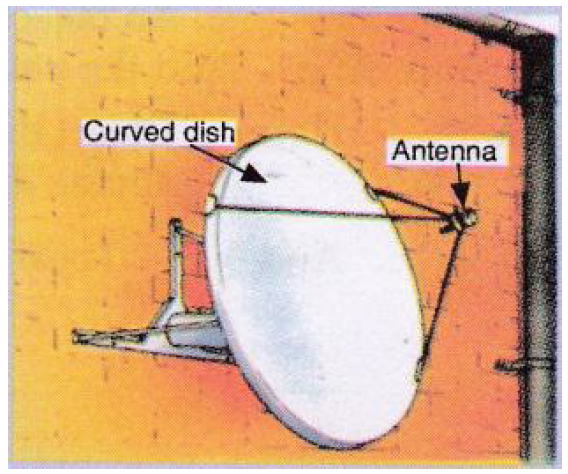
The diagram shows a dish antenna which is used to receive television signals from a satellite. The antenna (signal detector) is fixed in front of the curved dish.
  1. What is the purpose of the dish?
  2. Should it be concave or convex?
  3. Where should the antenna be positioned to receive the strongest possible signals?
  4. Explain what change you would expect in the signals if a larger dish was used.
View full solution
Q 33M.C.Q-[Phy-1M]1 Mark
Whatever be the position of the object, the image formed by a mirror is virtual, erect and smaller than the object. The mirror then must be:
  1. Plane.
  2. Concave.
  3. Convex.
  4. Either concave or convex.
View full solution
Q 34M.C.Q-[Phy-1M]1 Mark
Two big mirrors A and B are fitted side by side on a wall. A man is standing at such a distance from the wall that he can see the erect image of his face in both the mirrors. When the man starts walking towards the mirrors, he find that the size of his face in mirror A goes on increasing but that in mirror B remains the same.
  1. Mirror A is concave and mirror B is convex.
  2. Mirror A is plane and mirror B is concave.
  3. Mirror A is concave and mirror B is plane.
  4. Mirror A is convex and mirror B is concave.
View full solution
Q 35M.C.Q-[Phy-1M]1 Mark
The real image formed by a concave mirror is smaller than the object if the object is:
  1. Between centre of curvature and focus.
  2. At a distance greater than radius of curvature.
  3. At a distance equal to radius of curvature.
  4. At a distance equal to focal length.
View full solution
Q 36M.C.Q-[Phy-1M]1 Mark
The real image formed by a concave mirror is larger than the object when object is:
  1. At a distance equal to radius of curvature.
  2. At a distance less than the focal length.
  3. Between focus and centre of curvature.
  4. At a distance greater than radius of curvature.
View full solution
Q 37M.C.Q-[Phy-1M]1 Mark
The mirror which can form a magnified image of an object is:
  1. Convex mirror.
  2. Plane mirror.
  3. Concave mirror.
  4. Both convex and concave mirror.
View full solution
Fill in the following blank with a suitable word:
A ray of light which is parallel to the principal axis of a convex mirror, appears to be coming from ______ after reflection from the mirror.
View full solution
State whether the following statement is true or false:
A student says that we can see an object because light from our eyes is reflected back by the object
View full solution
Which of the following are concave mirrors and which convex mirrors?
Shaving mirrors, Car headlight mirror, Searchlight mirror, Driving mirror, Dentist’s inspection mirror, Torch mirror, Staircase mirror in a double-decker bus, Make-up mirror, Solar furnace mirror, Satellite TV dish, Shop security mirror.
View full solution
Which mirror is used as a torch reflector? Draw a labelled diagram to show how a torch reflector can be used to produce a parallel beam of light. Where is the bulb placed in relation to the torch reflector?
View full solution
When an object is placed at a distance of 50cm from a concave spherical mirror, the magnification produced is,$-\frac{1}{2}$ Where should the object be placed to get a magnification of, $-\frac{1}{5}?$ 
View full solution
When an object is placed 20cm from a concave mirror, a real image magnified three times is formed. Find:
  1. The focal length of the mirror.
  2. Where must the object be placed to give a virtual image three times the height of the object?
View full solution
With the help of a labelled ray-diagram, describe how a plane mirror forms an image of a point source of light placed in front of it. State the characteristics of the image formed in a plane mirror.
View full solution
When a spherical mirror is held towards the sun and its sharp image is formed on a piece of a carbon paper for some time, a hole is burnt in the carbon paper.
  1. What is the nature of spherical mirror?
  2. Why is a hole burnt in the carbon paper?
  3. At which point of the spherical mirror the carbon paper is placed?
  4. What name is given to the distance between spherical mirror and carbon paper?
  5. What is the advantage of using a carbon paper rather than a white paper?
View full solution
What is meant by ‘reflection of light’? Define the following terms used in the study of reflection of light by drawing a labelled ray-diagram :
  1. Incident ray.
  2. Point of incidence.
  3. Normal.
  4. Reflected ray.
  5. Angle of incidence.
  6. Angle of reflection.
View full solution

Generate a Reflection of Light paper free

Pick question groups from the list above, set marks and difficulty, and export a branded PDF with step-by-step answer keys. First 3 chapters free — no signup.

Download App