Questions

Answer the questions.[Phy-5M]

🎯

Test yourself on this topic

15 questions · timed · auto-graded

Question 15 Marks
Write all the capital letters of the alphabet which look the same in a plane mirror.
Answer
A, H, I, M, O.
View full question & answer
Question 25 Marks
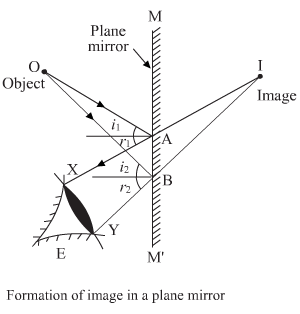
With the help of a labelled ray-diagram, describe how a plane mirror forms an image of a point source of light placed in front of it. State the characteristics of the image formed in a plane mirror.
Answer


Cosider a point source of light O placed in front of a plane mirror MM’. a ray of light OA coming from O in incident at point A on the mirror and gets reflected in the direction AX according to the laws of reflection of light. Another ray of light OB coming from O strikes the mirror ar point B and gets reflected in the direction BY. Rays AX and BY, on producing backwards, meet at point I behind the mirror; which is the image of point source O.

Characteristics of image formed in a plane mirror:
  1. The image formed in a plane mirror is virtual. It cannot be received on a screen.
  2. The image formed in a plane mirror is erect. It is the same side up as the object.
  3. The image in a plane mirror is of the same size as the object.
  4. The image formed by a plane mirror is at the same distance behind the mirror as the object is in front of the mirror.
  5. The image formed by a plane mirror is laterally inverted.
View full question & answer
Question 35 Marks
When a spherical mirror is held towards the sun and its sharp image is formed on a piece of a carbon paper for some time, a hole is burnt in the carbon paper.
  1. What is the nature of spherical mirror?
  2. Why is a hole burnt in the carbon paper?
  3. At which point of the spherical mirror the carbon paper is placed?
  4. What name is given to the distance between spherical mirror and carbon paper?
  5. What is the advantage of using a carbon paper rather than a white paper?
Answer
  1. The spherical mirror is concave.
  2. A concave mirror converges light rays, and in this case it will converge the incoming parallel rays of the sun at its focus. Since the carbon paper was kept at the focus of the concave mirror, the hole was burnt into it. 
  3. The carbon paper was kept at the focus of the spherical mirror.
  4. The distance between the mirror and the carbon paper is the focal length.
  5. A carbon paper is a good absorber of sunlight; hence, it burnt quickly.​
View full question & answer
Question 45 Marks
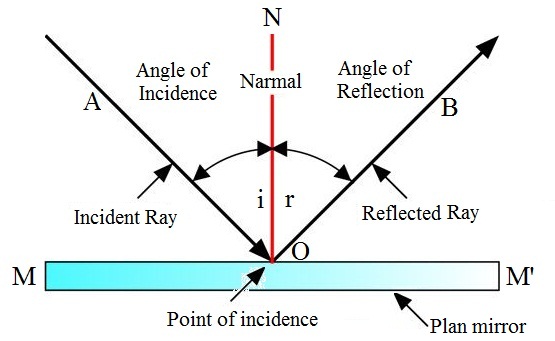
What is meant by ‘reflection of light’? Define the following terms used in the study of reflection of light by drawing a labelled ray-diagram :
  1. Incident ray.
  2. Point of incidence.
  3. Normal.
  4. Reflected ray.
  5. Angle of incidence.
  6. Angle of reflection.
Answer
The process of sending back the light rays which fall on the surface of an object is called reflection of light.

  1. Incident ray: The ray of light that falls on the mirror surface is called the incident ray.
  2. Point of incidence: The point at which the incident ray falls on the mirror is called the point of incidence.
  3. Normal: The normal is a line at right angle to the mirror surface at the point of incidence.
  4. Reflected ray: The ray of light which is sent back by the mirror is called the reflected rays.
  5. Angle of incidence: The angle of incidence is the angle made by the incident ray with the normal at the point of incidence.
  6. Angle of reflection: The angle of reflection is the angle made by the reflected ray with the normal at the point of incidence.
View full question & answer
Question 55 Marks
The image in a plane mirror is virtual and laterally inverted. What does this statement mean?
Answer
The image is virtual and laterally inverted means it cannot be obtained on a screen and is reversed sideways.
View full question & answer
Question 65 Marks
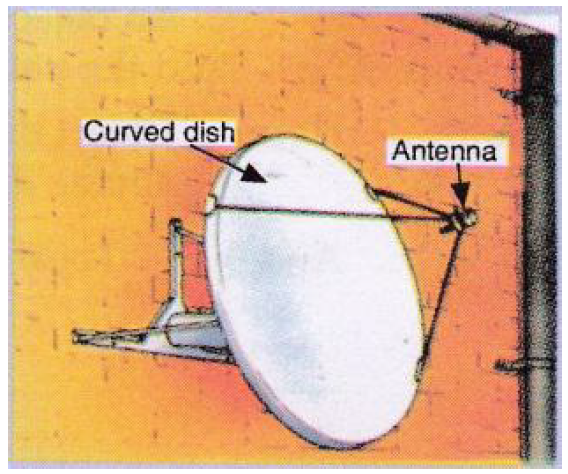
The diagram shows a dish antenna which is used to receive television signals from a satellite. The antenna (signal detector) is fixed in front of the curved dish.

  1. What is the purpose of the dish?
  2. Should it be concave or convex?
  3. Where should the antenna be positioned to receive the strongest possible signals?
  4. Explain what change you would expect in the signals if a larger dish was used.
Answer
  1. The dish is collecting the large amount of signal from the satellite, and converging them to the antenna.
  2. The dish should be concave.
  3. The antenna should be positioned at the focus of the concave dish to receive the strongest possible signals.
  4. If a larger dish was used, the aperture of the concave mirror would have been bigger; therefore, the signals received by the antenna would have been stronger.
View full question & answer
Question 75 Marks
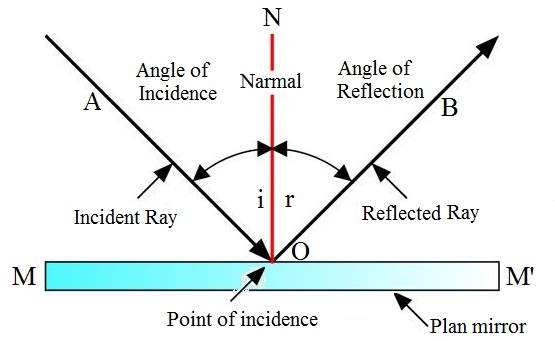
State and explain the laws of reflection of light at a plane surface (like a plane mirror), with the help of a labelled ray-diagram. Mark the angles of ‘incidence’ and ‘reflection’ clearly on the diagram. If the angle of reflection is 47.5°, what will be the angle of incidence?
Answer
Laws of reflection of light:

First law of reflection: According to the first law of reflection, the incidence ray, the reflected ray and the normal (at the point of incidence), all lie in the same plane.For e.g., in the figure, the incident ray AO, the reflected ray OB and the normal ON, all lie in the same plane, the plane of paper.
Second law of reflection: According to the second law of reflection, the angle of reflection is always equal to the angle of incidence. For e.g., if we measure the angle of reflection NOB in the figure, we will find that it is exactly equal to the angle of incidence AON. If the angle of reflection is 47.50, the angle of incidence will also be 47.50 in accordance with the second law of reflection.
View full question & answer
Question 85 Marks
If a concave mirror has a focal length of 10cm, find the two positions where an object can be placed to give, in each case, an image twice the height of the object.
Answer
$\text{f}=-10\text{cm}$
Case 1: m = 2 (Image is virtual and erect)
$\text{m}=-\frac{\text{v}}{\text{u}}$
$2=-\frac{\text{v}}{\text{u}}$
$\Rightarrow{\text{v}}=2{\text{u}}$
$\frac{1}{\text{v}}+\frac{1}{\text{u}}=\frac{1}{\text{f}}$
$\frac{1}{-2\text{u}}+\frac{1}{\text{u}}=\frac{1}{10}$
$\frac{1}{\text{2u}}=\frac{-1}{10}$
$\text{u}=-5\text{cm}$
Case 2:
$\text{m}=-\frac{\text{v}}{\text{u}}$
$2=-\frac{\text{v}}{\text{u}}$
$\Rightarrow{\text{v}}=2{\text{u}}$
$\frac{1}{\text{v}}+\frac{1}{\text{u}}=\frac{1}{\text{f}}$
$\frac{1}{2\text{u}}+\frac{1}{\text{u}}=\frac{1}{-10}$
$\frac{3}{\text{3u}}=\frac{-1}{10}$
$\text{u}=-15\text{cm}$
View full question & answer
Question 95 Marks
Explain why, though both a plane mirror and a sheet of paper reflect light but we can see the image of our face in a plane mirror but not in a sheet of paper.
Answer
We can see the image of our face in a plane mirror but not in a sheet of paper because images are formed by regular reflection of light and in case of a plane mirror, regular reflection takes place; while in case of a sheet of paper, diffuse reflection takes place.
View full question & answer
Question 105 Marks
At what distance from a concave mirror of focal length 10cm should an object be placed so that:
  1. Its real image is formed 20cm from the mirror?
  2. Its virtual image is formed 20cm from the mirror?
Answer
  1. Given,

It is a concave mirror.

F = −10cm

V = −20cm

the image is real and forms in front of the mirror, the equation will be

$\frac{1}{\text{f}}=\frac{1}{\text{v}}+\frac{1}{\text{u}}$

$\frac{1}{-10}=\frac{1}{-20}+\frac{1}{\text{u}}$

$\frac{1}{\text{u}}=\frac{1}{-10}+\frac{1}{20}$

$\frac{1}{\text{u}}=\frac{-20+10}{200}$

$\frac{1}{\text{u}}=\frac{-10}{200}$

$\frac{1}{\text{u}}=\frac{1}{-20}$

$\text{u}=-20\text{cm}$

Therefore, the object should be placed at a distance of 20cm from the mirror to form a real image

  1. Given,

F = −10cm

V = +20cm

Since the image is virtual and forms behind the mirror, the equation will be

$\frac{1}{\text{f}}=\frac{1}{\text{v}}+\frac{1}{\text{u}}$

$\frac{1}{-10}=\frac{1}{-20}+\frac{1}{\text{u}}$

$\frac{1}{\text{u}}=\frac{1}{-10}+\frac{1}{20}$

$\frac{1}{\text{u}}=\frac{-20-10}{200}$

$\frac{1}{\text{u}}=\frac{-3}{20}$ 

${\text{u}}=-\frac{20}{3}$

Therefore, the object must be placed at a distance of 20/3cm from the mirror to form the virtual image.
View full question & answer
Question 115 Marks
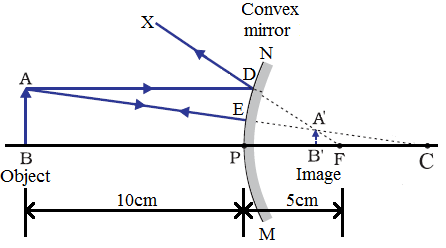
An object is placed at a distance of 10cm from a convex mirror of focal length 5cm.
  1. Draw a ray-diagram showing the formation of image.
  2. State two characteristics of the image formed.
  3. Calculate the distance of the image from mirror.
Answer
  1.  


  1. The image formed is diminished and erect.
  2. u = 10cm, f = 5cm

$\frac{1}{\text{v}}+\frac{1}{\text{u}}=\frac{1}{\text{f}}$

$\Rightarrow \frac{1}{\text{v}}+\frac{1}{-10}=\frac{1}{5}$

$\Rightarrow \frac{1}{\text{v}}=\frac{1}{10}+\frac{1}{5}=\frac{3}{10}$

$\therefore \frac{1}{\text{v}}=\frac{3}{10}\text{cm}=3.33\text{cm}$
View full question & answer
Question 125 Marks
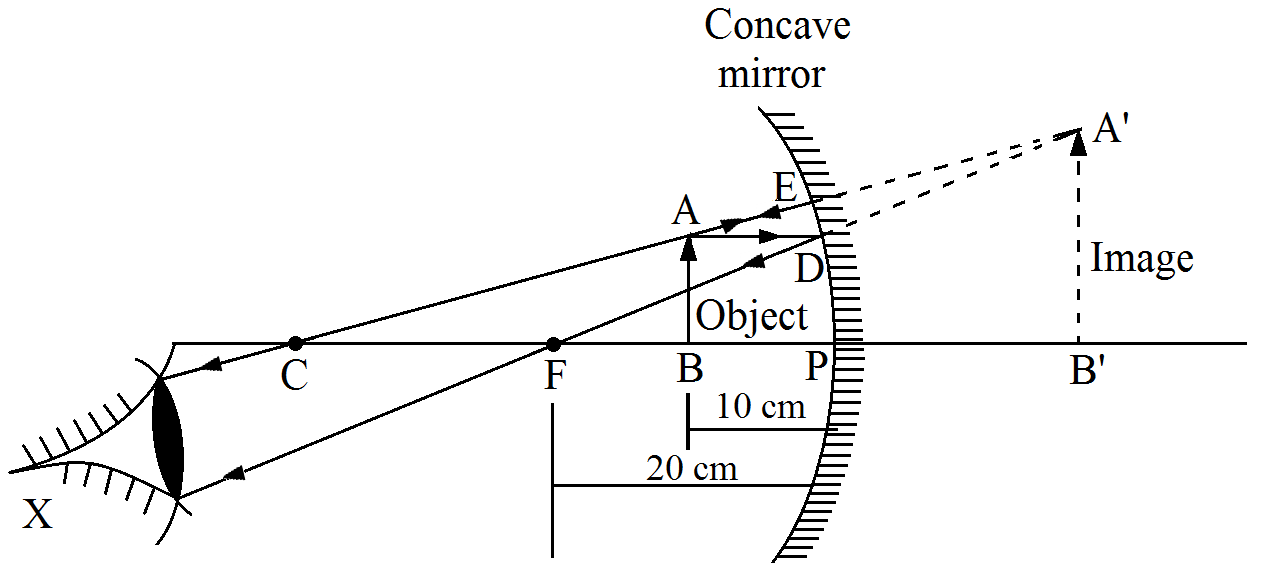
An object is placed at a distance of 10cm from a concave mirror of focal length 20cm.
  1. Draw a ray diagram for the formation of image.
  2. Calculate the image distance.
  3. State two characteristics of the image formed.
Answer
  1.  


Fig. Formation of image by the concave mirror when the object is palced between its pole and focus.

  1.  f = -20cm, u = -10cm, v = ?

We know that

$\frac{1}{\text{v}}+\frac{1}{\text{u}}=\frac{1}{\text{f}}$

$\Rightarrow\frac{1}{\text{v}}+\frac{1}{(-10)}=\frac{1}{(-20)}$

$\Rightarrow\frac{1}{\text{v}}=\frac{1}{20}+\frac{1}{10}=\frac{1}{20}$

$\therefore \text{v}=20\text{cm}$

  1. Characteristics of image formed
  1. Image is virtual.
  2. Image is erect.
View full question & answer
Question 135 Marks
An object is placed (a) 20cm, (b) 4cm, in front of a concave mirror of focal length 12cm. Find the nature and position of the image formed in each case.
Answer
  1. u = -20cm, f = -12cm

We know that

$\frac{1}{\text{v}}+\frac{1}{\text{u}}=\frac{1}{\text{f}}$

$\frac{1}{\text{v}}+\frac{1}{-20}=\frac{1}{-12}$

$\frac{1}{\text{v}}=\frac{-1}{20}+\frac{1}{20}=\frac{-20+12}{240}=\frac{-8}{240}$

$\text{v}=30\text{cm}$

The image is formed at a distance of 30cm in front of themirror.

The image is real and inverted.

  1. u = -4cm, f = -12cm

We know that

$\frac{1}{\text{v}}+\frac{1}{\text{u}}=\frac{1}{\text{f}}$

$\frac{1}{\text{v}}+\frac{1}{-4}=\frac{1}{-12}$

$\frac{1}{\text{v}}=\frac{-1}{12}+\frac{1}{4}=\frac{-1+3}{12}=\frac{-2}{12}$

$\text{v}=6\text{cm}$

The image is formed at a distance of 6cm in behind the mirror.

The image is virtual and erect.

View full question & answer
Question 145 Marks
An object is placed 15cm from (a) a converging mirror, and (b) a diverging mirror, of radius of curvature 20cm. Calculate the image position and magnification in each case.
Answer
Case 1:

It is a converging mirror, i.e. concave mirror.

Distance of the object 'u' = -15cm

Radius of curvature of the mirror 'R' = -20cm

Focal length of the mirror 'f' $=\frac{\text{R}}{2}=-10\text{cm}$

We have to find the position of the image 'v' and its magnification 'M'. Using the mirror formula, we get

Distance of the object (u) = -5 m

Magnification (m) = $\frac{1}{10}$

We have to find the position of the image (v), radius of curvature (R) and the focal length of the mirror (f). Using the magnification formula, we get

$\frac{1}{\text{f}}=\frac{1}{\text{u}}+\frac{1}{\text{v}}$

$\Rightarrow\frac{1}{-10}=\frac{1}{-15}+\frac{1}{\text{v}}$

$\Rightarrow\frac{1}{\text{v}}=\frac{1}{-10}+\frac{1}{15}$

$\Rightarrow\frac{1}{\text{v}}=-\frac{1}{10}+\frac{1}{15}$

$\Rightarrow\frac{1}{\text{v}}=\frac{-15}{150}+\frac{10}{150}$

$\Rightarrow\frac{1}{\text{v}}=\frac{-5}{150}$

$\Rightarrow\frac{1}{\text{v}}=-30\text{cm}$

The image will be form ata distance of 30cm in front of converging mirror.

Magnification$\frac{\text{-v}}{\text{u}}$

$\text{m}=\frac{-(-30)}{-15}$ 

$\text{m}=-2$

magnifacation = -2

Thus the image is real, inverted and large in size.

Case 2:

Mirror is converging mirror i.e. convex mirror.

Distance of the object u = -15cm

Radius of curvature of the mirror R = 20cm

Focal length of the mirror f $=\frac{\text{R}}{2}=10\text{cm}$

We have to find the position of the image v = ?

Magnification = ?

Using the mirror formula, we get

$\frac{1}{\text{f}}=\frac{1}{\text{u}}+\frac{1}{\text{v}}$

$\Rightarrow\frac{1}{\text{f}}=\frac{1}{-15}+\frac{1}{\text{v}}$

$\Rightarrow\frac{1}{10}=\frac{1}{-15}+\frac{1}{\text{v}}$

$\Rightarrow\frac{1}{\text{v}}=\frac{1}{10}+\frac{1}{15}$

$\Rightarrow\frac{1}{\text{v}}=\frac{15}{150}+\frac{10}{150}$

$\Rightarrow\frac{1}{\text{v}}=\frac{25}{150}$

$\Rightarrow\frac{1}{\text{v}}=\frac{1}{6}$ 

$\Rightarrow\text{v}=6\text{cm}$

Therefore, the image will form 6cm behind the mirror. Using the magnification formula, we get

$\text{m}=\frac{\text{-v}}{\text{u}}$

$\text{m}=\frac{-6}{-15}$

$\text{m}=0.4$

Thus, the image is virtual, erect and small in size.

View full question & answer
Question 155 Marks
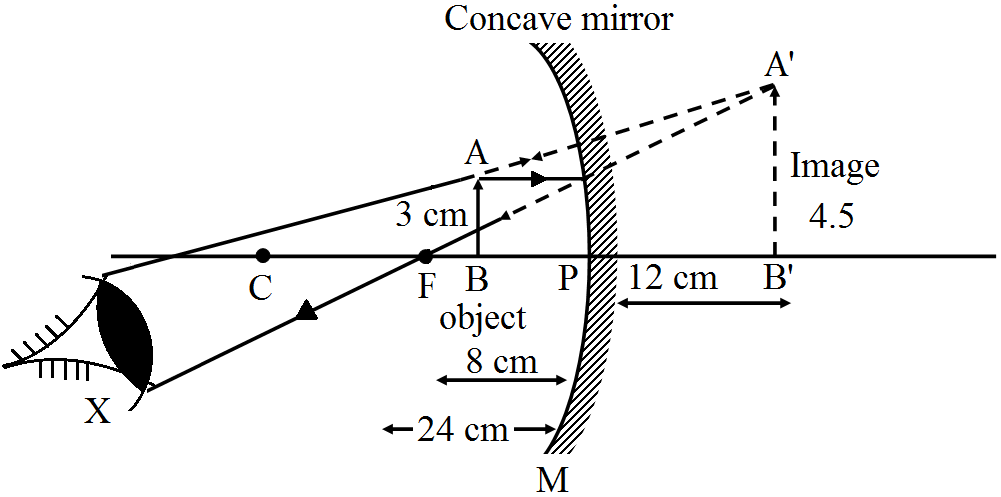
An object 3cm high is placed at a distance of 8cm from a concave mirror which produces a virtual image 4.5cm high:
  1. What is the focal length of the mirror?
  2. What is the position of image?
  3. Draw a ray-diagram to show the formation of image.
Answer
h= 3cm, u = -8cm, h2 = 4.5 (virtual image)

  1. We know that

$\text{m}=\frac{\text{h}_2}{\text{h}_1}=\frac{4.5}{3}=1.5$

and

$\text{m}=-\frac{\text{v}}{\text{u}}$

$\Rightarrow1.5=\frac{\text{v}}{(-8)}$

$\Rightarrow\text{v}=1.5\times8=12\text{cm}$

We have

$\frac{1}{\text{v}}+\frac{1}{\text{u}}=\frac{1}{\text{f}}$

$\Rightarrow\frac{1}{12}+\frac{1}{(-8)}=\frac{1}{\text{f}}$

$\Rightarrow\frac{1}{\text{f}}=\frac{1}{12}-\frac{1}{8}=\frac{2-3}{24}=-\frac{1}{24}$

$\therefore\text{f}=-24\text{cm}$

  1. v = 12cm

So, the image is formed 12cm behind the concave mirror.
  1.  

View full question & answer
Answer the questions.[Phy-5M] - Science STD 10 Questions - Vidyadip