- APlane.
- BConcave.
- ✓Convex.
- DEither concave or convex.
It should be a convex mirror. This is because when an object is in front of a convex mirror, irrespective of its distance, a virtual, erect and diminished image of the object is obtained.
45 questions · timed · auto-graded
It should be a convex mirror. This is because when an object is in front of a convex mirror, irrespective of its distance, a virtual, erect and diminished image of the object is obtained.
If a magnification of −1 (minus one) is to be obtained by using a converging mirror, the object needs to be placed at the centre of curvature so that an image of same size as the object can be formed.
The reason being, the image formed by a concave mirror is virtual, erect and magnified. The position of the object is between the pole and the focus.
Image formed by a plane mirror is virtual, erect and of the same size as the object.Image formed by a concave mirror is virtual, erect and larger than the object.
In accordance with the first law of reflection, which states that the angle of reflection is equal to the angle of incidence.
In order to obtain a magnification of −2 (minus 2) with a concave mirror, the object should be placed between the focus and the centre of curvature.
When an object is placed between the pole and the focus of a concave mirror, an enlarged image is formed.
A concave mirror produces a magnification of +4 when the object is placed between the focus and the pole.
Magnification produced by a convex mirror is always less than 1. This is because the size of the image formed by a convex mirror is smaller than the object.
The focal length of a spherical mirror is half of its radius of curvature.
Magnification, $\text{m}=\frac{\text{v}}{\text{u}}$
In a convex spherical mirror, reflection of light takes place at the bulged-out surface.
A concave mirror cannot be used as a rear view mirror because it forms inverted images of distant objects.
Distance between original image and final image = distance the mirror moved + same distance the image moved = 2 + 2 = 4c.
A concave mirror forms a real image of an object.
For an object placed between the focus and the centre of curvature, the real image formed by a concave mirror is larger than the object.
Both convex and plane mirrors always form virtual images.
A convex mirror diverges the rays of light incident on it; hence, it acts as a diverging mirror.

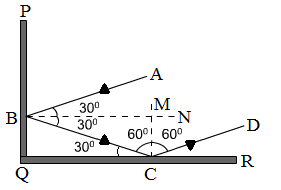
Here.
$\angle\text{A}\text{B}\text{N}= \angle\text{N}\text{B}\text{C}$ (angle of incidence = angle of reflection)
$\angle\text{B}\text{C}\text{O}=\angle\text{N}\text{B}\text{C}$ (alternate angles)
$\angle\text{M}\text{C}\text{B}=90^\circ-\angle\text{B}\text{C}\text{O}$ $\big(\angle\text{M}\text{C}\text{B}=$angle of incident for mirror QR$\big) $
= 60°
Now
$\big($$\angle\text{M}\text{C}\text{B}=\angle\text{M}\text{C}\text{D}=60^\circ $angle of reflection from mirror QR and angle of incidence = angle of reflection$\big)$
If R is the radius of curvature of a spherical mirror and f is its focal length, then R = 2f.
The reason being, the image cannot be projected on a screen.
When a light bulb is placed at the focus of a concave mirror reflector, the diverging light rays of the bulbare collected by the reflector and then reflected, to produce a strong, parallel-sided beam of light.
A concave mirror is used by a dentist to examine the teeth of a person.
An object is placed at a large distance but in front of a concave mirror with a radius of curvature of 40cm. The image of this object will be formed at the focus that is 20cm away
The reason being, a ray of light passing through the centre of curvature of a concave mirror strikes the mirror normally or perpendicularly.
The image formed by a plane mirror is virtual, behind the mirror and of the same size because it cannot be projected on a screen.
The reason being, the image formed by a concave mirror is virtual, erect and magnified. The position of the object is between the pole and the focus.
The reason being, the image formed by a concave mirror is real, inverted and highly diminished (much smaller than the object). Therefore, the object must be at infinity.
Magnification produced by a plane mirror is equal to one. This is because the size of the image formed by a plane mirror is same as the size of the object.
Radius of curvature 'R' = 2f
R = 2 × 12.5
= 25cm
The reason being, a concave mirror forms an erect image when an object is placed between the focus and the pole. Further, the radius of curvature is twice the distance between the focus and the pole. This gives a radius of curvature greater than 200mm.
A person must hold his face at a distance of 20cm, away from the concave mirror. A concave mirror forms an erect, virtual and magnified image when an object is placed between the focus and the pole. Therefore, it acts as a shaving mirror.