Questions

VSQ (2 Marks)

🎯

Test yourself on this topic

5 questions · timed · auto-graded

Question 12 Marks
Describe any three features of unitary government
Answer
Three features of the unitary government are:
i. Under the unitary system, either there is only one level of government or the sub-units are subordinate to the central government.
ii. The central government can pass on orders to the provincial or the local government.
iii. The local governments do not enjoy any freedom or powers. E.g. England, France, Italy, and Japan have adopted the Unitary system of government.
View full question & answer
Question 22 Marks
What are millets and why are they called coarse grains? Give some examples of millet crops and areas they are grown in.
Answer
Jawar, Bajra and ragi are the important Millets grown in India. These are known as coarse grains but they have very high nutritional value.
i. Jawar: Maharashtra is the largest producer of jawar followed by Karnataka, Andhra Pradesh and Madhya Pradesh.
ii. Bajra: Rajasthan is the largest producer of Bajra followed by Uttar Pradesh, Maharashtra, Gujarat, and Haryana.
iii. Ragi: Karnataka is the largest producer of ragi followed by Tamil Nadu.
iv. Millets are also known as dry crops because they are tough and hardy. They are draught resistant crops and requires less rainfall and high temperatures.
v. Millet crops are favored due to productivity and short growing season under dry, high- temperature conditions.
View full question & answer
Question 32 Marks
What were the political, social and economic ideas supported by the liberals in Europe?
Answer
The political, social and economic ideas supported by the liberals were as follows:
a. From the political point of view, they demanded constitutionalism with national unification, parliamentary administration and a nation-state with a written constitution. In German regions, a large number of political associations whose members were middle-class professionals, businessman and prosperous artisans came together in the city of Frankfurt and decided to vote for all German National Assembly.
b. From the social viewpoint, they wanted to free the society of its class-based biases and rights growing out of births. A large number of women had participated actively and formed their own political associations founded a newspaper, took part in political meetings and struggled for the right to vote.
c. Economically, they demanded markets to be free and the right to property. Abolition of state-imposed restrictions on the movements of goods and capital were also demanded.
View full question & answer
Question 42 Marks
Describe the role of Otto von Bismarck in the making of Germany.
Answer
The role of Otto von Bismarck in the making of Germany:
i. Prussian Leadership: After the failure of the 1848 liberal initiative, Prussia, under Bismarck's leadership, took charge of the movement for German unification.
ii. Architect of Unification: Otto von Bismarck, the chief minister of Prussia, played a crucial role in the unification of Germany by leading the nationalist movement.
iii. Use of Prussian Army: Bismarck utilized the strength of the Prussian army and bureaucracy to achieve unification through military means.
iv. Wars for Unification: He fought three wars over seven years with Austria, Denmark and France.
v. Victory: The wars ended with Prussian victory and completed the process of unification
View full question & answer
Question 52 Marks
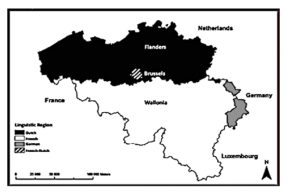
Study the map thoroughly and mention the language that is dominantly spoken in the Wallonia region.
Image
Answer
Country's 40 per cent people live in the Wallonia region and speak French.
View full question & answer
VSQ (2 Marks) - Social Studies STD 10 Questions - Vidyadip