Question types

Model Paper 4 question types

43 questions across 6 question groups — pick any mix to generate a Social Studies paper with step-by-step answer keys.

43
Questions
6
Question groups
5
Question types
Sample Questions

Model Paper 4 questions

One sample from each question group in this chapter. Select any group above to see the full set with answer keys.

Q 1MCQ (1 Mark)1 Mark
Read the information given below and select the correct option Amrita is a government teacher and belongs to a rich urban household whereas Rani - A Dalit, works as a helper on a construction site and comes from a poor rural household. Both have a crisis at home and wish to take a loan. Amrita got the loan from easily as compared to Rani. Why is Rani not able to get the loan? Tick the most appropriate reason.
  • A
    Because Rani is uneducated.
  • B
    Because Rani is engaged in informal sector.
  • C
    Because Rani is from an untouchable caste, Dalits.
  • D
    Because Rani is poor.
View full solution
Q 2MCQ (1 Mark)1 Mark
Read the following statements regarding the role of the Opposition party.
i. Opposition parties voice different views
ii. Opposition parties criticise government for its failures or wrong policies.
iii. Opposition parties mobilise opposition to the government.
Which of the following is the accurate role of the Opposition party? Choose the correct option.
  • A
    only iii
  • B
    ii and iii
  • C
    i, ii and iii
  • D
    only i
View full solution
Q 3MCQ (1 Mark)1 Mark
The Prime Minister's High-Level Committee is popularly known as:
  • A
    Poonchi Committee
  • B
    Mandal Committee
  • C
    Sarkaria Committee
  • D
    Sachar Committee
View full solution
Q 4MCQ (1 Mark)1 Mark
Which of the following statements will be considered by a political party while shaping public opinion?
Statement i: Raise and highlight issues popular issues.
Statement ii: Launch movements for the resolution of problems faced by people.
Statement iii: Provide access to government machinery and welfare schemes implemented by the government.
Statement iv: Voice different views and criticize the government for its failures or wrong policies.
  • A
    Statement i, ii and iii are right.
  • B
    Statement i and ii are right.
  • C
    Statement iii is right.
  • D
    Only statement iv is right.
View full solution
Q 5MCQ (1 Mark)1 Mark
In a geography class, the teacher engaged the students in a discussion to identify a specific type of soil. She provided them with four clues. The students had to use these clues to identify the soil type. Based on the clues given, which type of soil is being discussed?
Clues:
i. It is ideal for growing cotton.
ii. The formation of this soil depends on climatic conditions and parent rock material.
iii. It is typical of the Deccan trap (Basalt) region
iv. They cover the plateaus of Maharashtra, Saurashtra, Malwa, Madhya Pradesh and Chhattisgarh and extend in the south east direction along the Godavari and the Krishna valleys.
  • A
    Laterite soil
  • B
    Alluvial soil
  • C
    Black soil
  • D
    Red soil
View full solution
If we look at the country as a whole, we find that 93% of the workers in India are
in the unorganized sector. Organized sector employment is available to only about
7% of the workers in India.
SectorOrganisedUnorganizedTotal
Primary1 232
Secondary4174115
Tertiary4088172
Total82
Total in 100%
Percentage
Workers in the unorganized sector work hard, but earn very little. Give reasons.
What problems do they face there? Think why they are forced to work in this
sector.
View full solution
Compare and contrast the changes in India with the pattern that was observed for developed countries. What kind of changes between sectors were desired but did not happen in India?Table 8: Percentage Share of Sector-wise Contribution of GDP
CountryGross domestic product $ billionsAgriculture % of GDPIndustry % of GDPManufacturing % of GDPServices
% of GDP
2000201520002015200020152000201520002015
China1,211.3011,007.70159464132304050
India476.62,095.402317263015165153
Germany1,950.003,363.4011313023236869
Japan4,731.204,123.3021312721196772
UK1,635.402,858.0011251915107480
USA10,284.8018,036.6011232116127678
World33,391.0073,891.9054312819156468
View full solution
The average person in Haryana has more income than the average person in Kerala but lags behind in the crucial areas. The reason is money in your pocket cannot buy all the goods and services that you may need to live well. So. income by itself is not a completely adequate indicator of material goods and services that citizens are able to use.
Actually for many of the important things in life the best way, also the cheapest way, is to provide these goods and services collectively. Even now, in many areas. children, particularly girls, are not able to go to high school because the government society has not provided adequate facilities. Kerala has a low Infant Mortality Rate because it has an adequate provision of basic health and educational facilities. Similarly, in some states. PDS functions well. Health and nutritional status of people of such states is certainly likely to be better.
i. Why in some areas children are unable to go to high school? (1)
ii. State the effect of adequate public facilities. (1)
iii. Substantiate the statement with two instances:
Income by itself is not a completely adequate indicator of material goods and
services. (1)
View full solution
A dam is a barrier across flowing water that obstructs, directs or retards the flow. often creating a reservoir, lake or impoundment. "Dam" refers to the reservoir rather than the structure. Most dams have a section called a spillway or weir over which or through which it is intended that water will flow either intermittently or continuously. Dams are classified according to structure, intended purpose or height. Based on structure and the materials used, dams are classified as timber dams, embankment dams or masonry dams, with several subtypes. According to the height, dams can be categorised as large dams and major dams or alternatively as low dams, medium height dams and high dams
i. What does the word 'Dam' actually refer to? (1)
ii. Mention any one benefit of a Multi-purpose River Valley Project. (1)
iii. How have multi-purpose river valley projects a cause of social movements?
Explain. (2)
View full solution
Read the following text carefully and answer the questions that follow:
The movement started with middle-class participation in the cities. Thousands of students left government-controlled schools and colleges. headmasters and teachers resigned, and lawyers gave up their legal practices. The council elections were boycotted in most provinces except Madras, where the Justice Party, the party of the non-Brahmans. felt that entering the council was one way of gaining some power-something that usually only Brahmans had access to. The effects of non- cooperation on the economic front were more dramatic. Foreign goods were boycotted, liquor shops picketed, and foreign cloth burnt in huge bonfires. The import of foreign cloth halved between 1921 and 1922. its value dropping from 102 crore to ₹ 57 crore. In many places, merchants and traders refused to trade in foreign goods or finance foreign trade. As the boycott movement spread, and people began discarding imported clothes and wearing only Indian ones, the production of Indian textile mills and handlooms went up.
i. Explain the meaning of picketing liquor shop.(1)
ii. When did the Non-Cooperation-Khilafat Movement begin? (1)
iii. Why did the movement in the cities gradually slow down? (2)
View full solution
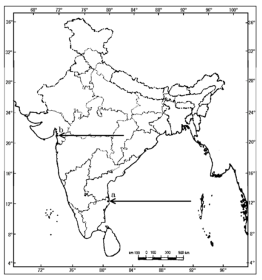
A. Two features a and b are marked on the given political outline map of India. Identify these features with the help of the following information. Write their correct names on the lines marked near them:
a. Place where Congress Session was held in 1927.
b. Place from where Gandhiji started the Civil Disobedience Movement.
B. Locate and label any three of the following with appropriate symbols on the same given political outline map of India:
i. Jamshedpur - Iron and Steel Plant
ii. Vijayawada - Thermal Power Plant
iii. Ahmedabad - Cotton Textile Centre
iv. Noida - Software Technology Park
v. Kochi - Sea-port
Image
View full solution

Generate a Model Paper 4 paper free

Pick question groups from the list above, set marks and difficulty, and export a branded PDF with step-by-step answer keys. First 3 chapters free — no signup.

Download App