Questions · Page 1 of 2

SHORT ANSWER QUESTIONS(3 Mark)

🎯

Test yourself on this topic

50 questions · timed · auto-graded

Question 13 Marks
What are the biotic and abiotic resources? Give some examples
 
Answer
Biotic Resources: The resources which are obtained from the biosphere and have life are called Biotic Resources.
Examples of biotic resources are animals, plants, human beings, fish, livestock etc.
Abiotic Resources: The resources which are composed of non-living things are called Abiotic Resources.
Examples of abiotic resources are, water, minerals, metals, wind, solar energy etc.
View full question & answer
Question 23 Marks
Name three states having black soil and the crop which is mainly grown in it.
Answer
The states of Maharashtra, Madhya Pradesh and Chhattisgarh have black soil. The crop which is mainly grown in this soil is cotton. This soil is also called 'Regur’ or black cotton soil.
View full question & answer
Question 33 Marks
What steps can be taken to control soil erosion in the hilly areas?
Answer
In hilly areas, soil erosion can be controlled by:
  • Ploughing across contour-lines.
  • Making use of terrace farming techniques.
  • Using strips of grasses to check soil erosion by wind and water.
View full question & answer
Question 43 Marks
What type of soil is found in the river deltas of the eastern coast? Give three main features of this type of soil.
Answer
Alluvial soil is found in the river deltas of the eastern coastal plains.The features of Alluvial soil:
  1. This is the most widely spread and important soil. The entire northern plains of our country are made of alluvial soil.
  2. Alluvial soils contain adequate proportion of potash, phosphoric acid and lime which are ideal for the growth of several crops like Sugarcane, Paddy, Wheat and Pulses.
  3. The alluvial soil consists of various proportions of sand, silt and clay.
View full question & answer
Question 53 Marks
Classify resources, on the basis of exhaustibility in two groups. Mention three characteristics of each.
Answer
Classification of resources on the basis of exhaustibility:-
  1. Renewable resources.
  2. Non-Renewable resources.
Characteristics of Renewable Resources:-
  1. They can be renewed or reproduced.
  2. Available in abundance.
  3. Cause no pollution.
  4. They may be continuous or flow resources.
  5. Examples: Solar, Wind Energy, Forest & wildlife, etc.
View full question & answer
Question 63 Marks
What is resource planning? Why is resource planning essential? Explain with three reasons.
Answer
Resource Planning: Resource planning refers to the strategy for planned and judicious utilisation of resources. Resource planning is essential for sustainable existence of all forms of life.
Resource planning is essential for India as there is enormous diversity in the availability of resources. For example the state of Rajasthan has vast potential for the development of solar and wind energy but is deficient in water resources.
The cold desert of Ladakh has rich cultural heritage but is deficient in water and some strategic minerals.
The state of Arunachal Pradesh has abundance of water resources but lacks infrastructure which shows mere availability of resources in the absence of technology and institutions hinders development.
This shows that the resource planning is needed at the national, regional, state and local levels for balanced development of a country.
View full question & answer
Question 73 Marks
In which states is over irrigation responsible for land degradation?
Answer
In the states of Punjab, Haryana, western Uttar Pradesh, over irrigation is responsible for land degradation due to water logging leading to increase in salinity and alkalinity in the soil.
View full question & answer
Question 83 Marks
Examine the three major problems that have been created due to the indiscriminate use of resources by human beings.
Answer
  1. The resources have been depleted in the process of satisfying the greed of individuals.
  2. Resources have got concentrated in a few hands which has resulted in the division of society into two segments- the 'have' and the, 'havenots' i.e. the rich and the poor.
  3. Exploitation of resources has resulted in the global ecological crisis such as global warming, environmental pollution.
View full question & answer
Question 93 Marks
What is the percentage of land degradation in India?
Answer
At present, there are about 130 million hectares of degraded land in India. Approximately, 28 percent of it belongs to the category of forest degraded area, 56 percent of it is water eroded area and the rest is affected by saline and alkaline deposits.
View full question & answer
Question 103 Marks
How does Terrace farming help in checking soil erosion?
Answer
Soil erosion occurs when the water with high velocity runs down washing the soil. As many terrace or step like slopes are present in terrace farming it reduces the speed as well as the quantity of water moving over the soil surface as a result of which it checks soil erosion by preventing it.
View full question & answer
Question 113 Marks
Distinguish between biotic and abiotic resources.
Answer
S.No.
Biotic Resources
Abiotic Resources
(i)
These resources are obtained from biosphere.
They refer to all those things which are composed of non-living things.
(ii)
These include flora and fauna fisheries, livestock, human beings, etc.
These include rocks, metals, land, air, mountains, rivers, etc.
(iii)
Minerals such as coal and petroleum are included in this category because they were formed from decayed organic matter.
Minerals such as gold, iron, copper, silver, etc. come in this category.
View full question & answer
Question 123 Marks
“The Earth has enough resources to meet the need of all but not enough to satisfy the greed of even one person”. How is this statement relevant to the discussion of development? Discuss.
Answer
Gandhiji was very apt in voicing his concern about resource conservation in these words:
“There is enough for everybody’s need and not for any body’s greed”. He placed the greedy and selfish individuals and exploitative nature of modern technology as the root cause for resource depletion at the global level. He was against mass production and wanted to replace it with the production by the masses.
View full question & answer
Question 133 Marks
What is the role of human beings in the development of a resource?
Answer
The process of transformation of things available in our environment involves an inter-dependent relationship between nature, technology and institutions. Human beings interact with nature through technology and create institutions to accelerate their economic development.
View full question & answer
Question 143 Marks
What is gross cropped area?
Answer
Gross Cropped Area (GCA) is the total area sown once as well as more than once in a particular year. When the crop is sown on a piece of land for twice, the area is counted twice in GCA.
View full question & answer
Question 153 Marks
What steps have been taken at the international level to conserve world resource?
Answer
  1. In June 1992, more than 100 heads of states met in Rio de Janeiro in Brazil for the First International Earth Summit. The summit was convened for addressing urgent problems of environmental protection and socio-economic development at the global level. In 2012, 172 nations participated in Rio Earth summit which was held from 13 to 22 June 2012.
  2. Agenda 21 was the declaration signed by world leaders in 1992 at the United Nations Conference on Environment and Development (UNCED), which aimed at achieving global sustainable development. It is an agenda to fight environmental damage, poverty, disease through global co-operation on common interests, mutual needs and shared responsibilities.
View full question & answer
Question 163 Marks
What is the comparative change in barren and waste land pattern in india between 1960-61 and 2008-09?
Answer
Barren and wasteland pattern decreased from 12.01% to 8.61% from 1960-61 to 2008-09. This is all due to new farming techniques like HYV seeds, ploughing tractors, pesticides, manures etc.
View full question & answer
Question 173 Marks
What restricts the infiltration of water in desert soil?
Answer
Arid soils range from red to brown in colour. They are generally sandy in texture and saline in nature. In some areas the salt content is very high and common salt is obtained by evaporating the water. Due to the dry climate, high temperature, evaporation is faster and the soil lacks humus and moisture. The lower horizons of the soil are occupied by Kankar because of the increasing calcium content downwards. The Kankar layer formations in the bottom horizons restrict the infiltration of water. After proper irrigation these soils become cultivable as has been in the case of western Rajasthan.
View full question & answer
Question 183 Marks
Which soils are called ‘black soils’?
Answer
Black soil is also called Regur soil. It is black in colour and ideal for growing cotton. This type of soil is typical of the Deccan trap (Basalt) region spread over North-West Deccan plateau and is made up of lava flows.
View full question & answer
Question 193 Marks
Why are shelter belts grown?
Answer
Planting lines of trees to create shelter also works in a similar way. Rows of such trees are called shelter belts. These shelter belts have contributed significantly to the stabilisation of sand dunes and in stabilising the desert in western India.
View full question & answer
Question 203 Marks
What are the various forces of nature that contribute to the formation of soil? What is the importance of soil?
Answer
  1. Various forces of nature that contribute to the formation of soil are change in temperature, actions of running water, wind and glaciers, activities of decomposers, etc.
  2. Soil is the most important renewable natural resource. It is the medium of i plant growth and supports different types of living organisms on the earth.
View full question & answer
Question 213 Marks
Overgrazing may cause land degradation. Give examples of some states affected by this.
Answer
Overgrazing is one of the main reasons which has caused land degradation in many parts of the country. States which are affected by overgrazing are Rajasthan, Gujarat, Maharashtra and Madhya Pradesh.
View full question & answer
Question 223 Marks
What resources can be acquired by a nation?
Answer
Technically, all the resources belong to the nation. The country has legal powers to acquire even private property for public good. All the minerals, water resources, forests, wildlife, land within the political boundaries and oceanic area upto 12 nautical miles (19.2km) from the coast termed as territorial water and resources therein belong to the nation.
View full question & answer
Question 233 Marks
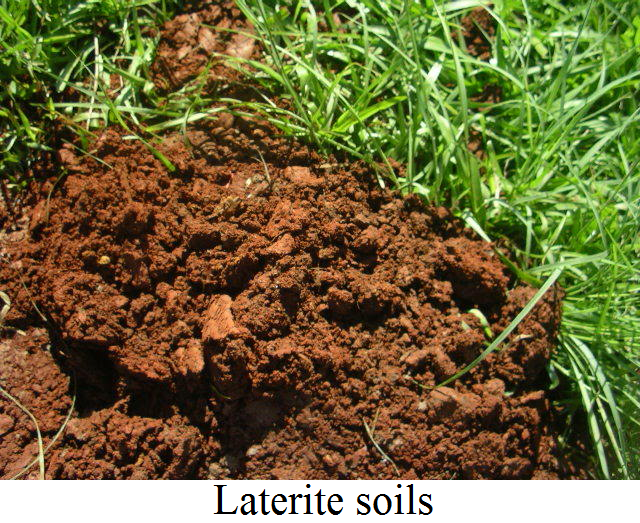
Define laterite soils. Where are they found?
Answer
Laterite soil is formed by intense leaching due to heavy rainfall. It forms in hot and tropical regions where the climate is humid.
Humus content of this soil is low on because most of the micro-organisms, particularly the decomposers, like bacteria get destroyed due to high temperature. These soils are rich in iron oxides, and are suitable for cultivation with adequate doses of manures and fertilisers. In the regions where there is sufficient humus, we find evergreen forests.

In India, laterite soils are basically found in southern states, Western Ghats of Maharashtra, Odisha, some of the regions of West Bengal and northeastern regions. Tea and coffee are grown in the laterite soils of Karnataka, Kerala and Tamil Nadu. Laterite soils of Tamil Nadu, Andhra Pradesh and Kerala are more suitable for cashew crops.
View full question & answer
Question 243 Marks
What is the objective of the Agenda 21?
Answer
The objective of the Agenda 21 is to combat environmental damage, poverty, disease through global cooperation on common interests, mutual needs and shared responsibilities.
View full question & answer
Question 253 Marks
Why is soil considered as a resource? Explain with five arguments.
Answer
  1. Soil is considered as a resource because it is used to satisfy our needs.
  2. Soil is the most important renewable natural resource.
  3. It is a living system.
  4. It is the medium of plant growth.
  5. It supports different types of living organism on the earth.
View full question & answer
Question 263 Marks
How are red and yellow soils formed? Why do they look red?
Answer
Red soil develops on crystalline igneous rocks in areas of low rainfall in the eastern and southern parts of the Deccan plateau. Yelllow and red soils are also found in parts of Orissa, Chhattisgarh, southern parts of the middle Ganga plain and along the piedmont zone of the Western Ghats.
These soils develop a reddish colour due to diffusion of iron in crystalline and metamorphic rocks. It looks yellow when it occurs in a hydrated form.
View full question & answer
Question 273 Marks
What are National Resources.
Answer
Technically, all the resources belong to the nation. The country has legal powers to acquire even private property for public good. All the minerals, water resources, forests, wildlife, land within the political boundaries and oceanic area upto 12 nautical miles (19.2km) from the coast termed as territorial water and resources therein belong to the nation.
View full question & answer
Question 283 Marks
Why is resource conservation important?
Answer
Resources are vital for any developmental activity. But irrational consumption and over-utilization of resources may lead to socio-economic and environmental problems. To overcome these problems, resource conservation at various levels is important.
View full question & answer
Question 293 Marks
What are renewable resources?
Answer
The resources which can be renewed or reproduced by physical, chemical or mechanical processes are known as renewable or replenish able resources. For example, solar and wind energy, water, forests and wildlife, etc.
View full question & answer
Question 303 Marks
Give an example of a non-renewable resource that is non- recyclable also.
Answer
Coal is a best example which is non-renewable as well as non-recyclable.Nonrenewable resources are those found inside the earth, and they took millions of years to form. These include the fossil fuels, oil, natural gas, and coal and nuclear energy.
View full question & answer
Question 313 Marks
Give examples of potential resources.
Answer
The western parts of India particularly Rajasthan and Gujarat have enormous potential for the development of wind and solar energy. But so far these have not been developed properly.
View full question & answer
Question 323 Marks
What is a culturable wasteland?
Answer
Culturable Waste Land: This includes land available for cultivation, whether taken up or not taken up for cultivation once, but not cultivated during the last five years or more in succession including the current year for some reason or the other.
View full question & answer
Question 333 Marks
What are the main relief features of India?
Answer
India has land under a variety of relief features, namely; mountains, plateaus, plains and islands. About 43 percent of the land area is plain, which provides facilities for agriculture and industry. Mountains account for 30 percent of the total surface area of the country and ensure perennial flow of some rivers, provide facilities for tourism and ecological aspects. About 27 percent of the area of the country is the plateau region. It possesses rich reserves of minerals, fossil fuels and forests.
View full question & answer
Question 343 Marks
Explain how deforestation is responsible for land degradation and soil erosion.
Answer
Deforestation is responsible for land degradation because due to deforestation since the roots hold the soil firmly and when we cut trees the soil gets loose and this can be eroded easily by the natural actions such as rain wind etc. so we can conclude that trees prevent soil erosion and thus Land Degradation.
View full question & answer
Question 353 Marks
“Planning is widely accepted strategy for judicious use of resources in a country like India”. Justify this statement with two relevant points and an example.
Answer
An equitable distribution of resources has become essential for a sustained quality of life and global peace. If the present trend of resource depletion by a few individuals and countries continues, the future of our planet is in danger.
Therefore, resource planning is essential for sustainable existence of all forms of life. Sustainable existence is a component of sustainable development.
View full question & answer
Question 363 Marks
How is soil eroded?
Answer
Approximately, 28 percent of it belongs to the category of forest degraded area, 56 percent of it is water eroded area and the rest is affected by saline and alkaline deposits. Some human activities such as deforestation, over grazing, mining and quarrying too have contributed significantly in land degradation.
View full question & answer
Question 373 Marks
What are the drawbacks of arid soils?
Answer
Due to the dry climate, high temperature, evaporation is faster and the soil lacks humus and moisture. The lower horizons of the soil are occupied by Kankar because of the increasing calcium content downwards. The Kankar layer formations in the bottom horizons restrict the infiltration of water.
View full question & answer
Question 383 Marks
What percentage of land in India is put for agriculture uses?
Answer
Agricultural land (% of land area) in India was reported at 60.45% in 2015, according to the World Bank collection of development indicators, compiled from officially recognized sources. Agricultural landrefers to the share of land area that is arable, under permanent crops, and under permanent pastures.
View full question & answer
Question 393 Marks
Explain the major factors which are responsible for the formation of soil.
Answer
The factors responsible for the formation of soil are:
  1. Relief, parent rock or bed rock, climate, vegetation, and other forms of life and time are important factors responsible for the formation of soil.
  2. Various forces of nature such as change in temperature, actions of running water, wind and glaciers, activities of decomposers, etc. contribute to the formation of soil.
  3. Chemical and organic changes which take place in the soil are equally important. Soil also consists of organic and inorganic materials.
View full question & answer
Question 403 Marks
What was Agenda 21 of Earth Summit of Rio de Janeiro?
Answer
It aims at achieving global sustainable development. It is an agenda to combat environmental damage, poverty, disease through global co-operation on common interests, mutual needs and shared responsibilities.
View full question & answer
Question 413 Marks
Which soils are formed at the foothills?
Answer
In the upper reaches of the river valley i.e. near the place of the break of slope, the soils are coarse. Such soils are more common in piedmont plains such as Duars, Chos and Terai.
View full question & answer
Question 423 Marks
Why do we need to conserve resources?
Answer
Resources are vital for any developmental activity. But irrational consumption and over-utilisation of resources may lead to socio-economic and environmental problems. To overcome these problems, resource conservation at various levels is important.
View full question & answer
Question 433 Marks
What are wastelands?
Answer
The unused land that becomes either unproductive or overgrown is called a wasteland.
In ​1960-61, the area of barren and unculturable waste land was 12.01% but in ​2008-09 it reduced to 8.61%.
As on 2000, wastelands constitute 29.47% in the total land area in India. Types of wasteland are:
  1. Water eroded area.
  2. Saline and alkaline land.
  3. Forests degraded area.
  4. Wind eroded area.
View full question & answer
Question 443 Marks
Define the term soil erosion. What are the different types of soil erosion?
Answer
The denudation of the top fertile soil cover and subsequent washing down is described as soil erosion. Natural forces like wind, glacier and water lead to soil erosion.
Different types of soil erosion:
  1. When the running water cuts through the clayey soils and makes deep channels, they are called gullies. Due to the formation of gullies, the land becomes unfit for cultivation and is known as bad land or ravines.
  2. When the top soil is washed away due to heavy flow of water down the slopes, it is known as sheet erosion.
  3. When the top fertile soil blows off due to wind, it is known as wind erosion.
View full question & answer
Question 453 Marks
Which factors affect the land use pattern of India?
Answer
Land is used for various purposes, such as cultivation of crops, building of houses, construction of roads and railways, grazing of animals, etc. This is commonly known as land use pattern. The percentage of land used for various purposes varies from one region to another. The utilisation of land is determined by the continuous interplay of the physical factors, such as relief, soil, climatic conditions, mineral resources, etc., and the human factors like density of population and the technological and social requirements of people.
View full question & answer
Question 463 Marks
What are the three processes involved in Resource Planning?
Answer
Resource planning is a complex process which involves:
  1. Identification and inventory of resources across the regions of the country.
  2. Evolving a planning structure endowed with appropriate technology.
  3. Matching the resource development plans with overall national development plans.
View full question & answer
Question 473 Marks
Why was the International Earth Summit convened in Rio de Janeiro, Brazil in 1992.
Answer
The Summit was convened for addressing urgent problems of environmental protection and socioeconomic development at the global level.
View full question & answer
Question 483 Marks
"India is rich in certain types of resources but deficient in some other resources." Support your answer with examples.
Answer
India has enormous diversity in the availability of resources but deficient in some other resources, as:
  1. Arunachal Pradesh has abundance of water resources but lacks in infrastructural development.
  2. The state of Rajasthan is very well it endowed with solar and wind energy but lacks in water resources.
  3. The cold desert of Ladakh has very rich cultural heritage but it is deficient in water, infrastructure and some vital minerals.
View full question & answer
Question 493 Marks
Define the following:
  1. Gross cropped area.
  2. Waste land.
Answer
  1. Gross cropped area: It is an area sown more than once in an agricultural year plus net sown area.
  2. Waste land: It includes rocky, arid and desert areas and land put to other non-agricultural uses such as roads, railways, industries, settlements, etc.
View full question & answer
Question 503 Marks
Do you think, there will any impact on human life if coal supplies get exhausted in the next five years?
Answer
Yes, there will be tremendous impact on human life if, coal supplies get exhausted in next five years. This is so because coal is the main source of electricity generation. In absence of coal,it will be difficult to get electricity. Moreover, coal is essential for iron and steel industries as well. So a non-renewable source like coal should be used limitedly.
View full question & answer
SHORT ANSWER QUESTIONS(3 Mark) - Social Studies STD 10 Questions - Vidyadip