Questions · Page 2 of 2

SHORT ANSWER QUESTIONS(3 Mark)

Question 513 Marks
Why is it essential to have resource planning? Explain any three reasons.
Answer
Conservation of resources are essential for following reasons:
  1. Resources are vital for any develop mental activity.
  2. Irrational consumption and over-utilisation of resources may lead to socio-economic and environmental problems.
  3. Resources are overexploited by some greedy and selfish individuals. To overcome these problems, resource conservation at various levels is important.
View full question & answer
Question 523 Marks
An equitable distribution of resources has became essential today. Explain it. Enlist a few ways to conserve resources.
Answer
Resources are vital for human survival as well as for maintaining the quality of life. But unfortunately they are being used indiscriminately which has resulted in their depletion. Whatever resources are there, they are accumulated in a few hands. Hence, an equitable distribution of resources has become essential for a sustained quality of life and global peace. If the present trend of resource depletion by a few individuals and countries continues, the future of our planet will be in danger. Resource planning is essential to avert this situation. We can conserve resources by reducing waste, reusing materials, recycling a variety of non-hazardous materials.
View full question & answer
Question 533 Marks
Which factors determine the use of land?
Answer
The use of land is determined both by physical factors such as topography, climate, soil types as well as human factors such as population density, technological capability and culture and traditions etc.
View full question & answer
Question 543 Marks
What is the importance of land as a natural resource?
Answer
Land is a natural resource of utmost importance. It supports natural vegetation, wild life, human life, economic activities, transport and communication systems. However, land is an asset of a finite magnitude, therefore, it is important to use the available land for various purposes with careful planning.
View full question & answer
Question 553 Marks
Define the term ‘Resource’.
Answer
Everything available in our environment, which can be used to satisfy our needs, provided, it is technologically accessible, economically feasible and culturally acceptable can be termed as ‘Resource’.
View full question & answer
Question 563 Marks
How does land get degraded due to human activities?
Answer
Four human activities which are responsible for land degradation in India are:
  1. Mining has resulted in the degradation of land. Mining sites are abandoned after the completion of excavation work. This has resulted in land degradation in the states of Madhya Pradesh, Chhattisgarh and Odisha.
  2. Over grazing in various states (e.g. Gujarat and Rajasthan) has resulted in the degradation of land.
  3. Over irrigation of land leads to water logging resulting in the salinity of soil. Over irrigation has degraded the land mainly in the states of Punjab and Haryana.
  4. Industrial effluents and wastes have also resulted in land degradation.
View full question & answer
Question 573 Marks
Differentiate Net sown Area from cultivable land?
Answer
The land which can be used for the production of crops is called cultivable land but the cultivated land in an agricultural year is called net sown land and net sown land plus the land which is cultivated more than once in an agricultural year is called gross crop land.
View full question & answer
Question 583 Marks
What is soil erosion? State how it can be prevented in deserts.
Answer
The denudation of the soil cover and subsequent washing down is described as soil erosion.
Planting lines of trees to create shelter works in a similar way. Rows of such trees are called shelter belts. These shelter belts have contributed significantly to the stabilisation of sand dunes and in stabilising the desert in western India.
View full question & answer
Question 593 Marks
Do you think that resources are free gifts of nature as is assumed by many? Explain your argument.
Answer
Resources are not free gifts of nature. Resources are a function of human activities. Human beings themselves are essential components of resources. They transform material available in our environment into resources and use them.
View full question & answer
Question 603 Marks
Why is there a need of planning resources in India?
Answer
Planning is the widely accepted strategy for judicious use of resources. It has importance in a country like India, which has enormous diversity in the availability of resources. There are regions which are rich in certain types of resources but are deficient in some other resources.
View full question & answer
Question 613 Marks
Why is soil considered as a living system? Mention any two factors that are responsible for soil formation.
Answer
The soil is a living system. It takes millions of years to form soil upto a few cm in depth. Relief, parent rock or bed rock, climate, vegetation and other forms of life and time are important factors in the formation of soil. Various forces of nature such as change in temperature, actions of running water, wind and glaciers, activities of decomposers etc. contribute to the formation of soil. Chemical and organic changes which take place in the soil are equally important. Soil also consists of organic (humus) and inorganic materials.
View full question & answer
Question 623 Marks
What do you mean by sustainable development?
Answer
Sustainable economic development means ‘development should take place without damaging the environment, and development in the present should not compromise with the needs of the future generations’.
View full question & answer
Question 633 Marks
Describe the following methods of cultivation that can be adopted in mountainous areas to prevent soil erosion.
OR
Describe the following methods of soil conservation.
  1. Contour ploughing.
  2. Terrace cultivation.
Answer
  1. Contour ploughing: Ploughing along the contour lines which helps in decelerating the flow of water down the slopes is called contour ploughing.
  2. Terrace cultivation: When steps are constructed on slopes of hills making terraces is called terrace cultivation.
View full question & answer
Question 643 Marks
How is resource conservation different from resource planning?
Answer
  1. Resource conservation is a part of resource planning. It is vital for the development of the country. Overuse of resources and irrational consumption of resources can lead to socio-economic and environmental problems and thus resource conservation is important.
  2. Resource planning is a complex process which involves identification of resources, evolving a planning structure for implementing resources, development plans and matching resource development plans with overall national development plans.
View full question & answer
Question 653 Marks
Define Individual Resources.
Answer
Resources which are owned by private individuals are known as individual resources. Plots, fields, house, car, book, etc. are some examples of individual resources.
View full question & answer
Question 663 Marks
What is Agenda 21? List its two principles.
Answer
Agenda 21 was adopted at first International Earth Summit held in 1992 at Rio de Janerio, Brazil.The objectives or principles of the Agenda 21 are as follows:
  1. Achieving global sustainable development.
  2. Combat environmental damage, poverty, disease through global cooperation on common interests, mutual needs and shared responsibilities.
  3. Every local government should draw its own local Agenda 21.
View full question & answer
Question 673 Marks
Describe the process of resource planning in India.
Answer
Resource planning is a complex process which involves:
  1. Identification and inventory of resources across the regions of the country. This involves surveying, mapping and qualitative and quantitative estimation and measurement of the resources.
  2. Evolving a planning structure endowed with appropriate technology, skill and institutional set up for implementing resource development plans.
  3. Matching the resource development plans with overall national development plans.
View full question & answer
Question 683 Marks
What is strip cropping?
Answer
Large fields can be divided into strips. Strips of grass are left to grow between the crops. This breaks up the force of the wind. This method is known as strip cropping.
View full question & answer
Question 693 Marks
What are non-renewable resources?
Answer
These occur over a very long geological time. Minerals and fossil fuels are examples of such resources. These resources take millions of years in their formation. Some of the resources like metals are recyclable and some like fossil fuels cannot be recycled and get exhausted with their use.
View full question & answer
Question 703 Marks
What is the importance of land?
Answer
We live on land, we perform our economic activities on land and we use it in different ways. Thus, land is a natural resource of utmost importance. It supports natural vegetation, wild life, human life, economic activities, transport and communication systems. However, land is an asset of a finite magnitude, therefore, it is important to use the available land for various purposes with careful planning.
View full question & answer
Question 713 Marks
What is soil?
Answer
Soil is the uppermost layer of the earth's crust which is loose and fragmented. It is rich in both organic (humus) and inorganic materials and fit for cultivation.
View full question & answer
Question 723 Marks
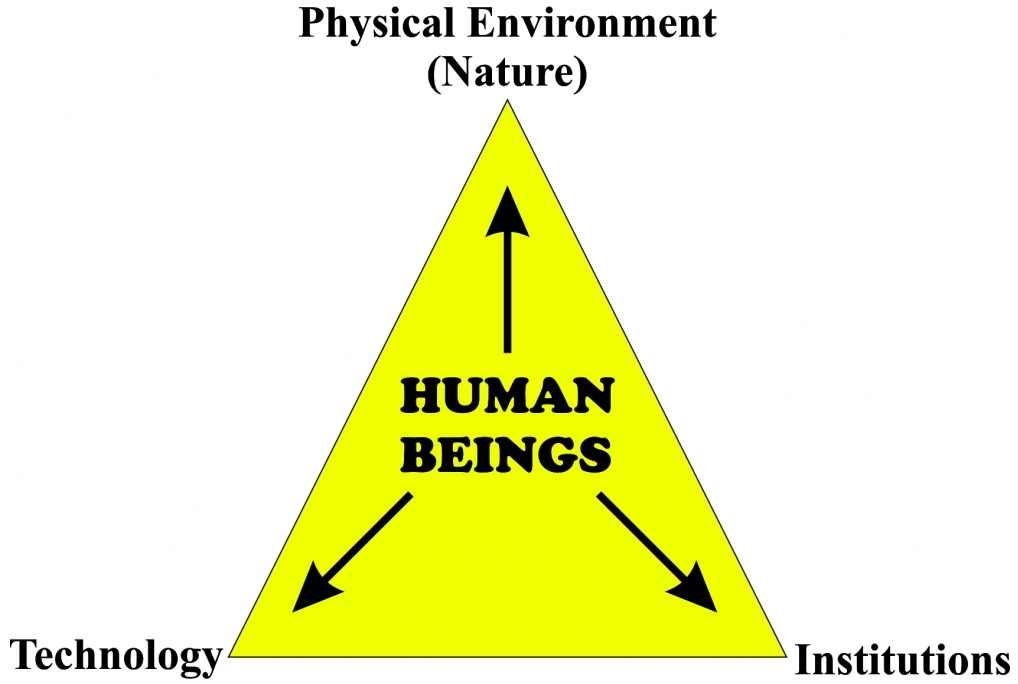
Explain with a diagram how nature, technology and institutions are interdependent.
Answer
  1. Nature is full of resources. Human beings interact with nature through technology and create institutions to accelerate their economic development.
  1. Human beings themselves are essential components of resources.
  2. They transform material available in our environment into resources and use them.
View full question & answer
Question 733 Marks
Describe two other methods that can be adopted to prevent soil erosion.
OR
Describe two other methods of soil conservation.
Answer
  1. Strip cropping: Large fields can be divided into strips. Strips of grass are left to grow between the crops. This breaks the force of the wind.
  2. Planting of shelter belts: Planting lines of trees to create shelter also works in a similar way. It breaks the force of the wind and restricts soil erosion. These shelter belts have contributed significantly in the stabilisation of sand dunes and deserts.
View full question & answer
Question 743 Marks
How is mineral processing responsible for land degradation?
Answer
The mineral processing like grinding of limestone for cement industry and calcite and soapstone for ceramic industry generate huge quantity of dust in the atmosphere. It retards the process of infiltration of water into the soil after it settles down on the land.
View full question & answer
Question 753 Marks
Which resources are community owned resources?
Answer
There are resources which are accessible to all the members of the community. Village commons (grazing grounds, burial grounds, village ponds, etc.) public parks, picnic spots etc.
View full question & answer
Question 763 Marks
What is the importance of soil as a resource?
Answer
Soil is the most important renewable natural resource. It is the medium of plant growth and supports different types of living organisms on the earth.
View full question & answer
Question 773 Marks
Which resources are termed as ‘International Resources’?
Answer
There are international institutions which regulate some resources. The oceanic resources beyond 200km of the Exclusive Economic Zone belong to open ocean and no individual country can utilise these without the concurrence of international institutions.
View full question & answer
Question 783 Marks
What were the aims of Agenda 21 to achieve global sustainable development?
Answer
It aims at achieving global sustainable development. It is an agenda to combat environmental damage, poverty, disease through global co-operation on common interests, mutual needs and shared responsibilities. One major objective of the Agenda 21 is that every local government should draw its own local Agenda 21.
View full question & answer
Question 793 Marks
What are Potential Resources?
Answer
Resources which are found in a region, but have not been utilised. For example, the western parts of India particularly Rajasthan and Gujarat have enormous potential for the development of wind and solar energy, but so far these have not been developed properly.
View full question & answer
Question 803 Marks
How are resources associated with colonialism?
Answer
The history of colonisation reveals that rich resources in colonies were the main attractions for the foreign invaders. It was primarily the higher level of technological development of the colonizing countries that helped them to exploit resources of other regions and establish their supremacy over the colonies.
View full question & answer
Question 813 Marks
How can the land be saved from degradation?
Answer
There are many ways to solve the problems:
Management of grazing can help to some extent.
Planting of shelter belts of plants, control on over grazing, stabilisation of sand dunes by growing thorny bushes are some of the methods to check land degradation.
Proper management of waste lands, control of mining activities, proper discharge and disposal of industrial effluents and wastes after treatment can reduce land and water degradation in industrial and suburban areas.
View full question & answer
Question 823 Marks
Give some important features of the black soil.
Answer
The black soils are made up of extremely fine i.e. clayey material. They are well-known for their capacity to hold moisture. In addition, they are rich in soil nutrients, such as calcium carbonate, magnesium, potash and lime. These soils are generally poor in phosphoric contents. They develop deep cracks during hot weather, which helps in the proper aeration of the soil.
View full question & answer
Question 833 Marks
What was Gandhiji’s concern about resources conservation?
Answer
Mahatma Gandhi demonstrated his worry about the usage of resources by raising his voice against it. He made everybody mindful that the regular resources are altogether restricted, in his words he said "Earth has enough to satisfy the need of everybody except insufficient to fulfill their selfish desire".He put the greedy and narrow minded people and exploitative nature of current innovation as the main cause of resource exhaustion. He was against mass production and needed to supplant it with by result of masses.
View full question & answer
Question 843 Marks
What are ‘Reserves’?
Answer
Reserves are the subset of the stock, which can be put into use with the help of existing technical ‘know-how’ but their use has not been started. These can be used for meeting future requirements. River water can be used for generating hydroelectric power but presently, it is being utilised only to a limited extent. Thus, the water in the dams, forests etc. is a reserve which can be used in the future.
View full question & answer
Question 853 Marks
Why is alluvial soil called ‘fertile soil’?
Answer
Alluvial soils as a whole are very fertile. Mostly these soils contain adequate proportion of potash, phosphoric acid and lime which are ideal for the growth of sugarcane, paddy, wheat and other cereal and pulse crops.
View full question & answer
Question 863 Marks
Define Developed Resources.
Answer
Resources which are surveyed and their quality and quantity have been determined for utilization. The development of resources depends on technology and level of their feasibility.
View full question & answer
Question 873 Marks
Why did the colonial government never try to conserve resources?
Answer
The following are the reasons why the British government in India did not try to conserve resources:
  1. They themselves were exploiting the natural resources to fulfill the demand of their home nation for raw material.
  2. It was the trade that enabled the British government to rule over the vast nation (India) and in order to meet the demand of trade and expand imperial power, the imperial administration exploited numerous natural resources of India.
View full question & answer
Question 883 Marks
What do resources mean? How are resources classified?
Answer
Resources are the means available for economic and political development, such as mineral wealth, labour force, etc. In other words, everything available in environment that can be used to satisfy our needs provided, it is technologically accessible, esenemically feasible and oulturally acceptable can be called resources.These resources can be classified in the following ways:
  1. On the basis of origin-biotic and abiotic.
  2. On the basis of exhaustibility renewable and non-renewable.
  3. On the basis of ownership-individual, community, national and international.
  4. On the basis of status of development potential, developed, stock and reserves.
View full question & answer
Question 893 Marks
Why is resource planning a complex process?
Answer
Resource planning is a complex process.It involves:
  1. Identification and keeping record of resources which involves surveying, mapping and qualitative and quantitative estimation and measurement of the resources.
  2. Developing a planning structure with proper technology, skill and institutional set up for implementing resource development plans.
  3. Comparing the resource development plans with overall national develop ment plans.
View full question & answer
Question 903 Marks
What steps can be taken to control soil erosion in hilly areas?
Answer
  1. Ploughing along the contour lines can decelerate the flow of water down the slopes. This is contour ploughing.
  2. Steps can be cut out on the slopes maping terraces. Terrace cultivation restricts erosion.
  3. Strip cropping is a very effective method of soil conservation or controlling soil erosion.
Large fields are divided into strips and strips of grass are left to grow between the crops.
View full question & answer
Question 913 Marks
Why are arid soils found to be non-productive?
Answer
Arid soils are generally sandy in texture and saline in nature. In some areas the salt content is very high and common salt is obtained by evaporating the water. Due to the dry climate, high temperature, evaporation is faster and the soil lacks humus and moisture. The lower horizons of the soil are occupied by Kankar because of the increasing calcium content downwards. The Kankar layer formations in the bottom horizons restrict the infiltration of water.
View full question & answer
Question 923 Marks
Why was the Rio de Janeiro Earth Summit, 1992 held?
Answer
In June 1992, more than 100 heads of states met in Rio de Janeiro in Brazil, for the first International Earth Summit. The Summit was convened for addressing urgent problems of environmental protection and socioeconomic development at the global level. The assembled leaders signed the Declaration on Global Climatic Change and Biological Diversity. The Rio Convention endorsed the global Forest Principles and adopted Agenda 21 for achieving Sustainable Development in the 21st century.
View full question & answer
Question 933 Marks
What is waste land?
Answer
A part of the land is termed as waste land which is put to other non-agricultural uses. Waste land includes rocky, arid and desert areas and land put to other non-agricultural uses includes settlements, roads, railways, industry etc.
View full question & answer
Question 943 Marks
What are international resources?
Answer
The oceanic resources beyond 200km of the Exclusive Economic Zone are international resources. They belong to open ocean and no individual country can utilise these without the concurrence of international institutions.
View full question & answer
Question 953 Marks
What should be the area under forest cover to maintain ecological balance?
Answer
Forest area in the country is far lower than the desired 33 per cent of geographical area, as it was outlined in the National Forest Policy (1952). It was considered essential for maintenance of the ecological balance.
View full question & answer
Question 963 Marks
  1. Distinguish between Bangar and Khadar soils by giving four characteristic features of each.
  2. Name any two nutrients that alluvial soil is rich in.
Answer
  1.  
S.No.
Bangar
Khadar
(i)
It is old alluvial soil.
It is new alluvial soil.
(ii)
It has high concentration of Kanker modules.
It has less concentration of Kanker Kanker modules.
(iii)
It is less fertile.
It is more fertile.
(iv)
There are less fine particles in it.
There are more fine particles in it.
  1. Nutrients that alluvial soils are rich in are:
  1. Potash.
  2. Phosphoric acid and lime.
View full question & answer
Question 973 Marks
What do you understand by the term ‘stock’?
Answer
Materials in the environment which have the potential to satisfy human needs but human beings do not have the appropriate technology to access these, are included among stock.
For example, water is a compound of two inflammable gases; hydrogen and oxygen, which can be used as a rich source of energy. But we do not have the required technical ‘know-how’ to use them for this purpose. Hence, it can be considered as stock.
View full question & answer
Question 983 Marks
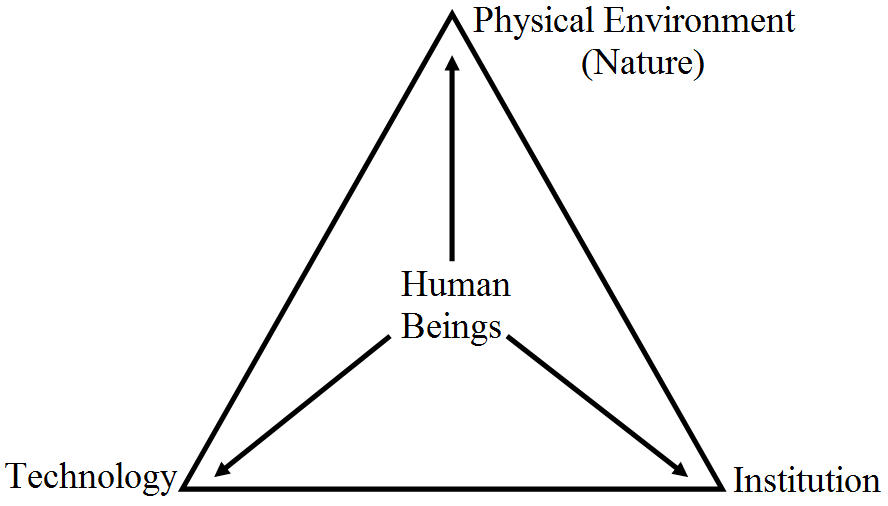
Explain the interdependent relationship between nature, technology and institutions. Also make a diagram to represent the same.
Answer

The process of transformation of things available in our environment involves an inter-dependent relationship between nature, technology and institutions. Human beings interact with nature through technology and create institutions to accelerate their economic development.
View full question & answer
SHORT ANSWER QUESTIONS(3 Mark) - Page 2 - Social Studies STD 10 Questions - Vidyadip