Question types

Unit 3 Ch 1 : Power-sharing question types

615 questions across 16 question groups — pick any mix to generate a Social Studies paper with step-by-step answer keys.

615
Questions
16
Question groups
5
Question types
Sample Questions

Unit 3 Ch 1 : Power-sharing questions

One sample from each question group in this chapter. Select any group above to see the full set with answer keys.

Q 1MCQ (1 Mark)1 Mark
Which of the following statements accurately distinguishes between Majoritarianism and Power sharing?
  • Majoritarianism emphasizes the dominance of the majority community, while Power sharing emphasizes the sharing of power among different groups.
  • B
    Majoritarianism emphasizes the need for consensus building, while Power sharing emphasizes the exclusion of minority groups.
  • C
    Majoritarianism emphasizes the importance of accommodating minority interests, while Power sharing emphasizes the need for majority rule.
  • D
    Majoritarianism emphasizes the need for peaceful resolution of conflicts, while Power sharing emphasizes the use of force to impose the majority's will.

Answer: A.

View full solution
Q 2MCQ (1 Mark)1 Mark
When many countries of Europe came together to form the European Union $ , ......... $ was chosen as its headquarters.
  • Brussels
  • B
    Paris
  • C
    London
  • D
    Zurich

Answer: A.

View full solution
Q 3MCQ (1 Mark)1 Mark
Modern democracies maintain check and balance system. Identify the correct option based on the horizontal power sharing arrangement.
  • A
    Central government, state government, local bodies.
  • Legislature, executive, judiciary.
  • C
    Among different social groups.
  • D
    Among different pressure groups.

Answer: B.

View full solution
Q 4MCQ (1 Mark)1 Mark
Which one of the following is a major caste group of Sri Lanka :
  • A
    Christian and Tamil.
  • B
    Buddhist and Hindu.
  • Sinhali and Tamil.
  • D
    Sinhali and Christian.

Answer: C.

View full solution
Q 5MCQ (1 Mark)1 Mark
Belgium has borders with :
  • A
    USA, Germany, Netherlands and France.
  • B
    Russia, Germany, Netherlands and Luxembourg.
  • C
    Canada, USA, Russia and Luxembourg.
  • France, Netherlands, Germany and Luxembourg.

Answer: D.

View full solution
Direction : Mark the option which is most suitable:
Assertion $(A)$ : Horizontal distribution of power allows different organs of the government placed at same level to exercise different powers.
Reason $(R)$ : The separation ensures that different organs can exercise unlimited power.
  • A
    If both assertion $(A)$ and reason $(R)$ are true and reason $(R)$ is the correct explanation of assertion $(A).$
  • B
    If both assertion $(A)$ and reason $(R)$ are true but reason $(R)$ is not the correct explanation of assertion $(A).$
  • Assertion $(A)$ is true but reason $(R)$ is false.
  • D
    Both assertion $(A)$ and reason $(R)$ are false.

Answer: C.

View full solution
Direction : Mark the option which is most suitable:
Assertion $(A)$ : Power sharing is good for democracy.
Reason $(R)$ : It helps to reduce the possibility of conflict between the social groups.
  • If both assertion $(A)$ and reason $(R)$ are true and reason $(R)$ is the correct explanation of assertion $(A).$
  • B
    If both assertion $(A)$ and reason $(R)$ are true but reason $(R)$ is not the correct explanation of assertion $(A).$
  • C
    Assertion $(A)$ is true but reason $(R)$ is false.
  • D
    Both assertion $(A)$ and reason $(R)$ are false.

Answer: A.

View full solution
Direction : Mark the option which is most suitable:
Assertion $(A)$ : Community government in Belgium allows to share power among religious and linguistic groups.
Reason $(R)$ : In India there are legal and constitutional arrangements where by socially weaker sections and women are represented in the legislatures and administration.
  • A
    If both assertion $(A)$ and reason $(R)$ are true and reason $(R)$ is the correct explanation of assertion $(A).$
  • If both assertion $(A)$ and reason $(R)$ are true but reason $(R)$ is not the correct explanation of assertion $(A).$
  • C
    Assertion $(A)$ is true but reason $(R)$ is false.
  • D
    Both assertion $(A)$ and reason $(R)$ are false.

Answer: B.

View full solution
After reading this chapter, three students drew different conclusions. Which of these do you agree with and why? Give your reasons in about 50 words.
  • Thomman: Power sharing is necessary only in societies which have religiousm, linguistic or ethnic divisions.
  • Mathayi: Power sharing is suitable only for big countries that have regional divisions.
  • Ouseph: Every society needs some form of power sharing even if it is small or does not have social divisions.
View full solution
Read the passage below and answer the questions that follow:
Government measures, coming one after the other, gradually increased the feeling of alienation among the Sri Lankan Tamils. They felt that none of the major political parties led by the Buddhist Sinhala leaders were sensitive to their language and culture. They felt that the constitution between the Sinhala and Tamil communities strained over time. The Sri Lankan Tamils launched parties and struggles for the recognition of Tamil as an official language, forregional autonomy and equality of opportunity in securing education and jobs. But their demand for more autonomy to provinces populated by the Tamils was repeatedly denied. By 1980s several political organisations were formed demanding an independent Tamil Eelam (state) innorthern and eastern parts of Sri Lanka.The distrust between the two communities turned into widespread conflict. It soon turned into a CIVIL WAR. As a result thousands of people of boththe communities have been killed. Many families were forced to leave the country as refugees and many more lost their livelihoods.
  1. What is not the geographical location of Sri Lanka as compared to India?
  1. Sri Lanka is an island nation.
  2. It is about 20kms from Rameshwaram, the Southern coast of Tamil Nadu.
  3. It lies in the Indian Ocean.
  4. None of the above.
  1. What happened when demand of Tamils, for more autonomy , repeatedly denied by the government?
  1. It soon turned into a Civil war. Thousands of people of both the communities have been killed.
  2. Many became refugees.
  3. It improved the social , cultural and economic life of the country.
  4. Both (A) and (B).
  1. Which of the following was not a provision of the Act of 1956 passed in Sri Lanka?
  1. It recognises Sinhala as the only official language
  2. The government followed preferential policies that favoured Sinhala applicants.
  3. A new constitution stipulated that the state should protect and foster Buddhism.
  4. Provincial autonomy was given to Tamils.
  1. The Sri Lankan Tamils lauched parties and struggles for:
  1. For regional autonomy.
  2. Equality of opportunity in securing education and jobs.
  3. The recognition of Tamils as an official language.
  4. All of the above.
View full solution
Read the given extract and answer the following questions.
Belgium is a small country in Europe, smaller in area than the state of Haryana. It has borders with France, the Netherlands, Germany and Luxembourg. It has a population of a little over one crore, about half the population of Haryana. The ETHNIC composition of this small country is very complex. Of the country's total population, 59 per cent lives in the Flemish region and speaks Dutch language. Another 40 per cent people live in the Wallonia region and speak French. Remaining one per cent of the Belgians speak German. In the capital city Brussels, 80 per cent people speak French while 20 per cent are Dutch speaking. Sri Lanka has a diverse population. The major social groups are the Sinhala-speakers (74 per cent) and the Tamil-speakers (18 per cent). Among Tamils, there are two subgroups. Tamil natives of the country are called 'Sri Lankan Tamils' (13 per cent). The rest, whose forefathers came from India as plantation workers during colonial period, are called 'Indian Tamils'.
The following MCQs by choosing the most appropriate option:
  1. Who are called Indian Tamils in context of Srilanka?
  1. Forefathers came from India as plantation workers during colonial period, are called 'Indian Tamils'.
  2. Indentured labourers of Carribean.
  3. Red Indians.
  4. Nordic Aryans.
  1. Complete the sentence with appropriate word.
In the capital city, 80 per cent people speak French, while 20 per cent are Dutch speaking.
  1. Brussels.
  2. Paris.
  3. London.
  4. Moscow.
  1. Why is the ethnic composition of the small country Belgium very complex?
  1. Of the country's total population, 59 per cent lives in the Flemish region and speaks Dutch language.
  2. Another 40 per cent people live in the Wallonia region and speak French.
  3. In the capital city Brussels, 80 per cent people speak French while 20 per cent are Dutch speaking.
  4. All of these.
  1. The major social groups are the Sinhala-speakers ________ and the Tamil-speakers ________.
  1. 72,16
  2. 74,18
  3. 70, 20
  4. 73,19
View full solution
Read the given extract and answer the following questions.
Different organs of government placed at the same level to exercise different powers. Such a separation ensures that none of the organs can exercise unlimited power. Each organ checks the others. This results in a balance of power among various institutions. Last year, we studied that in a democracy, even though ministers and government officials exercise power, they are responsible to the Parliament or State Assemblies. Similarly, although judges are appointed by the executive, they can check the functioning of executive or laws made by the legislatures. This arrangement is called a system of checks and balances.
Answer the following MCQs by choosing the most appropriate option:
  1. The above extract related to which of the following options:
  1. Horizontal Power Sharing.
  2. Vertical Power Sharing.
  3. Regional Power Sharing.
  4. None of these.
  1. Which among the following option is correct regarding power sharing?
  1. When power is shared among different organs of the government.
  2. When power is shared among at different levels.
  3. When power is shared among different social groups.
  4. All of these.
  1. Match List I with List II:
List I
List II
1.
Power shared among different organs of government.
(A)
Community Government
2.
Power shared among governments at different levels.
(B)
Separation of Powers
3.
Power shared by different social groups.
(C)
Coalition Government
4.
Power shared by two or more political parties.
(D)
Federal Government
  1. 1-(D), 2-(A), 3-(B), 4-(C)
  2. 1-(B), 2-(C), 3-(D), 4-(A)
  3. 1-(B), 2-(D), 3-(A), 4-(C)
  4. 1-(C), 2-(D), 3-(A), 4-(B)
  1. Which among the following is called a system of checks and balances?
  1. The judges are appointed by the executive and further judges can check the functioning of executive or laws made by the legislature.
  2. The President of India appoints the Prime Minister and further the Prime Minister checks the powers of the President.
  3. The Supreme Court judges checks the powers of the High Court.
  4. All of these.
View full solution
Read the given extract and answer the following questions.
The idea of power-sharing has emerged in opposition to the notions of undivided political power. For a long time it was believed that all power of government must reside in one person or group of persons located at one place. It was felt that if the power to decide is dispersed, it would not be possible to take quick decisions and to enforce them. But these notions have changed with the emergence of democracy. One basic principle of democracy is that people are source of all political power. ln a democracy, people rule themselves through institutions of self-government. ln a good democratic government, due respect is given to diverse groups and views that exist in a society. Everyone has a voice in the shaping of public policies. Therefore, it follows that in a democracy, political forms of power-sharing should be distributed amongst as many citizens as possible.
Answer the following MCQs by choosing the most appropriate option:
  1. The basic principle of democracy is:
  1. People are the source of political power.
  2. None can exercise unlimited power.
  3. Power of a government reside in one person.
  4. To reduce conflict between social groups.
  1. Which is a prudent reason for power-sharing?
  1. lt reduces the possibility of conflict between communities and ensures the stability of political order.
  2. Power-sharing is the very spirit of democracy.
  3. Both (a) and (b).
  4. None of these.
  1. Which of the following options describes a good democratic system?
  1. Everyone has a voice in the shaping of public policies.
  2. Power to take quick decision and to enforce them.
  3. All powers reside in the person.
  4. Power is shared among central and state governments.
  1. Which of the following is not one of the aspects of federal division of power?
  1. Sharing of powers among central provincial and local governments.
  2. Division of powers involving higher and lower levels of governments.
  3. The Constitution clearly lays down powers of different levels of government.
  4. There is no vertical division of powers.
View full solution
Read the passage below and answer the questions that follow:
Sri Lanka emerged as an independent country in 1948. The leaders of the Sinhala community sought to secured dominance over government by virtue of their majority. As a result, the democratically elected government adopted a series of MAJORITARIAN measures to establish Sinhala supremacy. In 1956, an Act was passed to recognize Sinhala as the only official language, thus disregarding Tamil. The governments followed preferential policies that favoured Sinhala applicants for university positions and government jobs. A new constitution stipulated that the state shall protect and foster Buddhism.
  1. In which country Majoritarianism is followed?
  1. Sri Lanka.
  2. India.
  3. Belgium.
  4. None of the above.
  1. Most of the Sinhala speaking people in Sri Lanka are:
  1. Hindu
  2. Buddhist
  3. Telugu
  4. Christian
  1. Name the most vibrant minority social group in Sri Lanka?
  1. Sinhala
  2. Buddhist
  3. Tamil
  4. Christian
  1. Which of the following are the ethnic communities of Sri Lanka?
  1. Indian Tamils and Sri Lankan Tamils.
  2. Tamils, Buddhists, Hindus.
  3. Indian Tamils, Sri Lankan Tamils and Buddhists.
  4. Sinhala speakers, Sri Lankan Tamils and Indian Tamils.
View full solution
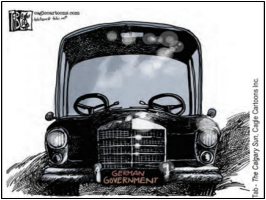
The cartoon below depicts Germany’s government that was formed after the 2005 elections. It included the two major parties of the country, namely the Christian Democratic Union and the Social Democratic Party. The two parties are historically rivals to each other. Which of the following options best explains the cartoon?
Image
  • Coalition Government.
  • B
    Two Party System.
  • C
    Democratic government.
  • D
    Bi-party system.

Answer: A.

View full solution
Which of the following statement(s) are true with respect to the ethnic composition of Belgium?
I. 59 percent of the total population of Belgium lives in the Wallonia region and speaks French.
II. 40 percent live in the Flemish region and speak Dutch.
III. One percent of the Belgians speak German.
IV. In the capital city Brussels, 80 percent people speak French while 20 per cent are Dutch speaking.
Choose the correct option :
  • I and II
  • B
    III and IV
  • C
    I, II and III
  • D
    I and IV

Answer: A.

View full solution
Which of the following statements accurately distinguishes between Majoritarianism and Power sharing?
  • Majoritarianism emphasizes the dominance of the majority community, while Power sharing emphasizes the sharing of power among different groups.
  • B
    Majoritarianism emphasizes the need for consensus building, while Power sharing emphasizes the exclusion of minority groups.
  • C
    Majoritarianism emphasizes the importance of accommodating minority interests, while Power sharing emphasizes the need for majority rule.
  • D
    Majoritarianism emphasizes the need for peaceful resolution of conflicts, while Power sharing emphasizes the use of force to impose the majority's will.

Answer: A.

View full solution
DIRECTION: Mark the option which is most suitable:
  1. If both assertion (A) and reason (R) are true and reason (R) is the correct explanation of assertion (A).
  2. If both assertion (A) and reason (R) are true but reason (R) is not the correct explanation of assertion (A).
  3. Assertion (A) is true but reason (R) is false.
  4. Both assertion (A) and reason (R) are false.
Assertion(A): Horizontal distribution of power allows different organs of the government placed at same level to exercise different powers.
Reason(R): The separation ensures that different organs can exercise unlimited power.
View full solution
DIRECTION: Mark the option which is most suitable:
  1. If both assertion (A) and reason (R) are true and reason (R) is the correct explanation of assertion (A).
  2. If both assertion (A) and reason (R) are true but reason (R) is not the correct explanation of assertion (A).
  3. Assertion (A) is true but reason (R) is false.
  4. Both assertion (A) and reason (R) are false.
Assertion(A): Community government in Belgium allows to share power among religious and linguistic groups.
Reason(R): In India there are legal and constitutional arrangements where by socially weaker sections and women are represented in the legislatures and administration.
View full solution
DIRECTION: Mark the option which is most suitable:
  1. If both assertion (A) and reason (R) are true and reason (R) is the correct explanation of assertion (A).
  2. If both assertion (A) and reason (R) are true but reason (R) is not the correct explanation of assertion (A).
  3. Assertion (A) is true but reason (R) is false.
  4. Both assertion (A) and reason (R) are false.
Assertion(A): Power sharing is good for democracy.
Reason(R): It helps to reduce the possibility of conflict between the social groups.
View full solution
Read the following passage and pick out any one of the prudential reasons for power sharing offered in this.
"We need to give more power to the panchayats to realise the dream of Mahatma Gandhi and the hopes of the makers of our Constitution. Panchayati Raj establishes true democracy. It restores power to the only place where power belongs in a democracy – in the hands of the people. Giving power to Panchayats is also a way to reduce corruption and increase administrative efficiency. When people participate in the planning and implementation of developmental schemes, they would naturally exercise greater control over these schemes. This would eliminate the corrupt middlemen. Thus, Panchayati Raj will strengthen the foundations of our democracy."
View full solution
The Mayor of Merchtem, a town near Brussels in Belgium, has defended a ban on speaking French in the town’s schools. He said that the ban would help all non-Dutch speakers integrate in this Flemish town. Do you think that this measure is in keeping with the spirit of Belgium’s power sharing arrangements? Give your reasons in about 50 words.
View full solution
After reading this chapter, three students drew different conclusions. Which of these do you agree with and why? Give your reasons in about 50 words.
  • Thomman: Power sharing is necessary only in societies which have religiousm, linguistic or ethnic divisions.
  • Mathayi: Power sharing is suitable only for big countries that have regional divisions.
  • Ouseph: Every society needs some form of power sharing even if it is small or does not have social divisions.
View full solution
Sri Lanka emerged as an independent country in 1948. The leaders of the Sinhala community sought to secure dominance over government by virtue of their majority. As a result, the democratically elected government adopted a series of MAJORITARIAN measures to establish Sinhala supremacy. Over the years, it created feelings of alienation among the Sri Lankan Tamils. They felt that none of the major political parties led by the Buddhist Sinhala leaders was sensitive to their language and culture. As a result, the relations between the Sinhala and Tamil communities strained over time. On the other hand, the Belgian leaders took a different path. They recognised the existence of regional differences and cultural diversities. Between 1970 and 1993, they amended their constitution four times to work out an arrangement that would enable everyone to live together within the same country.
1. State any two demands of Tamils in Sri Lanka.
2. State the results of the Majoritarian Government in Sri Lanka.
3. Explain any two provisions of the Belgian model of power sharing.
View full solution
Read the passage below and answer the questions that follow:
The Belgian leaders took a different path. They recognised the existence of regional differences and cultural diversities. Between 1970 and 1993, they amended their constitution four times so as to work out an arrangement that would enable everyone to live together within the same country. The arrangement they worked out is different from any other country and is very innovative.Apart from the Central and the State Government, there is a third kind of government. This ‘community government’ is elected by people belonging to one language community - Dutch, French and German-speaking - no matter where they live. This government has the power regarding cultural, educational and language-related issues. It is very complicated, even for people living in Belgium. But these arrangements have worked well so far. They helped to avoid civic strife between the two major communities and a possible division of the country on linguistic lines. When many countries of Europe came together to form the EuropeanUnion, Brussels was chosen as its headquarters.
  1. What was chosen as the headquarters of the European Union?
  1. Brussels
  2. Zurich
  3. Swiden
  4. France
  1. Who elects the community government in Belgium?
  1. People belonging to one language community only
  2. By the leader of Belgium.
  3. The citizens of the whole country.
  4. The community leaders of the Belgium.
  1. The community Government signifies:
  1. The powers of the government regarding community development.
  2. The powers of the government regarding law making for the community.
  3. The powers of the government regarding cultural ,educational and language related issues.
  4. The government enjoys privileges to safeguard the interest of a particular community.
  1. How many times the constitution of Belgium was amended?
  1. Two times.
  2. Three times.
  3. Four times.
  4. Five times.
View full solution
Read the passage below and answer the questions that follow:
Sri Lanka emerged as an independent country in 1948. The leaders of the Sinhala community sought to secured dominance over government by virtue of their majority. As a result, the democratically elected government adopted a series of MAJORITARIAN measures to establish Sinhala supremacy. In 1956, an Act was passed to recognize Sinhala as the only official language, thus disregarding Tamil. The governments followed preferential policies that favoured Sinhala applicants for university positions and government jobs. A new constitution stipulated that the state shall protect and foster Buddhism.
  1. In which country Majoritarianism is followed?
  1. Sri Lanka.
  2. India.
  3. Belgium.
  4. None of the above.
  1. Most of the Sinhala speaking people in Sri Lanka are:
  1. Hindu
  2. Buddhist
  3. Telugu
  4. Christian
  1. Name the most vibrant minority social group in Sri Lanka?
  1. Sinhala
  2. Buddhist
  3. Tamil
  4. Christian
  1. Which of the following are the ethnic communities of Sri Lanka?
  1. Indian Tamils and Sri Lankan Tamils.
  2. Tamils, Buddhists, Hindus.
  3. Indian Tamils, Sri Lankan Tamils and Buddhists.
  4. Sinhala speakers, Sri Lankan Tamils and Indian Tamils.
View full solution
Read the passage below and answer the questions that follow:
Power may also be shared among different social groups, such as the religious and linguistic groups. ‘Community government’ in Belgium is a good example of this arrangement. In some countries there are constitutional and legal arrangements whereby socially weaker sections and women are represented in the legislatures and administration. This type of arrangement is meant to give space in the government and administration to diverse social groups who otherwise would feel alienated from the government. This method is used to give minority communities a fair share in power.
  1. Power sharing means:
  1. System of political arrangement in which power is shared between ministers of the government.
  2. System of political arrangement in which power is shared between different organs of the government.
  3. System of political arrangement in which power is shared between different levels of the government.
  4. All of the above.
  1. Which one is not a benefit of Power sharing?
  1. Reduces the possibilities of conflicts between social groups.
  2. Ensures political stability in the long run.
  3. All the political parties get their expected share.
  4. It upholds the spirit of democracy.
  1. Apart from the Central and State Government, there is a third type of government in Belgium called the:
  1. Regional Government.
  2. State Government.
  3. Union Government.
  4. Community Government.
  1. Which is not a feature of Community government?
  1. Apart from the Central and the State Government, this is a third type of government.
  2. It is elected by the people belonging to one community that is Dutch, French, German speaking.
  3. It is mainly based on cooperation and tolerance.
  4. It does not have the power regarding cultural, educational and language related issues.
View full solution
Read the passage below and answer the questions that follow:
Power is shared among different organs of government, such as the legislature, executive and judiciary. Let us call this horizontal distribution of power because it allows different organs of government placed at the same level to exercise different powers. Such a separation ensures that none of the organs can exercise unlimited power. Each organ checks the others. This results in a balance of power among various institutions. Last year we studied that in a democracy, even though ministers and government officials exercise power, they are responsible to the Parliament or State Assemblies. Similarly, although judges are appointed by the executive, they can check the functioning of executive or laws made by the legislatures. This arrangement is called a system of checks and balances.
  1. Power sharing between different organs of the government is being referred as:
  1. Horizontal distribution of power.
  2. Vertical division of power.
  3. Union Government.
  4. Community Government.
  1. Power Sharing is between:
  1. Legislature, executive and parliament.
  2. Legislature, executive and judiciary.
  3. Legislature, high court and judiciary.
  4. None of the above.
  1. It allows different organs of government placed at the same level to exercise different powers is known as:
  1. Circular distribution of power.
  2. Vertical distribution of power.
  3. Horizontal distribution of power.
  4. All of the above.
  1. Judges are appointed by the executive, they can check the functioning of executive or laws made by the legislature known as:
  1. Horizontal distribution of power.
  2. Vertical distribution of power.
  3. Checks and balances.
  4. All of the above.
View full solution

Generate a Unit 3 Ch 1 : Power-sharing paper free

Pick question groups from the list above, set marks and difficulty, and export a branded PDF with step-by-step answer keys. First 3 chapters free — no signup.

Download App