Questions

SHORT ANSWER QUESTIONS(3 Mark)

🎯

Test yourself on this topic

49 questions · timed · auto-graded

Question 13 Marks
Explain how Belgium was able to solve her ethnic problems.
Answer
  1. The Belgium leaders recognised the existence of regional differences and cultural diversities through accommodation method.
  2. Dutch and French speaking ministers are equal number in the central government.
  3. Many powers of the central government had been given to the state governments of the two regions.
  4. State governments are not subordinate to the central government.
  5. Brussels have a separate government in which both the communities have equal representation.
  6. There is a separate ‘community government’ elected by the people belonging to one language community no matter where they live.

View full question & answer
Question 23 Marks
Explain, how power is shared among different organs of government.
Answer
Power is shared among different organs of government:-
  1. Legislature:-makes laws.
  2. Executive:-implements laws.
  3. Judiciary:-safeguards laws.
View full question & answer
Question 33 Marks
After reading this chapter, three students drew different conclusions. Which of these do you agree with and why? Give your reasons in about 50 words.
  • Thomman: Power sharing is necessary only in societies which have religiousm, linguistic or ethnic divisions.
  • Mathayi: Power sharing is suitable only for big countries that have regional divisions.
  • Ouseph: Every society needs some form of power sharing even if it is small or does not have social divisions.
Answer
Ouseph's statement is the most logical, and thus, should be agreed on. Every society needs some form of power sharing even if it is small or does not have social divisions. A democratic society is one where its members or citizens through participation acquire a stake in the system. Power sharing not only prevents conflict between various groups in the society but it also generates a sense of belongingness among them to the society. Power sharing helps to maintain a balance of power among various institutions and also keep a check on how it is exercised. Irrespective of the size of a country or the type of a society, people will be more satisfied where they have a say in the functioning and decision making processes of the system.
View full question & answer
Question 43 Marks
What is the population of Belgium? Describe the ethnic composition of this country.
OR
How is the ethnic composition of Belgium? Explain.
Answer
The population of Belgium is a little over one crore. In January 2016, the population of Belgium was estimated to be 11337654. The ethnic composition of this small country is very complex. bor Of the country's total population,
  1. 59 percent lives in the Flemish region and speaks Dutch language.
  2. Another 40 percent people live in the Son Wallonia region and speak French.
  3. Remaining one percent of the Belgians speak German.
  4. In the capital city, Brussels, 80 percent people speak French while 20 percent are Dutch-speaking.
View full question & answer
Question 53 Marks
What is the source of political power in a democracy?
Answer
In a democracy, the source of power is the people of the nation. Democracy is a form of government in which the government is chosen by People to rule them. Moreover, the decision-making power in Democracy lies in the hands of the people. in this way, people are the only source of power in Democracy.
View full question & answer
Question 63 Marks
Both Belgium and Sri Lanka are democracies but they follow different systems of power sharing. Support the statement by giving these points of difference.
Answer
Both countries are democracies. Both have various ethnic groups living in their respective countries.
Differences:
  1. In Belgium, the leaders have realised that the unity of the country is possible only byrespecting the feelings and interests of different communities and regions. Such a realisation resulted in mutually acceptable arrangement for sharing the power.
  2. Sri Lanka shows us a contrasting example. It shows us that if a majority community wants to force its dominance over others and refuses to share power, it can undermine the unity of the country.
View full question & answer
Question 73 Marks
How did Belgians tackle the problems of different communities?
Answer
In Belgium, the leaders have realised that the unity of the country is possible only by respecting the feelings and interests of different communities and regions. Such a realisation resulted in mutually acceptable arrangements for sharing power.
View full question & answer
Question 83 Marks
Evaluate the steps which turned out to be milestones to establish majoritarianism in Sri Lanka.
Answer
  1. Sri Lanka emerged as an independent country in 1948. The leaders of the Sinhala community sought to secure dominance over government by virtue of their majority.
  2. As a result, the democratically elected government adopted majoritarian measures to establish Sinhala supremacy.
  3. In 1956, an act was passed to recognise Sinhala, as the only official language,thus disregarding Tamil.
  4. The government followed policies that favoured Sinhala applicants for university positions and government jobs.
With a new constitution, Buddhism was adopted as a state religion.
View full question & answer
Question 93 Marks
How did the Tamils make efforts to gain power in Sri Lanka?
Answer
  1. Sri Lankan Tamils launched parties and struggles for the recognition of Tamil as the official language.
  2. They also made efforts for regional autonomy and equality of opportunity in securing education and jobs.
  3. Several political organisations were formed demanding an independent Tamil Eelam (state) in northern and eastern parts of Sri Lanka.
View full question & answer
Question 103 Marks
Give a comparative study of the ways in which the Belgian and Sri Lankan governments dealt with the problem of cultural diversities. What lessons do we learn from the principles of majoritarianism and accommodation followed in Sri Lanka and Belgium respectively?
Answer
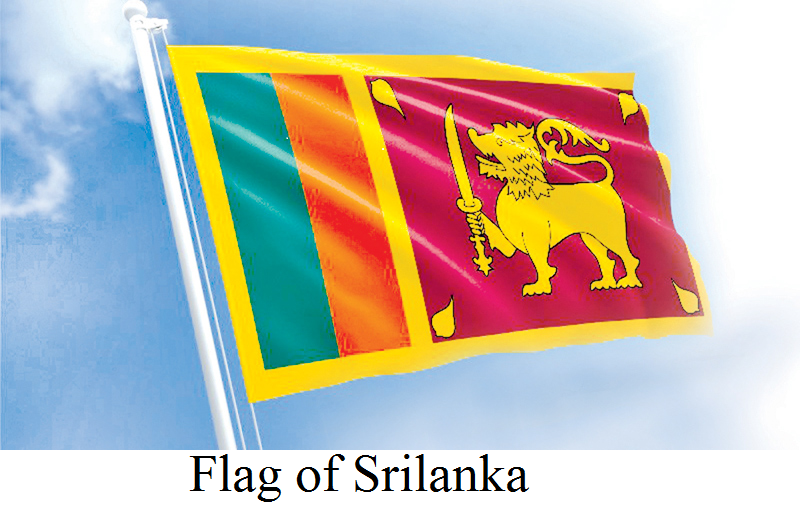
The Belgian leaders, in order to solve the problem of cultural diversities, adopted a compromising path. They amended their Constitution four times so as to work out an arrangement that would enable everyone to live together peacefully within the same country. It was declared that no single community can make decisions unilaterally. Brussels has a separate government in which both the communities enjoy equal representation. These measures helped to avoid civic strife between the two communities and a possible division of the country on linguistic lines. Sri Lanka presents a different story. The leaders of the majority community namely the Sinhala adopted a series of majoritarian measures to establish Sinhala supremacy. An Act was passed in 1956 which recognised Sinhala as the only official language, thus disregarding Tamil. The government followed preferential policies that favoured Sinhala applicants for university positions and government jobs. These measures gradually increased the feeling of alienation among the Sri Lankan Tamils. Their relations with the Sinhala community got strained over time which finally resulted in civil war. Lessons learnt from Belgium: In Belgium, the leaders realised that unity of the country could be maintained by respecting the feelings and interests of the different communities living in the country. So they worked on the principle of accommodation whereby mutually acceptable arrangement of sharing power were evolved. A possible division of the country on linguistic lines was also avoided. Lessons from Sri Lanka: In a country if a majority community learns to face its dominance over others and refuses to share power it can undermine the unity of the country.
View full question & answer
Question 113 Marks
What did Belgians do to bring the ethnic groups together?
Answer
The Belgian leaders recognised the existence of regional differences and cultural diversities. Between 1970 and 1993, they amended their constitution four times so as to work out an arrangement that would enable everyone to live together within the same country.
View full question & answer
Question 123 Marks
What is the moral reason behind power sharing?
Answer
Power sharing is the very spirit of democracy. A democratic rule involves sharing power with those affected by its exercise, and who have to live with its effects. People have a right to be consulted on how they are to be governed.
View full question & answer
Question 133 Marks
How is power shared among governments at different levels?
Answer
  1. There is a general government for the entire country and governments at the provincial or regional level. The government for the entire country is usually called federal government. In India, it is called the central or state government.
  2. The governments at provincial or regional level are called by different names in different countries. In India, we call them State Governments.
  3. There are governments at local levels too. They are known as the municipality and panchayat.
Our Constitution clearly lays down the powers of different levels of government.
View full question & answer
Question 143 Marks
How is the ethnic composition of Belgium very complex? Explain.
Answer
  1. Of the country's total population, 59 percent live in the Flemish region and speak Dutch language.
  2. Another 40 percent people live in the Wallonia region and speak French.
  3. Remaining one percent of the Belgians speak German.
  4. In the capital city Brussels, 80 percent people speak French while 20 percent are Dutch speaking.
View full question & answer
Question 153 Marks
State one prudential reason and one moral reason for power sharing with an example from the Indian context.
Answer
  1. Prudential reason: Power sharing helps to reduce the possibility of conflict between social groups. For example in India, Hindi has not been imposed on the southern states.
  2. Moral reason: Power sharing is the very soul of democracy. People have right to be consulted on how they are to be governed. In India, reservation of seats for SCs and STs in state assemblies and parliament is an example of moral reason.
View full question & answer
Question 163 Marks
What measures were adopted by the democratically elected government of Sri Lanka to establish Sinhala Supremacy.
Answer
  1. In 1956, an Act was passed to recognise ‘Sinhala’ as the only official language; thus disregarding Tamil.
  2. The governments followed preferential policies that favoured Sinhala applicants for university positions and government jobs.
  3. A new constitution specified that the state shall protect and foster Buddhism.
View full question & answer
Question 173 Marks
What kind of government is there in Brussels?
Answer
Brussels has a separate government in which both the communities have equal representation. The French speaking people accepted equal representation in Brussels because the Dutch speaking community has accepted equal representation in the Central government.
View full question & answer
Question 183 Marks
What were the majoritarian measures taken in Sri Lanka to establish Sinhala supremacy?
OR
Examine any four reasons for strained relationship between the Sinhala and Tamil communities.
Answer
When Sri Lanka emerged as an independent country in 1948, the leaders of the Sinhala community tried to dominate over the government by virtue of their majority. In order to establish their supremacy they took some majoritarian measures' which are given below:
  1. In 1956, an Act was passed which declared Sinhala as the only official language, thus disregarding Tamil.
  2. Preferences were given to Sinhala applicants for university positions and government jobs.
  3. A new Constitution stipulated that the state shall protect and promote Buddhism.
All these government measures, coming one after the other, gradually strained the relationship between the two communities.
View full question & answer
Question 193 Marks
What kind of government was adopted by Sri Lanka?
Answer
Sri Lanka emerged as an independent country in 1948. The leaders of the Sinhala community sought to secure dominance over government by virtue of their majority. As a result, the democratically elected government adopted a series of majoritarian measures to establish Sinhala supremacy.
View full question & answer
Question 203 Marks
What are federal governments?
Answer
Federal governments: Body of individuals at the federal level that sets and administers public policy, exercises executive and political power through customs, institutions, and laws within a country.
View full question & answer
Question 213 Marks
What led to tensions between the Dutch-speaking and French-speaking communities in Belgium during the 1950s and 1960s? Where was this Si tension more acute, and why?
Answer
  1. The minority French-speaking community in Belgium was relatively rich and powerful. This was resented by the Dutch-speaking community who got the benefit of economic development and education much later.
  2. This led to tensions between the Dutch-speaking and French-speaking communities during the 1950s and 1960s.
  3. This tension between the two commu nities was more acute in Brussels.
  4. It was because the Dutch-speaking people constituted majority in the country, but minority in the capital, i.e. Brussels.
View full question & answer
Question 223 Marks
The Mayor of Merchtem, a town near Brussels in Belgium, has defended a ban on speaking French in the town’s schools. He said that the ban would help all non-Dutch speakers integrate in this Flemish town. Do you think that this measure is in keeping with the spirit of Belgium’s power sharing arrangements? Give your reasons in about 50 words.
Answer
No, the measure taken by the Mayor of Merchtem is not in keeping with the spirit of Belgium’s power sharing arrangements. As 59 per cent of the population in the Flemish region speaks Dutch, the ban on speaking French in the town’s schools would prevent French and Dutch speakers to mingle with each other, and also create feelings of distrust and suspicion. The ban ignores the regional differences and cultural diversities. It is against the spirit of accommodating every linguistic group, and creating a right environment for everyone to live. The ban, rather, makes the ground for a civic strife, and a possible division of the community on linguistic lines.
View full question & answer
Question 233 Marks
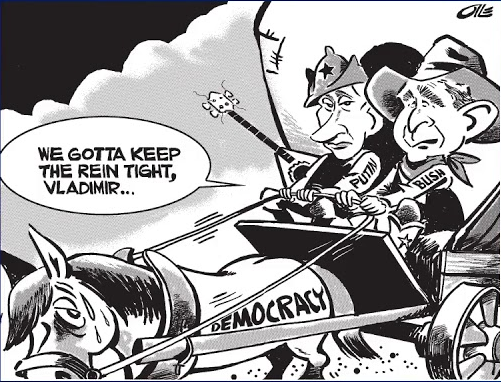
What according to the cartoon shown here, is the relationship between democracy and concentration of power? Can you think of a few examples to illustrate the point being made here?
Answer
Concentration of power means power of government resides in one person or group of persons located at one place. Earlier, it was believed that if power to decide is dispersed, it would not be possible to take quick decisions and to enforce them. But these philosophies changed with the emergence of democracy. In a democracy, people rules themselves through institutions of self-governance and different groups are given due respect and equal rights. Everyone has a voice in shaping the public policies, e.g., Belgium and Sri Lanka.
View full question & answer
Question 243 Marks
What is the concept of ‘Community government’ of Belgium?
Answer
The ‘community government’ is elected by the people belonging to one language community-Dutch, French and German speaking-no matter where they live. This government has the power regarding cultural, educational and language related issues.
View full question & answer
Question 253 Marks
What is common between the Indian and Belgian form of power sharing arrangements?
Answer
Both India and Belgium have a federal form of government where power is shared among governments at different levels called the Federal form of government as in Belgium, or the Central or Union Government as in India.
Power in both the countries is also shared among different social groups, such as religious and linguistic groups. Community Government' in Belgium and 'Reserved Constituencies' in Assemblies in India is a good example.
View full question & answer
Question 263 Marks
Which minority community is relatively rich and powerful in Belgium?
Answer
The minority French-speaking community was relatively rich and powerful. This was resented by the Dutch-speaking community who got the benefit of economic development and education much later. This led to tensions between the Dutch-speaking and French-speaking communities during the 1950s and 1960s.
View full question & answer
Question 273 Marks
Why was the minority French speaking community relatively rich and powerful?
Answer
French speakers got the benefit of economic development.
They were well-qualified and educated.
Because of their qualifications and education, they were well-settled and thus, rich and powerful.
View full question & answer
Question 283 Marks
What are the main principles of democracy?
Answer
One basic principle of democracy is that people are the source of all political power.
In a democracy, people rule themselves through institutions of self-governance.
In a democracy, due respect is given to diverse groups and views that exist in a society.
Everyone has a voice in the shaping up of public policies.
View full question & answer
Question 293 Marks
Why is power sharing desirable?
OR
Why is power sharing necessary in democracy? Explain.
Answer
There are two different sets of reasons e in favour of power sharing:
  1. It is good because it reduces the possibility of conflict between social groups. It ensures stability of political order and strengthens the unity of the nation.
  2. It is good and essence for democracies. A democratic rule involves sharing power with those affected by its exercise, and who have to live with its effects. People have a right to be consulted on how they are to be governed. A legitimate government is one where citizens, through participation, acquire a stake in the system.
View full question & answer
Question 303 Marks
What was LTTE?
Answer
The Liberation Tigers of Tamil Eelam was a Tamil militant and political organisation that was based in northeastern Sri Lanka. Its aim was to secure an independent state of Tamil Eelam in the north and east in response to the state policies of successive Sri Lankan governments towards Tamils.
View full question & answer
Question 313 Marks
How do political parties and pressure groups help in power sharing in a democracy?
Answer
  1. Political parties and pressure groups control to influence those in power.
  2. In a democracy citizens must have the freedom to choose among various contenders of power. This takes the form of electoral competition among different political parties. Such elections ensure that power does not remain in one hand and governments do not become dictator.
  3. Power is also shared among different political parties when two or more parties form an alliance to contest elections.
  4. In a democracy, pressure groups of traders, farmers, workers etc. have a share in governmental power through participation in governmental committees.
View full question & answer
Question 323 Marks
Explain the significance of ‘Democracy’ in details.
Answer
Democracy is a system of government where citizens are allowed to participate in the proposal and creation of laws. Throughout history, different places have had different forms of democracy.
Two of the most common forms of democratic government are direct democracy and representative democracy. In a direct democracy, citizens are directly involved with creating laws, and in a representative democracy, citizens elect representatives who create laws on their behalf.
View full question & answer
Question 333 Marks
Define a coalition government.
Answer
A coalition government in a parliamentary system is a government in which multiple political parties cooperate, reducing the dominance of any one party within that "coalition". The usual reason for this arrangement is that no party on its own can achieve a majority in the parliament.
View full question & answer
Question 343 Marks
What does ‘Majoritarianism’ mean?
Answer
It means a belief that the majority community should be able to rule a country in whichever way it wants, by disregarding the wishes and needs of the minority, e.g., Sri Lanka opted for majoritarianism, in which majority Sinhalas rule the country.
View full question & answer
Question 353 Marks
What do you mean by checks and balances?
Answer
Check and balance is the essential process of the horizontal division of power in which Different organ of the government check each other and if there is any disturbance then Is solved by each other.
View full question & answer
Question 363 Marks
What is the majoritarianism? What will happen if a majority community refuses to share power in a country?
Answer
Majoritarianism is a belief that the majority community should rule the country in its own way by disregarding the wishes and needs of the minority. Power in the hands of a majority community will make the other community feel marginalised, deprived and discriminated. As a result, the struggle against such inequalities can take the path of complicit and defiance of state power.
View full question & answer
Question 373 Marks
What was the division of power between Central and State governments of Belgium?
Answer
Many powers of the Central government have been given to State government of the two regions of the country. The State governments are not subordinate to the Central Government.
View full question & answer
Question 383 Marks
What was the division of power between Dutch and French speaking in Belgium?
Answer
The constitution prescribed that the number of Dutch and French speaking ministers shall be equal in the central government. Thus, no single community can make decisions unilaterally.
View full question & answer
Question 393 Marks
Why has the idea of power sharing emerged?
Answer
The idea of power sharing has emerged in opposition to the notions of undivided political power. For a long time, it was believed that all powers of a government must reside in one person or group of persons located at one place. It was felt that if the power to decide is dispersed, it would not be possible to take quick decisions and to enforce them. But these notions have changed with the emergence of democracy.
View full question & answer
Question 403 Marks
Give a brief assessment of the diverse population of Sri Lanka.
Answer
Sri Lanka is an island nation having about two crore people. In January 2016, the population of Sri Lanka was estimated to be 2077049. The major social groups in the country are the Sinhala-speakers whose percentage is 74 and the Tamilspeakers who constitute 18% of the population. Among Tamils there are two sub-groups. Tamil natives of the country are Sri Lankan Tamils (13%). The rest, whose forefathers came from India as plantation workers during colonial period, are called 'Indian Tamils'. Most of the Sinhala-speaking people are Buddhists, while most of the Tamils are Hindus or Muslims. There are about 7% Christians, who are both Tamils and Sinhalas.
View full question & answer
Question 413 Marks
Why is horizontal power sharing also called a ‘system of checks and balances’?
Answer
Each organ checks the other. This results in a balance of power among various institutions. In it, ministers are responsible to parliament or state assemblies and judges are appointed by executive but can check the functioning of executive or laws made by legislatures.
View full question & answer
Question 423 Marks
What kind of power sharing problems were faced by Belgians and Sri Lankans?
Answer
In Belgium, the Dutch community could have taken advantage of its numeric majority and force its will on the Flemists and German-speaking population. This would have pushed the conflict among all these communities further. This could lead to a very messy partition of the country, both the sides would claim control over Brussels. In Sri Lanka, the Sinhala community enjoyed an even bigger majority and could impose its will on the entire country.
View full question & answer
Question 433 Marks
What is so special about the ‘community government’ in Belgium?
Answer
  1. Community government is elected by people belonging to one language community-Dutch, French and German speaking, no matter where they live.
  2. This government has the power relating to culture, education and language issues.
  3. This kind of government helped to avoid civic strife between the two major communities.
View full question & answer
Question 443 Marks
Who are the Indian Tamil in Sri Lanka?
Answer
Sri Lankan Tamils (also called Ceylon Tamils) are descendants of the Tamils of the old Jaffna Kingdom and east coast chieftaincies called Vannimais. The Indian Tamils (or Hill Country Tamils) are descendants of bonded labourers sent from Tamil Nadu to Sri Lanka in the $19^{th}$ century to work on tea plantations.
View full question & answer
Question 453 Marks
What is a reserved constituency?
Answer
Reserved Constituencies are the constituencies in which people only belonging to the schedule tribes and schedule castes which can contest election.
In India, there are certain numbers of university positions and political positions are organized for specified groups of people including Scheduled Castes, Scheduled Tribes, women and etc.
The reserved constituencies are in both parliamentary elections and assembly elections. In case of elections in the municipality and also the elections of the other Local Bodies, and then the constituencies are called as Wards.
View full question & answer
Question 463 Marks
In which region does the Dutch constitute as a majority and minority?
Answer
Belgium is a small country in Europe, smaller in area than the state of Haryana. It has borders with Netherlands, France and Germany. It has a population of a little over one crore, about half the population of Haryana. The ETHNIC composition of this small country is very complex. Of the country’s total population, 59 per cent lives in the Flemish region and speaks Dutch language. Another 40 per cent people live in the Wallonia region and speak French. Remaining 1 per cent of the Belgians speak German.
In the capital city Brussels, 80 per cent people speak French while 20 per cent are Dutch-speaking.
View full question & answer
Question 473 Marks
What were the earlier notions of power sharing and how have they changed with the emergence of democracy?
Answer
  1. Earlier it was believed that all power of government should reside in one person or group of persons located at one place. It was believed that if power to decide is dispersed, it would not be possible to take quick decisions and to enforce them.
  2. But these philosophies changed with the emergence of democracy. In a democracy, people rule themselves through institutions of self-governance and different groups are given due respect and equal rights. Everyone has a voice in the shaping of public policies.
View full question & answer
Question 483 Marks
“Existence of Dutch and the French speaking people in Belgium created an ethnic tension.” Elaborate the statement.
Answer
Causes of conflict in Belgium:
  1. The minority French speaking community was relatively rich and powerful.
  2. This was resented by the Dutch speaking community, who got the benefits of economic development and education much later.
  3. This led to tension between the Dutch and French speaking communities.
View full question & answer
Question 493 Marks
What is the advantage enjoyed by the Sinhala community in Sri Lanka?
Answer
Advantage enjoyed by the Sinhala community in Sri Lanka:
  • The government had made Sinhala as the official language of Srilanka.
  • The Sinhala speakers now got more support in getting government jobs and other reservations.
  • The government decided to protect and foster Buddhism religion only as it was the religion of the Sinhalas.
  • Due to this the minority Tamil speakers felt alienated and began protesting.
  • This led to the Civil War in the country which resulted in massive loss to life and property.
View full question & answer
SHORT ANSWER QUESTIONS(3 Mark) - Social Studies STD 10 Questions - Vidyadip