Questions

3 Marks Question

🎯

Test yourself on this topic

42 questions · timed · auto-graded

Question 13 Marks
Why the statement of assets and liabilities prepared under Single Entry System at the end of the accounting period is called a Statement of Affairs instead of Balance Sheet?
Answer
Although Statement of Affairs, like Balance Sheet, shows assets and liabilities yet it is not a Balance Sheet. It is so because the values of the assets and liabilities, shown in the Statement of Affairs are merely the result of estimates made by the owner and no Ledger Accounts exist for them. Since, these amounts are not drawn from the accounts, they cannot strictly be called balances and their depiction as liabilities and assets in a Balance Sheet.
View full question & answer
Question 23 Marks
From the following particulars, prepare Total Creditors Account:
 
Credit purchases 2,40,000
Cash purchases 50,000
payment to creditors 2,10,000
Discount allowed by them 5,000
Bills Payable accepted 30,000
Creditors in the beginning of the year 90,000
View full question & answer
Question 33 Marks
Prepare the bills payable account from the following and find out missing figure if any:
 
Bills accepted, 1,05,000
Discount received, 17,000
Purchases returns, 9,000
Return inwards, 12,000
Cash paid to accounts payable, 50,000
Bills receivable endorsed to creditor, 45,000
Bills dishonoured, 17,000
Bad debts, 14,000
Balance of accounts payable (closing), 85,000
Credit purchases, 2,15,000
View full question & answer
Question 43 Marks
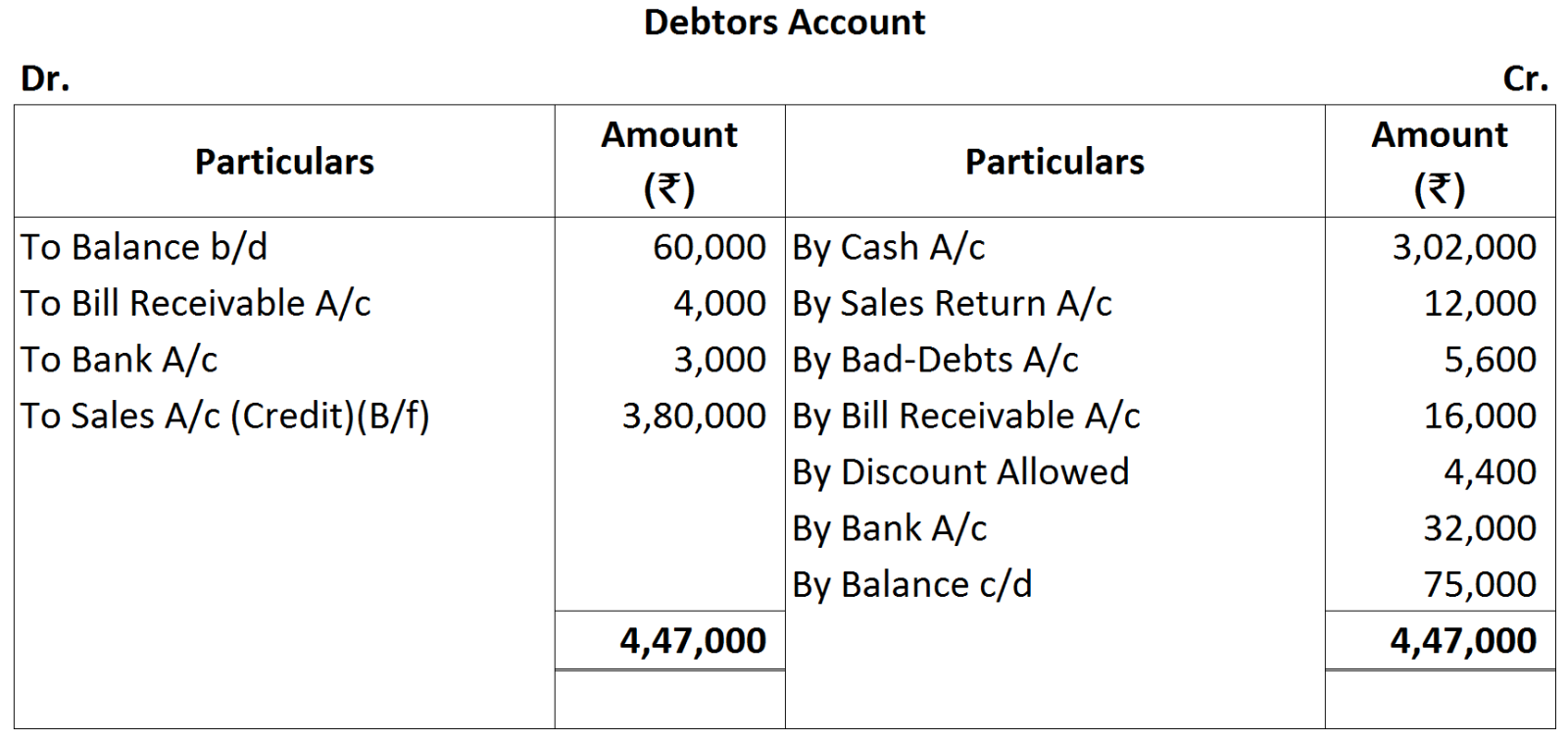
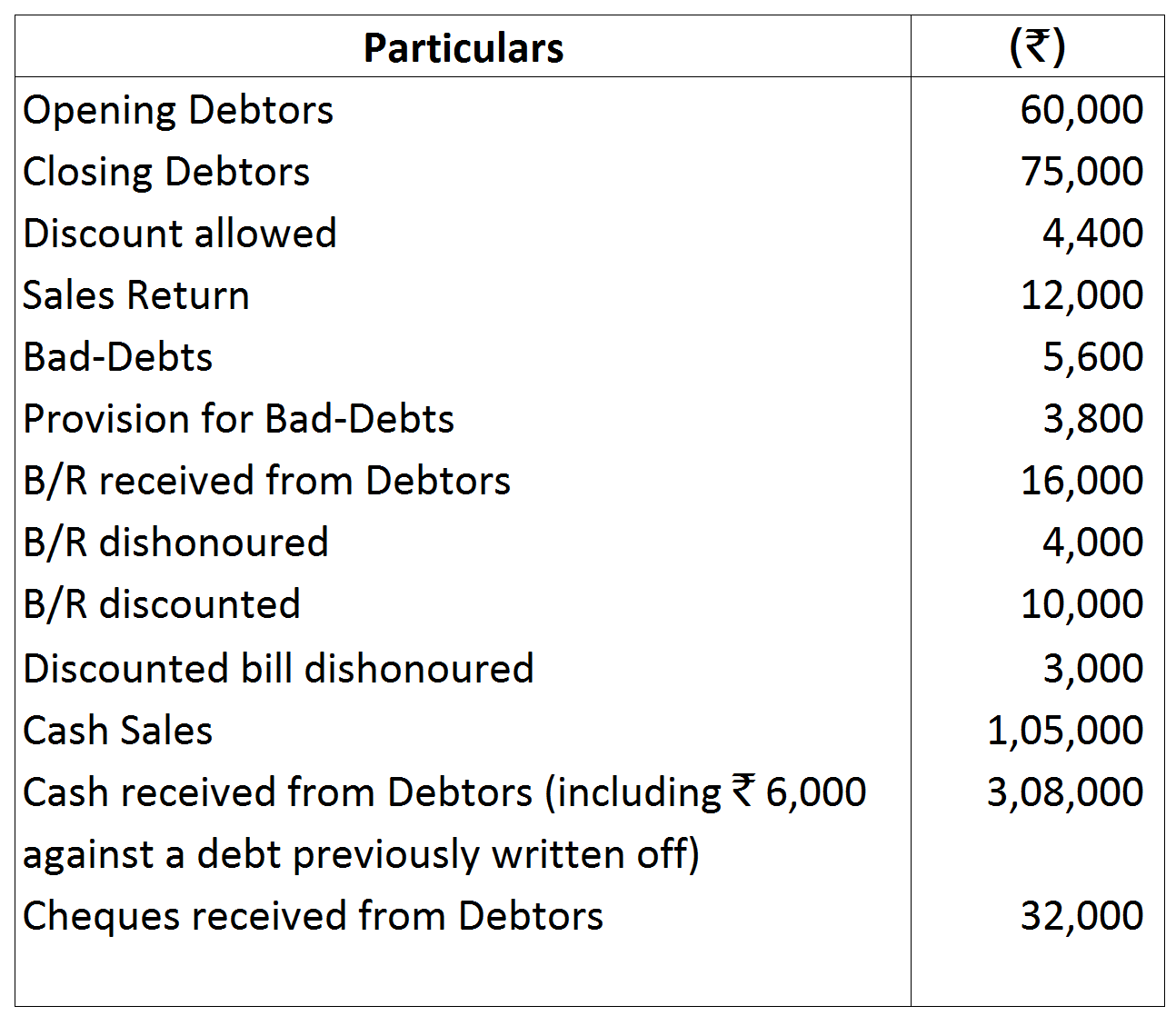
From the details given below find out the Credit Sales and Total Sales:
Answer

Total Sales = Cash Sales + Credit Sales
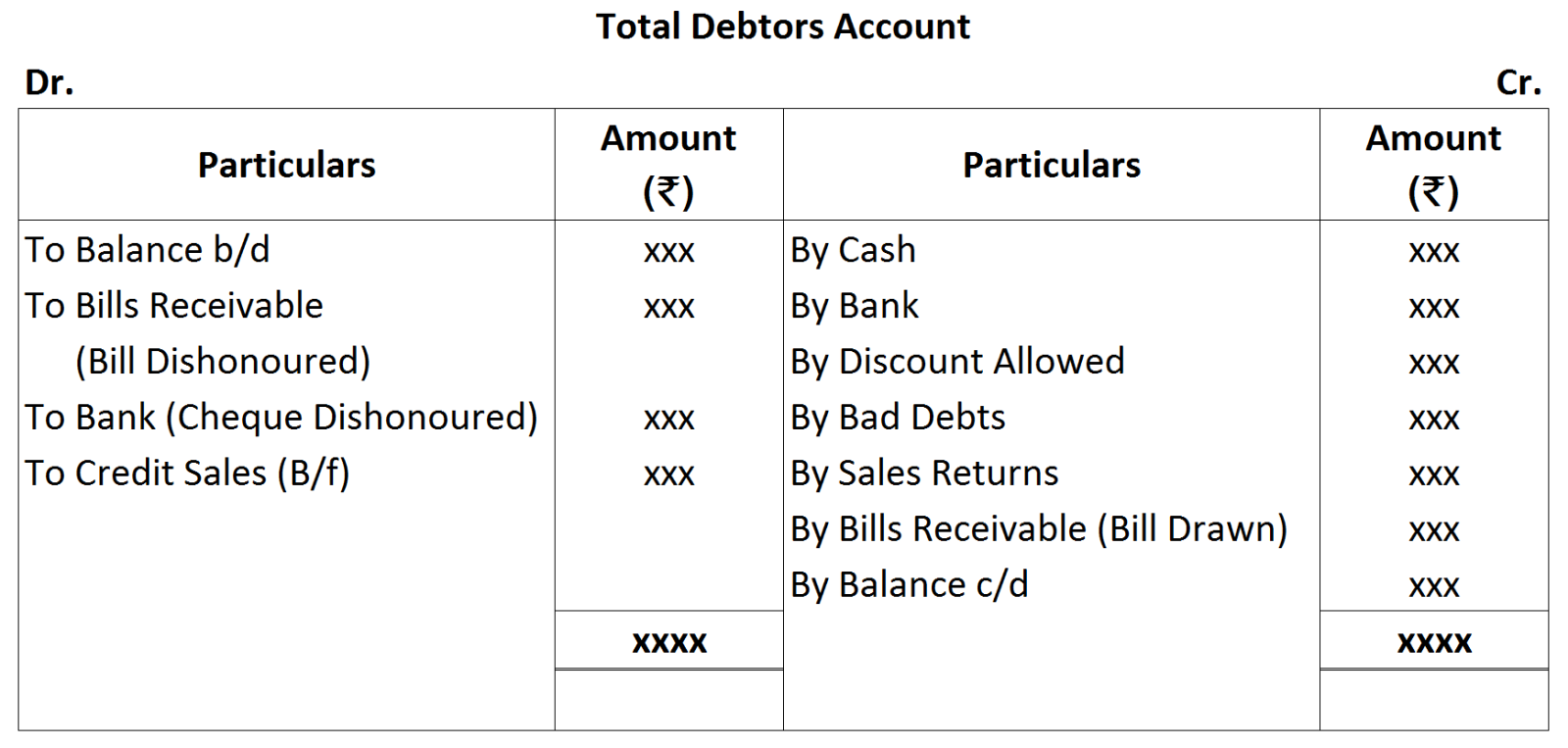
Total Sales = 1,05,000 + 3,80,000 = 4,85,000
View full question & answer
Question 53 Marks
Find out the amount of bills matured during the year on the basis of information given below:
 
Bills payable dishonoured, 37,000
Closing balance of Bills payable, 85,000
Opening balance of Bills payable, 70,000
Bills payable accepted, 90,000
Cheque dishonoured, 23,000
View full question & answer
Question 63 Marks
From the following information, Calculate Capital at the beginning:
 
Capital at the end of the year. 4,00,000
Drawings made during the year. 60,000
Fresh Capital introduce during the year. 1,00,000
Profit of the current year. 80,000
Answer
Capital in the beginning
=
Capital at the end + Drawings - (Fresh Capital Introduced + Profit)
 
=
4,00,000 + 60,000 – (1,00,000 + 80,000)
 
=
2,80,000
Note: As per the solution, the profit should be of ₹ 2,80,000; but, the answer given in the book is ₹ 2,60,000.
View full question & answer
Question 73 Marks
“Single Entry System of book keeping is most incomplete, inaccurate, unscientific and unsystematic.” Discuss this statement.
Answer
Because of the following reasons:
  1. It doesn't record both the aspects of a transaction.
  2. We cannot prepare Trial Balance, so mathematical errors can not be found out.
  3. Because complete transactions are not recorded, so, we can not prepare final accounts of business and can not get true profit or loss made by business.
  4. Assets may be misappropriated, because assets accounts are not maintained.
View full question & answer
Question 83 Marks
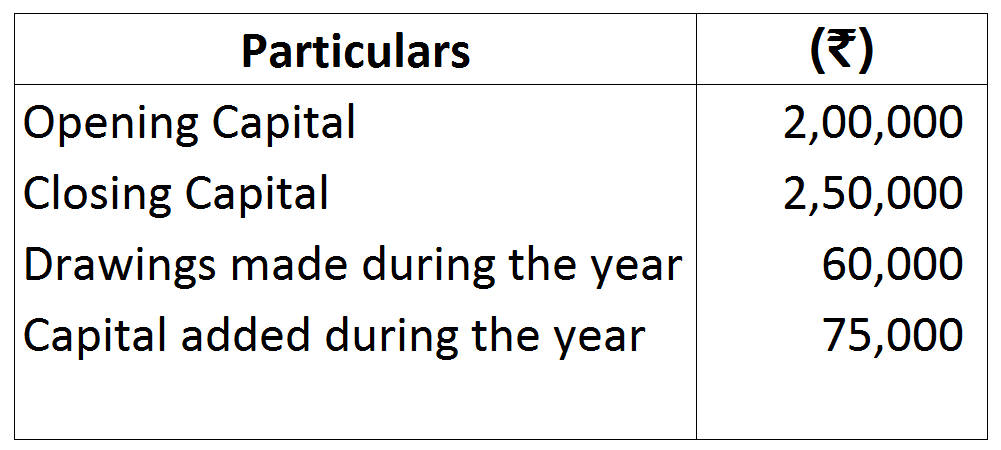
Mayank does not keep proper records of his business, he gives you the following information:
 
Opening Capital 1,00,000
Closing Capital 1,25,000
Drawings during the year 30,000
Capital added during the year 37,500
Calculate the profit or loss for the year.
View full question & answer
Question 93 Marks
Calculate the amount of bills receivable dishonoured from the following information.
 
Opening balance of bills receivable. 1,20,000
Bills collected (honoured). 1,85,000
Bills receivable endorsed. 22,800
Closing balance of bills receivable. 50,700
Bills receivable received. 1,50,000
View full question & answer
Question 103 Marks
Following information is given below prepare the statement of profit or loss:
 
Capital at the end of the year. 5,00,000
Capital in the beginning of the year. 7,50,000
Drawings made during the period. 3,75,000
Additional Capital introduced. 50,000
View full question & answer
Question 113 Marks
Cash sales of a business in a year were ​₹ 85,000, the Cost of Goods Sold (including direct expenses) was ₹ 97,000 and Gross Profit as shown by the Trading Account for the year was ₹ 1,29,000. Calculate Credit Sales during the year.
Answer
Gross Profit = Net Sales - Cost of Goods Sold
1,29,000 = Net Sales - 97,000
Net Sales = ₹ 2,26,000
Credit Sales = Total Net Sales - Cash Sales
Credit Sales = 2,26,000 - 85,000 = ₹ 1,41,000
View full question & answer
Question 123 Marks
Is it possible to prepare a Trial Balance and check the arithmetical accuracy of the books of account under Single Entry System?
Answer
No, Trial Balance cannot be prepared under Single Entry System as it does not record the dual aspect of each transaction. Therefore, the arithmetical accuracy of the books of account cannot be verified.
View full question & answer
Question 133 Marks
A firm sells goods at Cost plus 25%. Sales to credit customers (3/4 of total) was ₹ 1,80,000. His Opening and Closing Stocks were ₹ 20,000 and ₹ 15,000 respectively. Find out the value of Purchases.
Answer
Credit Sales = ₹ 1,80,000 (3/4 of Total Sales)
Total Sales = ₹ 2,40,000
Gross Profit = 25% of Cost or 20% of Sales
Gross Profit = ₹ 48,000
Cost of Goods Sold = Net Sales - Gross Profit
Cost of Goods Sold = 2,40,000 - 48,000 = ₹ 1,92,000
Cost of Goods Sold = Opening Stock + Purchases - Closing Stock
1,92,000 = 20,000 + Purchases - 15,000
Purchases = ₹ 1,87,000
View full question & answer
Question 143 Marks
Explain how the following may be ascertained from incomplete records:
Credit sales and credit purchase.
Answer
Credit Sales and Credit Purchases: Credit sales are ascertained as the balancing figure of the Total Debtors Account and Credit Purchases are ascertained as the balancing figure of the Total Creditors Account.
View full question & answer
Question 153 Marks
From the following, calculate the amount of bills accepted during the year.
 
Bills payable as on April 01, 2016. 1,80,000
Bills payable as on March 31, 2017. 2,20,000
Bills payable dishonoured during the year. 28,000
Bills payable honoured during the year. 50,000
View full question & answer
Question 163 Marks
Write any three defects of Incomplete Records.
Answer
Single Entry System is an incomplete and insufficient system of information, hence it has the following disadvantages:
  1. Arithmetical Accuracy cannot be Proved: Trial Balance cannot be prepared hence, arithmetical accuracy of books cannot be proved or tested. Chances of error mischief or fraud remaining undetected are high.
  2. No Control on Assets: Since assets accounts are not maintained, it is difficult to keep full control, in order to avoid misappropriations of assets.
  3. Correct Profit or Loss cannot be Determined: Trading and Profit and Loss Account cannot be prepared hence, correct profit earned or loss incurred during the accounting period cannot be determined.
View full question & answer
Question 173 Marks
Calculate Stock in the beginning:
 
Sales 80,000
Purchases 60,000
Stock at the end 8,000
Loss on Cost $\frac{1}{6}$
Answer
Let cost be ₹ 100
Loss = ₹ 16.67 $\Big(\frac{1}{6}$ of 100$\Big)$
Sale = ₹ 83.33 (100 - 16.67)
% Loss on Sale $=20\%\Big(\frac{16.67}{83.33}\Big)$
Loss on Sale = ₹ 16,000 (20% of 80,000)
Cost of Goods Sold = Net Sales + Loss on Sale
Cost of Goods Sold = 80,000 + 16,000 = ₹ 96,000
Cost of Goods Sold = Opening Stock + Purchases - Closing Stock
96,000 = Opening Stock + 60,000 - 8,000
Opening Stock = ₹ 44,000
View full question & answer
Question 193 Marks
State one point of difference between Statement of Affairs and Balance Sheet.
Answer
Differnce between Balance Sheet and Statement of Affairs
S.No.
Basis
Balance Sheet
Statement of Affairs
1.
Objective
The main objective of preparing Balance Sheet is to know about the financial position of the business.
The main objective of preparing Statement of Affairs is to know about capital at a point of time.
2.
Accounting System
Balance Sheet is prepared when accounts are maintained under Double Entry System.
Statement of Affairs is prepared when accounts are maintained under Single Entry System.
3.
Accounts and Information
This is prepared exclusively on the basis of ledger accounts.
In view of incomplete accounts, its preparation is based on limited accounts, calculations, estimates and other information.
 
View full question & answer
Question 203 Marks
The following information is given.
 
Opening creditors 60,000
Cash paid to creditors 30,000
Closing creditors 36,000
Returns Inward 13,000
Bill matured 27,000
Bill dishonoured 8000
Purchases return 12000
Discount allowed 5,000
Calculate credit purchases during the year.
View full question & answer
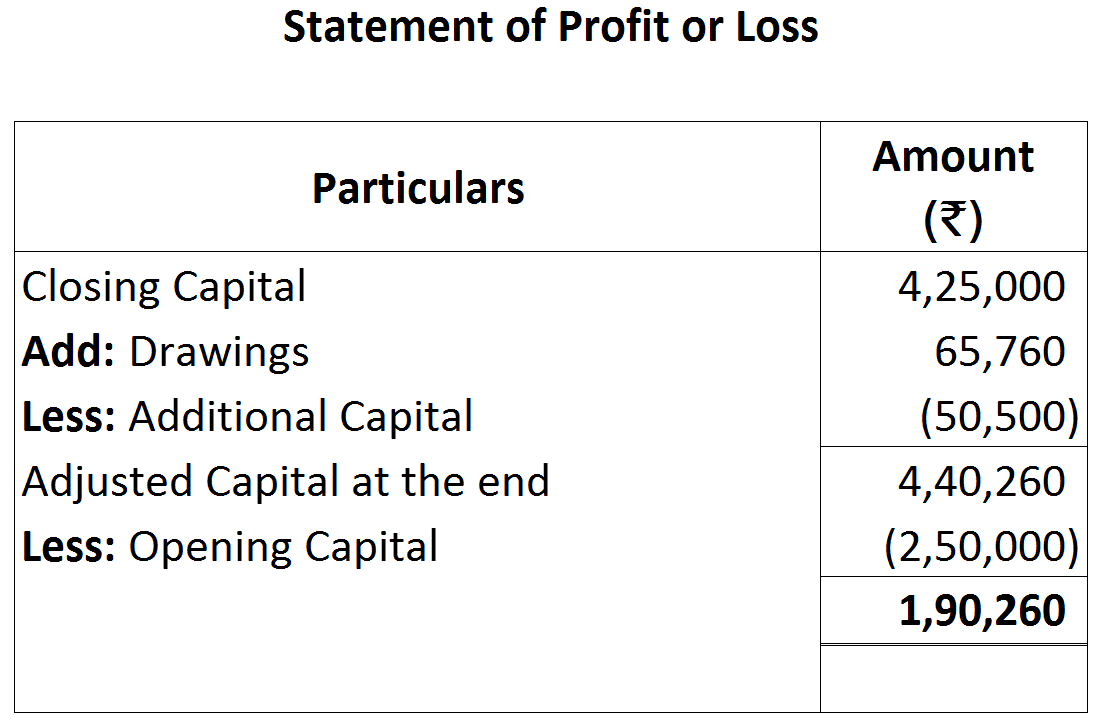
Question 213 Marks
Vikas is keeping his accounts according to Single Entry System. His capital on 31st December, 2015 was ₹ 2,50,000 and his capital on 31st December, 2016 was ₹ 4,25,000. He further informs you that during the year he gave a loan of ₹ 30,000 to his brother on private account and withdrew ₹ 1,000 per month for personal purposes. He used a flat for his personal purpose, the rent of which @ ₹ 1,800 per month and electricity charges at an average of 10% of rent per month were paid from the business account. During the year he sold his 7% Government Bonds of ₹ 50,000 at 1% premium and brought that money into the business.
Prepare a Statement of Profit or Loss for the year ended 31st December, 2016.
Answer

Note: Drawings include loan to brother, withdrawals in cash, rent and electricity charges.
View full question & answer
Question 223 Marks
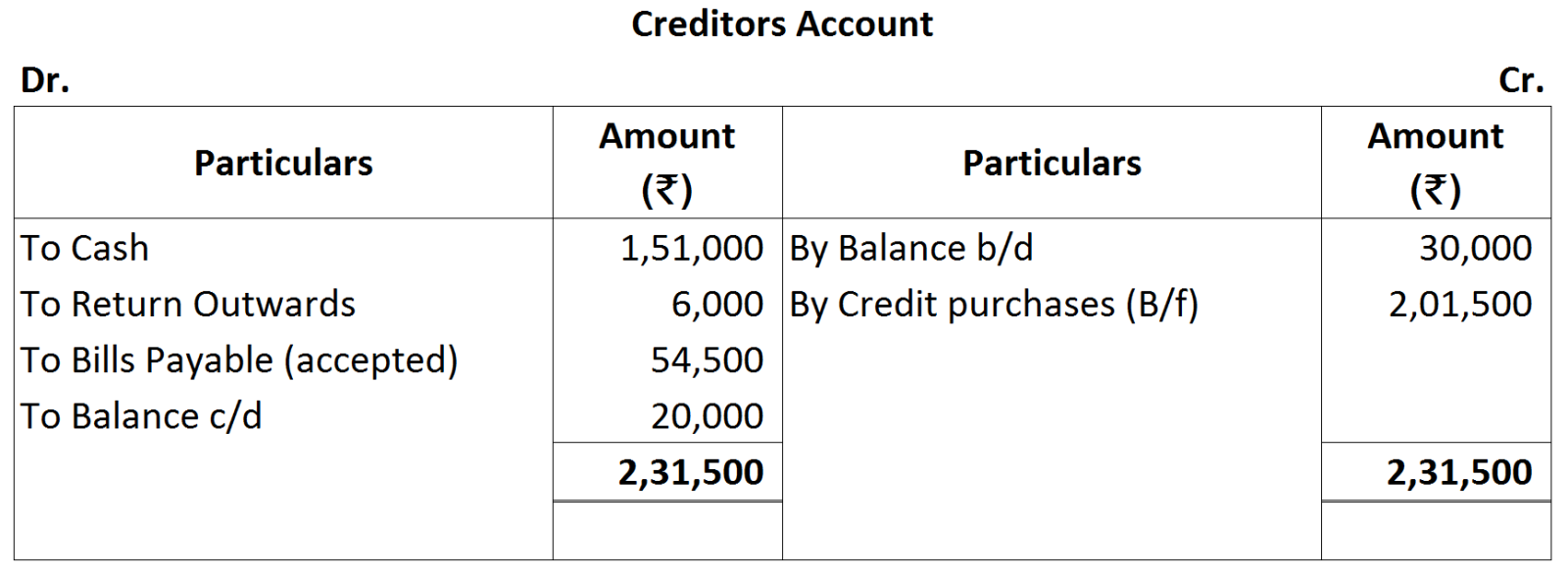
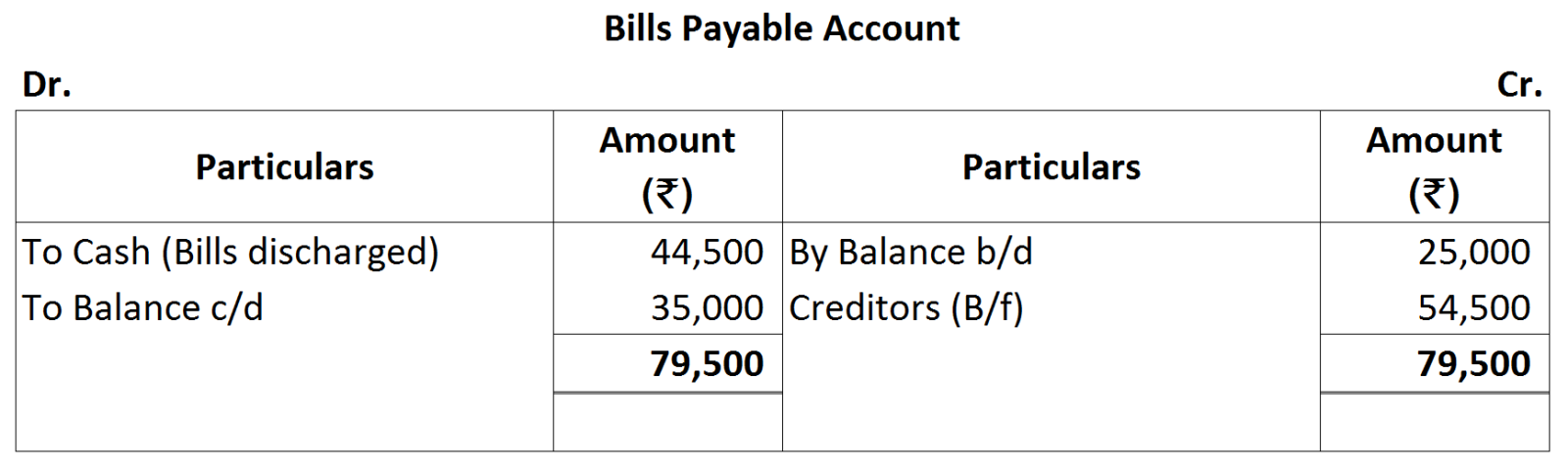
From the following information calculate total purchases.
 
Creditors April 01, 2016 30,000
Creditors March 31, 2017 20,000
Opening balance of Bills payable 25,000
Closing balance of Bills payable 35,000
Cash paid to creditors 1,51,000
Bills discharged 44,500
Cash purchases 1,29,000
Return outwards 6,000
Answer


Total Purchases = Cash Purchases + Credit Purchases (as per Creditors Account)
  = 1,29,000 + 2,01,500
  = 3,30,500
View full question & answer
Question 233 Marks
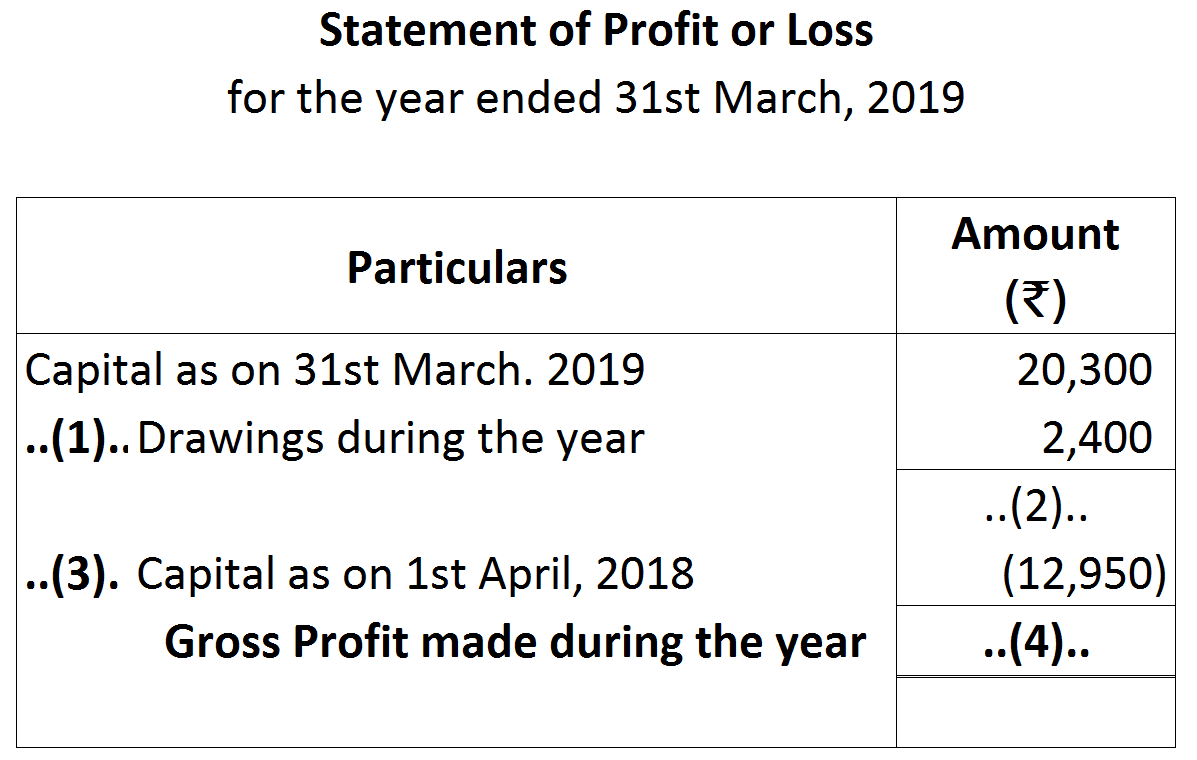
Mohan maintains books on Single Entry System. He gives you the following information:
 
Capital on 1st April, 2018 15,200
Capital on 31st March, 2019 16,900
Drawings made during the year 4,800
Capital introduced on 1st August, 2018 2,000
You are required to calculate the Profit or Loss made by Mohan.
View full question & answer
Question 243 Marks
Books maintained by the Single Entry System are not as reliable as they are when maintained following the Double Entry System. Comment.
Answer
Double Entry System of accounting records both aspects of a transaction. Thus, it provides accurate information as to profit, liabilities, assets, etc. On the other hand, Single Entry System of accounting does not record all transactions in some cases, while in some, it records both aspects and still in some only one aspect. Thus, Single Entry System is less reliable than Double Entry System.
View full question & answer
Question 253 Marks
Atul does not keep proper records of his business. He gives you the following information:

Calculate profit or loss for the year.
View full question & answer
Question 263 Marks
Calculate the amount of bills receivable during the year.
 
Opening balance of bills receivable. 75,000
Bill dishonoured. 25,000
Bills collected (honoured) 1,30,000
Bills receivable endorsed to creditors. 15,000
Closing balance of bills receivable. 65,000
View full question & answer
Question 283 Marks
What is meant by Statement of Affairs?
Answer
A Statement of Affairs is a statement of assets and liabilities. Difference between the amounts of the two sides is taken as capital. Under the Single Entry System, it is necessary to prepare Statement of Affairs at the end of the year and also in the beginning of the year, if not already prepared to determine profit. Statement of Affairs like Balance Sheet, has two sides-right-hand side for Assets and left-hand side for Liabilities. The difference between the total of assets and liabilities is capital.
Capital = Total Assets – Liabilities
View full question & answer
Question 303 Marks
From the information given below ascertain the profit for the year:
 
Capital at the beginning of the year, 70,000
Additional capital introduced during the year, 17,500
Stock, 59,500
Sundry debtors, 25,900
Business premises, 8,600
Machinery, 2,100
Sundry creditors, 33,400
Drawings made during the year, 26,400
View full question & answer
Question 313 Marks
Calculate the Stock at the end:
 
Stock in the beginning 20,000
Cash Sales 60,000
Credit Sales 40,000
Purchases 70,000
Rate of Gross Profit on Cost 1/3
Answer
Rate of Gross Profit on Cost = 1/3
Rate of Gross Profit on Sale = 1/4
Total Sales = Cash Sales + Credit Sales
Total Sales = 60,000 + 40,000 = 1,00,000
Gross Profit = ₹ 25,000 (1/4 of 1,00,000)
Cost of Goods Sold = Net Sales - Gross Profit
Cost of Goods Sold = 1,00,000 - 25,000 = ₹ 75,000
Cost of Goods Sold = Opening Stock + Purchases - Closing Stock
75,000 = 20,000 + 70,000 - Closing Stock
Closing Stock = ₹ 15,000
View full question & answer
Question 323 Marks
Capital of Ganesh Gupta in the beginning of the year was ₹ 70,000. During the year his business earned a profit of ₹ 20,000, he withdrew ₹ 7,000 for his personal use. He sold ornaments of his wife for ₹ 20,000 and invested that amount into the business. Find out his Capital at the end of the year.
Answer
Capital at the end
= Opening Capital + Additional Capital + Profit - Drawings
= 70,000 + 20,000 + 20,000 - 7,000 = ₹ 1,03,000
View full question & answer
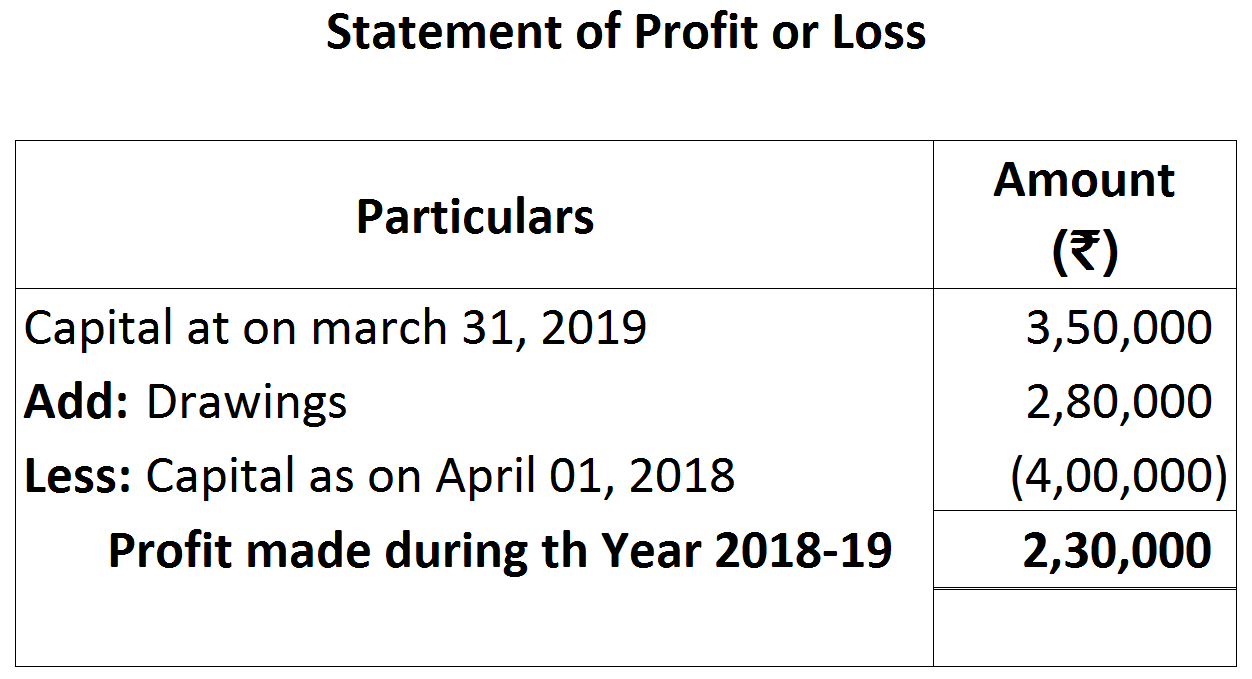
Question 333 Marks
Mahesh who keeps his books on Single Entry System sells goods at Cost plus 50%. On 1st April, 2018 his Capital was ₹ 4,00,000 and on 31st March, 2019 it was ₹ 3,50,000. He had withdrawn ₹ 20,000 per month besides goods of the sale value of ₹ 60,000. How much did he earn in 2018-19?
Answer

Cash withdrawn = ₹ (20,000 × 12) = ₹ 2,40,000

Goods taken for personal use $=₹\Big(60,000\times\frac{100}{150}\Big)=₹ \ 40,000$
Total Drawings = Cash withdrawn + Goods withdrawn for personal use
Total Drawings = ₹ (2,40,000 + 40,000) = ₹ 2,80,000
View full question & answer
Question 343 Marks
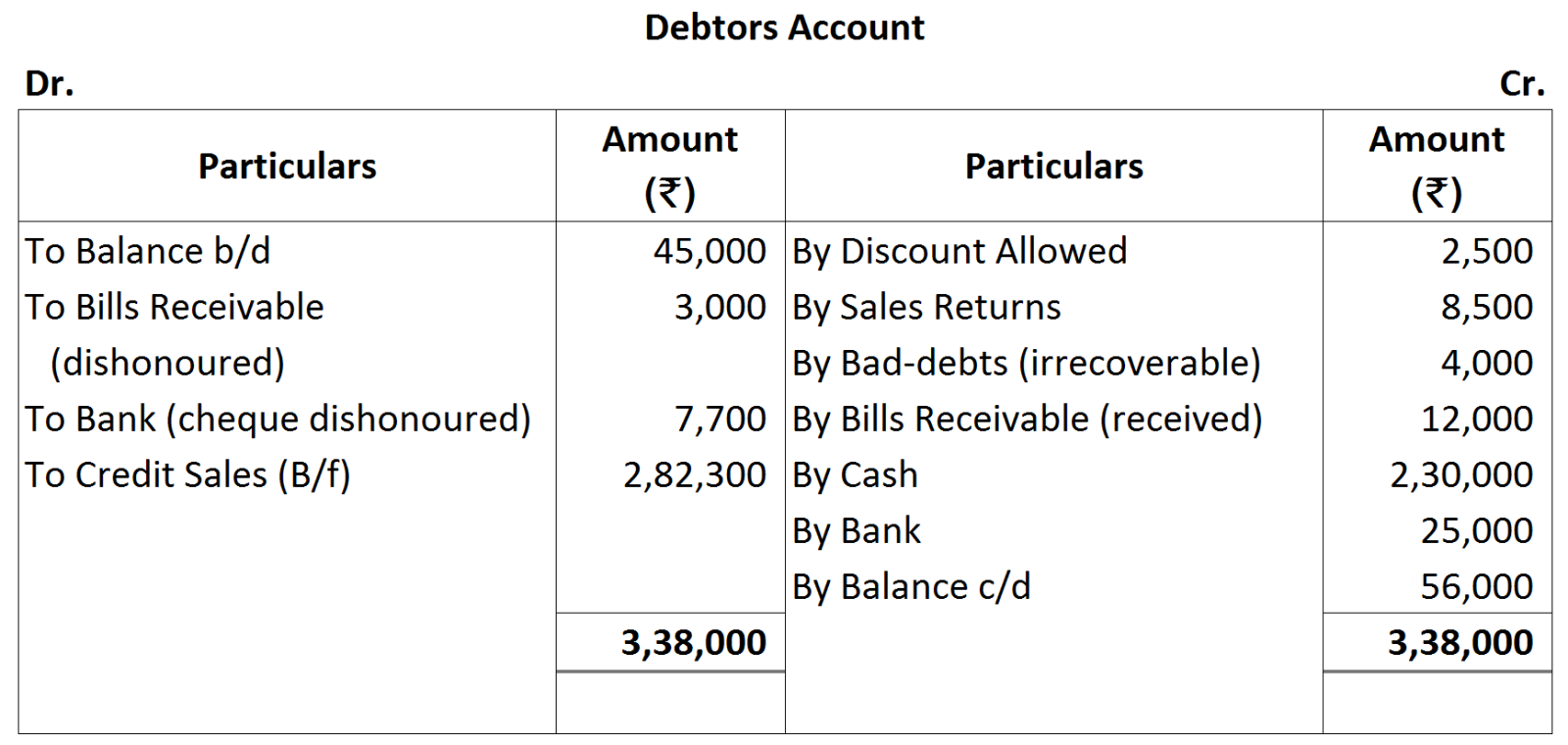
Calculate the amount of bills receivable dishonoured from the following information.
 
Opening debtors. 45,000
Closing debtors. 56,000
Discount allowed. 2,500
Sales returns. 8,500
Irrecoverable amount. 4,000
Bills receivables received. 12,000
Bills receivable dishonoured. 3,000
Cheque dishonoured. 7,700
Cash sales. 80,000
Cash received from debtors. 2,30,000
Cheque received from debtors. 25,000
Answer

Working Note:
Credit sales is 2,82,300
Total Sales
= Cash Sales + Credit Sales
 
= 80,000 + 2,82,300
 
= 3,62,300
View full question & answer
Question 353 Marks
Calculate the value of Closing Stock from the following particulars:
Answer
Rate of Gross Profit (on cost) = 25%
Rate of Gross Profit (on sales) = 20%
Gross Profit = 20% of 1,20,000 = 24,000
Gross Profit = Net Sales - Cost of Goods Sold
24,000 = 1,20,000 - Cost of Goods Sold
Cost of Goods Sold = 1,20,000 - 24,000 = ₹ 96,000
Cost of Goods Sold = Opening Stock + Purchases + Direct Expenses - Closing Stock
96,000 = 16,000 + 93,000 + 20,000 - Closing Stock
Closing Stock = 16,000 + 93,000 + 20,000 - 96,000 = ₹ 33,000
View full question & answer
Question 363 Marks
Following information of an accounting year is given:
Opening Capital ₹ 60,000; Drawings ₹ 5,000; Capital added during the year ₹ 10,000 and Closing Capital ₹ 90,000. Calculate the Profit or Loss for the year.
View full question & answer
Question 373 Marks
Manveer started his business on April 01, 2016 with a capital of ₹ 4,50,000. On March 31, 2017 his position was as under:
 
Cash, 99,000
Bills receivable, 75,000
Plant, 48,000
Land and Building, 1,80,000
Furniture, 50,000
View full question & answer
Question 383 Marks
A firm sells goods at a Gross profit of 25% of sales. On 1st April, 2017 the Stock was ₹ 40,000; Purchases were ₹ 1,10,000 and the Stock on 31st March, 2018 was ₹ 30,000. What was the value of Sales?
Answer
Cost of Goods Sold = Net Sales - Gross Profit
Cost of Goods Sold = Opening Stock + Purchases - Closing Stock
Cost of Goods Sold = 40,000 + 1,10,000 - 30,000 = ₹ 1,20,000
Gross Profit = 25% of Sales or 33.33% of COGS
Gross Profit = ₹ 40,000
Net Sales = Cost of Goods Sold + Gross Profit
Net Sales = 1,20,000 + 40,000 = ₹ 1,60,000
View full question & answer
Question 393 Marks
Calculate Closing Capital:
Opening Capital ₹ 90,000; Profit for the year ₹ 25,000; Drawings ₹ 17,000. During the year proprietor sold ornaments of his wife for ₹ 40,000 and invested the same in business.
Answer
Closing Capital + Drawings - Additional Capital - Opening Capital = Profits
Closing Capital = Opening Capital + Additional Capital + Profits - Drawings
Closing Capital = 90,000 + 40,000 + 25,000 - 17,000
Closing Capital = ₹ 1,38,000
View full question & answer
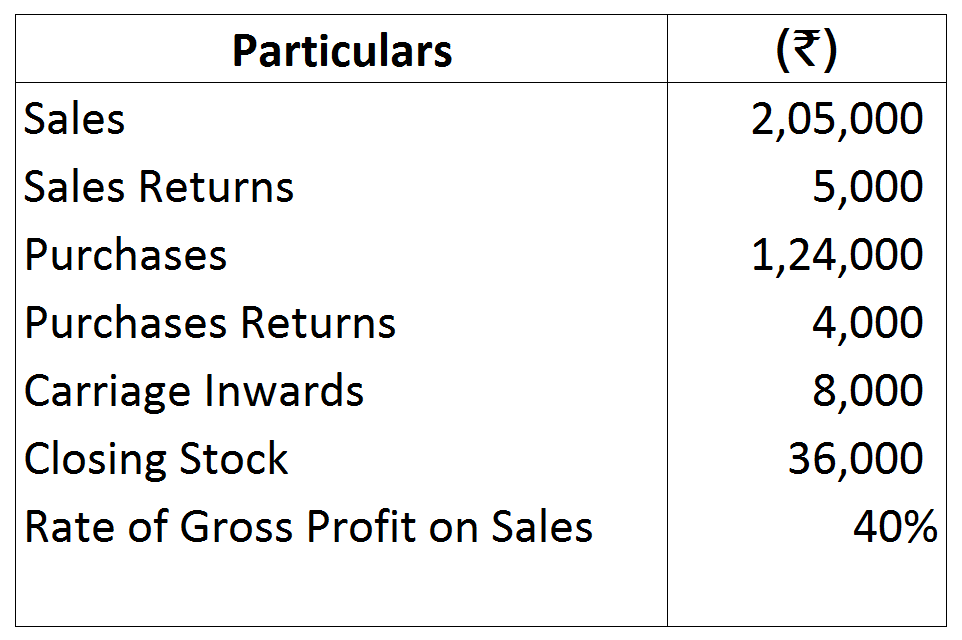
Question 403 Marks
Calculate the value of Opening Stock from the following:
Answer
Rate of Gross Profit (on sales) = 40%
Gross Profit = 40% of (2,05,000 - 5,000) = 80,000
Gross Profit = Net Sales - Cost of Goods Sold
80,000 = 2,00,000 - Cost of Goods Sold
Cost of Goods Sold = 2,00,000 - 80,000 = ₹ 1,20,000
Cost of Goods Sold = Opening Stock + Purchases + Direct Expenses - Closing Stock
1,20,000 = Opening Stock + (1,24,000 - 4,000) + 8,000 - 36,000
Opening Stock = 1,20,000 - 1,20,000 - 8,000 + 36,000 = ₹ 28,000
View full question & answer
Question 413 Marks
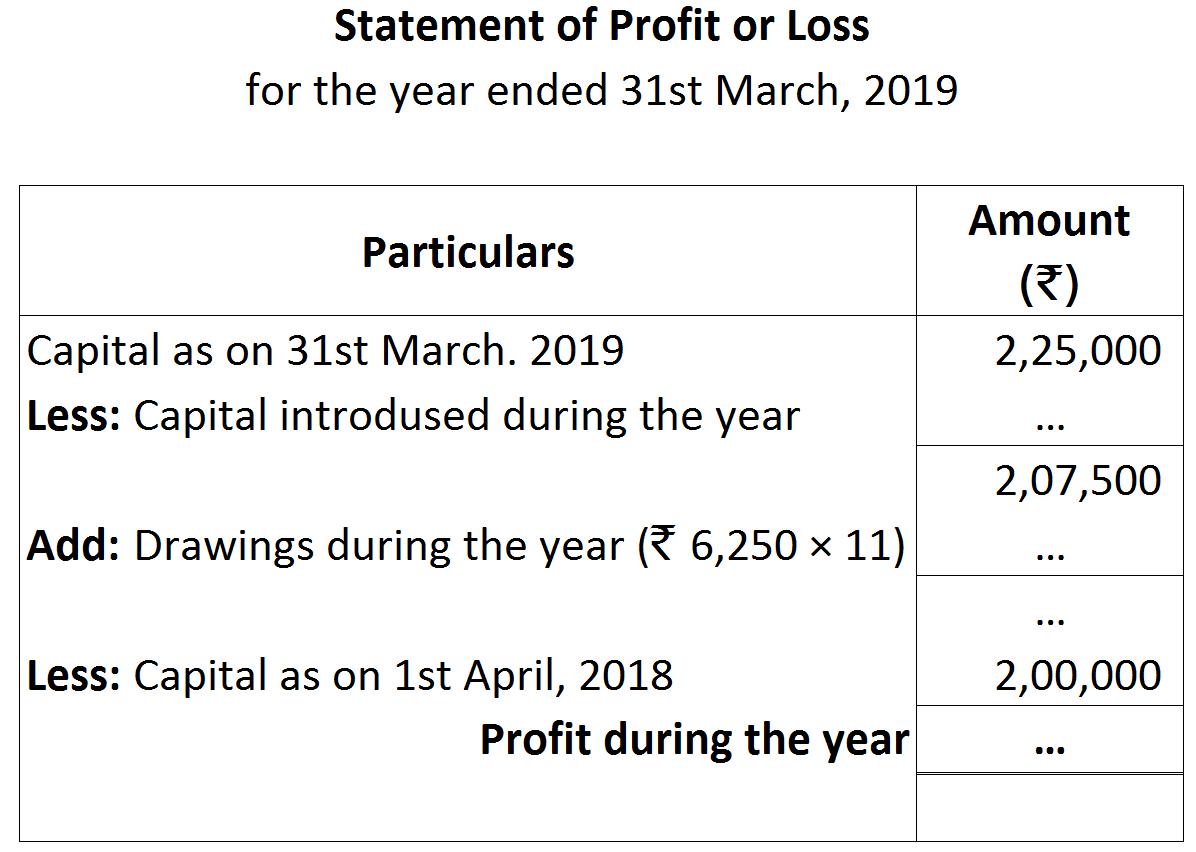
How profit is calculated under Statement of Affairs Method?
Answer
For determining the profit, capital in the beginning of the year must also be determined, if necessary, by preparing a Statement of Affairs as in the beginning of the year. If the capital at the end of the year exceeds that in the beginning, it is taken as a profit. If, on the other hand, the capital in the beginning was more than that at the end, a loss. However, following two adjustments must be kept in mind for determin.
  1. Adjustments for Capital Introduced: If the proprietor brought in additional capital during the year, it should be deducted from the capital at the end (since this increase is not due to profit but fresh introduction of capital).
  2. Adjustment for Drawings: Drawings by the proprietor should be added to the capital at the end-had the drawings not been made, the capital at the end of the year would have been higher.
Formula: Formula for determining the Profit is as follows:
Profit = Capital at the end + Drawings - Additional capital introduced - Capital in the beginning
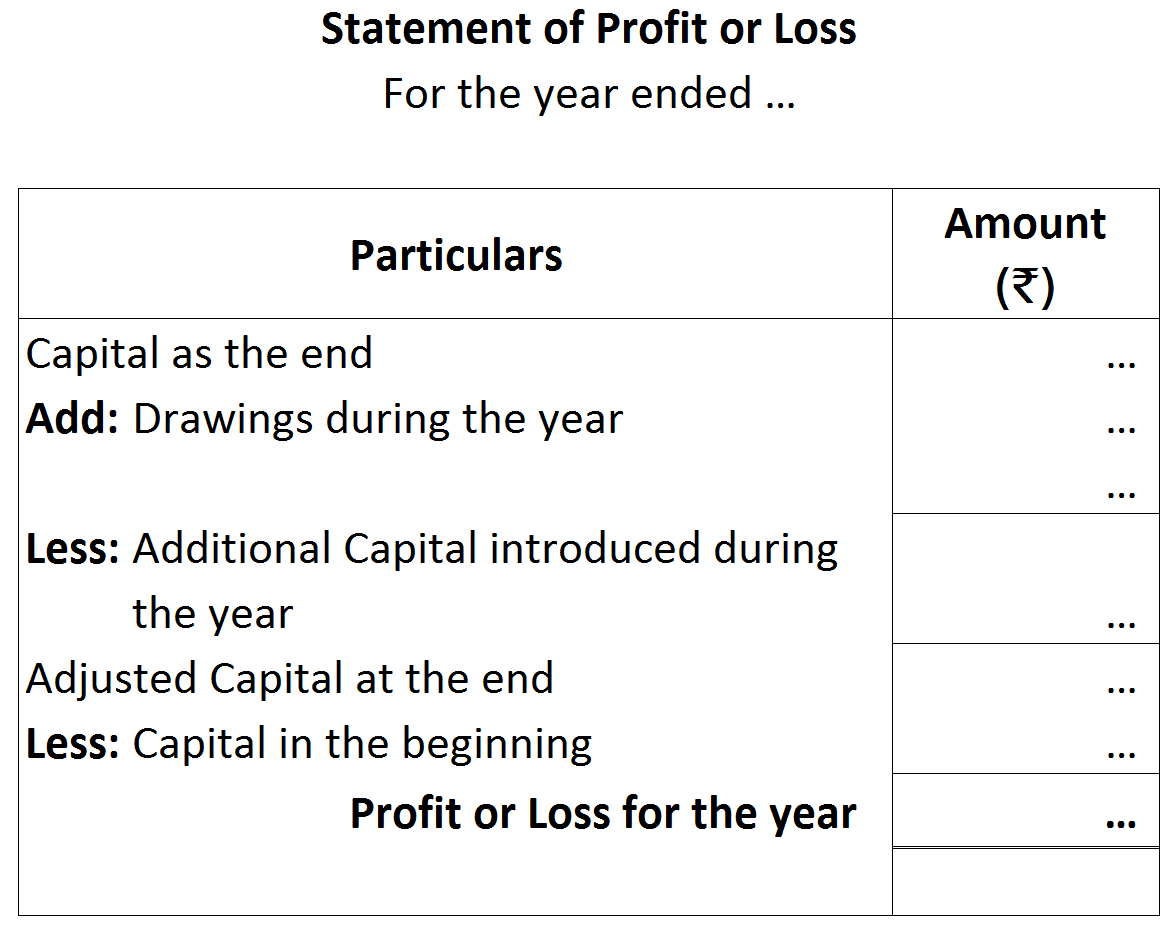
The above formula may be shown as follows in the form of Statement of Profit or Loss.
View full question & answer
Question 423 Marks
Vikas maintains his books of account on Single Entry System. He provides following information from his books. Find out additional capital introduced in the business during the year 2018-19.
Opening Capital - ₹ 1,30,000 Drawings during the year ₹ 50,000
Closing Capital - ₹ 2,00,000 Profit made during the year ₹ 1,00,000
Answer
Additional Capital:= Capital at the End + Drawings - (Capital in the Beginning + Profit)
= 2,00,000 + 50,000 - (1,30,000 + 1,00,000)
= 2,50,000 - 2,30,000 = ₹ 20,000
View full question & answer
3 Marks Question - Account STD 11 Commerce Questions - Vidyadip