Questions · Page 1 of 2

6 Marks Question

🎯

Test yourself on this topic

50 questions · timed · auto-graded

Question 16 Marks
X sold goods to Y on 1.3.2017 for ₹ 12,000 and drew upon Y a bill of exchange for the same amount payable after two months. X immediately discounted the bill with his bank at 9% p.a. The maturity date of the bill was a non business day (holiday), therefore, X had to present the bill as per the provisions of the Indian Instruments Act, 1881. The bill was dishonoured by Y and X paid ₹ 45 as noting charges. Y settled the claim of X five days after the dishonour of the bill by a cheque which included interest @ 12% for the term of the bill.
Journalise the above transactions in the books of X and Y and prepare Y's account in the books of X and X's account in the books of Y.
Answer
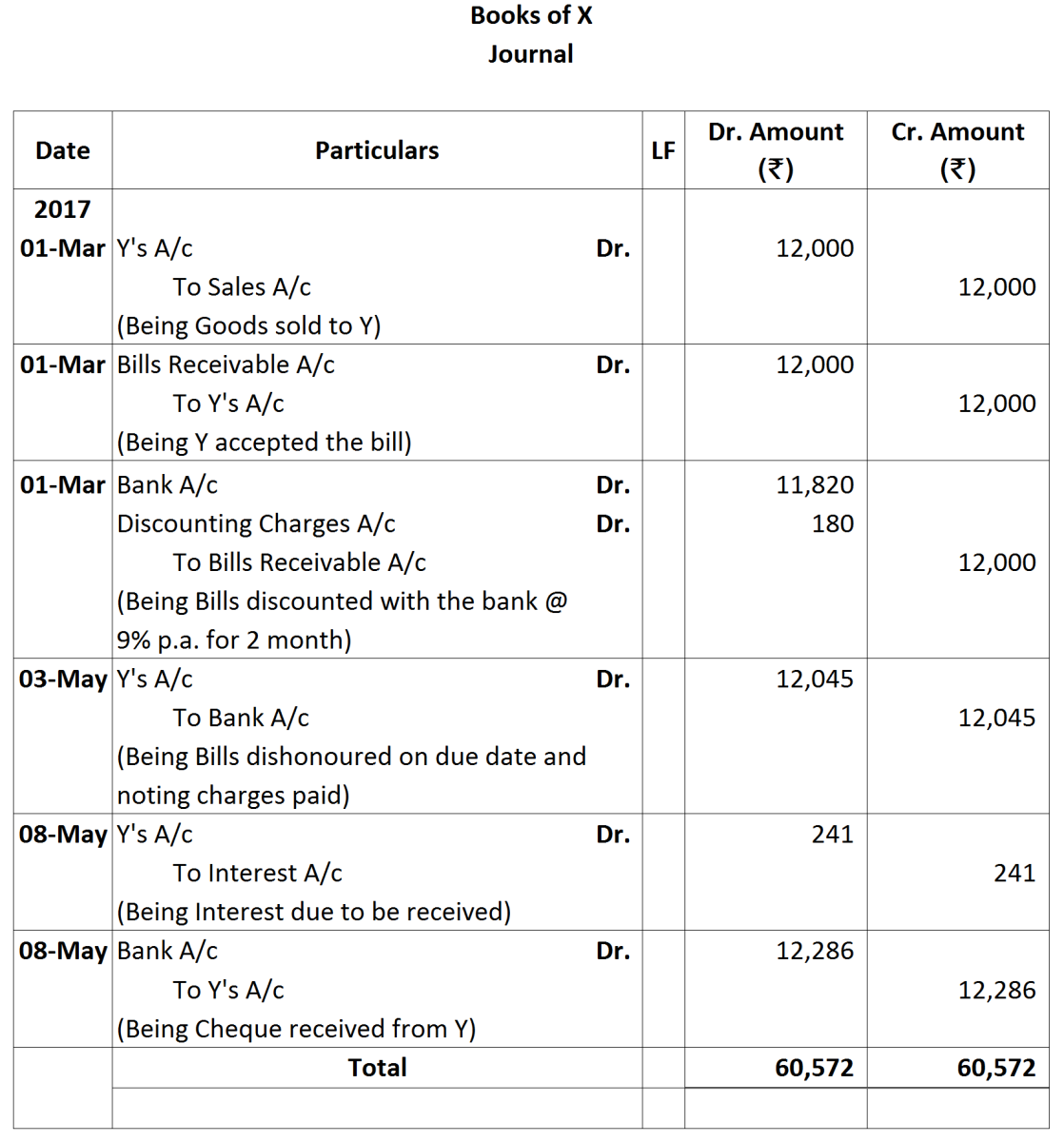
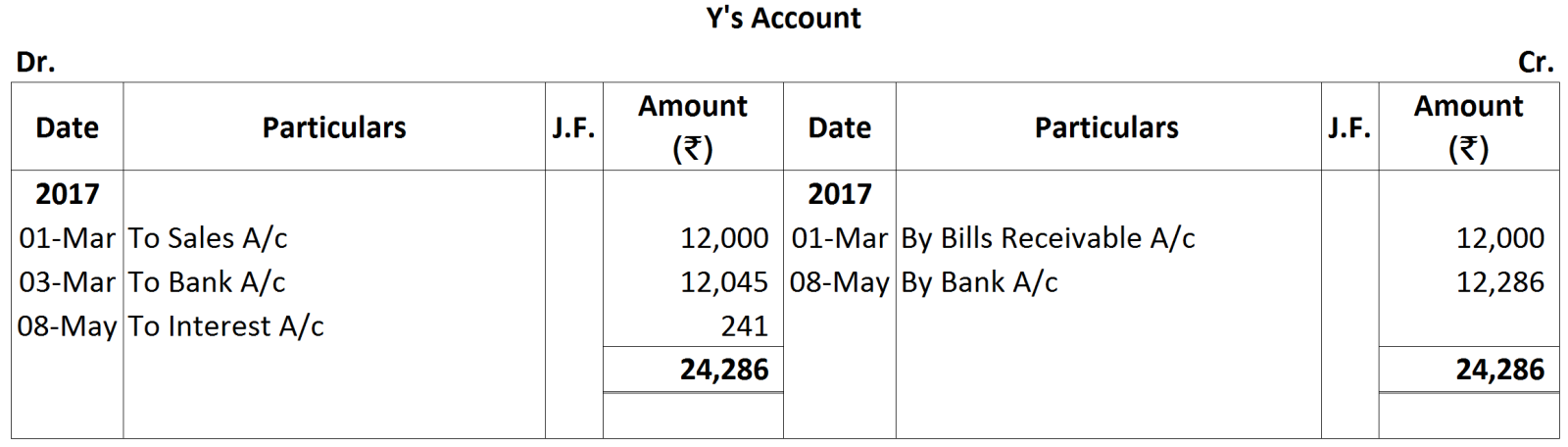
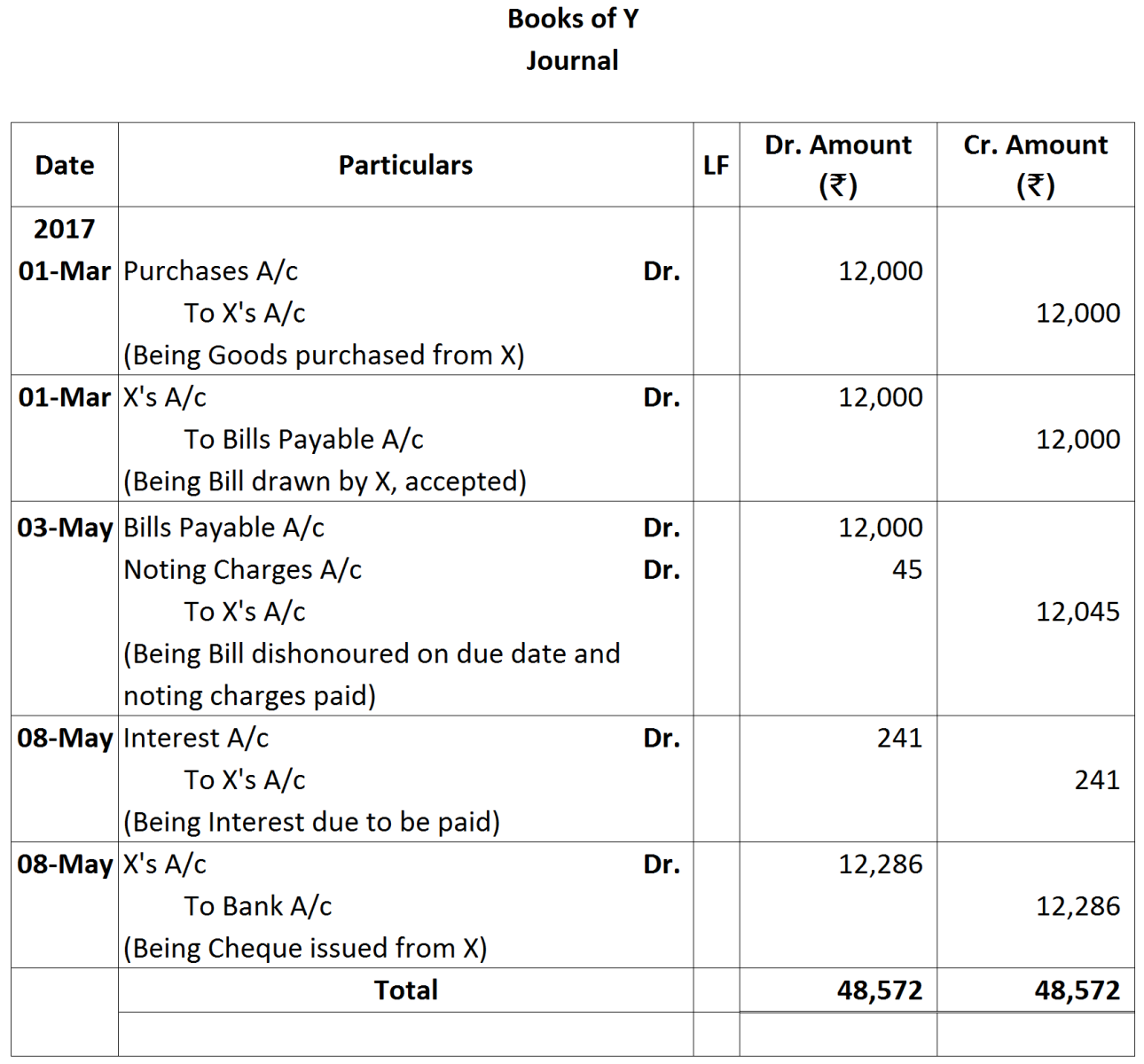
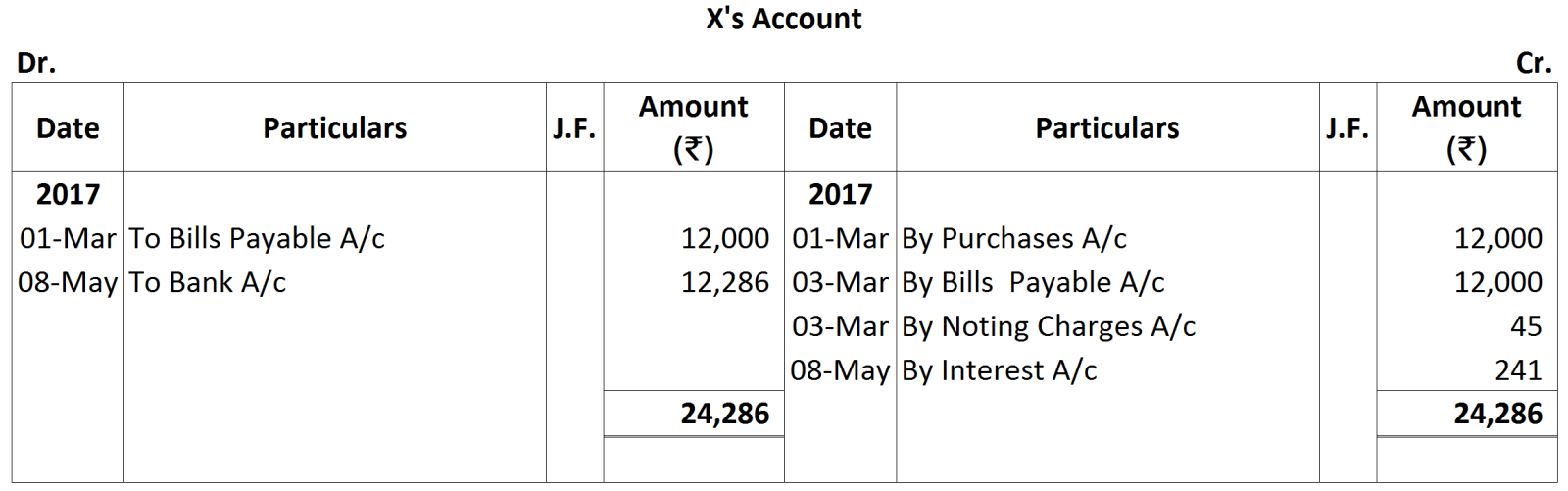

Working Notes:
WN 1: Calculation of Discounting Charges,
Discounting Charges $=12,000\times\frac{9}{100}\times\frac{2}{12}=₹\ 180$
WN 2: Calculation of amount of Interest,
Amount of Interest $=12,045\times\frac{12}{100}\times\frac{2}{12}=₹\ 241$
Note: When due date falls on Public holiday or Sunday or Gazetted holiday (here May 4, 2017), then due date is preceding date (here May 03, 2017).
View full question & answer
Question 36 Marks
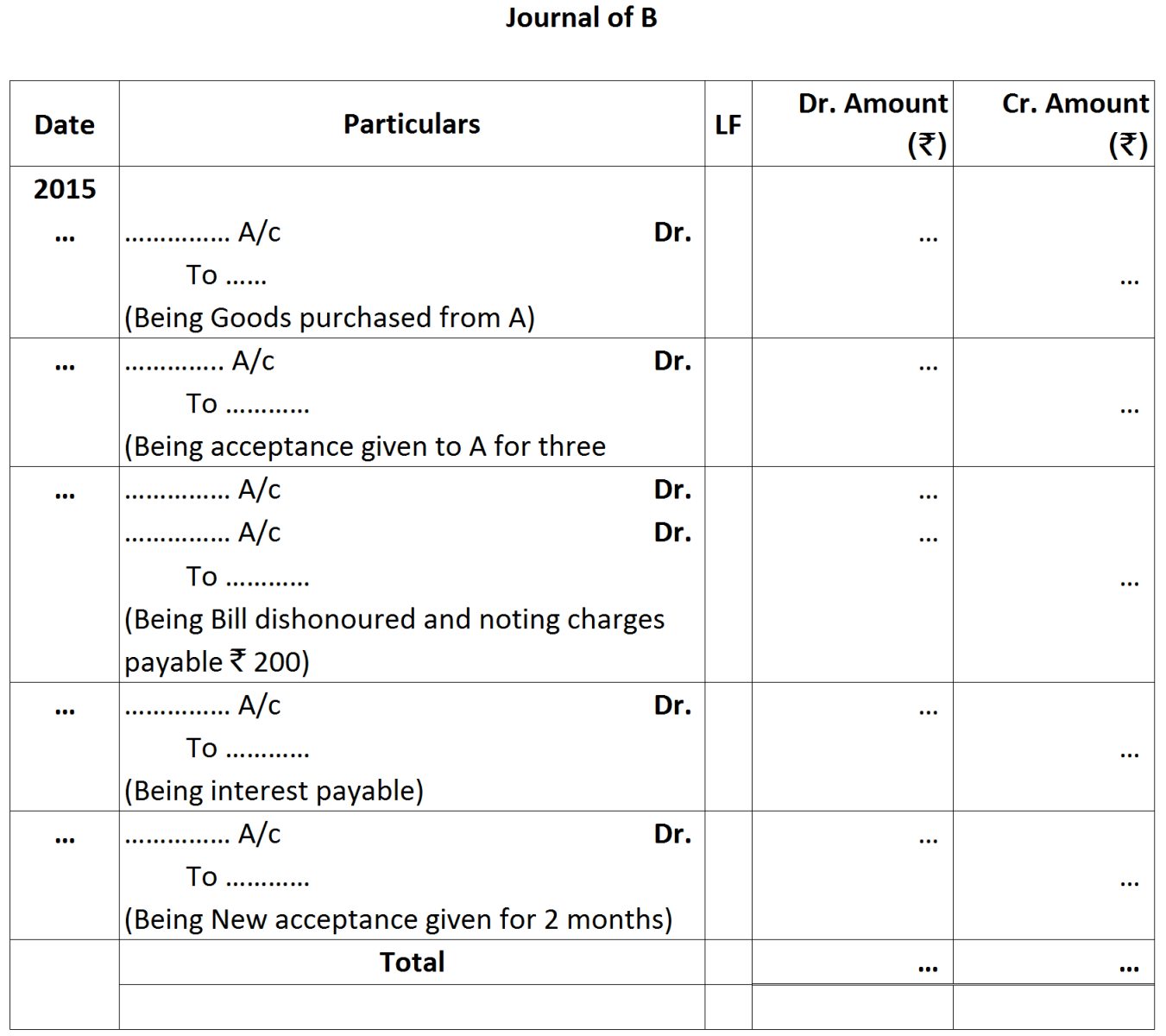
On 1st January, 2019, A drew a bill on B for ₹ 10,000 payable after 3 months. B accepted the bill and returned it to A. After 10 days, A endorsed the bill to his creditor C. On the due date, the bill was dishonoured and C paid ₹ 50 as noting charges.
Record the transactions in the books of A, B and C.
View full question & answer
Question 46 Marks
On Feb. 01, 2017, Mohan sold goods worth ₹ 25,000 to Naresh and drew upon him a bill payable after 90 days. Naresh accepted the bill and Mohan endorsed the bill immediately in favour of his creditor Raja in full settlement of his account of ₹ 25,300. One week before the maturity of the bill Naresh requested Mohan to cancel the bill and draw upon him a new bill including interest of ₹ 400. Mohan agreed to it. Mohan immediately took the bill from Raja by making the payment to him and then drew upon Naresh a new bill for 30 days which was duly met by Naresh on due date.
Pass necessary entries in the books of Mohan.
View full question & answer
Question 56 Marks
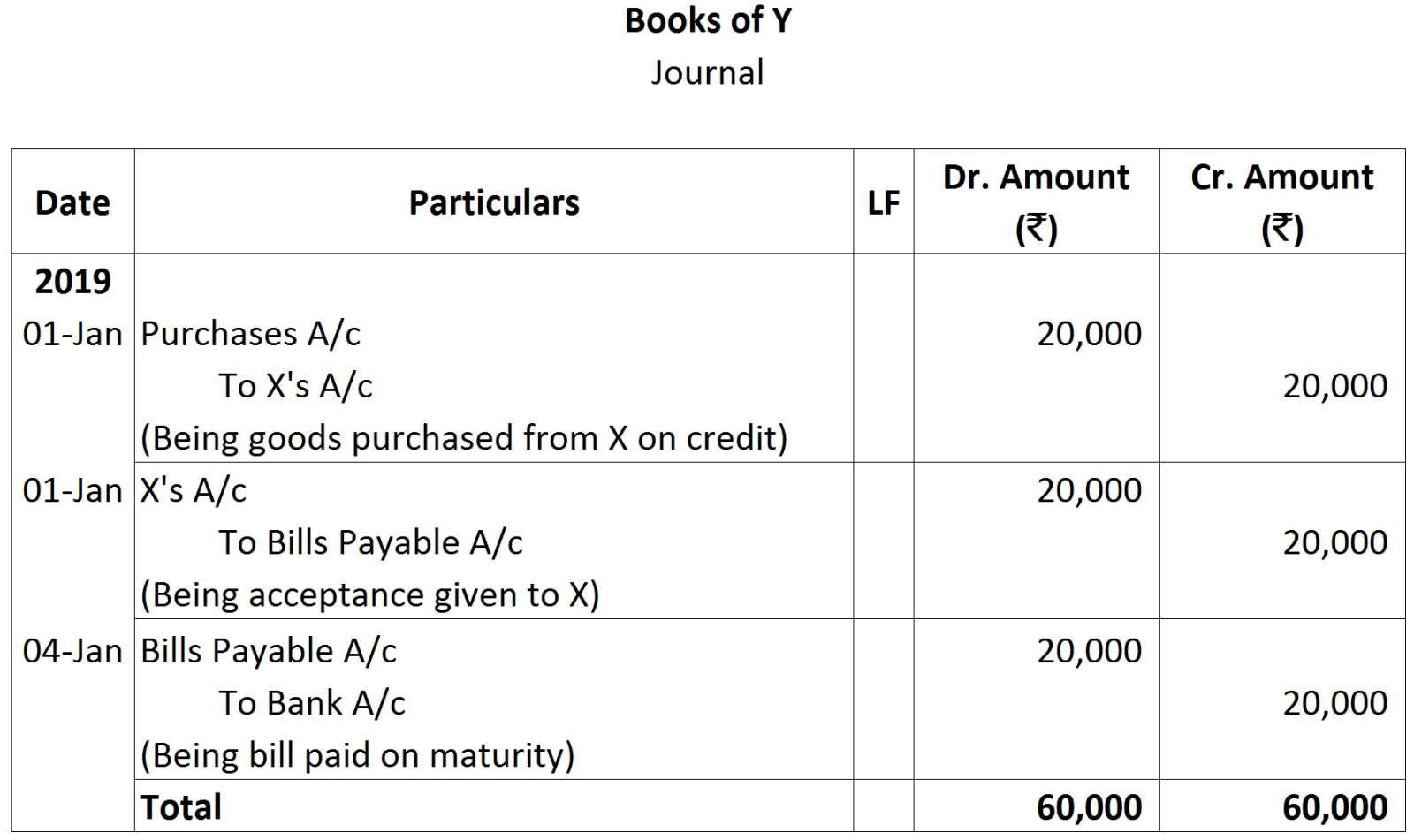
Vinod sold goods to Darbara Singh for ₹ 1,000 on 1st January, 2019. He drew on the latter a bill for the amount payable 3 months after date. He discounted the bill with his bank for ₹ 990 on 4th January, 2019. On maturity, the bill is duly met. Make the Journal entries in the books of Vinod and Darbara Singh.
View full question & answer
Question 66 Marks
On 21st Sept. 2017, Radhika sold goods for ₹ 2,00,000 to Parvati and drew upon later a bill for the same amount payable after 3 months. The bill was accepted by Parvati, Radhika discounted the bill from bank at a discount of 15% p.a. on 21st Oct., 2017. On maturity, the bill was dishonoured. Parvati agreed to pay ₹ 1,20,000 in cash including ₹ 3,000 interest and accepted a new bill for 3 months. The new bill was endorsed to Gayatri in full settlement of his account ₹ 85,000. It was duly met on maturity. Pass entries in the books of Radhika.
View full question & answer
Question 76 Marks
On 17th April, 2016, X sold goods to Y for ₹ 80,000 and draws a bill for 2 months upon Y for the amount due. Y accepted the bill and returned it to X. On due date the bill became dishonoured and X paid ₹ 400 as Noting Charges. Fifteen days later Y pays the amount due to X. Pass Journal entries in the books of both the parties.
View full question & answer
Question 86 Marks
Explain any three of the following:
  1. Retiring of Bills of Exchange.
  2. Holder in due course.
  3. Bills sent to bank for collection.
  4. Noting charges.
Answer
  1. Retiring of Bills of Exchange: Retirement of a bill means making the payment of a billbefore the date of maturity. Due to the premature payment done by the drawee, the drawer allows some discount as consideration. Such a discount at the time of retirement of a bill is an income for the drawee and is an expense for the drawer.
  2. Holder in due course:
Holder: A person who is holder or possessor of the bill.

In due course: in normal time or in the expected amount of time.

Thus, we can say that a person who has received or holds any negotiable instrument in good faith for good time is known as holder in due course. It implies that the people who are holding bill of exchange for its normal due time without having the knowledge of any falsification for the instrument issued or for the previous instruments.
  1. Bills sent to bank for collection: A bill received may be retained till the date of maturity, But, it may be deposited with the bank, with instructions that the bill be retained till maturity and realised on its due date. It is known as Bill Sent for Collection.
  2. Noting charges: Noting Charges is the fee paid to the Notary Public for notinįg and protesting the Bill of Exchange of its dishonour.
View full question & answer
Question 96 Marks
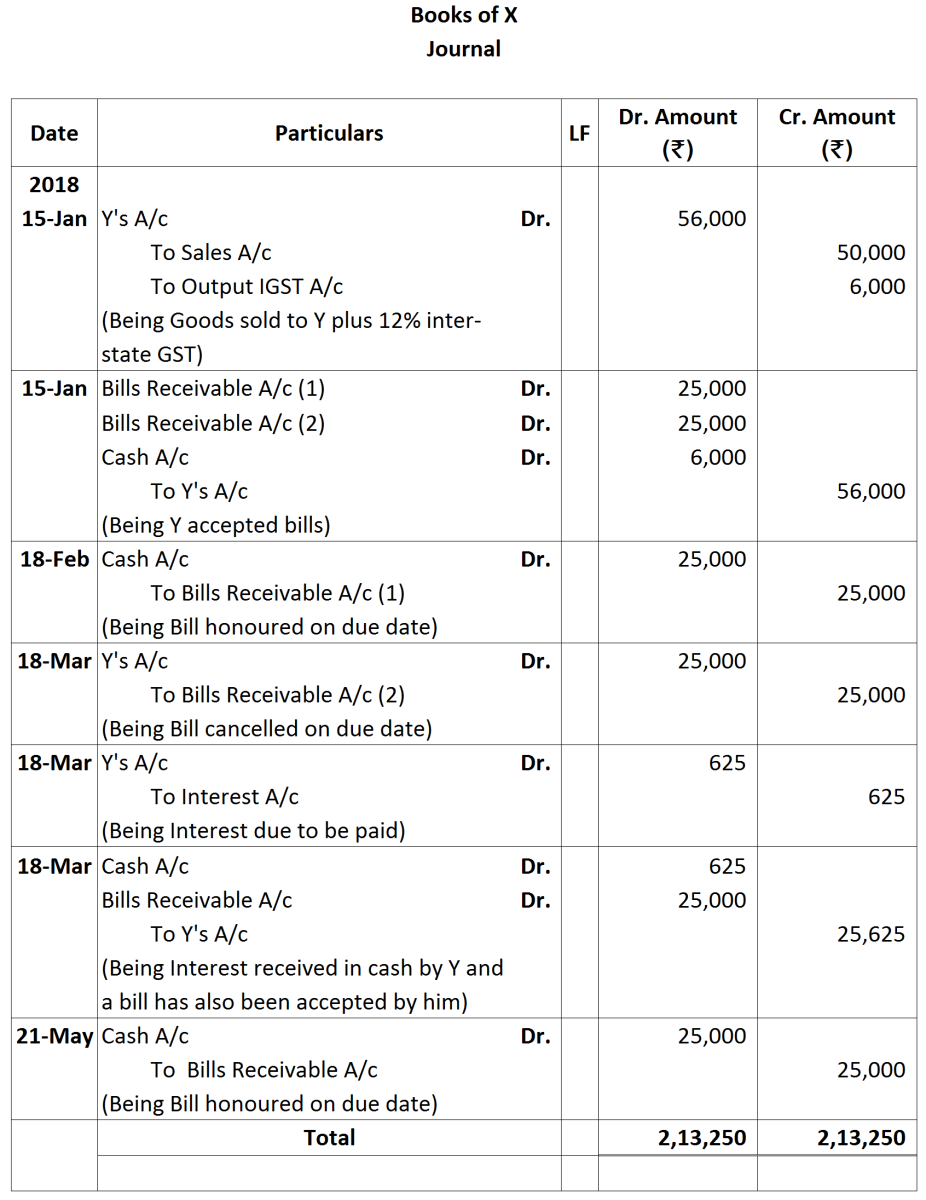
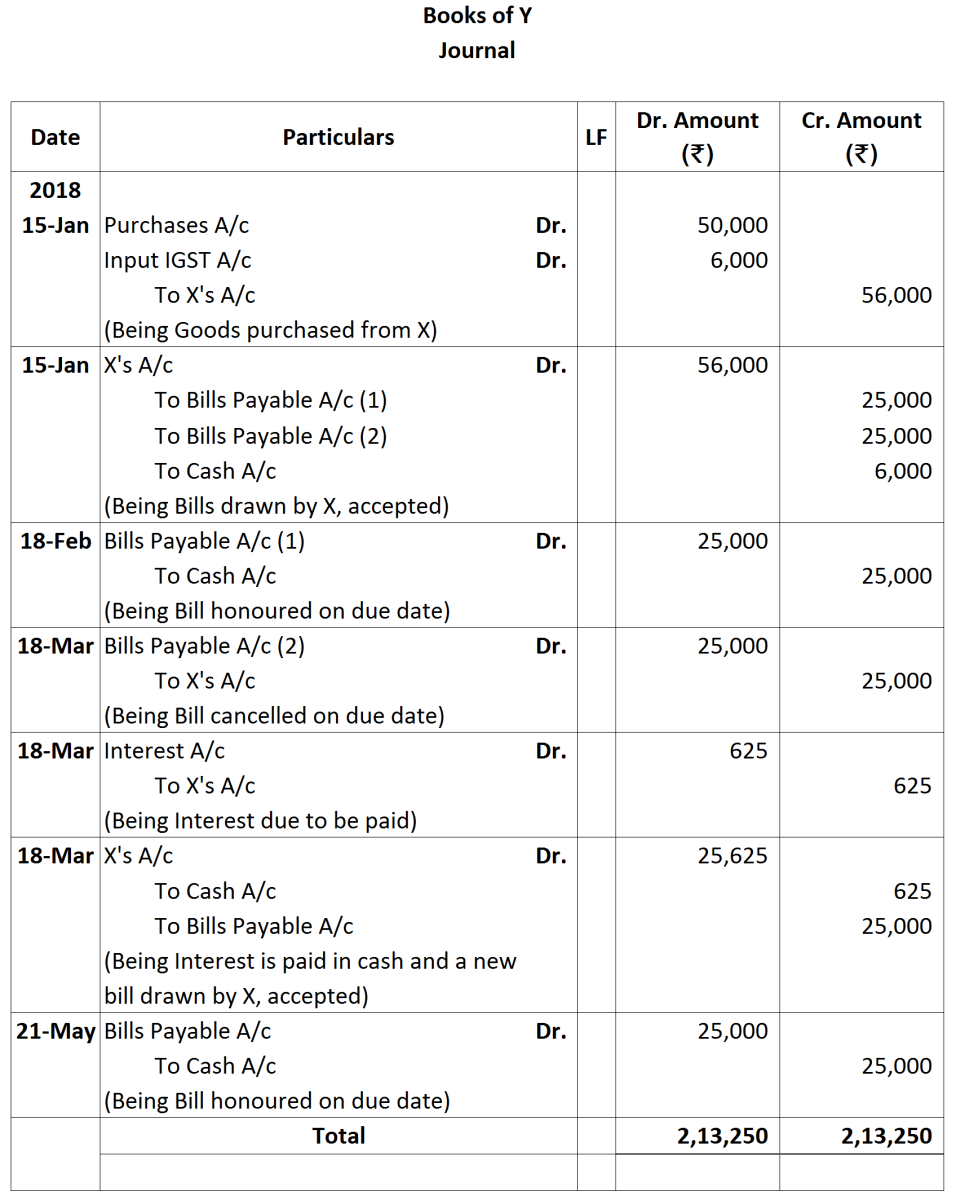
On 15th January 2018, X sold goods to Y for ₹ 50,000 charging IGST @ 12%. Yimmediately paid ₹ 6,000 in cash and accepted two bills of equal amount, the first for one month and the second for two months. The first bill was met on due date but on the due date of the second bill, Y requested that the bill be renewed for a further period of two months. X agreed provided that interest at 15% p.a. was paid immediately in cash. Yagreed to this. The second bill was met on the due date.
Give journal entries in the books of X and Y.
Answer


Working Note:
Calculation of amount of Interest,
Amount of Interest $=25,000\times\frac{15}{100}\times\frac{2}{12}=₹\ 625$
View full question & answer
Question 106 Marks
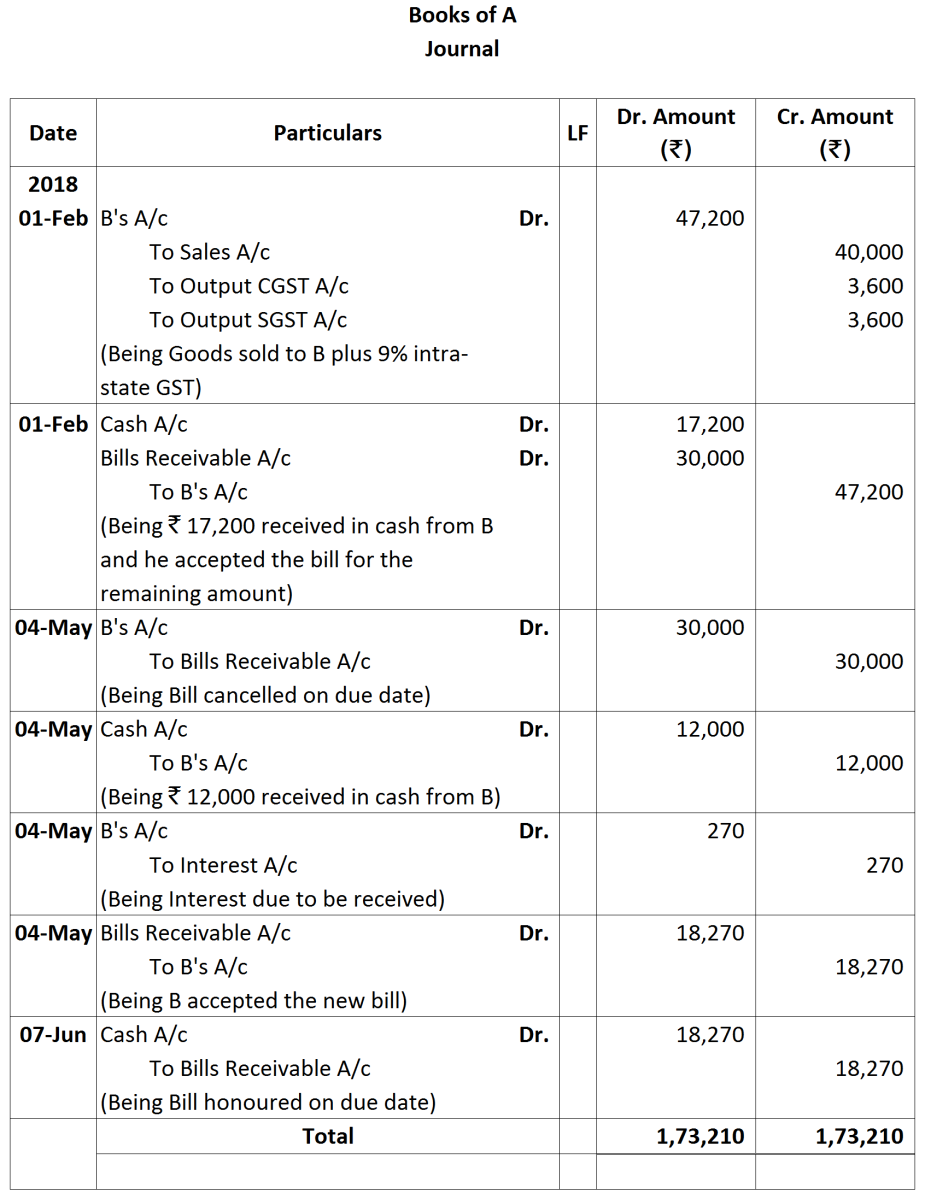
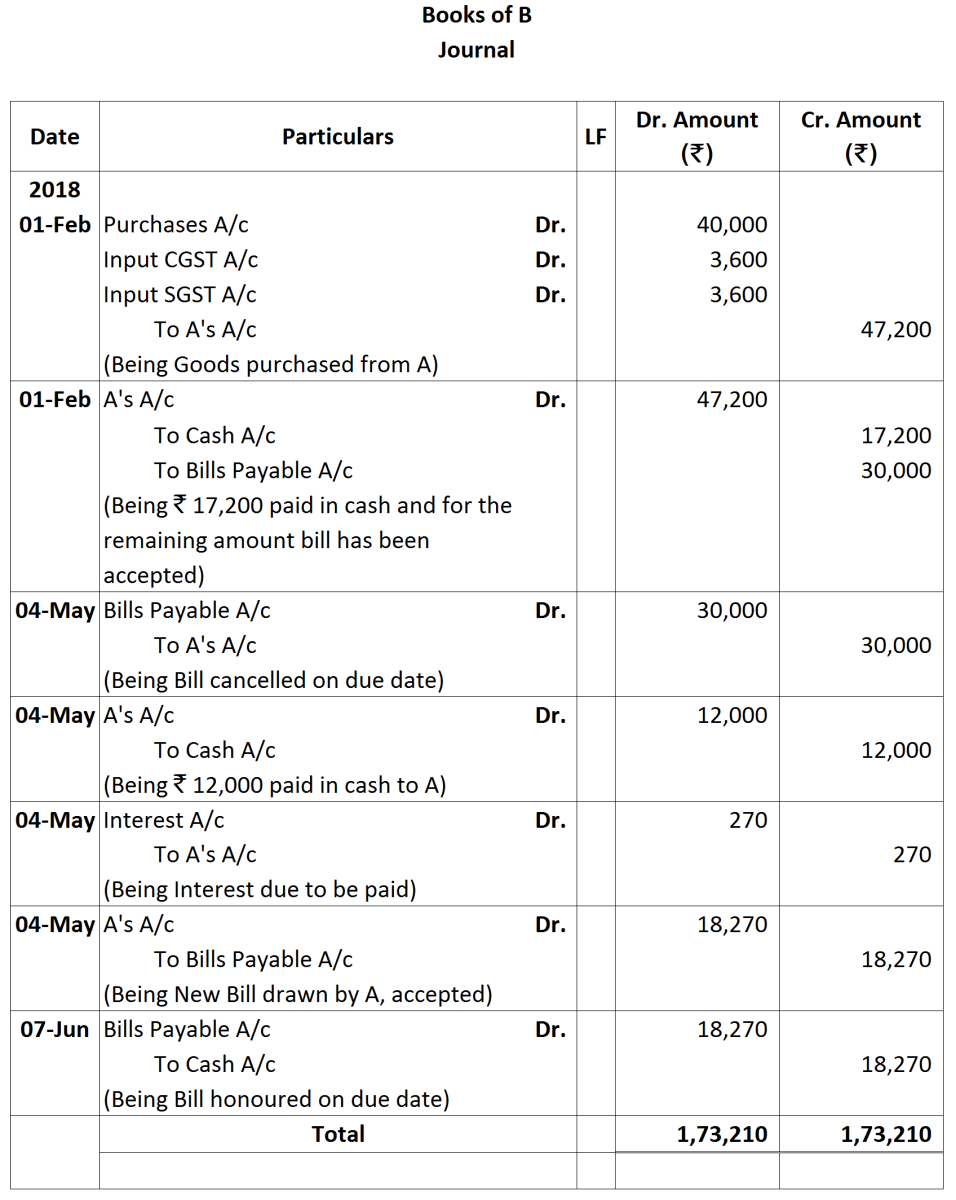
On 1st February 2018, A sold goods to B for ₹ 40,000 Charging CGST and SGST @ 9% each. B pays ₹ 17,200 in cash and accepted a three months bill for the balance. On the due date, B expressed his inability to meet the bill and offered ₹ 12,000 in cash and to accept a new bill for one month for the balance plus interest at 18% p.a. A agrees to the proposal. On the due date the bill was duly honoured by B. Pass entries in the books of A and B.
Answer


Working Note:
Calculation of amount of Interest,
Amount of Interest $=18,000\times\frac{18}{100}\times\frac{1}{12}=₹\ 270$
View full question & answer
Question 116 Marks
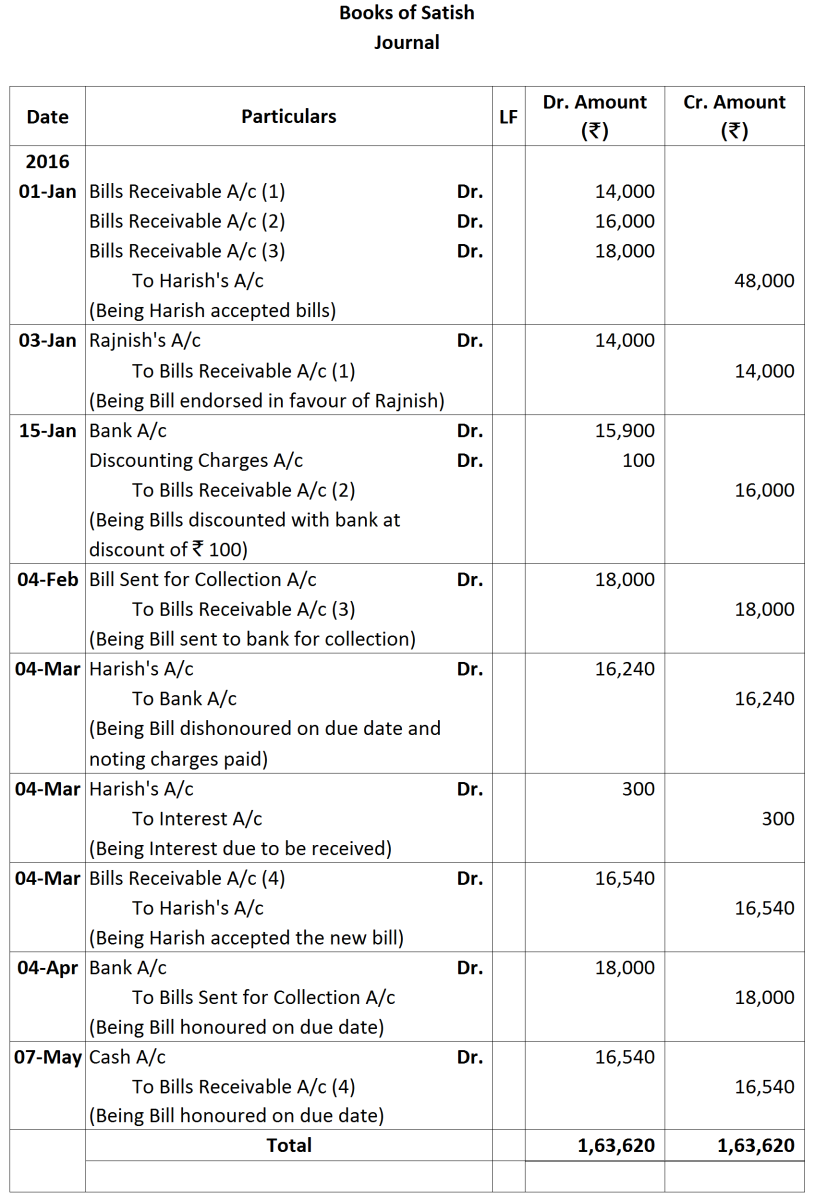
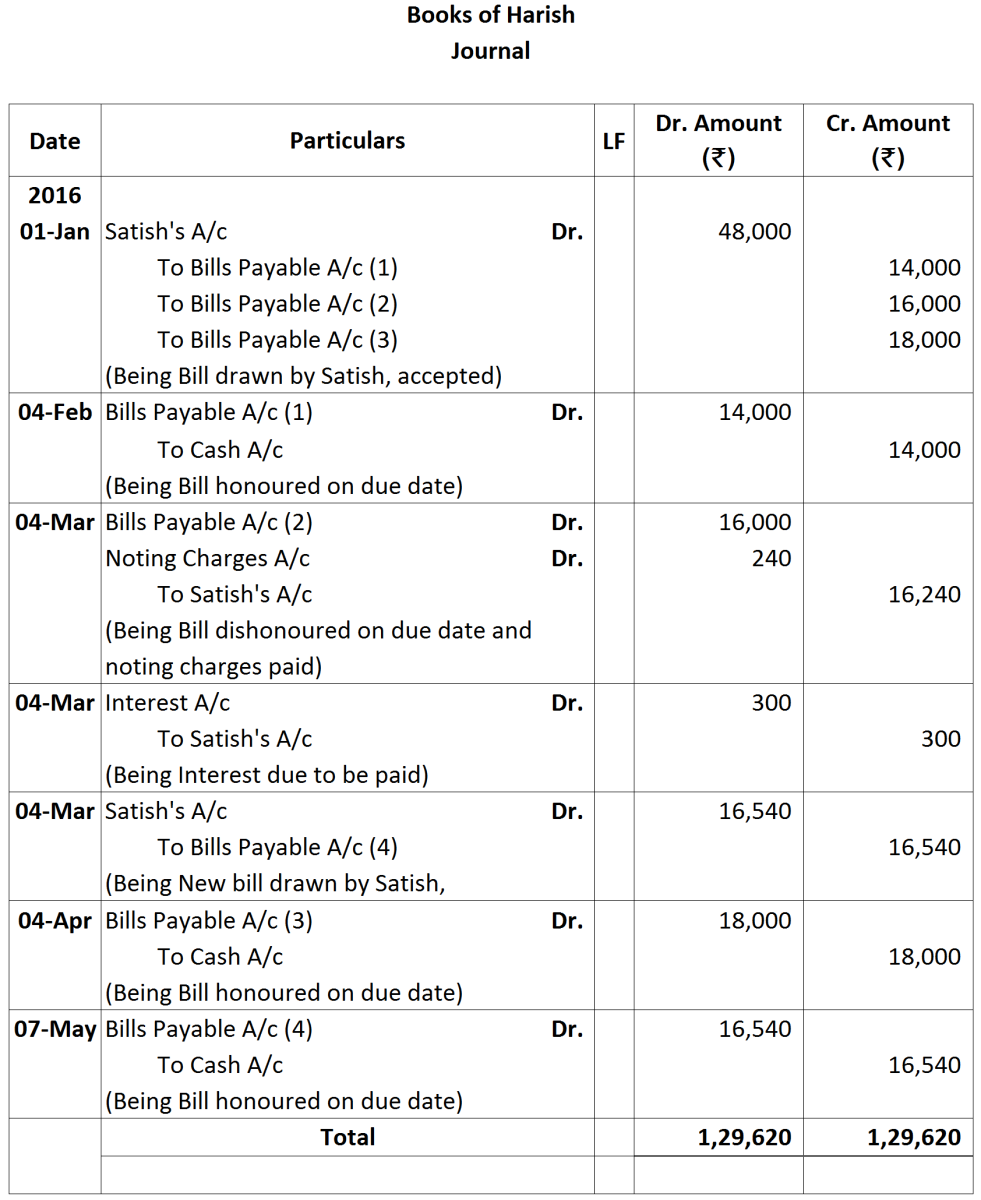
On 1st Jan., 2016, Satish drew on Harish three bills of exchange in full settlement of claims, the first for ₹ 14,000 at one month; the second for ₹ 16,000 at two months and the third for ₹ 18,000 at three months. The bills were duly accepted by Harish. The first bill was endorsed by Satish to his creditor Rajnish on 3rd Jan., 2016. The second bill was discounted on 15th Jan. for ₹ 15,900 and the third bill was sent to bank for collection on 4th Feb. All the bills were met on maturity except the second bill which was dishonoured, noting charges being paid ₹ 240. Satish charged ₹ 300 for interest from Harish and drew on him a fourth bill for two months for ₹ 16,540. The fourth bill was duly met on maturity. Give Journal entries in the books of Satish and Harish.
Answer
Solution is as follows:

View full question & answer
Question 126 Marks
A purchased goods for ₹ 15,000 from B on March 01, 2017 and accepted a bill of exchange drawn by B for the same amount. The bill was payable after 60 days. On April 28, B sent the bill to his bank for collection. The bill was duly presented by the bank. Adishonoured the bill and the bank paid ₹ 150 as noting charges.
Record the necessary journal entries for the above transactions in the books of A and B.
View full question & answer
Question 136 Marks
Leena sold goods to Meena on 1st March, 2009 for ₹ 68,000 and drew two Bills of Exchange of the equal amount upon Meena payable after three months. Leena immediately discounted the first bill with her bank at 12% p.a. The bill was dishonoured by Meena and Bank paid ₹ 55 as noting charges.
The second bill was retired on 4th May, 2009 under a rebate of 6% p.a. with mutual agreement.
Journalise the above in the books of Leena and Meena.
View full question & answer
Question 146 Marks
Briefly explain the benefits of maintaining a Bills Payable Book and state how is its posting is done in the ledger?
Answer
A bills payable book is a special purpose book, maintained to keep records of acceptance of bills, given to the creditors. It contains details of the amount, date of bill, due date and name of the drawer to whom acceptance is given for future references.
Benefits of Maintaining Bills Payable Book:
  1. Source of information: The general information related to the each of the bills i.e. the amount, due date and name of the drawee are recorded at one place and hence are easily accessible.
  2. Avoid fraud: As the details of all the bills are recorded at one place, possibility of fraud is reduced.
  3. Time saving: Recording of bills receivable through the bills receivable book takes lesser time than that of journal entry.
  4. Responsibility: As the transactions are recorded by the same person errors if any can be easily detected and rectified. This leads to enhancement of responsibility and accountability of the accountant.
View full question & answer
Question 156 Marks
A sold goods to B for ₹ 60,000 Charging IGST @18% and immediately drew a bill on Bwho duly accepted the same. A endorsed the bill to C. C endorsed it to his creditor D. Ddiscounted the bill for ₹ 68,000. On the date of maturity, the bill was dishonoured and Bank paid noting charges amounting to ₹ 200.
Show Journal entries in the books of all the parties to record these transactions.
View full question & answer
Question 166 Marks
Calculate the due dates of the bills in the following cases:
Date of Bill
Tenure (Period)
(i)
1st December, 2018
60 Days
(ii)
30th April, 2019
2 Months
(iii)
28th January, 2019
1 Month
(iv)
23rd November, 2018
2 Months
(v)
29th May, 2018
4 Months
Answer
 
Date of Bill
Tenure
Calculation
Due Date
(i)
December 01, 2018
60 Days
30 (December) + 30 (January) + 3 days of grace
February 02, 2019
(ii)
April 30, 2019
2 Months
2 Months from April 30, 2019 would be June 30, 2019 + 3 days of grace
July 03, 2019
(iii)
January 28, 2019
1 Months
1 Month from January 28, 2019 would be February 28, 2019 + 3 days of grace
March 03, 2019
(iv)
November 23, 2018
2 Months
2 Months from November 23, 2018 would be January 23, 2019 + 3 days of grace
January 26, 2019, but it is a national holiday so, due date would be one day before i.e., January 25, 2019
(v)
May 29, 2018
4 Months
4 Months from May 29, 2019 would be September 29, 2019 + 3 days of grace
October 02, 2019 but it is a national holiday so, due date would be one day before i.e., October 01, 2019
View full question & answer
Question 176 Marks
Briefly explain the purpose and benefits of retiring a bill of exchange to the debtor and the creditor.
Answer
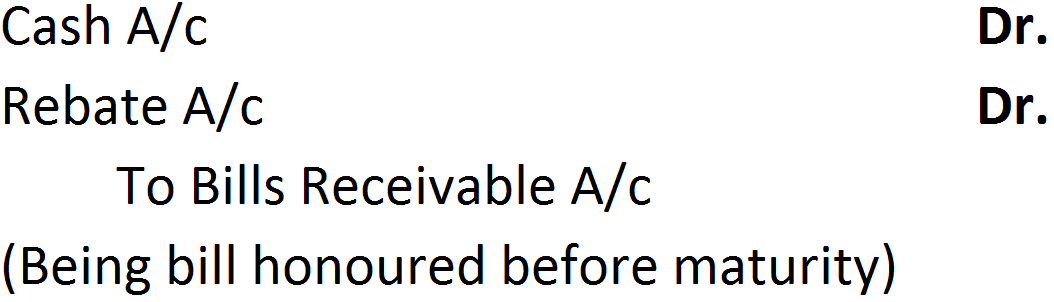
When a holder receives the amount of a bill before the maturity date on request of the acceptor, it is called retirement of the bill of exchange. Holder of the bill may give discount for such earlier payment. This discount is termed as ‘rebate’.
Rebate is given by the holder to the acceptor of the bill on account of payment before the due date. Rebate is a loss for the holder of the bill; so, it is debited in the books of the holder when payment is received.
Cash A/c
Dr.
Rebate A/c
Dr.
To Bills Receivable A/c
 
(Payment received and rebate allowed for early payment)
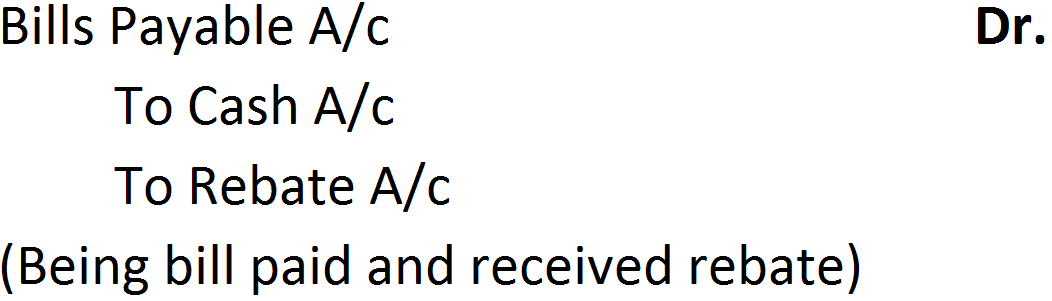
Acceptor of the bill gets rebate for the payment made before the due date. The rebate is a gain for the drawee; so, it is credited in the books of the drawee.
Bills Payable A/c
Dr.
To Cash A/c
 
To Rebate A/c
 
(Bill paid before the due date and rebate received for early payment)
 
View full question & answer
Question 186 Marks
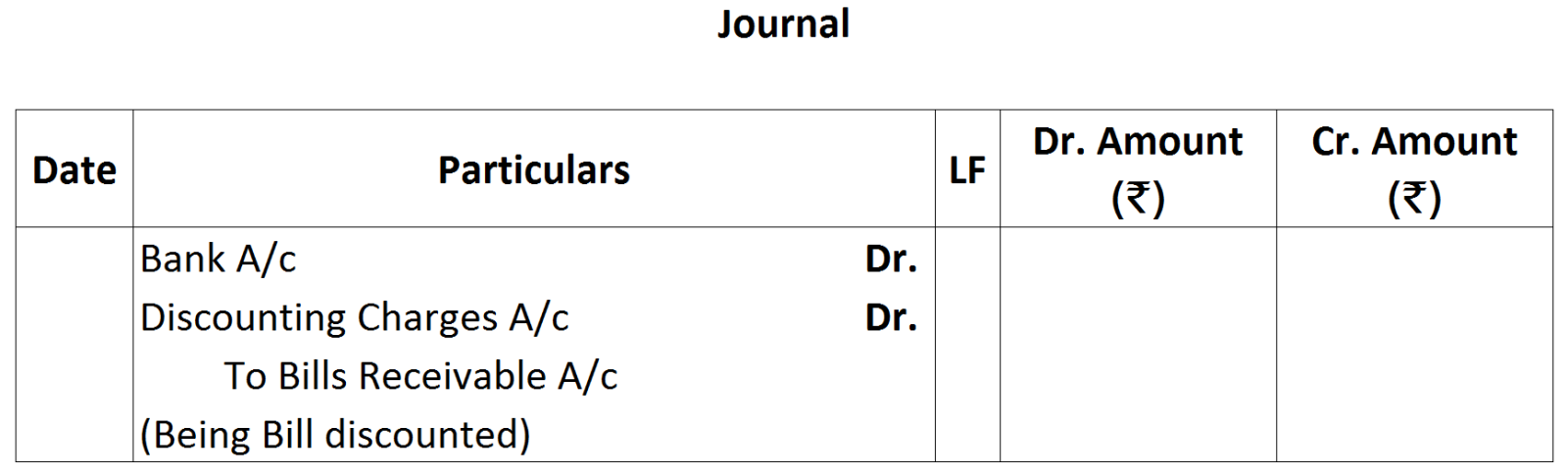
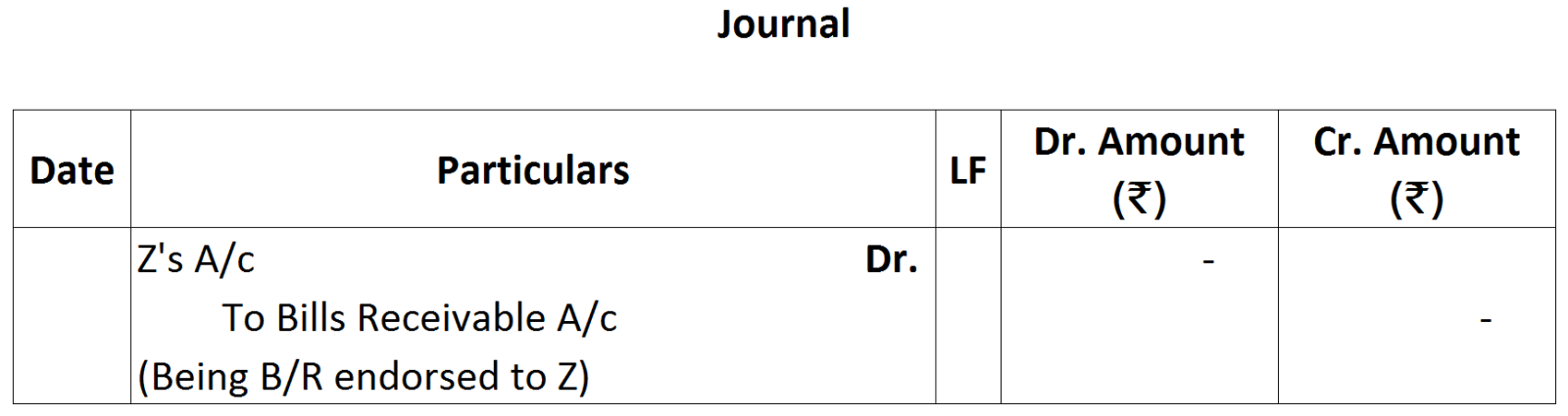
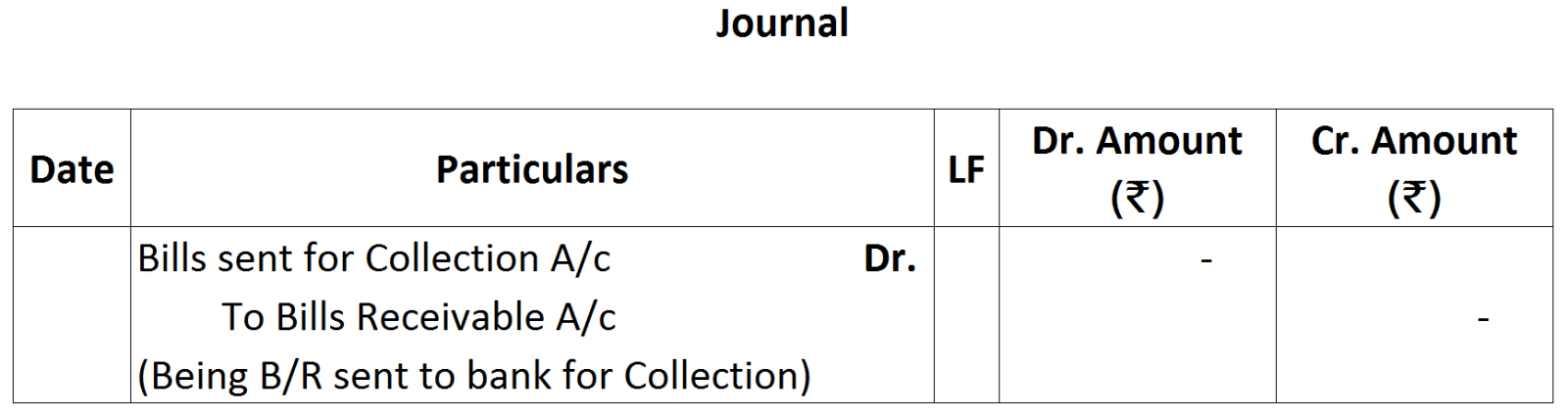
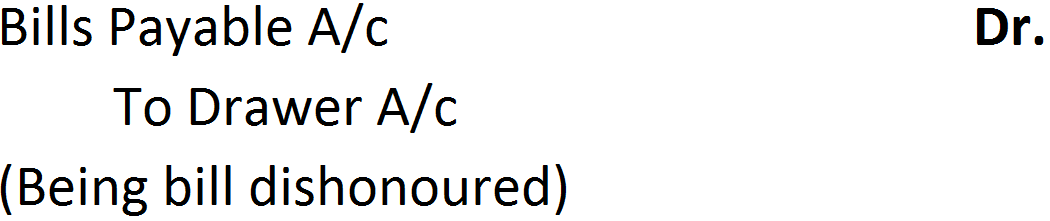
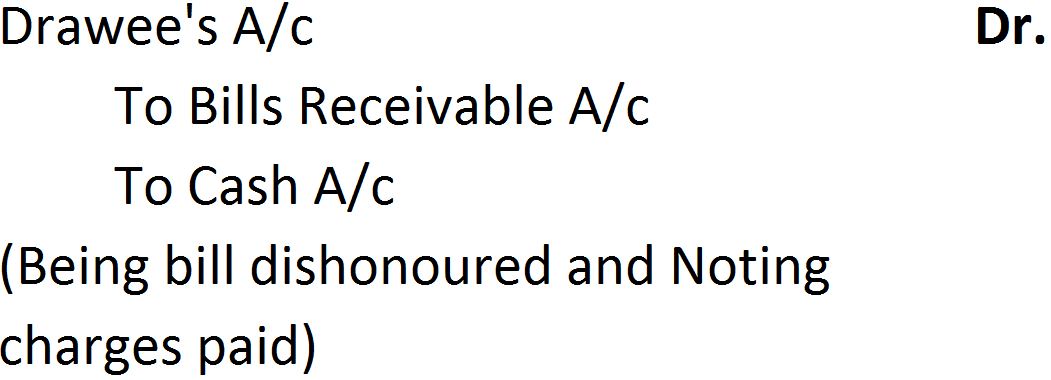
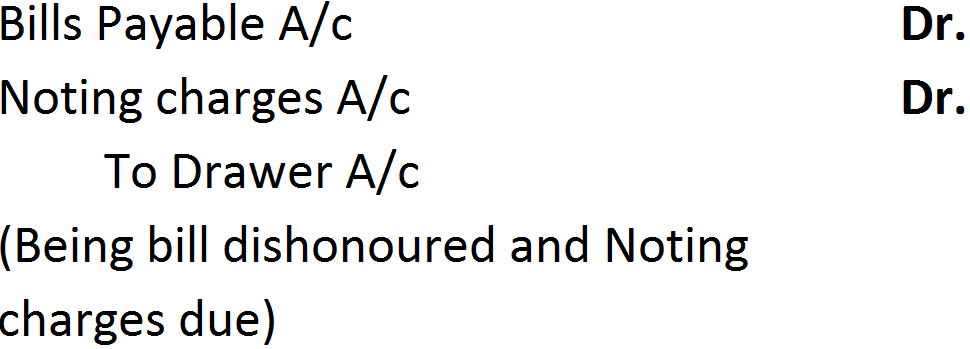
What do you mean by dishonour of a bill? What entries will be made in the books of Drawer, if:
  1. Bill is with the drawer himself.
  2. Bill is discounted with the Bank.
  3. Bill is with the endorsee.
  4. Bill is sent to the Bank for collection.
Answer
Dishonour of a Bill means a situation when the acceptor of the bill does not pay (say because of insolvency) the amount. Holder of the bill can recover the amount from the Drawer or any of the previous endorsers. The holder of the bill may present the bill through a Notary Public and get the dishonour of the bill noted.
  1.  
  1.  
  1.  
  1.  
View full question & answer
Question 196 Marks
Explain briefly the purpose and advantages of maintaining of a Bills Receivable Book.
Answer
Bills receivable book is a special purpose book that is maintained to keep records of bills received from the debtors. It contains details such as acceptor’s name, date of bill, due date and amount. for future references.
Benefits of maintaining the bill receivable book:
  1. Source of information: The general information related to the each of the bills i.e. the amount, due date and name of the drawee are recorded at one place and hence are easily accessible.
  2. Avoid fraud: As the details of all the bills are recorded at one place, possibility of fraud is reduced.
  3. Responsibility: The person who maintains the bills receivable book will also be responsible for any errors or omissions. Therefore, higher degree of accountability and responsibility exists. Also, if any error is detected, then it can be fixed quickly.
  4. Time saving: Recording of bills receivable through the bills receivable book takes lesser time than that of journal entry.
View full question & answer
Question 206 Marks
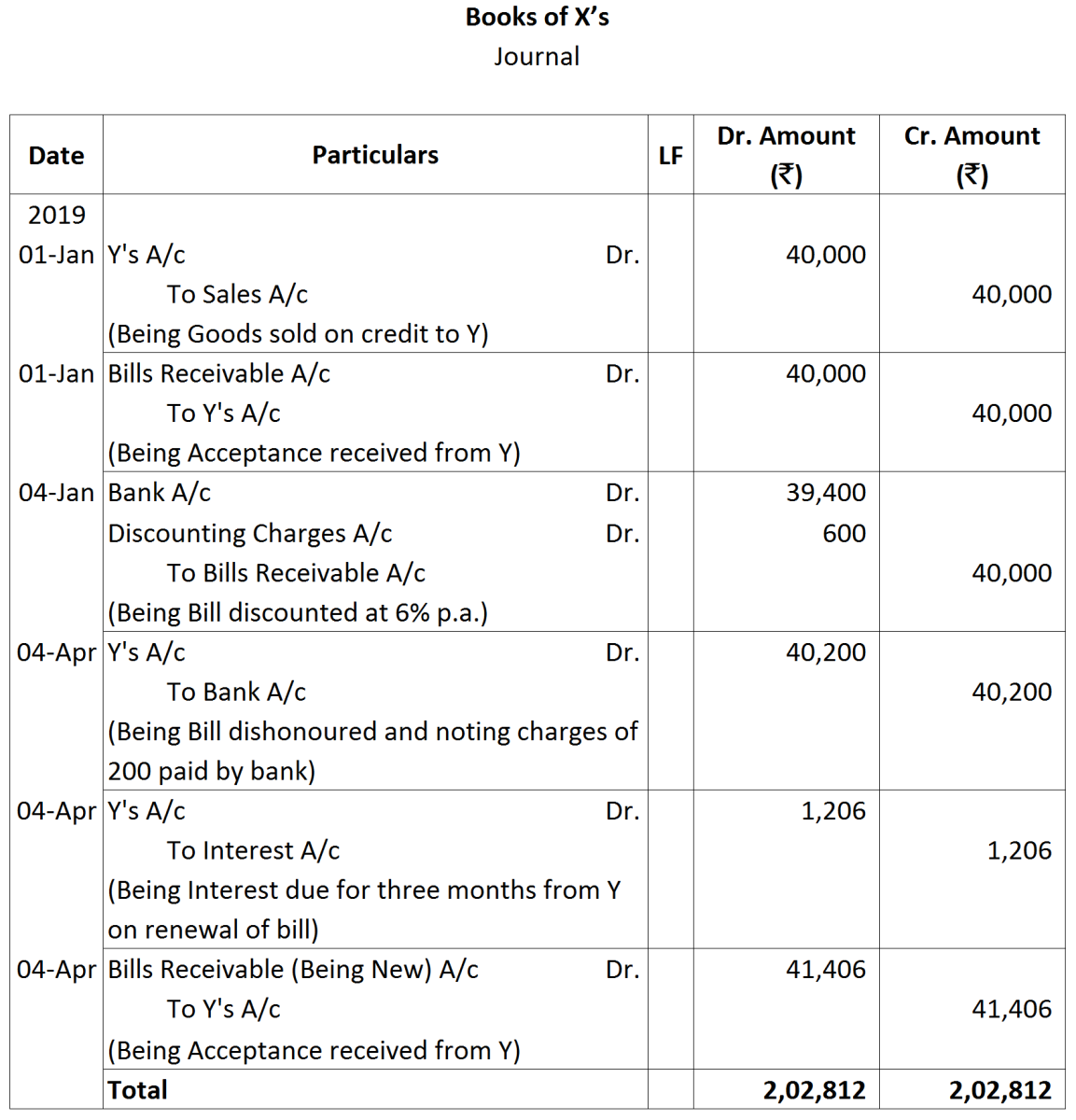
X sells goods for ₹ 40,000 to Y on 1st January, 2019 and on the same day draws a bill on Y at three months for the amount. Y accepts it and returns it to X, who discounted it on 4th January, 2019 with his bank at 6% p.a. The acceptance is dishonoured on the due date and the noting charges were paid by bank being ₹ 200.
On 4th April, 2019, Y accepts a new bill at three months for the amount then due to X together with interest at 12% p.a.
Make Journal entries to record these transactions in the books of X.
Answer

Working Notes:
WN 1: Amount of Discounting Charges $=\frac{40,000\times6\times3}{100\times12}=₹ \ 200$
WN 2: Amount of Interest on Renewal of Bill $=\frac{40,200\times12\times3}{100\times12}=₹ \ 1,206$
View full question & answer
Question 216 Marks
Give the meaning of rebate.
Answer
If the drawee expresses his/ her wish to pay the bill before the due date to the holder, and if the holder accepts his/ her request, then on account of the early payment, the holder may give some discount. This discount is termed as rebate. In other words, rebate is a discount given by the holder to the drawee (or acceptor) for his/ her request of early payment of the bill before the due date. It is an expense for the drawer and hence, is debited to the drawer’s books. On the other hand, as it is a gain for the acceptor of bill, so it is credited in the drawee’s books. Entry in the books of drawer of the bill.
Entry in the books of drawee of the bill.
View full question & answer
Question 226 Marks
Give the Journal entries for the following:
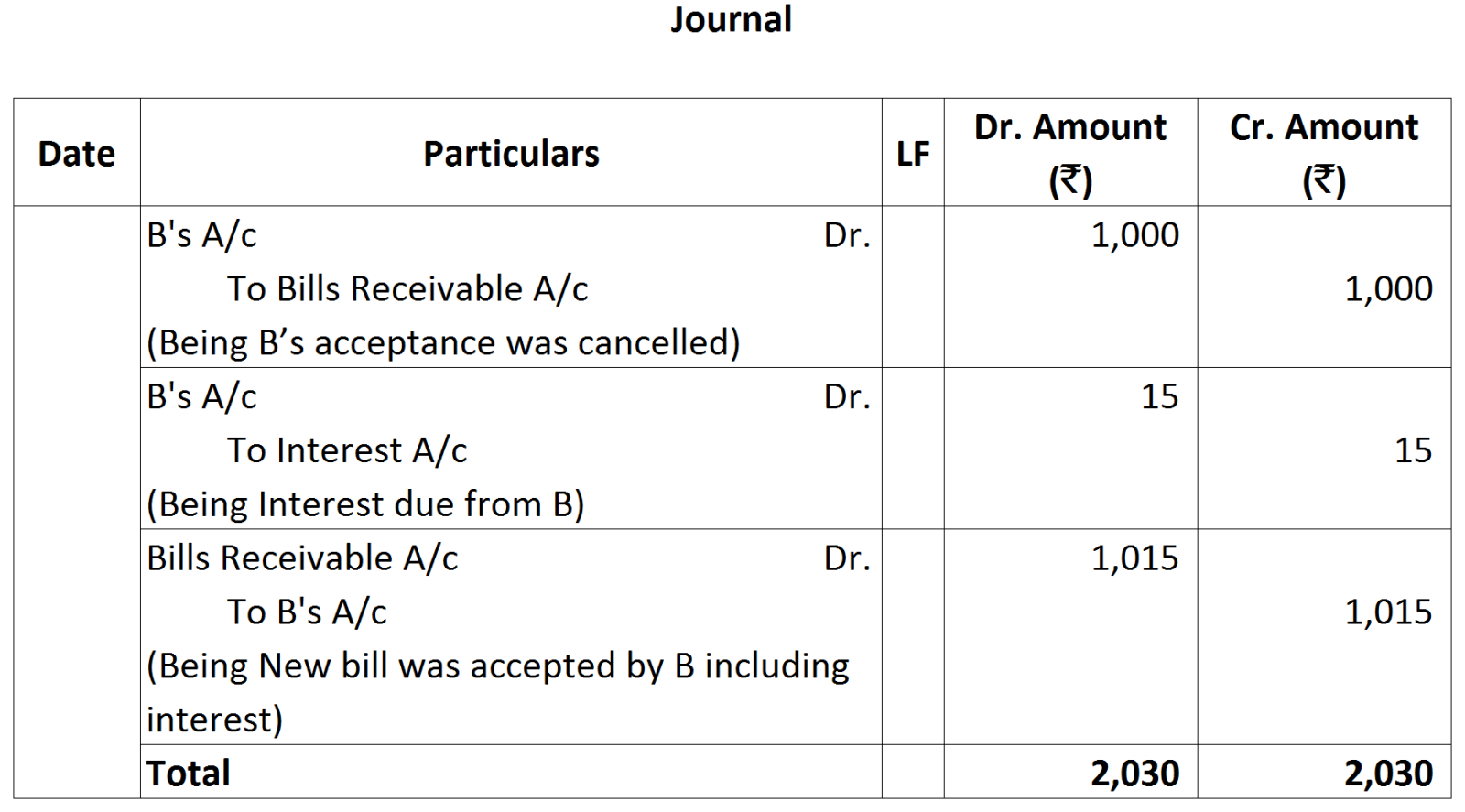
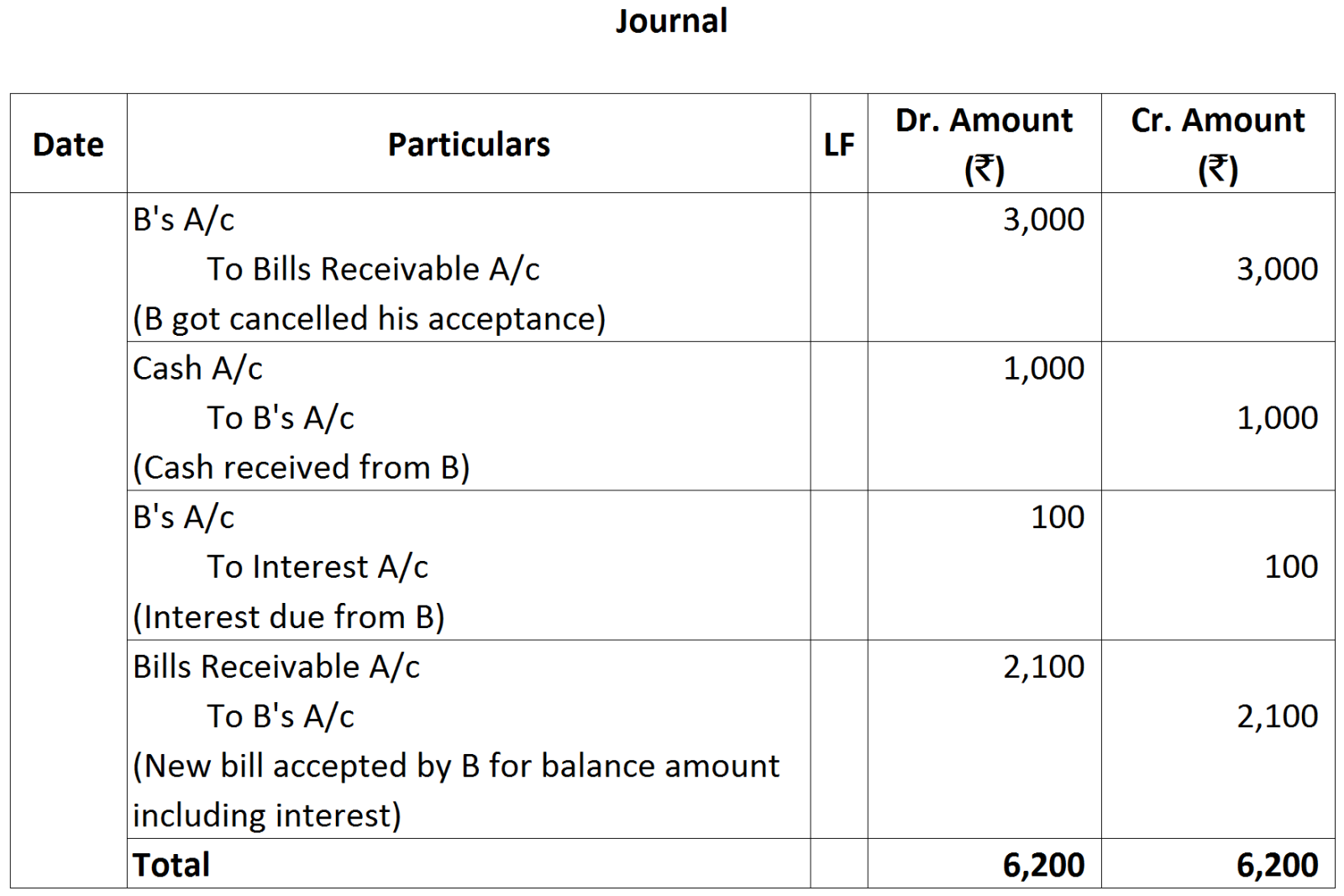
  1. B's acceptance to us for ₹ 1,000 due this day, renewed at his request for 3 months with interest @ 6% p.a.
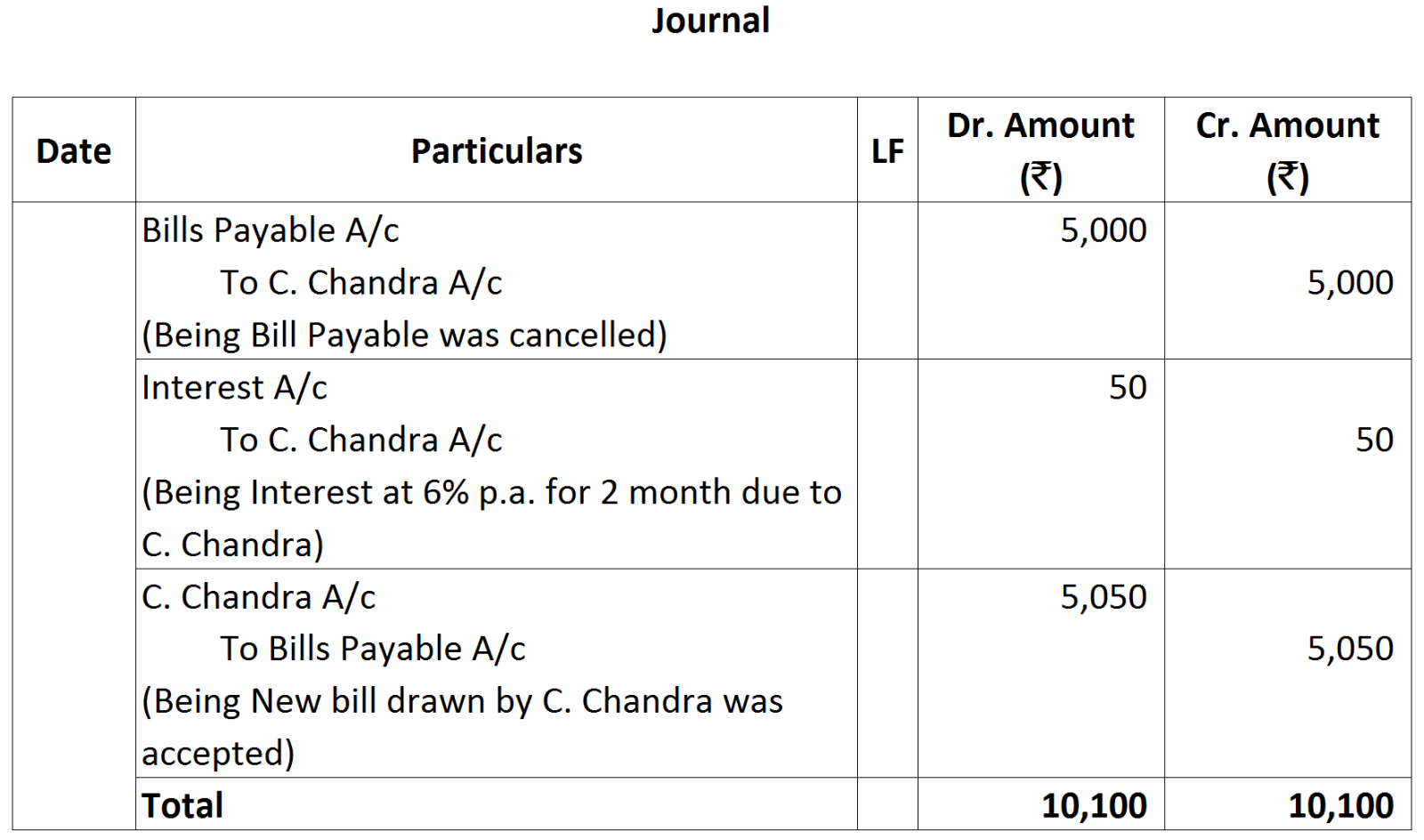
  2. Our bill to Chandra for ₹ 5,000 renewed for 2 months with interest @ 6% p.a.
  3. B's acceptance of ₹ 3,000 is discharged on his paying us cash ₹ 1,000 and accepting a fresh bill for the balance with interest ₹ 100.
Answer

Working Note:
$\text{Interest}=1,000\times\frac{6}{100}\times\frac{3}{12}=₹ \ 15$
Working Note:
$\text{Interest}=5,000\times\frac{6}{100}\times\frac{2}{12}=₹ \ 50$
View full question & answer
Question 236 Marks
Give a definition of Promissory Note and give its four characteristies.
Answer
“A Promissory Note is an instrument in writing (not being a bank note or a currency note) containing an unconditional undertaking signed by the maker to pay a certain sum of money only to or to the order of a certain person or to the bearer of the instrument." -Section 4 of the Negotiable Instruments Act, 1881Features of a Promissory Note:
  1. Promissory Note is an unconditional written undertaking to pay the specified amount.
  2. It is drawn and signed by the maker, i.e., promisor.
  3. It specifies the name of the payee, i.e., to whom payment is to be made.
  4. Specified amount is payable to the specified person or to his order or to the bearer.
  5. Date of payment is specified.
View full question & answer
Question 246 Marks
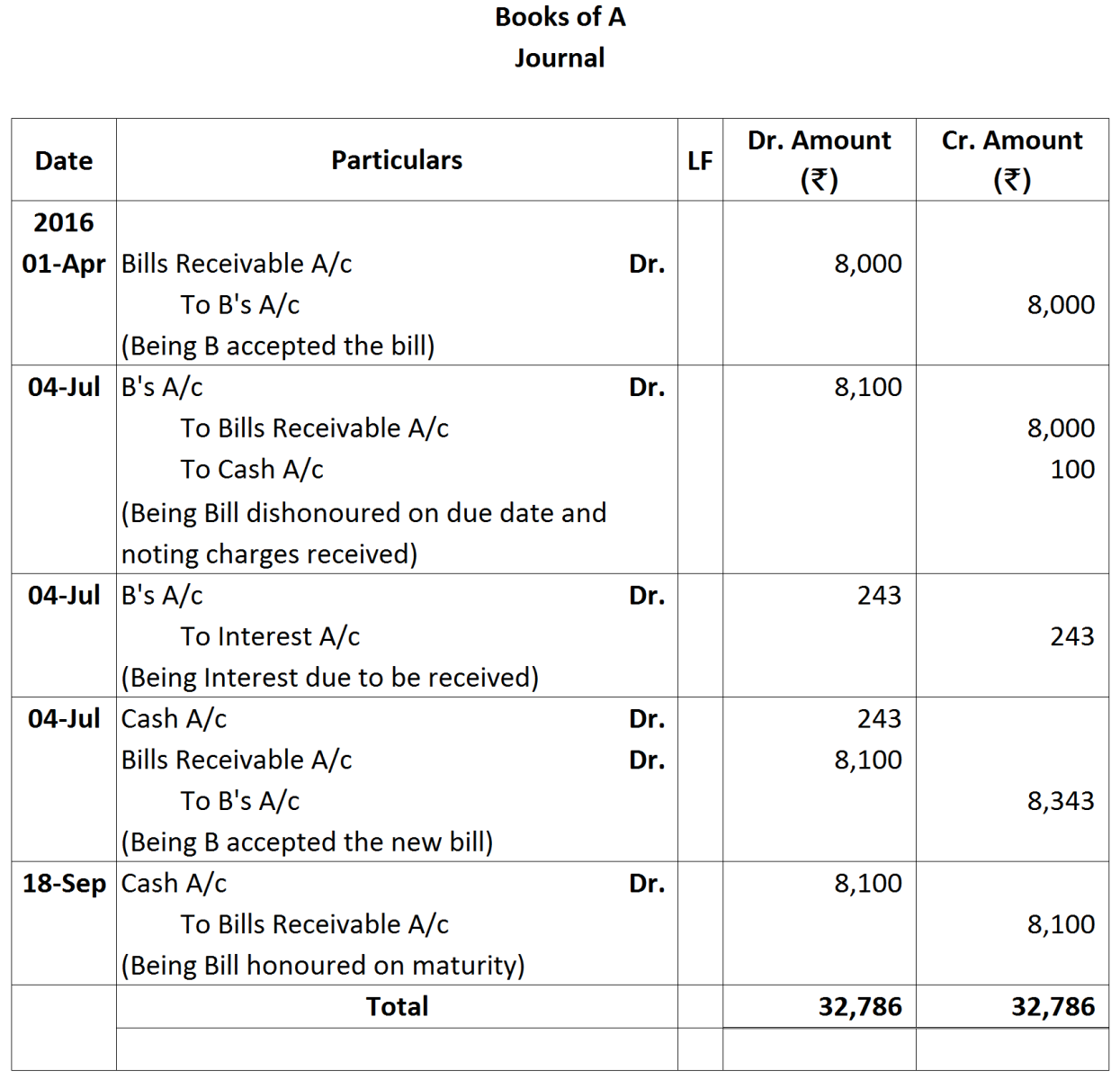
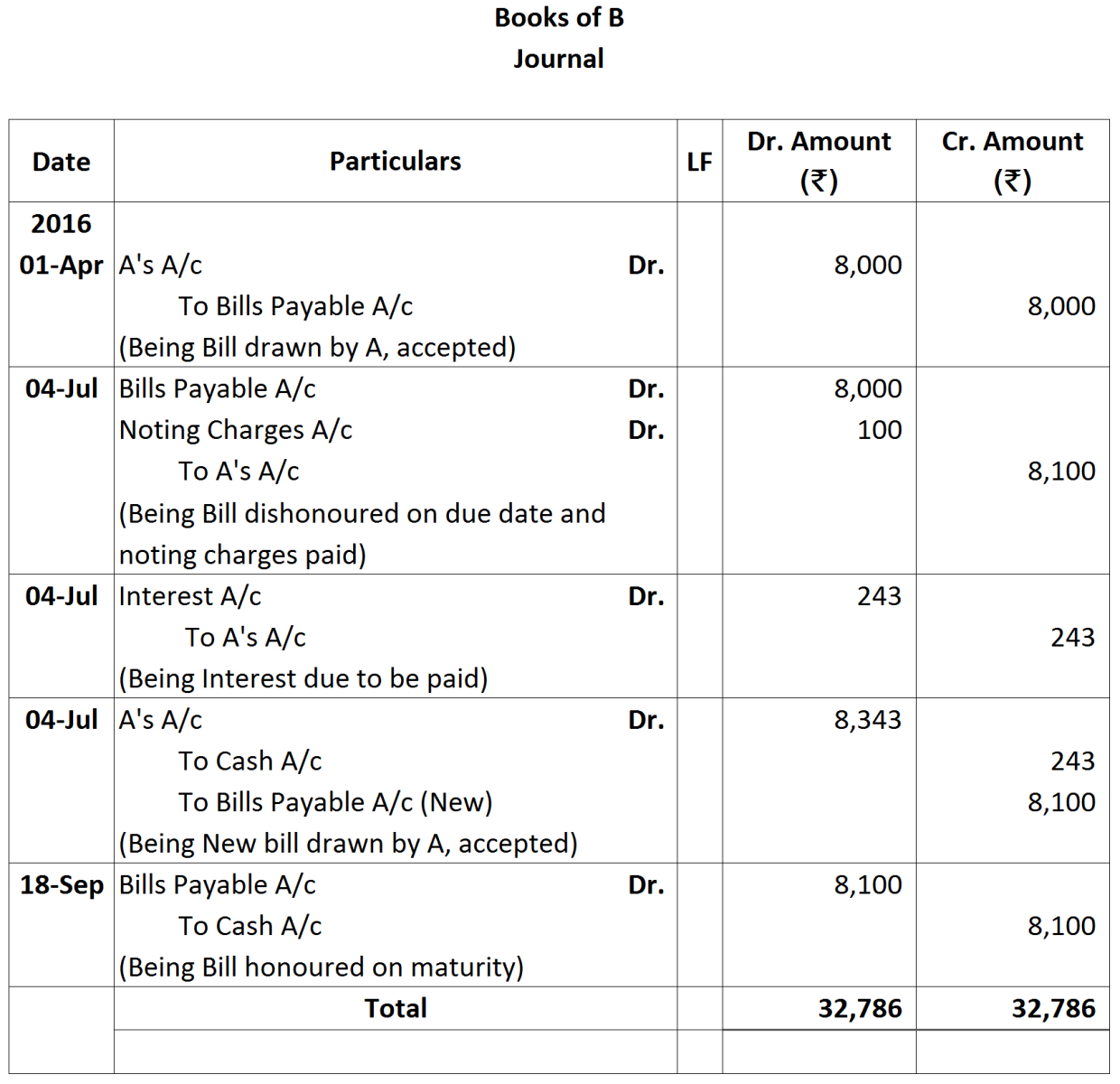
On 1st April, 2016, B accepts a bill drawn by A at three months for ₹ 8,000 in payment of debt. On the due date the acceptance is dishonoured and A gets the bill noted paying ₹ 100. On 4th July, 2016 A draws a new bill payable after 73 days provided interest is paid in cash @ 15% p.a. To this B is agreeable. The bill is met on maturity.
Record these transactions in the Journal of both the parties.
Answer


Working Note:
Calculation of amount of Interest,
Amount of Interest $=8,100\times\frac{15}{100}\times\frac{73}{365}=₹\ 243$
View full question & answer
Question 256 Marks
Briefly explain the effects of dishonour and noting of a bill of exchange.
Answer
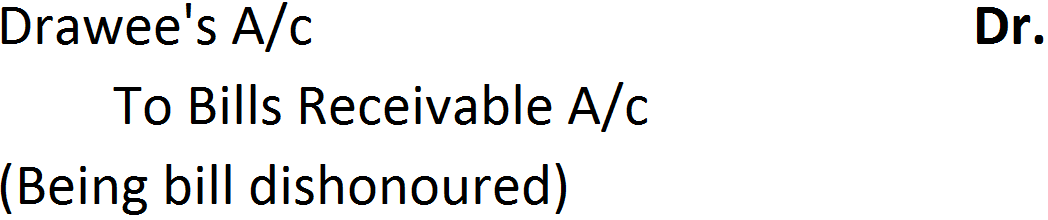
On the maturity of the bill, when the acceptor of the bill fails to make the payment, it is said that the bill is dishonoured. This restores the liability of the acceptor. Entry in the books of drawer: Entry in the books of drawee:
Noting charges is the fee paid to the notary public for noting and protesting the bill of exchange of its dishonour. Effect of Noting charges in the books of the drawer:
View full question & answer
Question 266 Marks
On 1st June, 2019, A sold goods to B for ₹ 250. B gave to A his acceptance payable 1 month after date. Before maturity B requests A to renew it, which A does adding ₹ 10 to the new bill for interest.
Make the necessary Journal entries to record these transactions in the books of both Aand B.
View full question & answer
Question 276 Marks
Define Bill of Exchange. What are the parties to a Bill of Exchange?
Answer
"A Bill of Exchange is an instrument in writing containing an unconditional order signed by the maker, directing a certain person to pay a certain sum of money only to, or to the order of, a certain person or to the bearer of the instrument." -Section 5 of the Negotiable Instruments Act, 1881A Bill of Exchange has three parties namely:
  1. Drawer: Drawer is the person who makes or writes the Bill of Exchange. He is a person who has granted credit to the person on whom the Bill of Exchange is drawn. In the specimen example, Shri Roibat Banerji is the Drawer.
  2. Drawee: Drawee is the person on whom the Bill of Exchange is drawn, for his acceptance. He is a person to whom credit has been granted by the Drawer of the Bill of Exchange. In the specimen example, Shri N.N. Duttagupta is the Drawee.
  3. Payee: Payee is the person named in the Bill of Exchange to whom the amount is to be paid. Payee may be the Drawer himself or a third person. In the specimen example, Shri Rajiv Sarkar is the Payee.
View full question & answer
Question 286 Marks
X draws on Y a bill for ₹ 4,000 which was duly accepted by Y. Y meets the bill on its due date. Show what entries would be passed in the books of X and Y under each of the following circumstances:
  1. If X retains the bill till due date.
  2. If X discounts the same with his banker paying ₹ 100 for discount.
  3. If X endorses the same to his creditor Z, in full settlement of his debt of ₹ 4,080.
  4. If X sends the bill to his banker for collection.
View full question & answer
Question 296 Marks
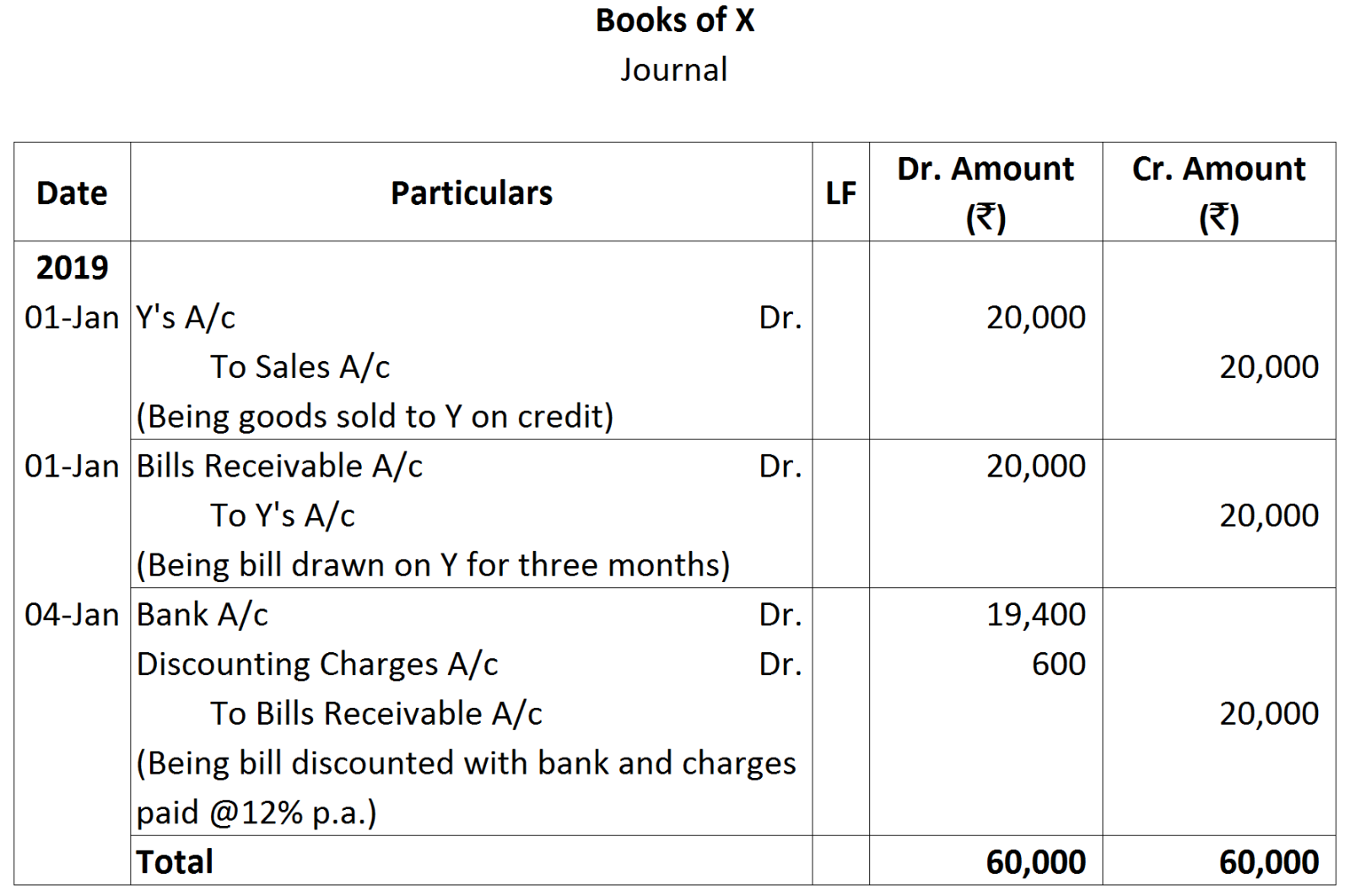
On 1st January, 2019, X sold goods of ₹ 20,000 to Y and drew a bill on Y at three months for the amount. Y accepted the bill. The bill is met on maturity. Pass the necessary Journal entries in the books of X and Y, if X discounted the bill @ 12% p.a. from bank on 4th January.
Answer

Working Notes:
Discounting Charges $=₹\Big(20,000\times\frac{12}{100}\times\frac{3}{12}\Big)=₹ \ 600$
View full question & answer
Question 306 Marks
On Jan 01, 2016 Rao sold goods ₹ 10,000 to Reddy. Half of the payment was made immediately and for the remaining half Rao drew a bill of exchange upon Reddy payable after 30 days. Reddy accepted the bill and returned it to Rao. On the due date Rao presented the bill to Reddy and received the payment. Journalise the above transactions in the books Rao and prepare of Rao’s account in the books of Reddy.
View full question & answer
Question 316 Marks
On 1st March, 2019, R accepted a Bill of Exchange of ₹ 20,000 from S payable 3 months after date in full settlement of his dues. On the same day S endorsed the Bill of Exchange to T together with a cheque for ₹ 5,000 in settlement of his debt to the latter. On 2nd March, 2019, T discounted the Bill of Exchange @ 6% p.a. with his bank. On maturity the Bill of Exchange was dishonoured.
Journalise the transactions in the books of R and T.
View full question & answer
Question 326 Marks
Dinesh received from Shridhar an acceptance for ₹ 3,000 on 1st September, 2018 at 3 months. Dinesh got the acceptance discounted at 9% p.a. from his bank. On the due date, Shridhar paid the required amount.
Give the Journal entries in the books of Dinesh and Shridhar.
View full question & answer
Question 336 Marks
On Jan. 01, 2016 Arun sold goods for ₹ 30,000 to Sunil. 50% of the payment was made immediately by Sunil on which Arun allowed a cash discount of 2%. For the balance Sunil drew a promissory note in favour of Arun payable after 20 days. Since, the date of maturity of bill was a public holiday, Arun presented the bill on a day, as per the provisions of Negotiable Instrument Act which was met by Sunil. State the date on which the bill was presented by Arun for payment and Jounalise the above transactions in the books of Arun and Sunil.
View full question & answer
Question 346 Marks
On 1st January 2017, Amar sold goods to Akbar for ₹ 60,000. Akbar accepts two bills of ₹ 25,000 for 2 months, and ₹ 35,000 for 3 months.
The first bill was discounted from bank on 3rd January 2017 for ₹ 24,900 and 2nd bill endorsed to Anthony on 15th January 2017.
First bill was met on maturity but second bill got dishonoured and noting charges of ₹ 200 being paid. Amar charged ₹ 300 as Interest and drew another bill for the amount due for further 2 months. This bill was met on maturity.
Pass the necessary Journal Entries in the books of Amar, Akbar and Anthony.
View full question & answer
Question 356 Marks
On Feb 01, 2016, John purchased goods for ₹ 15,000 from Jimmi. He immediately made a payment of ₹ 5,000 by cheque and for the balance accepted the bill of exchange drawn upon him by Jimmi. The bill of exchange was payable after 40 days. Five days before the maturity of the bill, Jimmi sent the same to his bank for collection. The bank duly presented the bill to John on the due date who met the bill. The bank informed the same to Jimmi. Prepare John’s account in the books of Jimmi and Jimmi account in the books of John.
View full question & answer
Question 366 Marks
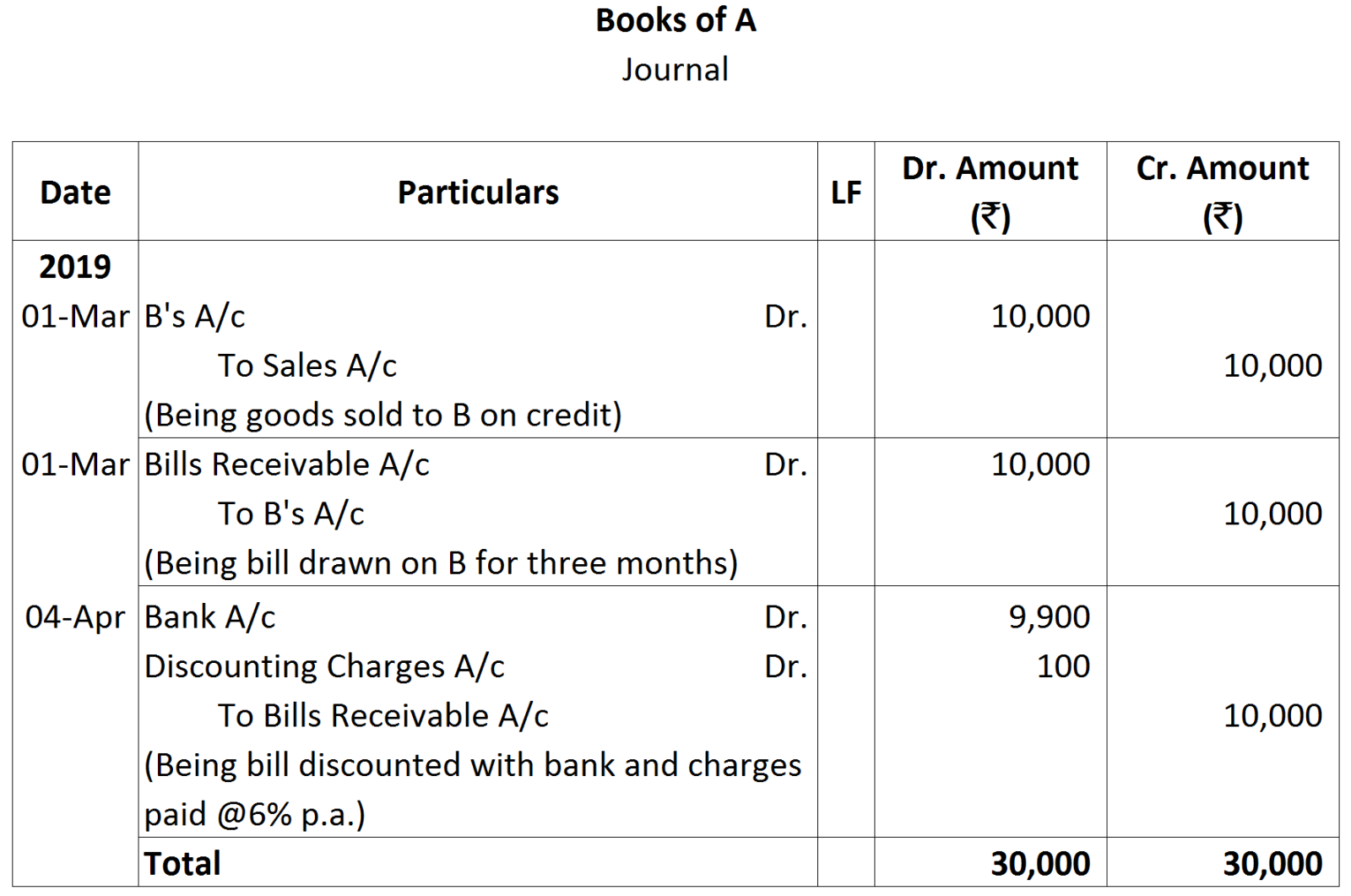
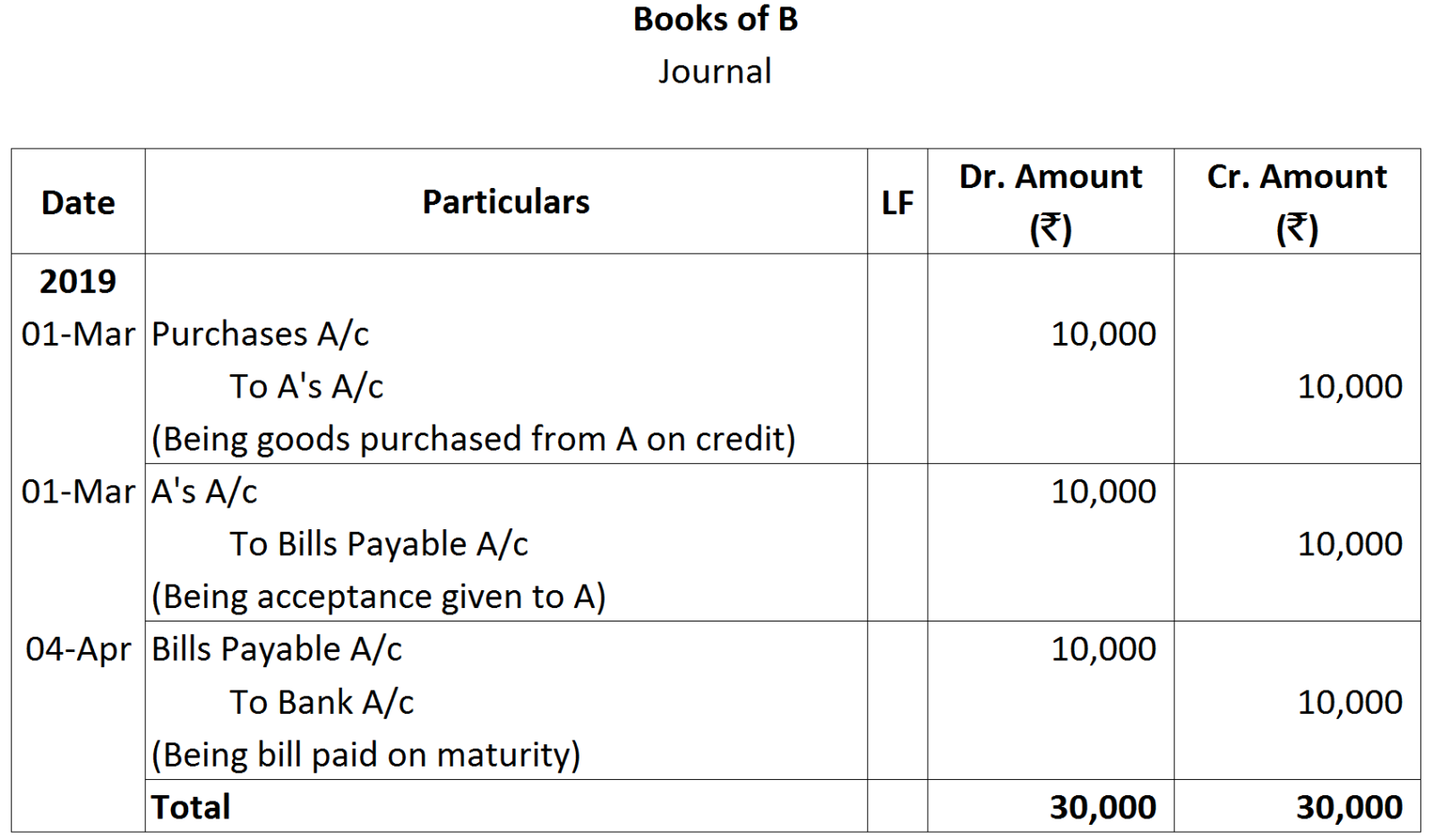
A sells goods of ₹ 10,000 on 1st March, 2019 to B on credit. B accepts a bill on the same date for the amount payable three months after date. A discounts the bill at 6% p.a. from bank on 4th April. On maturity, the bill is met by B. Pass the necessary Journal entries in the books of both the parties.
Answer

Working Notes:
Discounting Charges $=₹\Big(10,000\times\frac{6}{100}\times\frac{2}{12}\Big)=₹ \ 100$
View full question & answer
Question 376 Marks
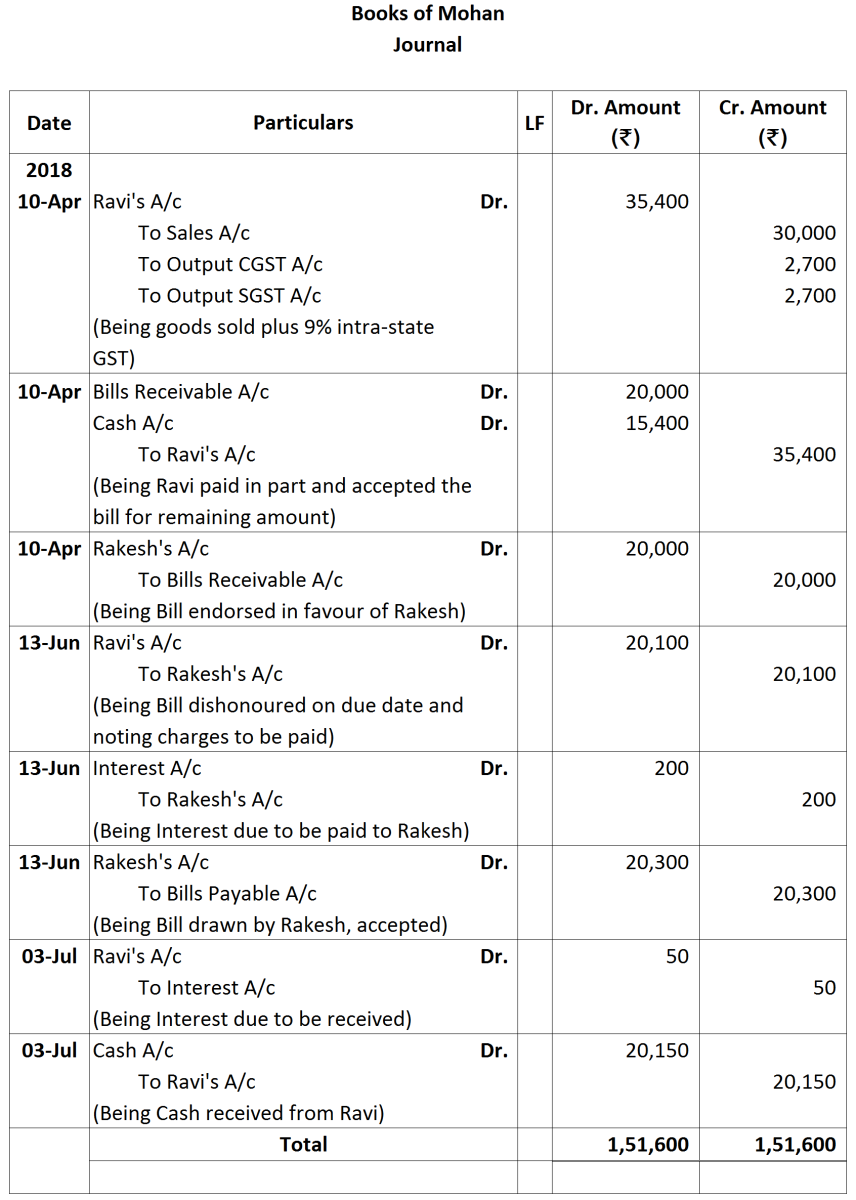
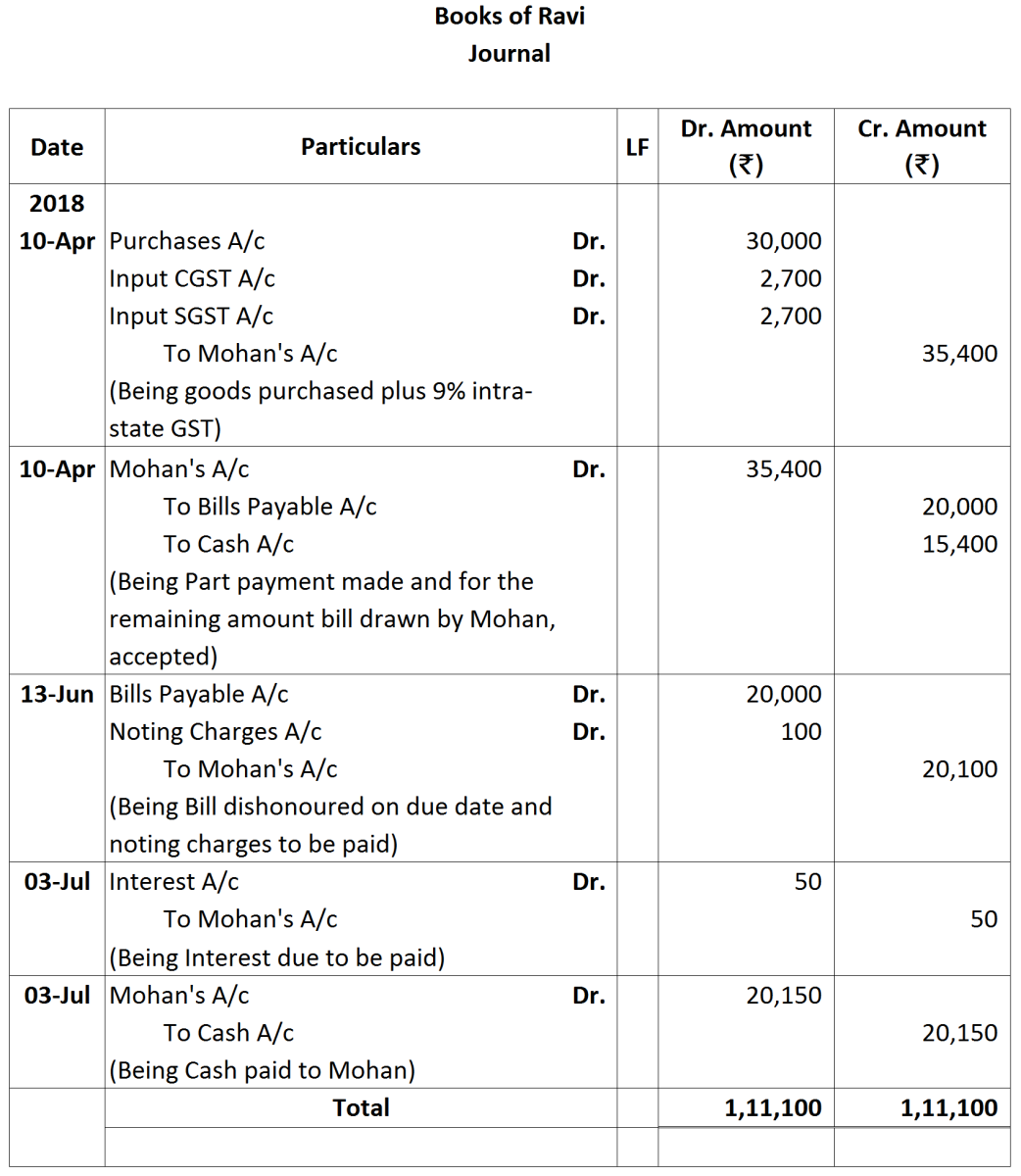
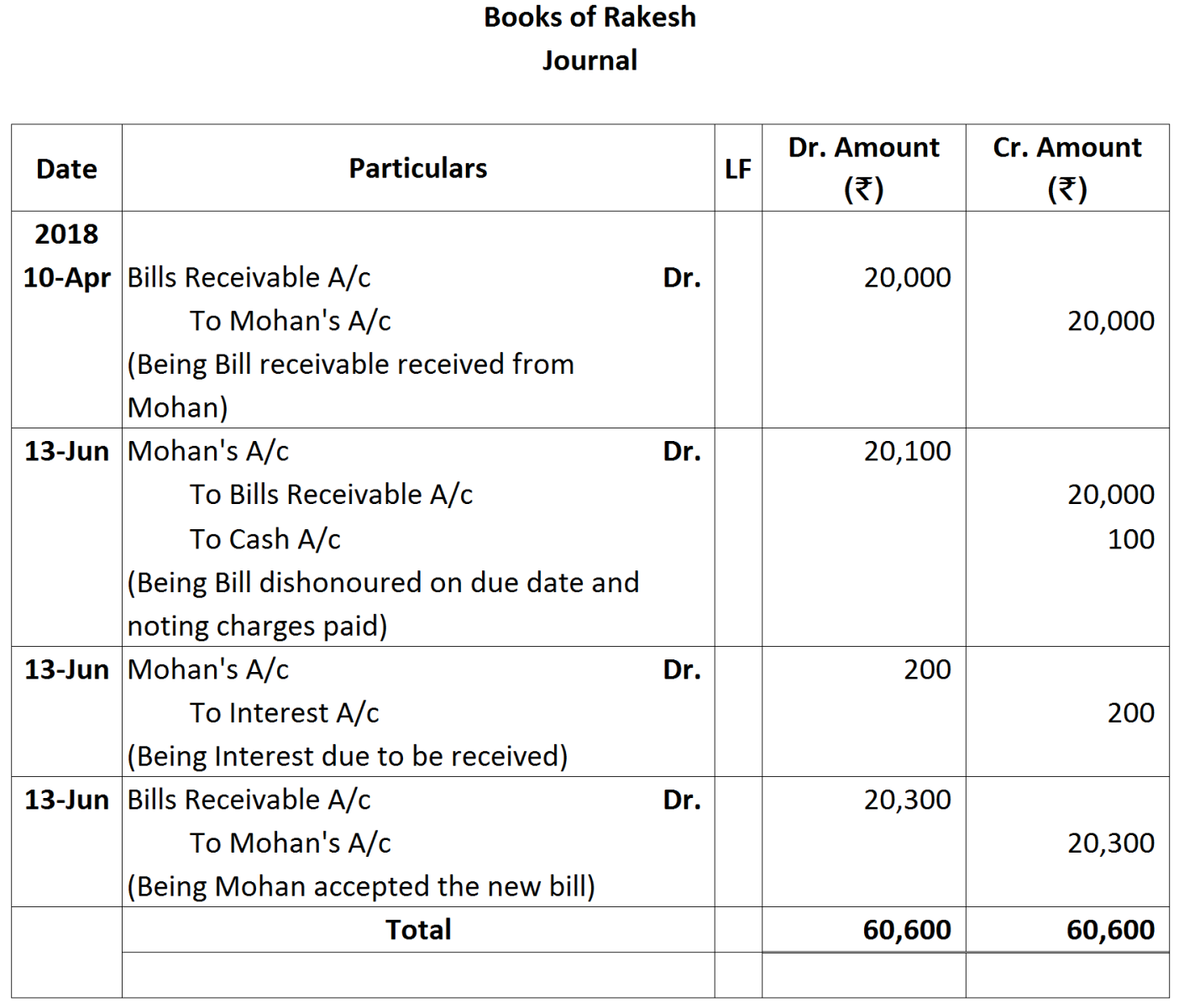
On 10th April, 2018, Ravi purchased from Mohan goods for ₹ 30,000 plus CGST and SGST @ 9% each. Ravi paid ₹ 15,400 in cash and accepted a bill for two months for the balance amount drawn on him by Mohan. Mohan endorsed the bill to Rakesh. The bill was dishonoured on the due date. Rakesh had to spend ₹ 100 as noting charges. Immediately after the dishonour, Mohan accepted a new bill drawn by Rakesh, in which ₹ 200 for interest were also included. After 20 days of the dishonour of the bill, Ravi paid full amount of Mohan including ₹ 50 as interest. Show Journal entries in the books of Ravi, Mohan and Rakesh.
Answer
Solution is as follow:


View full question & answer
Question 386 Marks
Explain briefly the procedure of calculating the date of maturity of a bill of exchange? Give example.
Answer
The procedure to calculate the date of maturity of a bill of exchange is given below.
1. Ascertain the date on which the bill will be honoured.
2. Add three days of grace to the above date.
For example, a bill with maturity period of one month is drawn on $1^{\text {st }}$ July and due date is $1^{\text {st }}$ September. Then add 3 days of grace and payment will be made on $4^{\text {th }}$ September.
Days of grace depend on the following situations:
Declared holidays: If the payment day happens to be a national holiday or Sunday, then the preceding day becomes the payment day.
For example,
If a bill is drawn on $12^{\text {th }}$ July and its due date is $12^{\text {th }}$ August, then after adding 3 days of grace the maturity day is $15^{\text {th }}$ August. However, as $15^{\text {th }}$ August is a national holiday; so, $14^{\text {th }}$ August becomes the payment day.
If a bill is drawn on $1^{\text {st }}$ May and the maturity period is of one month, then the due date is $1^{\text {st }}$ June. After adding 3 days of grace, the payment date becomes $4^{\text {th }}$ June. However, if $4^{\text {th }}$ June happens to be a Sunday, then the payment will be made on $3^{\text {rd }}$ June.
Undeclared holidays: If the payment day happens to be an emergency holiday, then the succeeding day becomes the payment day. For example, if a bill is drawn on $1^{\text {st }}$ May and is payable after 15 days, then, after adding 3 days of grace period, the due date becomes $18^{\text {th }}$ May. However, if a national strike is declared on $18^{\text {th }}$ May, then $19^{\text {th }}$ May becomes the due date of the bill.
View full question & answer
Question 396 Marks
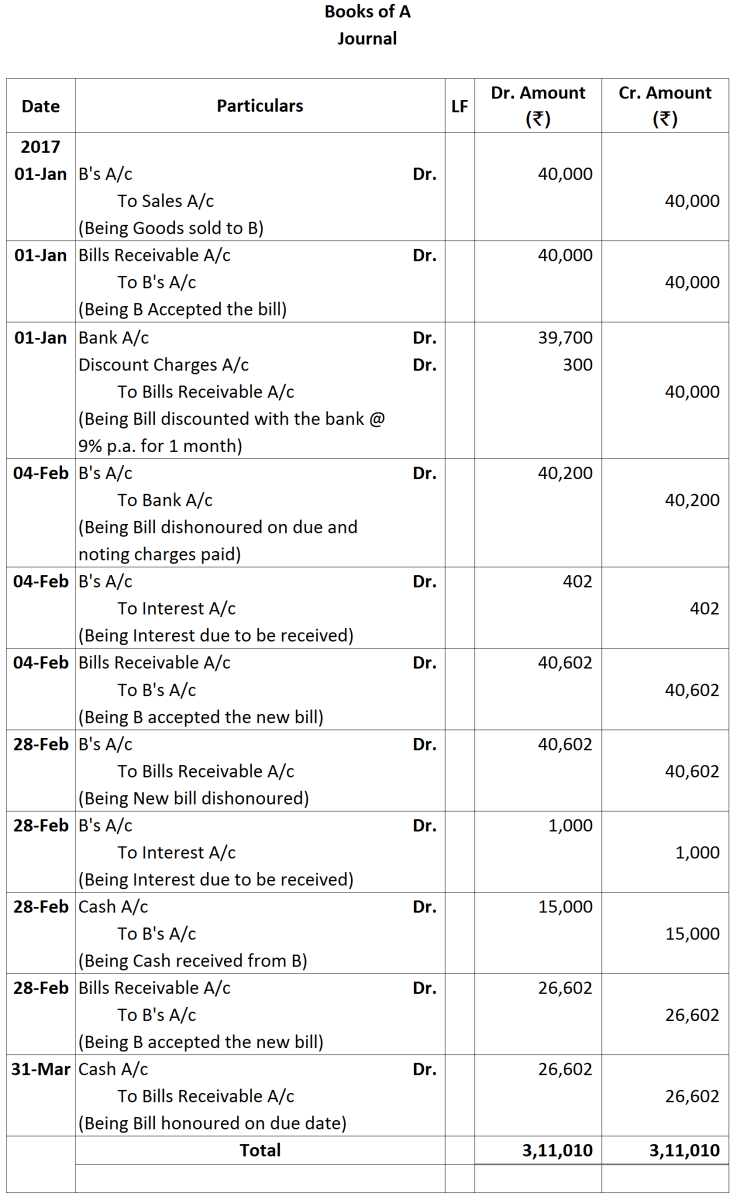
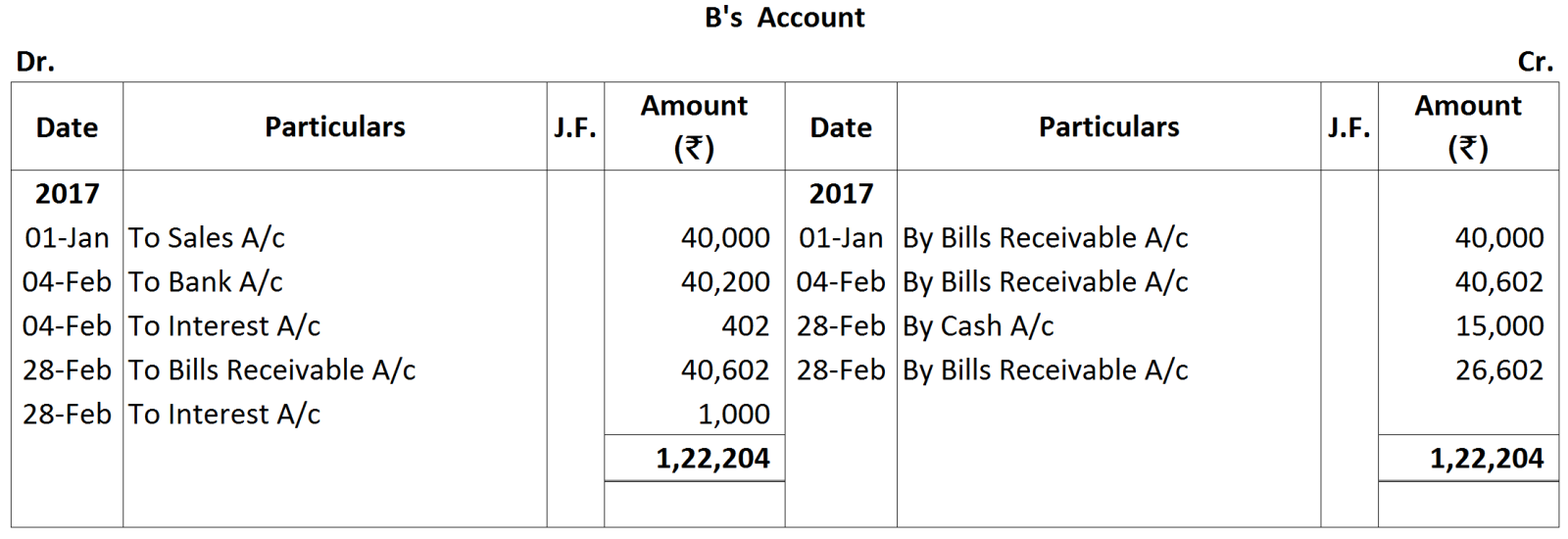
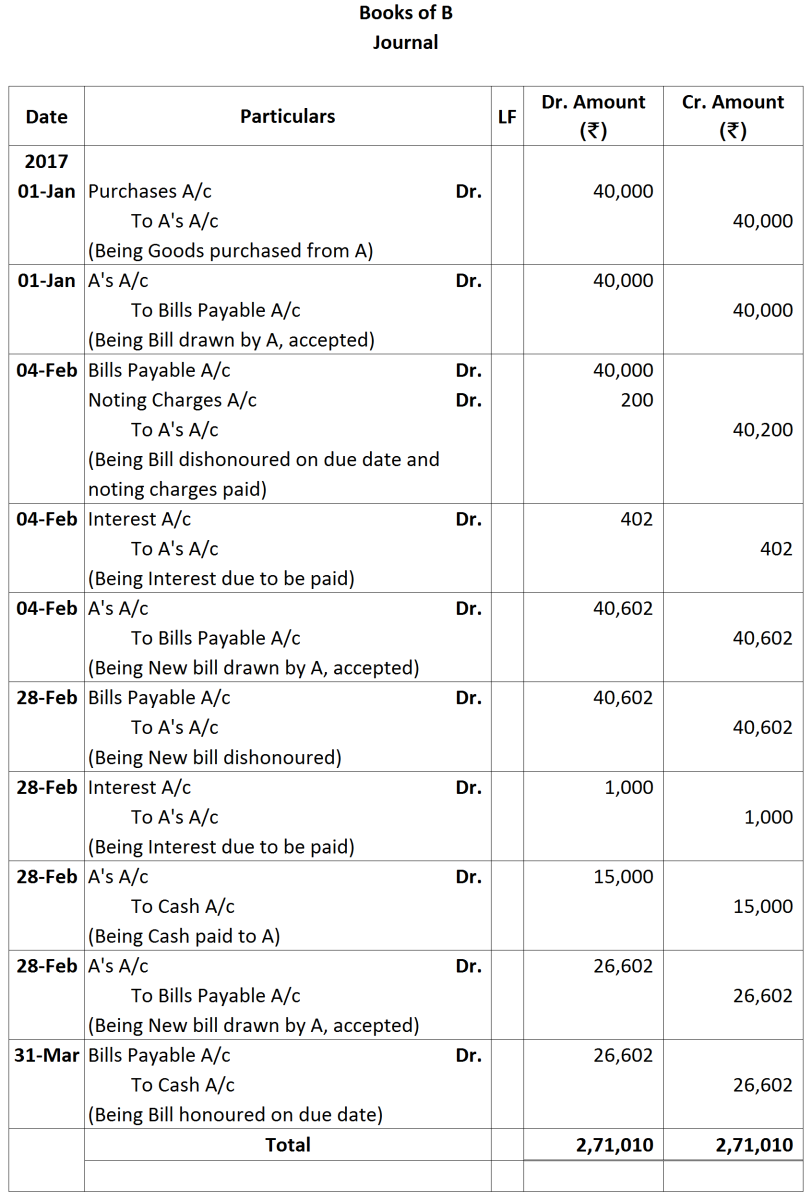
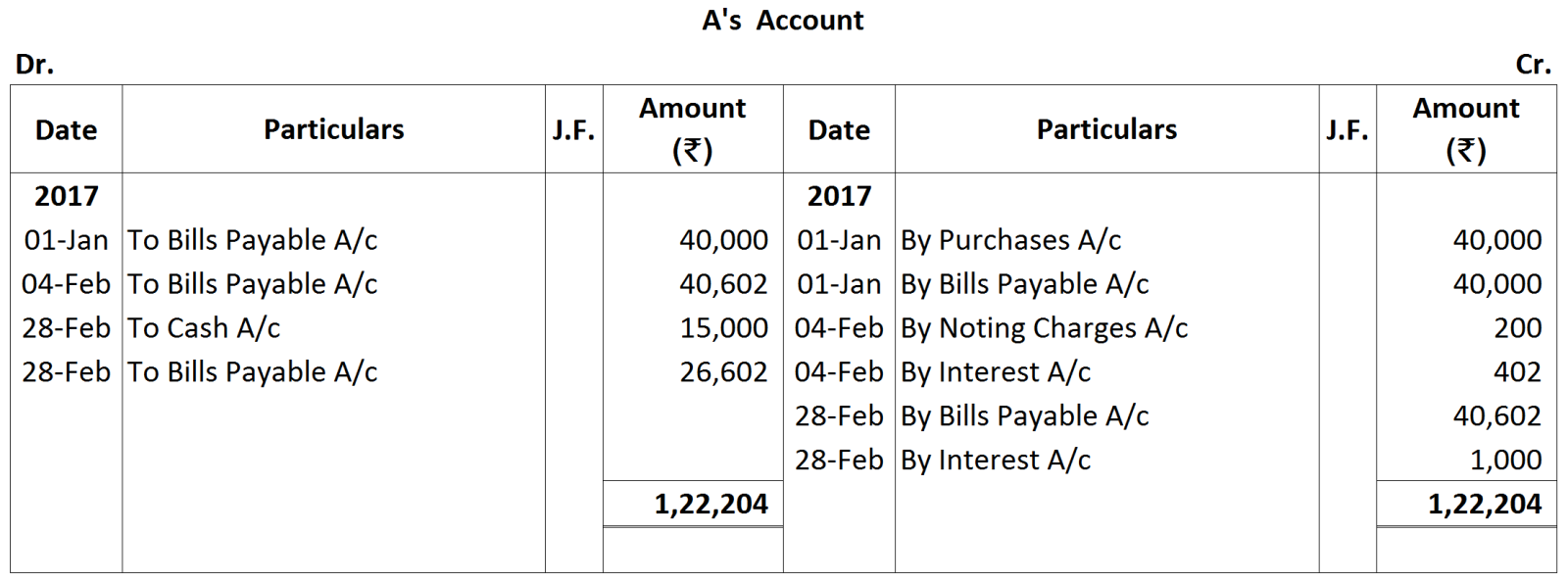
A sold goods for ₹ 40,000 to B on Jan. 01, 2017. He drew upon B a bill of exchange for the same amount payable after 1 month. B accepted the bill and sent it back to A. Adiscounted the bill immediately with his bank @ 9% p.a. On the due date B dishonoured the bill of exchange and the bank paid ₹ 200 as noting charges. B requested A to draw a new bill upon him with interest @ 12% p.a. which he agreed. The new bill was payable after 1 month. One week before the maturity of the second bill B requested A to cancel the second bill. He further requested to accept ₹ 15,000 in cash immediately and draw a third bill upon him including interest of ₹ 1,000. A agreed to B's request. The third bill was payable after one month. B met the third bill on its maturity. Record the necessary journal entries in the books of A and B and also prepare B's account in the books of Aand A's account in the books of B.
Answer


Working Notes:
WN 1: Calculation of Discounting Charges,
Discounting Charges $=40,000\times\frac{9}{100}\times\frac{1}{12}=₹\ 300$
WN 2: Calculation of amount of Interest,
Amount of Interest $=40,200\times\frac{12}{100}\times\frac{1}{2}=₹\ 402$
View full question & answer
Question 406 Marks
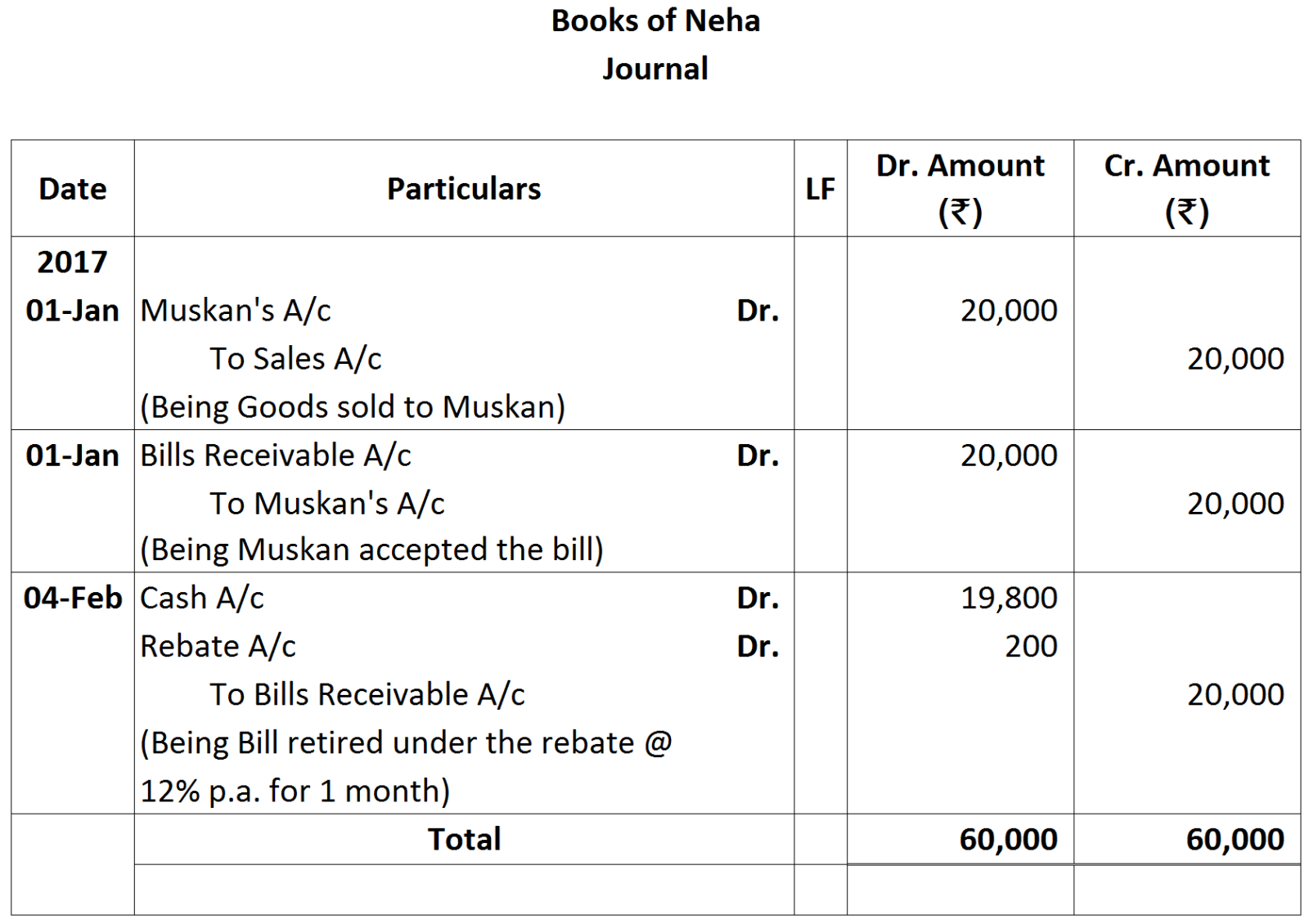
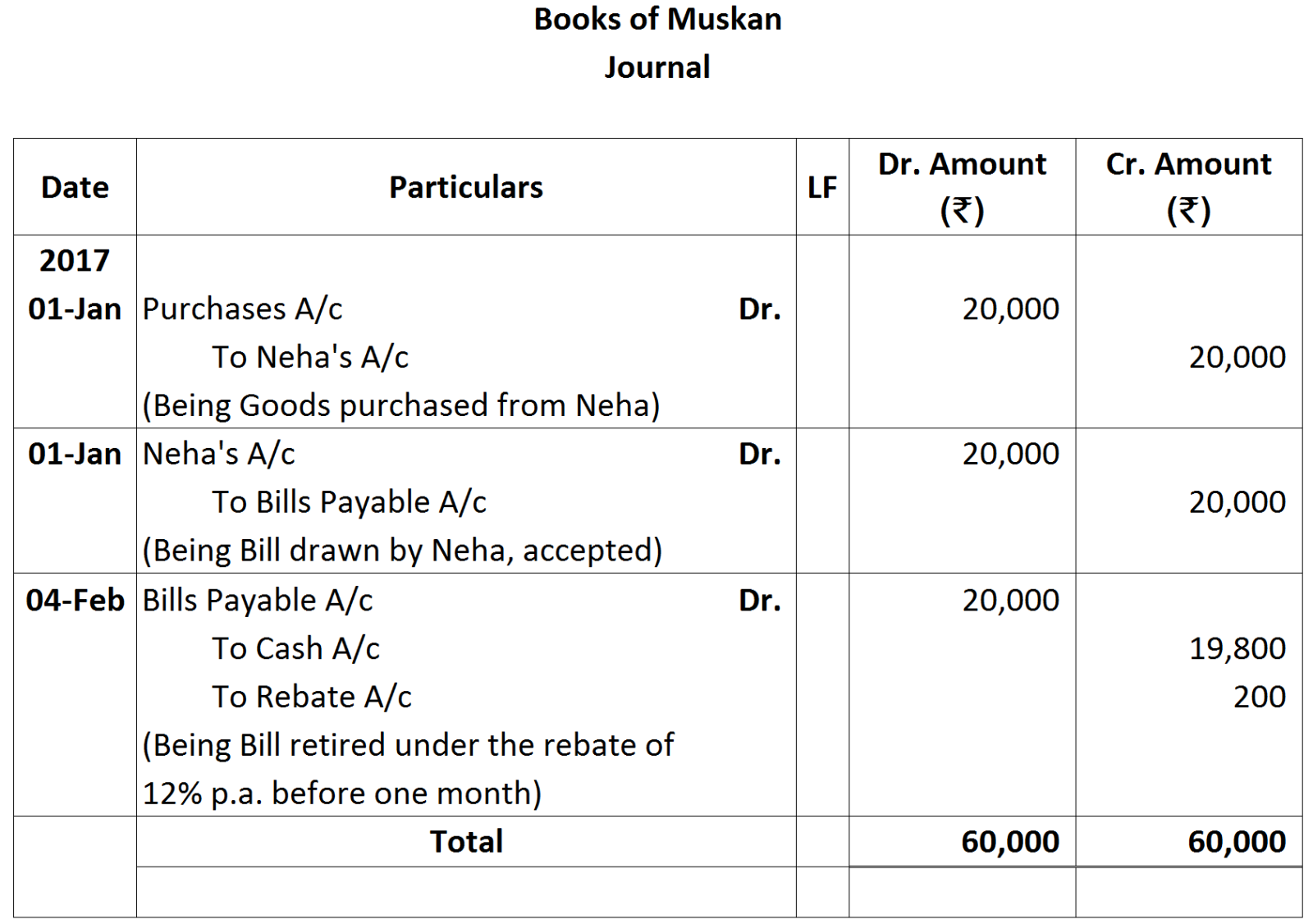
On Jan. 1, 2017 Neha sold goods for ₹ 20,000 to Muskan and drew upon her a bill of exchange payable after two months. One month before the maturity of the bill Muskan approached Neha to accept the payment against the bill at a rebate @12% p.a. Neha agreed to the request of Muskan and Muskan retired the bill under the agreed rate of rebate.
Journalise the above transactions in the books of Neha and Muskan.
Answer


Working Note:
Calculation of amount of Rebate,
Amount of Rebate $=20,000\times\frac{12}{100}\times\frac{1}{12}=₹\ 200$
View full question & answer
Question 416 Marks
On Jan 01, 2016 Neha sold goods for ₹ 20,000 to Muskan and drew upon her a bill of exchange payable after two months. One month before the maturity of the bill Muskan approached Neha to accept the payment against the bill at a rebate @ 12% p.a. Neha agreed to the request of Muskan and Muskan retired the bill under the agreed rate of rebate. Journalise the above transaction in the books of Neha and Muskan.
View full question & answer
Question 426 Marks
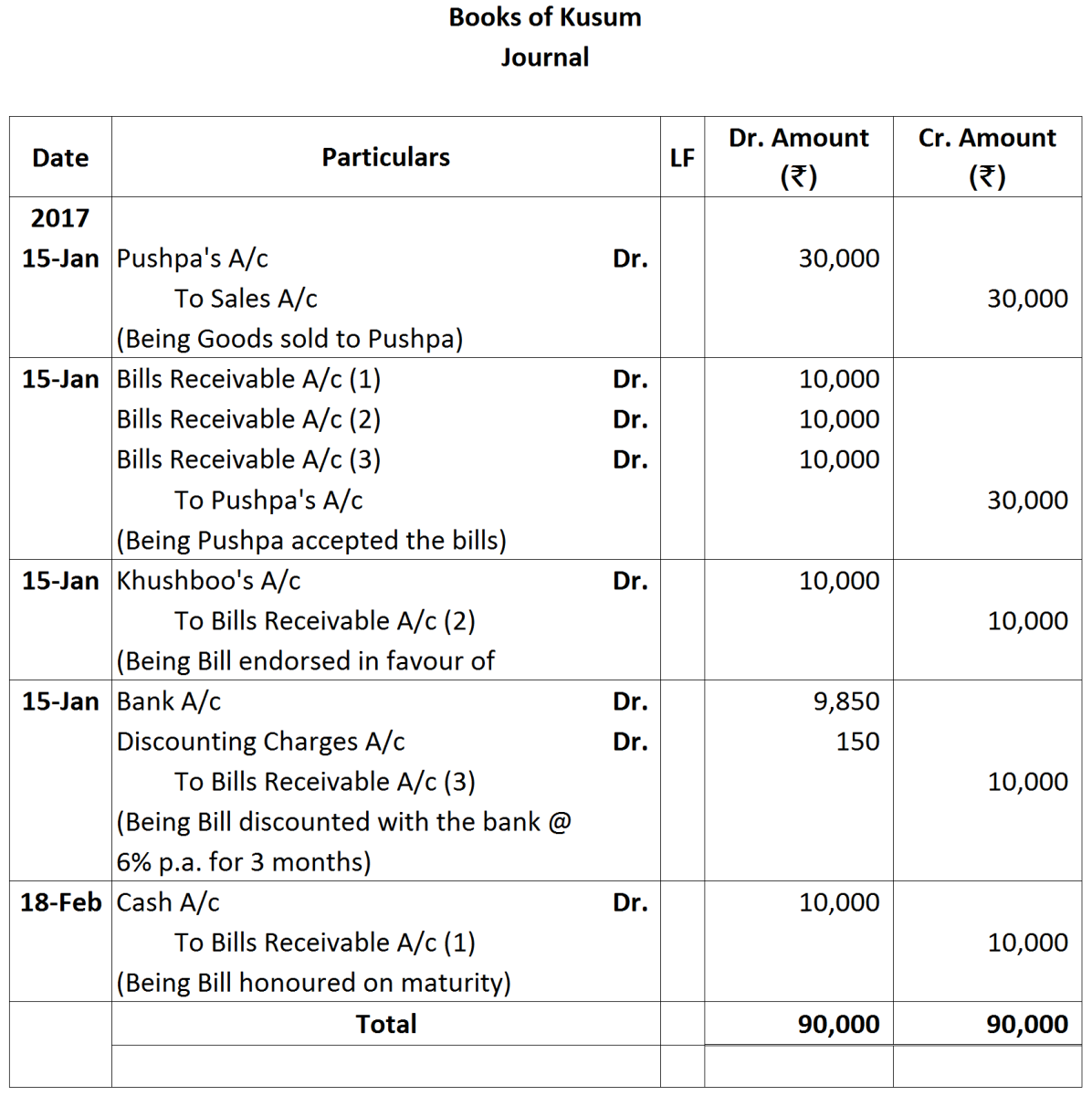
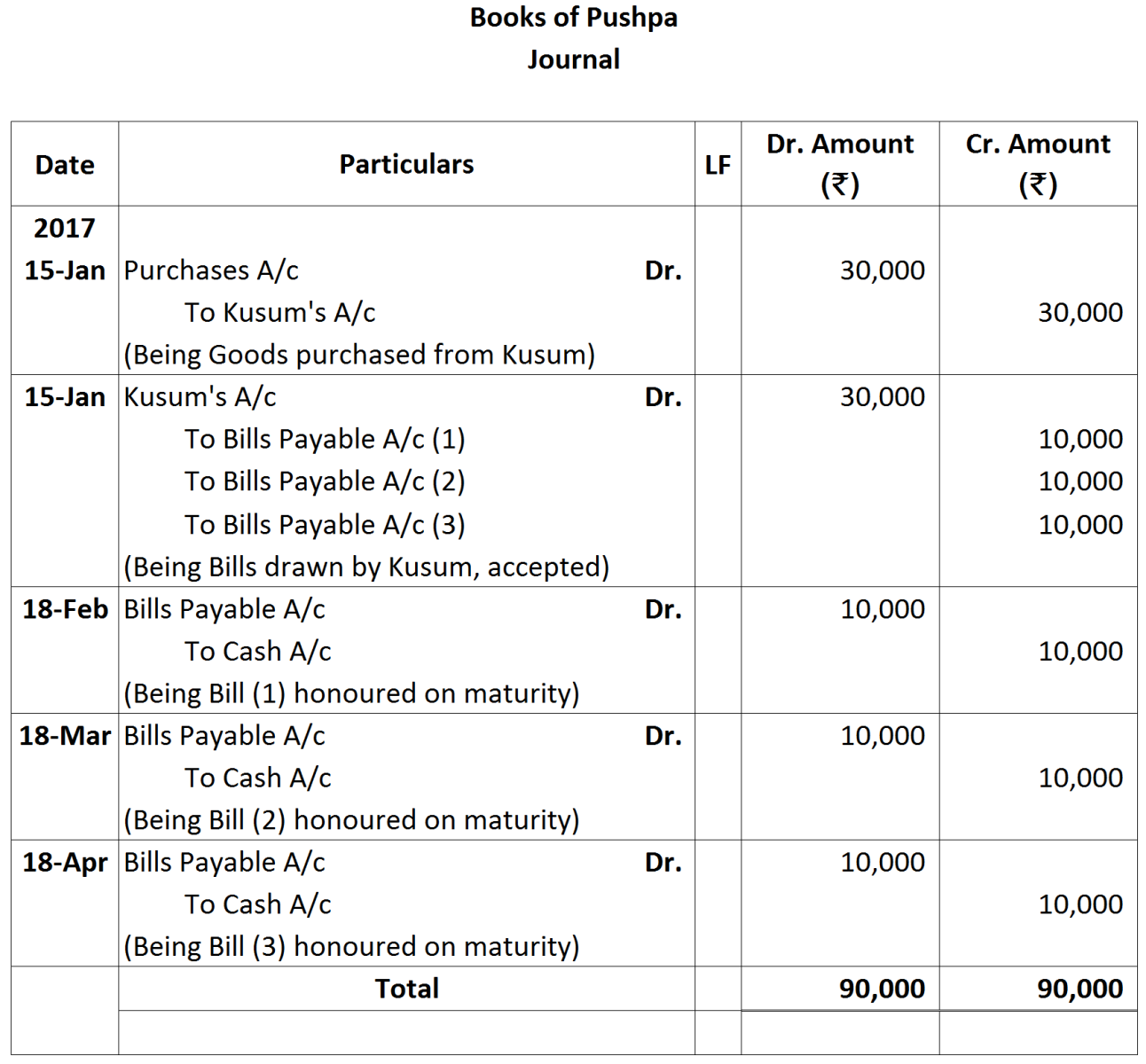
On Jan. 15, 2017, Kusum sold goods for ₹ 30,000 to Pushpa and drew upon her three bills of exchanges of ₹ 10,000 each payable after one month, two months and three months respectively. The first bill was retained by Kusum till its maturity. The second bill was endorsed by her in favour of her creditor Khushboo and the third bill was discounted by her immediately @ 6% p.a. All the bills were met by Pushpa. Journalise the above transactions in the books of Kusum and Pushpa.
Answer


Working Note:
Calculation of Discounting Charges,
Discounting Charges $=10,000\times\frac{6}{100}\times\frac{3}{12}=₹\ 150$
View full question & answer
Question 436 Marks
On 15th June, 2019, X sold to Y goods to the value of ₹ 15,000 drawing upon the latter two bills, one for ₹ 10,000 payable 2 months after date and other for ₹ 5,000 payable 3 months after date, X discounted the first bill with his bank at 6% p.a. and endorsed the second bill in favour of his creditor, Z. The first bill was met on maturity but the second was dishonoured. Z paid ₹ 50 as noting charges. On 1st October, Y cleared his account to X by paying ₹ 5,100 which included ₹ 50 as interest.
Record the necessary Journal entries in the books of both X and Y.
View full question & answer
Question 446 Marks
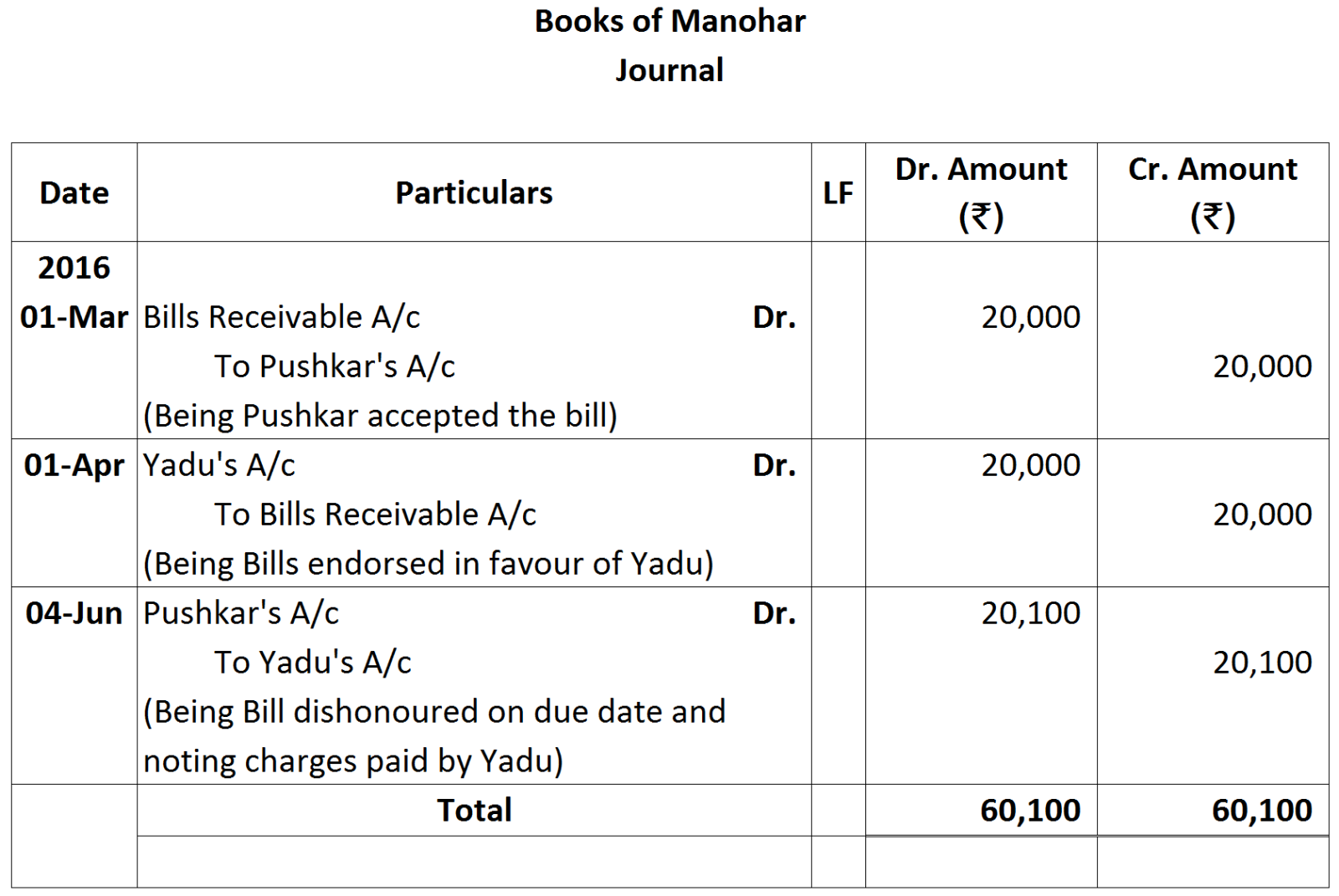
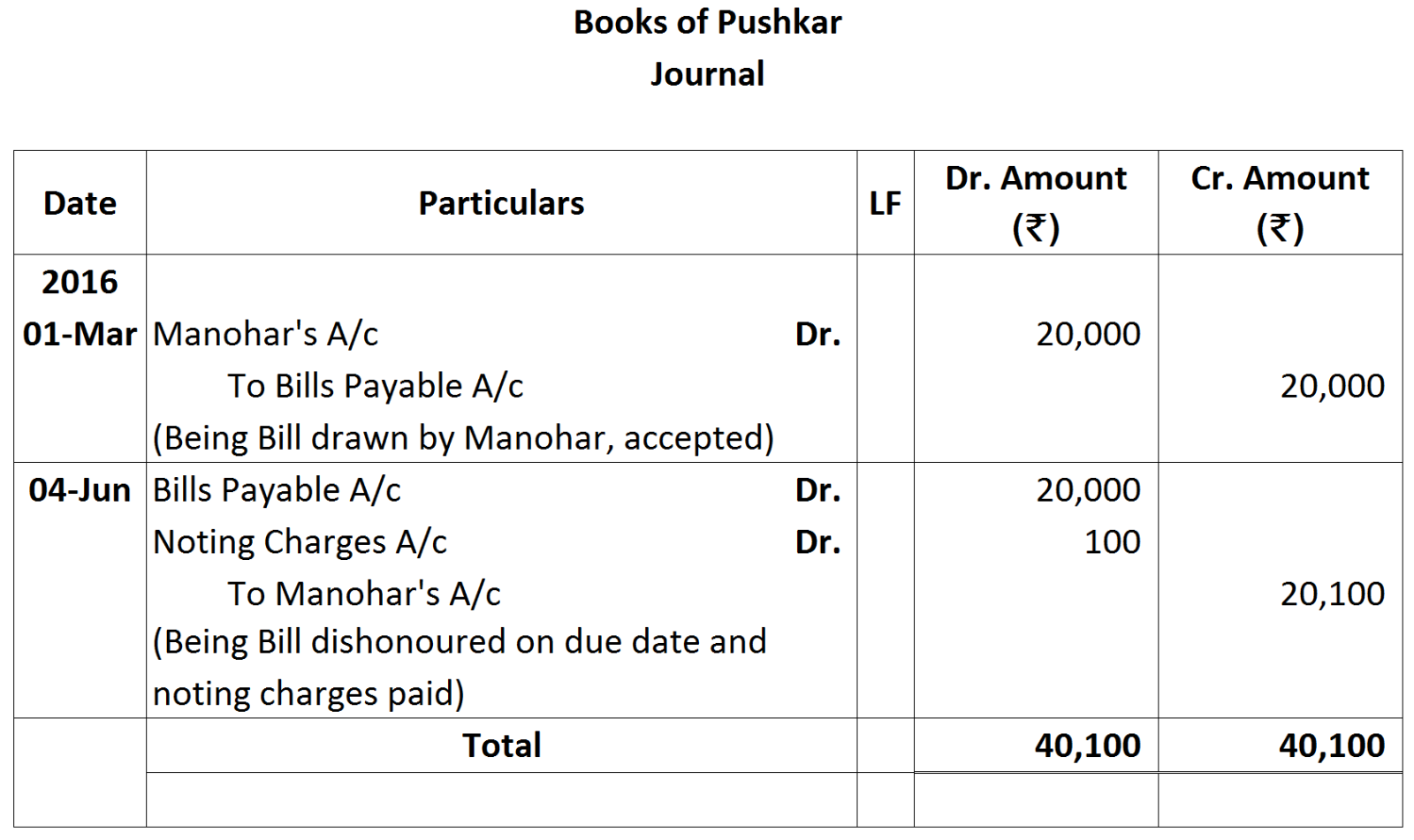
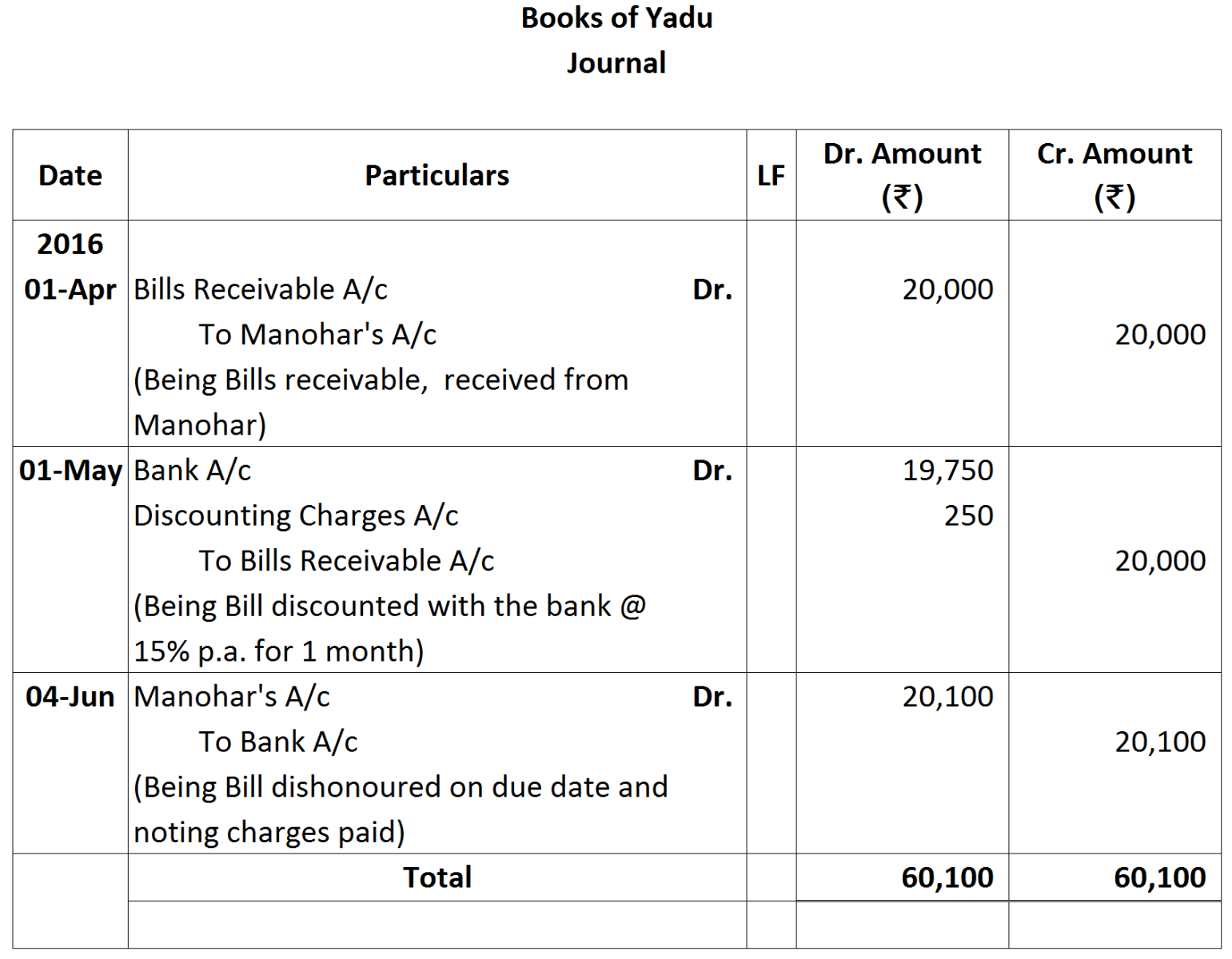
Manohar drew a bill of exchange on Pushkar, his debtor, for ₹ 20,000 on 1st March 2016 for 3 months. Pushkar accepted the same and returned it to the drawer. Manohar endorsed the bill to Yadu on 1st April 2016 for a debt of equal amount. Yadu discounted it with the bank at 15% p.a. on 1st May 2016. On the due date the bill was dishonoured. (Noting charges amounted to ₹ 100). Show the journal entries in the books of:
  1. Drawer
  2. Drawee/Acceptor
  3. Endorsee
Answer


Working Note:
Calculation of Discounting Charges,
Discounting Charges $=20,000\times\frac{15}{100}\times\frac{1}{12}=₹\ 250$
View full question & answer
Question 456 Marks
X draws upon Y a bill of ₹ 10,000 for three months on 1st July, 2016. The bill was duly accepted and returned by Y. On due date bill became dishonoured and noting charges paid under each of the following circumstances ₹ 75. Pass entries in the following cases:
  1. If drawer retains the bill with him till due date.
  2. If drawer discounts the same with his Banker and noting charges paid by the Banker.
  3. If drawer endorses the same to his creditor Z and noting charges paid by Z.
  4. If drawer sends the bill for collection to his Banker and noting charges paid by the Banker.
View full question & answer
Question 466 Marks
Vimal purchased goods ₹ 25,000 from Kamal on Jan. 15, 2017 and accepted a bill of exchange drawn upon him by Kamal payable after two months. On the date of the maturity the bill was duly presented for payment. Vimal dishonoured the bill.
Record the necessary journal entries in the books of Kamal and Vimal when:
  1. The bill was retained by Kamal till the date of its maturity.
  2. The bill was immediately discounted by Kamal with is bank @ 6% p.a.
  3. The bill was endorsed by Kamal in favour of his creditor Sharad.
  4. Five days before its maturity the bill was sent by Kamal to his bank for collection.
View full question & answer
Question 476 Marks
Mehak sold goods for ₹ 24,000 to Shally on July 31, 2017 and drew three bills for ₹ 6,000, ₹ 8,000 and ₹ 10,000 payable after two, three and four months respectively. The first bill was kept by Mehak with her till maturity date. She endorsed the second bill in favour of her creditor Kanak. The third bill was discounted on September 3, 2017 @ 12% p.a. from bank. The first and second bill were duly met on maturity but the third bill was dishonoured and the bank paid ₹ 150 as noting charges. On December 3, 2017 Shally paid ₹ 5,000 and noting charges in cash and accepted a new bill at two months after date for the balance amount plus interest ₹ 200. The new bill was met on maturity by Shally.
You are required to give the Journal Entries in the books of Mehak.
View full question & answer
Question 486 Marks
Vishal sold goods for ₹ 7,000 to Manju on Jan 05, 2016 and drew upon her a bill of exchange payable after 2 months. Manju accepted Vishal’s draft and handed over the same to Vishal after acceptance. Vishal immediately discounted the bill with his bank @ 12% p.a. On the due date Manju met her acceptance. Journalise the above transactions in the books of Vishal and Manju.
View full question & answer
Question 496 Marks
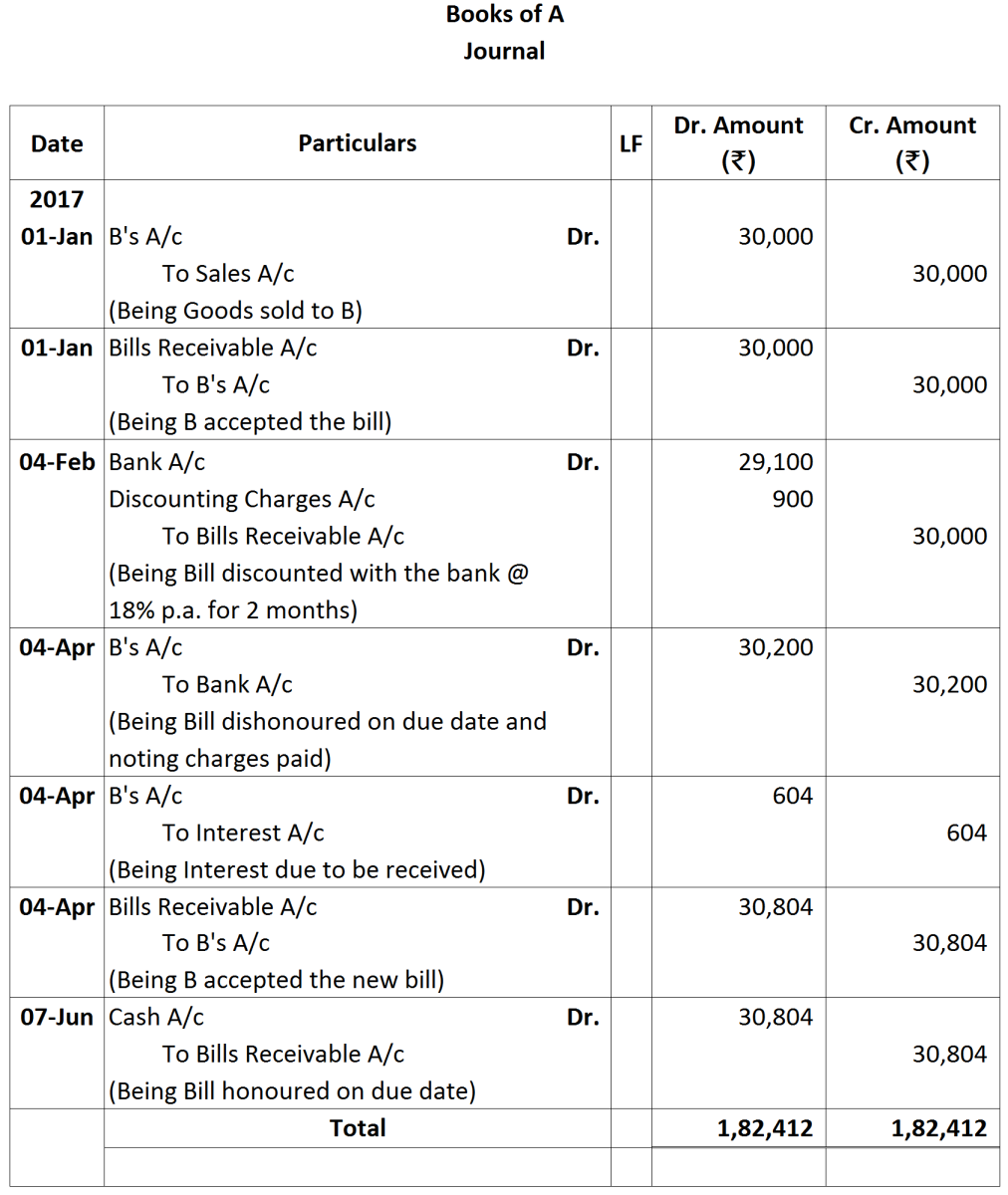
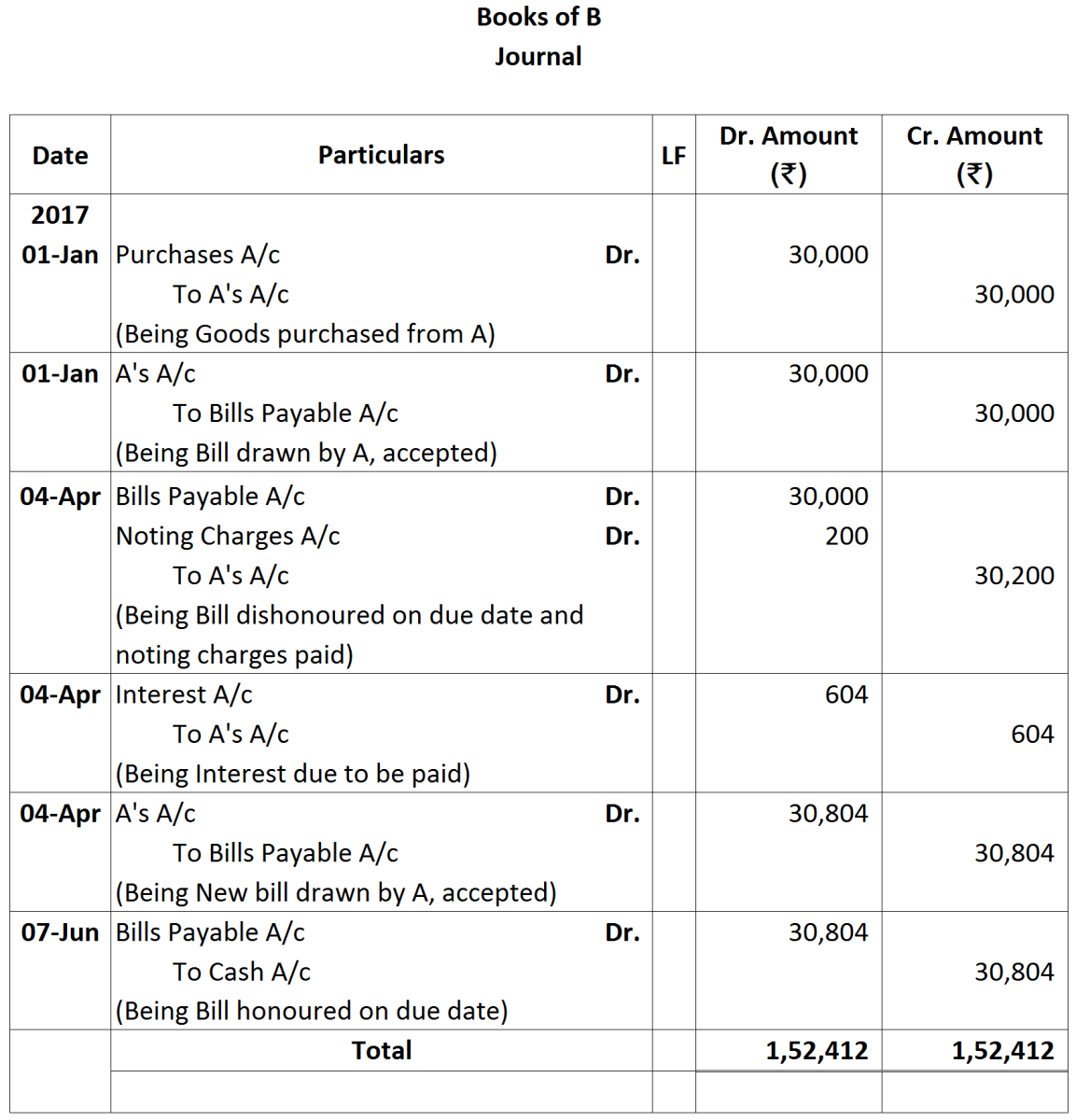
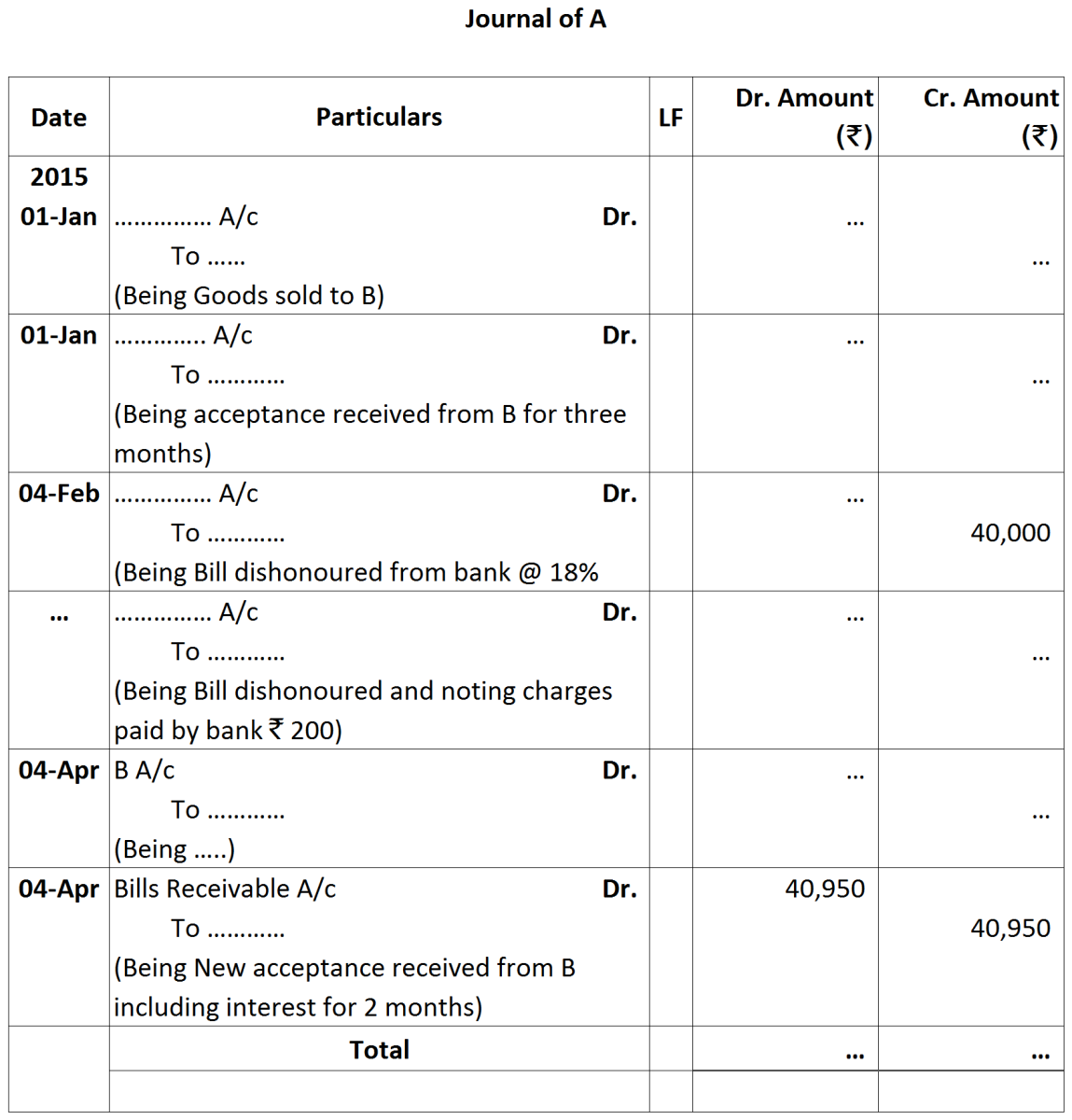
A sells goods for ₹ 30,000 to B on 1st January, 2017 and on the same day draws a bill on B at three months for the amount. B accepts it and returns it to A, who discounts it on 4th February, 2017 with his bank at 18% per annum. The acceptance is dishonoured on the due date, the noting charges paid by the bank being ₹ 200.
On 4th April, 2017, B accepts a new bill at two months for the amount then due to Atogether with interest at 12 per cent per annum. Make Journal entries to record these transactions in the books of A and B.
Answer


Working Note:
WN 1: Calculation of Discounting Charges,
Discounting Charges $=30,000\times\frac{18}{100}\times\frac{2}{12}=₹\ 900$
WN 2: Calculation of amount of Interest,
Amount of Interest $=30,200\times\frac{12}{100}\times\frac{2}{12}=₹\ 604$
View full question & answer
Question 506 Marks
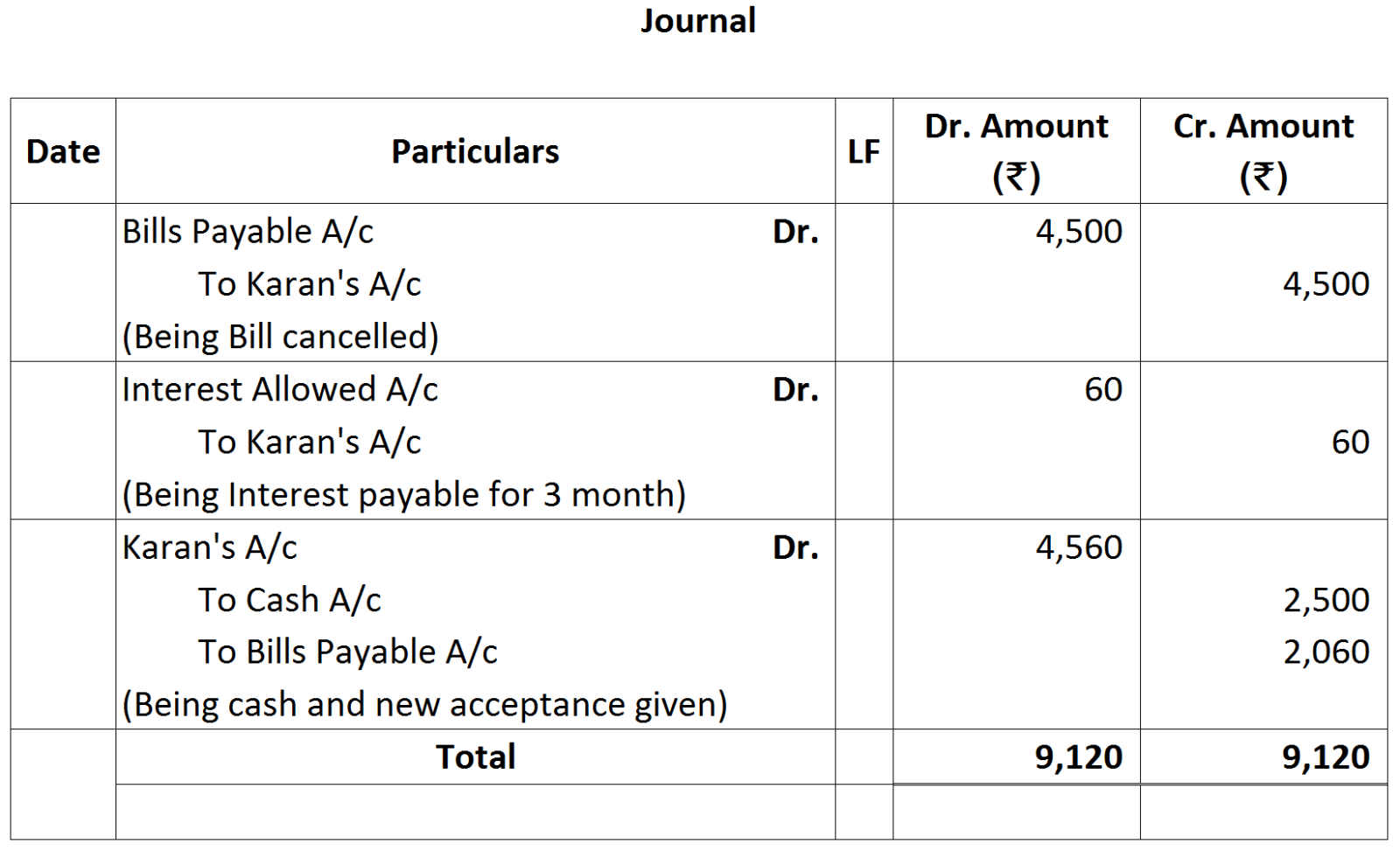
Journalise the following transactions in our books:
  1. Our acceptance to Karan for ​₹ 4,500 renewed for 3 months on the condition that ₹ 2,500 is paid in cash immediately and a new bill to be drawn including interest @ 12% p.a.
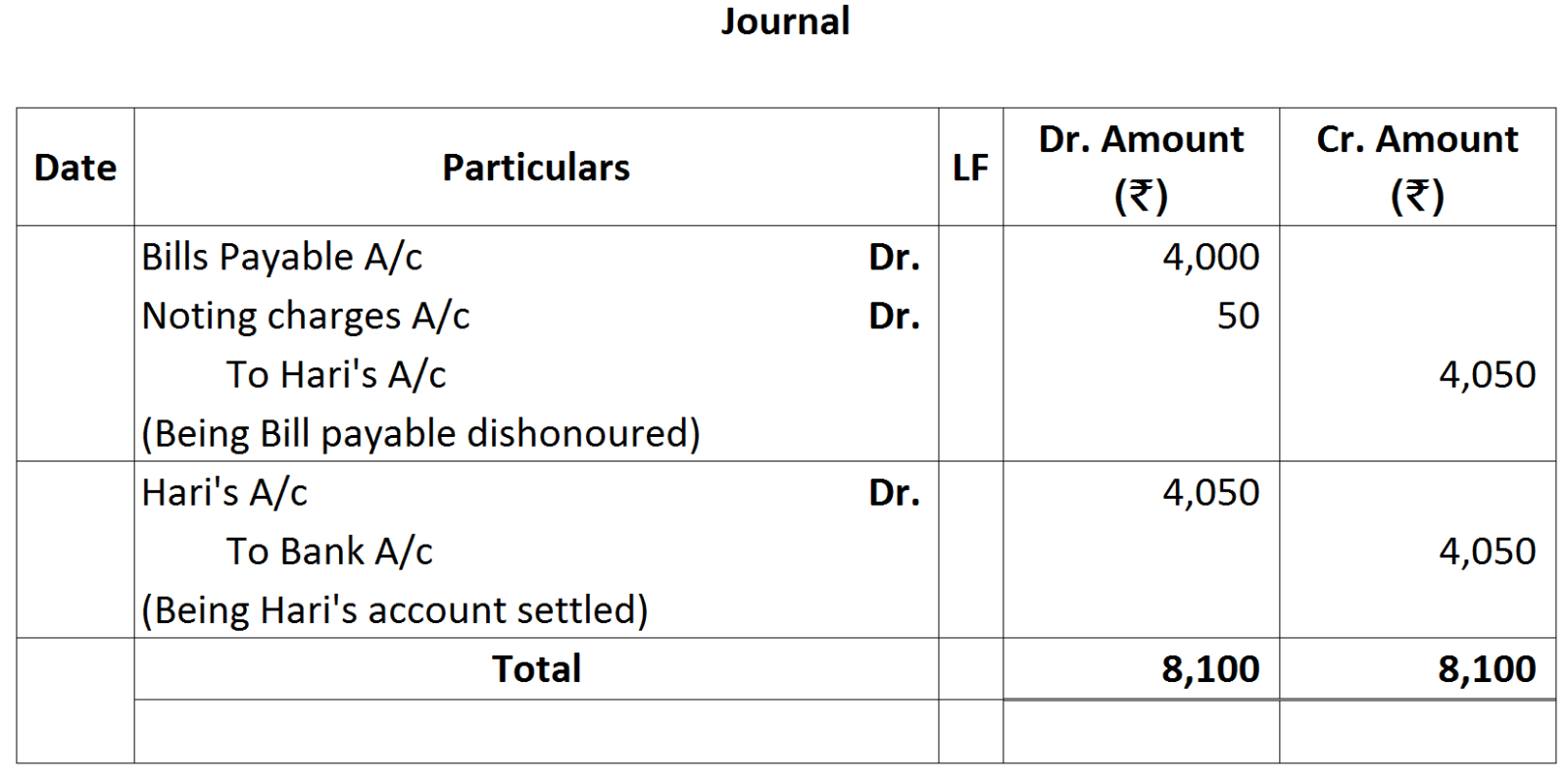
  2. A bill payable accepted in favour of Hari for ₹ 4,000 returned unpaid due to lack of instructions to the bank. Hari claims ₹ 4,050. (₹ 50 as noting charges), which is paid by cheque.
Answer
  1.  
  1.  
View full question & answer
6 Marks Question - Account STD 11 Commerce Questions - Vidyadip