Questions

4 Marks Question

🎯

Test yourself on this topic

29 questions · timed · auto-graded

Question 14 Marks
Why is Balance Sheet prepared?
Answer
Balance Sheet is the statement prepared after preparing Trading and Profit and Loss Account. Balance Sheet is “a statement which sets out the assets and liabilities of a firm or an institution as at a certain date.”
In the words of Francis R. Stead. "A Balance Sheet is a screen picture of the financial position of a going business at a certain moment."
View full question & answer
Question 24 Marks
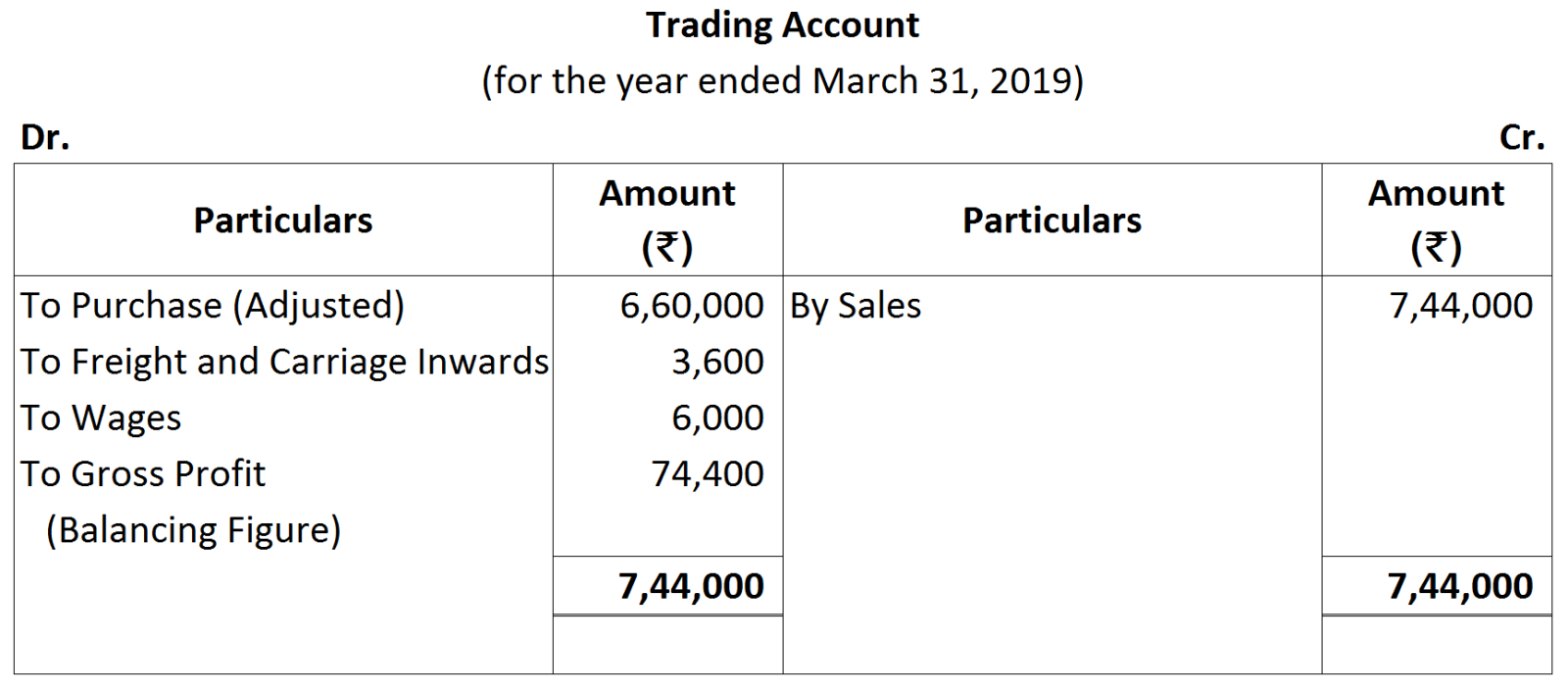
From the following information, prepare Trading Account for the year ended $31^{\text {st }}$ March, $2019:$
Adjusted Purchases ₹ $6,60,000$; Sales ₹ $7,44,000$; Closing Stock ₹ $50,400$; Freight and Carriage Inwards ₹ $3,600$; Wages ₹ $6,000$; Freight and Cartage Outwards ₹ $2,000.$
Answer

Notes:
  1. Freight and Carriage Outwards are indirect expenses, therefore it is not recorded in the Trading Account.
  2. Closing Stock (i.e. ₹ 50,400) is not recorded in the Trading Account as it is already adjusted in the amount of Adjusted Purchases.
View full question & answer
Question 34 Marks
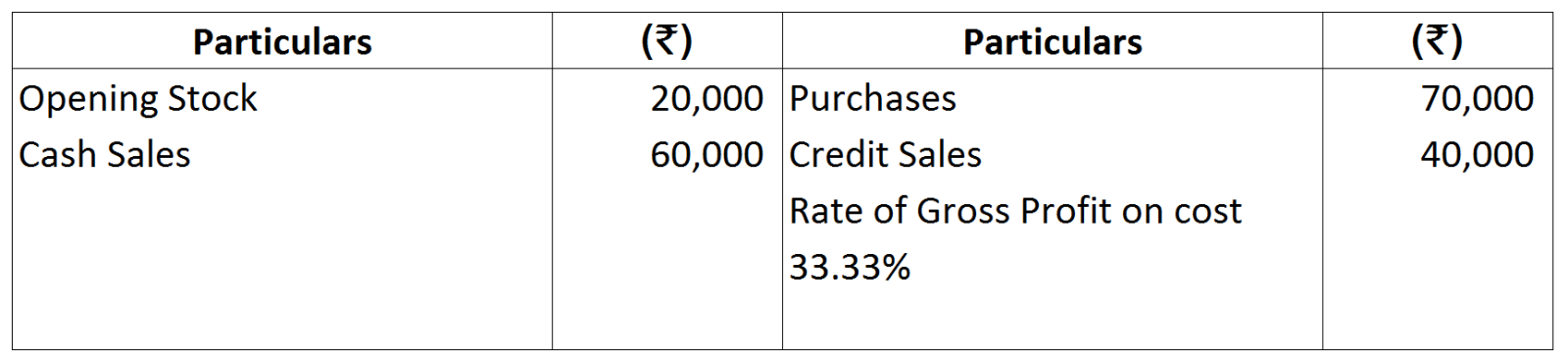
Calculate Closing Stock from the following details:
Answer
Calculation of amount of Closing Stock
Gross Profit $=33\frac{1}{3}\%$ on cost $=\frac{1}{3}\text{rd}$ on Cost
$\therefore\ $Gross Profit on sales $=\frac{1}{4}\text{th}$ on Sales
And, Sales = Cash Sales + Credit Sales = 60,000 + 40,000 = ₹ 1,00,000
So, Gross Profit $=1,00,000\times\frac{1}{4}=₹\ 25,000$
Cost of Goods Soles = Sales - Gross Profit
= ₹ 1,00,000 - ₹ 25,000 = ₹ 75,000
Cost of Goods Sold = Opening stock + Purchases Expenses - Closing Stock
₹ 75,000 = ₹ 20,000 + ₹ 70,000 + 0 - Closing Stock
Closing Stock = ₹ 75,000
View full question & answer
Question 44 Marks
From the following figures, calculate Operating Profit:
Answer
Operating Profit = Net Profit - Rent Received - Gain on Sale of Machine + Interest on Donation
= ₹ 1,00,000 - ₹ 10,000 - ₹ 15,000 + ₹ 20,000 - ₹ 2,000 = ₹ 93,000.
View full question & answer
Question 54 Marks
Calculate Gross Profit and Cost of Goods Sold from the following information:Net Sales $₹\ 1,00,000$
Gross Profit $33\frac{1}{3}\%$ on Cost.
Answer
Total Sales $=₹\ 1,00,000$
Let Cost be ₹ 100,
Gross Profit $33\frac{1}{3}\%$ on Cost $=₹\ 33\frac{1}{3},$ Sales $=₹\ 133\frac{1}{3}$
Gross Profit $₹\ 1,00,000\times\frac{1}{4}=₹\ 25,000$
Cost of Goods Sold = Sales - Gross Profit = ₹ 1,00,000 - ₹ 25,000 = ₹ 75,000.
View full question & answer
Question 64 Marks
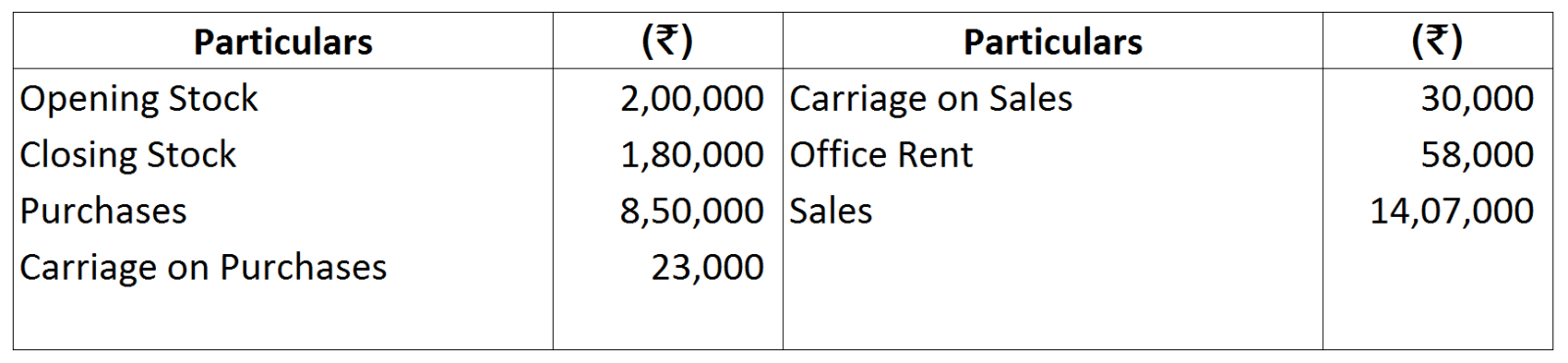
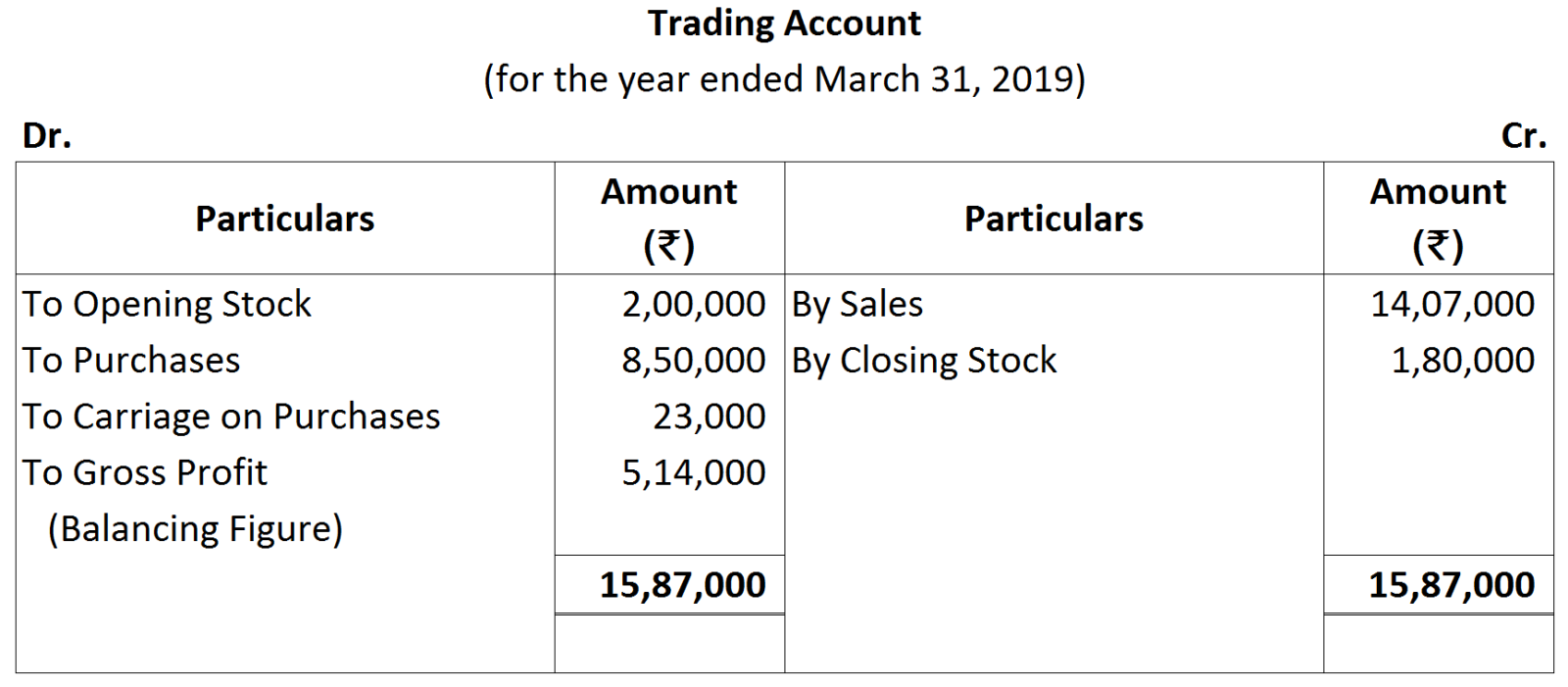
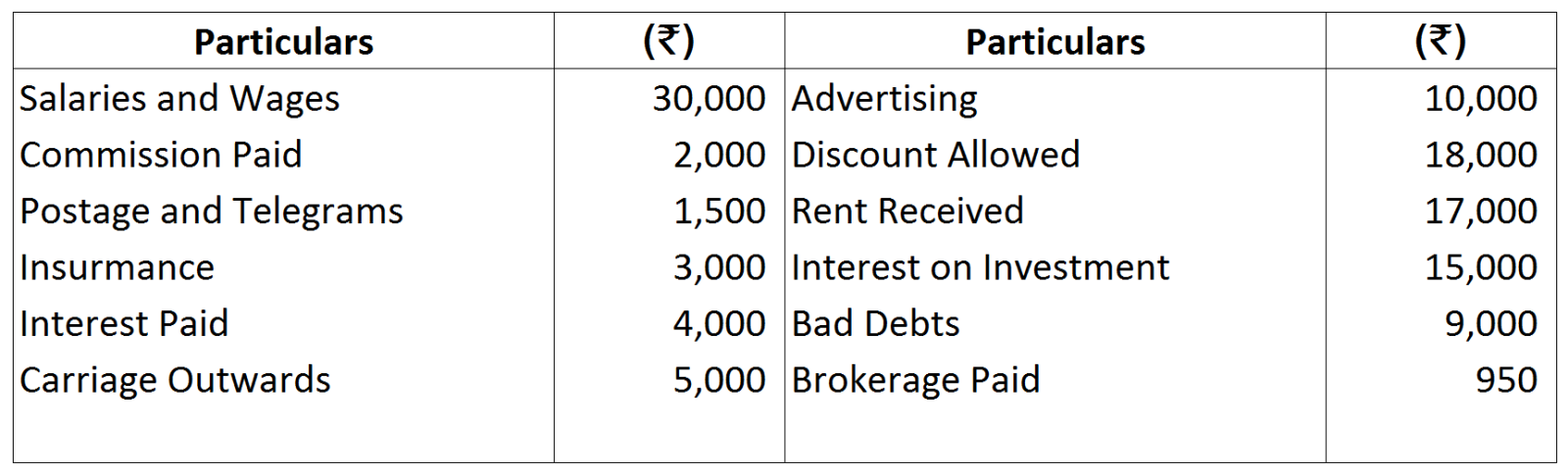
Ascertain Gross Profit from the following:
Answer

Note: Carriage on Sales and Office Rent are the Indirect Expenses, therefore, these are not considered to compute the amount of Gross Profit.
View full question & answer
Question 74 Marks
Ascertain Cost of Goods Sold from the following:
 
Opening Stock
8,500
Purchases
30,700
Direct Expenses
4,800
Indirect Expenses
5,200
Closing Stock
9,000
Answer
Cost of Goods Sold = Opening Inventory + Purchases (Net) + Direct Expenses - Closing Inventory
= ₹ 8,500 + ₹ 30,700 + ₹ 4,800 - ₹ 9,000 = ₹ 35,000.
View full question & answer
Question 84 Marks
From the following, prepare Profit and Loss Account of Sohan Lal as it would appear in the $1^{\text {st }}$ year that ended $31^{\text {st }}$ March, 2019:

The Gross Profit was $45\%$ of sales, which amounted to ₹ $6,50,000.$
Also, pass the Journal entries.
View full question & answer
Question 94 Marks
Explain the objects of preparing Profit and Loss Account.
Answer
Profit and Loss Account is prepared with the following objectives:
  1. Determine Net Profit or Net Loss: The main purpose of preparing Profit and Loss Account is to ascertain net profit earned or net loss incurred by the business during the accounting period.
  2. Comparison with the Previous Year's Profit: Profit determined by the Profit and Loss Account for the accounting period can be compared with that of the previous year's profit. It helps in ascertaining whether the business is being conducted efficiently or not.
  3. Finding Details of Indirect Expenses: Indirect expenses are shown in the Profit and Loss Account. These expenses can be compared over the period and suitable steps can be taken for controlling these expenses.
  4. Helps in Preparing Balance Sheet: A Balance Sheet can be prepared only after ascertaining Net Profit or Net Loss through the preparation of Profit and Loss Account.
View full question & answer
Question 104 Marks
Write a short note on Contingent Liability.
Answer
Contingent Liabilities: Contingent Liability is a liability that becomes payable on the happening of an event. In case, the event does not happen, no amount is payable. Such liabilities are not accounted and are not shown in the Balance Sheet; they are disclosed by way of a note.
Examples of contingent liabilities are:
  1. Liabilities in Respect of Bills Discounted: If the firm got its bills receivable discounted with bank, the primary liability will be that of the acceptor. If the acceptor does not pay, then it becomes firm's liability.
  2. Guarantee for Loan: If the firm has stood surety for a loan, it will be liable to pay the amount if the other person fails to meet his obligation.
  3. Disputed Claims: If some other party has lodged a claim against the firm, the firm will be liable to pay if the claim succeeds.
View full question & answer
Question 114 Marks
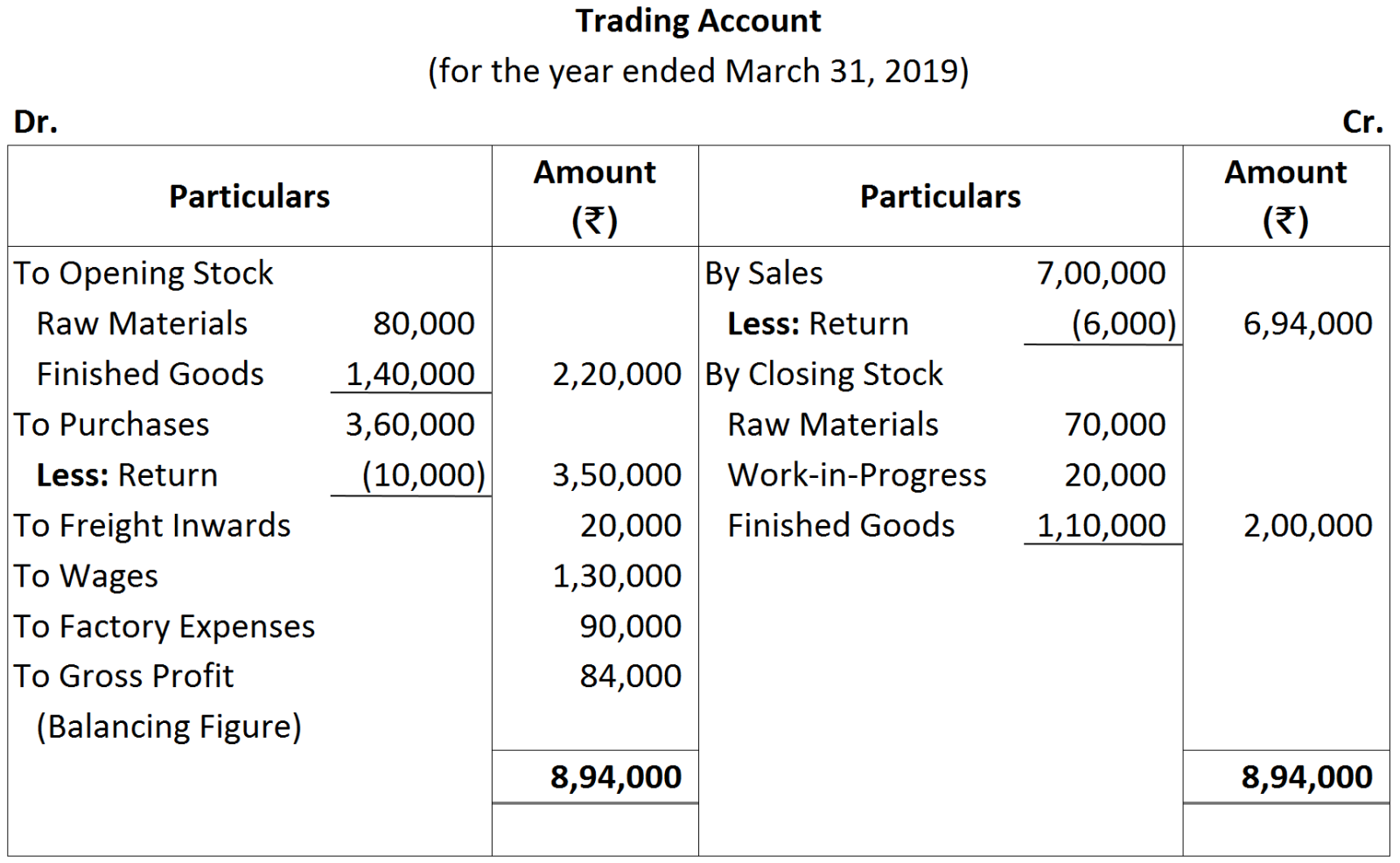
Following balances appear in the Trial Balance of a firm as on $31^{st}$ March, $2019$:
 
 
Opening Stock:
Raw Material
80,000
 
Finished Goods
1,40,000
Purchases
 
3,60,000
Sales
 
7,00,000
Returns:
Purchases
10,000
 
Sales
6,000
Wages
 
1,30,000
Factory Expenses
 
90,000
Freight:
Inwards
20,000
 
Outwards
30,000
At the end of the accounting period, stock was:
 
Raw Materials
 
70,000
Work-in-Process
 
20,000
Finished Goods
 
1,10,000
Prepare Trading Account of the firm.
Answer

Note: Freight outwards is an indirect expense. It will be recorded in Profit & Loss A/c.
View full question & answer
Question 124 Marks
Which out of the following are (a) Capital Expenditure; (b) Revenue Expenditure and (c) Deferred Revenue Expenditure?
  1. ₹ 1,200 spent on the repairs of machines.
  2. ₹ 72,500 spent on the overhaul of machines purchased second hand.
  3. Whitewash expenses.
  4. Paper purchased for use as stationery.
  5. Advertising campaign to launch a new product.
  6. Renovation of a cinema hall.
  7. Brokerage paid in connection with purchase of land.
  8. Expenses incurred to get the manager's office air-conditioned.
  9. Loss on investments.
  10. Expenses to move the stock of goods from one place to another.
Answer
  1. Capital Expenditure:
  1. ₹ 72,500 spent on the overhaul of machines purchased second hand.
  1. Brokerage paid in connection with purchase of land.
  2. Expenses incurred to get the manager's office air-conditioned.
  1. Revenue Expenditure:
  1. ₹ 1,200 spent on the repairs of machines.
  1. Whitewash expenses.
  2. Paper purchased for use as stationery.
  1. Loss on investments.
  2. Expenses to move the stock of goods from one place to another.
  1. Deferred Revenue Expenditure:
  1. Advertising campaign to launch a new product.
  2. Renovation of a cinema hall.
View full question & answer
Question 144 Marks
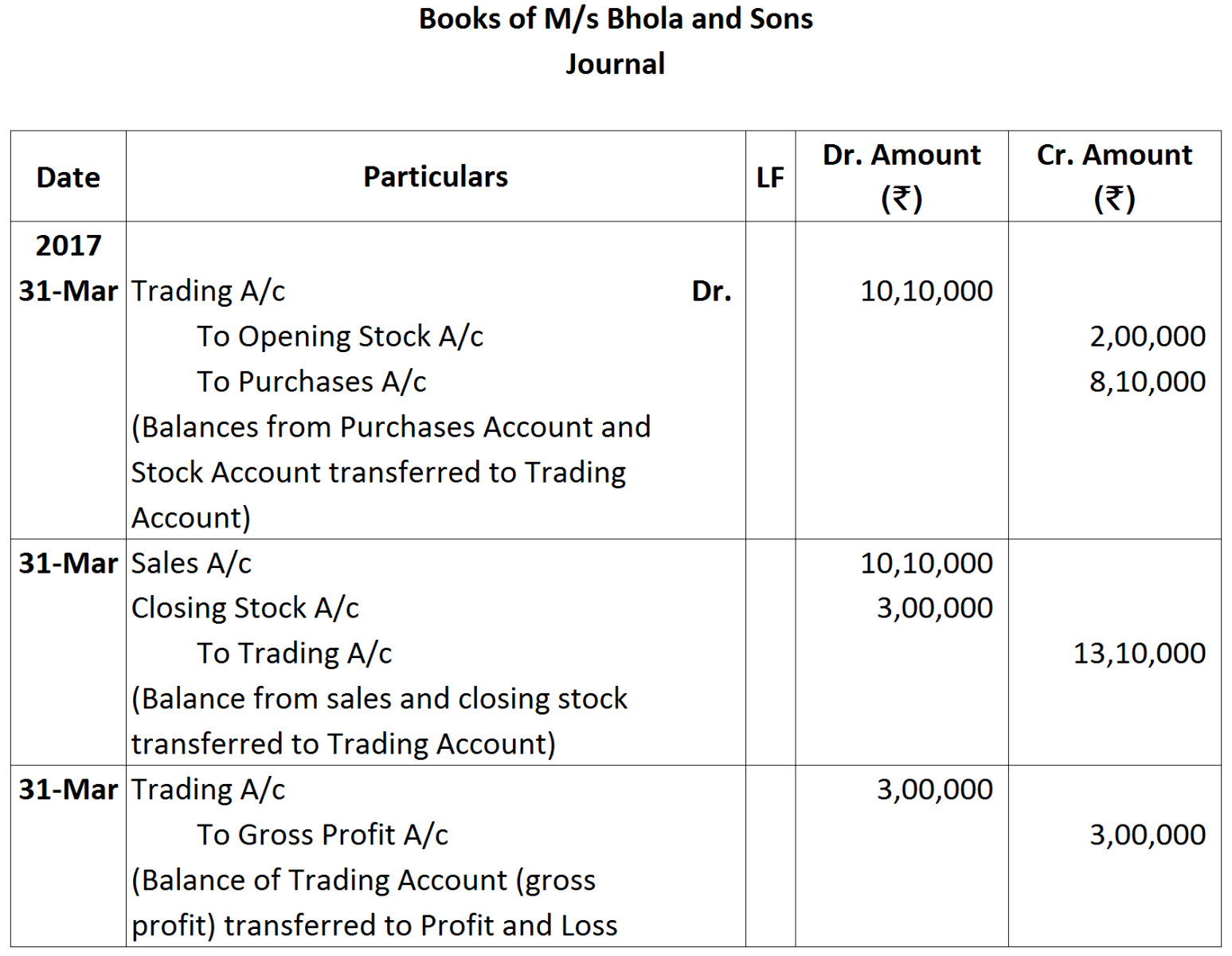
The following are the extracts from the trial balance of M/s Bhola & Sons as on March 31, 2017

Closing Stock as on date was valued at ₹ 3,00,000.
You are required to record the necessary journal entries and show how the above items will appear in the trading and profit and loss account and balance sheet of M/s Bhola & Sons.
View full question & answer
Question 154 Marks
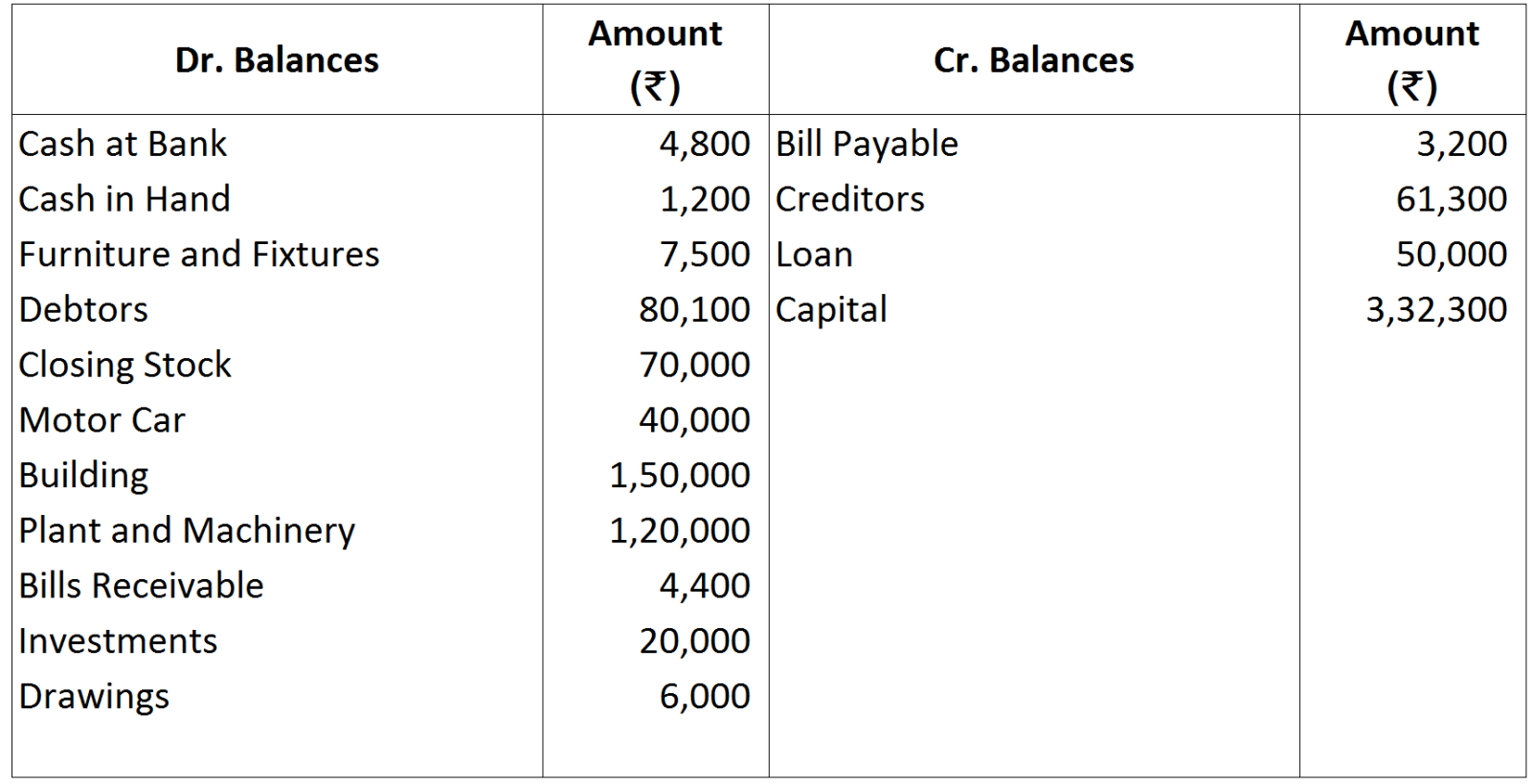
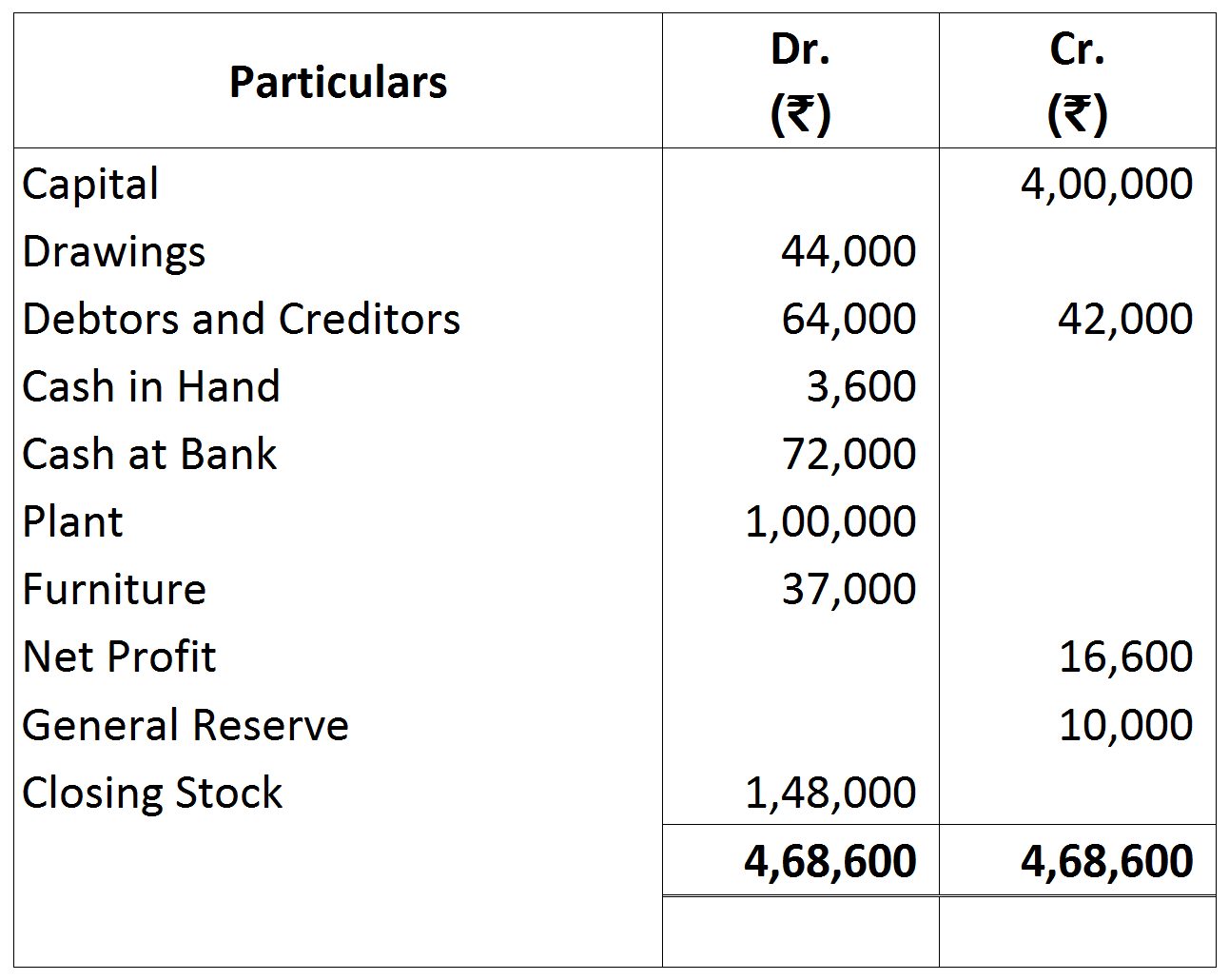
A merchant has earned a Net Profit of ₹ 57,200 for the year ended 31st March, 2017. Other balances in his Ledger are as under:
Prepare his Balance Sheet as at 31st March, 2017.

View full question & answer
Question 164 Marks
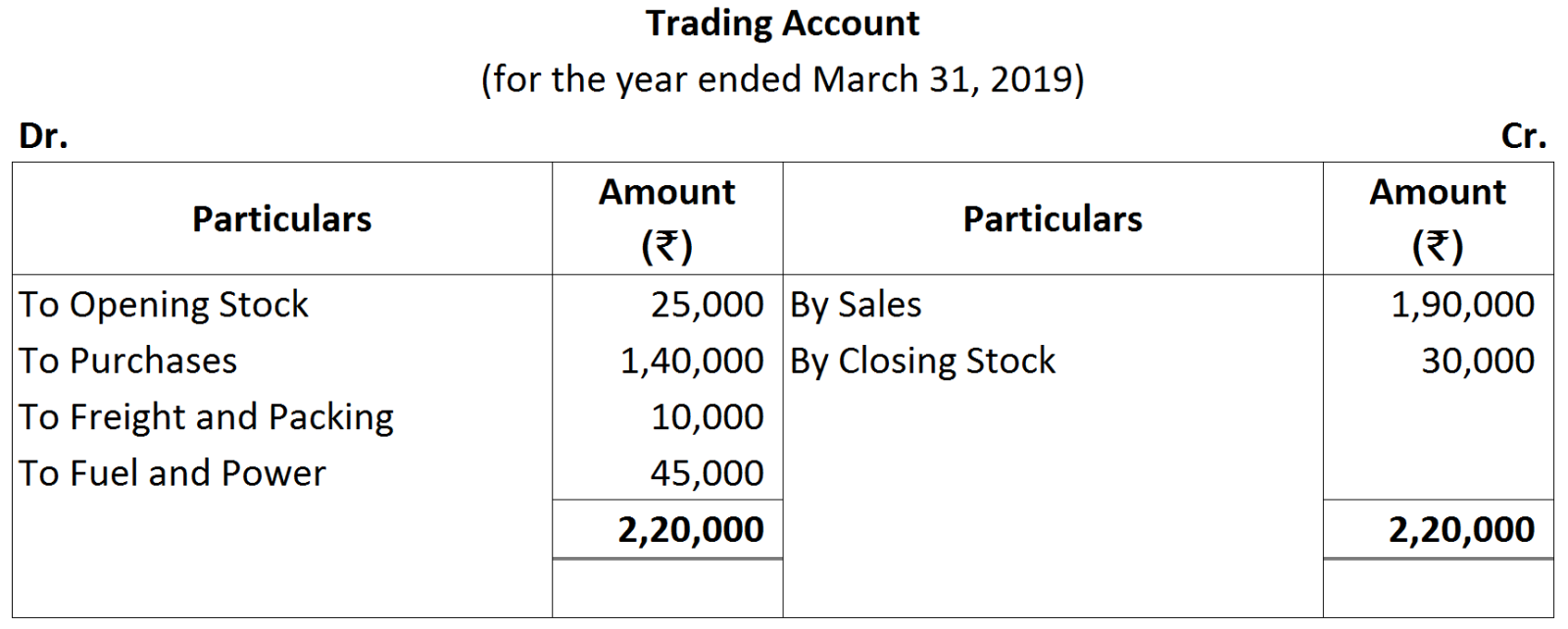
From the following information, determine Gross Profit for the year ended $31^{st}$​​​​​​​ March,$ 2019:$​​​​​​​
[Hint: Packing Expenses on Sales' are indirect expenses, therefore, they are not considered whike computing Cost of Goods Sold.]
Answer
Gross Profit
=
Sales + Closing Stock - (Opening Stock + Freight and Packing + Goods Purchased)
 
=
₹ $1,90,000 + ₹ 30,000 - (₹ 25,000 + ₹ 10,000 + ₹ 1,40,000)$
 
=
₹ $2,20,000 - ₹ 1,75,000 = ₹ 45,000$
Alternate Answer

Note: Packing Expenses (₹ 6,000) on Sales is an Indirect Expense, therefore it is not considered to compute the amount of Gross Profit.
View full question & answer
Question 184 Marks
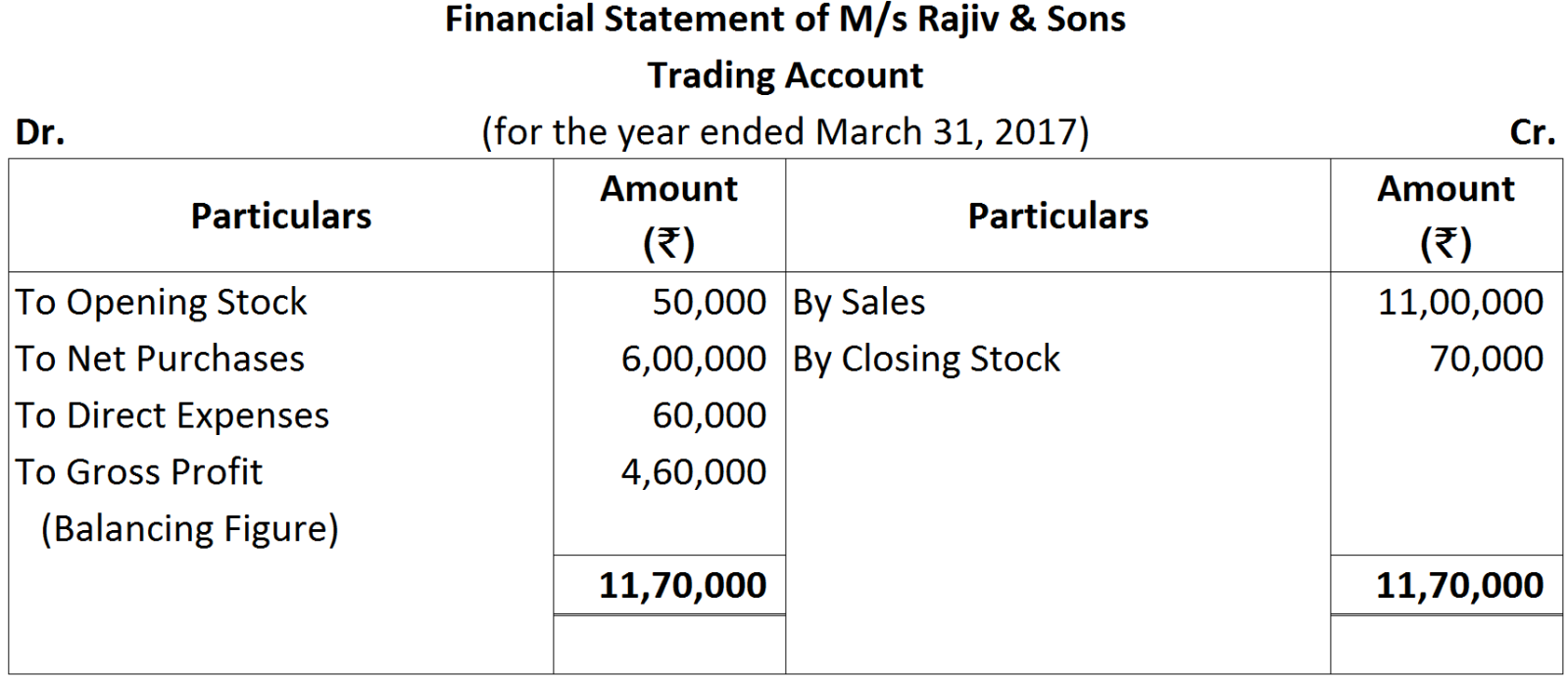
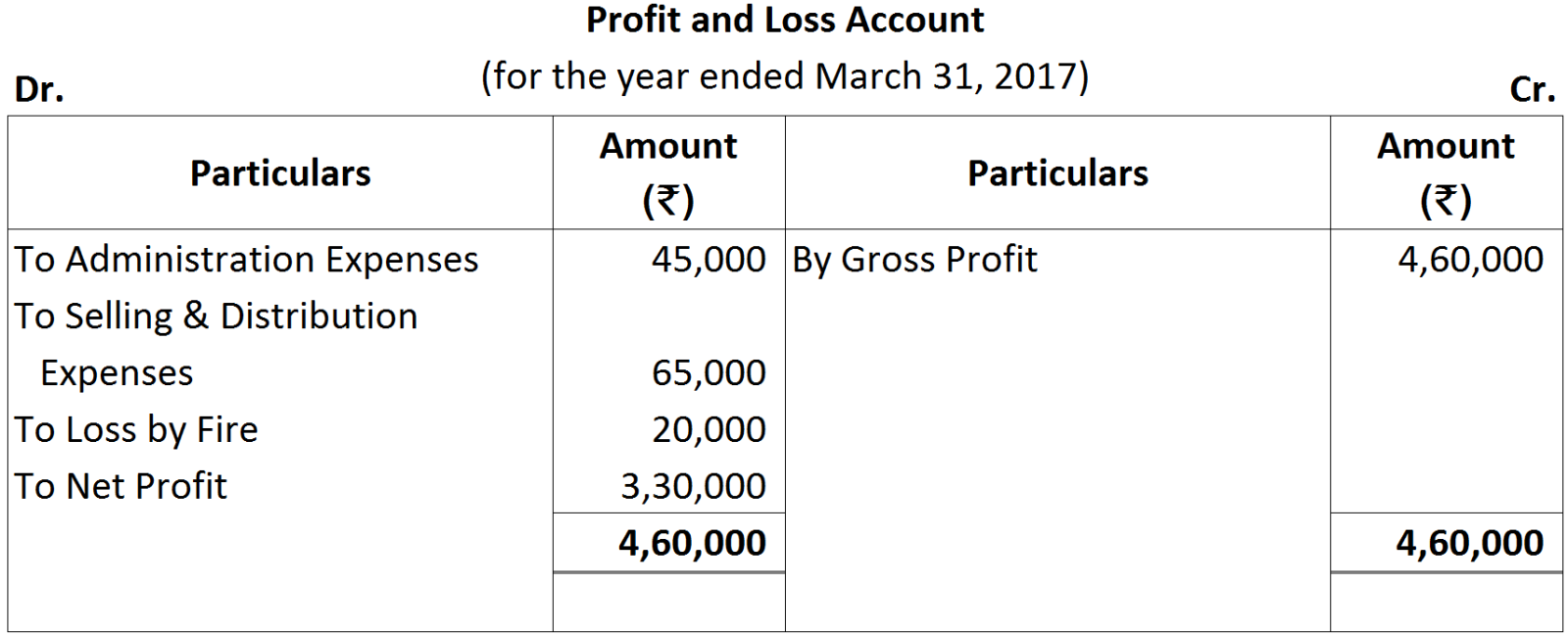
Calculate the amount of gross profit, operating profit and net profit on the basis of the following balances extracted from the books of M/s Rajiv & Sons for the year ended March 31, 2017.
 
Opening Stock
50,000
Net Sales
11,00,000
Net Purchases
6,00,000
Direct Expenses
60,000
Administration Expenses
45,000
Selling and Distribution Expenses
65,000
Loss due to Fire
20,000
Closing Stock
70,000
Answer


Working Notes:
Operating Profit = Net Profit − Non Operating Income + Non Operating Expenses
= 3,30,000 − 0 + 20,000
= Rs 3,50,000
Loss by Fire is a non-operating expense, thus, added to the net profit to arrive at operating profit.
View full question & answer
Question 194 Marks
How does Profit and Loss Account differ from Trading Account?
Answer
Difference between Trading Account and Profit and Loss Account-
 
Basis
Trading Account
Profit and Loss Account
1.
Relation
Trading Account is a part of Profit and Loss Account
Profit and Loss Account is prepared to ascartain net profit or net the business.
2.
Nature
Gross Profit or Gross Loss is determined from Trading Account.
Profit and Loss Account is prepared to ascertain net profit or net loss of the business.
3.
Transfer of Balace
Balance of the Trading Account is Transferred to profit and Loss Account
Balance of the Profit and Loss Account is transfered to Capital Account of the proprietor.
4.
Items
Items shown in the Trading Account are purchases, sales, opening and closing stock direct expencses etc.
Items like indirect related to sales, distribution, administration, finance etc, are shown in the profit Loss Account.
View full question & answer
Question 204 Marks
Distinguish between Current Assets and Fixed Assets.
Answer
Difference between Fixed Assets and Current Assets:
 
Basis
Fixed Assets
Current Assets
1.
Nature
These are long-term resources of a business.
Thses are short-term resource of a business.
2.
Purpose of Holding
These assets are used to operate the business and to earn profits.
These assets are realised in cash or consuned during the normal operating of business.
3.
Valuation
These assets are valued at cost less depreciation.
These assets are valued at cost or net area isable value (market price), whichever is less.
4.
Sources of Finance
These assets are acquired out of long-term funds of the business.
These assets are acquired out of short-term funds of the business.
5.
Subject to Change
These assets are not usually subject to change.
These assets are usually subject to change.
6.
Profit on sale
Profit on sale of these assets is capital profit.
Profit on sale of these assets is revenue profit.
 
View full question & answer
Question 214 Marks
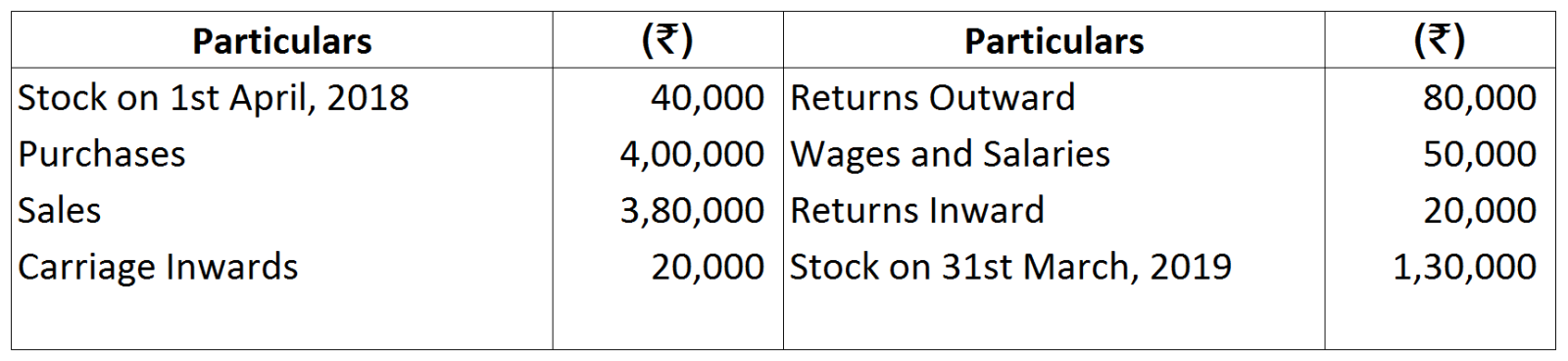
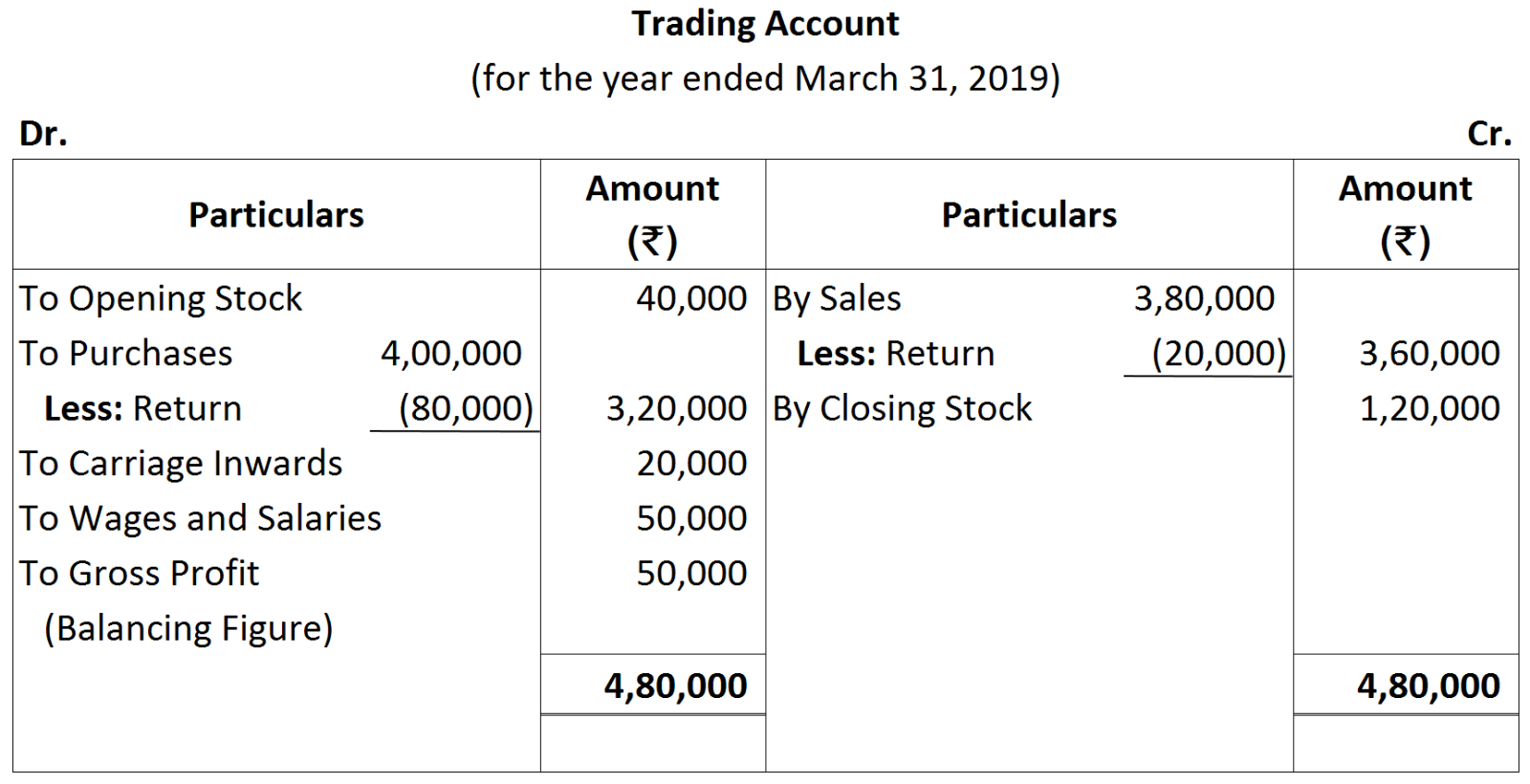
From the following information, prepare Trading Account for the year ended $31^{st}$​​​​​​​ March, $2019$:
Net Realisable Value (Market Value) of stock as on $31^{st}$​​​​​​​ March, $2019$ was $₹ 1,20,000$.
​​​​​​​[Hint: Closing Stock is shown at Net Realisable Value, i.e., Market Value $(₹ 1,20,000)$ since Market Value is less the Cost of Stock.]
Answer


Note: Closing Stock is taken at its Market Price (i.e. $₹ 1,20,000$) instead of its Cost (i.e. $₹ 1,30,000$). This is because, as per Principle of Conservatism, Closing stock is taken at Cost or Market Price whichever is less.
View full question & answer
Question 224 Marks
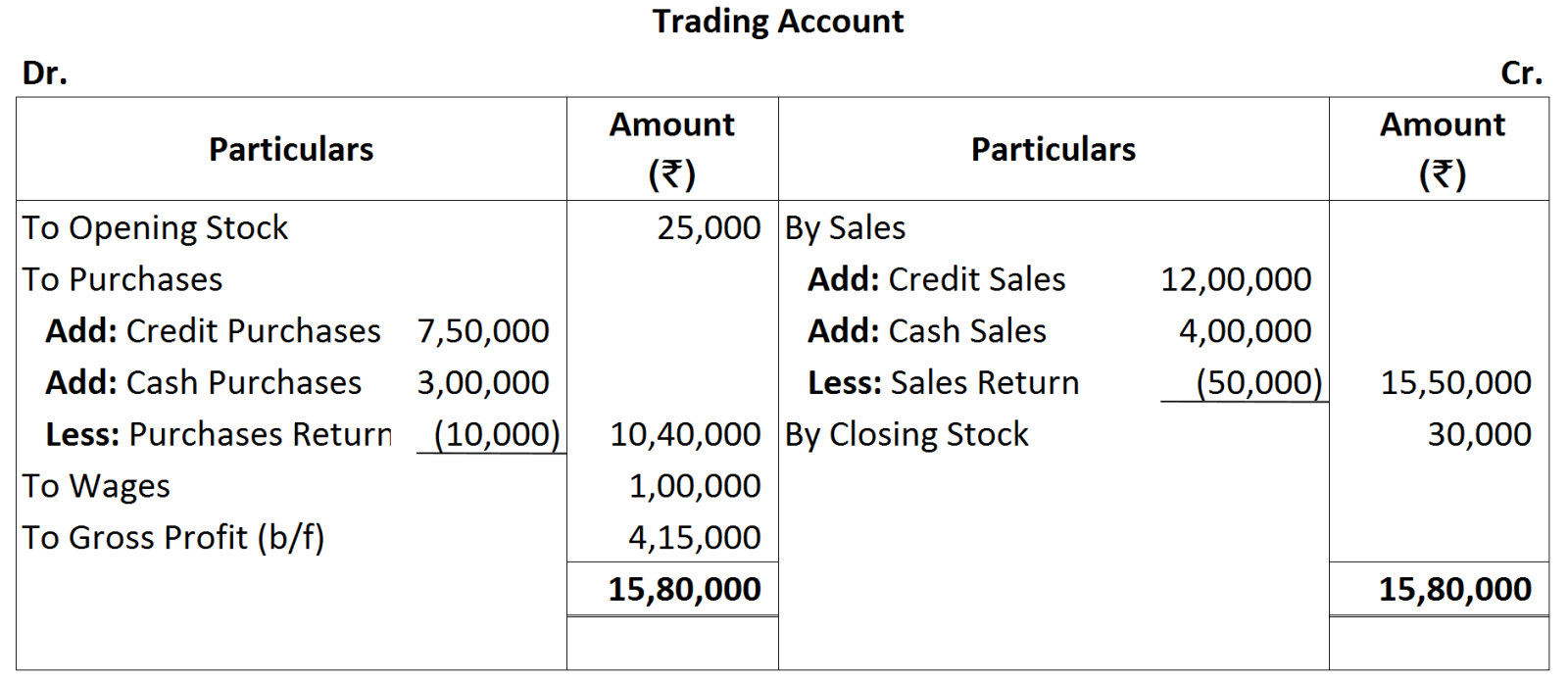
From the following balances extracted from the books of M/s Ahuja and Nanda. Calculate the amount of:
  1. Cost of goods available for sale.
  2. Cost of goods sold during the year.
  3. Gross Profit.
 
Opening stock. 25,000
Credit purchases 7,50,000
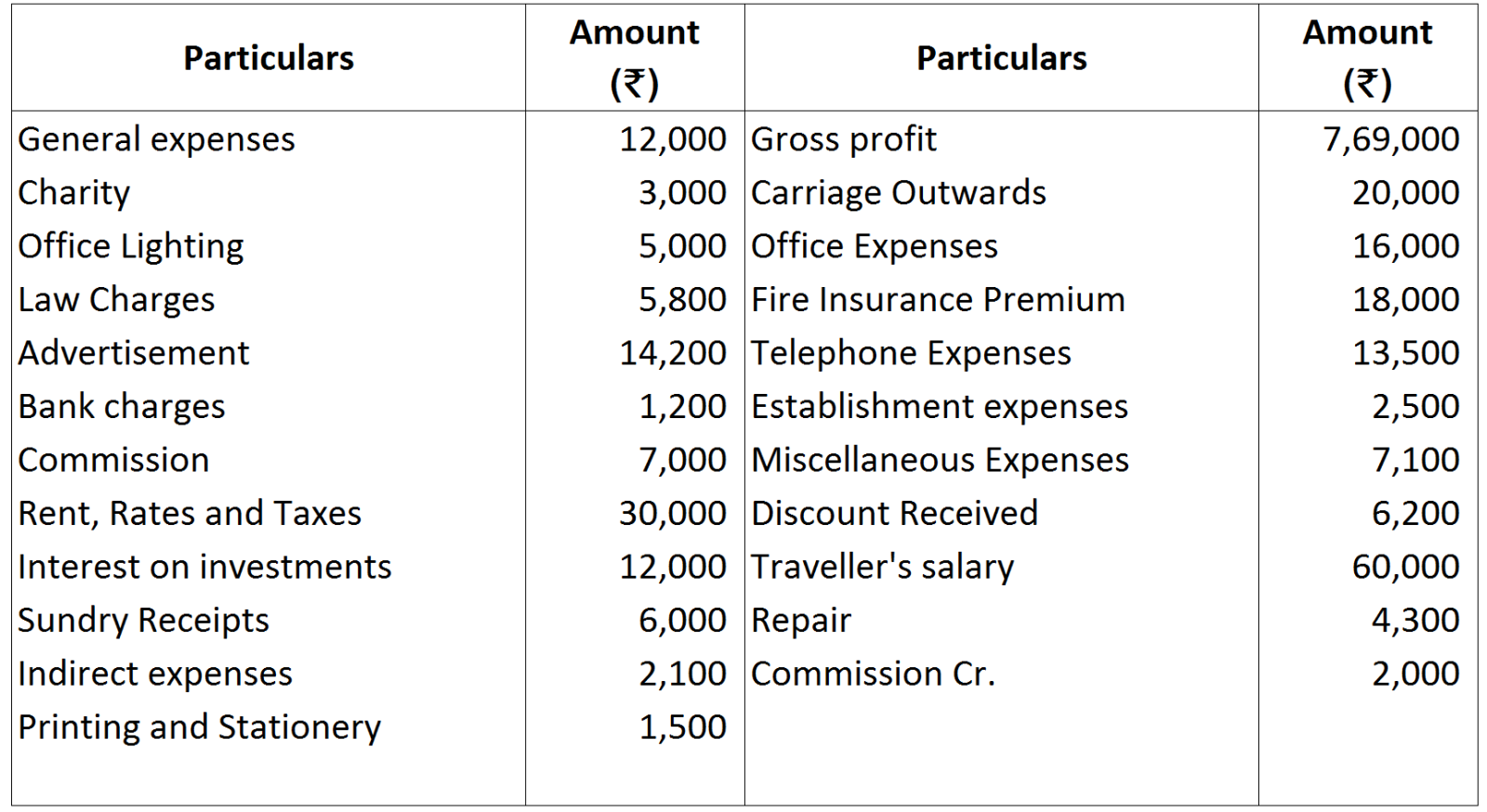
Cash purchases 3,00,000
Credit sales 12,00,000
Cash sales 4,00,000
Wages 1,00,000
Salaries 1,40,000
Closing stock 30,000
Sales return 50,000
Purchases return 10,000
Answer
  1. Cost of goods sold Available for sales
Or

Cost of goods manufactured = opening stock + Net purchase + wages

= 25,000 + 10,40,000 + 1,00,000

= ₹ 11,65,000
  1. Cost of goods sold = opening stock + Net purchase + wages - closing stock
= 25,000 + 10,40,000 + 1,00,000 - 30,000

= ₹ 11,35,000

Or

Cost of Goods sold = Net sales - gross profit

= 15,50,000 - 4,15,000

= ₹ 11,35000
  1.  
View full question & answer
Question 234 Marks
What is the purpose of preparing trading and profit and loss account?
Answer
The purposes of preparing Trading Account are:
  1. To calculate gross profit earned or gross loss incurred during an accounting period.
  2. To estimate the cost of goods sold.
  3. To record direct expenses (i.e., expenses incurred on the purchases and manufacturing of goods).
  4. To measure the adequacy and reasonability of direct expenses incurred by comparing purchases with direct expenses incurred.
  5. To compare the realised efficiency and performance with the desired or proposed targets.
The purposes of preparing Profit and Loss Account are:
  1. To calculate net profit or net loss.
  2. To ascertain net profit ratio and to compare this year’s net profit ratio with that of the desired and proposed target in order to assess the efficiency and effectiveness.
  3. To measure the adequacy and reasonability of indirect expenses incurred by ascertaining ratio between indirect expenses and net profit.
  4. To compare current year’s actual performance with desired and planned performance.
  5. To provide various provisions and reserves to meet unforeseen future conditions and to toughen the financial position of the business.
View full question & answer
Question 244 Marks
What are Direct Expenses? Give two examples.
Answer
Direct Expenses: Direct Expenses are the expenses incurred on the goods purchased, till they are brought to the place of business. Examples of such expenses are freight inwards, insurance, customs (import) duty, clearing charges, cartage, loading and unloading charges, etc. In a manufacturing concern, besides the above, expenses incurred for purposes of production such as wages, power and fuel, factory rent, etc., are also Direct Expenses.
Examples:
  1. Carriage or Freight or Cartage Inwards: It is the cost of bringing materials to the firm's godown. If any freight or carriage is paid on any asset, like machinery, it is added to the cost of the asset and is not debited to Trading Account.
  2. Wages: Wages paid to workers in the factory, including stores, are debited to the Trading Account; if any amount is outstanding it is accounted for so that the total wages for the period are debited to Trading Account.
View full question & answer
Question 254 Marks
What are the objectives of preparing financial statements?
Answer
The main purpose of preparing financial statements is to:
  • Provide information about the financial status and financial position of the organization (or other entities).
  • Provide information to analyze and assess the economic and business performance of the organization (or other entities).
  • Serve as an accounting database for future references.
  • Facilitate effective, accurate and well-thought-out policies and strategies for the organization (or other economic entities).
  • Serve as an important tool to promote effective decision making.
  • Act as an important source of crucial business information.
  • Ascertain the results of various business operations such as income, expenditure, debtors, payables, receivables, profits, losses, etc.
View full question & answer
Question 264 Marks
Discuss the need of preparing a balance sheet.
Answer
The needs to prepare a Balance Sheet are given below:
  1. It helps in determining the nature and book value of various assets, such as fixed assets, investments, current assets, etc. at the end of an accounting period.
  2. It helps in ascertaining the nature and amount of various liabilities like long term liabilities, current liabilities, provisions, etc., which a business owes.
  3. It discloses important information about capital invested in a business. The additional capital invested during the accounting period, drawings of the owners and profit (or loss) added to (or deducted from) the capital of the business.
  4. It helps in assessing the solvency of a business.
  5. It discloses the true financial position of a business at a particular point of time.
  6. It lays down the basis for maintaining new books for next accounting period.
View full question & answer
Question 274 Marks
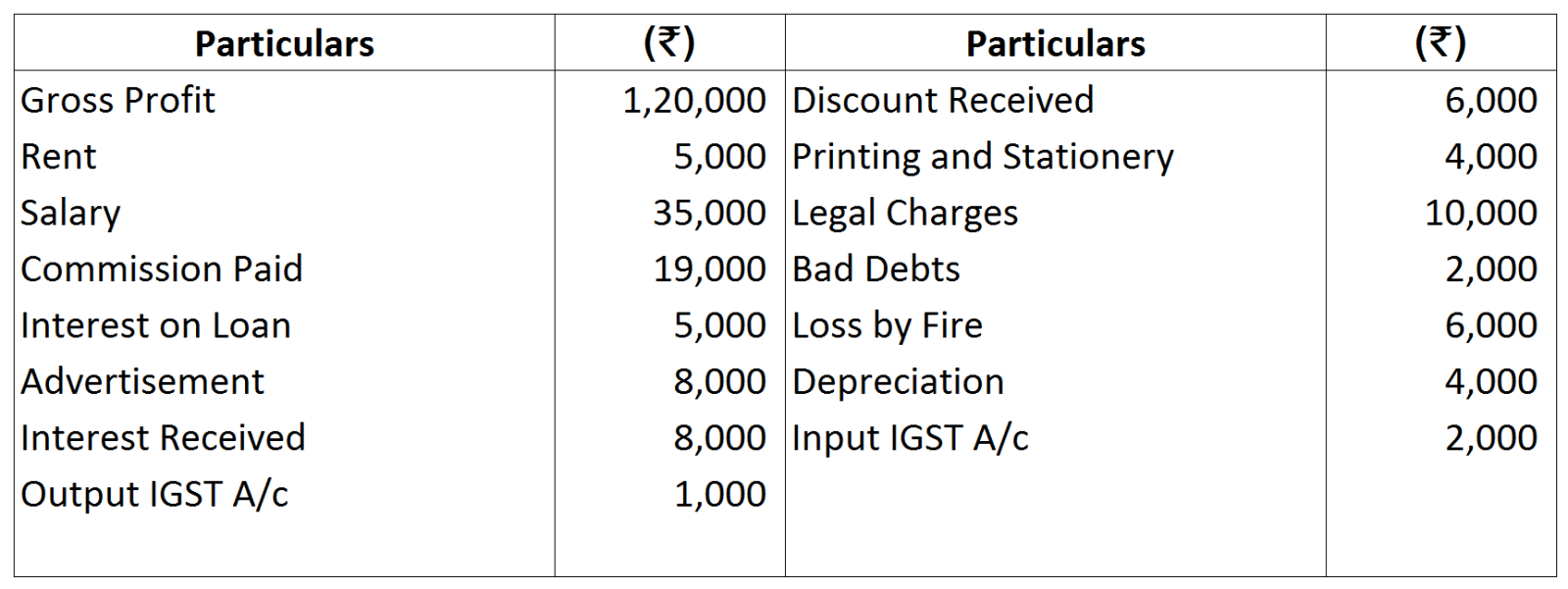
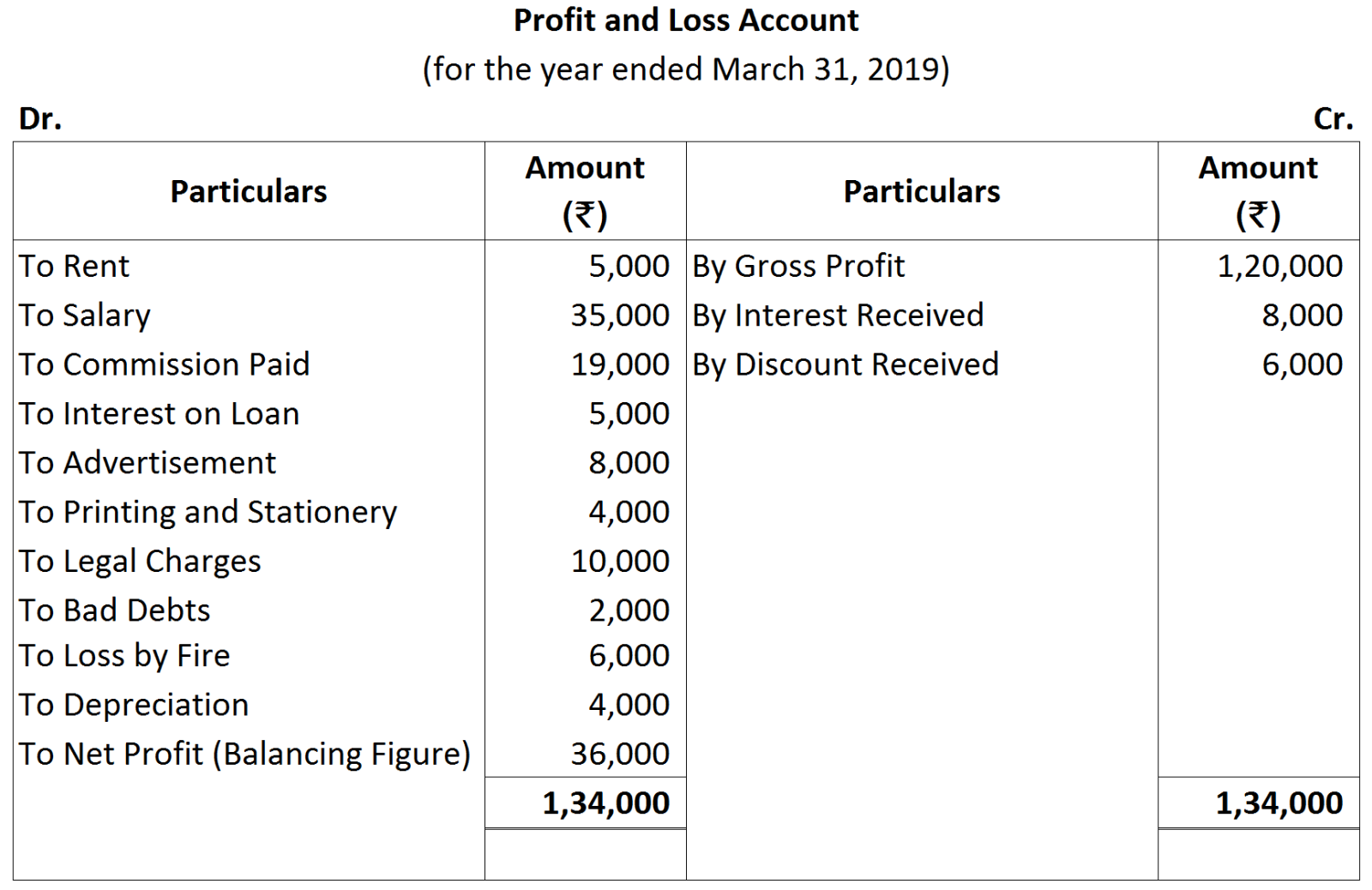
From the following information, prepare Profit and Loss Account for the year ended $31^{st}$​​​​​​​ March,$ 2019:$​​​​​​​
Answer

Note: ₹ 1,000 Input IGST after adjusting against Output IGST will be shown on the asset side of the balance sheet.
View full question & answer
Question 284 Marks
Give four points of distinction between Trading Account & Profit and Loss Account.
Answer
Difference between Trading Account and Profit and Loss Account.
 
Basis
Trading Account
Profit and Loss Account
1.
Relation
Trading Account is a part of Profit and Loss Account.
Profit and Loss Account is the main account.
2.
Nature
Gross Profit or Gross Loss is determined from Trading Account.
Profit and Loss Account is prepared to ascertain net profit or net loss of the business.
3.
Transfer of Balance
Balance of the Trading Account is transferred to Profit and Loss Account.
Balance of the Profit and Loss Account is transferred to Capital Account of the proprietor.
4.
Items
Items shown in the Trading Account are purchases, sales, opening and closing stock, direct expenses, etc.
Items like indirect expenses related to sales, distribution, administration, finance, etc., are shown in the Profit and Loss Account.
View full question & answer
Question 294 Marks
Write a note on types of Assets with one example of each.
Answer
Assets in the Balance Sheet are divided into two parts as follows:
  1. Fixed Assets: Fixed Assets are those assets that are acquired for continued use and not for resale. They may be tangible assets like land, building, plant and machinery, furniture and fixtures, etc., or intangible assets like goodwill, patents, etc.
  1. Tangible Fixed Assets are those fixed assets which can be seen and touched, e.g., Land and Building, Plant and Machinery, Furniture, etc.
  2. Intangible Fixed Assets are those fixed assets which are not in a physical form, i.e., they can neither be seen nor touched, e.g, goodwill of a firm or the know-how which it possesses, patents, trademarks, coputer software, etc.
  1. Current Assets: Thssets: These are the assets of business which are held for reslae or for converting into cash. These are the assets which are likely to be realised within a period of one year or during the period of normal operating cycle. A business earns profit by sale of these assets but not by keeping them in hand. Examples are unsold goods, debtors, bills receivalbe, bank balance, cash in hand, etc. These assets are temporary in nature and may change from time to time. These are sometimes referred to as floating or circulating assets.
View full question & answer
4 Marks Question - Account STD 11 Commerce Questions - Vidyadip