Questions · Page 3 of 3

3 Marks Question

Question 1013 Marks
Show the accounting equation on the basis of following transactions:
  1. Commenced business with Cash ₹ 20,000; Goods ₹ 50,000 and Furniture ₹ 30,000.
  2. Purchased goods from Gopal on Credit ₹ 40,000.
  3. Sold goods for Cash ₹ 40,000 (costing ₹ 30,000).
  4. Sold goods to Ram on Credit ₹ 65,000 (costing ₹ 50,000).
  5. Withdrew for personal use goods costing ₹ 5,000.
  6. Purchased typewriter for personal use of the proprietor ₹ 20,000.
  7. Purchased chairs for office use for Cash ₹ 10,000.
  8. Paid for printing ₹ 500 and received Commission ₹ 1,200.
  9. Introduced fresh Capital ₹ 40,000.
  10. Paid to Gopal ₹ 30,000.
View full question & answer
Question 1023 Marks
Enter the following transactions in Return Outward Book of Modern Furniture House, Udaipur (Rajasthan) assuming CGST @ 6% and SGST @ 6% and post it into Ledger:
2017
 
Nov. 7
Returned to Sachdeva Furniture Store, Ahmedabad (Gujarat):
5 Chairs @ ₹ 2,000 each
1 Table for ₹ 15,000
Less: 10% Trade Discount
Nov. 22
Returned 8 Chairs to India Furniture House, Jodhpur (Rajasthan) @ ₹ 1,500 each, being not of specified quality
Nov. 24
Returned one Dining Table to Arora & Co., Jaipur (Rajasthan) being not according to sample ₹ 50,000
Nov. 28
Allowance claimed from Delhi Furniture Shop, Ahmedabad (Gujarat) on account of mistake in the invoice ₹ 16,000
View full question & answer
Question 1033 Marks
Show the effect of following transaction on the accounting equation:
a.
Manoj started business with
(i) Cash
(ii) Goods
(iii) Building
₹ 2,30,000
₹ 1,00,000
₹ 2,00,000
b.
He purchased goods for cash
₹ 50,000
c.
He sold goods (costing ₹ 20,000)
₹ 35,000
d.
He purchased goods from Rahul
₹ 55,000
e.
He sold goods to Varun (Costing ₹ 52,000)
₹ 60,000
f.
He paid cash to Rahul in full settlement
₹ 53,000
g.
Salary paid by him
₹ 20,000
h.
Received cash from Varun in full settlement
₹ 59,000
i. Rent outstanding ₹ 3,000
j. Prepaid Insurance ₹ 2,000
k. Commission received by him ₹ 13,000
l. Amount withdrawn by him for personal use ₹ 20,000
m. Depreciation charge on building ₹ 10,000
n. Fresh capital invested ₹ 50,000
o. Purchased goods from Rakhi ₹ 10,000
(Ans: Assets = Cash ₹ 2,42,000 + Goods ₹ 1,43,000 + Building ₹ 1,90,000 + Prepaid Insurouce ₹ 2,000 = ₹ 5,77,000; Liabilities = Outstanding Rent ₹ 3,000 + Creditor ₹ 10,000 + Capital ₹ 5,64,000 = ₹ 5,77,000)
View full question & answer
Question 1043 Marks
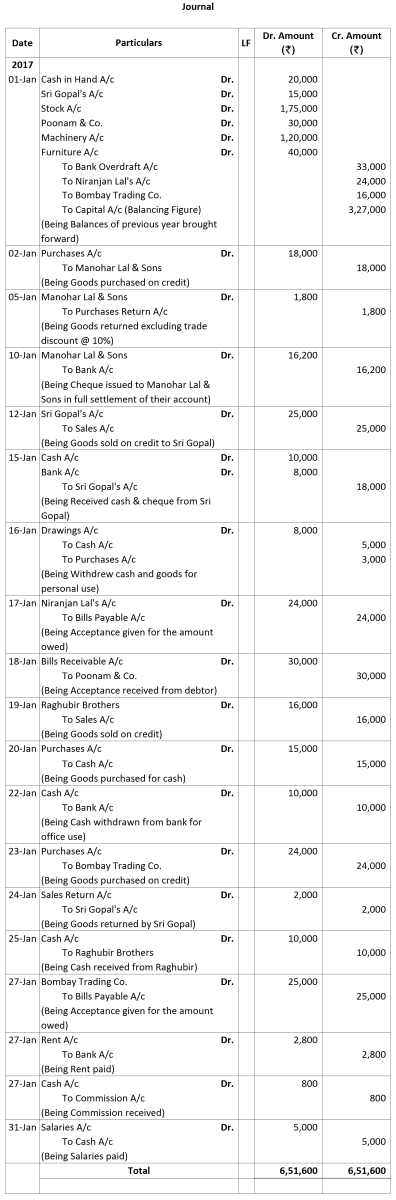
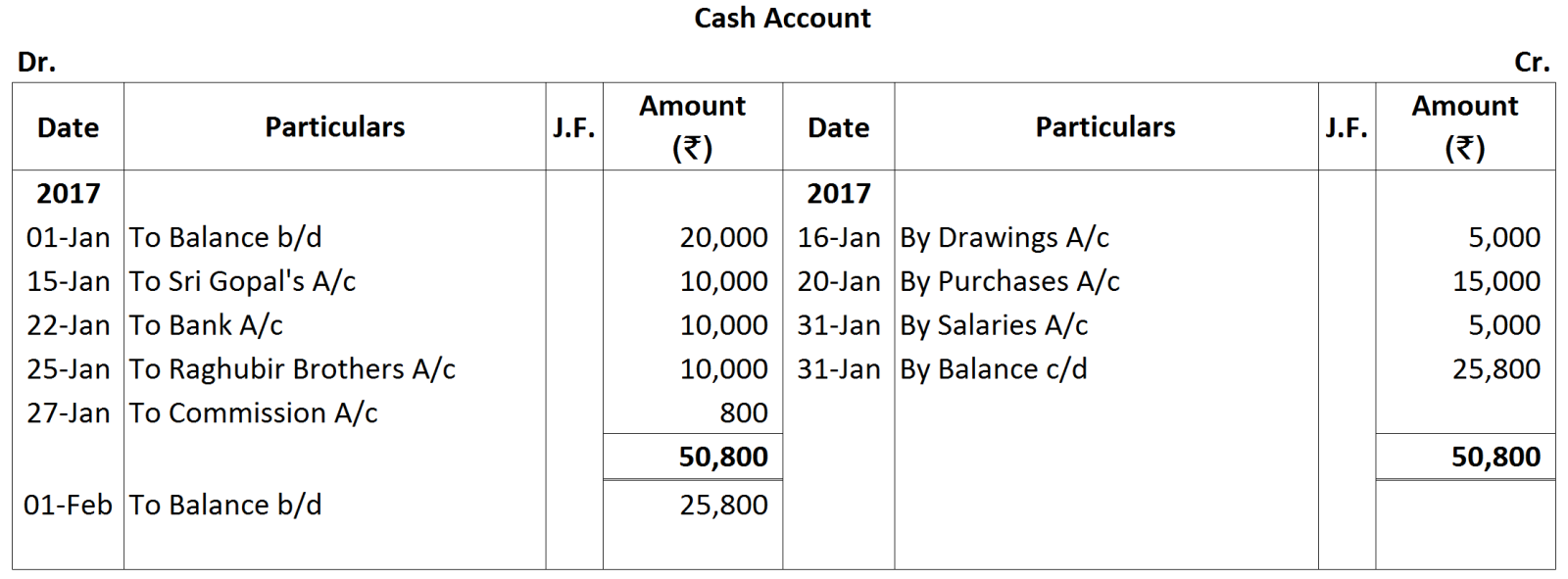
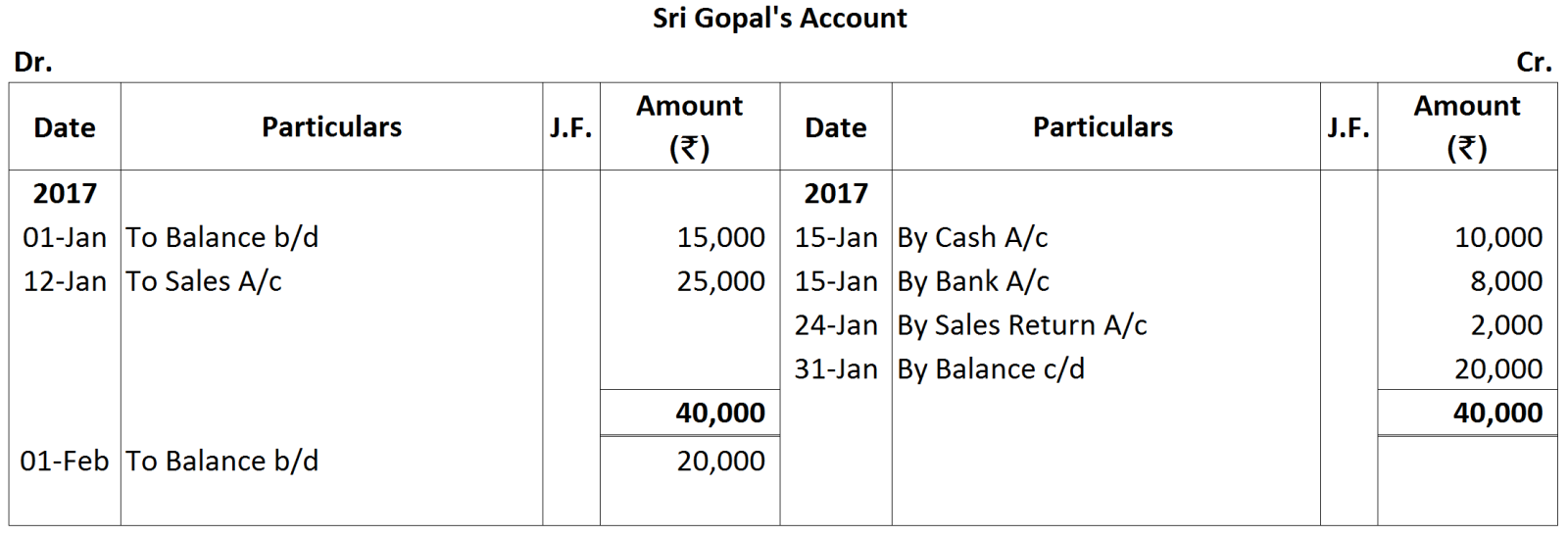
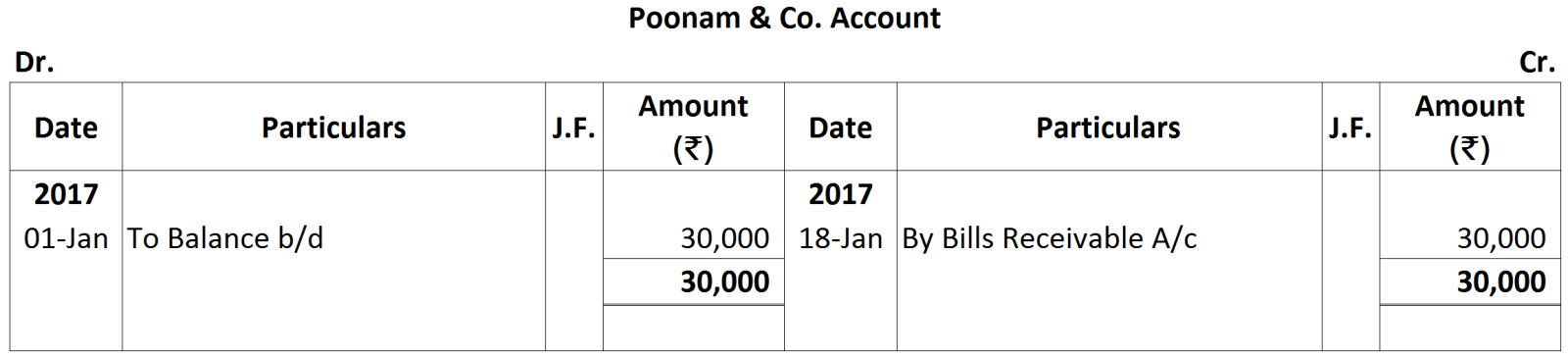
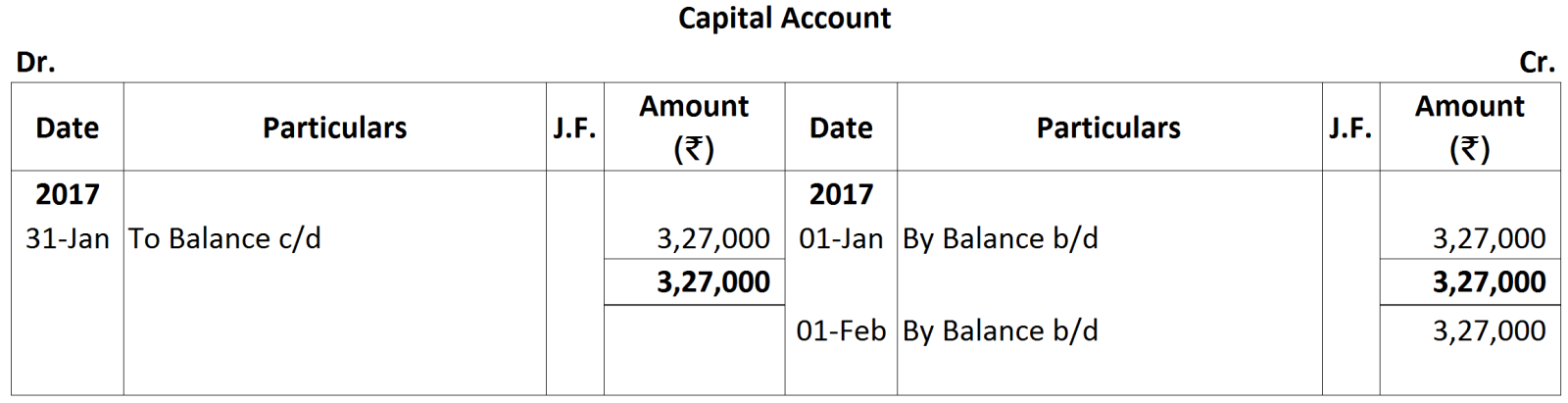
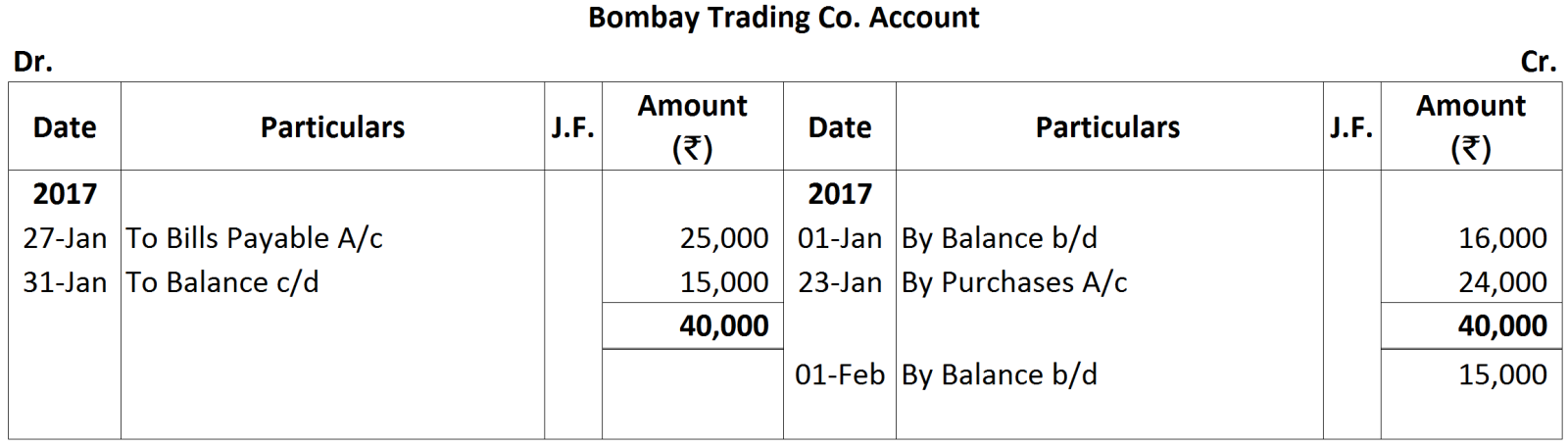
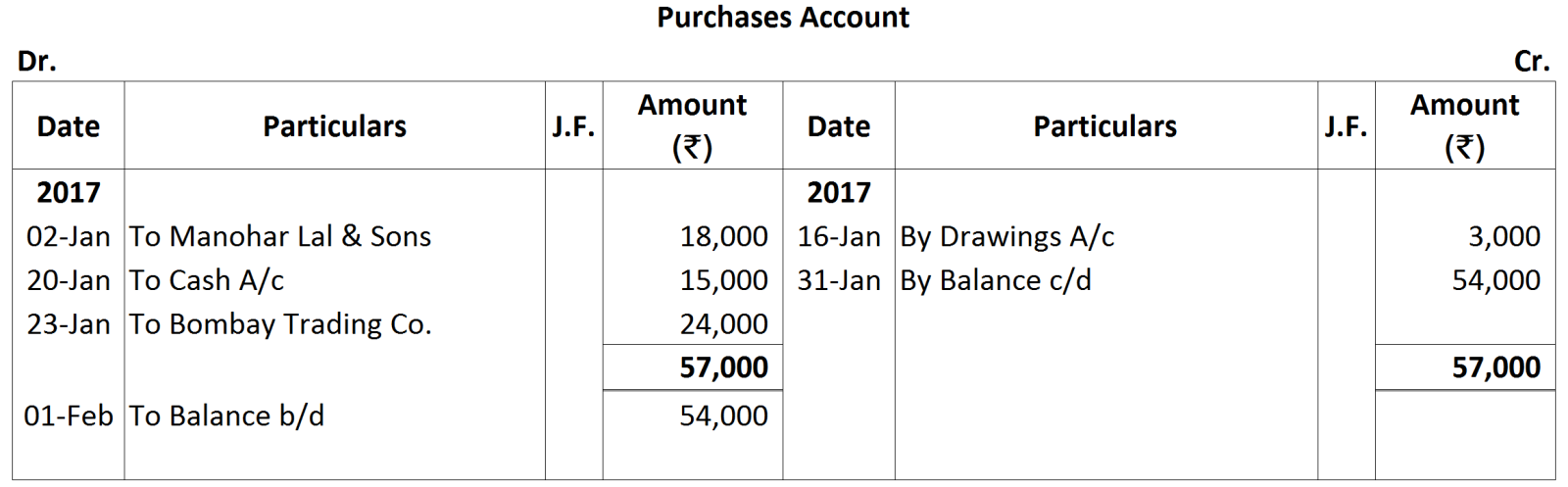
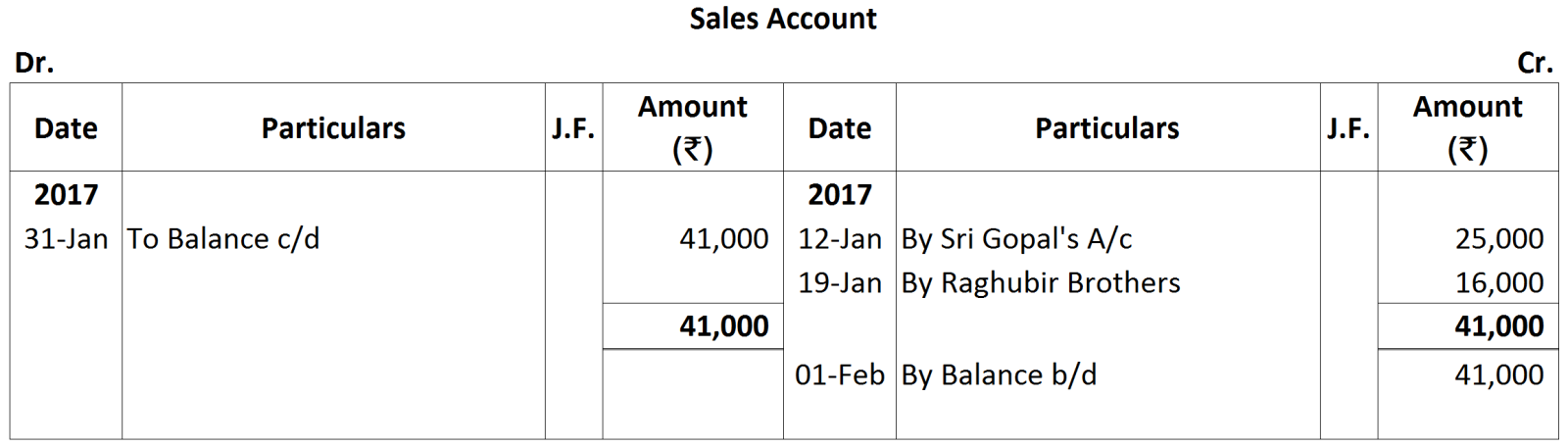
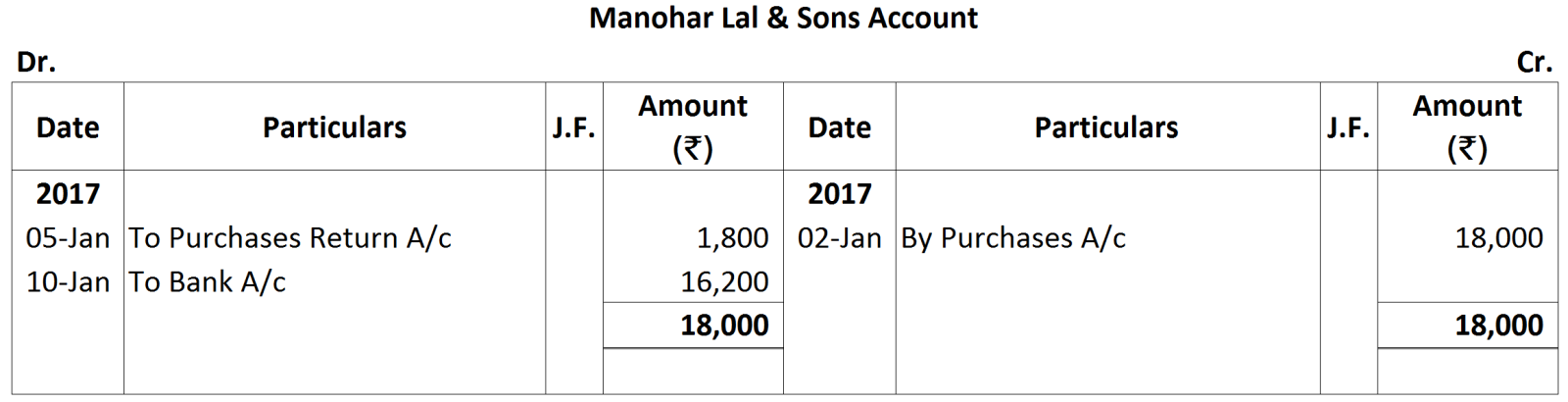
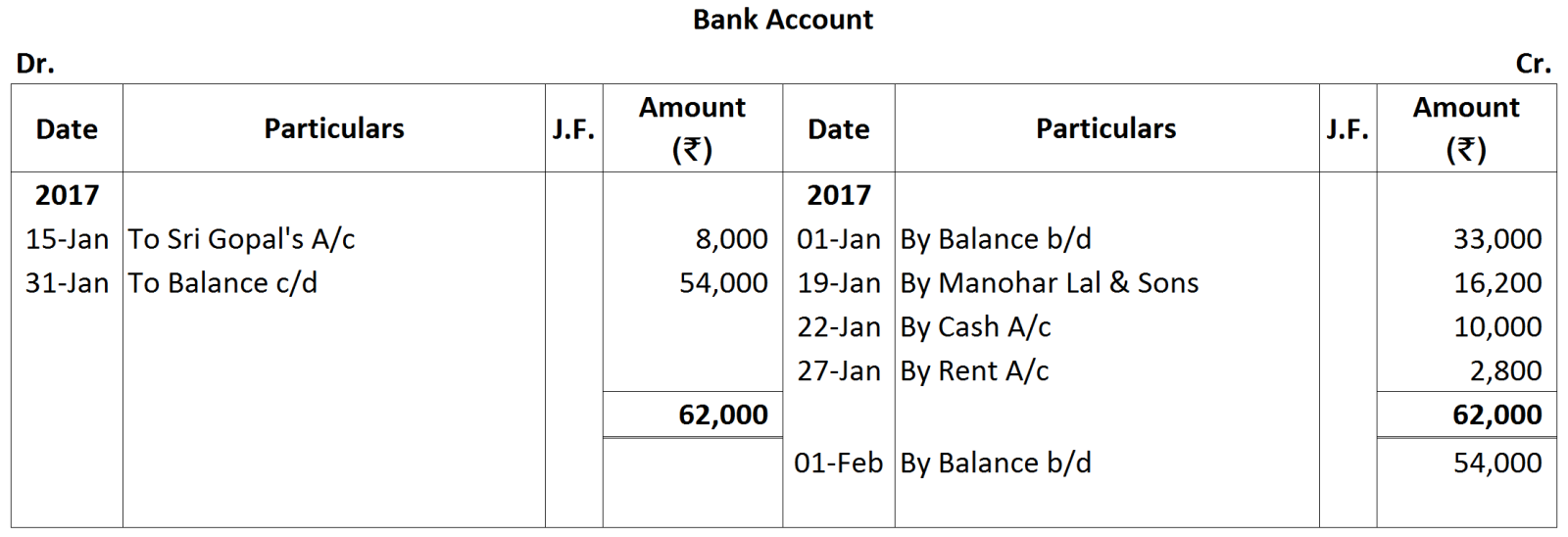
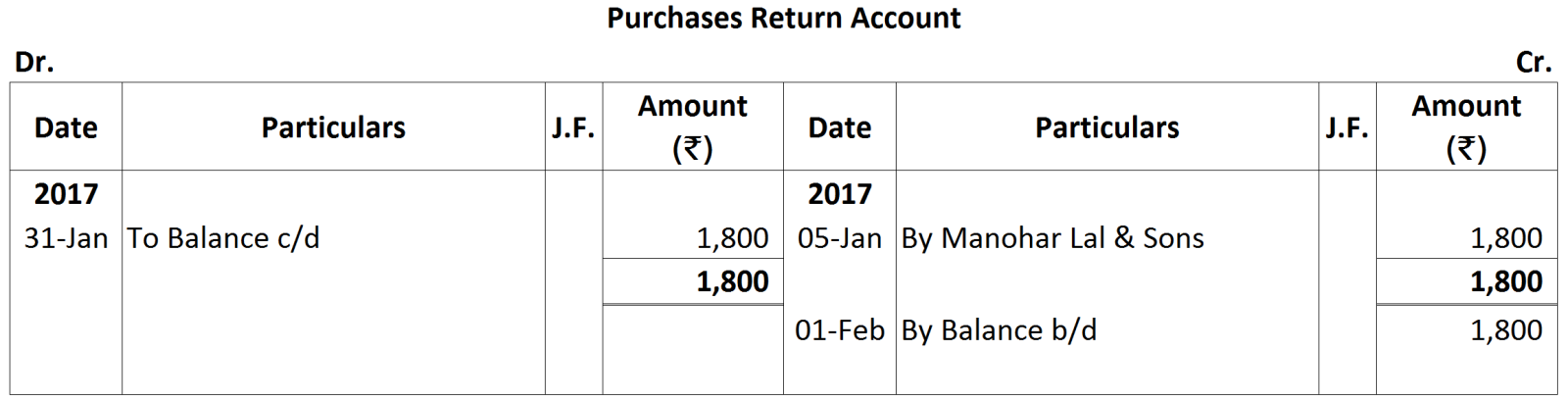
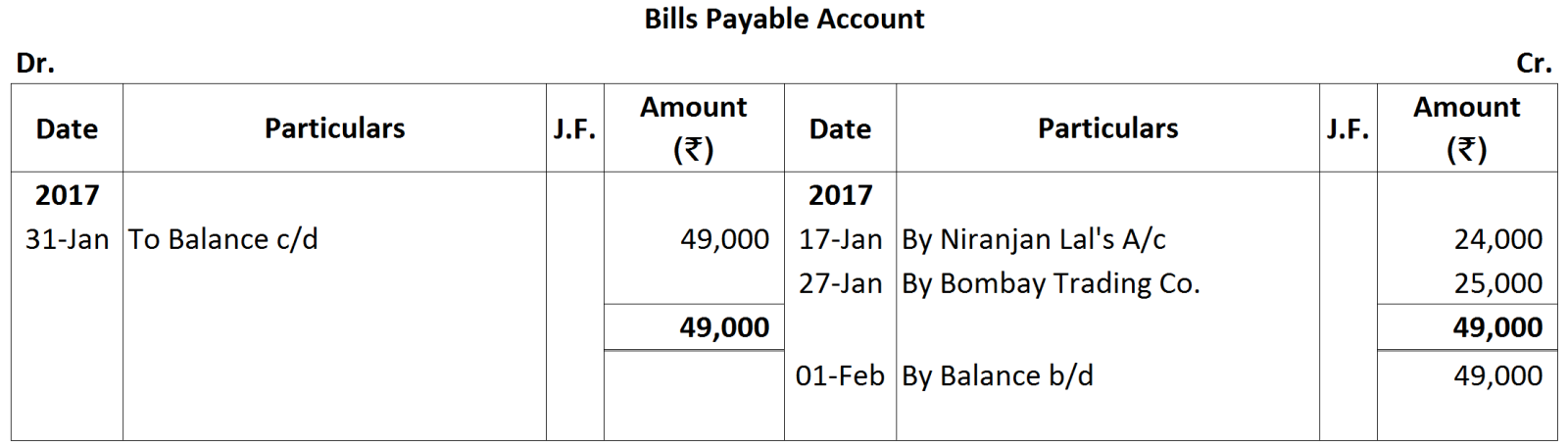
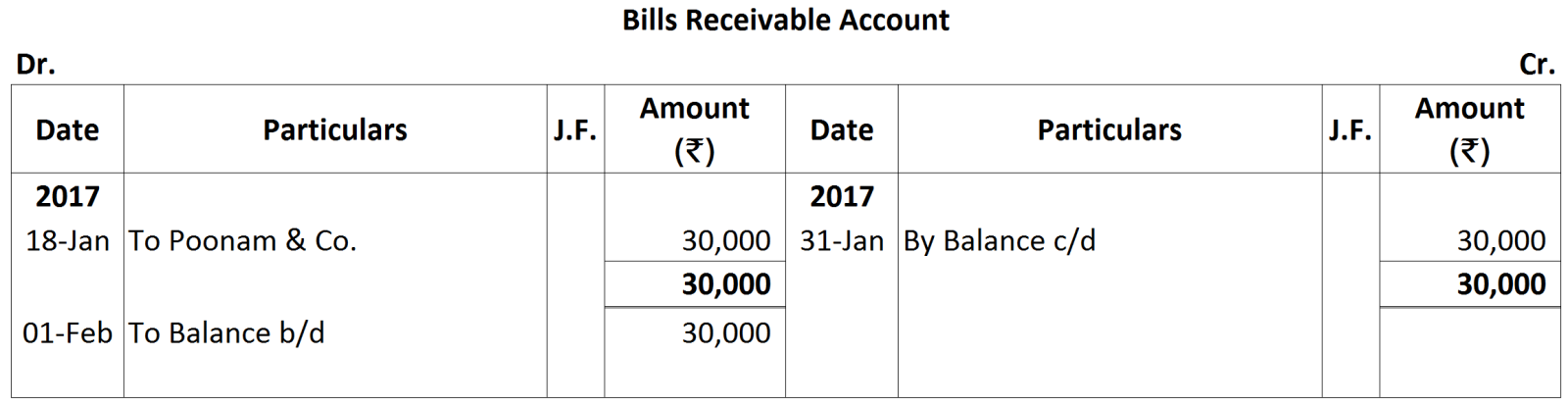
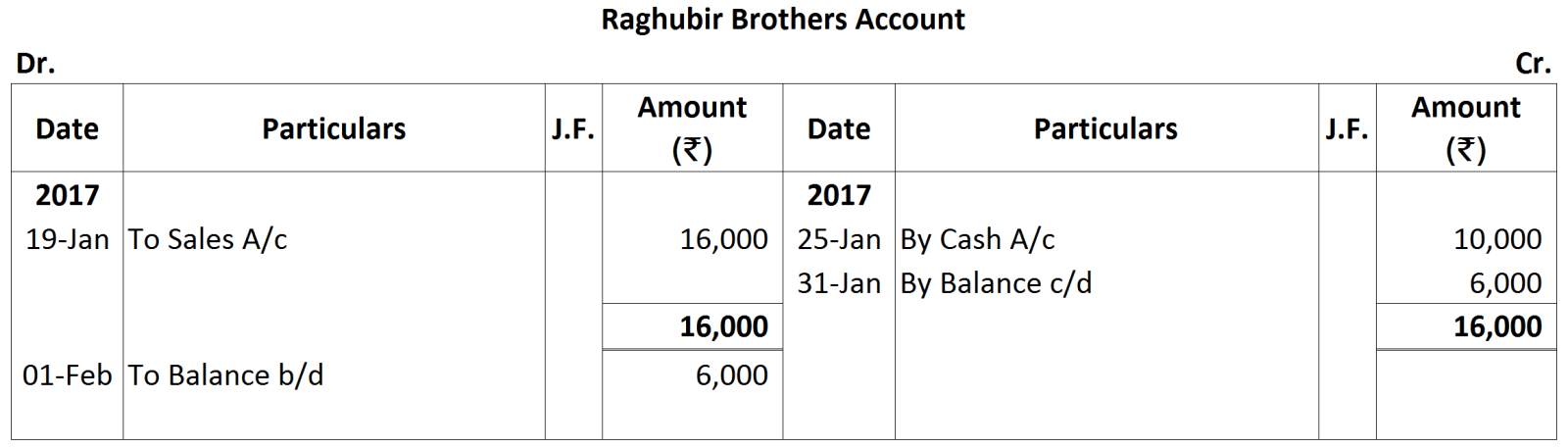
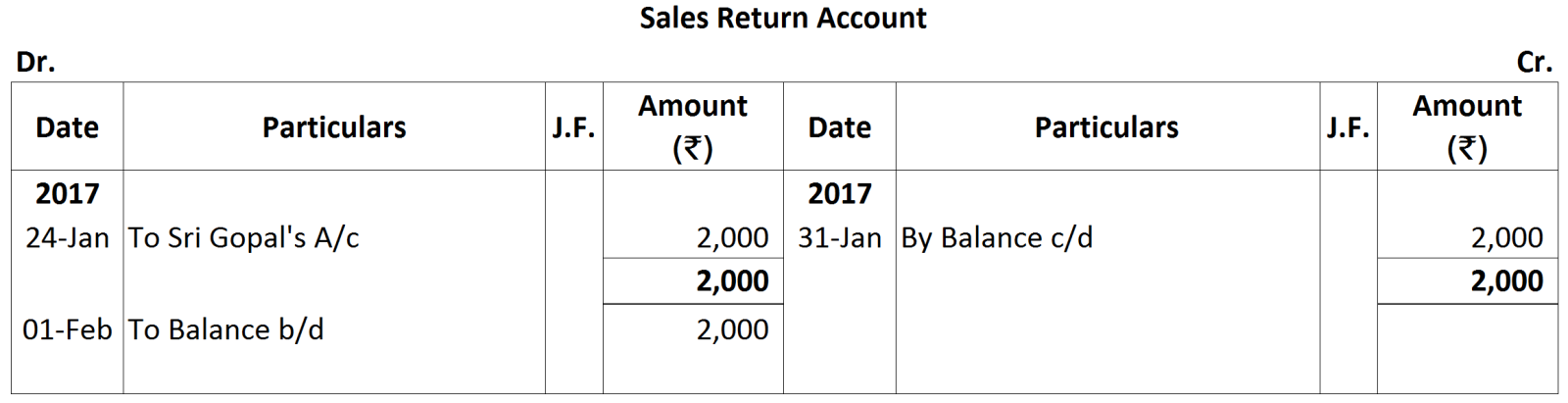
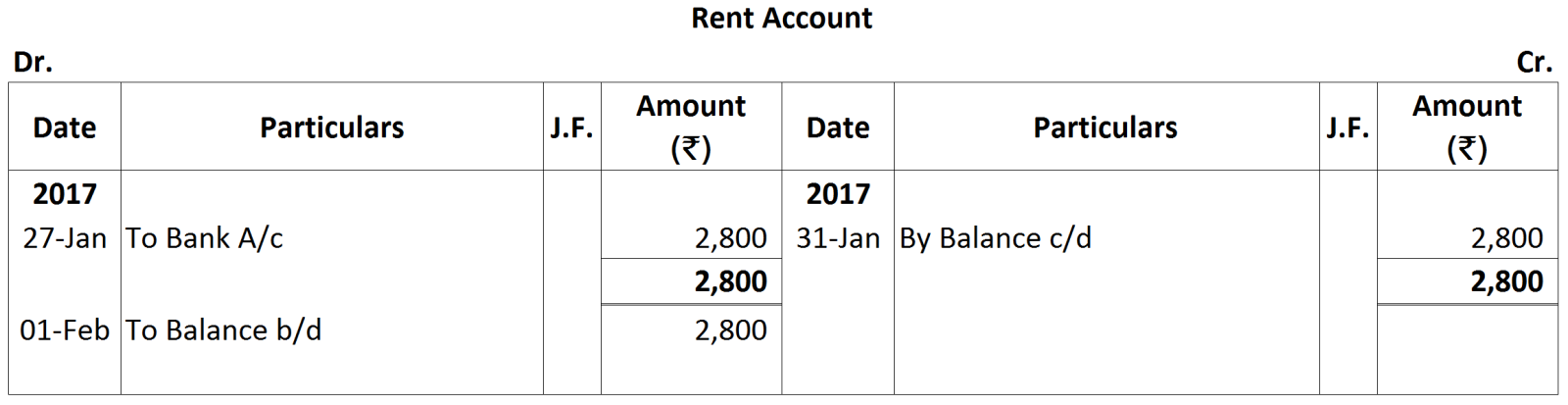
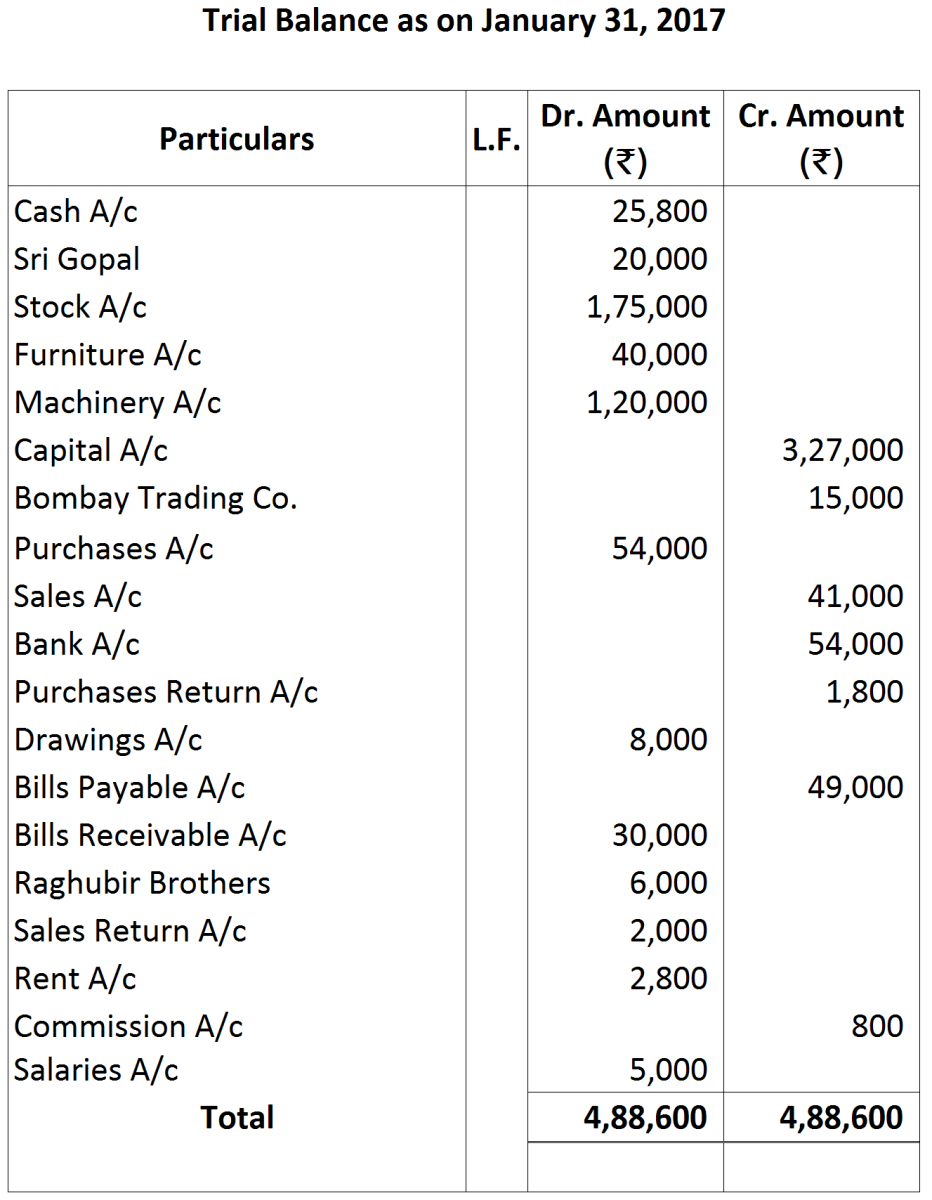
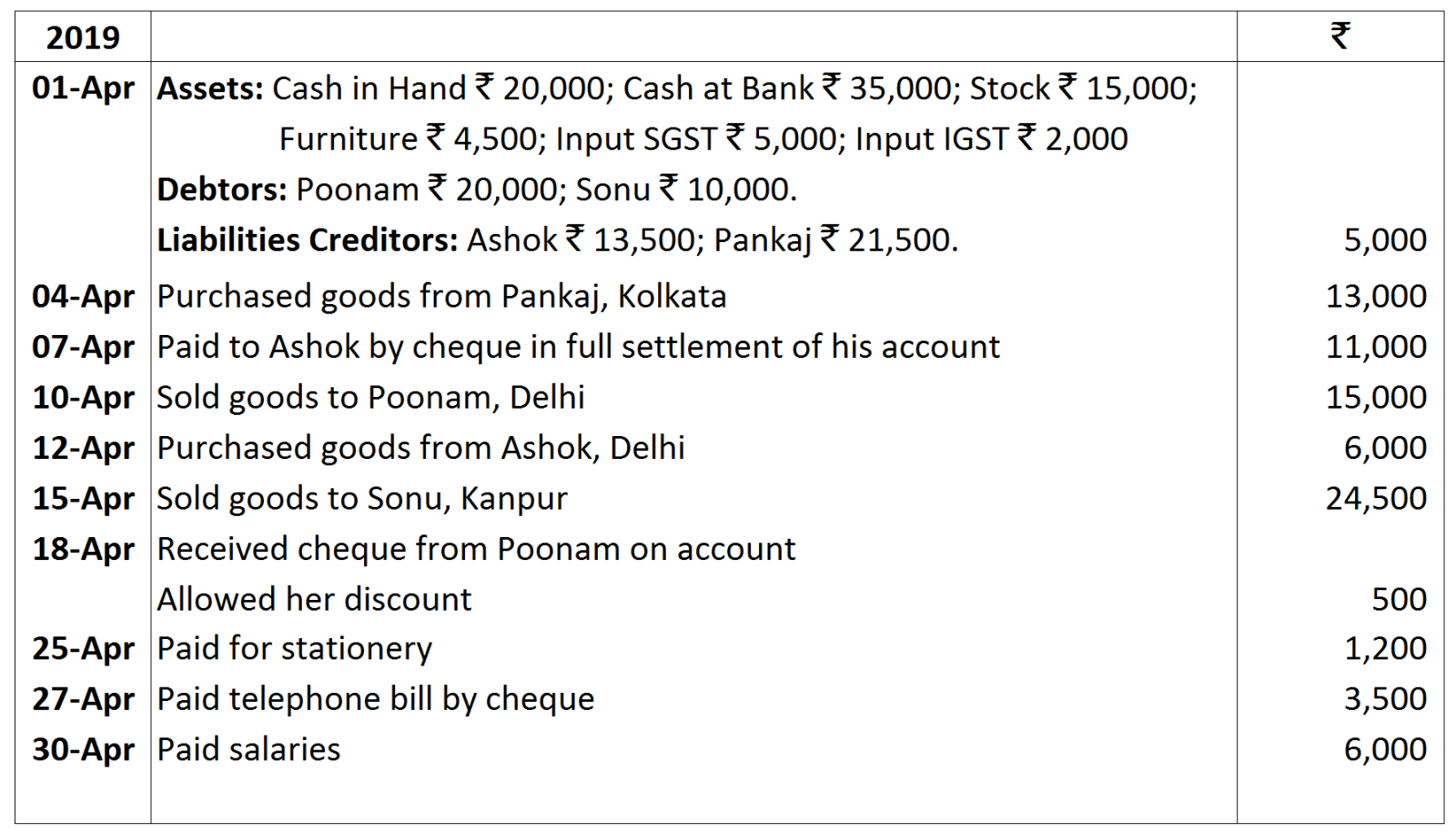
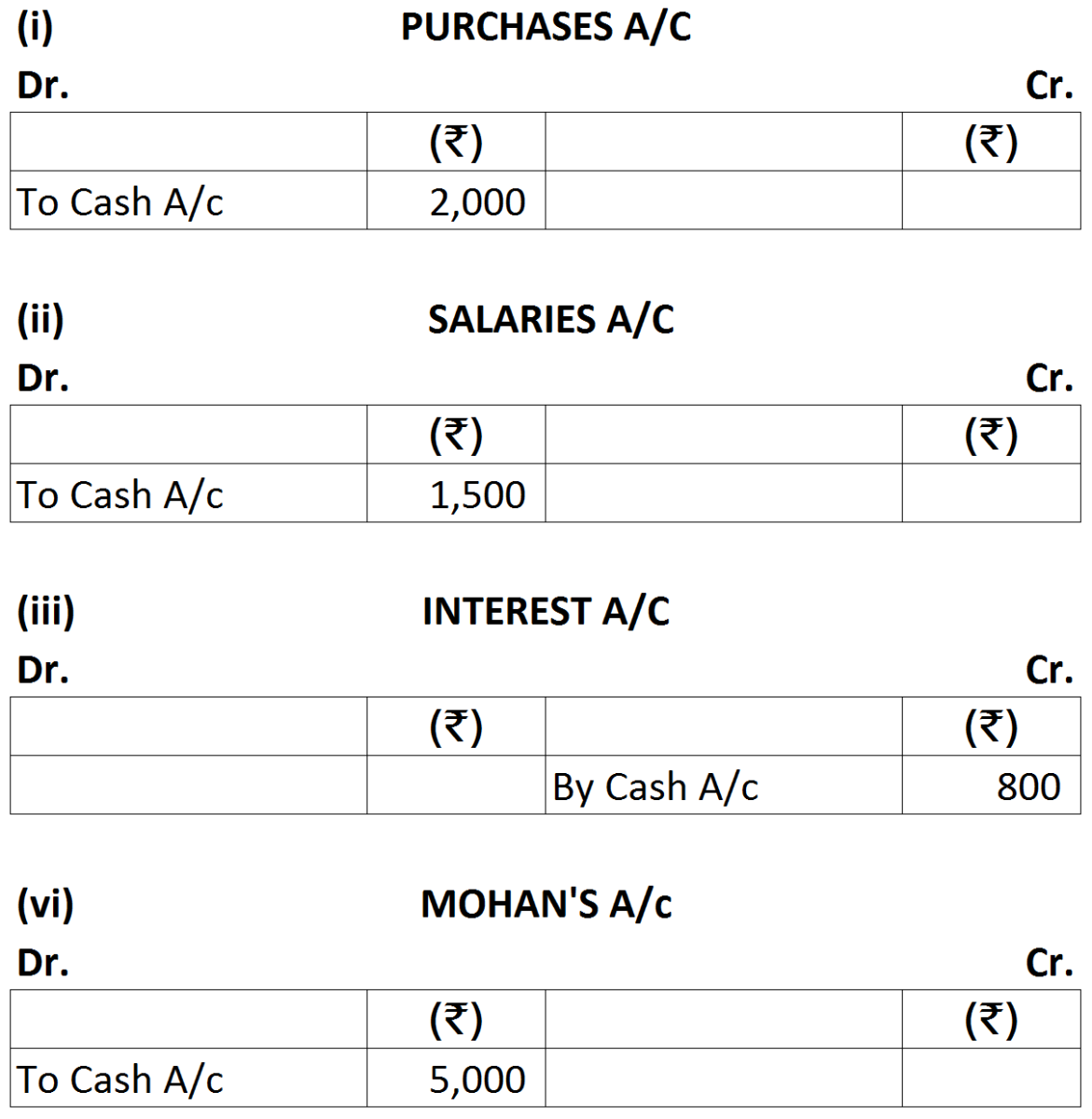
Enter the following transactions in proper Subsidiary Books, post them into Ledger Accounts, balance the accounts and prepare a Trial Balance:
2017  
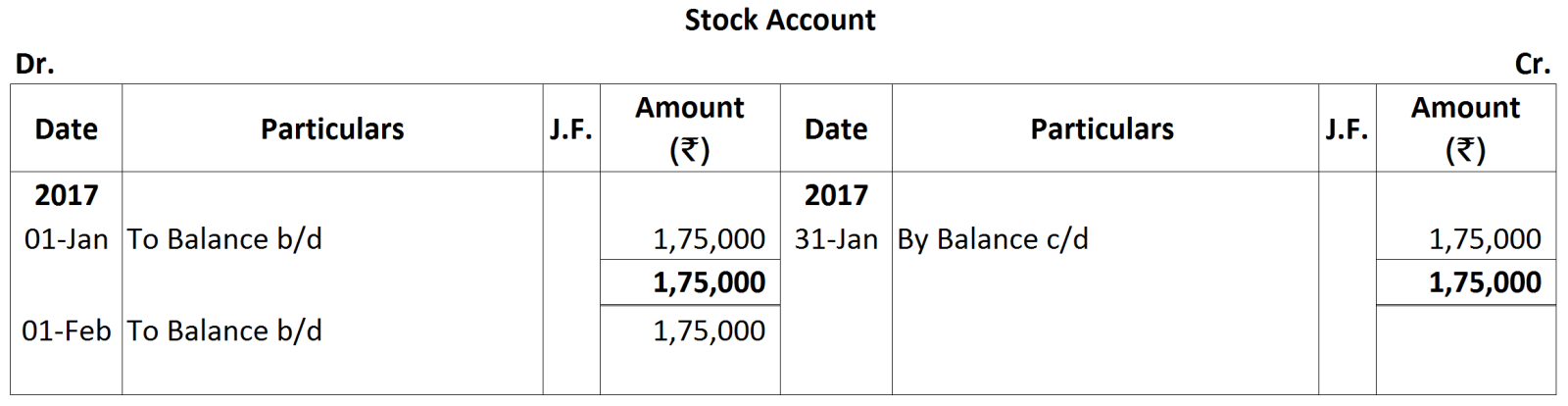
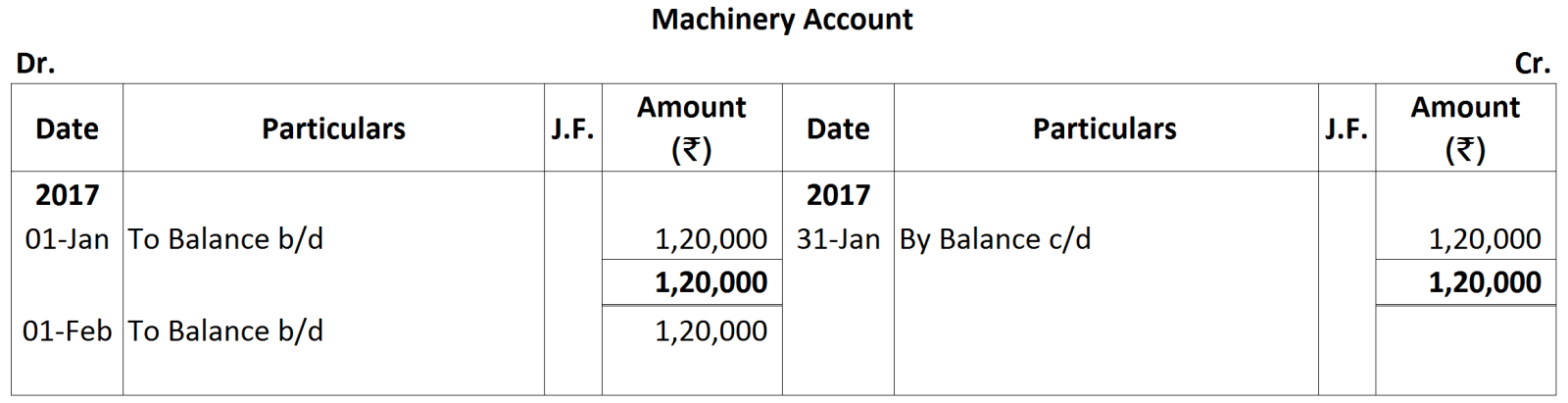
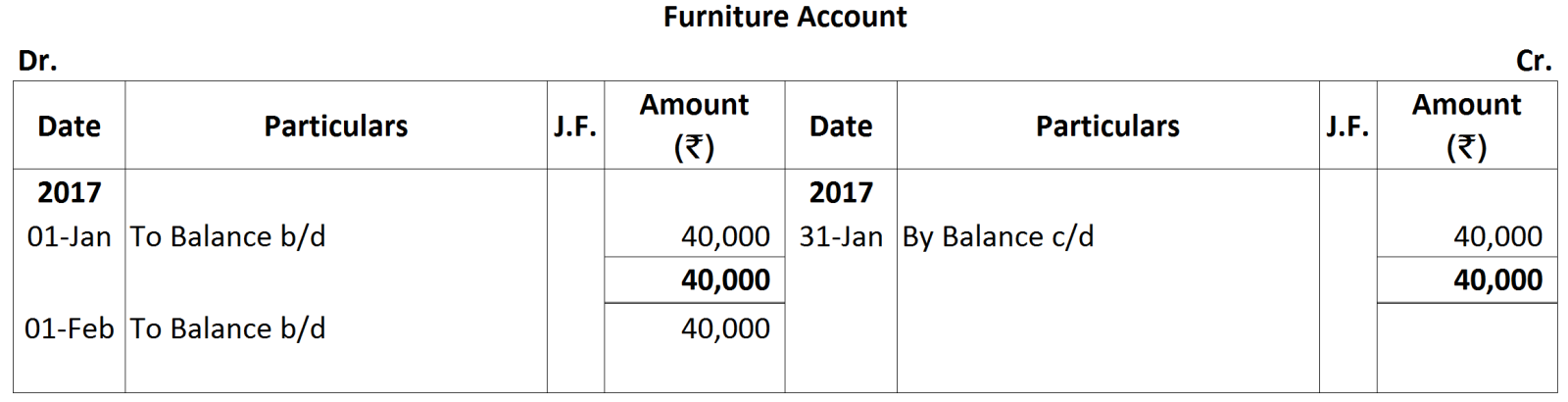
Jan. 1 Assets: Cash in hand ₹ 20,000; Debtors: Sri Gopal ₹ 15,000, Poonam & Co. ₹ 30,000; Stock ₹ 1,75,000, Machinery ₹ 1,20,000; Furniture ₹ 40,000
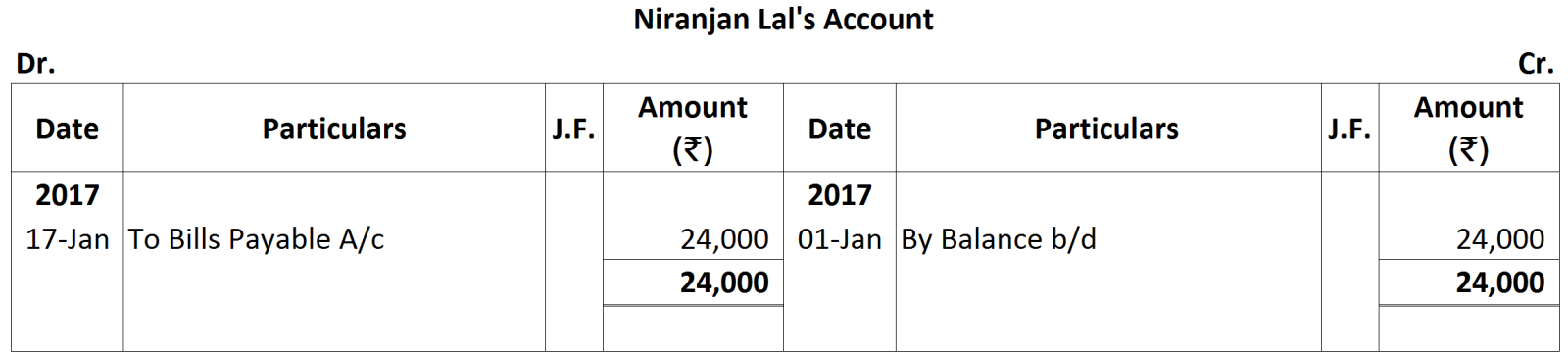
Liabilities: Bank Overdraft ₹ 33,000; Creditors: Niranjan Lal ₹ 24,000, Bombay Trading Co. ₹ 16,000
Jan. 2 Purchased from Manohar Lal & Sons goods of the list price of ₹ 20,000 at 10% trade discount
Jan. 5 Returned to Manohar Lal & sons goods of the list price of ₹ 2,000
Jan. 10 Issued a Cheque to Manohar Lal & Sons in full settlement of their account
Jan. 12 Sold to Sri Gopal, goods worth ₹ 25,000
Jan. 15 Received Cash ₹ 10,000 and a Cheque for ₹ 8,000 from Sir Gopal. The Cheque was immediately sent to bank
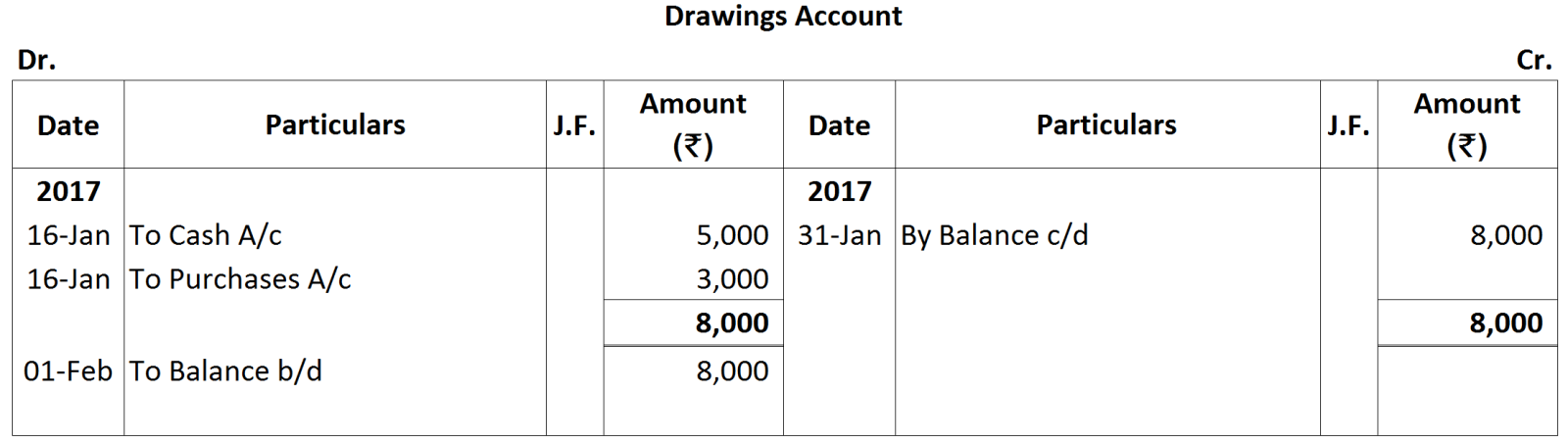
Jan. 16 Withdrew for personal use: Cash ₹ 5,000 and goods ₹ 3,000
Jan. 17 Accepted a bill for 45 days drawn by Niranjan Lal for the amount due to him
Jan. 18 Acceptance received from Poonam & Co. for the amount due from them payable after 30 days
Jan. 19 Sold to Raghubir Brothers, goods valued ₹ 16,000
Jan. 20 Cash purchases ₹ 15,000
Jan. 22 Withdrew from bank fo office use ₹ 10,000
Jan. 23 Purchased from Bombay Trading Co., goods valued ₹ 24,000
Jan. 24 Sri Gopal returned goods worth ₹ 2,000
Jan. 25 Received from Raghubir Brothers ₹ 10,000
Jan. 27 Accepted a bill for ₹ 25,000 for 1 month drawn by Bombay Trading Co
Jan. 27 Paid Rent by Cheque ₹ 2,800
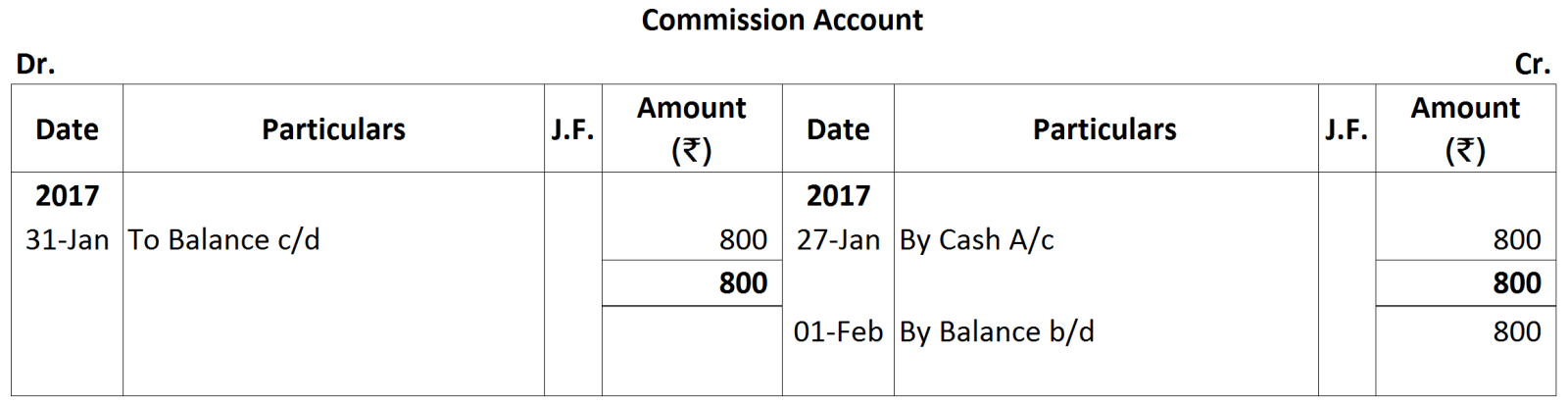
Received Commission in Cash ₹ 800
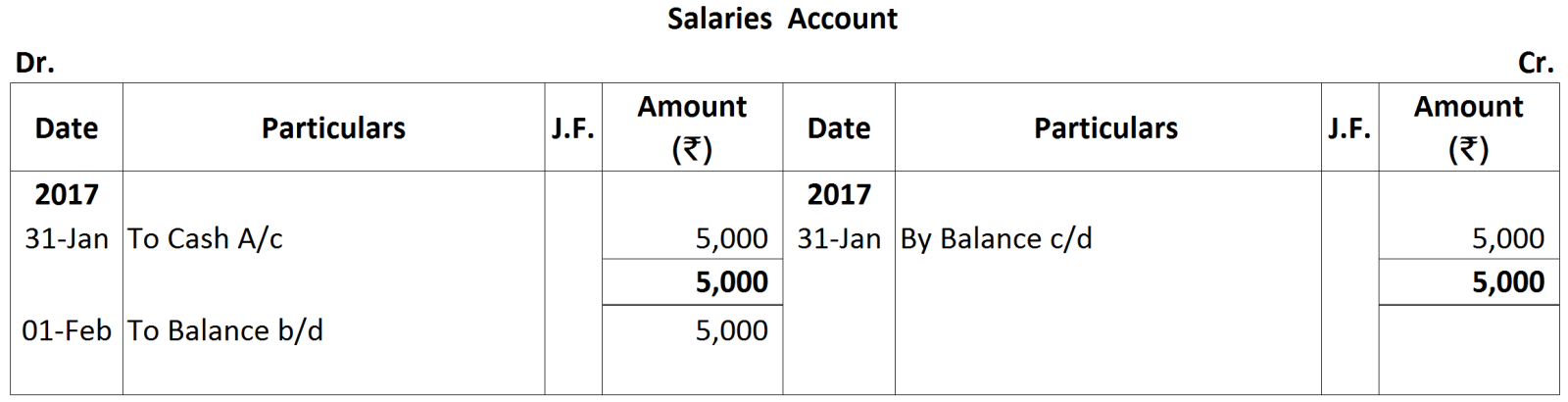
Jan. 31 Paid salaries ₹ 5,000
Answer


Note: Answer of Journal proper as per solution (₹ 6,51,600) is different from answer provided by the book (₹ 4,82,000).
View full question & answer
Question 1053 Marks
Journalise the following transactions in the Journal of M/s. Gupta Brothers (Prop. Shri R. K. Gupta), Delhi and post them to the Ledger:
2019
 
March 1
Started business with cash
2,00,000
March 2
Opened bank account with SBI
80,000
March 4
Goods purchased from Raj, Jaipur (Rajasthan)
22,000
March 5
Goods purchased for cash
30,000
March 8
Goods sold to Naman, Delhi
12,000
March 10
Cash paid to Raj
22,000
March 15
Cash received from Naman
11,700
Discount allowed
300
March 16
Paid wages
200
March 18
Furniture purchased for office use
5,000
March 20
Withdrawn from bank for personal use
4,000
March 22
Issued cheque for rent
3,000
March 23
Goods taken for household purpose. These goods were purchased from Raj
2,000
March 24
Drawn cash from bank for office use
6,000
March 26
Commission received
1,000
March 27
Bank charges
300
March 28
Cheque issued for life insurance premium of Proprietor
3,000
March 29
Paid salary
10,000
March 30
Cash sales
20,000
View full question & answer
Question 1063 Marks
What do you understand by the classification of accounts? Explain the different types of accounts.
Answer
Classification of Accounts
Personal Account
Impersonal Account
Real Account
Nominal Account
 
Personal Account: The accounts which relate to an individual, firm, company or an institution are called personal accounts. Account of Mohan, Account of Ram Chander Krishan Chander, Account of D.C.M. Limited, Account of Delhi University, Bank Account, Capital Account of the proprietor, Drawings Account of the proprietor etc. are examples of Personal Accounts.
Rule: Rule for recording a transaction in personal accounts in simple words is ‘Debit the receiver and credit the giver'. In other words, "Debit that person's account who receives something from the business and credit that person's account who gives something to the business”.
Real Account: The accounts of all those things whose value can be measured in terms of money and which are the properties of the business are termed as Real Accounts. Such as, Cash Account, Furniture Account, Machinery Account Building Account, Goodwill Account etc.
Rule: Rule for recording a transaction in real account is ‘Debit what comes in and credit what goes out'.
According to this rule, whenever any property comes into the business, it is debited and when it goes outside the business, it is credited.
Nominal Account: These accounts include the accounts of all expenses and incomes. The examples of nominal accounts relating to expenses are Salaries paid, Rent paid, Discount allowed, Bad Debts etc.
The examples of nominal accounts relating to incomes are Commission received, Interest received, Discount received etc.
Rule: Rule for recording in nominal accounts is, “Debit the expenses and losses and Credit incomes and gains”.
Rules of Debit and Credit (Treditional Clsssification) at a Glance:
S.No Types of Account Account to be Debited Account to be Credited
1 Personal Account Receiver Giver
2 Real Account What comes in What goes out
3 Nominal Account Expense and Loss Income and Gain
View full question & answer
Question 1073 Marks
Enter the following transactions in proper Subsidiary Books and post them into Ledger:
2017
 
March 2
Purchased from Navrang Traders for ₹ 8,300
March 3
Sold goods to Rohan for ₹ 3,200
March 5
Bought of Ruchi Traders for ₹ 12,100
March 8
Rohan returns the goods for ₹ 600
March 10 Purchased goods from Jaipur Stores of the list price of ₹ 15,400 less 5% Trade Discount
March 12 Sold goods to Arun Traders for ₹ 18,000 less 15% Trade Discount
March 12 Bought of Amit Traders for ₹ 10,000
March 16 Purchased Machinery from Kirloskar Ltd. ₹ 20,000
March 18 Returned goods to Jaipur Stores for ₹ 800 less 5% Trade Discount
March 19 Arun Traders returned goods for ₹ 3,000, less 15% Trade Discount
March 20 Sales to Kalpna & Co. for ₹ 14,700
March 22 Purchased goods from Navrang Traders ₹ 25,000
March 25 Returns outward to Navrang Traders for ₹ 1,200
March 26 Sales to Rupa Traders for ₹ 10,000 less 10% Trade Discount
March 29 Returns inward from Kalpana & Co. for ₹ 2,000
View full question & answer
Question 1083 Marks
Suresh, Kanpur commenced business on 1st January, 2019 introducing capital in cash ₹ 1,00,000. His other transactions during the month were as follows:
2019
 
Jan 1
Started business with cash
1,00,000
Jan 2
Bought goods for cash
20,000
Jan 3
Sold goods for cash
7,000
Jan 15
Sold goods to Shravan, Delhi Bought goods on
6,000
Jan 18
Credit from Anurag, Kanpur
50,000
Jan 19
Goods returned to Anurag
5,000
Jan 20
Sold goods for cash
30,000
Jan 22
Paid electricity bill
1,000
Jan 28
Paid for telephone bill
500
Jan 29
Paid rent
800
Jan 31
Paid wages
3,000
Enter the above transactions in his books of account.
View full question & answer
Question 1093 Marks
Bobby opened a consulting firm and completed these transactions during November, 2017:
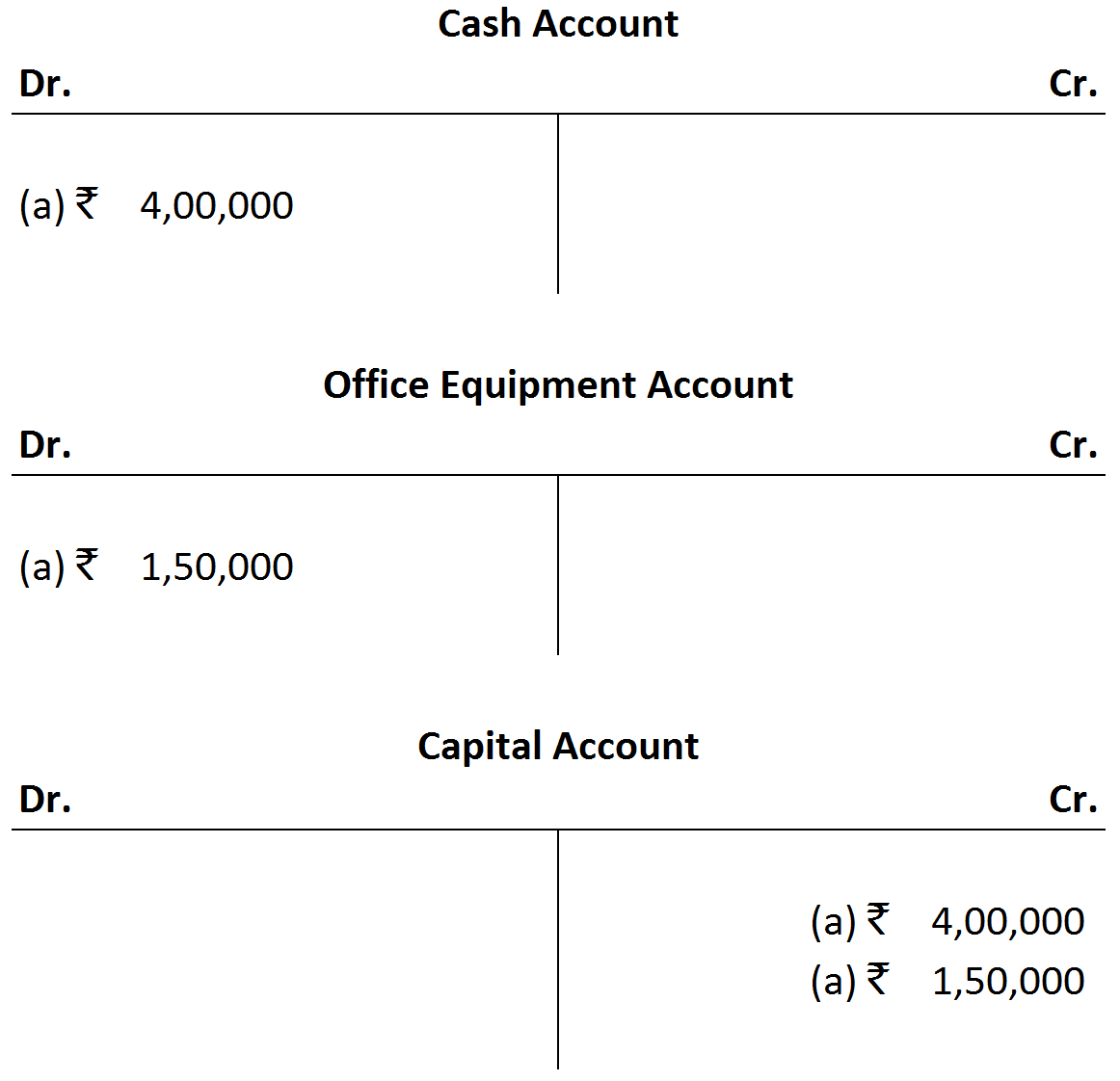
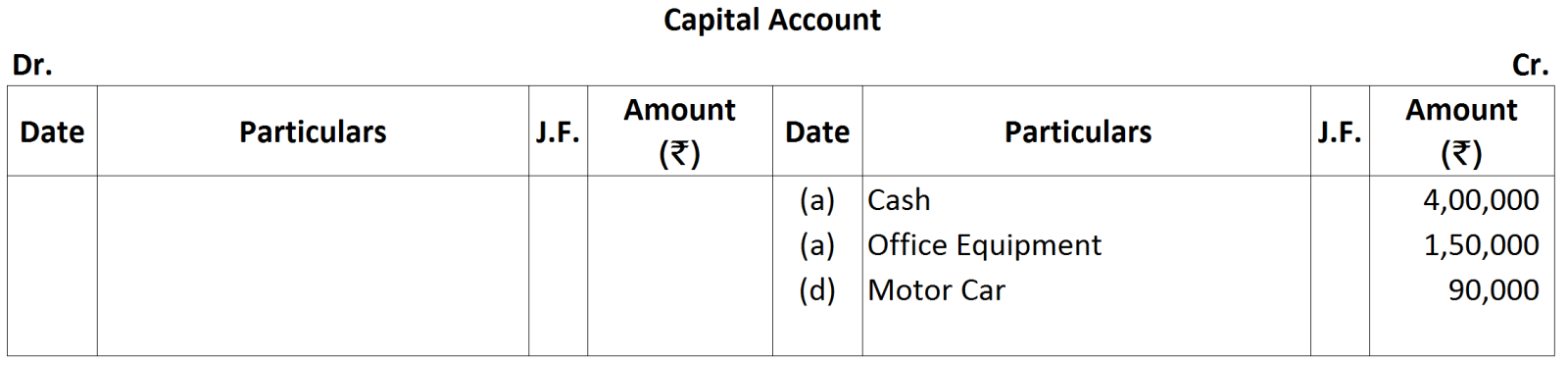
  1. Invested ₹ 4,00,000 cash and office equipment with ₹ 1,50,000 in a business called Bobbie Consulting.
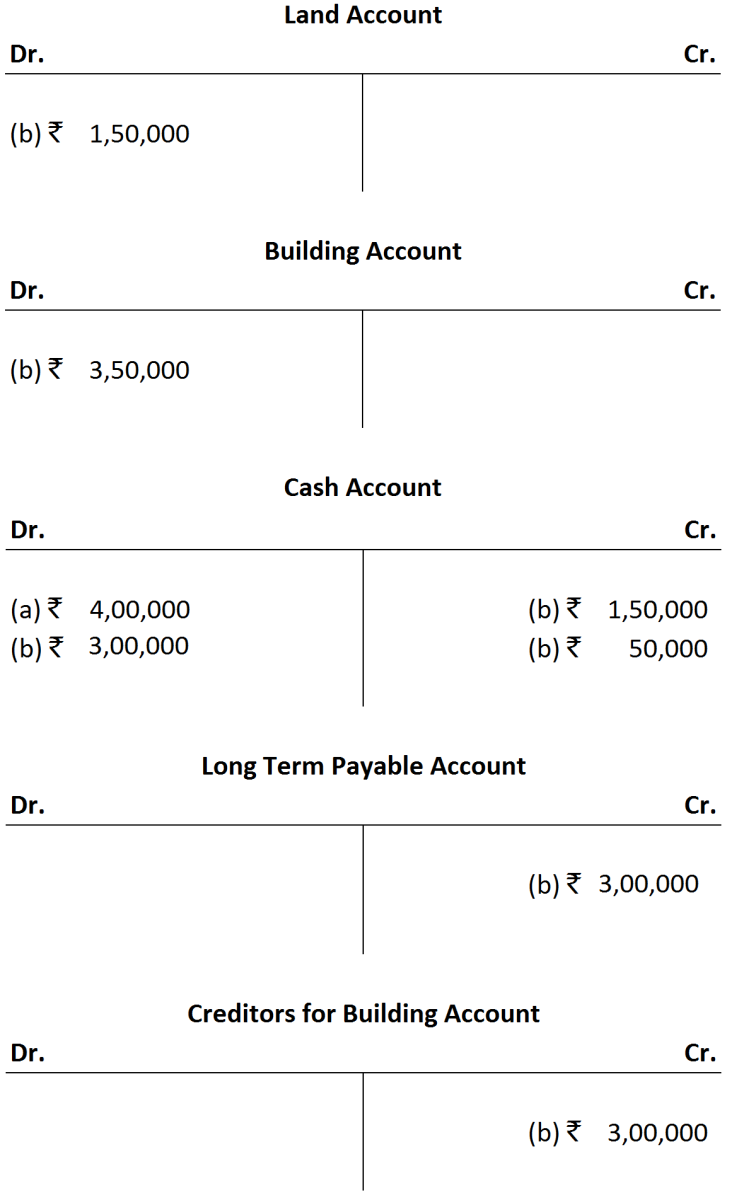
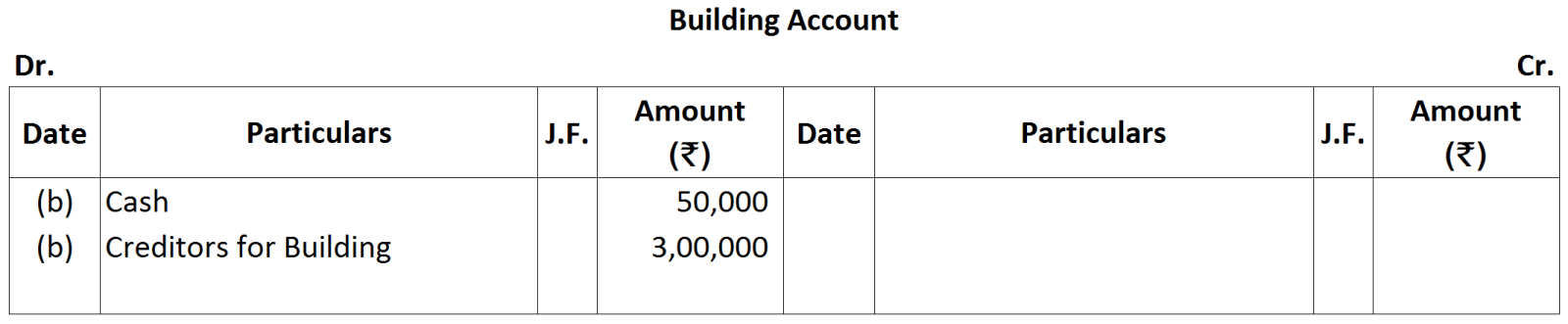
  2. Purchased land and a small office building. The land was worth ₹ 1,50,000 and the building worth ₹ 3,50,000. The purchase price was price was paid with ₹ 2,00,000 cash and a long term note payable for ₹ 3,00,000.
  3. Purchased office supplies on credit for ₹ 12,000.
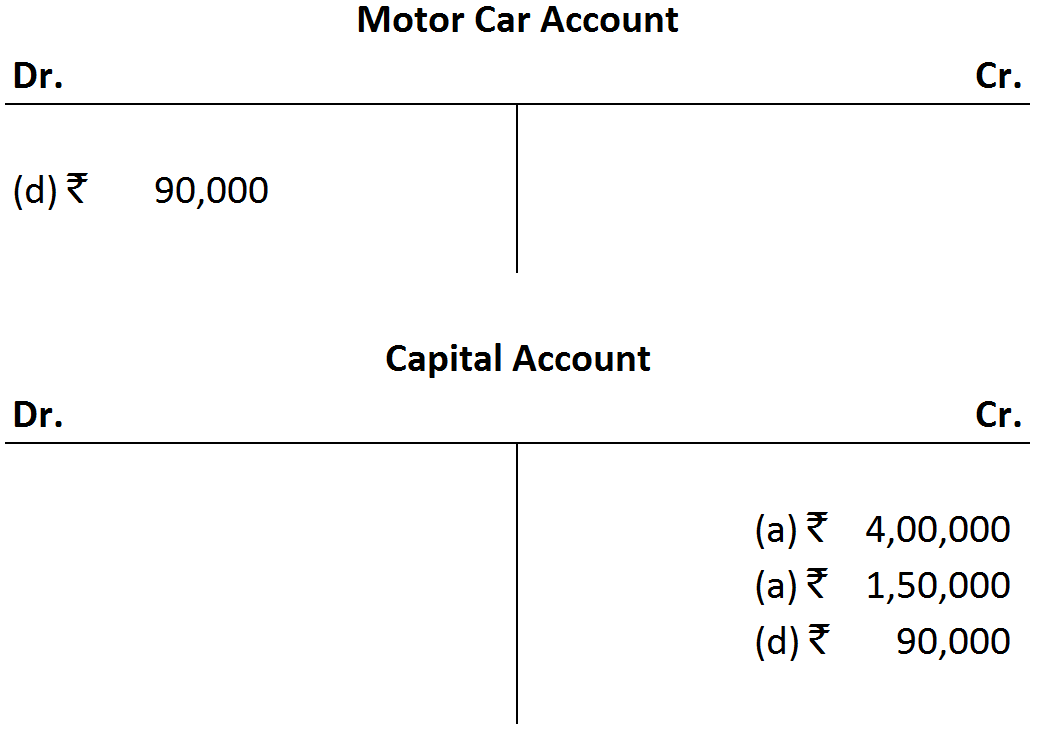
  4. Bobbie transferred title of motor car to the business. The motor car was worth ₹ 90,000.
  5. Purchased for ₹ 30,000 additional office equipment on credit.
  6. Paid ₹ 75,00 salary to the office manager.
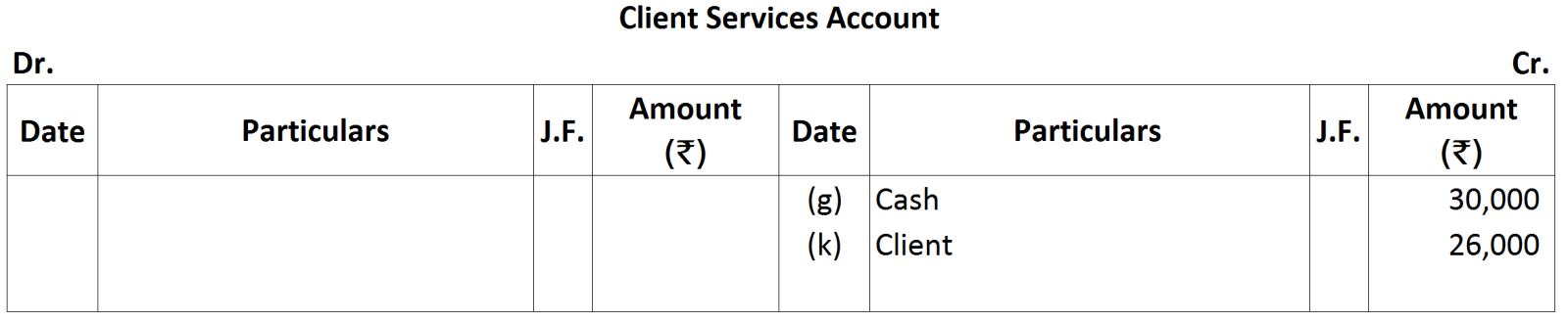
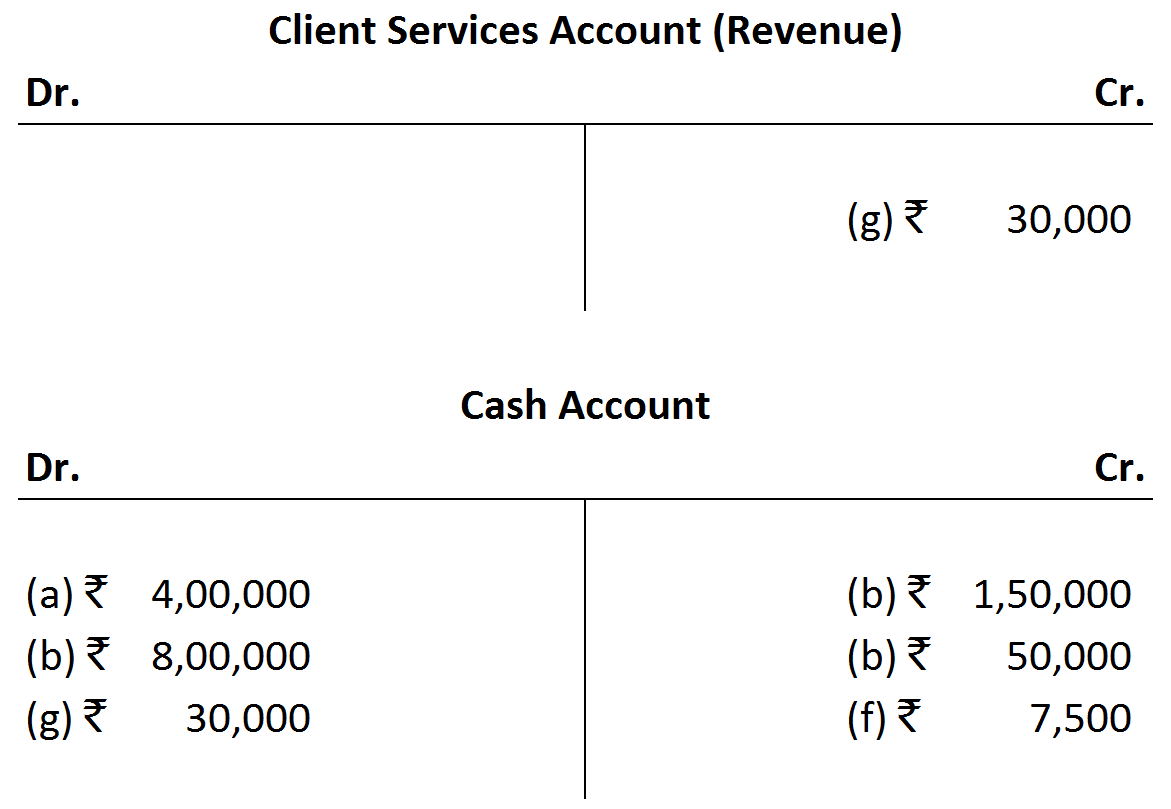
  7. Provided services to a client and collected ₹ 30,000
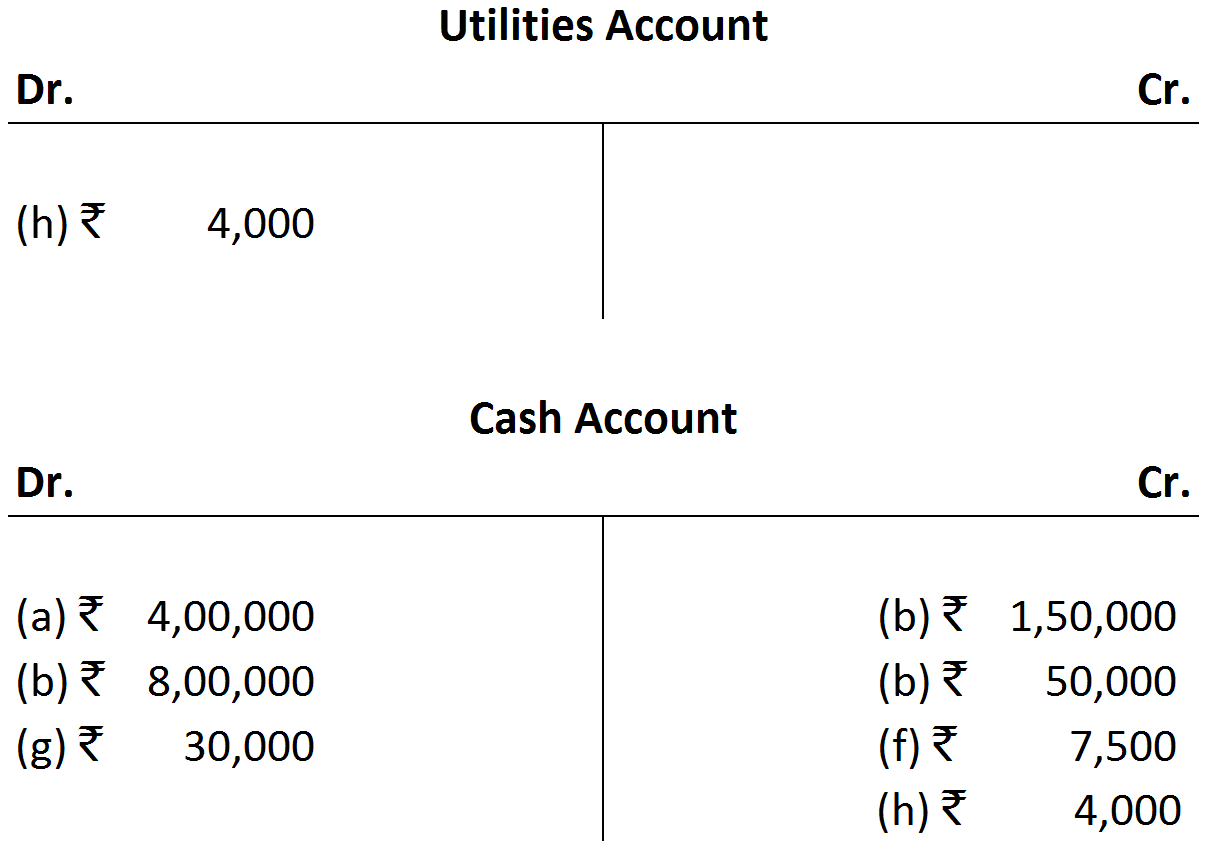
  8. Paid ₹ 4,000 for the month’s utilities.
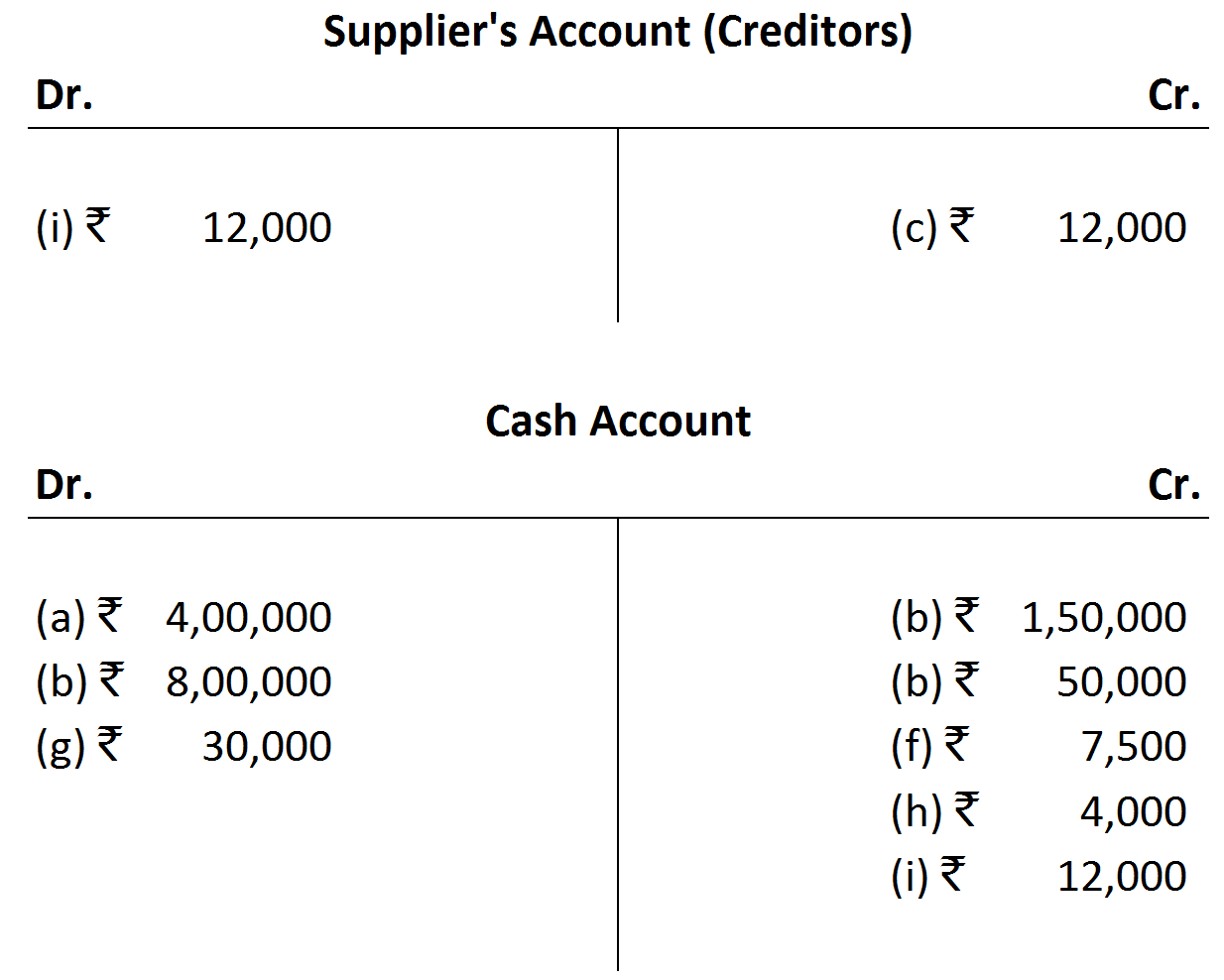
  9. Paid supplier created in transaction c.
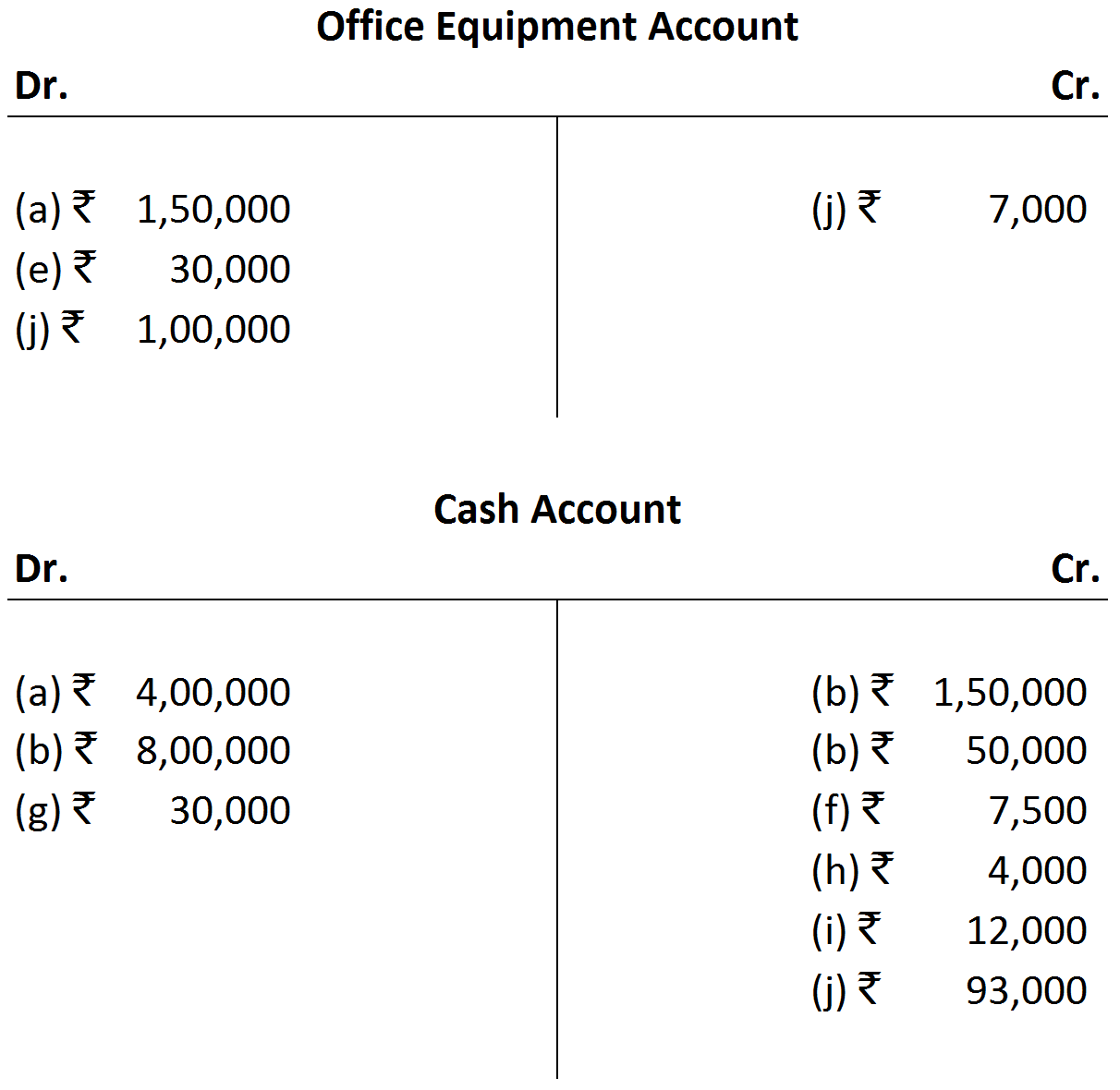
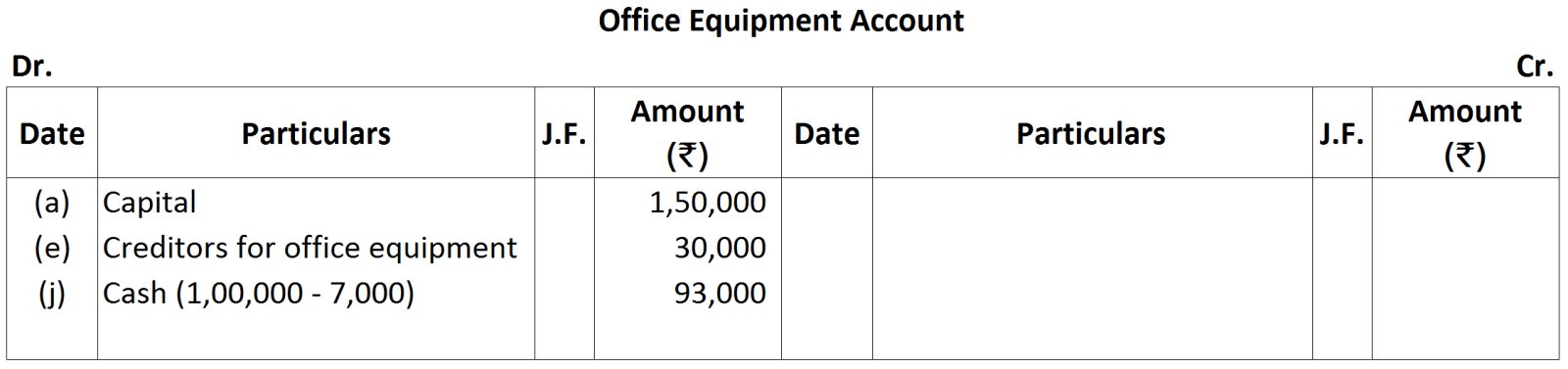
  10. Purchase new office equipment by paying ₹ 93,000 cash and trading in old equipment with a recorded cost of ₹ 7,000.
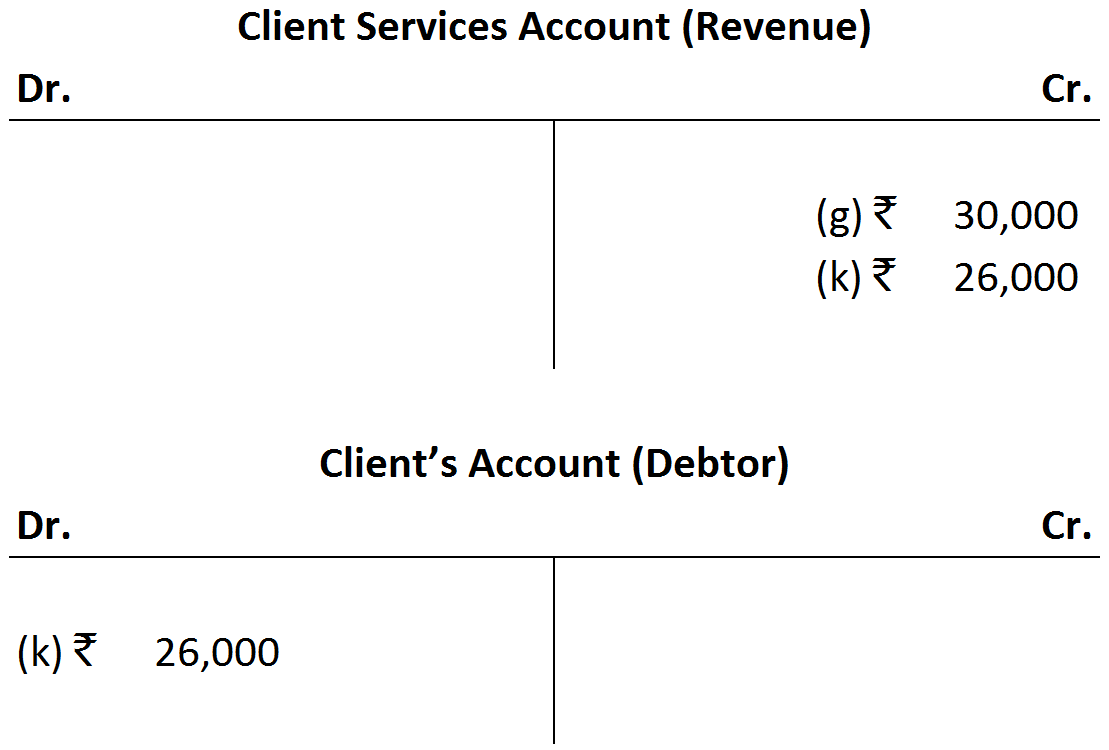
  11. Completed services of a client for ₹ 26,000. This amount is to be paid within 30 days.
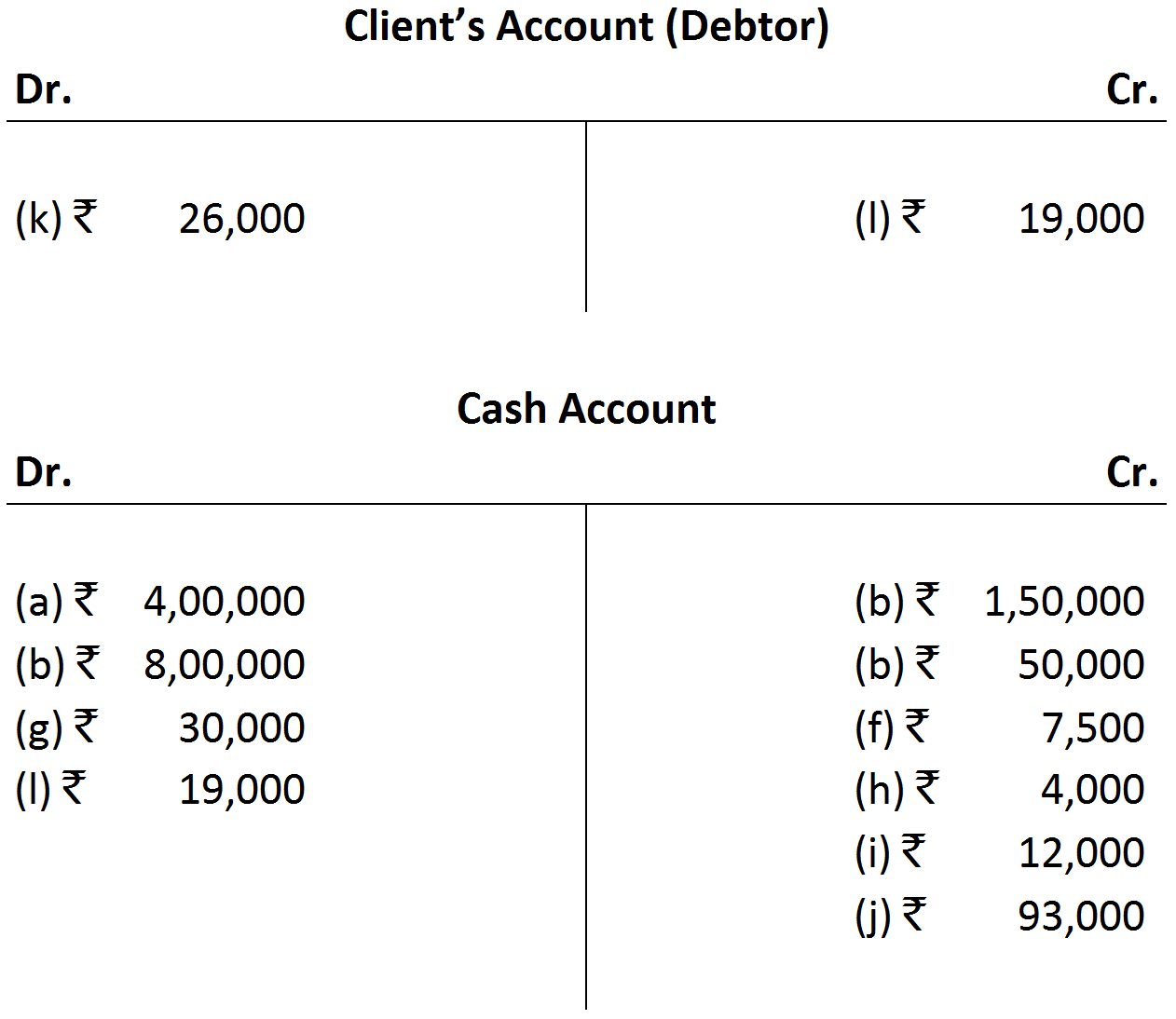
  12. Received ₹ 19,000 payment from the client created in transaction k.
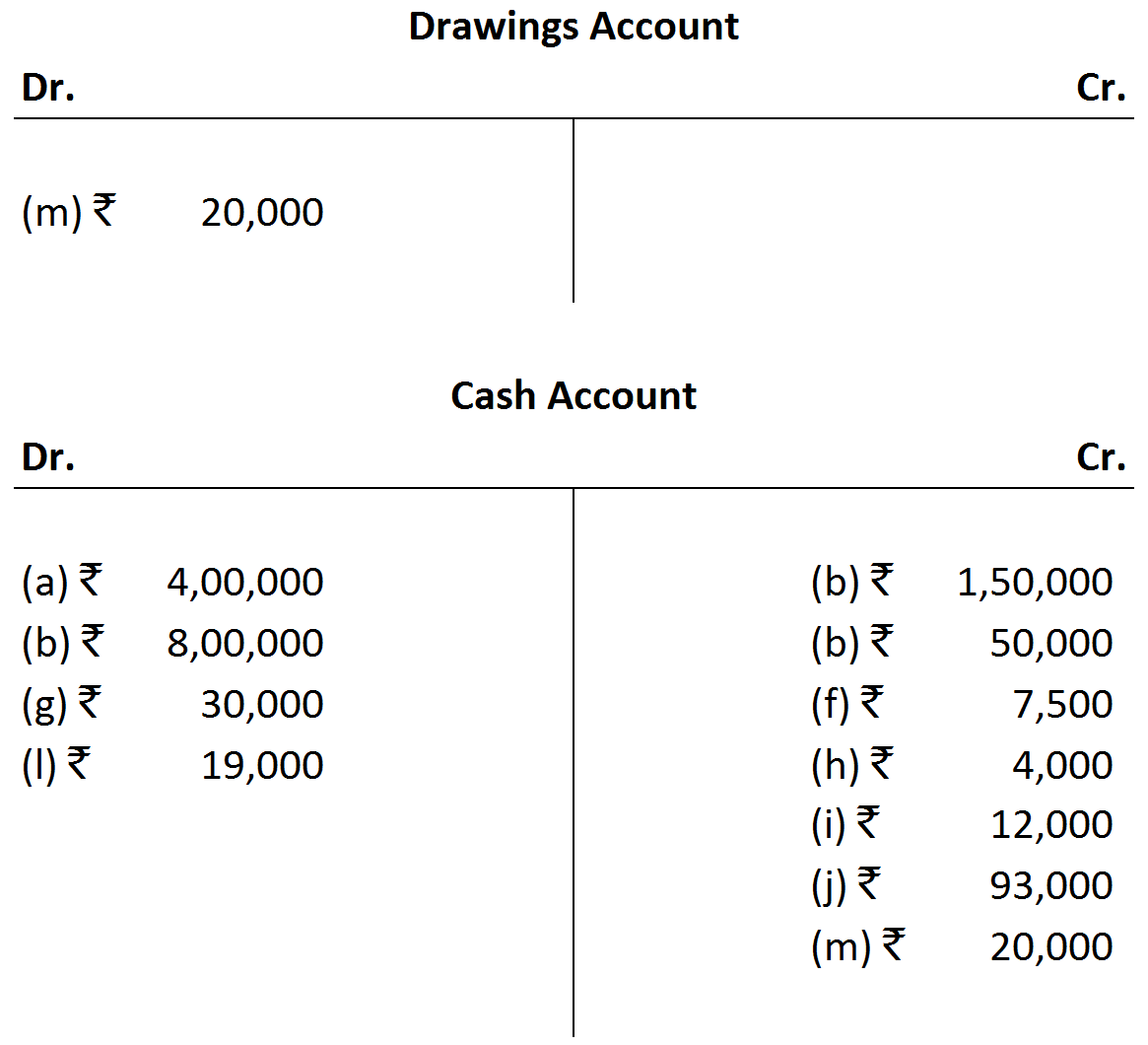
  13. Bobby withdrew ₹ 20,000 from the business.
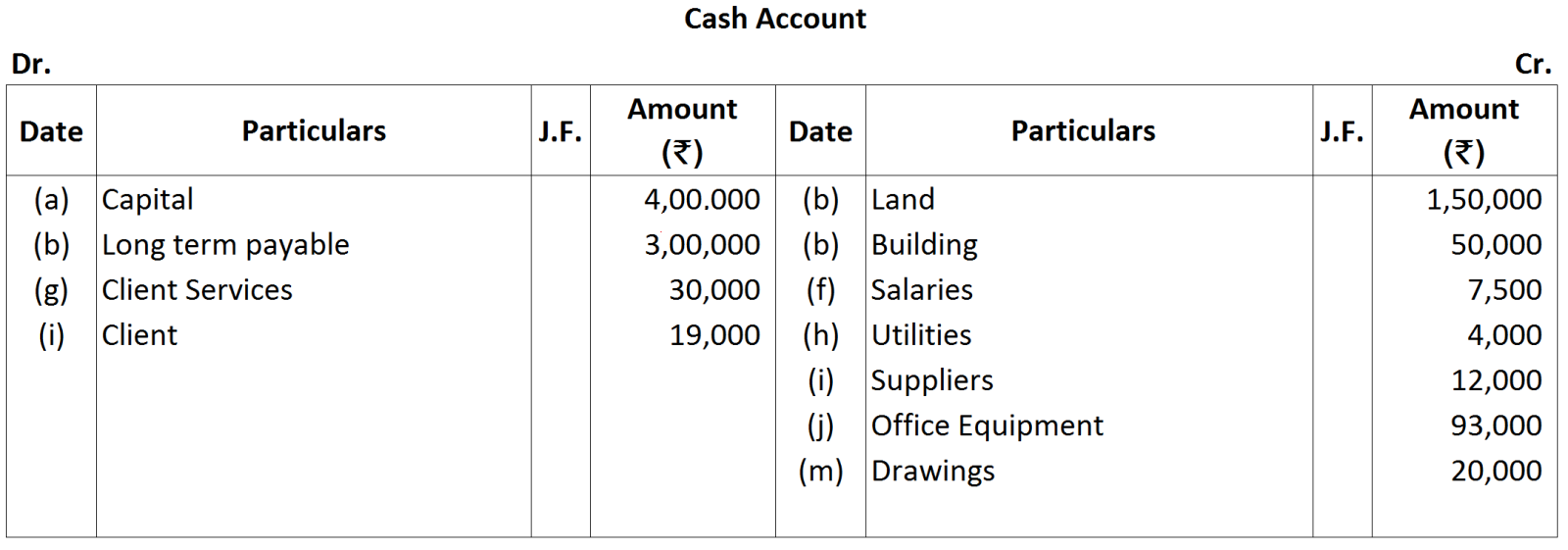
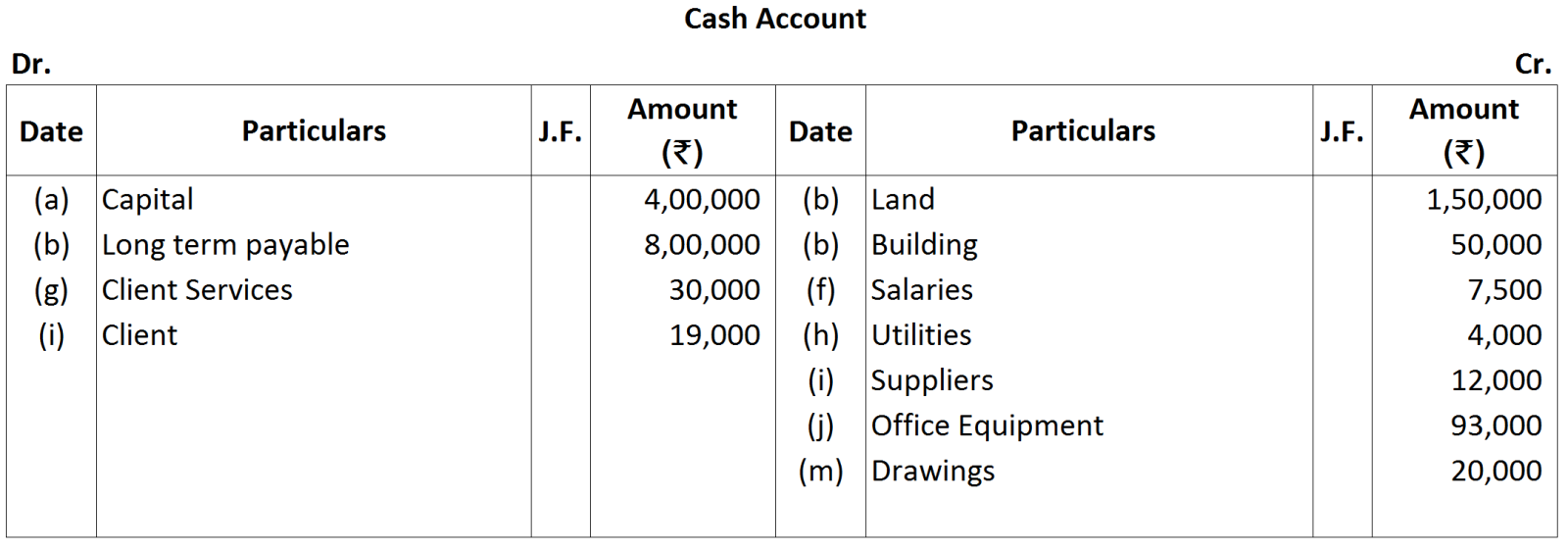
Analyse the above stated transactions and open the following T-accounts: Cash, client, office supplies, motor car, building, land, long term payables, capital, withdrawals, salary, expense and utilities expense.
Answer
  1. The transaction (a) increases assets by ₹ 5,50,000 (cash ₹ 4,00,000 and office equipment ₹ 1,5,000) it will be debited and on the other hand it will increase the capital by ₹ 5,50,000, so it will be credited in capital account.
  1. Purchase of land and small office building are assets. On one hand, the purchase of these items will increase their individual accounts and this will increase the total amount of the assets in the business; so, both the accounts will be debited. On the other hand, payment in cash on the purchase of these assets will decrease the cash balance, so cash account will be credited to the extent of amount paid. After payment for building in cash, the balance of building account will be transferred to creditors for building account. This will increase the amount of the creditors, which in turn will increase the total liabilities of the business. Long term payables are regarded as loan to the business that will increase both cash balance (due to intake of loan) as well as liabilities of the business.
  1. Here ‘office supplies’ is an expense. So, according to the golden rule, ‘All expenses are debited’, it will be debited on one hand while on the other hand, office supplies has been purchased on credit, so it will increase the liability, on account of which, supplier’s account will be credited.
  1. Amount invested (motor car) by the proprietor in the business would increase both the capital and assets.
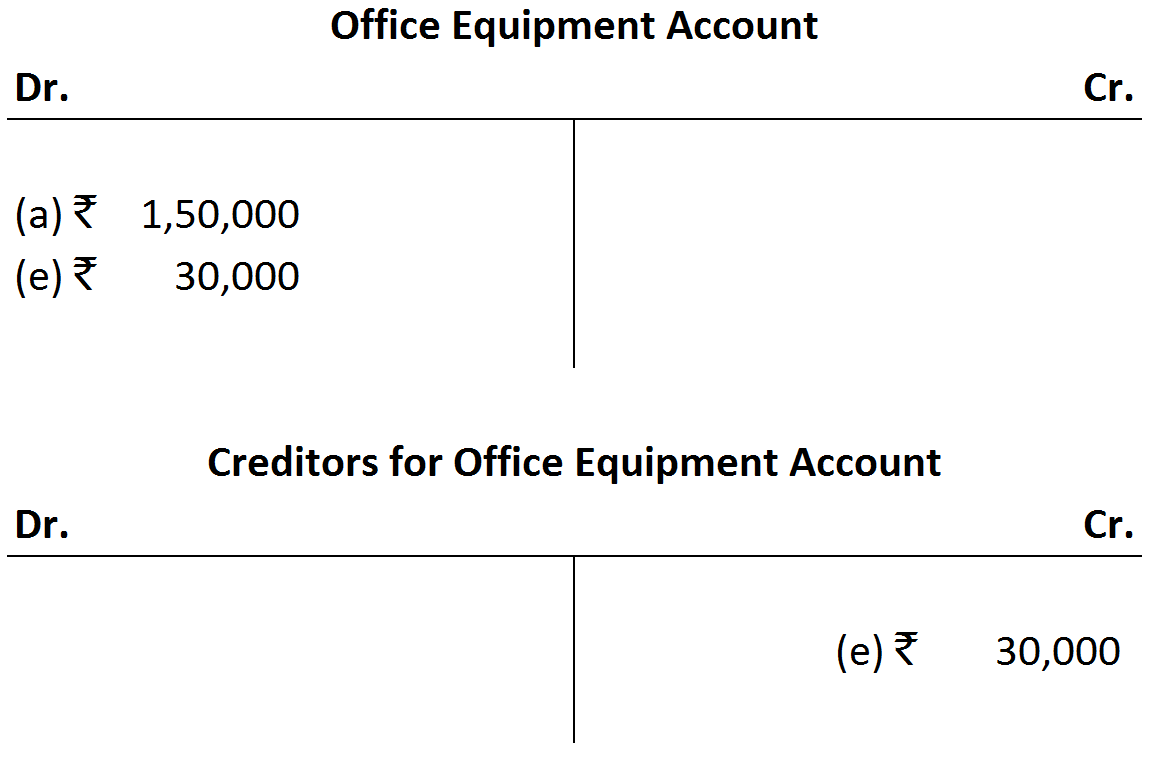
  1. Purchase of additional equipment increases the assets; hence, offices equipment account will be debited.
Further as the office equipment was purchased on credit, it increases the amount of the creditors for office equipment and the creditors account will be credited.
  1. Salary is an expense and as all the expenses are debited, so the payment of salary to the manager will be debited to the salary account. And on the other hand the payment of the salary in cash decreases the cash balance (Assets) so the cash account would be credited (as decrease in assets is credited).
  1. Amount received or receivable from services rendered to the client is revenue for the business. All revenues are to be credited so client service account will be credited.
On the other hand, cash received in exchange of services would increase the cash balance. It would be debited to the cash account.
  1. The ‘utilities’ has been treated as a revenue expense. All expenses are to be debited. Amount paid for utilities would be debited to Utilities account.
Utilities have been paid in cash so the cash account will be credited (as this decreases assets).
  1. Payment to the supplier (creditors) will be debited. It results in the decrease in liabilities. Further as the payment has been made in cash, so it results in decrease in the cash balance (assets) and hence the cash account will be credited.
  1. Purchase of the equipments will be debited in the Equipment Account (as there is increase in the assets). Also as the equipments of worth ₹ 1,00,000 and ₹ 93,000 have been purchased for cash and old equipments of worth ₹ 7,000 have been exchanged so the purchase of the equipments will be debited in the Office Equipment account and equipment of ₹ 7,000 will be credited in the same account.
  1. Receipt from ‘Client services’ is revenue. All revenues are credited. The client services account will be credited and client is considered as debtors, so the client account will be debited.
  1. The client has been considered as Debtors. The amount received from the client will lead to the decrease in the debtors balance and the client account will be credited. Receipts from the client will increase the cash balance (asset), and hence the cash account will be debited.
  1. The amount withdrawn by the proprietor is considered as ‘drawings’. According to the Business Entity Concept, drawings decrease the owner’s capital,) Thus the drawings account will be debited (as decrease in capital is debited). On the other hand as drawings have been made in cash, decrease in cash means cash account will be credited with the amount of drawings.


View full question & answer
Question 1103 Marks
Shri S. K. Gupta, Chandigarh commenced business on 1st April, 2019 with a capital of ₹ 1,20,000 of which ₹ 60,000 was paid into his Bank Account and balance retained as cash. His other transactions during the month were as follows:
2019
 
April 2
Bought office furniture
20,000
April 5
Purchased goods
16,000
April 8
Purchased goods from Ramesh, Chandigarh
11,000
April 12
Sold goods to Sameer, Delhi
21,000
April 13
Purchased stationery for cash
1,800
April 13
Paid to Ramesh in cash on account*
10,000
 
Discount allowed by him*1,000
April 17
Withdrawn cash for office use*
4,000
April 18
Sen of Chandigarh sold goods to S.K. Gupta
30,000
April 19
Cash received from Sameer on account*
20,000
 
Allowed him discount*
1,000
April 20
Sold to Raj Banwari, Delhi
40,000
April 28
Cash sales
1,400
April 30
Paid salary by cheque*
8,000
April 30
Paid rent by cheque
5,000
April 30
Paid telephone expenses by cheque
2,000
April 30
Paid cash into bank*
2,000
Inter-state transactions are subject to levy of IGST @ 12% and Intra-state transactions are subject to levy of CGST and SGST @ 6% each. GST is not levied on transactions marked with (*).
Journalise the above transactions and post them to the Ledger.
View full question & answer
Question 1113 Marks
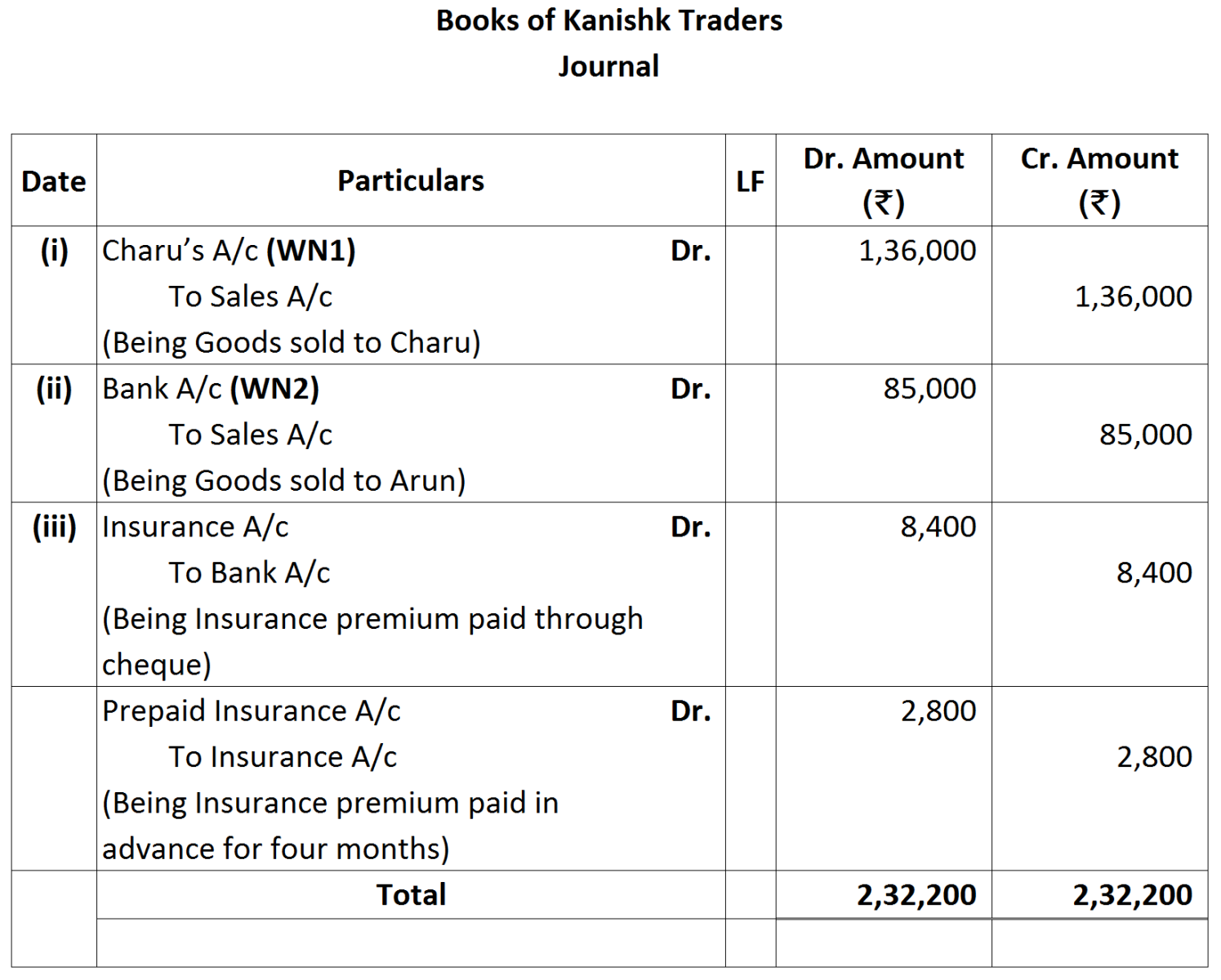
Journalise the following transactions in the books of Kanishk Traders:
i.
Sold goods costing ₹ 1,20,000 to Charu at a profit of $33\frac{1}{3}\%$ on cost less 15% Trade Discount.
ii.
Sold goods costing ₹ 80,000 to Arun against cheque at a profit of 25% on cost less 15% Trade Discount.
iii.
Paid by cheque ₹ 8,400 as insurance premium for a period of 12 months starting 1st August 2016. Financial year closes on 31st March every year.
Answer

Working Notes:
WN 1: Calculation of amount of goods sold to Charu.
Cost
=
1,20,000
Add: Profit $@\ 33\frac{1}{3}\%\text{ on }1,20,000$
=
40,000
 
 
$\overline{1,60,000}$
Less: Trade Discount @ 15% on 1,60,000
=
24,000
 
 
$\overline{1,36,000}$
WN 2: Calculation of amount of goods sold to Arun.
Cost
=
80,000
Add: Profit @ 25% on 80,000
=
20,000
 
 
$\overline{1,00,000}$
Less: Trade Discount @ 15%
=
15,000
 
 
$\overline{85,000}$
View full question & answer
Question 1123 Marks
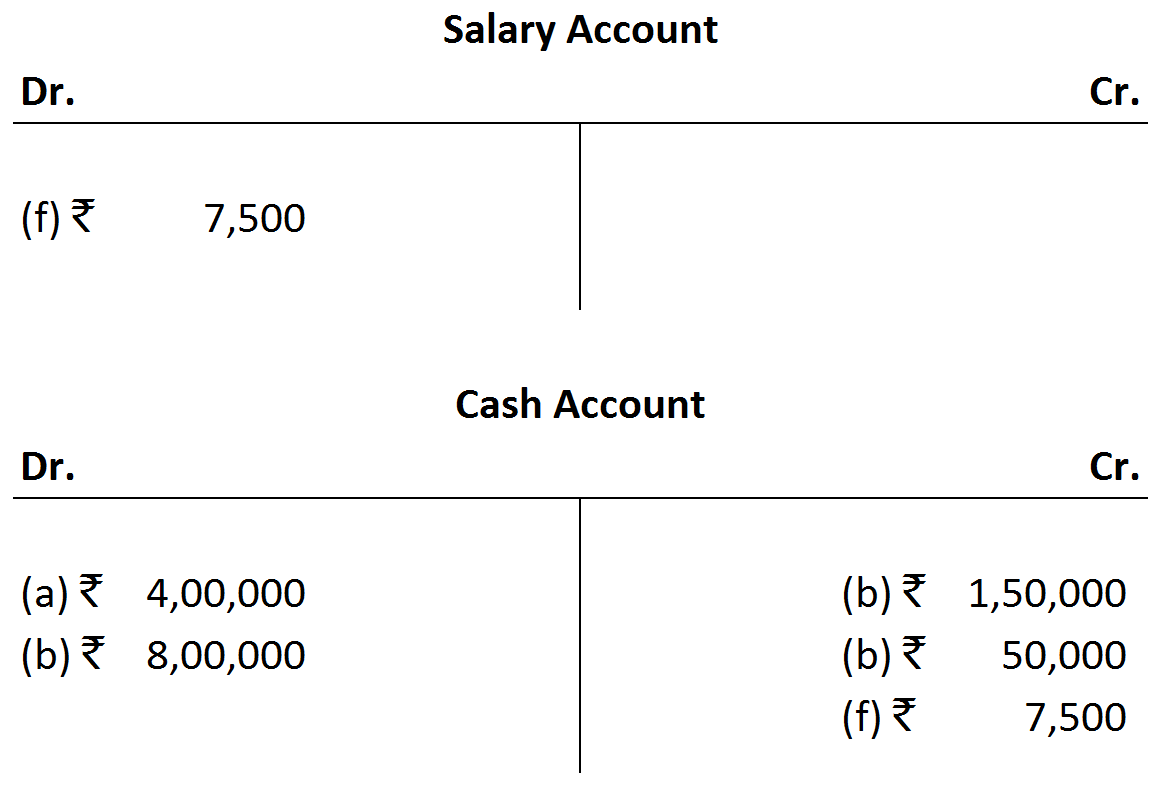
Journalise the following:
  1. Received a V.P.P. from Mohan Lal for ₹ 25,000. Sent a peon to collect it who paid ₹ 200 as cartage.
  2. Received ₹ 1,000 from sales of old newspapers and ₹ 5,000 from sales of old chairs.
  3. Goods given away as charity goods costing ₹ 7,000.
  4. Received Cash from a debtor written off as bad-debt last year ₹ 20,000.
  5. Sold goods costing ₹ 50,000 to Ashok on credit at a profit of 20% on cost.
  6. Sold goods costing ₹ 1,00,000 for ₹ 1,40,000.
  7. Provide ₹ 50,000 as interest on Capital.
  8. Paid rent of building ₹ 60,000 by cheque. Half the building is used by the proprietor for residential purpose.
  9. Outstanding salary at the end of the year ₹ 30,000.
View full question & answer
Question 1133 Marks
Journalise the following transactions is the journal of M/s. Goel Brothers and post them to the ledger.
2017
 
Jan. 01
Started business with cash
1,65,000
Jan. 02
Opened bank account in PNB
80,000
Jan. 04
Goods purchased from Tara
22,000
Jan.05
Goods purchased for cash
30,000
Jan.08
Goods sold to Naman
12,000
Jan.10
Cash paid to Tara
22,000
Jan.15
Cash received from Naman
11,700
 
Discount allowed
300
Jan. 16
Paid wages
200
Jan. 18
Furniture purchased for office use
5,000
Jan. 20
Withdrawn from bank for personal use
4,000
Jan. 22
Issued cheque for rent
3,000
Jan. 23
Goods issued for house hold purpose
2,000
Jan. 24
Drawn cash from bank for office use
6,000
Jan. 26
Commission received
1,000
Jan. 27
Bank charges
200
Jan. 28
Cheque given for insurance premium
3,000
Jan. 29
Paid salary
7,000
Jan. 30
Cash sales
10,000
View full question & answer
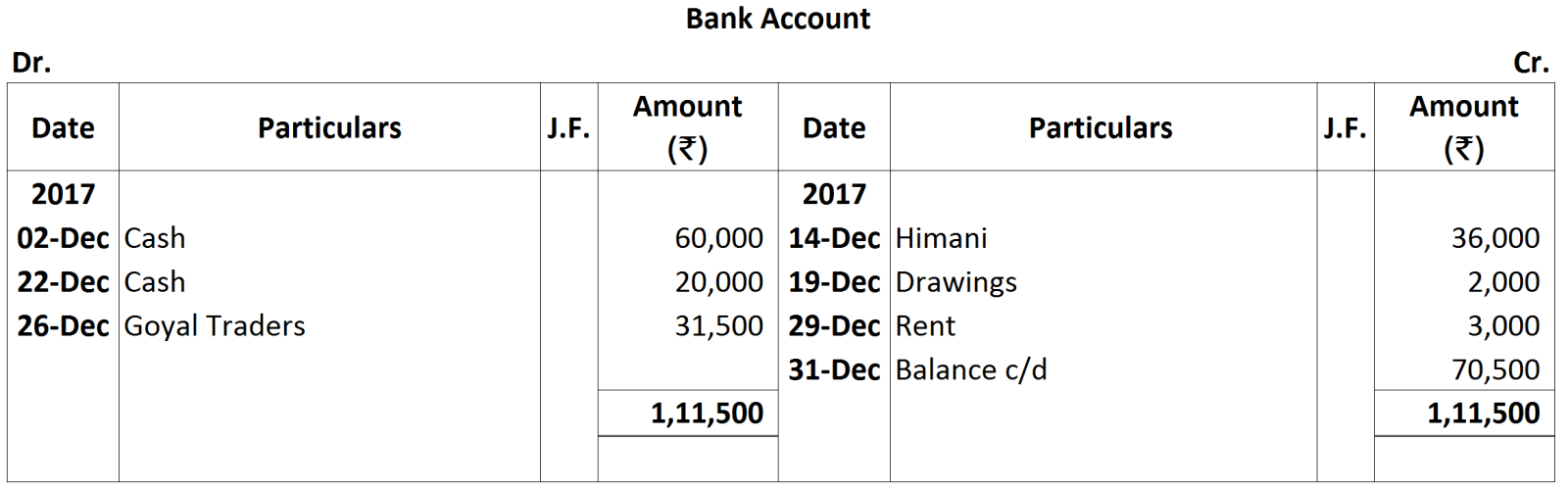
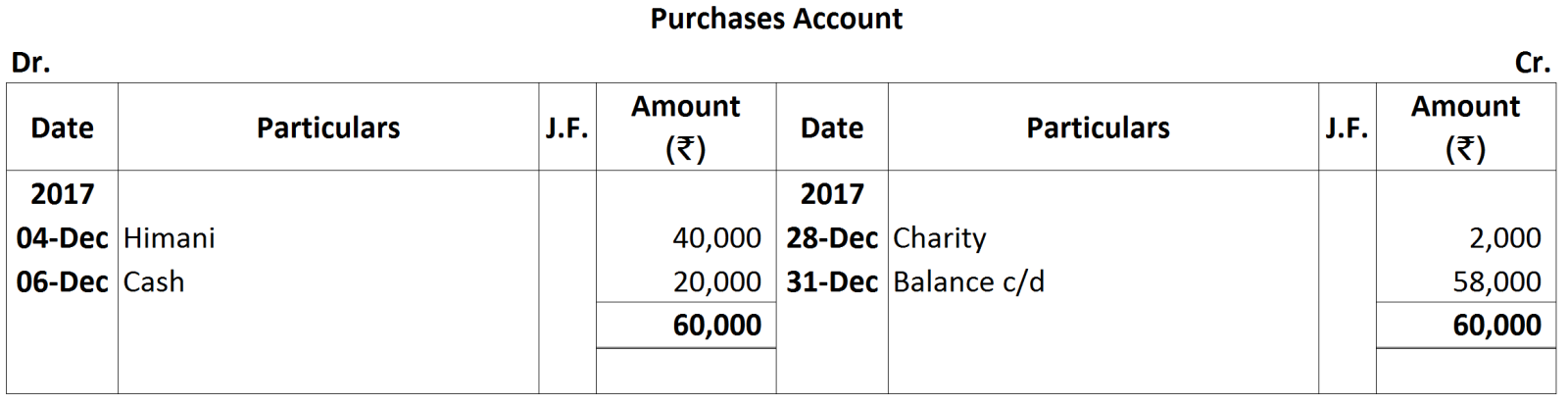
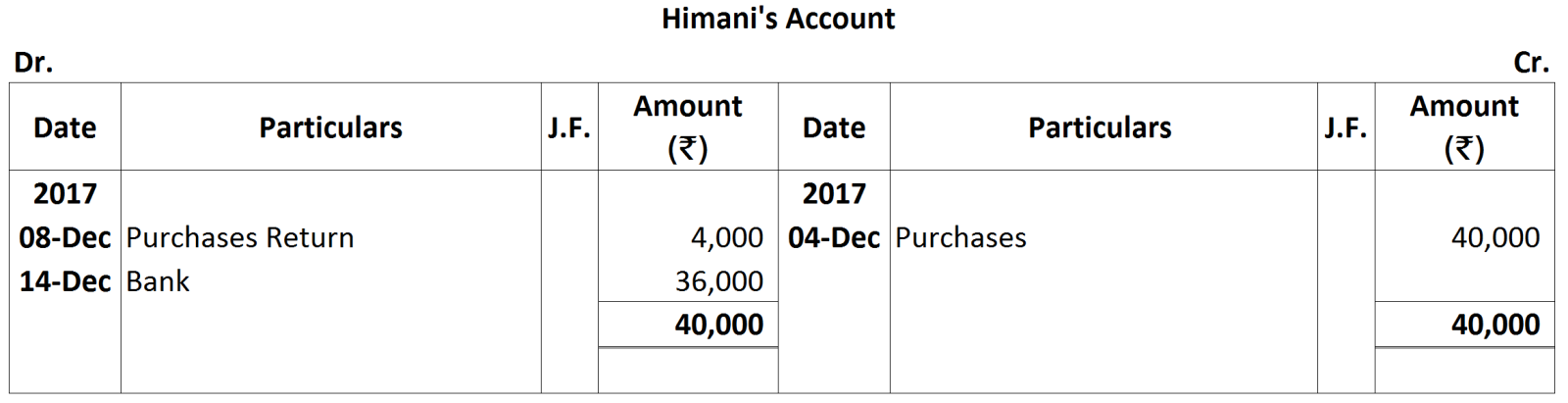
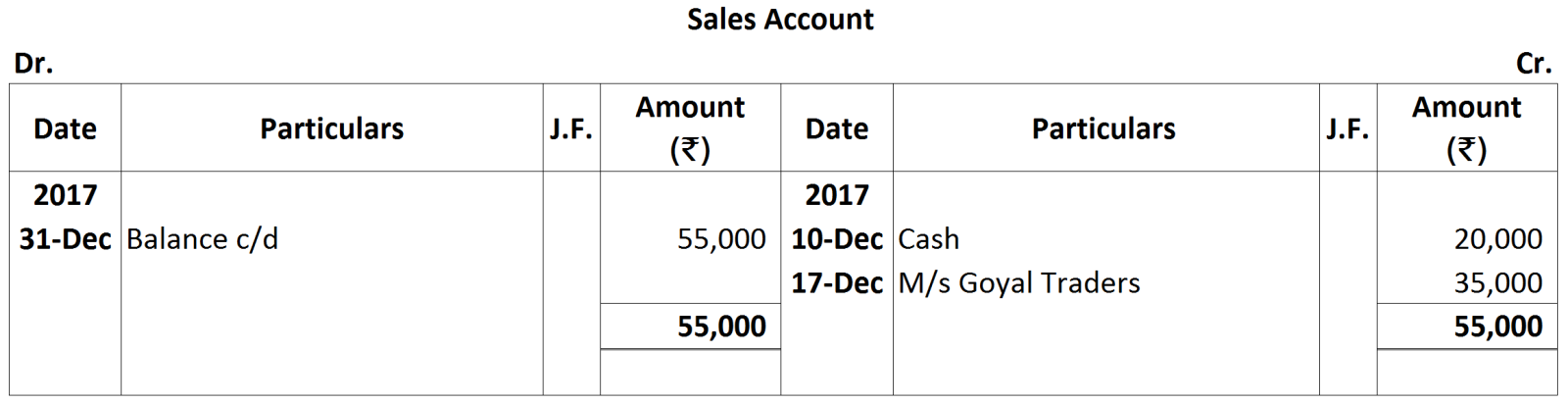
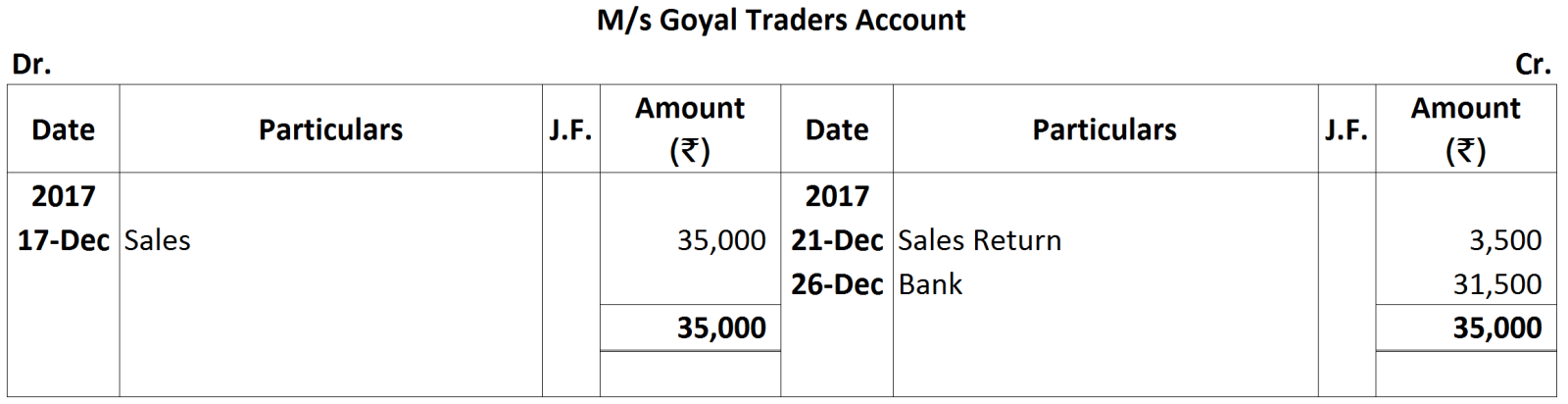
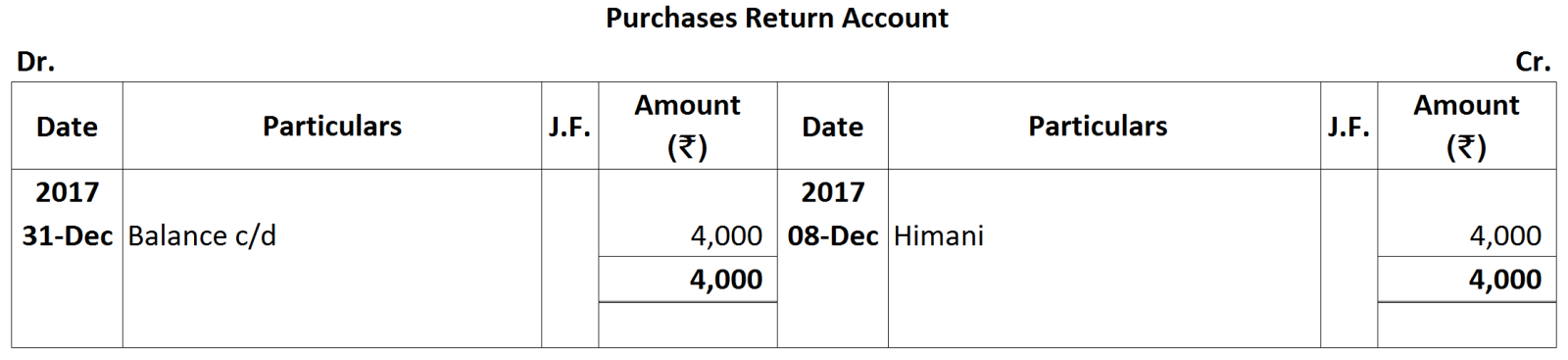
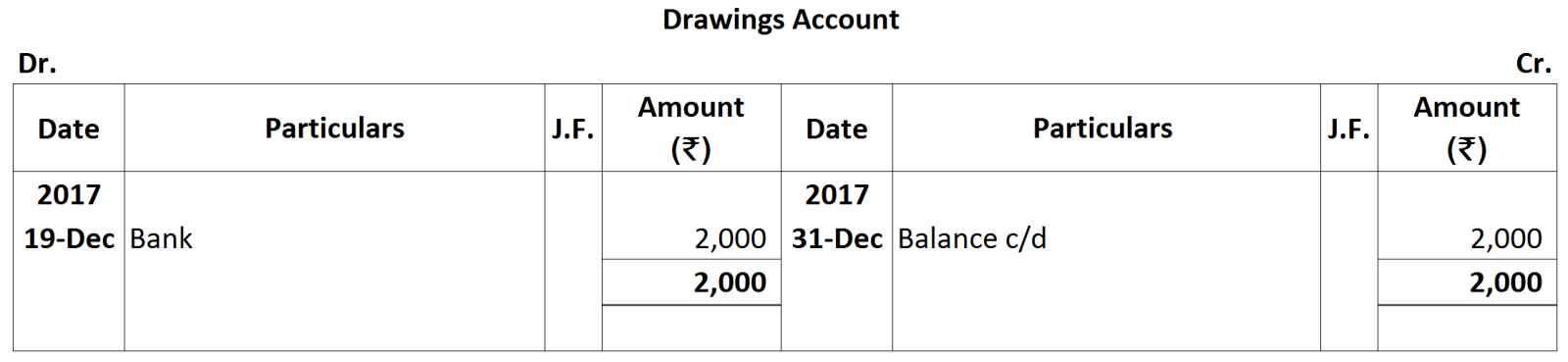
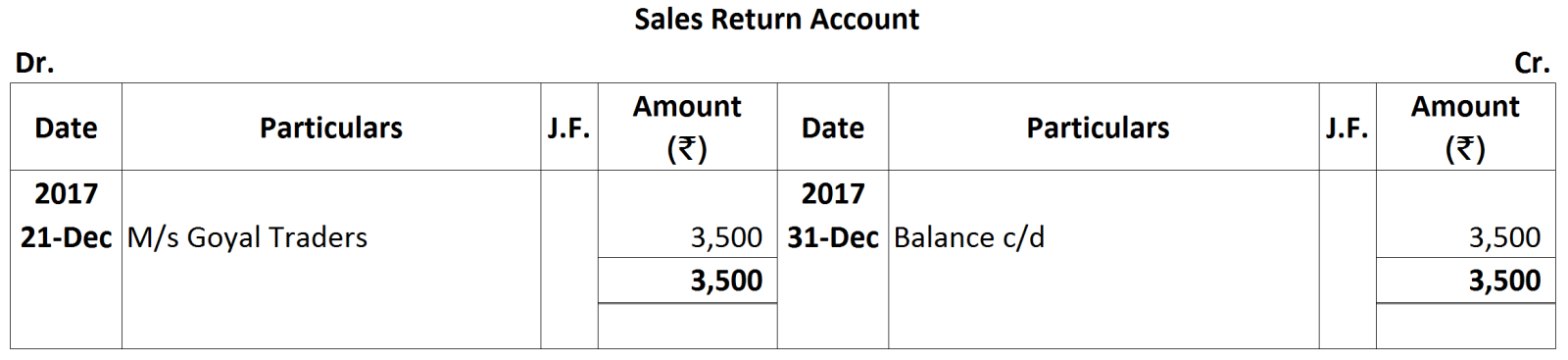
Question 1143 Marks
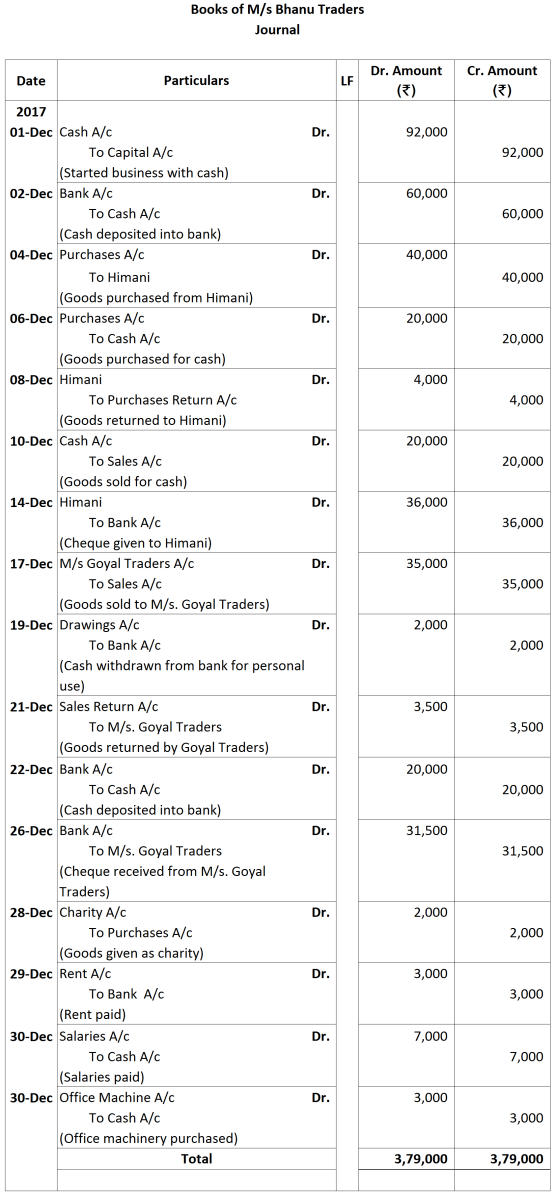
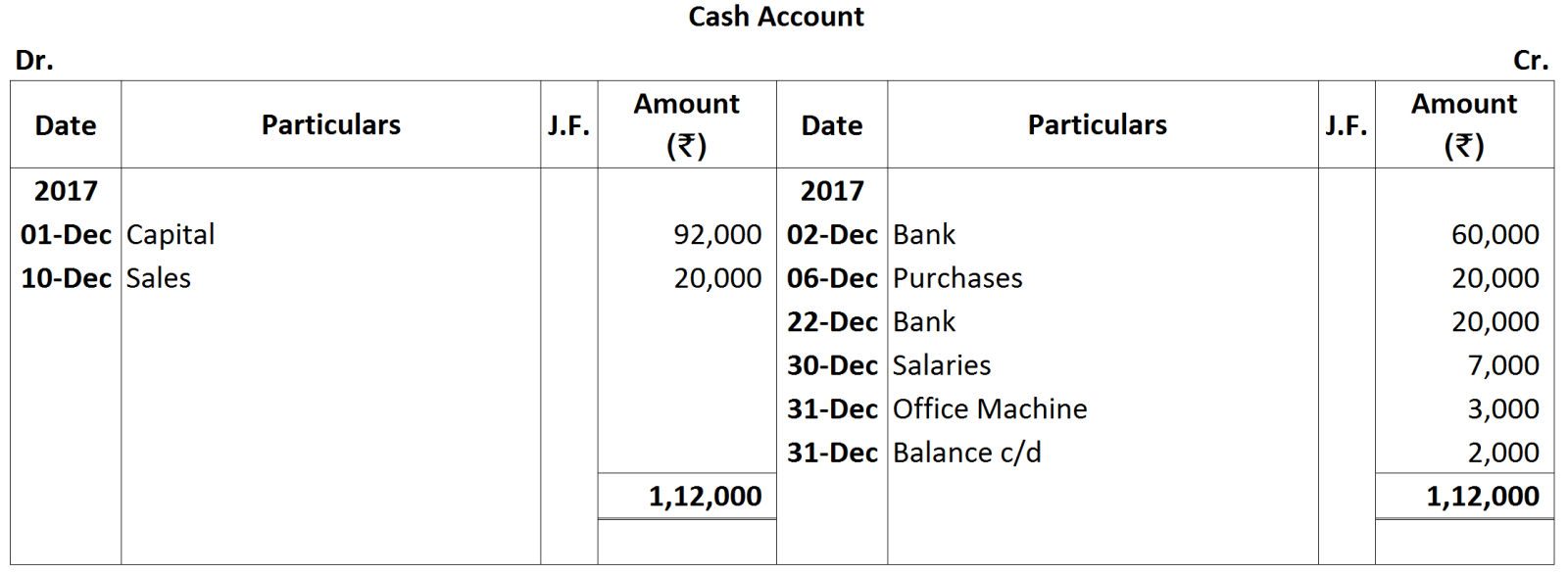
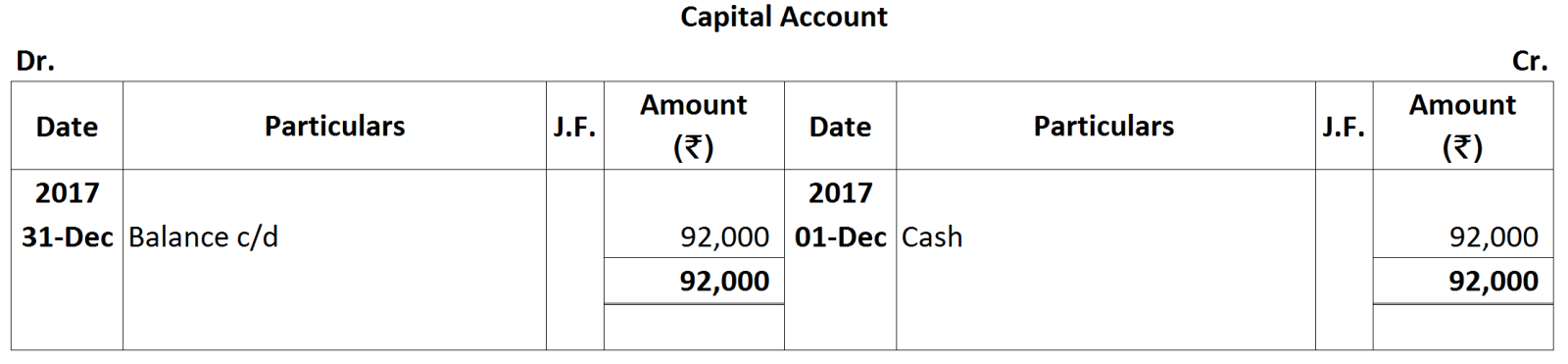
Journalise the following transaction in the Books of the M/s. Bhanu Traders and Post them into the Ledger.
December, 2017
 
1
Started business with cash
92,000
2
Deposited into bank
60,000
4
Bought goods on credit from Himani
40,000
6
Purchased goods from cash
20,000
8
Returned goods to Himani
4,000
10
Sold goods for cash
20,000
14
Cheque given to Himani
36,000
17
Goods sold to M/s. Goyal Traders
3,50,000
19
Drew cash from bank for personal use
2,000
21
Goyal traders returned goods
3,500
22
Cash deposited into bank
20,000
26
Cheque received from Goyal Traders
31,500
28
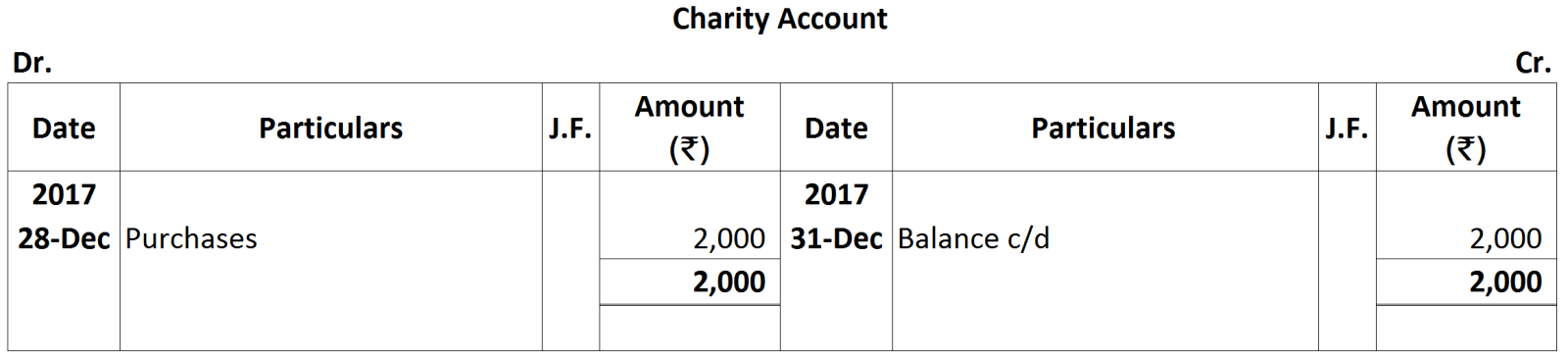
Goods given as charity
2,000
29
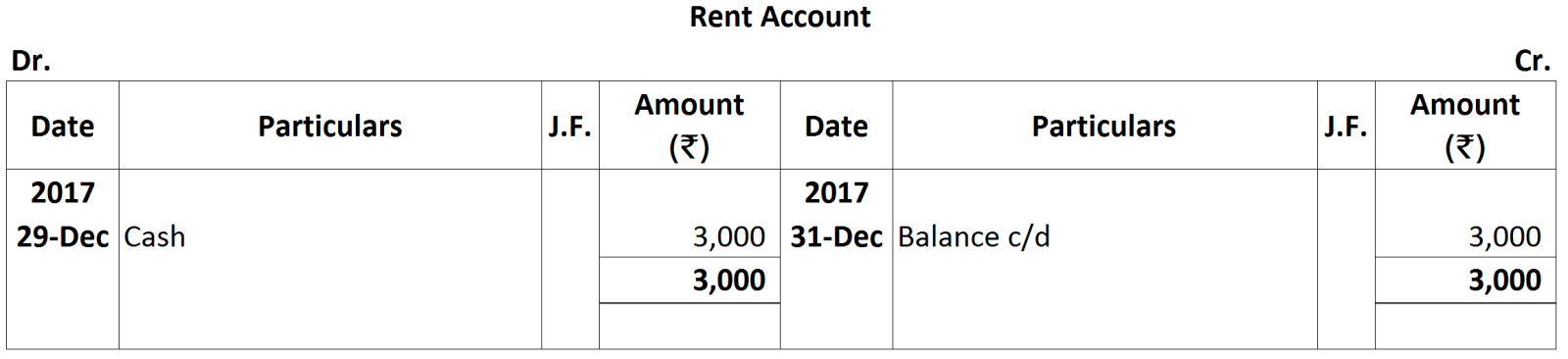
Rent paid
3,000
30
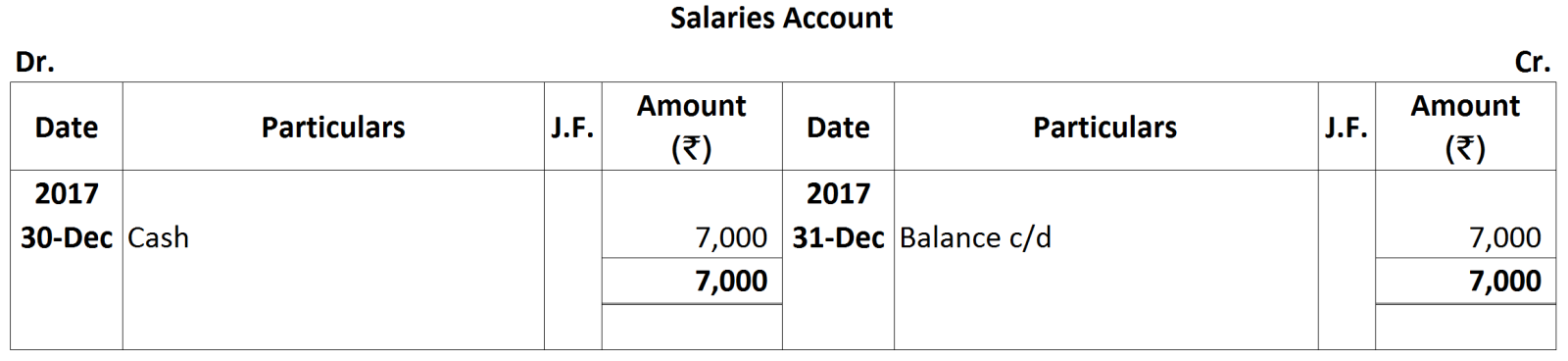
Salary paid
7,000
31
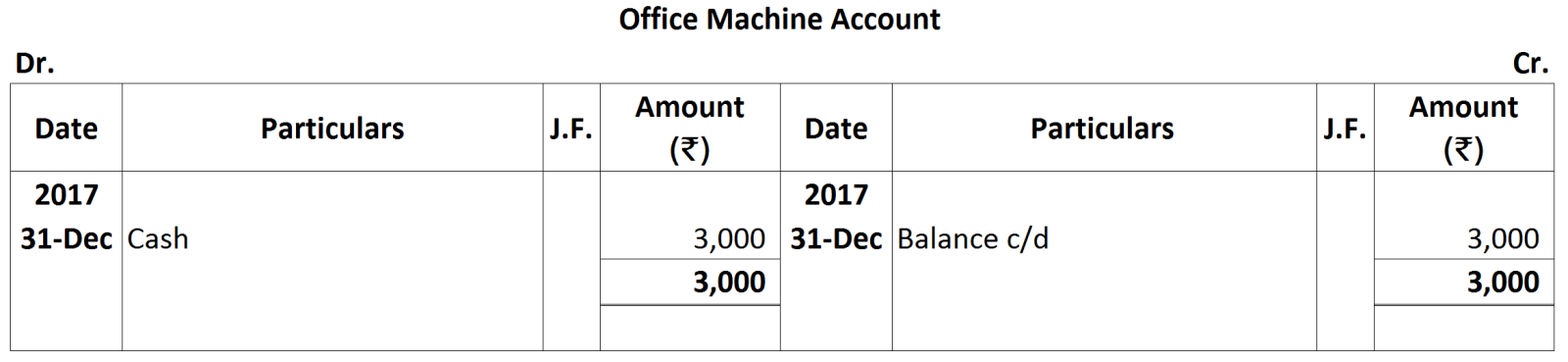
Office machine purchased for cash
3,000
Answer


Note: For transaction on December 29, 2017, it has been assumed that the rent of ₹ 3,000 is paid through cheque. If instead the rent would have been paid in cash, the cash account would have shown a credit (negative) balance and that is logically not correct.


View full question & answer
Question 1153 Marks
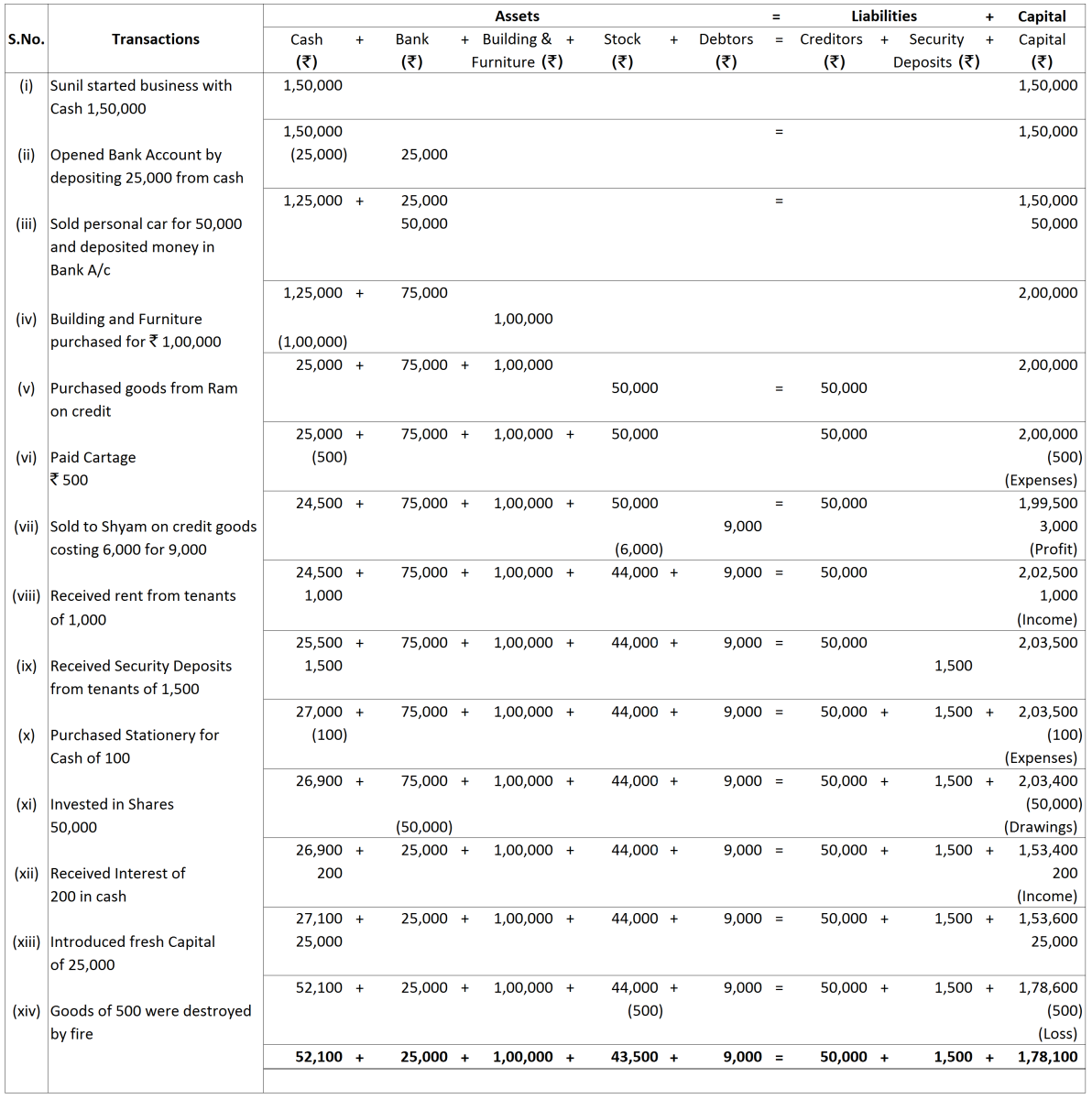
Show an Accounting Equation on the basis of the following transactions:
S.no  
(i) Sunil started business with cash 1,50,000
(ii) Opened a Bank Account by depositing ₹ 25,000 out of cash  
(iii) He sold his personal car for ₹ 50,000 and deposited the amount in the firm's Bank Account  
(iv) He purchased a building and furniture for 1,00,000
(v) He purchased goods from Ram on credit 50,000
(vi) He paid cartage 500
(vii) He sold to Shyam on credit goods costing ₹ 6,000 for 9,000
(viii) Received rent from tenants 1,000
(ix) Received security deposit from tenants 1,500
(x) Purchased stationery for cash 100
(xi) Invested in shares (personal) 50,000
(xii) Received interest in cash 200
(xiii) Introduced fresh capital 25,000
(xiv) Goods destroyed by fire 500
Answer

Assets = 52,100 + 25,000 + 1,00,000 + 43,500 + 9,000 = 2,29,600
Liabilities = 50,000 + 1,500 = 51,500
Capital = 1,78,100
View full question & answer
Question 1163 Marks
Enter the following transactions in the Journal of M/s. Karim Bros., Prop. Shri Karim Khan, Kolkata, post to the Ledger:
Inter-state transactions are subject to levy of IGST @ 12% and Intra-state transactions are subject to levy of CGST and SGST @ 6% each. GST is not levied on transactions marked with (*).
View full question & answer
Question 1173 Marks
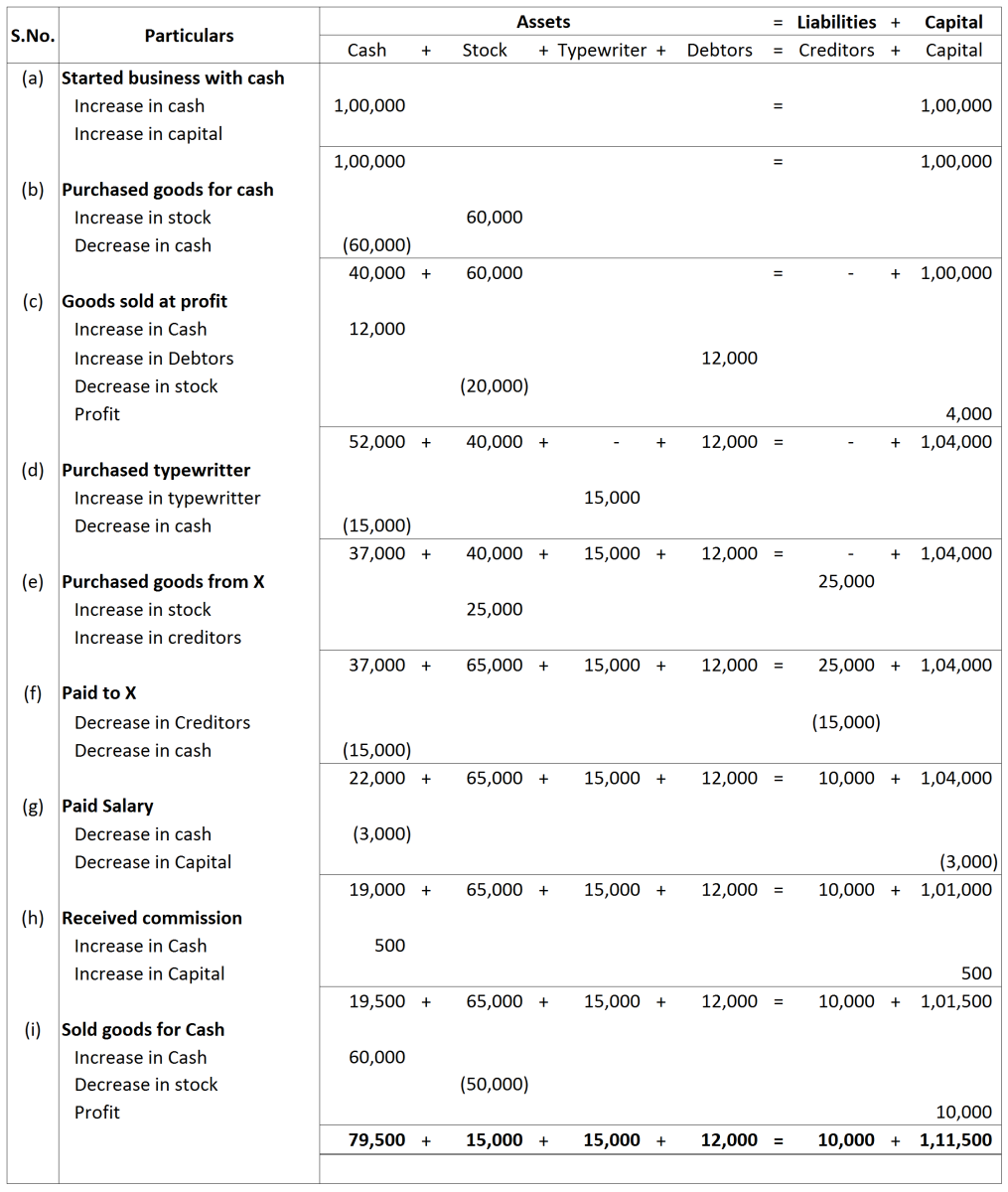
Prove that the accounting equation is satisfied in the following transactions:
    (₹)
i. Brij Mohan commenced business with Cash 1,00,000
ii. Bought goods for Cash 60,000
iii. $\frac{1}{3}\text{rd}$ of the above goods sold at a profit of 20% on cost. Half the payment recieved in Cash  
iv. Purchased typewritter for office use 15,000
v. Purchased goods on Credit from X 25,000
vi. Paid to X 15,000
vii. Paid Salary 3,000
viii. Received commission 500
ix. Sold goods for Cash (Cost ₹ 50,000) 60,000
Answer

Working Note:
Calculation of Selling Price
Cost of Goods Sold $=60,000\times\frac{1}{3}$ = 20,000
Add: Profit 20% of ₹ 20,000 = 4,000
$\therefore$ Sales = $\overline{24,000}$
Cash Sales (50%) = 12,000
$\therefore$ Credit Sales = 12,000
View full question & answer
Question 1183 Marks
Enter the following transactions in subsidiary books, post them into Ledger and prepare a Trial Balance:
The following balances existed in Sunil Bros. books on April 1, 2017:
Assets: Cash in hand ₹ 27,500; Bank Balance ₹ 40,000; Debtors: Ashok ₹ 18,000, Bahadur ₹ 25,000, Charu ₹ 30,000; Stock ₹ 1,60,000 and Furniture ₹ 40,000.
Liabilities: Creditors: Dinesh ₹ 20,000 and Ekta ₹ 15,000.
2017
 
April 1
Cash Sales ₹ 18,000
April 2 Deposited into Bank ₹ 20,000
April 3
Purchased from Dinesh:
300 metres Cotton @ ₹ 60 per metre
200 metres Silk @ ₹ 100 per metre
April 5 Cheque issued to Dinesh for ₹ 25,000
April 6 Accepted a bill at one month for ₹ 15,000 drawn by Dinesh
April 8 Sold to Ashok:
400 metres Cotton @ ₹ 80 per metre
250 metres Silk @ ₹ 140 per metre
April 10 Returned by Ashok 50 metres Silk
April 12 Received Cash ₹ 8,000 and a Cheque for ₹ 40,000 from Ashok. Cheque was immediately sent to Bank.
April 13 Received a B/R from Bahadur for ₹ 20,000 at one month
April 15 Accepted a bill at two months drawn by Ekta for the amount due to her.
April 16 Purchased a Computer for office use from Shiva Ltd. for ₹ 45,000 on Credit.
April 18 Cash purchases ₹ 10,000
April 19 Received full payment from Charu by cheque, sent it to Bank. Discount allowed 2%
April 20 Issued a cheque to Dinesh in full payment of his account after deducting 1% discount
April 22 Settled the account of Shiva Ltd. by a cheque
April 24 Proprietor took away goods worth ₹ 5,000 and Cash ₹ 6,000
April 25 Purchased from Ganesh 200 metres Cotton @ ₹ 70 per metre subject to trade discount of 5%
April 27 Paid Rent ₹ 3,000 and Salaries ₹ 8,000
April 30 Interest allowed by bank ₹ 600
View full question & answer
Question 1193 Marks
Pass entries in the books of Krishnan of Bengaluru (Karnataka) in the following cases:
1.
Purchased goods from Karunakaran of Chennai for ₹ 1,00,000.
(IGST @18%)
2.
Sold goods to Ganeshan of Bengaluru for ₹ 1,50,000.
(CGST @ 6% and SGST @ 6%)
3.
Sold goods to S. Nair of Kerala for ₹ 2,60,000.
(IGST @18%)
4.
Purchased a Machinery for ₹ 80,000 from Surya Ltd. against cheque.
(CGST @ 9% and SGST @ 9%)
5.
Paid rent ₹ 30,000 by cheque.
(CGST @ 6% and SGST @ 6%)
6.
Purchased goods from Ram Mohan Rai of Bengaluru for ₹ 2,00,000.
(CGST @ 6% and SGST @ 6%)
7.
Paid insurance premium ₹ 10,000 by cheque.
(CGST @ 9% and SGST @ 9%)
8.
Received commission ₹ 20,000 by cheque which is deposited into bank.
(CGST @ 9% and SGST @ 9%)
9.
Payment made of balance amount of GST.
View full question & answer
Question 1213 Marks
Journalise the following transactions in the books of Prakash:
  1. Opened a current account with Punjab National Bank ₹ 1,00,000.
  2. Received a cheque of ₹ 12,900 from Chandradev and allowed discount ₹ 300 to him. The cheque was deposited into Bank on the same day.
  3. Purchased machinery for ₹ 1,00,000, payment made by cheque. Installation charge of machinery ₹ 6,000 paid in cash.
  4. Purchased a horse for business for ₹ 20,000.
  5. Sold goods to Gokul at a list price of ₹ 4,000. Trade discount 10% and cash discount 5%. He paid the amount on the same day and availed the cash discount.
  6. Purchased goods for ₹ 10,000 and paid ₹ 400 for carriage on these goods.
  7. Additional cash introduced by the proprietor ₹ 40,000.
  8. Purchased stationery ₹ 800 and postal stamps ₹ 100.
  9. Withdrawn from bank ₹ 20,000.
  10. Received an order to supply goods of ₹ 40,000 from Manu and received ₹ 10,000 as an advance together with the order.
  11. Cash ₹ 10,000 and goods worth ₹ 4,000 were stolen.
  12. Purchased goods from Devendra for ₹ 40,000 and the payment was made by cheque.
  13. Sold $\frac{1}{4}\text{th}$ of the above goods at a profit of 25% on cash.
View full question & answer
Question 1223 Marks
Pass Journal entries in the books of Hari Shankar & Co. from the following:
2017
 
April 1
Commenced business with cash
50,000
April 2
Purchased goods from Subhash
20,000
April 4
Sold goods to Ramnath
15,000
April 6
Ramnath returned defective goods
1,000
April 10 Received cash from Ramnath and 13,800
Discount allowed 200
April 12
Gopal sold goods to us
10,000
April 14
Paid to Gopal in full settlement of his account after deducting 5% discount
 
April 15
Paid Rent
10,000
April 16
Paid Rent of Hari Shankar's residence
5,000
April 18
Purchased goods for cash from Govind for ₹ 6,000 at 20% trade discount
 
April 20
Purchased goods from Govind for ₹ 10,000 at 20% trade discount
 
April 24
Paid to Govind ₹ 7,850 in full settlement of his account
 
April 25
Paid to Subhash ₹ 4,750 discount received ₹ 250
 
April 30
Paid wages ₹ 400, Salaries ₹ 4,000, Advertisement expenses ₹ 800 and Trade expenses ₹ 1,000
 
View full question & answer
Question 1233 Marks
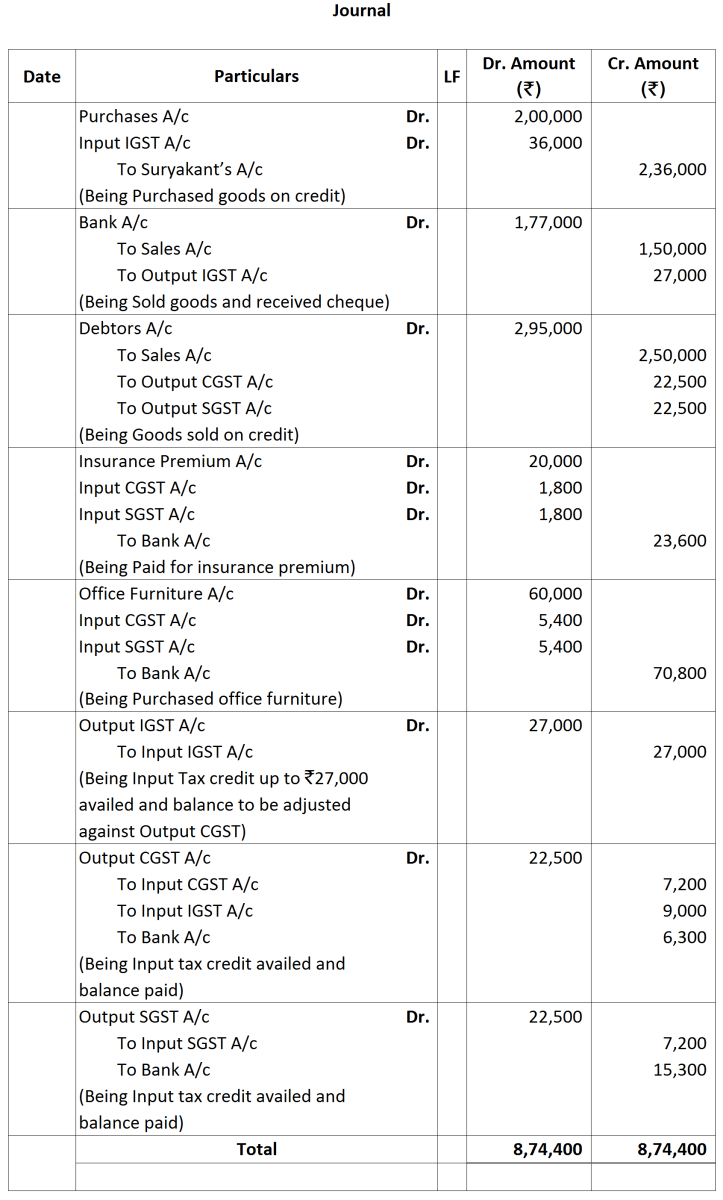
Pass entries in the books of Mr. Roopani of Gujarat assuming CGST @ 9% and SGST@ 9%.
1.
Purchased goods for ₹ 2,00,000 from Suryakant of Jaipur (Rajasthan) on Credit.
2.
Sold goods for ₹ 1,50,000 to Mr. Pawar of Mumbai (Maharashtra) and the cheque received was sent to bank.
3.
Sold goods for ₹ 2,50,000 within the state on credit.
4.
Paid insurance premium of 20,000 by cheque.
5.
Purchased furniture for office for ₹ 60,000 by cheque.
6.
Payment made of balance amount of GST.
Answer

Working Note:
GST Common Set Off Procedure:
 
Output IGST
(₹)
Output CGST
(₹)
Output SGST
(₹)
 
27000
22500
22500
Input IGST
-27,000
(36000 - 9000)
- 9000
-
Input CGST
-
-7,200
(1800 + 5400)
-
Input SGST
-
-
-7,200
(1800 + 5400)
Payable
Nil
6,300
15,300
View full question & answer
Question 1243 Marks
Raghunath had the following transactions in an accounting year:
  1. Commenced business with cash ₹ 50,000.
  2. Paid into bank ₹ 10,000.
  3. Purchased goods for cash ₹ 20,000 and credit ₹ 30,000.
  4. Sold goods for cash ₹ 40,000 costing ₹ 30,000.
  5. Rent paid ₹ 500.
  6. Rent outstanding ₹ 100.
  7. Bought furniture ₹ 5,000 on credit.
  8. Bought refrigerator for personal use ₹ 5,000.
  9. Purchased motorcycle for cash ₹ 20,000.
Create an Accounting Equation to show the effect of the above and also show his Balance Sheet.
View full question & answer
Question 1253 Marks
Journalise the following transactions, post to the ledger:
2017
 
Nov. 01
Business started with
(i) Cash
1,50,000
 
 
(ii) Goods
50,000
Nov. 03
Purchased goods from Harish
30,000
Nov. 05
Sold goods for cash
12,000
Nov. 08
Purchase furniture for cash
5,000
Nov. 10
Cash paid to Harish on account
15,000
Nov. 13
Paid sundry expenses
200
Nov. 15
Cash sales
15,000
Nov. 18
Deposited into bank
5,000
Nov. 20
Drew cash for personal use
1,000
Nov. 22
Cash paid to Harish in full settlement of account
14,700
Nov. 25
Good sold to Nitesh
7,000
Nov. 26
Cartage paid
200
Nov. 27
Rent paid
1,500
Nov. 29
Received cash from Nitesh
6,800
 
Discount allowed
200
Nov. 30
Salary paid
3,000
View full question & answer
Question 1263 Marks
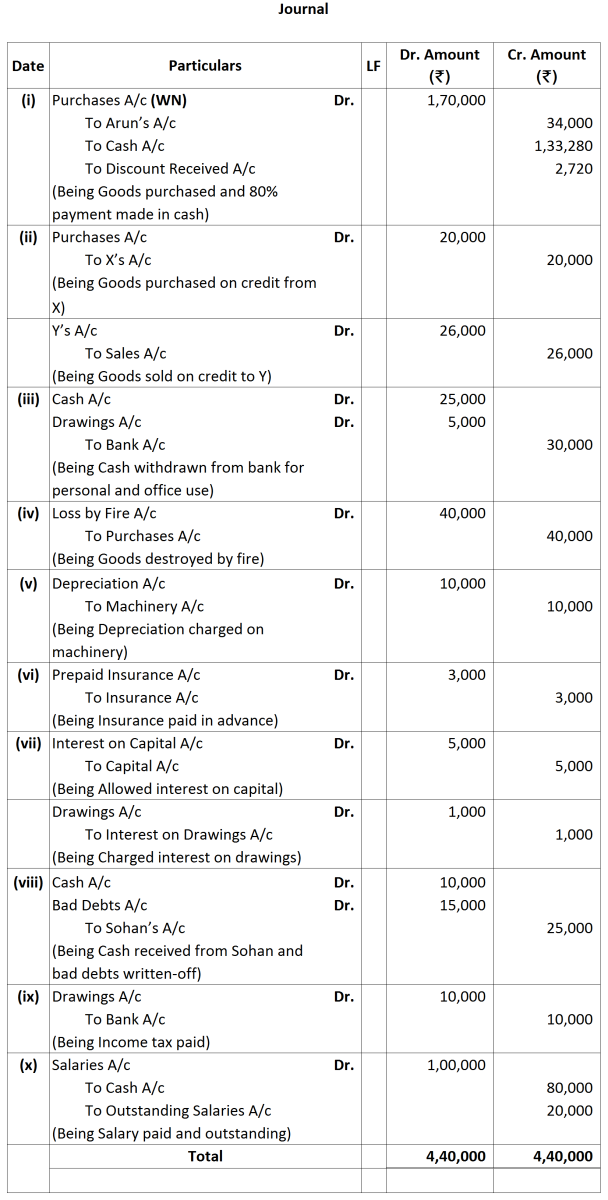
Journalise the following transactions:
  1. Bought goods from Arun for 2,00,000 at a trade discount of 15% and cash discount of 2%. Paid 80% amount immediately.
  2. Purchased foods for 20,000 from X and supplied it to Y for ₹ 26,000.
  3. Cash withdrawn from bank 5,000 for personal use and 25,000 for office use.
  4. Goods destroyed by fire: Cost Price 40,000.
  5. Provide 20% depreciation on machinery costing 50,000.
  6. Out of insurance paid this year, 3,000 is related to next year.
  7. Allow 5,000 as interest on capital and charge 1,000 as interest on drawings.
  8. Sohan who owed us 25,000 was declared insolvent and a cheque of 40 paise in a is received from him in full settlement.
  9. Paid Income Tax 10,000 by cheque.
  10. Salary paid 80,000 and Salary Outstanding 20,000.
Answer

Working Notes: Calculation of payment made and outstanding amount to Arun.
Cost
=
2,00,000
Less: Trade Discount (15% on 66,000)
 
30,000
 
=
$\overline{1,70,000}$
Payment made in Cash (80% of 1,70,000)
=
1,36,000
Less: Cash Discount (2% on 1,36,000)
=
2,720
Net Amount
=
$\overline{1,33,280}$
Outstanding amount to Arun (20% of 1,70,000)
=
₹ 34,000
View full question & answer
Question 1273 Marks
Journalise the following transaction in the books of Sanjana and post them into the ledger:
January, 2017
 
1
Cash in hand
6,000
 
Cash at bank
55,000
 
Stock of goods
40,000
 
Due to Rohan
6,000
 
Due from Tarun
10,000
3
Sold goods to Karuna
15,000
4
Cash sales
10,000
6
Goods sold to Heena
5,000
8
Purchased goods from Rupali
30,000
10
Goods returned from Karuna
2,000
14
Cash received from Karuna
13,000
15
Cheque given to Rohan
6,000
16
Cash received from Heena
3,000
20
Cheque received from Tarun
10,000
22
Cheque received from to Heena
2,000
25
Cash given to Rupali
18,000
26
Paid cartage
1,000
27
Paid salary
8,000
28
Cash sale
7,000
29
Cheque given to Rupali
12,000
30
Sanjana took goods for Personal use
4,000
31
Paid General expense
500
View full question & answer
Question 1283 Marks
Enter the following transactions in the Journal of Ganesh Bros.:
2017
 
March 3
Sold goods to Dev
1,00,000
March 5
Received from Dev in full settlement of his account
98,000
March 6
Sold goods to Manmohan
80,000
March 8
Manmohan returned goods
1,000
March 15
Received from Manmohan in full settlement of his account
78,200
March 16 Received cash from Ram and 19,500
Discount allowed 500
March 20 Paid cash to Pawan and 4,700
Discount received from him 300
March 25
Sold goods to Varun of the list price of 25,000 at 20% trade discount
 
View full question & answer
Question 1293 Marks
Following balances appeared in the books of Radhika Traders as on 1st April, 2017:
Assets: Cash ₹ 8,000; Cash at Bank ₹ 7,000; Stock ₹ 30,000; Debtors; ₹ 36,000 (Mohan ₹ 10,000; Sohan ₹ 12,000; Dinesh ₹ 14,000); Furniture ₹ 5,000; Building ₹ 25,000.
Liabilities: Creditors− X ₹ 5,000; Y ₹ 6,000.
In April, 2017, the following transaction took place:
2017
 
April 2
Bought goods of the list price of ₹ 6,000 from Khanna Brothers less 15% trade discount and 2% cash discount and paid 40% price at the same time.
 
April 3
Received a draft from Mohan in full settlement and deposited it into Bank
 
April 5
Purchased goods from Suresh of the list price of ₹ 8,000 at 20% trade discount and paid him by cheque.
9,750
April 8
Sold goods and received a cheque
25,000
April 10
Deposited the above cheque into Bank
12,000
April 12
Sohan deposited in our Bank A/c
4,000
April 16
Paid Income Tax by Cheque
5,600
April 20 Received a cheque from Sohan and sent to Bank 7,800
Discount allowed 200
April 21
Withdrew from Bank−for office
2,000
for private use
4,000
April 23
Sent a cheque to X in full settlement of his A/c
4,900
April 27
Cheque of Sohan returned by the bank as dishonoured.
 
April 28
Dinesh was declared insolvent and a payment of 60 paise in a ₹ received from his estate by a Cheque
 
April 30
Bank allowed Interest
350
Paid for Rent by cheque
1,500
Paid for traveling expenses by cheque
500
Pass Journal entries for the above transactions.
View full question & answer
Question 1303 Marks
Following transactions took place in M/s Goodluck Computers. Prepare the Accounting Vouchers
2019
Particular
Jan-1 Bought Computer Mouse (4 Nos.) vide Cash Memo No. 338* 6,000
Jan-8 Wages paid for the month of December, 2018 10,000
Jan-12 Purchased two Desktop Computers from M/s Computech for cash vide Cash Memo No. 170 32,500
Jan-25 Paid cash to Hari & Sons vide receipt No. 102 for repairs 1,000
Jan-28 Paid postage 200
Jan-30 Cash withdrawn from bank 10,000
Transactions marked with * are subject to levy of CGST and SGST @ 6% each.
View full question & answer
Question 1313 Marks
Prepare the Accounting Vouchers for the following transactions:?
2019
Particular
Jan-1
Started business with cash
2,00,000
Jan-1
Purchased furniture vide Cash Memo No. 210*
10,000
Jan-5
Opened a Bank Account in Canara Bank
60,000
Jan-10
Purchased garments on credit from M/s Madras Store vide Bill No. 291*
20,000
Jan-12
Sold shirts to Ram Parkash on credit vide Bill No. 1*
5,000
Jan-15
Sold shirts for cash vide Cash Memo No. 1*
7,000
Jan-20
Withdrew from bank for office use by cheque No. 23301
20,000
Jan-27
Withdrew for personal use by cheque No. 51003
5,000
Transactions marked with * are subject to levy of CGST and SGST @ 6% each.
View full question & answer
3 Marks Question - Page 3 - Account STD 11 Commerce Questions - Vidyadip