Questions

3 Marks Question

Take a timed test

42 questions · self-marked practice — reveal the answer and mark yourself.

Question 13 Marks
Distinguish between economic activities and non economic activities with examples.
Answer
  1. Economic activities refer to the activities performed by various people to earn their livelihood whereas non-economic activities refers to the activities undertaken not for the sake of earning money, but they are undertaken for the sake of love, duty, compassion etc. Examples of economic activities are like a doctor attending to the patients in the hospital, a teacher teaching his students in the class room etc.
  2. Examples of non-economic activities are like a doctor attending to his sick child at home, a teacher teaching her own son at home etc.
View full question & answer
Question 23 Marks
“Conventional divisions of the study of economics comprise study of consumption, production and distribution'. Explain.
Answer
Economics involves the study of people engaged in economic activities of all kinds which are production, consumption and distribution.
  1. Production: Manufacturing of products by producers for the market is called production.
  2. Consumption: Use of products by consumers to satisfy their wants is called consumption.
  3. Distribution: Division of national income into factor incomes like wages, profit, rent and interest is called distribution.
View full question & answer
Question 33 Marks
Give meaning of statistics.
Answer
It is very difficult to give such a definition of statistics which covers all of its characteristics. However a simple definition can be given by a layman as well. If we ask a man what is statistics, he may reply, it is numerical facts. He is also true to some extent. But it is not a complete definition. Many statisticians have also tried but there is hardly any definition which covers all its aspects. Bowley defined statistics in two ways. (a) "Statistics is the science of counting". (b) "Statistics may rightly be said science of averages." By giving two definitions, he proved that none of his definition is complete. But even if we take both definitions together, it is incomplete because statistics is much more than counting and averages. Broadly speaking statistics can be defined in two senses.
  1. Singular sense.
  2. Plural Sense.
View full question & answer
Question 43 Marks
Differentiate between economic and non-economic activities.
Answer
Difference between economic and non-economic activities are:
 
Basis
Economic activities
Non-economic activities
1.
Meaning
Economic activities are those which are performed to earn livelihood.
Non-economic activities are those which are performed out of love, sympathy, care, affection, self-satisfaction, patriotism, etc.
2.
Purpose
To earn money.
To satisfy social and psychological needs.
3.
Examples
A worker working in a factory, an entrepreneur performing entrepreneurial functions for production or trading of goods and services, etc.
A teacher teaching her son, a person going to temple for offering prayers, etc.
 
View full question & answer
Question 53 Marks
State any three functions of statistics.
OR
Explain any three functions of Statistics.
Answer
The three functions of statistics are:
  1. Statistics presents complex facts into simple and definite form.
  2. Statistics helps in condensing vast statistical information into a few significant figures.
  3. Statistics facilitates comparison among similar data.
View full question & answer
Question 63 Marks
Statistics are affected by multiplicity of causes. What does it mean? Explain.
Answer
There are many factors which work behind statistical facts and these forces operating together. For example, statistics of employment in an economy are affected by demand and supply of labour force, working conditions, production methods used etc. Similarly if the average weight of class is 56kg then there are many factors responsible for it-geographical, genetic, gender etc.
View full question & answer
Question 73 Marks
How do scarcity and choice go together?
Answer
Had there been no scarcity, there would have been no need for optimizing the resources. But the fact is that resources are scarce in relation to unlimited human wants and therefore, we need to optimize their utilization so as to maximize our utility level. It is used for decisions at individual as well as society level. Had there been no scarcity, there would have been no problem of making a choice. We need not make choice in case of abundant things. Therefore, it is right to say that scarcity and choice go together.
View full question & answer
Question 83 Marks
'Economics is a study of wealth.' Discuss.
Answer
Pioneers of the science of economics defined it as a science of wealth.
Adam Smith who is known as father of economics in his famous book on economics “An Enquiry into the Nature and Causes of Wealth of Nations”, defined economics as.
“Economics enquires into the causes that determine the wealth of a country and its growth.”
According to J B Say "Economics is a science which deals with wealth.
"According to F A Walker, "Economics is the name of that part of knowledge which relates to wealth."
Critical Evaluation of the wealth definition:
  1. It ignored immaterial things such as education, health etc outside the definition of wealth and therefore beyond the bounds of economic wealth.
  2. It ignored many aspects of economics like welfare and social justification.
  3. They also showed a biased attitude by regarding rights to private property or wealth as natural and moral rights.
View full question & answer
Question 93 Marks
Define Statistics in Plural Sense.
Answer
In the words of Croxton and Cowden, "Statistics can be defined as the collection presentation and interpretation of numerical data." According to Bowley, "Statistics are numerical statement of facts in any department of enquiry placed interrelation to each other". The most accepted definition of statistics is one which is given by Horace Secrist. According to Horace Secrist, “By Statistics we mean aggregate of facts affected to a marked extent by multiplicity of causes numerically expressed, enumerated or estimated according to a reasonable standard of accuracy, collected in a systematic manner for a pre-determined purpose and placed in relation to each other."
View full question & answer
Question 103 Marks
Explain briefly the methods of studying statistics.
Answer
The methods of studying statistics are:
  1. Descriptive Statistics: Descriptive statistics gives information that describes the data in some manner. It deals with the data related to every unit of population.
  2. Inferential Statistics: Inferential statistics makes inferences about the population on the basis of a sample drawn from the population.
A sample is a set of data collected from the population which represents the population. The results of the sample are deemed to hold true for the entire population.
View full question & answer
Question 113 Marks
What are statistical methods? Name the various statistical methods.
Answer
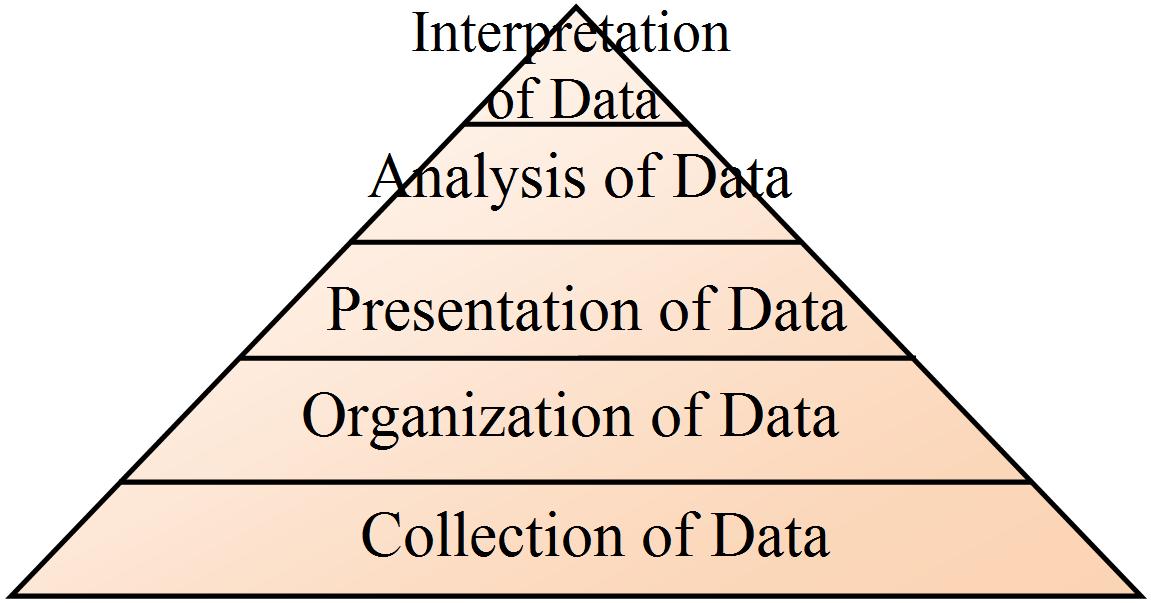
Methods which facilitate the understanding of statistical data are referred to as 'statistical methods'.The various statistical methods are enumerated below:
  1. Collection of data.
  2. Organisation of data.
  3. Presentation of data.
  4. Analysis of data.
  5. Interpretation of data.
View full question & answer
Question 123 Marks
How can the distrust of statistics be removed?
Answer
The distrust of statistics can be removed by undertaking the following measures:
  1. While using statistics, the various limitations of statistics should be kept in mind.
  2. The user using statistics should be an honest who uses the data carefully.
  3. As far as possible, statistics should be used only by experts.
View full question & answer
Question 133 Marks
Using examples differentiate between quantitative and qualitative data.
Answer
Difference between Quantitative and equalitative data is given below:
 
Basis
Quantitative Data
Qualitative data
1.
Meaning
The variables which can be expressed in numerical terms are known as quantitative variables, and data collected on quantitative variables is known as quantitative data.
Variables which cannot be expressed in quantitative terms are called qualitative variables and data on qualitative variables is called qualitative data.
2.
Example
Marks of students, number of employees in a factory, prices of vegetables, number of vehicles on roads, Infant mortality rate etc.
Honesty, beauty, intelligence, quality of employment, etc.
 
View full question & answer
Question 143 Marks
Statistics is clay which can be used to make god or devil. How?
Answer
Statistics is mostly a tool of analysis. Statistical techniques are used to analyze and interpret the collected information in an enquiry. As it is, statistics does not prove or disprove anything. It is just a means to an end. Statements supported by statistics are more appealing and are commonly believed. For this. statistics is often misused. Statistical methods rightly used are beneficial but if misused these become harmful. Statistical methods used by less expert hands will lead to inaccurate results. Here the fault does not lie with the subject of statistics but with the person who makes wrong use of it.
View full question & answer
Question 153 Marks
Problem of choice is unavoidable in the ordinary business of life. How?
Answer
Problems of choice is unavoidable in the ordinary business of life because of following reasons.
  1. Unlimited Wants: Human wants are unlimited. The moment one want is satisfied other one creeps up. It is a never ending phenomenon both in quantitative and qualitative terms. An important thing to note is that however, wants are unlimited but they vary in their intensity. It is because of this variation in intensity that people are able to allocate the resources to satisfy their some wants.
  2. Scarce Means: Means to satisfy human wants are scarce. Had means been unlimited, there would have been no Deconomic problem at all. Resources being limited, all wants can not be satisfied; then the problem of prioritizing the wants arises.
  3. Means have alternative uses: Economic resources can be put to various uses. Like a piece of land can be used for agriculture, school, hospital or residential building. It is because of alternative uses of resources that we have to decide about best allocation of resources.
View full question & answer
Question 163 Marks
'Today nearly every decision in business is made with the help of statistical data and statistical methods'. Discuss.
Answer
Statistical data is used extensively in business. For example the promoters of the business makes an extensive use of data to arrive at the conclusions which guide them in starting a new business.
Statistical data also helps in the formulation of policies on the basis of cause and effect relationship. These policies help a businessman to take important decision. For example, the law of demand states that as price rises, demand falls. So, this law will help a businessman to take necessary decision about price. Statistical data and methods are also used by business men to take decisions related to volume of production, pricing policy, purchase policy, distribution channel etc. Thus, it can be concluded that nearly every decision in business is made with the help of statistical data and methods.
View full question & answer
Question 173 Marks
Distinguish between quantitative and qualitative data and give some examples of both.
Answer
Difference between quantitative and qualitative data are as follows:
 
Basis
Quantitative Data
Qualitative Data
1.
Meaning
This refers to the data whose variables can be measured in numerical terms.
This refers to the data whose variables cannot be measured in numerical terms.
2.
Examples
Price of commodities, heights, weights of individuals, etc.
Honesty of individuals, intelligence of individuals, etc.
View full question & answer
Question 183 Marks
Describe various stages of statistics ad the tools used in it.
Answer
It can be presented in the form of a hierarchy.
View full question & answer
Question 193 Marks
Discuss the importance of Statistics for government.
Answer
Government needs statistics in all its functions.
  1. Government needs Statistics in Administration: In a jail, record is maintained for all prisoners and others whose cases are still under trial. In military, records are required for administration and planning.
  2. Government needs Statistics for policy formulation: Policy formulation is not possible without having statistical details with us. When our finance minister needs to take a decision on fund allocation to different sectors, he needs statistics; when he wants to announce a poverty alleviation programme, he needs statistics, when he thinks of an employment policy, he needs statistics.
  3. Political Parties Need Statistics: In India, political parties also make use of statistics to gauge the priorities of their countrymen. They also use statistics to pinpoint loopholes of ruling parties and ruling parties use it to prove their efficacy and achievements.
View full question & answer
Question 203 Marks
There are three kinds of lies: lies, damned lies, and statistics. Explain.
OR
There is a general perception that statistical knowledge is intentionally misused. Explain how.
Answer
Statistics is the most dangerous tool in the hands of an inexpert. Figures can be moulded and manipulated to conceal the truth and present a distorted picture of the facts to meet selfish ends. By choosing a certain sample, results can be manipulated. Such manipulations can arise from unintentional bias of the researcher, or faulty choice of sample or data. The graphs used to summarise data can also be misleading. If various studies appear to contradict one another, then the people may come to distrust such studies. For example, one study may suggest that a given diet or activity raises blood pressure, while another may suggest that it lowers blood pressure. It is, thus, essential to know the subject thoroughly and use it with due care. Before interpreting the results, it is necessary to know the complete facts, and the results should be verified.
View full question & answer
Question 213 Marks
Is economics an Art or Science? Give reasons.
Answer
Economics is a science but it is different from physical sciences. It is a social science i.e. it is a science dealing with human beings.
Unlike physical sciences, Economics is based on assumptions. Since our subject matter is human being whose behaviour is very unpredictable, economics assumes man to behave rationally. However, many a times, a man is not rational but emotional and in such cases economics laws do not operate. Similarly, there are many factors which affect a phenomenon simultaneously. But for simplicity sake, we assume other things to remain same which they may not.
View full question & answer
Question 223 Marks
Elaborate how 'scarcity is the root of all economic problems.
Answer
It is very rightly stated that scarcity is the root of all economic problems. In the absence of scarcity, no economic problem would have arisen. In other words, if everything was available in abundance everyone could have it in as much quantity as one wanted.
But this is not true as in the real life we have unlimited wants but the means or resources to satisfy them are limited. They are also such that they can be put to a number of uses, i.e., have alternative uses. This makes them more scarce in the economy.
As a result, “a problem of choice' crops up between various commodities that can be produced by these resources.
An individual/ household/ economy has to pick and choose the commodity which is most urgent and gives maximum satisfaction.
View full question & answer
Question 233 Marks
Give some recent definitions of Economics.
Answer
Some recent definitions have been called growth definitions. According to Professor Henry Smith, "Economics is the study of how in a civilized society one obtains the share of what other people have produced and of how the total product of society changes and is determined."
According to Jacob Viner, “Economics is what economists do."
According to Paul A Samuelson, "Economics is the study of how men and society choose, with or without the use of money, to employ scarce productive resources which could have alternative uses, to produce various commodities over time and distribute them for consumption now and in future amongst various people and groups of society."
View full question & answer
Question 243 Marks
Name the definition which has got maximum acceptability. Give this definition. Critically evaluate it.
Answer
Scarcity Definition was given by Robbins.
According to him, “Economics is the science which studies human behavior as a relationship between ends and scarce means which have alternative uses."
Critical Evaluation of Scarcity Definition: Robbins defined economics as neutral between ends and declaring economists to be least bothered about values and welfare.
Robbins definition of economics does not cover the aspects of economic growth and economic development. Problem of unemployment is not a problem of scarcity but a problem of abundance of manpower. It has reduced the scope of economics only to allocation of resources.
View full question & answer
Question 253 Marks
You have unlimited wants and limited resources to satisfy them. Explain by giving two examples.
Answer
Scarcity is the root of all economic problems. In our daily life, we face various forms of scarcity. We face scarcity because the commodities that satisfy our wants are available in limits.
The long queues at railway booking counters, massive crowd in buses, shortage of essential commodities, etc. show scarcity.
If there had been no scarcity, then there would not have been any economic problem.
View full question & answer
Question 263 Marks
'An activity can be economic activity in one situation and non-economic in another situation'. Do you agree? Give an example to justify your answer.
Answer
Yes, I agree with the statement. Human activities are classified into economic and non-economic activities. Economic activities are those which are performed for some economic consideration, whereas non-economic activities are performed for psychological satisfaction and out of love, sympathy, patriotism, etc.
For example, when a doctor treats a patient at a hospital or a clinic, he charges fee for that, thus it becomes an economic activity. However, when the same doctor treats his son/ daughter at home, it becomes a non-economic activity.
View full question & answer
Question 273 Marks
Differentiate between economic and non economic activities.
Answer
 
Basis
Economic Activities
Non Economic Activities
1.
Meaning
Activities which are undertaken to earn money are called economic activities.
Activities which are undertaken because of love, care, religious factors, emotional reasons, hygienic reasons etc are non-economic activities. In other words, all activities other than economic activities are non-economic activities.
2.
National Income
These activities are included in National Income.
These activities are not included in national income.
3.
Example
A teacher teaching in a school; A doctor treating a patient; A farmer working in his farm; A lady performing on stage as a paid artist etc.
A student preparing for IAS and being taught by his father; a father dropping his child to school; a person brushing his teeth; a person offering prayers in the morning etc.
View full question & answer
Question 283 Marks
'Statistics are figures, but all figures are not statistics'. Justify the statement.
Answer
Statistics is often regarded as being a means by which observations are expressed numerically in order to investigate causal relations or associations. Things that can be counted, added, divided and sub-divided, analysed, compared, scored as a quantitative measure of assessment. Thus, any fact to be called statistics must be numerically expressed, and should be placed in relation to each other. Qualitative data cannot be included in statistics unless they are quantified by assigning some figures for assessment. However, not all numbers are continuous and measurable. For example, the fact that marks of a student are 50 tells nothing unless it is comparable. Thus, for figures to be included in statistics, they must be aggregate of facts and not individual figures.
View full question & answer
Question 293 Marks
“There are three lies-lie, damn lie and statistics”. Explain.
Answer
By manipulating data, one can prove or disprove anything. Therefore, it is rightly said that there are three lies, lie, damn lie and statistics. If we start presenting data, we can prove that during 1950-1990, India made great achievements and we can also present facts in a way which will prove that we could not achieve anything during this period.
Here are some examples to show how statistics are misused.
  1. 50% girls of this college marry the lecturers of the college. (There were two girls, one of them married college lecturer).
  2. My result has been 100%. (Lady claiming so taught only one student).
  3. Company's A's profits are double than company B's Profits. (in absolute terms they are but comparison is to be made in percentage and according to that company B's performance is better.) Therefore, one should have an expert knowledge to derive meaning of statistical statements and be cautious before relying on them.
View full question & answer
Question 303 Marks
How will you choose the wants to be satisfied?
Answer
An individuals’ choice of fulfilling a want depends upon the need of the hour, level of satisfaction and priority attached to the wants. An individual will fulfill those wants first which are on his top priority and yield him/ her the highest satisfaction. His/ her decision to satisfy a particular want is also guided by the need of the hour, the availability of good he/ she want and availability of the resources (money) to acquire the want.
View full question & answer
Question 313 Marks
How is statistics important in economics and economic planning?
Answer
Statistics is widely used in the modern days. Whenever and wherever a mass of figures requires systematic study to draw inferences, or test hypothesis, statistics has its role to play. Statistics and statistical data are invaluable in proper understanding of various economic issues and help in testing theories and drawing conclusions based on the collected facts.
Statistics has a particular role to play in economic planning since data has to be collected for various components of the economy. Suitable information has to be collected regarding population, unemployment figures, poverty ratio, growth in production, etc. The evaluation of development of the economy would be impossible without statistical data.
View full question & answer
Question 323 Marks
“All statistics are numerical facts but all numerical facts are not statistics." Explain.
Answer
A single figure is not called statistics. Aggregate of facts is called statistics. It is for a simple reason that a single figure can neither be compared, nor presented nor analyzed. If Ram says that his weight is 56kg, it is not statistics but if he says average weight of his class is 60kg, it is a statistical statement because it is backed by aggregate of facts.
View full question & answer
Question 333 Marks
Discuss the importance of statistics in economics.
OR
Explain the importance of statistics in economics. Give any three points.
Answer
Statistics is immensely useful in the study of economics as:
  1. It helps an economist to understand an economic problem. Using various statistical methods, efforts are made to find the causes behind the problem, with the help of the qualitative and quantitative facts. Once the causes of the problem are identified, it is easier to formulate certain policies to tackle it.
  2. Statistics enables an economist to present economic facts in precise and definite form. When economic facts are expressed in statistical terms, they become facts which are more convincing than vague statements.
  3. Statistics is used in finding relationship between different economic variables. We can find the relationship between demand and price, consumption expenditure and income, general price level and government expenditure by applying the statistical tool of correlation.
  4. Statistics helps an economist in predicting changes in one factor due to changes in another factor.
View full question & answer
Question 343 Marks
Why do we need to study Economics?
Answer
Economics is required in all spheres of life.
  1. As a Consumer: All of us have a limited income and we wish to satisfy our unlimited wants from it. Economics helps us to take optimum decisions regarding consumption and allocation of income to different goods and services.
  2. As a Producer: A producer wants to produce his goods and services in such a way that his cost is least and profits are most. Economics gives such principles which help him to attain such a combination.
  3. As an Investor: As an investor, we need to invest our funds in such a venture which give us maximum returns with minimum risk. Once again Economics gives such principles which help him to attain such a combination.
  4. As a Citizen: As a citizen, Economics helps us to understand the impact of Government policies on our society and economy. Accordingly, we can say if government is working efficiently or not.
  5. As a human being: When we apply the principle of scarcity on our life, we realize that time is our scarce most resource and is non renewable. We can't increase our life by one second by spending our entire wealth. Therefore, we must make best possible use of our e time. It teaches us efficiency, optimum utilization, no wastage, rationality and decision making by cost-benefit analysis. What are vital economic activities?
View full question & answer
Question 353 Marks
Discuss the role of statistics in economic planning.
Answer
Statistics are used in economic planning for the following purposes:
  1. Statistical data helps us in comparing the rate of development of one country with the rate of development of the other country.
  2. The importance of consumption, production, distribution, etc can be known from the available statistical data.
  3. The success that a plan achieves is measured best by the use of statistical methods.
  4. Statistical data is used for knowing about the progress in the techniques of production, volume of production, imports, exports, etc.
  5. Planning involves fixation of targets and priorities. Targets which are fixed, have to be achieved within a specific period of time. Targets can be fixed only with the help of statistical data.
View full question & answer
Question 363 Marks
Distinguish between quantitative data and qualitative data. Give two examples of each.
Answer
  1. Quantitative data: Refers to the data which can be measured in numerical terms, e.g., daily temperature, heights and weights of individuals, prices of goods, income of individuals etc.
  2. Qualitative data: Refers to the data or facts which cannot be measured directly in numerical terms, e.g., beauty, intelligence, ability to sing, learning skills etc.
View full question & answer
Question 373 Marks
Explain the role of statistics in economic planning.
Answer
Statistics plays a vital role in the formulation of various plans and policies.
Statistics is required at every stage of economic planning. Economic planning is done in advance, i.e., for future.
For example: How much is going to be the expected level of consumption say in 2020. This is to formulate the production plan of the economy in 2020. So statistical tools will be used to predict consumption in 2020. For this, the data related to consumption of past years and also of recent years will be obtained by surveys. Surely the data will help in formulation of effective economic policies, which help in the meaningful solution of economic problems being faced, be it population, poverty or price rise etc.
View full question & answer
Question 383 Marks
Explain any three limitations of statistics.
OR
State any three limitations of statistics.
Answer
The three limitations of statistics are:
  1. Most of the results/ statistical findings are true only on an average. They express only the broad tendencies.
  2. Statistics studies only aggregates of quantitative facts and does not study facts related to any particular unit. For example, the marks of one student of a class in economics does not constitute statistics, but the average marks of the class have relevance.
  3. Statistics can be misused, once it goes in wrong hands of the people who manipulate and present 'cooked-up' data to achieve their selfish motive. So wrong statistics can do more harm than good.
View full question & answer
Question 393 Marks
Make a list of activities in a bus stand or a market place. How many of them are economic activities?
Answer
The activities that constitute the ordinary business of life are:
  • Buying of goods and services.
  • Rendering services to a company by employees and workers.
  • Selling of goods and services.
Yes, the above mentioned activities are regarded as economic activities as it involve the exchange of money to earn livelihood.
View full question & answer
Question 403 Marks
'Statistical methods are most dangerous tools in the hands of an inexpert.' Which limitation of statistics does it indicate?
Answer
It indicates that statistics can be used only by those persons who have special knowledge of statistical methods. Those who are ignorant about these methods cannot make sensible use of statistics, leading to dangerous consequences.
For example, an inexpert person may assume that the average age of 20 persons represents the actual age of those 20 persons. However, this is not true. Out of those 20 persons, some of them will be aged below 20 years, some above 20 years and a few can be aged 20 years.
View full question & answer
Question 413 Marks
What are the vital activities in an economy?
Answer
Consumption: Consumption deals with satisfaction of human wants. It is an economic activity which deals with the use of goods and services for the satisfaction of human wants. For example, if you are feeling hot and when you use fan, it gives you satisfaction in the form of comfort, you are consuming electricity.
Production: Production includes all those activities which are undertaken to produce goods and services for generation of income by enhancing utility of goods and services. It is the process which adds to the level of utility. For example, when wood is converted into furniture, it increases the worth of wood. Similarly, transport creates place utility by taking goods or persons from place where their utility is less to places where their utility is more. For the production of any goods and services, a person needs land, labour, capital and entrepreneur.
Distribution: Distribution is that economic activity which studies how income generated is distributed amongst different factors of production of land, labour, capital and entrepreneur in the form of rent, wages, interest and profits. It studies if income is distributed equally or unequally.
View full question & answer
Question 423 Marks
Discuss briefly the nature of statistics.
Answer
The nature of statistics is both; a science and an art.
Statistics as a Science: Statistics is a science because it has a systematised body of knowledge. However, it is not an exact science like Physics or Chemistry because statistical phenomena are affected by multiplicity of causes which cannot be measured accurately.
Statistics as an Art: Statistics is an art because it applies theoretical knowledge to solve the problems of real life.
In statistics, facts related to a problem are collected and analysed and then conclusions are drawn and adequate measures are suggested to solve the problem. So, it can be concluded that statistics is a science, as well as an art.
View full question & answer
3 Marks Question - Economics STD 11 Commerce Questions - Vidyadip