Questions

4 Marks Question

Take a timed test

4 questions · self-marked practice — reveal the answer and mark yourself.

Question 14 Marks
Explain the concepts of
i. Marginal Rate of Substitution (MRS),
ii. Budget line, with the help of numerical examples.
Answer
i. Marginal Rate of Substitution refers to the rate at which the consumer is willing to sacrifice one goods to obtain one more unit of the other goods.
ii. A budget line is the line that shows the maximum amount of goods-X or of goods-Y (or the possible combinations of X and Y) that the consumer can buy, given his money income and the prices of the goods X and Y.
Let the two goods be X and Y. We are given PX = ₹ 4, P = ₹ 5, Consumer's income (M) = ₹ 20. Budget line equation is : Px X + PyY = M or ⇒ 4x + 5y = 20.
View full question & answer
Question 24 Marks
Giving reasons, Identify the equilibrium level of output and find profit at this output using Marginal Cost and Marginal Revenue approach from the following table:
Output (units)12345
Total Revenue (Rs.)1020304050
Total Cost (Rs.)1222304052
Answer
OutputTR (Rs.)TC (Rs.)Profit (TR -TC)MR (Rs.)MC (Rs.)
11012-2--
22022-21010
330300108
4404001010
55052-21012
Equilibrium refers to a state of rest when no change is required. A firm (producer) is said to be in equilibrium when it has no inclination to expand or to contract its output. This state either reflects maximum profits or minimum losses.
There are two methods for determination of Producer’s Equilibrium:
1. Total Revenue and Total Cost Approach (TR-TC Approach)
2. Marginal Revenue and Marginal Cost Approach (MR-MC Approach) According to MR - MC approach, the producer’s equilibrium refers to the stage of that output level at which:
i. MC = MR: As long as MC is less than MR, it is profitable for the producer to go on producing more because it adds to its profits. He stops producing more only when MC becomes equal to MR.
ii. MC is greater than MR after MC = output level. When MC is greater than MR after equilibrium, it means producing more will lead to a decline in profits.
As per the given schedule, the producer will be at equilibrium when he is producing 4 units of output because both the conditions of producers equilibrium are being fulfilled at this point i.e.
i. MC = MR [MC = MR = 10 ].
ii. MC becomes greater than MR after the MC = MR output level [MC = 9, whereas MR = 7 at the 5th unit of output].
iii. Producer won’t be at equilibrium at the 2nd unit of output though MC = MR because MC is not greater than MR after that level of output.
View full question & answer
Question 34 Marks
Differentiate between Short Period and Long period.
Answer
Short periodBasisLong Period
A short period refers to the period of time in which a firm cannot change some of its factors like plant, machinery, building, etc. due to insufficiency of time but can change any variable factor like labour, raw material, etc.MeaningA long period, on the other hand, is a time period during which a firm can change all factors of production including machines, building, organization etc.
Output can only be increased by changing the quantity of variable factors.OutputOutput can be increased by making changes in the quantity of both fixed as well as the variable factor inputs.
Factors of production here can be grouped in two categories:
• Fixed Factors
• Variable Factors
ClassificationIn the long period, the distinction between the fixed and the variable factors disappea
Demand here plays a dominant role in the determination of price of a commodityEffectsIn the long period, supply can be adjusted to any change in demand. So, demand and supply play equal role in price determination.
View full question & answer
Question 44 Marks
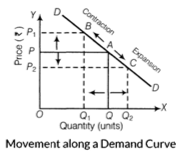
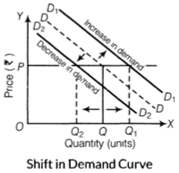
Explain the difference between ‘change in demand’ and ‘change in quantity demanded’
View full question & answer