Questions

3 Marks Question

🎯

Test yourself on this topic

40 questions · timed · auto-graded

Question 13 Marks
Explain the implication of non-price competition in an oligopoly market.
OR
Explain the implication of non-price competition under oligopoly.
Answer
Non-price competition in an oligopoly market implies that a firm distinguish its product by offering quality of service, customer focus, coupons, gifts etc. other than price. Firms are engaged in non-price competition in spite of the additional costs involved, because it is more profitable than selling at a lower price and avoids the risk of a price-war.
View full question & answer
Question 23 Marks
Distinguish between cooperative and non-cooperative oligopoly.
Answer
When firms in an oligopoly market co-operate with each other in determining price or output or both, it is called co-operative oligopoly. When the firms compete with each other it is called non-co-operative oligopoly.
View full question & answer
Question 33 Marks
Distinguish between perfect oligopoly and imperfect oligopoly.
Answer
  1. Perfect Oligopoly: In an oligopoly industry, if the firms produce homogeneous products, it is called perfect oligopoly.
  2. Imperfect Oligopoly: If the firms, under oligopoly industry, produce differentiated products, it is called imperfect oligopoly.
View full question & answer
Question 43 Marks
"A day without selling costs is nearly impossible". Comment.
Answer
  1. The given statement is correct. It is the expenses which are incurred for promoting sales or inducing customers to buy a good of a particular brand.
  2. This includes, the cost of advertisement through newspaper, television and radio and cost on each other sales promotional activities.
  3. As selling costs by the firms in the form of various promotional tools have become a routine activity and the firm generally persuades or lures the customer to avail from one brand to another.
View full question & answer
Question 53 Marks
State three features of monopoly.
Answer
  1. A single seller market.
  2. No close substitutes of the product.
  3. Barriers to the entry of new firms.
View full question & answer
Question 63 Marks
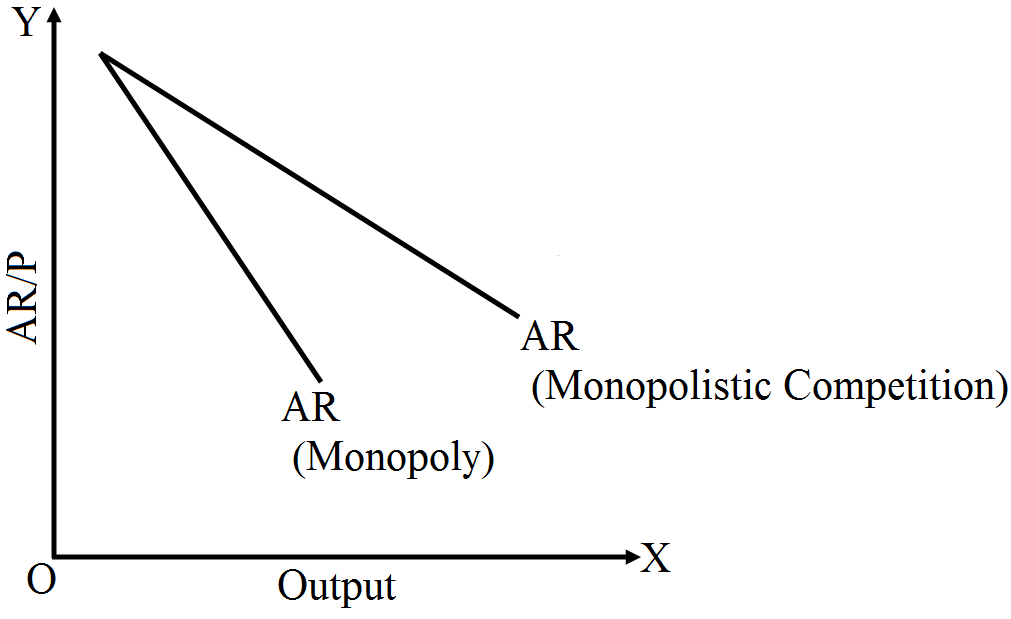
Why AR curve (demand curve) under monopolistic competition is more elastic than AR curve under monopoly?
Answer
  1. AR curve under both the markets slope downwards.
  2. However, AR curve under monopolistic competition is more elastic as compared to AR curve under monopoly because of presence of close substitutes.
  3. AR curve is less elastic in monopoly because of no close substitutes.
View full question & answer
Question 73 Marks
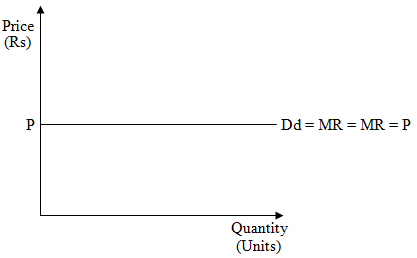
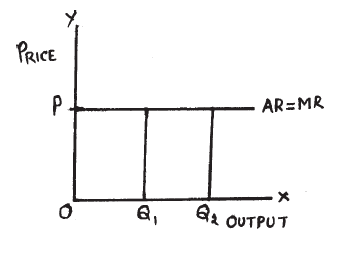
Draw in a single diagram the average revenue and marginal revenue curves of a firm which can sell any quantity of the good at a given price. Explain.
Answer
In such a market whether the firm sells more or sells less, it does not affect the market price. It makes the $AR$ curve parallel to the x-axis so that whether quantity produced is $OQ_1$ or $OQ_2$ market price remains unchanged. Since $AR$ is unchanged $AR$ must be equal to $MR$. The $MR$ curve thus coincides with the AR curve.
View full question & answer
Question 83 Marks
Explain the implications of the following:
The feature ‘differentiated products’ under monopolistic competition.
Answer
Implication: In terms of power to influence price by a firm.
View full question & answer
Question 93 Marks
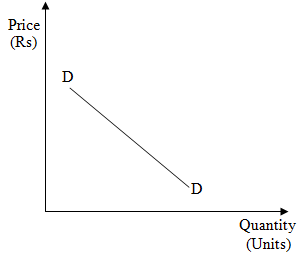
Suppose that the demand curve for the XYZ company slopes downward and to the right. Would you conclude that the firm is a price taker or a price maker? Give reasons.
Answer
  1. Since the demand curve of XYZ Co. is downward sloping, it has to lower its price to sell additional units of output.
  2. But in perfect competition the demand curve is parallel to x-axis as the firm can sell any amount of the output at the same price.
  3. Hence, XYZ Co. is not a price taker but a price maker.
View full question & answer
Question 103 Marks
Explain the cause of limited number of firms in an oligopoly market.
Answer
The number of firms is small in oligopoly because there are barriers which prevent the entry of new firms into the industry. Patents, large capital requirements, control over the important raw materials etc. prevent new firms from entering into the given industry. Only those firms that are able to cross these barriers, enter the industry.
View full question & answer
Question 113 Marks
Explain the feature' interdependence of firms' in an oligopoly market.
Answer
The feature implies that when a producer, in an oligopoly market, takes decision about price or output, he takes into consideration the likely reactions of the rival producers. For taking decisions, thus, a producer in an oligopoly market is dependent on other producers.
View full question & answer
Question 123 Marks
From the following table, find out the level of output at which the producer will be in equilibrium. Give reasons for your answer.
Output

(units)
Marginal Revenue

Marginal Cost

1

2

3

4

5
8

8

8

8

8
10

8

7

8

9
Answer
The producer will be in equilibrium at 4 units of output because at this level of output:
  1. MC = MR, and
  2. Beyond this, MC > MR.
These are the two conditions of producers equilibrium which are satisfied when 4 units are produced.
View full question & answer
Question 133 Marks
Explain the main features of barriers to the entry of firms.​​​​​​​
Answer
  1. The main reason why the number of firms is small is that there are barriers which prevent entry of firms into industry.
  2. Patents, large capital, control over the crucial raw material etc, prevent new firms from entering into industry.
  3. Only those who are able to cross these barriers are able to enter.
View full question & answer
Question 143 Marks
Why are the firms said to be interdependent in an oligopoly market? Explain.
Answer
When there are only a few firms in the market, it is likely that each firm has some Knowledge as to how its rivals operate. Each firm expects reactions from the rival firms. Therefore, each firm in deciding price and output, takes into account the expected reactions by the rival firms. In this way the firms are interdependent on each other.
View full question & answer
Question 153 Marks
Explain the implication of 'perfect knowledge about market' under perfect competition.
Answer
Perfect knowledge means that both buyers and sellers are fully informed about the market price. Therefore no firm is in a position to charge a different price and no buyer will pay a higher price. As a result a uniform price prevails in the market.
View full question & answer
Question 163 Marks
Why is the average revenue curve of a monopolist less elastic than the average revenue curve of a firm under monopolistic competition? Explain.
Answer
The AR curve under monopoly is less elastic than the AR curve under monopolistic competition because of availability of close substitutes in case of monopolistic competition. Close substitutes are not available in case of monopoly and therefore, the AR curve is less elastic under monopoly.
View full question & answer
Question 173 Marks
Explain the relation between marginal revenue and total revenue.
Answer
  1. When MR is positive TR increases.
  2. When MR is zero TR is constant.
  3. When MR is negative TR decreases.
View full question & answer
Question 183 Marks
Explain any two sources of restricted entry under monopoly.
Answer
  1. Grant of patent rights:
  1. When a company introduces a new product or new technology it applies to the government to grant it patent certificate by which it gets exclusive rights to produce new product or in use new technology.
  2. Patent rights prevent others to produce the same productor use the same technology without obtaining license from the concerned company. Patent rights are granted by the government for a certain number of years.
  1. Licensing by Government: A monopoly market emerges when government gives a firm license, i.e. exclusive legal rights to produce a given product or service in a particular area or region.
View full question & answer
Question 193 Marks
Explain the significance of the feature 'product differentiation' in monopolistic competition.
Answer
One important feature of monopolistic competition is that the product produced and sold by various firms (or sellers) is not identical but is slightly different from each other. Products are differentiated from each other on the basis of brand, name, shape, colour, packing etc. These differentiated products are close substitutes of each other and therefore, their price cannot be very much different from each other. Each firm enjoys some monopoly on its product and is in a position to fix its price to some extent.
View full question & answer
Question 203 Marks
Explain what happens to the profits in the long run if the firms are free to enter the industry.
Answer
When existing firms are earning profit, freedom of entry induces new firms to enter the industry. This raises market supply which in turn leads to fall in market price. Profits fall and continue to fall till each firm is earning zero economic profit/normal profit/Zero profit.
View full question & answer
Question 213 Marks
State the relation between marginal revenue and average revenue.
Answer
When MR < AR, AR falls.
When MR = AR, AR is constant.
When MR > AR, AR rises.
View full question & answer
Question 223 Marks
Explain the free entry and exit of firms' feature of monopolistic competion.
Answer
  1. New firms can enter the market, if found profitable. Similarly, inefficient firms already operating in the market are free to quit the market if they incur losses.
  2. It is because of this feature that like perfect competition, monopolistic competition also gives rise to normal profit.
  3. No firm receives abnormal profit in the long run as then new firms can emerge and old ones can expand output and adjust supply with changing demand.
View full question & answer
Question 233 Marks
Explain the implication of non-price competition in an oligopoly market.
Answer
Non-Price competition means competition between firms on the basis of methods other than price. Firms try to avoid price competition for the fear of price-war. They use other methods like advertising, better services to customers. etc to compete with each other.
View full question & answer
Question 243 Marks
Explain what happens to losses in the long run if the firms are free to leave the industry.
Answer
When existing firms are incurring losses, the firms start leaving the industry. This reduces the number of firms. The market supply is reduced which in turn leads to rise in market price. Losses fall and continue to fall till they are wiped out and each firm left in the industry is earning zero economic profit/normal profit/Zero profit.
View full question & answer
Question 253 Marks
Why is the number of firms small in oligopoly? Explain.
Answer
The main reason why the number of firms is small is that there are barriers which prevent entry of firms into industry. Patents, large capital requirement control over the crucial raw materials, etc. prevent new firms from entering the industry. Only those who are able to cross these barriers enter.
View full question & answer
Question 263 Marks
Explain why there are only a few firms in an oligopoly market.
Answer
The main reason why the number of firms is few is that there are barriers which prevent entry of firms into industry. Patents, large capital requirement, control over crucial raw materials, etc. prevent new firms from entering into industry. Only those who are able to cross these barriers are able to enter.
View full question & answer
Question 273 Marks
List the three different ways in which oligopoly firms may behave.
Answer
Oligopoly firms may behave in the following three ways:
  1. Cartel: In order to avoid undue competition, oligopolistic firms may engage in formal agreements or contracts. This will not only allow them to maximise their total profits together, but also capture a significant market portion.
  2. Barriers to the entry and exit of new firms: It may happen that existing firms try to adopt enry-prenting- price which restricts the entry of new firms into oligopoly market. Every producer believes in sales maximisation policy instead of profit maximisation while determining prices.
  3. Advertisement and differentiated product: It may happen that the firms realise that price competition will leave them nowhere and consequently they emphasise more on advertising their products. It will enable them to capture the minds of consumers and indirectly increase their market portion.
View full question & answer
Question 283 Marks
What would be the shape of the demand curve so that the total revenue curve is:
  1. a positively sloped straight line passing through the origin?
  2. a horizontal line?
Answer
  1. If the total revenue curve is a positively sloped straight line passing through the origin, then the slope of the demand curve will be a horizontal line parallel to the x-axis. This happens when prices are constant.
  1. If the total revenue curve is a horizontal line, then the demand curve will be downward sloping. Firms can increase their volume by decreasing the price i.e., AR falls with increase in sales.
View full question & answer
Question 293 Marks
Explain why the demand curve facing a firm under monopolistic competition is negatively sloped.
Answer
A monopolistic firm has differentiated products; thus, it has to lower its price in order to increase its sales. The products of different monopolistic firms are close substitutes to each other. Hence, the demand for all the products is elastic. For this reason, the demand curve is negatively sloped.
View full question & answer
Question 303 Marks
Why is Average Revenue always equal to price?
Answer
$\text{Given AR}=\frac{\text{TR}}{\text{Q}}$$\text{Since TR}={\text{P}}\times\text{Q}$
$\text{AR}=\frac{\text{P}\times{\text{Q}}}{\text{Q}}=\text{P.}$
View full question & answer
Question 313 Marks
Complete the following table:
Output

(Units)
Total Revenue

(Rs.)
Marginal Revenue

(Rs.)
Average Revenue

(Rs.)
1 - - 8
2 - 4 -
3 12 - 4
4 8 - 2
Answer
Output TR MR AR
1 8 8 8
2 12 4 6
3 12 0 4
4 8 - 4 2
View full question & answer
Question 323 Marks
Why is the number of firms small in an oligopoly market? Explain.
Answer
Number of firms is small in Oligopoly because of barriers to entry into industry. Patents, large capital requirement, control over crucial raw material etc. prevent new firms from entering.
View full question & answer
Question 333 Marks
What is meant by price rigidity, under oligopoly?
Answer
  1. Price rigidity refers to a situation in which whether there is change in demand and supply the price tends to stay fixed.
  2. If a firm tries to reduce the price the rivals will also react by reducing their prices. Likewise, if it tries to raise the price, other firms will not do so. It will lead to loss of customers for the firm which intended to raise the price.
View full question & answer
Question 343 Marks
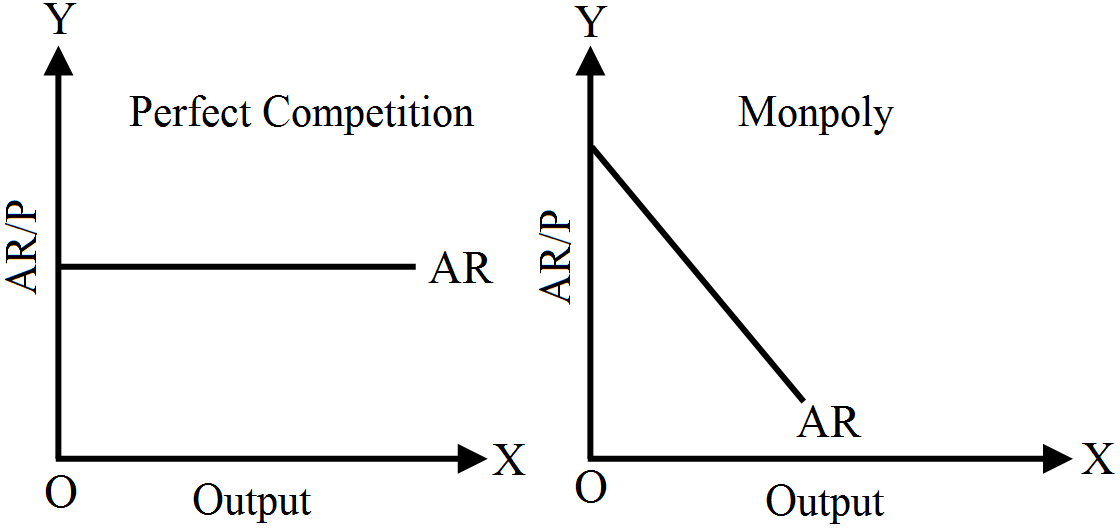
Draw the average revenue curve of a firm under (a) monopoly and (b) perfect competition. Explain the difference in these curves, if any.
OR
Why is the average revenue curve of a firm under perfect competition parallel to OX-axis and negatively sloped under monopoly?
Answer
Under perfect competition:
  • The average revenue curve of a firm under perfect competition is parallel to x-axis whereas under monopoly it is downward sloping steeper curve.
  • A perfectly competitive firm is a price-taker and can sell as much as it likes at the prevailing price (given price). Therefore, AR is equal to price and remains constant. It is parallel to x-axis whereas under monopoly the firm is a price-maker and can increase its sales only when the price of the good falls. Therefore, when price or AR falls, the firm can increase its sales. Thus, under monopoly, AR curves is negatively sloped or downward sloping.
View full question & answer
Question 353 Marks
Why is the demand curve of a firm under monopolistic competition more elastic than under monopoly? Explain.
Answer
Under monopoly there are no close substitutes of the good but under monopolistic competition there are close substitutes of the good in market. Therefore, under monopoly consumers have no choice other than buying the product whereas in monopolistic competition, close substitution provide a variety of options for the consumer. It makes the demand under monopolistic competition more elastic than under monopoly.
View full question & answer
Question 363 Marks
  1. ‘Differentiated products’ feature of monopolistic competition.
Answer
Differentiated products: Another feature of the monopolistic competition is the product differentiation. Product differentiation refers to a situation when the buyers of the product differentiate the product with other. Basically, the products of different firms are not altogether different; they are slightly different from others. Although each firm producing differentiated product has the monopoly of its own product, yet he has to face the competition. This product differentiation may be real or imaginary. Real differences are like design, material used, skill, etc. whereas imaginary differences are through advertising, trade mark and so on.
View full question & answer
Question 373 Marks
A monopoly firm has a total fixed cost of Rs. 100 and has the following demand schedule:
Quantity 1 2 3 4 5 6 7 8 9 10
Price 100 90 80 70 60 50 40 30 20 10
Find the short run equilibrium quantity, price and total profit. What would be the equilibrium in the long run? In case the total cost was Rs. 1000, describe the equilibrium in the short run and in the long run.
Answer
Quantity Price TR (P × Q)
1 100 100
2 90 180
3 80 240
4 70 280
5 60 300
6 50 300
7 40 280
8 30 240
9 20 180
10 10 100
The total cost of the monopolist firm is zero. The profit will be maximum where TR is maximum. As, in the above case, TR is maximum at the 6th unit of output.
Profit of the firm = 300
Short run equilibrium price = Rs. 50
Profit = TR – TC
= 300 - 0 = 300
As per the case if the total cost is Rs. 1000 then
= 300 - 1000 = -700
The firm is earning loss in the short run and It hill stop its production in the long run.
View full question & answer
Question 383 Marks
Selling cost is a nail in the coffin of consumer's sovereignty. How?
Answer
  1. Selling cost is the expenses which are incurred for promoting sales or inducing customers to buy a good of a particular brand.
  2. Theoretically, a consumer is the king because whatever he desires/ demands is produced/ supplied.
  3. But in reality this is not so. Advertisement and salesmanship bias his mind in favour of certain commodities which otherwise may not be good.
View full question & answer
Question 393 Marks
Explain why are firms mutually interdependent in an oligopoly market.
Answer
Firms are mutually interdependent because an individual firm takes decision about price and output after considering the possible reactions by the rival firms.
View full question & answer
Question 403 Marks
Distinguish between collusive and non-collusive oligopoly.
Answer
Collusive oligopoly refers to a situation where firms cooperate with each other rather than compete in setting price and output. Agreement (written or oral) may be entered to cooperate by raising prices, restricting output, dividing markets or otherwise. Whereas Non-collusive oligopoly refers to the situation where firms compete with each other and follow their own price and output policy independent of the rival firms. Every firm tries to increase its market share through competition.
View full question & answer
3 Marks Question - Economics STD 11 Commerce Questions - Vidyadip