Questions

4 Marks Question

Take a timed test

32 questions · self-marked practice — reveal the answer and mark yourself.

Question 14 Marks
Give any three points of difference between monopoly and monopolistic competition.
Answer
Monopoly differs from monopolistic competition in the following ways:
  1. Under monopoly, there is a single seller of a product, whereas under monopolistic competition there are large number of sellers (firms) selling a product.
  2. A monopolist produces or sells a product which has no close substitutes. On the other hand, the various firms working under monopolistic competition produce and sell differentiated products, which are close substitutes of each other.
  3. In case of monopoly, there are strong barriers to the entry of new firms in the industry. Whereas under monopolistic competition there is free entry of new firms in the industry, as there are no restrictions on their entry.
View full question & answer
Question 24 Marks
Explain the implication of the following: The feature of ‘no close substitutes' under monopoly.
Answer
No close substitute:
  1. A monopolist produces all the S output in a particular market. So, there is no close substitute in monopoly.
  2. The monopolist is a 'price-maker'. It does not mean that monopolist can fix both price and the quantity demanded. If he fixes a high price, less commodity will be demanded.
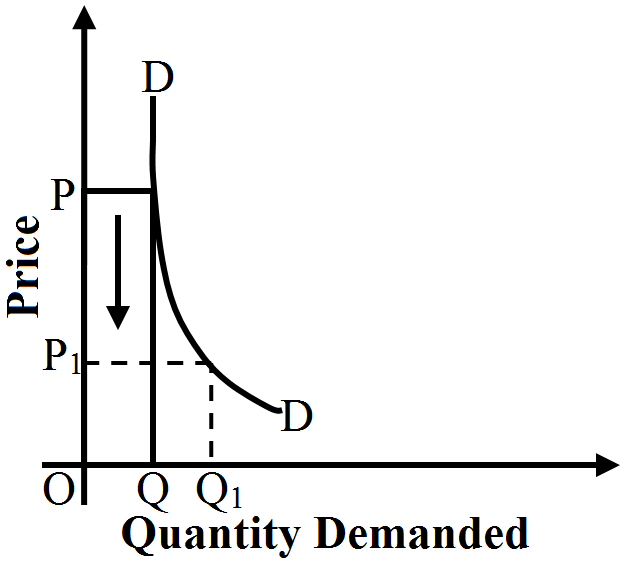
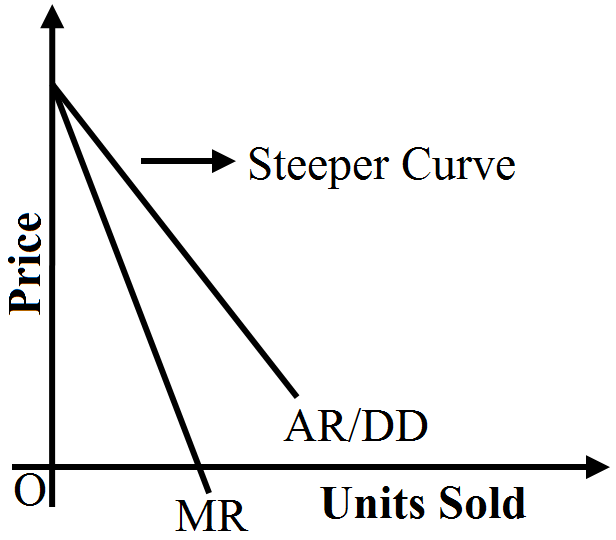
  3. Implication: The result is an inelastic demand curve as shown in Figure. The demand curve is a constraint facing a monopoly firm. Demand curve is also the price line and the AR curve. Since AR is downward sloping, MR lies below AR curve and is twice as steep as the AR curve.
View full question & answer
Question 34 Marks
Demand curve facing a monopoly firm is a constraint for the monopolist." Comment.
Answer
  1. A monopoly firm has market power and is itself a price-maker. It can choose any price, it likes.
  2. Unlike perfect competition where as output increases, price remains unchanged.
  3. In monopoly as output increases or decreases, price changes according to what consumers are willing to pay along the demand curve. It produces and supplies a product to satisfy the entire market.
  4. It is because a monopoly firm faces the entire demand of the market, that market demand curve is said to be a constraint facing a monopoly firm.
View full question & answer
Question 44 Marks
The market demand curve for a commodity and the total cost for a monopoly firm producing the commodity is given by the schedules below. Use the information to calculate the following:
Quantity 0 1 2 3 4 5 6 7 8
Price 52 44 37 31 26 22 19 16 13
Quantity 0 1 2 3 4 5 6 7 8
Total Cost 10 60 90 100 102 105 109 115 125
  1. The MR and MC schedules.
  2. The quantites for which the MR and MC are equal.
  3. The equilibrium quantity of output and the equilibrium price of the commodity.
  4. The total revenue, total cost and total profit in equilibrium.
Answer
  1.  
Quantity (units) Price / AR (Rs) $TR = P \times Q (Rs)$ $MR = TR_n - TR_{n-1}$ TC(Rs) $MC = TC_n - TC_{n-1} (Rs)$
0 52 0 - 10 -
1 44 44 44 60 50
2 37 74 30 90 40
3 31 93 19 100 10
4 26 104 11 102 2
5 22 110 6 105 3
6 19 114 4 109 4
7 16 112 -2 115 6
8 13 104 -8 125 10
  1. MR equals MC at the 6th unit of output i.e., 4.
  2. At equilibrium, MR equals MC, and here MR equals MC at the 6th unit of output, where MC is upward sloping. Thus, the equilibrium price is Rs. 19.
  3. TR = RS. 114
TC = Rs. 109

Total profit = TR - TC

= Rs. 114 - 109 = Rs. 5
View full question & answer
Question 54 Marks
Give reasons for the following statements:
  1. Demand curve facing a perfectly competitive firm is a horizontal straight line.
  2. Demand curve facing a monopolistic competitive firm is a downward sloping curve.
  3. Demand curve facing a monopoly firm is less elastic than that curve facing a monopolistic competitive firm.
Answer
  1. Under perfect competition, every firm is a price-taker firm. The price is set by industry demand and supply. Therefore, every firm faces a horizontal straight line demand curve indicating that it can sell any quantity at the given price.
  2. A monopolistic competitive firm has to design its own pricing strategy. It can expect to sell larger quantity at a lower price, and vice-versa. Hence, its demand curve slopes downwards.
  3. A monopolist is the only producer of a good which has no close substitutes. A monopolistic competitive firm, on the other hand, produces a good that has several close substitutes. Hence, the demand curve facing a monopolistic competitive firm is more elastic than that faced by a monopoly firm.
View full question & answer
Question 64 Marks
From the schedule provided below calculate the total revenue, demand curve and the price elasticity of demand:
Quantity 1 2 3 4 5 6 7 8 9
Marginal Revenue 10 6 2 2 2 0 0 0 -5
Answer
Quantity Marginal Revenue TR Demand curve(TR/Q) $\text{ED}=\frac{\Delta\text{Q}}{\Delta\text{P}}\times\frac{\text{P}}{\text{Q}}$
1 10 10 10.00  
2 6 16 8.00 $\frac{1}{2}\times\frac{10}{1}=5$
3 2 18 6.00 $\frac{1}{2}\times\frac{8}{2}=2$
4 2 20 5.00 $\frac{1}{1}\times\frac{6}{3}=2$
5 2 22 4.40 $\frac{1}{0.5}\times\frac{5}{4}=2.5$
6 0 22 3.67 $\frac{1}{0.9}\times\frac{4.5}{5}=1$
7 0 22 3.14 $\frac{1}{0.5}\times\frac{3.6}{6}=1.2$
8 0 22 2.75 $\frac{1}{0.4}\times\frac{3.1}{7}=1.1$
9 -5 17 1.89 $\frac{1}{0.8}\times\frac{2.7}{9}=0.38$
View full question & answer
Question 74 Marks
Complete the following table:
Output

(Units)
Price

(Rs.)
Total Revenue

(Rs.)
Marginal Revenue

(Rs.)
4 9 36 -
5 - - 4
6 - 42 -
7 6 - -
8 - 40 -
Answer
Output
(Units)
Price
(Rs.)
TR
(Rs.)
MR
(Rs.)
4 9 36 -
5 8 40 4
6 7 42 2
7 6 42 0
8 5 40 -2
View full question & answer
Question 84 Marks
Comment on the shape of the $MR$ curve in case the $TR$ curve is a:
  1. Positively sloped straight line.
  2. Horizontal straight line.
Answer
  1. Positively sloped straight line:
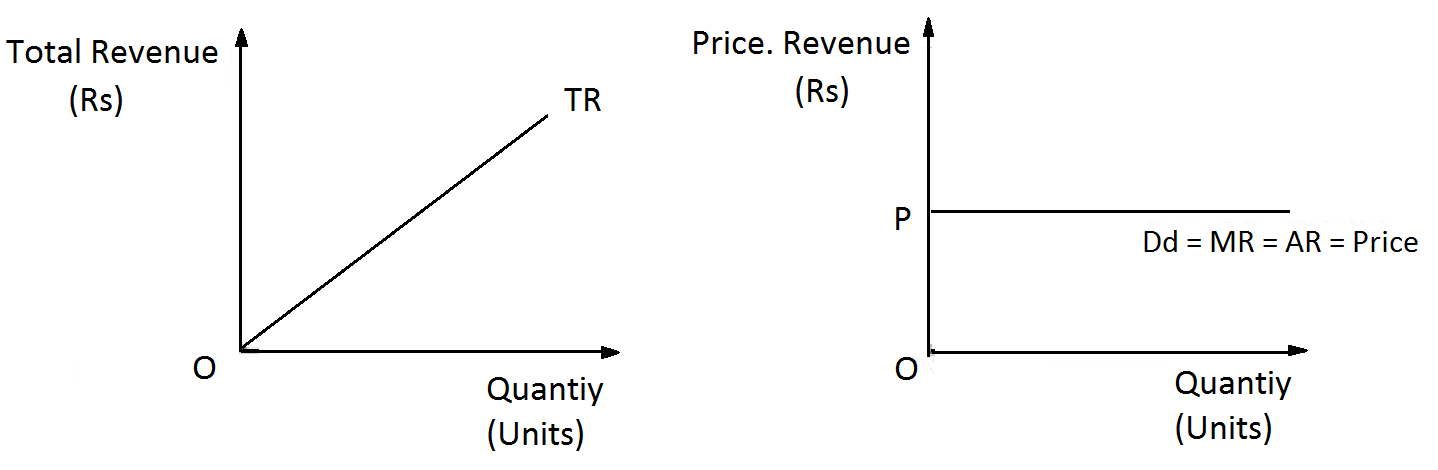
Based on the relationship between $MR$ and $TR$ it can be said that when $TR$ curve is a positively sloped straight line, then $MR$ curve is a horizontal line. $MR$ and demand curve are the same, and the price $(AR)$ remains constant for different output levels. This happens under perfect competition. $MR$ is constant therefore, $TR$ increases at increasing rate. That is why $TR$ is positively sloped strainght line.

  1. Horizontal straight line:
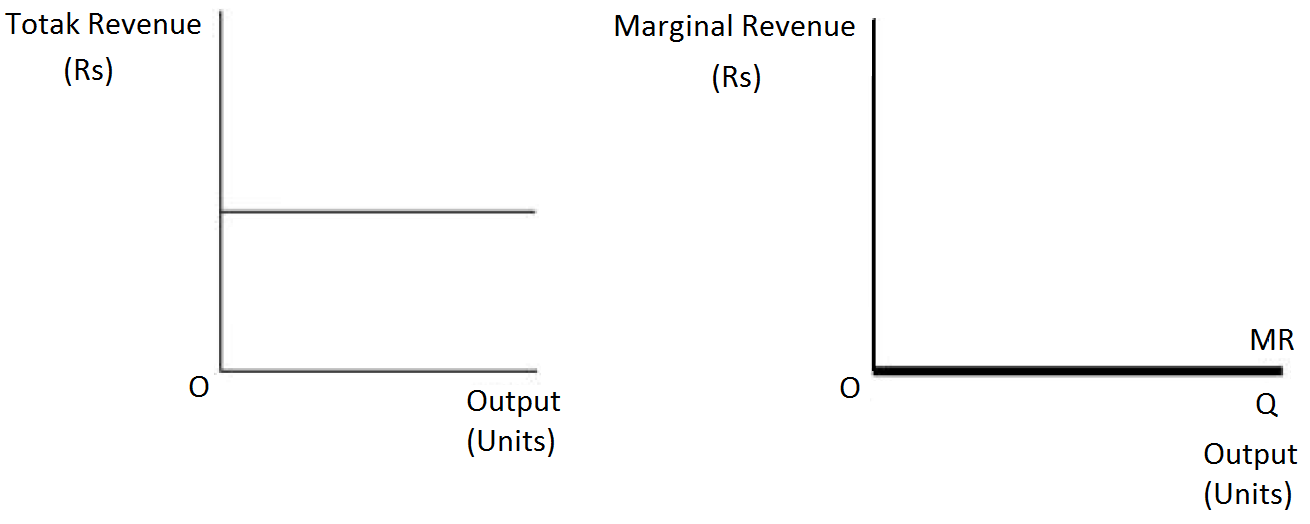
When $TR$ curve is a horizontal straight line, then $MR$ is zero. Therefore, $MR$ curve is also a horizontal straight line and coincides with the output-axis. It is because the units sold is same at every level of output and Marginal revenue is the additional revenue generated from the sale of an additional unit of output.
$MR = TR_n - TR_{n - 1}$

View full question & answer
Question 94 Marks
What will be the effect of the following changes in total revenue on marginal revenue?
  1. Total revenue increases at a decreasing rate.
  2. Total revenue increases at a constant rate.
Answer
  1. MR will be positive and decreasing.
  2. MR will be positive and constant.
View full question & answer
Question 104 Marks
Explain the "interdependence between firms" characteristic of oligopoly market.
Answer
Firms are mutually interdependent because only a few firms dominate the market.A change in price and output by any individual firm is likely to influence the profits and output of the rival firms.This may invite reactions from the rival firms. Therefore, an individual firm must take into account the probable reactions of its rivals before setting his price and output. This makes the firms mutually dependent on each other for taking price and output decisions.
View full question & answer
Question 114 Marks
Explain the implications of the "product differentiation" feature of monopolistic competition.
Answer
It implies that buyers differentiate between the products of different firms.It may be on account of different brand names, packing, colour, shape, the friendly behavior of the seller or any other consideration.These differentiated products are close substitutes of each other.Since a group of buyers prefers the product of a particular producer, that producer enjoys some monopoly in its product and is in a position to influence the market for it.This makes monopolistic competition different from perfect competition.
View full question & answer
Question 124 Marks
Identify the market forms for the sellers of goods A and B, given the following information. Give reasons for your answer.
S. No
Output Sold (in Units)
Price of A ()
Price of B ()
1.
10
5
5
2.
20
5
4
3.
30
5
3
Answer
Market of good A is perfectly competitive, because there is no change in the price, which is assumed to be given as ₹ 5 at various levels of output.
Market of good B may be monopoly or monopolistic competitive market (Imperfect in nature) because in order to sell more of the commodity, the seller has to reduce price.
View full question & answer
Question 134 Marks
Complete the following table:
Output

(Units)
Average Revenue

(Rs.)
Marginal Revenue

(Rs.)
Total Revenue

(Rs.)
1 - 15 -
2 - - 26
3 11 - -
4 - 3 -
Answer
Output

(Units)
AM

(Rs.)
MR

(Rs.)
TR

(Rs.)
1 15 15 15
2 13 11 26
3 11 7 33
4 9 3 36
View full question & answer
Question 144 Marks
Distinguish between cooperative and non-cooperative oligopoly.
OR
Differentiate between collusive and non-collusive oligopoly.
Answer
S. No
Basis
Collusive Oligopoly
Non-Collusive Oligopoly
1.
Meaning
When in an oligopoly market, the firms cooperate with each other in determining prices and output both.
When in Oligopoly market, the firm's compete with each other.
2.
Profit
Under Collusive Oligopoly, the firms would behave as a single monopoly (i.e., cartel) and aim at maximising their collective profit rather than their individual profits.
Under Non-Collusive Oligopoly, each firm aims at maximising its own profits and decides how much quantity to produce assuming that the other firms would not change their quantity supplied.
3.
Aim
All firms collude to form a cartel and fix output and price by themselves through output quotas and market price.
Each firm tries to increase its market share through competition.
4.
Alternative Name
Cooperative Oligopoly.
Non-Cooperative Oligopoly.
View full question & answer
Question 154 Marks
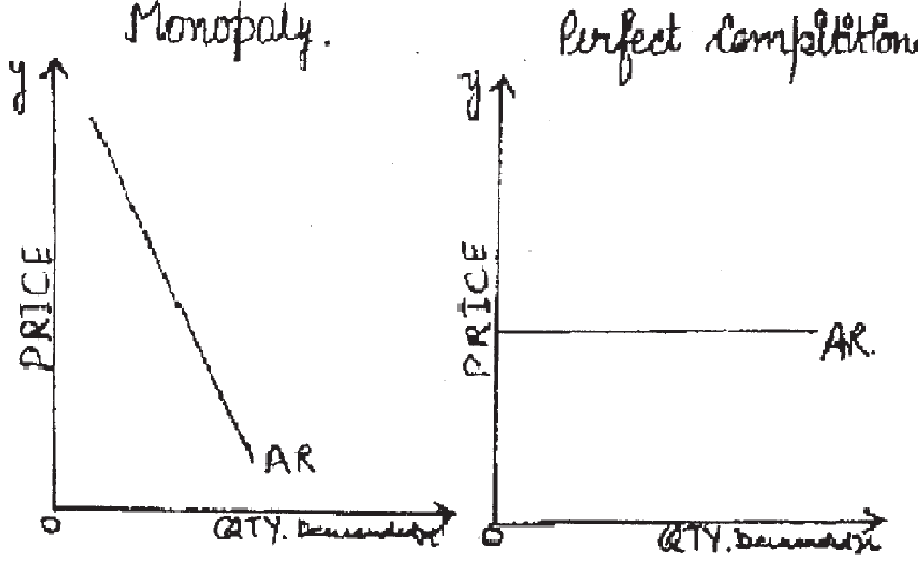
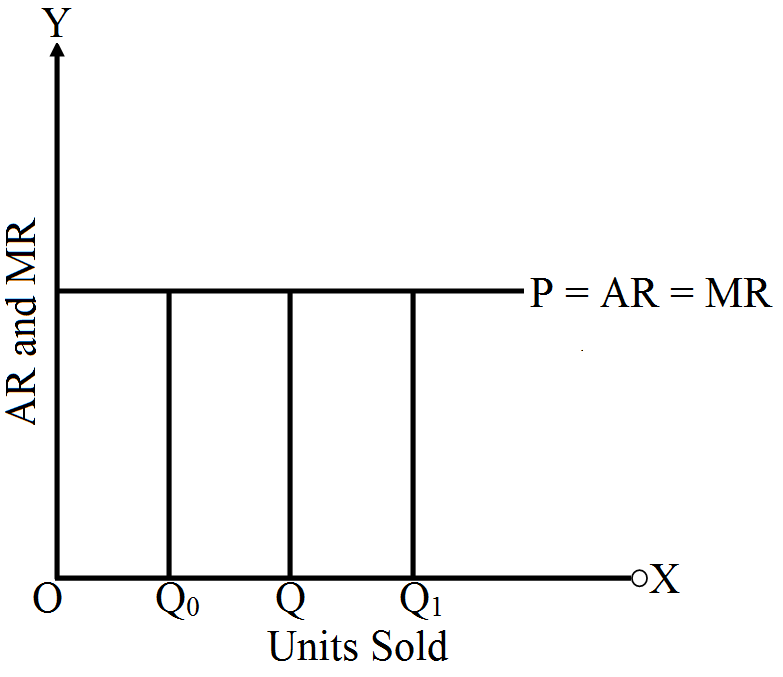
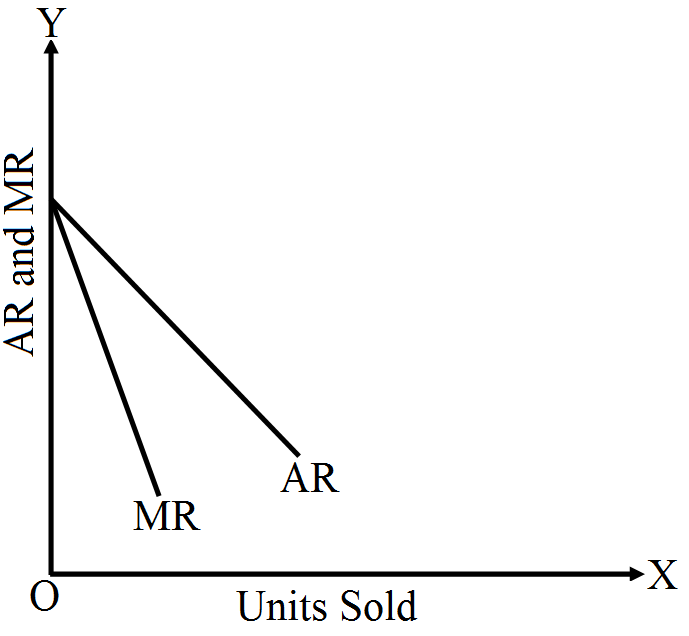
Draw the average revenue curve of a firm under (1) monopoly and (2) perfect competition. Explain the difference in these curves, if any.
Answer

Reasons:
In monopoly, a firm can sell more only at a lower price.
In perfect competition, a firm can sell any quantity at a given price.
View full question & answer
Question 164 Marks
What is the reason for the long run equilibrium of a firm in monopolistic competition to be associated with zero profit?
Answer
In monopolistic competition the number of firms is large. There is free entry and exit of firms. The goods produced are differenciated. In the short run a firm may earn abnormal profit which attracts the new firms. It will expand the output of the commodity. It will cause fall in the market price of the commodity. Thus phenomenon of entry of firms, expansion of output and falling of price will continue till profit become zero. At this level of profit there will be no attraction for new firms to enter in the market. Contrary to it if firms are facing losses in the short run. Some firms would stop producing the commodity. It results in contraction of output that will dead to a higher price. The exit would half once profits become zero. Thus, entry or exit of firms in long run half once profits become zero and this would serve as the long run equilibrium.
View full question & answer
Question 174 Marks
Explain the 'free entry and exit of firms' feature of monopolistic competition.
Answer
Free entry and exit of firms means that there are no barriers before the firm for entering into the industry and leaving the industry. New firms enter when they find that the existing firms are earning super normal profits. With their entry, output of the industry increases, which leads to fall in the price of the product. This continues till each firm is earning only normal profit. The existing firms leave when they face losses. As they leave, output of the industry goes down, raises the price of the product till the losses are wiped out.
View full question & answer
Question 184 Marks
Discuss the relationship between total revenue, average revenue and marginal revenue under perfect competition and monopolistic competition. Use diagrams.
Answer
S .No
 
 
1.
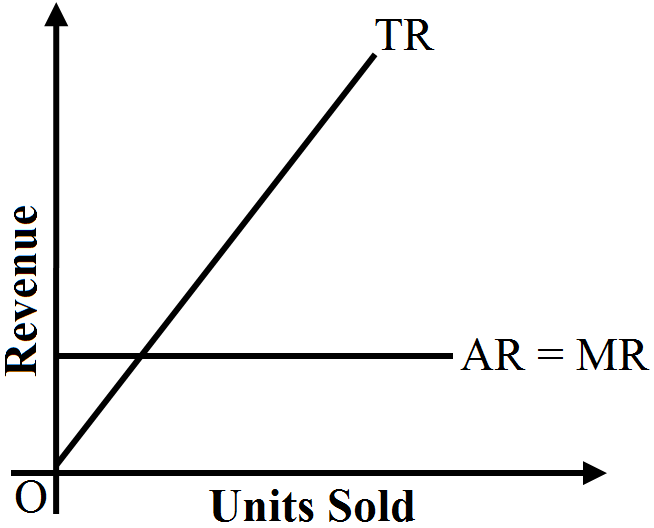
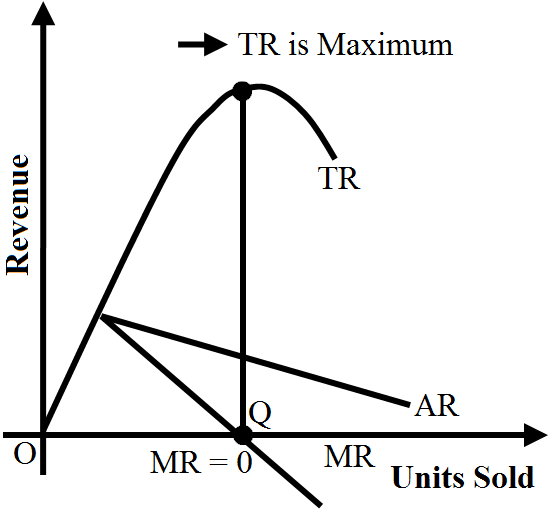
In perfect competition, a firm is not in a position to influence the price; it has to sell its output at the same price. Hence, AR curve and MR curve will be a straight line parallel to X-axis. As a consequence TR increases at constant prices as shown below.
In monopolistic competition a firm can sell more quantity of a commodity only by lowering the price. When price falls means Average Revenue falls and when Average Revenue falls, Marginal Revenue also falls but at a much faster rate, i.e., AR > MR. Total Revenue increases but at a diminishing rate. At point Q where Marginal Revenue = 0, Total Revenue is maximum and constant. After point Q when MR is negative, TR starts falling.
2.
View full question & answer
Question 194 Marks
Give reasons for the following statements:
  1. A perfectly competitive firm is a price-taker.
  2. Product differentiation is a characteristic feature of a monopolistic competitive market.
  3. A monopolist cannot fix both the quantity that he likes to produce and the price at which he would like to sell.
Answer
  1. In a perfectly competitive market there are a large number of producers of a product. All of them produce a homogeneous product. Therefore, all the firms have to sell at the same price. This price is determined by industry demand and supply.
  2. In a monopolistic competitive market there is a large number of producers. But each of these producers produces a product which is somewhat different from what others do. At least, the producers make all the attempts to influence the consumer with the idea that their product is better than the product of the rival producers.
  3. A monopolist is faced with a downward sloping curve. He can sell a larger quantity at a lower price; or alternatively, he may charge a higher price and be satisfied with lower quantity. He has to make a choice between the two alternatives.
View full question & answer
Question 204 Marks
Define revenue. State the relation between marginal revenue and average revenue.
Answer
Revenue in Economics refers to the market value of output produced Or receipts from sale of output produced.If MR > AR, AR rises.
If MR = AR, AR is constant.
If MR < AR, AR Falls.
View full question & answer
Question 214 Marks
Explain the feature of few firms in an oligopoly market.
Answer
  1. The number of sellers in an oligopoly market is small-when there are two or more than two, but not many sellers.
  2. What matters is that these few sellers account for most of the industry's sales.
  3. These "few” sellers consciously dominate the industry and indulge in intense competition. Each firm is aware of that it possesses a large degree of monopoly power.
  4. For example, the market for mobile service provider in India is an oligopolist structure as there are only few producers of mobile service provider. There exists severe competition among different firms and each firm tries to manipulate both prices and volume of production to outsmart each other.
View full question & answer
Question 224 Marks
Draw a demand curve in different market situation and also compare its elasticity of demand.
Answer
1.
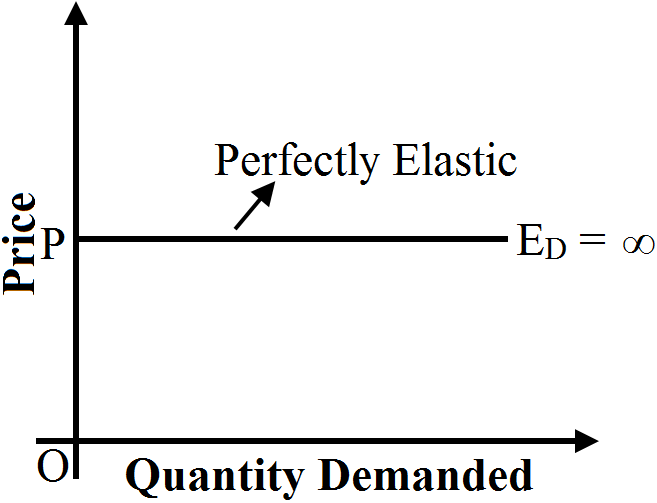
Perfect Competition: As we know in perfect competition homogeneous goods are produced. So, price remains constant and we are having perfectly elastic demand.
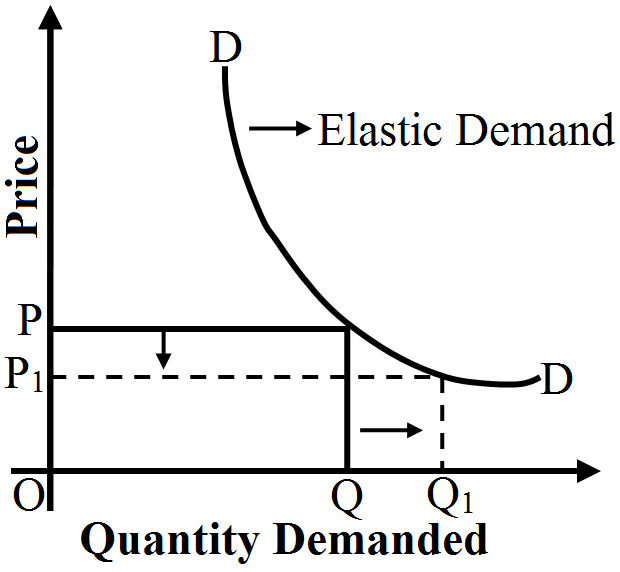
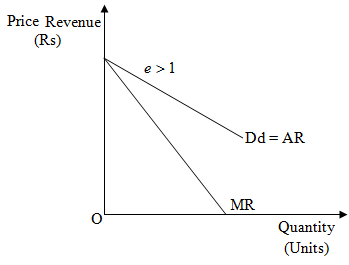
Monopolistic Competition: As we know, in monopolistic competition close substitutes are produced. So, demand fluctuates more proportionately than the price of the commodity. So, we are having more than unit elastic demand.
Monopoly: As we know in monopoly no close substitute are produced. That is why demand fluctuates less proportionately than the price of the commodity. So, we are having less than unitary elastic demand.
2.
3.
PED = Perfectly elastic demand.
PED > 1 More than unitary elastic demand.
PED < 1 Less than elastic demand.
View full question & answer
Question 234 Marks
Distinguish between perfect and imperfect oligopoly.
Answer
S. No
Basis
Perfect oligopoly
Imperfect oligopoly
1.
Meaning
In the case of perfect oligopoly, firms produce homogenous products
In imperfect oligopoly, firms produce differentiated products.
2.
Example
Copper, iron and steel and aluminium.
Toilet soap, cigarettes or soft drinks.
3.
Alternative name
Pure oligopoly
Impure or Differentiated.
View full question & answer
Question 244 Marks
Under perfect competition, the seller is a price taker. Under monopoly, he is the price maker. Explain.
OR
Briefly explain why a perfectly competitive firm is a price taker in this market.
Answer
Under perfect competition, there are a large number of sellers selling 'homogenous product'. Each seller sells so less that none of them can influence the price in the market. The price of a commodity under perfect competition is determined by the forces of demand and supply of the product. Every seller accepts the price as given/ determined by the industry. No individual firm can influence this price. It has to decide how much quantity of the commodity it wants to sell. It is because of this that the seller under perfect competition is a "price taker".
On the other hand, under monopoly, there is a single seller of a product which has no close substitutes. The seller has substantial control over the supply. He is in a position to influence the price of the product. Demand curve facing a monopolist slopes downward which implies that if he charges a higher price, quantity demanded of its product will be less, if he fixes a lower price, quantity demanded will be more. He will fix a price which maximises his profits. Thus, under monopoly, the seller is a price maker and not price taker.
View full question & answer
Question 254 Marks
What change in total revenue will result in (1) a decrease in marginal revenue, and (2) an increase in marginal revenue?
Answer
  1. An increase in total revenue at a diminishing rate or a decrease in total revenue will result in a decrease in marginal revenue.
  2. An increase in total revenue at an increasing rate will result in an increase in marginal revenue.
View full question & answer
Question 264 Marks
Explain the feature of firms mutually interdependent in an oligopoly market.
OR
Explain the feature of interdependence of firms in an oligopoly market.
Answer
  1. Interdependence means that actions of one firm affects the actions of other firms.
  2. Since the number of sellers is small, each firm has to take into consideration the possible reaction of its competitors, when making decisions.
  3. The business decision of a single seller will have a substantial impact on the product price, output and profits of the rival firms.
  4. For example the "National Newspapers" market, when the "Economic Times" introduced invitation pricing policy-they offered the newspaper at a price of ₹ 1.50 on weekdays. The Hindustan Times was forced to reduce its prices from ₹ 2.50 per copy to ₹ 1.50 per copy on weekdays. When Hindustan Times was celebrating its 75 years of service, they offered the newspaper at ₹ 1/- weekdays. The Times of India responded by matching the price cut.
View full question & answer
Question 274 Marks
Under perfect competition, MR = AR, but under monopoly, MR < AR. Explain.
Answer
  1. Under Perfect Competition, AR = MR: Here, industry is the price maker and firm is the price taker. A firm has to accept the price as given by the industry. At this price a firm can sell any amount of the commodity it wants. This means that with sale of every additional unit, additional revenue (i.e., MR) and average revenue (AR) will be equal to the price and thus equal to each other.
  1. Under Monopoly, MR < AR: Here, more of a commodity can be sold only at a lower price and thus MR
View full question & answer
Question 284 Marks
Complete the following table:
Price

(Rs.)
Output

(Units)
Total Revenue

(Rs.)
Marginal Revenue

(Rs.)
- 1 6 -
4 - - 2
- 3 6 -
1 - - - 2
Answer
Price

(Rs.)
Output

(units)
TR

(Rs.)
MR

(Rs.)
6 1 6 6
4 2 8 2
2 3 6 - 2
1 4 4 - 2
View full question & answer
Question 294 Marks
Explain two points of distinction between monopoly and monopolistic competition.
Answer
Points of distinction between monopoly and monopolistic competition:
  1. Under monopoly there is a single seller/producer of the commodity where as under monopolistic competition there are large number of sellers. So the firm under monopoly has greater influence over price then under monopolistic competition.
  2. There is freedom of entry of new firms under monopolistic competition whereas there is no such freedom under monopoly. As a result a monopolist can earn abnormal profits in the long run.
  3. Under monopolistic competition the product is heterogeneous while under monopoly there are no close substitutes of the product.
  4. The demand in a monopoly market is less elastic than the demand under monopolistic competition because under monopoly there are no close substitutes of the product.
View full question & answer
Question 304 Marks
What is meant by prices being rigid? How can oligopoly behaviour lead to such an outcome?
Answer
Price rigidity implies that the price is unresponsive to the changes in demand. Every firm in an oligopoly market is faced with a Kinked Demand Curve, the kink being at that point on the demand curve which corresponds to the prevailing common price accepted by all the firms at which they sell their output.This is because of the fact that even if any firm raises the price of its product with the motive of earning higher profits, the other firm will not do so, and the first firm will lose its customers. On the other hand, if one firm lowers its price in order to earn higher profits by maximising its sales, then in response, the other firm may also reduce the price. Consequently, the increase in total market sales is shared by both the firms. The firm that initiated selling at a lower price may get a lower share of the increase than expected.
Therefore, the firms do not change their prices due to the fear of rival's reaction. Hence, there is no incentive for any firm to change its price. That is why the prices are regarded as rigid prices or sticky prices.
View full question & answer
Question 314 Marks
How the efficiency may increase if two firms merge?​​​​​​​
Answer
  1. Suppose that initially there are two firms in an industry and both are same but inefficient.
  2. Their MC curves are at a high level and consequently they charge a higher price and produce less.
  3. They realize, however, that if they merge with each other - and thereby become a monopoly-they can reduce their cost.
  4. For instance, one firm may have excellent technical manpower but may not have good marketing skills, whereas the other may not have good technical manpower but possesses superior marketing knowledge by merging the resulting monopoly firms MC curve will be at a lower level and thus it will be more efficient firm.
  5. This, by itself will induce the monopoly to charge a price which HR is less and produce a quantity which is greater than when both firms were competing with each other.
View full question & answer
Question 324 Marks
What is the value of the MR when the demand curve is elastic?
Answer
When demand curve is elastic $(e_d > 1$), then according to the relationship $\text{MR}=\text{p}\Big(1-\frac{1}{\text{e}_\text{d}}\Big),$ the fraction $\frac{1}{\text{e}_\text{d}}$ will be less than 1. Hence, MR will be positive when $\text{p}\Big(1-\frac{1}{\text{e}_\text{d}}\Big)$is positive. AR or demand curve will never be 0 as TR is always positive.
View full question & answer
4 Marks Question - Economics STD 11 Commerce Questions - Vidyadip