Question
Demand curve facing a monopoly firm is a constraint for the monopolist." Comment.

Answer

  1. A monopoly firm has market power and is itself a price-maker. It can choose any price, it likes.
  2. Unlike perfect competition where as output increases, price remains unchanged.
  3. In monopoly as output increases or decreases, price changes according to what consumers are willing to pay along the demand curve. It produces and supplies a product to satisfy the entire market.
  4. It is because a monopoly firm faces the entire demand of the market, that market demand curve is said to be a constraint facing a monopoly firm.

Need a full question paper?

Generate a complete, print-ready paper with questions like this in minutes — across 16+ boards, with answer keys.
Start Generating Free

Similar questions

Explain with the help of a diagram the effect of a decrease in demand for a commodity on its equilibrium price and quantity
OR
Explain the chain of effects on demand, supply and price of a commodity caused by a leftward shift of its demand curve. Use diagram.
When price of a good rises from ₹ 8 per unit to ₹10 per unit, producer supplies 40 units more. Price elasticity of supply is 2. What is the quantity supplied before the price change? Calculate.
Given the price of a good, how will a consumer decide as to how much quantity of that good to buy? Use utility analysis.
Explain the effect of change in income of a consumer on demand of a good.
Under perfect competition, firms can sell any quantity at the existing price, then why firms are reluctant to reduce the price in order to capture the entire market?
Give the meaning of producer's equilibrium. A producer produces that quantity of his product at which MR and MC are equal, is he earning maximum profits, give reason for your answer.
Draw supply curves with price elasticity of supply throughout equal to:
  1. Zero.
  2. One.
  3. Infinity.
  4. Less than one.
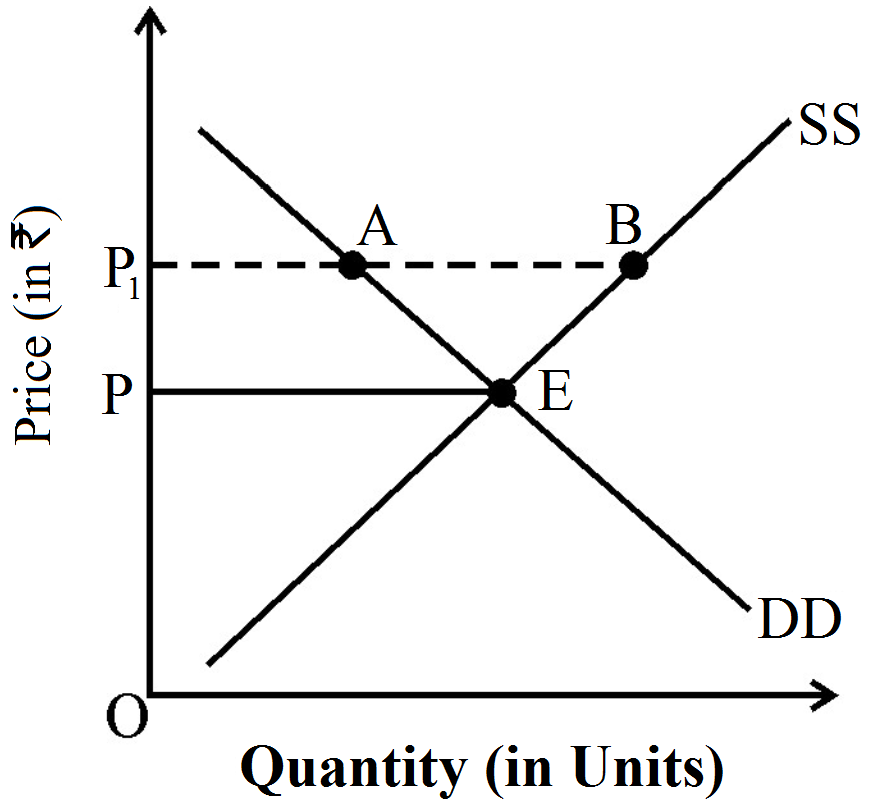
In the given diagram, $OP$ is the market determined price and $OP_1 $is the price fixed by the government.
  1. Identify if the diagram represents, price ceiling or price flooring.
  2. Discuss the likely behaviour of the market in the given condition.
How does an increase in the input price affect equilibrium price and quantity exchanged of a commodity? Use diagram.
Calculate TVC and total cost from the following cost schedule of a firm whose fixed cost is ₹ 10.
Output (Units)
1
2
3
4
Marginal Cost ()
6
5
4
6