Questions

3 Marks Question

Take a timed test

20 questions · self-marked practice — reveal the answer and mark yourself.

Question 13 Marks
What is a class interval? How do the magnitude of the class interval and class limits get determined?
Answer
When the whole range of values is classified in some groups in the form of intervals, then each such interval is known as class interval. For example, we may want to classify a group of people according to age group. Here, the class intervals may be 15 - 19 years, 20 – 24 years, 25 – 29 years etc.
The difference between the upper and lower boundaries of a class interval is called the magnitude of the class interval.
The numerical figures used to specify the lower and upper limits of a 'class interval' are called class limits. For example, if the class interval is 15 – 19 years, the lower class limit is 15 and the upper limit is 19 in this case.
View full question & answer
Question 23 Marks
Do you agree that classified data is better than raw data? Why?
Answer
Yes, classified data is better than raw data. This is because:
  1. Simplification: Raw data are large and difficult to handle. On the other hand, classification facilitates the arrangement of data in a presentable form which appears to be brief and simple for analysis.
  2. Effective: Raw data is not easy to understand and cannot conclude any meaningful information for the study. On the other hand, classification enhances the usage of data as it brings out similarity within the diverse set of data. Thus, classification of things makes it more effective.
  3. Save time: Raw data is huge to search for particular information, whereas classified data saves time when searching for information.
View full question & answer
Question 33 Marks
Give objectives of classification of data.
Answer
The objectives of classification of data are:
  1. To condense the mass of data in a brief and simple form, so as to make them easily understandable.
  2. To clearly reveal the points of similarities and dissimilarities in the statistical data. e.g., married and unmarried, employed and unemployed.
  3. To facilitate the comparison of data.
  4. To present data scientifically.
  5. To make the data attractive and effective.
  6. To provide basis for tabulation. No tabulation is possible without classification.
View full question & answer
Question 43 Marks
What are the general guidelines for the construction of a frequency distribution?
Answer
The general guidelines for the construction of a frequency distribution are:
  1. The number of classes should neither be too small nor too large, preferably between 5 to 15.
  2. All class intervals should be of equal size.
  3. Open-end classes should be avoided.
  4. We should preferably classify the data into exclusive series (if it is not specified otherwise).
  5. We should avoid unequal sized class intervals.
View full question & answer
Question 53 Marks
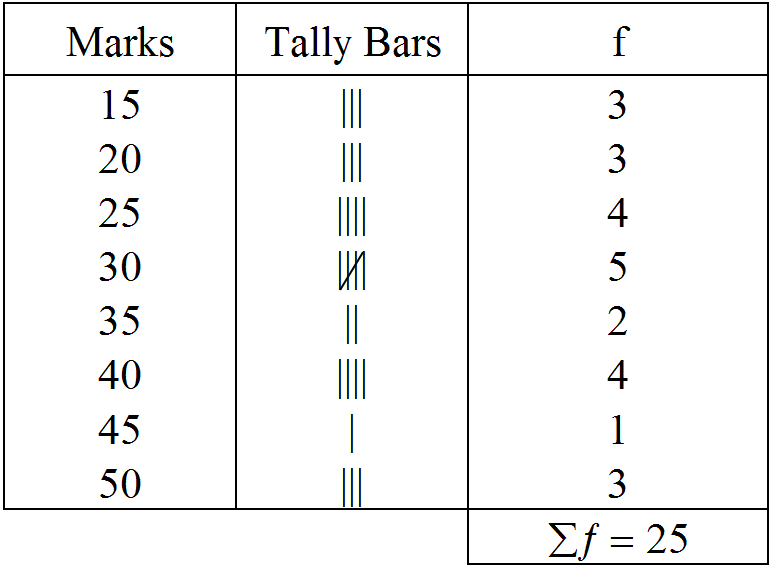
Prepare a frequency array of marks obtained by 25 students of a class in the Economics test:
20, 15, 20, 30, 40, 25, 25, 30, 40, 20, 35, 35, 50, 15, 50, 25, 40, 40, 30, 50, 25, 30, 30, 15, 45
Answer
Array: 15, 15, 15, 20, 20, 20, 25, 25, 25, 25, 30, 30, 30, 30, 30, 35, 35, 40, 40, 40, 40, 45, 50, 50, 50
View full question & answer
Question 63 Marks
The marks obtained by 25 students in a class are as follows:
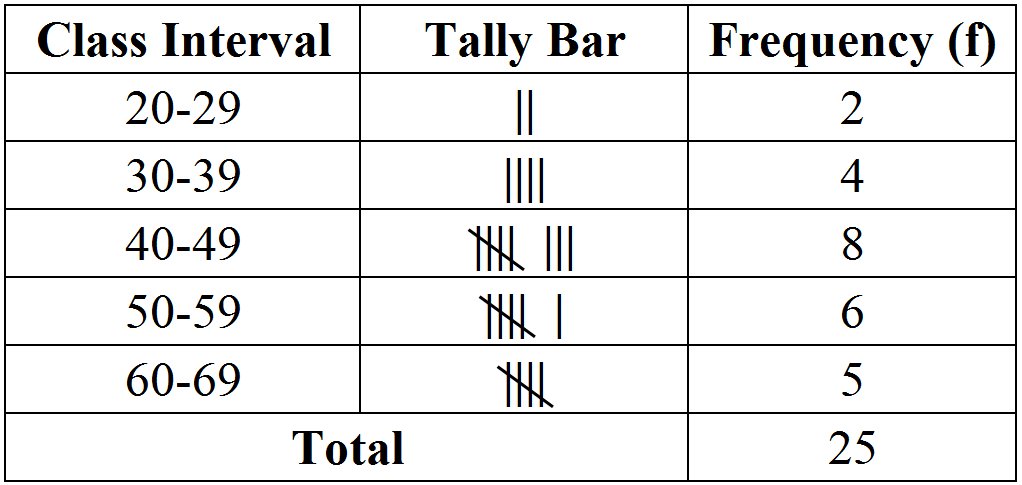
22, 28, 30, 32, 35, 37, 40, 41, 43, 44, 45, 45, 48, 49, 52, 53, 54, 56, 56, 58, 60, 62, 65, 68, 69
  1. Arrange the above data in the form of a frequency distribution taking class interval.
20-29, 30-39, 40-49, 50-59, 60-69
  1. Form the less than cumulative frequency distribution also.
Answer
Here, we can convert given data into frequency distribution and cumulative frequency distribution by using tally bar and inclusive series.
  1. The frequency distribution of given data is shown below.
  1. To form cumulative frequency distribution (less than) of the given distribution, exclusive group will be formed.
Class Interval
Exclusive Group
Frequency (f)
20-29
19.5-39.5
2
30-39
29.5-39.5
4
40-49
39.5-49.5
8
50-59
49.5-59.5
6
60-69
59.5-69.5
5
Total
 
25
Cumulative frequency distribution (less than) is given below.
Class Interval
Cumulative Frequency (cf)
Less than 29.5
2
Less than 39.5
6
Lesss than 49.5
14
Less than 59.5
20
Less than 69.5
25
View full question & answer
Question 73 Marks
Calculate lower limit of the first class and upper limit of last class from the given data:
Classes
Frequency
Less than 10
12
10-20
15
20-30
4
30-40
16
Above 40
3
Total
50
Answer
In the given question, as the class intervals of 2nd, 3rd and 4th classes are uniform, i.e., 10 we can therefore assume that the class-intervals of open-end classes are also equal to 10.
This means that the lower limit of the first class is 10 - 10 = 0 and the upper limit of the last class is 40 + 10 = 50.
View full question & answer
Question 83 Marks
Explain the 'exclusive' and 'inclusive methods used in classification of data.
OR
Distinguish between exclusive method and inclusive method.
Answer
There are two methods of classifying data according to class intervals, namely,
  1. Exclusive method: Under this method, upper limit of the class is excluded. The upper limit of class interval is the lower limit of the next class, e.g.,
Marks
0 - 10
10 – 20
20 – 30
No. of Students
2
5
2
We include those students in first group whose marks are 0 or more but less than 10. If the marks of a student are 10, he is not included in the first group but in the second group, i.e., 10 - 20.
  1. Inclusive method: Under this method, both the lower limit and the upper limit is included in the respective class, e.g.,
Marks
0 - 9
10 – 19
20 – 29
No. of Students
2
5
2
We include students in the first group whose marks are between 0 and 9. If the marks of a student are 10, he is included in the next group, i.e., 10 – 19.
View full question & answer
Question 93 Marks
What do you know about Frequency distribution, Class limits and Class mark.
Answer
A comprehensive way to classify raw data of a quantitative variable is known as a frequency distribution. Class limits are the two ends of a class. The lowest value is called 'lower class limit' and the highest value is called the ‘upper class limit' of a distribution. Class mark refers to class ‘mid-point which is the middle value of a class. It is calculated by the formula given below.$\frac{\text{Class Mark}}{\text{Class Mid-Point}}=\text{Upper limit +}\frac{\text{Lower limit}}{2}$
View full question & answer
Question 103 Marks
Prepare a frequency distribution by inclusive method taking class interval of 7 from the following data.
28 17 15 22 29 21 23 27 18 12 7 2 9 4
1 8 3 10 5 20 16 12 8 4 33 27 21 15
3 36 27 18 9 2 4 6 32 31 29 18 14 13
15 11 9 7 1 5 37 32 28 26 24 20 19 25
19 20 6 9                    
View full question & answer
Question 113 Marks
Construct a frequency distribution with a class interval of 4 on exclusive basis for the following data:
91, 94, 111, 121, 95, 103, 99, 110, 100, 101, 92, 105, 110, 111, 93, 96, 98, 106, 94, 115.
Answer
Array: 91, 92, 93, 94, 94, 95, 96, 98, 99, 100, 101, 103,105, 106, 110, 110, 111, 111, 115, 121 The lowest value is 91 and the highest is 121. We have to take class interval of 4. The classes will be 90 - 94, 94-98 and so on.
C.I.
Tally Bars
Frequency
90-94
///
3
94-98
////
4
98-102
////
4
102-106
//
2
110-114
////
4
114-118
/
1
118-122
/
1
 
 
$\Sigma\text{f}=20$
View full question & answer
Question 123 Marks
Differentiate between Individual, discrete and continuous series.
Answer
S. No.
Difference between Individual, Discrete and Continuous series
1.
Individual Series
Discrete Series
Continuous Series
2.
In individual series, there is only one frequency for each item.
In case of discrete series, there is frequency of more than one for each item.
In case of continuous series, there is frequency of more than one for each item.
3.
Individual series has one column and that is of observations.
In discrete there are two columns, one for frequency and second for variable. Variable is a number.
In continuous series also, there are two columns as in discrete series but variable is in the form of a class.
4.
Values are given after a definite break.
Values are in the form of groups.
View full question & answer
Question 133 Marks
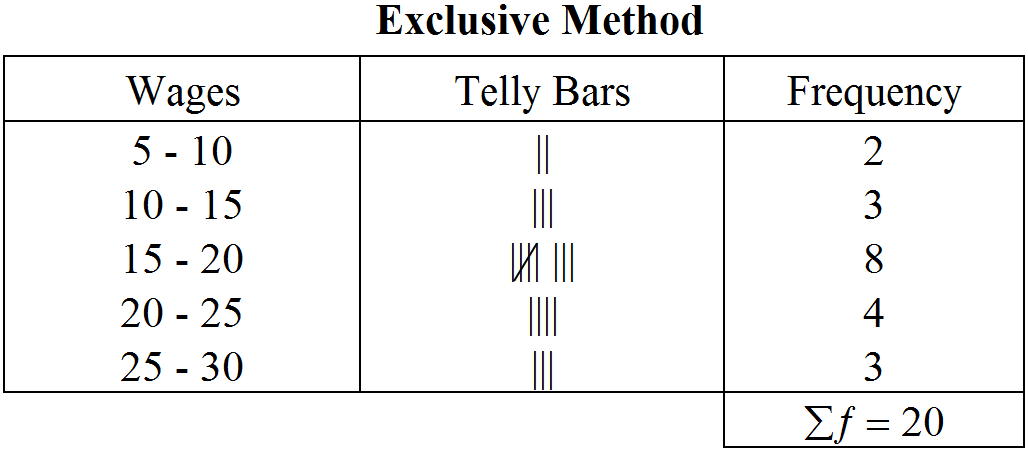
From the following data relating to wages of 20 workers, prepare frequency distribution with a class interval of 5 an exclusive basis:
10, 15, 25, 27, 29, 20, 24, 23, 22, 12, 14, 16, 17, 18, 19, 18, 16, 15, 5, 9
Answer
Array: 5,9, 10, 12, 14, 15, 15, 16, 17, 18, 18, 19, 20, 22,23, 24, 25, 27, 29.
View full question & answer
Question 143 Marks
How is inclusive series converted into exclusive series?
Answer
Following steps are followed to convert an exclusive series into an inclusive series.
  1. Find the difference between upper limit of preceding class and lower limit of succeeding class.
  2. Divide this difference by 2.
  3. Add this number in upper limit of all classes and deduct this number from lower limit of all classes.
For example, if classes are 0 - 9,10 - 19, 20 29 and so on. Then the difference between upper limit and lower limit of two succeeding classes is one. When we divide it by 2, we get 0.5. Therefore on deducting this number from upper limit and adding this number in lower limit, we can get new class intervals as- (-) 0.5 -9.5, 9.5 - 19.5, 19.5 and so on.
View full question & answer
Question 153 Marks
What is loss of information in classified data?
Answer
There is an inherent shortcoming in the classified data. No matter classification of data summarises the raw data by making it concise and easy to comprehend. But it does not show the details found in the raw data. There is thus a loss of information in classifying raw data. On the other hand, much is gained by summarising it as a classified data.
Once the data are grouped into classes, an individual value has no significance in further statistical calculations. Thus, the use of class mark instead of the actual value of the observation in statistics involves indeed, a considerable loss of information.
View full question & answer
Question 163 Marks
Distinguish between univariate and bivariate frequency distribution.
Answer
Univariate Frequency Distribution
Bivariate Frequency Distribution
The word 'Uni' refers to one.
The word 'Bi' refers to two.
This implies a series of statistical information representing the frequency distribution of one variable.
This implies a series of statistical information representing the frequency distribution of two variables such as production and sales of a particular product.
Examples: Marks of a Class VI student, income of an individual in a particular area.
Example: Production and sales of a particular product.
View full question & answer
Question 173 Marks
Explain the following series with the help of suitable examples:
  1. Individual series.
  2. Discrete series.
  3. Continuous series.
Answer
  1. Individual series are those series where there is no frequency of the items, i.e., it is a series without frequencies. They are presented according to serial numbers or in ascending or descending order, E.g., 15, 10, 25, 7, 20 are marks of 5 students in English.
Individual Seris (Marks arranged in ascending order)
X
7
10
15
20
25
  1. Discrete series are those series in which data are presented in away that exact values of items are clearly shown, e.g., 15, 10, 7, 20, 10, 5, 25, 7, 5, 30 are marks of 10 students in English.
Discrete series
Marks
Tally Bars
Frequency
5
//
2
7
//
2
10
//
2
15
/
1
20
/
1
25
/
1
30
/
1
 
 
$\Sigma\text{f}=10$
  1. Continuous series are those series in which the items assume a range of values and are placed within the range or limits, e.g., In this series, items cannot be exactly measured. The items assume a range of values and are placed within the range/ limits. The range is called the “class interval”.
View full question & answer
Question 183 Marks
What is a variable? Distinguish between a discrete and a continuous variable.
Answer
A characteristic, number, or quantity whose value changes overtime is called variable.
For example: Weight, income etc. It can be either discrete or continuous.
Discrete Variable
Continuous Variable
A variable that takes only whole number as its value is called discrete variable.
A variable that can take any value, within a reasonable limit is called a continuous variable
These variables increase in jumps or in complete numbers.
These variables assume a range of values or increase in fractions and not in jumps
For example: Number of people in a family, number of students in a class, etc.
For example: age, height, weight, etc.
View full question & answer
Question 193 Marks
Change the following into continuous series:
Mid-value
5
15
25
35
45
55
Frequency
16
24
30
18
8
4
Answer
C.L.
f
0-10
16
10-20
24
20-30
30
30-40
18
40-5
8
50-60
4
View full question & answer
Question 203 Marks
Categorise and explain the following variables as discretevariables and continuous variables:
  1. Height of a student.
  2. Distance covered.
  3. Number of Students in a class.
Answer
  1. Height of a student is a continuous variable. It is so because it can take fractional values like 80.85 cm, 101.62 cm etc.
  2. Distance covered is a continuous variable. It is so because it can take fractional values like 48.4 km, 59.2 km etc.
  3. Number of students in a class is a discrete variable because it can take value of whole numbers only. It cannot take fractional values, e.g., number of students can be 40 or 41 but not 40.5 or 40.6.
View full question & answer