Question types

Organisation of Data question types

215 questions across 7 question groups — pick any mix to generate a Economics paper with step-by-step answer keys.

215
Questions
7
Question groups
5
Question types
Sample Questions

Organisation of Data questions

One sample from each question group in this chapter. Select any group above to see the full set with answer keys.

A continuous frequency distribution has been grouped as follows:
Group
Less than
$10-25$ $25-40$
More than
Frequency
$5$ $15$ $10$ $8$
They above is an example of:
  • A
    Inclusive distribution.
  • Exclusive distribution.
  • C
    Class frequencies.
  • D
    None of the above.

Answer: B.

View full solution
A frequency distribution table showing value of sales in different columns and advertisement expenditure in different rows is termed as:
  • bilateral frequency distribution.
  • B
    univariate frequency distribution.
  • C
    multivariate frequency distribution.
  • D
    None of these.

Answer: A.

View full solution
Q 233 Marks Question3 Marks
Prepare a frequency array of marks obtained by 25 students of a class in the Economics test:
20, 15, 20, 30, 40, 25, 25, 30, 40, 20, 35, 35, 50, 15, 50, 25, 40, 40, 30, 50, 25, 30, 30, 15, 45
View full solution
Q 244 Marks Question4 Marks
Present the following table in the form of more than series:
Class Interval
Frequncy
10-20
12
20-30
13
30-40
18
40-50
13
50-60
12
60-70
9
70-80
8
80-90
1
Total
86
View full solution
Q 284 Marks Question4 Marks
Prepare a bivariate frequency distribution for the marks by 24 examinees in Statistics and Accountancy.
Marks Marks
Statistics
Accountancy
Statistics
Accountancy
22
16
23
16
23
16
25
17
23
18
23
17
23
16
22
17
23
16
27
16
24
17
27
18
23
16
25
19
25
19
28
19
22
16
25
19
23
18
24
16
24
18
23
17
24
17
24
19
View full solution
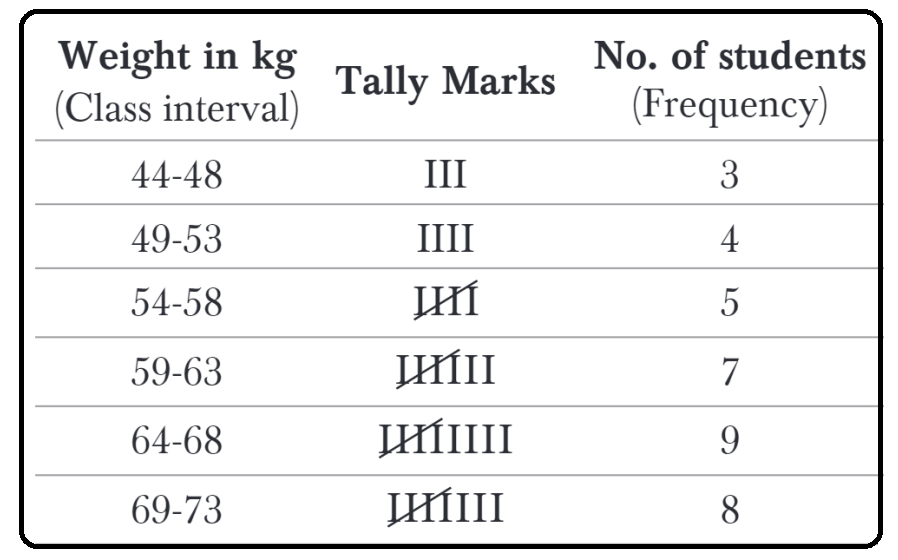
Q 296 Marks Question6 Marks
Direction Read the following case study table carefully and answer questions 1 to 5 on the basis of the same.
  1. The above series is an example of ..... series.
  1. Inclusive
  2. Exclusive
  3. Both (a) and (b)
  4. Neither (a) nor (b)
  1. The above situation shows which of the following types of presentation of data?
  1. Chronological classification
  2. Spatial classification
  3. Qualitative classification
  4. Quantitative classification
  1. What is the percentage of students having weight more than 63 kgs?
  1. 43.25%
  2. 47.22%
  3. 51.63%
  4. 62.32%
  1. How many students have weight less then 58 kgs?
  1. 12
  2. 15
  3. 7
  4. 10
  1. Variable which doesn't take integral values is known as .....
  1. Individual series
  2. Discrete series
  3. Continuous series
  4. None of the above
View full solution
Q 306 Marks Question6 Marks
From the following frequency distribution, prepare 'less than' and 'more than' cumulative frequency distribution.
Weges (In ₹)
100-110
100-120
120-130
130-140
140-150
Number of Workers
4
12
20
7
5
View full solution
Q 316 Marks Question6 Marks
Direction Read the following case study and answer questions 1 to 5 on the basis of the same.
Collection of data is the first step in a statistical analysis. Data can be collected either from primary source or secondary source. Primary data is original as it is being collected for the first time. After collecting the data, next step is to organise the data as raw data cannot be used for further statistical analysis. There are various methods of classification of data based upon the nature of quantitative data.
  1. Time series graphs are presented on the basis of general characteristics of a data. Choose from the options below.
  1. True
  2. False
  3. Partially true
  4. Incomplete statement
  1. Classification of data based on time period is known as ......... classification.
  1. Chronological
  2. Temporal
  3. Spatial
  4. Both (a) and (b)
  1. Data are grouped with reference to the attributes is referred to as ... classification.
  1. Qualitative
  2. Quantitative
  3. Both (a) and (b)
  4. Neither (a) nor (b)
  1. In which of the following method of frequency distribution, the upper limit of each class is excluded from the series but equal to the lower limit of the succeeding series?
  1. Continuous exclusive frequency distribution.
  2. Continuous inclusive frequency distribution.
  3. Continuous cumulative frequency distribution.
  4. None of the above.
View full solution
Q 326 Marks Question6 Marks
In a city 45 families were surveyed for the number of Cell phones they used. Prepare a frequency array based on their replies as recorded below.
1
3
2
2
2
2
1
2
1
2
2
3
3
3
3
3
3
2
3
2
2
6
1
6
2
1
5
1
5
3
2
4
2
7
4
2
4
3
4
2
0
3
1
4
3
View full solution

Generate a Organisation of Data paper free

Pick question groups from the list above, set marks and difficulty, and export a branded PDF with step-by-step answer keys. First 3 chapters free — no signup.

Download App