MCQ 1511 Mark
The equation of the ellipse with focus $(-1, 1),$ directrix $x - y + 3 = 0$ and eccentricity $\frac{1}{2}$ is:
- A$7\text{x}^2+2\text{xy}+7\text{y}^2+10\text{x}+10\text{y}+7=0$
- ✓$7\text{x}^2+2\text{xy}+7\text{y}^2+10\text{x}-10\text{y}+7=0$
- C$7\text{x}^2+2\text{xy}+7\text{y}^2+10\text{x}-10\text{y}-7=0$
- D$\text{None of these}$
Answer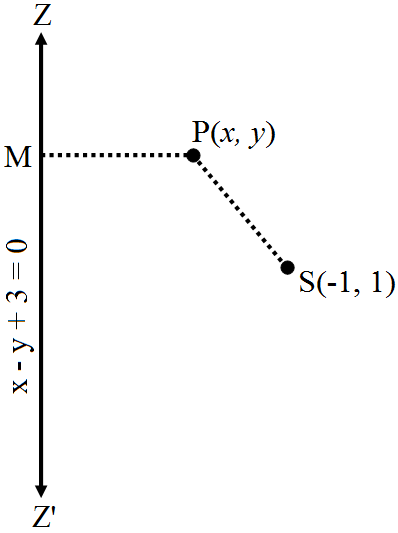
Let $P(x,y)$ be any point on the ellipse whose focus and eccentricity are $S(-1,1)$ and $\text{e}=\frac{1}{2},$respectively.
Let $PM$ be the perpendicular from $P$ on the directrix.
Then $\text{SP}=\text{e}\times\text{PM}$
$\Rightarrow\text{SP}=\frac{1}{2}\times\text{PM}$
$\Rightarrow2\text{SP}=\text{PM}$
$\Rightarrow4(\text{SP})^2=\text{PM}^2$
$\Rightarrow4\Big[(\text{x}+1)^2+(\text{y}-1)^2\Big]=\bigg(\frac{\text{x}-\text{y}+3}{\sqrt{1^2+}(-1)^2}\bigg)^2$
$\Rightarrow4\big[\text{x}^2+1+2\text{x}+\text{y}^2+1-2\text{y}\big]\\=\frac{{\text{x}^2+\text{y}^2+9-2\text{xy}-6\text{y}+6\text{x}}}{2}$
$\Rightarrow8\text{x}^2+8+16\text{x}+8\text{y}^2+8-16\text{y}\\=\text{x}^2+\text{y}62+9-2\text{xy}-6\text{y}+6\text{x}$
$\therefore7\text{x}^2+7\text{y}^2+2\text{xy}-10\text{y}+10\text{x}+7=0$
This is the required equation of the ellipse.
View full question & answer→Correct option: B.
$7\text{x}^2+2\text{xy}+7\text{y}^2+10\text{x}-10\text{y}+7=0$
Let $P(x,y)$ be any point on the ellipse whose focus and eccentricity are $S(-1,1)$ and $\text{e}=\frac{1}{2},$respectively.
Let $PM$ be the perpendicular from $P$ on the directrix.
Then $\text{SP}=\text{e}\times\text{PM}$
$\Rightarrow\text{SP}=\frac{1}{2}\times\text{PM}$
$\Rightarrow2\text{SP}=\text{PM}$
$\Rightarrow4(\text{SP})^2=\text{PM}^2$
$\Rightarrow4\Big[(\text{x}+1)^2+(\text{y}-1)^2\Big]=\bigg(\frac{\text{x}-\text{y}+3}{\sqrt{1^2+}(-1)^2}\bigg)^2$
$\Rightarrow4\big[\text{x}^2+1+2\text{x}+\text{y}^2+1-2\text{y}\big]\\=\frac{{\text{x}^2+\text{y}^2+9-2\text{xy}-6\text{y}+6\text{x}}}{2}$
$\Rightarrow8\text{x}^2+8+16\text{x}+8\text{y}^2+8-16\text{y}\\=\text{x}^2+\text{y}62+9-2\text{xy}-6\text{y}+6\text{x}$
$\therefore7\text{x}^2+7\text{y}^2+2\text{xy}-10\text{y}+10\text{x}+7=0$
This is the required equation of the ellipse.