MCQ 1011 Mark
On the parabola $y = x^2$, the point least distant from the straight line $y = 2x - 4$ is:
- ✓
$(1, 1)$
- B
$(1, 0)$
- C
$(1, -1)$
- D
AnswerCorrect option: A. $(1, 1)$
Given, parabola is $y = x^2 .... (i)$
and straight line is $y = 2x - 4 .... (ii)$
From equations $(i)$ and $(ii),$ we get
$x^2 - 2x - 4 = 0$
$\Rightarrow 2x - 2 = 0$
$\Rightarrow x = 1$
From equation $(i),$ we have $y = 1$
The point least distant from the line is $(1, 1).$
View full question & answer→MCQ 1021 Mark
The equation of parabola whose focus is $(3, 0)$ and directrix is $3x + 4y = 1$ is:
- A
$ 16 x^2-9 y^2-24 x y-144 x+8 y+224=0 $
- B
$ 16 x^2+9 y^2-24 x y-144 x+8 y-224=0 $
- C
$16 x^2+9 y^2-24 x y-144 x-8 y+224=0 $
- ✓
$ 16 x^2+9 y^2-24 x y-144 x+8 y+224=0 $
AnswerCorrect option: D. $ 16 x^2+9 y^2-24 x y-144 x+8 y+224=0 $
View full question & answer→MCQ 1031 Mark
If the equation of a circle is $\lambda\text{x}^2+(2\lambda-3)\text{y}^2-4\text{x}+6\text{y}-1=0,$ then the coordinates of centre are:
- A
$\Big(\frac{4}{3},\ -1\Big)$
- ✓
$\Big(\frac{2}{3},\ -1\Big)$
- C
$\Big(\frac{-2}{3},\ 1\Big)$
- D
$\Big(\frac{2}{3},\ 1\Big)$
AnswerCorrect option: B. $\Big(\frac{2}{3},\ -1\Big)$
To find the centre:
Coefficient of $x^2 =$ Coefficient of $y^2$
$\therefore\lambda=2\lambda-3$
$\Rightarrow\lambda=3$
Therefore, the given equation can be rewritten as $3\text{x}^2+3\text{y}^2-4\text{x}+6\text{y}-1=0.$
$\therefore\text{x}^2+\text{y}^2-\frac{4}{3}\text{x}+2\text{y}-\frac{1}{3}=0$
Thus, the coordinates of the centre is $\Big(\frac{2}{3},\ -1\Big).$
View full question & answer→MCQ 1041 Mark
Choose the correct answer. The distance between the foci of a hyperbola is $16$ and its eccentricity is $2.$ Its equation is:
- ✓
$\text{x}^2-\text{y}^2=32$
- B
$\frac{\text{x}^2}{4}-\frac{\text{y}^2}{9}=1$
- C
$2\text{x}-3\text{y}^2=7$
- D
AnswerCorrect option: A. $\text{x}^2-\text{y}^2=32$
We know that distance between the foci $= 2ae$
$\therefore\ 2\text{ae}=16$
$\Rightarrow\text{ae}=8$
Given that $\text{e}=\sqrt{2}$
$\therefore\ \sqrt{2}\text{a}=8$
$\Rightarrow\text{a}=4\sqrt{2}$
Now, $\text{b}^2=\text{a}^2(\text{e}^2-1)$
$\Rightarrow\text{b}^2=32(32-1)$
$\Rightarrow\text{b}^2=32$
So, the equation of the hyperbola is,
$\frac{\text{x}^2}{\text{a}^2}-\frac{\text{y}^2}{\text{b}^2}=1$
$\Rightarrow\frac{\text{x}^2}{32}-\frac{\text{y}^2}{32}=1$
$\Rightarrow\text{x}^2-\text{y}^2=32$
View full question & answer→MCQ 1051 Mark
The length of the latus$-$rectum of the parabola $y^2 + 8x − 2y + 17 = 0$ is
Answer$ y^2+8 x-2 y+17=0 $
$ \Rightarrow(y-1)^2-1+8 x+17=0 $
$ \Rightarrow(y-1)^2+8 x+16=0 $
$ \Rightarrow(y-1)^2=-8(x+2)$
Let $X=x+2, Y=y-1$
$\therefore Y^2=-8 X$
Comparing with $y^2=4 a x$ :
$a = 2$
Length of the latus rectum $= 4a = 8$ units
View full question & answer→MCQ 1061 Mark
Centre of circle whose normals are $x^2- 2xy - 3x + 6y = 0$, is:
- ✓
$\big(3, \frac{3}{2}\big)$
- B
$\big(3, -\frac{3}{2}\big)$
- C
$\big(\frac{3}{2},3\big)$
- D
AnswerCorrect option: A. $\big(3, \frac{3}{2}\big)$
$x^2- 2xy - 3x + 6y = 0$
$\Rightarrow (x - 3) (x - 2y) = 0$
$\Rightarrow x = 3$ and $x = 2y$ are two normals.
The intersection point of these two normals will be the centre of the circle.
$\therefore$ for $x = 3$
$\Rightarrow\text{y}=\frac{\text{x}}{2} = \frac{3}{2}$
The intersection point is $\big(3, \frac{3}{2}\big)$ the centre of the given circle is $\big(3, \frac{3}{2}\big)$
View full question & answer→MCQ 1071 Mark
Equation of the directrix of the parabola $x^2= 4ay$ is:
- A
$x = -a$
- B
$x = a$
- ✓
$y = -a$
- D
$y = a$
AnswerCorrect option: C. $y = -a$
Given, parabola $x^2= 4ay$
Now, its equation of directrix $= y = -a$
View full question & answer→MCQ 1081 Mark
Choose the correct answer. If $e$ is the eccentricity of the ellipse $\frac{\text{x}^2}{\text{a}^2}+\frac{\text{y}^2}{\text{b}^2}=1(\text{a}<\text{b}),$ then:
- A
$ b^2=a^2\left(1-e^2\right) $
- ✓
$ a^2=b^2\left(1-e^2\right) $
- C
$ a^2=b^2\left(e^2-1\right) $
- D
$ b^2=a^2\left(e^2-1\right) $
AnswerCorrect option: B. $ a^2=b^2\left(1-e^2\right) $
Given equation is $\frac{\text{x}^2}{\text{a}^2}+\frac{\text{y}^2}{\text{b}^2}=1(\text{a}<\text{b})$
$\therefore\text{ Eccentricity e}=\sqrt{1-\frac{\text{a}^2}{\text{b}^2}}$
$\Rightarrow\text{e}^2=1-\frac{\text{a}^2}{\text{b}^2}$
$\Rightarrow\frac{\text{a}^2}{\text{b}^2}=(1-\text{e}^2)$
$\Rightarrow\text{a}^2=\text{b}^2(1-\text{e}^2)$
View full question & answer→MCQ 1091 Mark
The eccentricity of an ellipse is:
- A
$e = 1$
- B
$e < 1$
- C
$e > 1$
- ✓
$0 < e < 1$
AnswerCorrect option: D. $0 < e < 1$
The eccentricity of an ellipse e $=(1-\frac{\text{a}^2}{\text{b}^2})$ and $0 < e < 1$
View full question & answer→MCQ 1101 Mark
If the circles $x^2+ y^2 = a$ and $x^2+ y^2 - 6x - 8y + 9 = 0$, touch externally, then $a =$
Answer$x^2+ y^2 = a ........ (1)$
And, $x^2+ y^2− 6x − 8y + 9 = 0 ........ (2)$
Let circles $(1)$ and $(2)$ touch each other at point $P.$
The centre of the circle $x^2+ y^2 = a, 0,$ is $(0, 0).$
The centre of the circle $x^2+ y^2− 6x − 8y + 9 = 0, C_1,$ is $(3, 4).$
Also, radius of circle $(1) =\sqrt{\text{a}}=\text{OP}$
Radius of circle $(2) \sqrt{9+16-9}=4=\text{C}_1\text{P}$
From figure, we have:
$\Rightarrow\sqrt{3^2+4^2}=4+\sqrt{\text{a}}$
$\Rightarrow5=4+\sqrt{\text{a}}$
$\Rightarrow\text{a}=1$
View full question & answer→MCQ 1111 Mark
The length of the latus$-$rectum of the parabola $x^2 - 4x - 8y + 12 = 0$ is
AnswerGiven:
$ x^2-4 x-8 y+12=0$
$(x-2)^2-8 y+8=0 $
$ (x-2)^2=8 y-8=8(y-1)$
$ \text { Let } X=x-2, Y=y-1 $
$ \therefore X^2=8 Y$
$\therefore$ Length of the latus rectum $= 4a = 8$ units
View full question & answer→MCQ 1121 Mark
Equation of the ellipse in its standard form is $\frac{\text{x}^2}{\text{a}^2}-\frac{\text{y}^2}{\text{b}^2}=1$:
AnswerEquation of ellipse in standard form is
$\frac{\text{x}^2}{\text{a}^2}-\frac{\text{y}^2}{\text{b}^2}=1$
View full question & answer→MCQ 1131 Mark
If the parabola $y^2= 4ax$ passes through the point $(3, 2),$ then the length of its latusrectum is:
- A
$\frac{2}{3}$
- ✓
$\frac{4}{3}$
- C
$\frac{1}{3}$
- D
$4$
AnswerCorrect option: B. $\frac{4}{3}$
Since, the parabola $y^2= 4ax$ passes through the point $(3, 2)$
$\Rightarrow 2^2= 4a \times 3$
$\Rightarrow 4 = 12a$
$\Rightarrow \text{a}=\frac{4}{12}$
$\Rightarrow \text{a}=\frac{1}{3}$
So, the length of latusrectum $= \text{4a} = 4 \times (\frac{1}{3}) = \frac{4}{3}$
View full question & answer→MCQ 1141 Mark
The equation $16x^2+ y^2+ 8xy - 74x - 78y + 212 = 0$ represents
AnswerComparing the given equation with $ax^2 + by^2 + 2hxy + 2gx + 2fy + c = 0$, we get:
$a = 16, b = 1, h = 4$
We have: $h^2 = 16 = ab$
Thus, the given equation represents a parabola.
View full question & answer→MCQ 1151 Mark
If a be the radius of a circle which touches $x-$axis at the origin, then its equation is:
- A
${x}^2 + \text{y}^2 + \text{ax} = 0$
- B
$\text{x}^{2} + \text{y}^{2} \underline{+} 2\text{ya} = 0$
- ✓
${x}^{2} + \text{y}^{2} \underline{+} 2\text{xa} = 0$
- D
${x}^2 + \text{y}^2 + \text{ya} = 0$
AnswerCorrect option: C. ${x}^{2} + \text{y}^{2} \underline{+} 2\text{xa} = 0$
View full question & answer→MCQ 1161 Mark
Find the Center of circle $x^2+ y^2 - 4x - 8x + 25 = 0:$
- ✓
$(2, 4)$
- B
$(-2, -4)$
- C
$(4, 2)$
- D
AnswerCorrect option: A. $(2, 4)$
The general equation of center of circle $x^2+ y^2 + 2gx + 2fy + c = 0$ is $(-g, -f)$
So, the center of circle $x^2+ y^2 - 4x, -8x + 25 = 0$ is $(2, 4)$
View full question & answer→MCQ 1171 Mark
The equation of the circle drawn with the two foci of $\frac{\text{x}^2}{\text{a}^2}+\frac{\text{y}^2}{\text{b}^2}=1$ end$-$point of a diameter is
- A
$\text{x}^2+\text{y}^2=\text{a}^2+\text{b}^2$
- B
$\text{x}^2+\text{y}^2=\text{a}^2$
- C
$\text{x}^2+\text{y}^2=2\text{a}^2$
- ✓
$\text{x}^2+\text{y}^2=\text{a}^2-\text{b}^2$
AnswerCorrect option: D. $\text{x}^2+\text{y}^2=\text{a}^2-\text{b}^2$
We have $\text{r}=\text{ae}$
Let the equation of the circle be $\text{x}^2+\text{y}^2=\text{r}^2.$
Now, $\text{x}^2+\text{y}^2=\text{a}^2\text{e}^2$ $(\because\text{r}=\text{ae})$
$\Rightarrow\text{x}^2+\text{y}^2=\text{a}^2\Big(1-\frac{\text{b}^2}{\text{a}^2}\Big)$ $\bigg(\because\text{e}=\sqrt{1-\frac{\text{b}^2}{\text{a}^2}}\bigg)$
$\Rightarrow\text{x}^2+\text{y}^2=\text{a}^2-\text{b}^2$
$\therefore\ $The required equation of the circle $\text{x}^2+\text{y}^2=\text{a}^2-\text{b}^2.$
View full question & answer→MCQ 1181 Mark
The foci of the hyperbola $9x^2− 16y^2 = 144$ are
- A
$(\pm4,0)$
- B
$(0,\pm4)$
- ✓
$(\pm5,0)$
- D
$(0,\pm5)$
AnswerCorrect option: C. $(\pm5,0)$
The equation of the hyperbola is given below:
$9x^2− 16y^2 = 144$
This equation can be rewritten in the following way:
$\frac{9\text{x}^2}{144}-\frac{16\text{y}^2}{144}=1$
$\Rightarrow\frac{\text{x}^2}{16}-\frac{\text{y}^2}{9}=1$
This is the standard equation of a hyperbola, where $a^2 = 16$ and $b^2 = 9.$
The eccentricity is calculated in the following way:
$b^2 = a^2(e^2− 1)$
$\Rightarrow 9 = 16(e^2 − 1)$
$\Rightarrow\frac{9}{16}=\text{e}^2-1$
$\Rightarrow\text{e}=\frac{5}{4}$
$\text{Foci}=(\pm\text{ae},0)=(\pm5,0)$
View full question & answer→MCQ 1191 Mark
The eccentricity of the ellipse, if the minor axis is equal to the distance between the foci, is:
- A
$\frac{\sqrt{3}}{2}$
- B
$\frac{2}{\sqrt{3}}$
- ✓
$\frac{1}{\sqrt{2}}$
- D
$\frac{\sqrt{2}}{3}$
AnswerCorrect option: C. $\frac{1}{\sqrt{2}}$
According to the question, the minor axis is equal to the distance between the foci.
i.e. $2\text{b}=2\text{ae}$
$\text{e}=\frac{\text{b}}{\text{a}}\ \dots(1)$
Now, $\text{e}=\sqrt{1-\frac{\text{b}^2}{\text{a}^2}}$
$\Rightarrow\text{e}=\sqrt{1-\text{e}^2}$ $\Big[\text{From}\ (1)\Big]$
On squaring both sides, we get:
$\text{e}^2=1-\text{e}^2$
$\Rightarrow2\text{e}^2=1$
$\Rightarrow\text{e}^2=\frac{1}{2}$
$\Rightarrow\text{e}=\frac{1}{\sqrt{2}}$
View full question & answer→MCQ 1201 Mark
Find the center$-$radius form of the equation of the circle with center $(4, 0)$ and radius $7:$
- ✓
$ (x-4)^2+y^2=49 $
- B
$ x^2+(y+4)^2=7 $
- C
$ x^2+(y-4)^2=7 $
- D
AnswerCorrect option: A. $ (x-4)^2+y^2=49 $
View full question & answer→MCQ 1211 Mark
If the length of the tangent from the origin to the circle centered at $(2, 3)$ is $2$ then the equation of the circle is:
- A
$ (x+2)^2+(y-3)^2=3^2 $
- B
$ (x-2)^2+(y+3)^2=3^2 $
- ✓
$ (x-2)^2+(y-3)^2=3^2 $
- D
$ (x+2)^2+(y+3)^2=3^2 $
AnswerCorrect option: C. $ (x-2)^2+(y-3)^2=3^2 $
Radius of the circle $= \sqrt{{(2 - 0)^2 + (3 - 0)^2 - 2^2}}$
$=\sqrt{(4 + 9 - 4)}$
$= \sqrt{9}$
$= 3$
So, the equation of the circle =$ (x-2)^2+(y-3)^2=3^2 $
View full question & answer→MCQ 1221 Mark
The radius of the circle passing through the point $(6, 2)$ and two of whose diameters are $x + y = 6$ and $x + 2y = 4$ is:
AnswerPoint of intersection of the given diameters is $(8, -2)$ which is the centre of the circle.
Also the circle pass through the point $(6, 2)$
so the radius is.
$=\sqrt{ (8-6)^2+(-2-2)^2}$
$=\sqrt{20}$
View full question & answer→MCQ 1231 Mark
If the vertices of a triangle are $(2, -2), (-1, -1)$ and $(5, 2)$ then the equation of its circumcircle is:
- A
$ x^2+y^2+3 x+3 y+8=0 $
- ✓
$ x^2+y^2-3 x-3 y-8=0 $
- C
$ x^2+y^2-3 x+3 y+8=0 $
- D
AnswerCorrect option: B. $ x^2+y^2-3 x-3 y-8=0 $
To find circumcentre we write the equation of perpendicular bisectors of two sides and find their intersection,
$3x - y - 3 = 0$ and $6x + 8y - 21 = 0$
Their intersection point is $\big(\frac{3}{2},\frac{3}{2}\big)$
Radius of circumcircle $=$ Distance of $\big(\frac{3}{2},\frac{3}{2}\big)$
from $(2,-2)$ or any other vertex $=\frac{5}{\sqrt2}$
So equation of circle $=(\text{x}-\frac{3}{2})^2+(\text{y}-\frac{3}{2})^2 = \frac{25}{2}$
View full question & answer→MCQ 1241 Mark
The locus of the points of trisection of the double ordinates of a parabola is a
Answer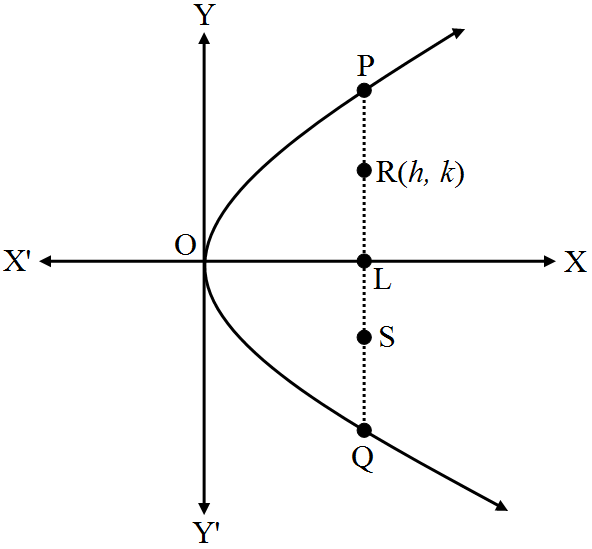
Suppose $PQ$ is a double ordinate of the parabola $y^2= 4ax$.
Let $R$ and $S$ be the points of trisection of the double ordinates.
Let $(h, k)$ be the coordinates of $R.$
Then, we have:
$OL = h$ and $RL = k$
$\therefore \ce{RS = RL + LS = k + k = 2k}$
$\Rightarrow \ce{PR = RS = SQ = 2K}$
$\Rightarrow \ce{LP = LR + RP = k + 2k = 3k}$
Thus, the coordinates of $P$ are $(h, 3k)$ which lie on $y^2 = 4ax.$
$\therefore 9k^2= 4ah$
Hence, the locus of the point $(h, k)$ is $9\text{y} = 4\text{ax}$
i.e. $\text{y}^2=\Big(\frac{4\text{a}}{9}\Big)\text{x}$ which represents a parabola. View full question & answer→MCQ 1251 Mark
The focus of parabola $y^2= 8x$ is:
- ✓
$(2, 0)$
- B
$(-2, 0)$
- C
$(0, 2)$
- D
$(0, -2)$
AnswerCorrect option: A. $(2, 0)$
Given, $y^2= 8x$
General equation is $y^2= 4ax$
Now, $4a = 8$
$\Rightarrow a = 2$
Now, focus $= (a, 0) = (2, 0)$
View full question & answer→MCQ 1261 Mark
The equation of the circle passing through the origin which cuts off intercept of length $6$ and $8$ from the axes is:
- A
$ x^2+y^2-12 x-16 y=0 $
- B
$ x^2+y^2+12 x+16 y=0 $
- C
$ x^2+y^2+6 x+8 y=0 $
- ✓
$ x^2+y^2-6 x-8 y=0 $
AnswerCorrect option: D. $ x^2+y^2-6 x-8 y=0 $
The centre of the required circle is$\Big(\frac{6}{2},\ \frac{8}{2}\Big)=(3,\ 4).$
The radius of the required circle is $\sqrt{3^2+4^2}=\sqrt{25}=5$
Hence, the equation of the circle is as follows:
$(x - 3)^2+ (y - 4)^2= 52$
$⇒ x^2+y^2-6 x-8 y=0 $
View full question & answer→MCQ 1271 Mark
The vertex of the parabola $y^2 - 4y - x + 3 = 0$ is:
- A
$(-1, 3)$
- ✓
$(-1, 2)$
- C
$(2, -1)$
- D
AnswerCorrect option: B. $(-1, 2)$
We have,
$y^2- 4y - x + 3 = 0$
$(y - 2)^2- 4 - x + 3 = 0$
$(y - 2)^2= (x + 1)$
$\therefore$ Vertex of the parabola $= (-1, 2)$
View full question & answer→MCQ 1281 Mark
Which of the following equations represents a parabola:
AnswerCorrect option: C. $\frac{\text{x}}{\text{y}}+\frac{\text{4}}{\text{x}}=0$
We know that the general equation of parabola is
$y^2= 4ax$
$y^2= -4ax$
$x^2= 4ax$
$x^2= -4ax$
From option $(a),$
$(x - y)^3= 3$
It is not represent the parabola.
From option $(b),$
$\frac{\text{x}}{\text{y}}-\frac{\text{y}}{\text{x}}=0$
$x^2= y^2$
It is not represent the parabola.
From option $(c),$
$\frac{\text{x}}{\text{y}}+\frac{\text{4}}{\text{x}}=0$
$x^2+ 4y = 0$
$x^2= -4y$
So, this is represented the parabola.
From option $(d),$
$(x + y)^3+ 3 = 0$
It is not represent the parabola.
View full question & answer→MCQ 1291 Mark
Choose the correct answer. Equation of the hyperbola with eccentricty $\frac{3}{2}$ and foci at $(\pm2,0)$ is:
- ✓
$\frac{\text{x}^2}{4}-\frac{\text{y}^2}{5}=\frac{4}{9}$
- B
$\frac{\text{x}^2}{9}-\frac{\text{y}^2}{9}=\frac{4}{9}$
- C
$\frac{\text{x}^2}{4}-\frac{\text{y}^2}{9}=1$
- D
AnswerCorrect option: A. $\frac{\text{x}^2}{4}-\frac{\text{y}^2}{5}=\frac{4}{9}$
Given that $\text{e}=\frac{3}{2}$
and foci $=(\pm\text{ae},0)=(\pm2,0)$
$\therefore\ \text{ae}=2$
$\text{a}\times\frac{3}{2}=2$
$\Rightarrow\text{a}=\frac{4}{3}$
Now we know that $\text{b}^2=\text{a}^2(\text{e}^2-1)$
$\text{b}^2=\frac{16}{9}\Big(\frac{9}{4}-1\Big)$
$\Rightarrow\text{b}^2=\frac{16}{9}\times\frac{5}{4}$
$\Rightarrow\text{b}^2=\frac{20}{9}$
So, the equation of the hyperbola is,
$\frac{\text{x}^2}{\big(\frac{4}{3}\big)^2}-\frac{\text{y}^2}{\frac{20}{9}}=1$
$\Rightarrow\frac{9\text{x}^2}{16}-\frac{9\text{y}^2}{20}=1$
$\Rightarrow\frac{\text{x}^2}{16}-\frac{\text{y}^2}{20}=\frac{1}{9}$
$\Rightarrow\frac{\text{x}^2}{4}-\frac{\text{y}^2}{5}=\frac{4}{9}$
View full question & answer→MCQ 1301 Mark
Coordinates of centre and radius of the circle $(x - 3)^2+ (y + 4)^2= 25$ are respectively:
- A
$(3, 4), 25$
- B
$(-3, 4), 5$
- ✓
$(3, -4), 5$
- D
AnswerCorrect option: C. $(3, -4), 5$
$ (x-3)^2+(y+4)^2=25 $
$ (x-3)^2+(y-(-4))^2-(5)^2 $
$ (x-4)^2+(y-k)^2-(r)^2 $
$ r=5(h, k)=(3,-4) $
View full question & answer→MCQ 1311 Mark
The straight line $y = mx + c$ cuts the circle $x^2+ y^2= a^2$ in real points if:
- A
$\sqrt{{\text{a}^2 × (1 + \text{m}^2)} < \text{c}}$
- B
$\sqrt{{\text{a}^2 × (1 - \text{m}^2)} < \text{c}}$
- ✓
$\sqrt{{\text{a}^2 × (1 + \text{m}^2)} > \text{c}}$
- D
$\sqrt{{\text{a}^2 × (1 - \text{m}^2)} > \text{c}}$
AnswerCorrect option: C. $\sqrt{{\text{a}^2 × (1 + \text{m}^2)} > \text{c}}$
View full question & answer→MCQ 1321 Mark
The diameter of a circle described by $\text{9x}^{2}+\text{9y}^2=16$ is:
- A
$\frac{16}{9}$
- B
$\frac{4}{3}$
- C
$4$
- ✓
$\frac{8}{3}$
AnswerCorrect option: D. $\frac{8}{3}$
Equation of circle is $\text{9x}^{2}+\text{9y}^2=16$
$\Rightarrow\text{x}^2+\text{y}^2=\frac{16}{9}$
$\Rightarrow\text{x}^2+\text{y}^2=(\frac{4}{3})^2$
$\therefore$ Radius of the circle $=\frac{4}{3}$
$\therefore$ Diameter of the circle $=\frac{4\times2}{3} = \frac{8}{3}$
View full question & answer→MCQ 1331 Mark
The directrix of the parabola $x^2- 4x - 8y + 12 = 0$ is
- A
$y = 0$
- B
$x = 1$
- ✓
$y = -1$
- D
$x = -1$
AnswerCorrect option: C. $y = -1$
Given:
$ x^2-4 x-8 y+12=0 $
$ \Rightarrow(x-2)^2-4-8 y+12=0 $
$ \Rightarrow(x-2)^2=8 y-8 $
$ \Rightarrow(x-2)^2=8(y-1)$
Putting $X = x - 2, Y = y - 1:$
$X^2= 8Y$
Comparing with $X^2= 4aY:$
$a = 2$
Equation of the directrix:
$Y = -a$
$\Rightarrow Y = -2$
$\Rightarrow y - 1 = -2$
$\Rightarrow y = -2 + 1$
$\Rightarrow y = -1$
View full question & answer→MCQ 1341 Mark
The locus of a planet orbiting around the sun is:
AnswerIt is a fact $\&$ proof of it can be seen from higher education physics books.
View full question & answer→MCQ 1351 Mark
If the length of the major axis of an ellipse is three times the length of the minor axis then its eccentricity is:
AnswerCorrect option: D. $\frac{2\sqrt{2}}{\sqrt{2}}$
View full question & answer→MCQ 1361 Mark
The equation of the parabola whose focus is $(1, -1)$ and the directrix is $x + y + 7 = 0$ is
- A
$x^2 + y^2 - 2xy - 18x - 10y = 0$
- B
$x^2 - 18x - 10y - 45 = 0$
- C
$x^2 + y^2 - 18x - 10y - 45 = 0$
- ✓
$x^2 + y^2 - 2xy - 18x - 10y - 45 = 0$
AnswerCorrect option: D. $x^2 + y^2 - 2xy - 18x - 10y - 45 = 0$
Let $P (x, y)$ be any point on the parabola whose focus is $S (1, -1)$ and the directrix is $x + y+ 7 = 0.$
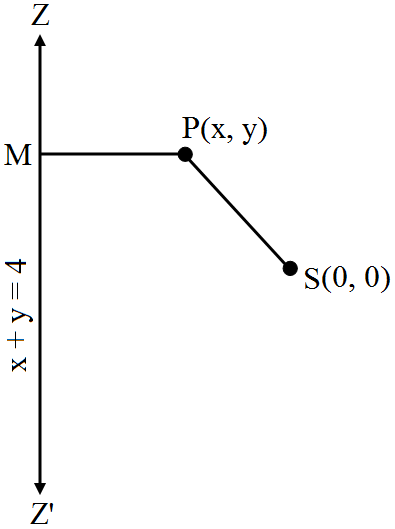
Draw $PM$ perpendicular to $x + y + 7 = 0.$
Then, we have:
$SP = PM$
$ \Rightarrow SP^2 = PM^2$
$\Rightarrow\ (\text{x} - 1)^2+ (\text{y} + 1)^2= \Big(\frac{\text{x+y+7}}{\sqrt{1+1}}\Big)^2$
$\Rightarrow\ (\text{x} - 1)^2+ (\text{y} + 1)^2= \Big(\frac{\text{x+y+7}}{\sqrt{2}}\Big)^2$
$\Rightarrow\ 2(\text{x}^2+1-2\text{x}+\text{y}^2+1+2\text{y})\\ \ \ =\text{x}^2+\text{y}^2+49+2\text{xy}+14\text{y}+14\text{x}$
$\Rightarrow\ (2\text{x}^2+2-4\text{x}+2\text{y}^2+2+4\text{y})\\ \ \ =\text{x}^2+\text{y}^2+49+2\text{xy}+14\text{y}+14\text{x}$
$\Rightarrow\ \text{x}^2+\text{y}^2-45-10\text{y}-2\text{xy}-18\text{x}=0$
Hence, the required equation is $x^2+ y^2- 2xy - 18x - 10y - 45 = 0$ View full question & answer→MCQ 1371 Mark
If the lines $3x - 4y - 7 = 0$ and $2s - 3y - 5 = 0$ are two diameters of a circle of area $49\pi$ square units, the equation of the circle is:
- A
$ x^2+y^2+2 x-2 y-62=0 $
- B
$ x^2+y^2-2 x+2 y-62=0 $
- ✓
$ x^2+y^2-2 x+2 y-47=0 $
- D
AnswerCorrect option: C. $ x^2+y^2-2 x+2 y-47=0 $
View full question & answer→MCQ 1381 Mark
One of the diameters of the circle $x^2+ y^2- 12x + 4y + 6 = 0$ is given by:
- A
$x + y = 0$
- ✓
$x + 3y = 0$
- C
$x = y$
- D
$3x + 2y = 0$
AnswerCorrect option: B. $x + 3y = 0$
The coordinate of the centre of the circle $x^2+ y^2 - 12x + 4y + 6 = 0$ are $(6, -2)$
Clearly, the line $x + 3y$ passes through this point.
$x + 3y = 0$ is a diameter of the given circle.
View full question & answer→MCQ 1391 Mark
The latus$-$rectum of the conic $3\text{x}^2+4\text{y}^2-6\text{x}+8\text{y}-5=0$ is:
- ✓
$3$
- B
$\frac{\sqrt{3}}{2}$
- C
$\frac{2}{\sqrt{3}}$
- D
$\text{none of these}$
Answer$\Rightarrow3(\text{x}^2-2\text{x})+4(\text{y}^2+2\text{y})=5$
$\Rightarrow3(\text{x}^2-2\text{x}+1)+4(\text{y}^2+2\text{y}+1)=5+3+4$
$\Rightarrow3(\text{x}-1)^2+4(\text{y}+1)^2=12$
$\frac{(\text{x-1})^2}{4}+\frac{(\text{y}+1)^2}{3}=1$
So, $\text{a}=2$ and $\text{b}=\sqrt{3}$
$\therefore\ $Latus rectum $=\frac{2\text{b}^2}{\text{a}}$
$\\=2\frac{\big[\sqrt{3}\big]^2}{2}\\=3$
View full question & answer→MCQ 1401 Mark
Choose the correct answer. Equation of the circle with centre on the $y-$axis and passing through the origin and the point $(2, 3)$ is:
- ✓
$x^2+y^2+13 y=0$
- B
$3 x^2+3 y^2+13 x+3=0$
- C
$6 x^2+6 y^2-13 x=0$
- D
$x^2+y^2+13 x+3=0$
AnswerCorrect option: A. $x^2+y^2+13 y=0$
Let the equation of the circle be,
$(x-h)^2+(y-k)^2=r^2$
Let the centre be $(0, a)$
$\therefore$ Radius $\mathrm{r}=\mathrm{a}$
So, the equation of the circle is
$ (x-0)^2+(y-a)^2=a^2 $
$ \Rightarrow x^2+(y-a)^2=a^2 $
$ \Rightarrow x^2+y^2+a^2-2 a y=a^2 $
$ \Rightarrow x^2+y^2-2 a y=0 \ldots .(i)$
$($image$)$
Now, $CP = r$
$\Rightarrow\sqrt{(2-0)^2+(3-\text{a}^2)}=\text{a}$
$\Rightarrow\sqrt{4+9+\text{a}^2-6\text{a}}=\text{a}$
$\Rightarrow\sqrt{13+\text{a}^2-6\text{a}}=\text{a}$
$\Rightarrow13+\text{a}^2-6\text{a}=\text{a}^2$
$\Rightarrow13-6\text{a}=0$
$\therefore\ \text{a}=\frac{13}{6}$
Putting the value of a in eq. $(i)$ we get
$\text{x}^2+\text{y}^2-2\Big(\frac{13}{6}\Big)\text{y}=0$
$\Rightarrow3\text{x}^2+3\text{y}^2-3\text{y}=0$
Note: $(a)$ option is correct and is should be $($dout solution$)$
View full question & answer→MCQ 1411 Mark
If $(x, 3)$ and $(3, 5)$ are the extremities of a diameter of a circle with centre at $(2, y),$ then the values of $x$ and $y$ are:
- A
$(3, 1)$
- B
$x = 4, y = 1$
- C
$x = 8, y = 2$
- ✓
AnswerThe end points of the diameter of a circle are $(x, 3)$ and $(3, 5).$
According to the question, we have:
$\frac{\text{x}+3}{2}=2,\ \text{y}=\frac{5+3}{2}$
$\Rightarrow\text{x}=1,\ \text{y}=4$
View full question & answer→MCQ 1421 Mark
If the equation $(4a - 3) x^2+ ay^2+ 6x - 2y + 2 = 0$ represents a circle, then its centre is:
- A
$(3, -1)$
- B
$(3, 1)$
- ✓
$(-3, 1)$
- D
AnswerCorrect option: C. $(-3, 1)$
If the equation $(4a - 3) x^2+ ay^2+ 6x - 2y + 2 = 0$ represents a circle, then we have:
Coefficient of $x^2=$ Coefficient of $y^2$
$\Rightarrow 4a - 3 = a$
$\Rightarrow a = 1$
$\therefore$ Equation of the circle $= x^2+ y^2+ 6x - 2y + 2 = 0$
Thus, the coordinates of the centre is $(-3, 1).$
View full question & answer→MCQ 1431 Mark
The length of latus rectum of the parabola $(x - 2a)^2+ y^2= x^2$ is:
AnswerWe have, $(x - 2a)^2+ y^2 = x^2$
$x^2- 4ax + 4a^2+ y^2= x^2$
$y^2= 4ax - 4a^2= 4a(x - a)$
Comparing it with standard parabola $Y^2= 4bX$
$Y = y, X = x - a, b = a$
We know length of latus rectum of parabola $Y^2 = 4bX$ is $4b$
length of latus rectum of given parabola is $= 4 \times a = 4a$
View full question & answer→MCQ 1441 Mark
The equation of the conic $9x^2- 16y^2= 144$ is
- ✓
$\frac{5}{4}$
- B
$\frac{4}{3} $
- C
$\frac{4}{5}$
- D
$\sqrt7$
AnswerCorrect option: A. $\frac{5}{4}$
Standard form of a hyperbola $=\frac{\text{x}^2}{16}-\frac{\text{y}^2}{9}=1$
Here, $a^2= 16$ and $y^2= 9$
The eccentricity is calculated in the following way:
$b^2= a^2(e^2- 1)$
$\Rightarrow 9 = 16(e^2- 1)$
$\Rightarrow\text{e}^2-1=\frac{9}{16} $
$\Rightarrow\text{e}^2=\frac{25}{16}$
$\Rightarrow\text{e}=\frac{5}{4}$
View full question & answer→MCQ 1451 Mark
An ambulance company provides services within an $80$ mile radius of their headquarters If this service area is represented graphically with the headquarters located at the coordinates $(0, 0)$ what is the equation that represents the service area:
- A
$x^2+y^2=80$
- B
$(x-0)^2+(y-0)^2=80$
- C
$x^2+y^2=1600$
- ✓
AnswerThe general equation of a circle with center at $(a, b)$ and radius $r$ is $(x - a)^2+ (y - b)^2= r^2$
so substituting the values we get the circle equation as $x^2+ y^2= 80^2= 6400$
View full question & answer→MCQ 1461 Mark
The equation of the parabola with focus $(0, 0)$ and directrix $x + y = 4$ is
AnswerCorrect option: A. $x^2+y^2-2 x y+8 x+8 y-16=0$
Let $P (x, y)$ be any point on the parabola whose focus is $S (0, 0)$ and the directrix is $x + y = 4.$
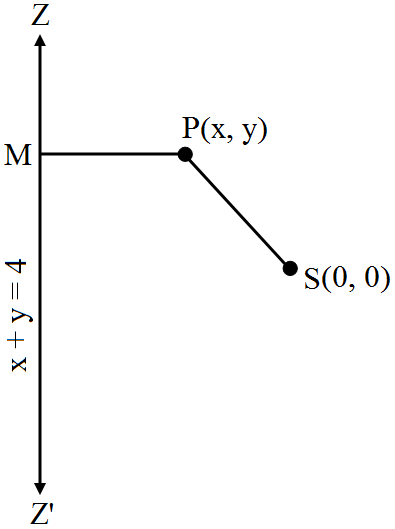
Draw $PM$ perpendicular to $x + y = 4.$
Then, we have:
$\ce{SP = PM}$
$\Rightarrow \ce{SP^2= PM^2}$
$\Rightarrow\ (\text{x}-0)^2+(\text{y}-0)^2=\Big(\frac{\text{x+y}-4}{\sqrt2}\Big)^2$
$\Rightarrow\ \text{x}^2+\text{y}^2=\Big(\frac{\text{x+y}-4}{\sqrt2}\Big)^2$
$\Rightarrow 2x^2+ 2y^2= x^2+ y^2+ 16 + 2xy - 8x - 8y$
$ \Rightarrow x^2+y^2-2 x y+8 x+8 y-16=0 $ View full question & answer→MCQ 1471 Mark
The length of the latus-rectum of the parabola $4y^2+ 2x - 20y + 17 = 0$ is
- ✓
$3$
- B
$6$
- C
$\frac{1}{2}$
- D
$9$
AnswerGiven:
$4y^2+ 2x - 20y + 17 = 0$
$\Rightarrow\ \text{y}^2+\frac{\text{x}}{2}-5\text{y}+\frac{17}{4}=0$
$\Rightarrow\ \Big(\text{y}-\frac{5}{2}\Big)^2+\frac{\text{x}}{2}-2=0$
$\Rightarrow\ \Big(\text{y}-\frac{5}{2}\Big)^2=-1\Big(\frac{\text{x}}{2}-2\Big)$
$\Rightarrow\ \Big(\text{y}-\frac{5}{2}\Big)^2=\frac{-1}{2}(\text{x}-4)$
$\text{Let }\text{X}=\text{x}-4,\ \text{Y}=\text{y}-\frac{5}{2}$
$\therefore\ \text{Y}^2=\frac{-\text{X}}{2}$
$\therefore$ Length of the latus rectum $=\ 4\text{a}=\frac{1}{2}$ units
View full question & answer→MCQ 1481 Mark
The radius of the circle with center $(0, 0)$ and which passes through $(-6, 8)$ is:
Answer$\text{r}=\sqrt{(6)^2+(-8)=10}$
View full question & answer→MCQ 1491 Mark
Find the area of $x^2+ y^2= 49:$
AnswerThe equation $x^2+ y^2= 49$ describes a circle with $7$ as radius So the area is given as $\pi\text{r}^2$
$=\frac{22}{7}\times7^2$
$=154$
View full question & answer→MCQ 1501 Mark
Choose the correct answer. The length of the latus rectum of the ellipse $3x^2+ y^2= 12$ is:
- A
$4$
- B
$3$
- C
$8$
- ✓
$\frac{4}{\sqrt{3}}$
AnswerCorrect option: D. $\frac{4}{\sqrt{3}}$
$3\text{x}^2+\text{y}^2=12$
$\Rightarrow\frac{\text{x}^2}{4}+\frac{\text{y}^2}{12}=1$
$\therefore\text{ a}^2=4$
$\Rightarrow\text{a}=2$
and $\text{b}^2=12$
$\Rightarrow\text{b}=2\sqrt{3}$
Since $b > a,$ length of latus rectum $=\frac{2\text{a}^2}{\text{b}}=\frac{2\times4}{2\sqrt{3}}=\frac{4}{\sqrt{3}}$
View full question & answer→