Questions

2 Marks Questions

Take a timed test

7 questions · self-marked practice — reveal the answer and mark yourself.

Question 12 Marks
if $O$ is the origin and $Q$ is a variable point on $y^2 = x.$ Find the locus of the mid$-$point of $OQ.$
Answer
Let the coordinates of $Q$ be $(a, b),$ which lies on the parabola.
$y^2=x$
$\Rightarrow b^2=a \ldots \ldots(i)$
Let $P(h, k)$ be the mid$-$point of $OQ.$
Now, we have
$h =\frac{0+a}{2}$ and $k =\frac{0+b}{2}$
$\Rightarrow a =2 h$ and $b =2 k$
Substituting $a = 2h$ and $b = 2k$ in equation $(i),$ we obtain
$(2 k)^2=2 h$
$\Rightarrow 2 k^2=h$
Therefore, the required locus of the mid$-$point of $O Q$ is $2 y^2=x$.
View full question & answer
Question 22 Marks
Write down all possible subsets of A = (1, {2, 3}).
Answer
Here, we have,
A contains two elements, namely 1 and
{2, 3} {2, 3} = B, then A = {1, B}
$\therefore P(A)=\{\phi,\{1\},\{B\},\{1, B\}\}$
$\Rightarrow P(A)=\{\phi,,\{1\},\{\{2,3\}\},\{1,\{2,3\}\}\}$.
View full question & answer
Question 32 Marks
Find the equations to the circles which pass through the origin and cut off equal chords of length $'a\ '$ from the straight lines $y = x$ and $y = -x.$
Answer
We see that there will be four such circles which pass through the origin and cut off equal chords of length a from the straight lines
$y= \pm x$.
Now, $\angle XOA =\pi / 4$ and, $OA =a$
$A C_1=a \sin \frac{\pi}{4}=\frac{-1}{\sqrt{2}}$ and $O C_1=a \cos \frac{\pi}{4}=\frac{a}{\sqrt{2}}$
So, the coordinates of $A (a / \sqrt{2}, a / \sqrt{2})$
Similarly, the coordinates $B.C D$ are $(-a / \sqrt{2}, a / \sqrt{2}),(-a / \sqrt{2},-a / \sqrt{2})$ and $(a / \sqrt{2},-a / \sqrt{2})$ respectively.
The equation of the circle with $AD$ as diameter is
$\left(x-\frac{a}{\sqrt{2}}\right)\left(x-\frac{a}{\sqrt{2}}\right)+\left(y-\frac{a}{\sqrt{2}}\right)\left(y+\frac{a}{\sqrt{2}}\right)=0$ or $x^2+y^2-\sqrt{2} a x=0$
Similarly, the equation of the required circle with $BC, CD$ and $AB$ as diameter are
$\left(x+\frac{a}{\sqrt{2}}\right)\left(x+\frac{a}{\sqrt{2}}\right)+\left(y-\frac{a}{\sqrt{2}}\right)\left(y+\frac{a}{\sqrt{2}}\right)=0 \text { or } x^2+y^2+\sqrt{2} a x=0$
$\left(x+\frac{a}{\sqrt{2}}\right)\left(x-\frac{a}{\sqrt{2}}\right)+\left(y+\frac{a}{\sqrt{2}}\right)\left(y+\frac{a}{\sqrt{2}}\right)=0 \text { or } x^2+y^2+\sqrt{2} a y=0$
$\left(x-\frac{a}{\sqrt{2}}\right)\left(x+\frac{a}{\sqrt{2}}\right)+\left(y-\frac{a}{\sqrt{2}}\right)\left(y-\frac{a}{\sqrt{2}}\right)=0 \text { of } x^2+y^2-\sqrt{2} a y=0$
View full question & answer
Question 42 Marks
Find equation of circle whose end points of its diameter are $(-2, 3)$ and $(0, -1).$
Answer
The equation of a circle with $\left(x_1, y_1\right)$ and $\left(x_2, y_2\right)$ as end points of one of its diameter is $\left(x-x_1\right)\left(x-x_2\right)+\left(y-y_1\right) \cdot\left(y-y_2\right)=0 \ldots(i)$
Given, $\left(x_1, y_1\right)=(-2,3)$ and $\left(x_2, y_2\right)=(0,-1)$
$(x - 2)(x - 0) + (y - 3)(y + 1) = 0$
$\Rightarrow x^2+2 x+y^2-2 y-3=0$
$\Rightarrow x^2+y^2+2 x-2 y-3=0,$  is the required equation of the circle. 
View full question & answer
Question 52 Marks
Evaluate $\lim _{x \rightarrow 0} \frac{e^{k x}-1}{x}$.
Answer
We have, $\lim _{x \rightarrow 0} \frac{e^{b x}-1}{x}=\lim _{x \rightarrow 0} \frac{e^{b_x}-1}{x} \times \frac{b}{b}$
$[$ multiplying numerator and denominator by $b]$
$=\lim _{x \rightarrow 0} \frac{b\left(e^{b x}-1\right)}{b x}$
On putting $h = bx$ and as $x \rightarrow 0$, then $h \rightarrow 0$, we get
$\lim _{x \rightarrow 0} \frac{e^x-1}{x}=b \lim _{h \rightarrow 0} \frac{\left(e^h-1\right)}{h}$
$=b \times 1\left[\because \lim _{x \rightarrow 0} \frac{e^x-1}{x}=1\right]$
$= b $
View full question & answer
Question 62 Marks
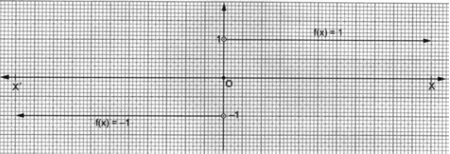
Draw the graph of the signum function, $f : R \rightarrow R$, defined by $f ( x )=\left\{\begin{array}{l}\frac{x}{\mid x}, \text { when } x \neq 0 \\ 0, \text { when } x=0\end{array}\right.$ or $f(x)=\left\{\begin{array}{l}1, \text { if } x>0 \\ 0, \text { if } x=0 \\ -1, \text { if } x<0\end{array}\right.$
Answer
Here we have, $f : R \rightarrow R,$ defined by $f ( x )=\left\{\begin{array}{l}\frac{x}{|x|}, \text { when } x \neq 0 \\ 0, \text { when } x=0\end{array}\right.$
or $f ( x )=\left\{\begin{array}{l}1, \text { if } x>0 \\ 0, \text { if } x=0 \\ -1, \text { if }
x<0\end{array}\right.$
Clearly, we have
We may now draw the graph as shown below.
$x<0 \Rightarrow f(x)=-1$
$x=0 \Rightarrow f(x)=0$
$x>0 \Rightarrow f(x)=1$
We may now draw the graph as shown below. 
Image
Graph of signum function
View full question & answer
Question 72 Marks
If $A=\{a, b\}, B=\{c, d\}$ and $C=\{d, c\}$, then find $A \times(B \cup C)$.
Answer
Given, $A=\{a, b\}, B=\{c, d\}$
and $C=\{d, c\}$.
Now, $B \cup C=\{c, d\}$
$\therefore A \times( B \cup C )=\{a, b\} \times\{c, d\}$
$=\{( a , c ),( a , d ),( b , c )( b , d )\}$
View full question & answer