Sample QuestionsRelations and Functions questions
One sample from each question group in this chapter. Select any group above to see the full set with answer keys.
If $A = \{1, 2, 3\}, B = \{1, 4, 6, 9\}$ and $R$ is a relation from $A$ to $B$ defined by $'x\ '$ is greater than $y$. The range of $R$ is
- A
$\{1, 4, 6, 9\}$
- B
$\{4, 6, 9\}$
- ✓
$\{1\}$
- D
Answer: C.
View full solution →If $9(x) = 3x^4 - 5x^2 +,$ then value of $f(x - 1)$ is:
- ✓
$3x4 + 12x + 13x + 2x + 7$
- B
$3x4 - 12x - 13x - 2x - 7$
- C
$3x4 - 12x + 13x - 2x + 7$
- D
$3x4 - 12x - 13x + 2x + 7$
Answer: A.
View full solution →Which of the following are functions?
- A
$\{(\text{x, y}):\text{y}^2=\text{x, x, y}\in\text{R}\}$
- ✓
$\{(\text{x, y}):\text{y}=\text{|x|},\text{x, y}\in\text{R}\}$
- C
$\{(\text{x, y}):\text{x}^2+\text{y}^2=1,\text{x, y}\in\text{R}\}$
- D
$\{(\text{x, y}):\text{x}^2-\text{y}^2=1\text{x, y}\in\text{R}\}$
Answer: B.
View full solution →The domain of $ \tan^{-1}(2\text{x}+1)$ is:
- ✓
$ \text{R}$
- B
$ \text{R}-\frac{1}{2}$
- C
$ \text{R}-\frac{-1}{2}$
- D
$\text{None of these}$
Answer: A.
View full solution →If $A$ and $B$ are two sets, then $ \text{A}\times\text{ B }=\text{ B}\times\text{A}$ If and only if:
Answer: C.
View full solution →Directions: In the following questions, a statement of assertion $(A)$ is followed by a statement of reason $(R).$ Mark the correct choice as:
Assertion: The range of the function $f(x) = 2 -3x, \text{x}\in\text{R}, x > 0$ is $R.$
Reason: The range of the function $f(x) = x^2 + 2$ is $(2,\infty).$
- A
$A$ is true, $R$ is true; $R$ is a correct explanation of $A.$
- B
$A$ is true, $R$ is true; $R$ is not a correct explanation of $A$.
- C
$A$ is true; $R$ is false.
- ✓
$A$ is false; $R $ is true.
Answer: D.
View full solution →Directions: In the following questions, a statement of assertion $(A)$ is followed by a statement of reason $(R).$ Mark the correct choice as:
Assertion: If $(x, 1), (y, 2)$ and $(z, 1)$ are in $A - B$ and $n(A) = 3, n(B) = 2,$ then $A = \{x, y, z\}$ and $B = \{1, 2\}.$
Reason: If $n(A) = 3$ and $n(B) = 2,$ then $n(A . B) = 6.$
- A
$A$ is true, $R$ is true; $R$ is a correct explanation of $A.$
- ✓
$A$ is true, $R$ is true; $R$ is not a correct explanation of $A.$
- C
$A$ is true; $R$ is false.
- D
$A$ is false; $R$ is true.
Answer: B.
View full solution →Directions: In the following questions, a statement of assertion $(A)$ is followed by a statement of reason $(R)$. Mark the correct choice as:
Assertion: $(A)$ Let $A = \{1, 2, 3, 5\}, B = \{4, 6, 9\}$ and $R = {(\text{x},\text{y}):\mid\text{x}-\text{y}\mid}$ is odd, $\text{x}\in\text{A},\text{y}\in\text{B}$. Then, domain of $R$ is $\{1, 2, 3, 5\}.$
Reason: $\mid\text{x}\mid$ is always positive $\forall\ \text{x}\in\text{R}.$
- A
$A$ is true, $R$ is true; $R$ is a correct explanation of $A.$
- ✓
$A$ is true, $R$ is true; $R$ is not a correct explanation of $A.$
- C
$A$ is true; $R$ is false.
- D
$A$ is false; $R$ is true.
Answer: B.
View full solution →Directions: In the following questions, a statement of assertion $(A)$ is followed by a statement of reason $(R).$ Mark the correct choice as:
Assertion: The cartesian product of two non $-$ empty sets $P$ and $Q$ is denoted as $P . Q$ and $\text{P}\cdot\text{Q}=\{(\text{p},\text{q}):\text{p}\in\text{P},\text{q}\in\text{Q}\}.$
Reason: If $A = \{$red, blue$\}$ and $B = \{b, c, s\},$ then $A . B = \{($red, $b), ($red, $c), ($red, $s), ($blue, $5), ($blue, $c), ($blue, $s)\}.$
- ✓
$A$ is true, $R$ is true; $R$ is a correct explanation of $A.$
- B
$A$ is true, $R$ is true; $R$ is not a correct explanation of $A.$
- C
$A$ is true; $R$ is false.
- D
$A$ is false; $R$ is true.
Answer: A.
View full solution →Directions: In the following questions, a statement of assertion $(A)$ is followed by a statement of reason $(R).$ Mark the correct choice as:
Assertion: The following arrow diagram represents a function.
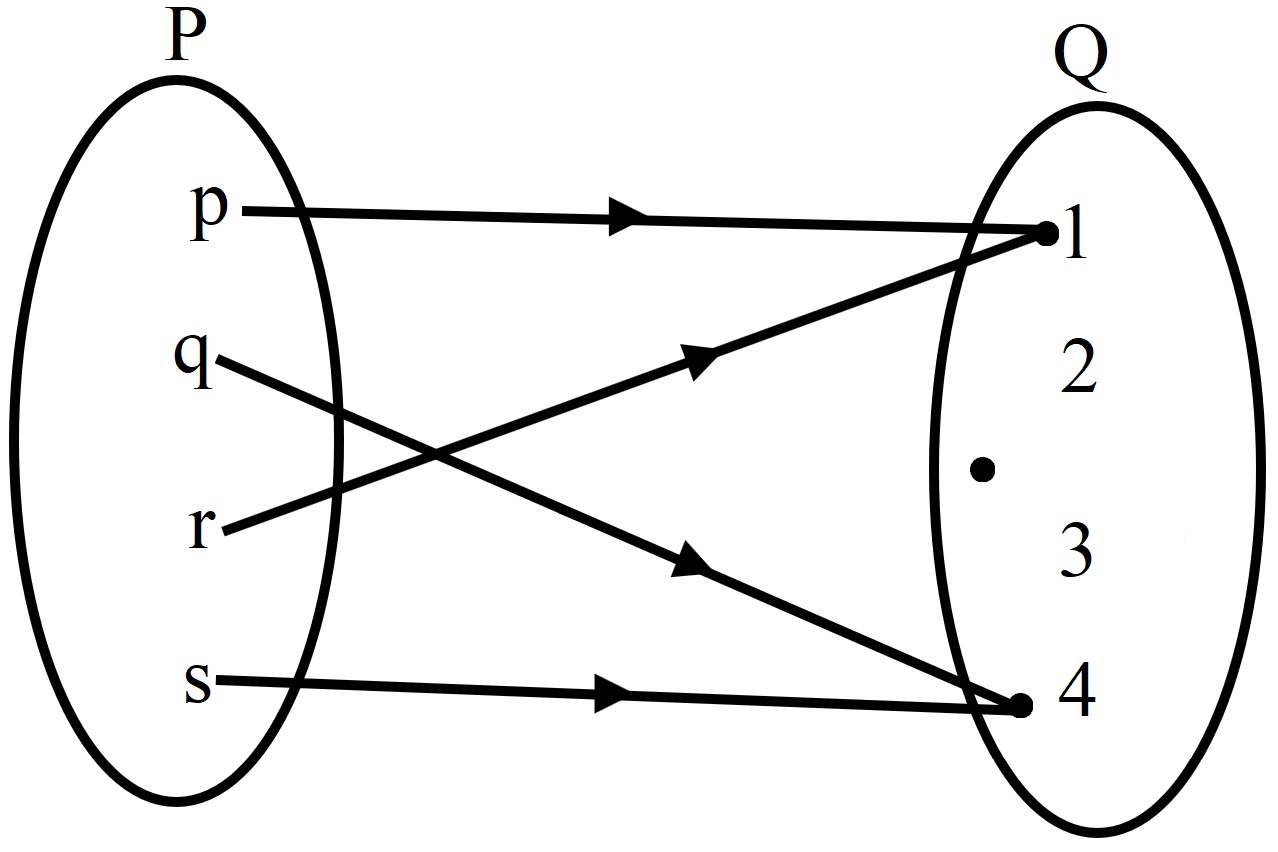
Reason: Let $f : R - {2} \rightarrow R$ be defined by $\text{f}(\text{x})=\frac{\text{x}^{2}-4}{\text{x}-2}$ and $g : R \rightarrow R$ be defined by $g(x) = x + 3,$ Then, $f = g.$ - A
$A$ is true, $R$ is true; $R$ is a correct explanation of $A.$
- B
$A$ is true, $R$ is true; $R$ is not a correct explanation of $A.$
- ✓
$A$ is true; $R$ is false.
- D
$A$ is false; $R$ is true.
Answer: C.
View full solution →Let $R$ be a relation from $N$ to $N$ defined by $R=\left\{(a, b): a, b \in N\right.$ and $\left.a=b^2\right\}$. Check whether, $(a, b) \in R,(b, c) \in R$ implies $(a, c) \in R$ ? Justify your answer.
View full solution →Let $R$ be a relation from $N$ to $N$ defined by $R=\left\{(a, b): a, b \in N\right.$ and $\left.a=b^2\right\}$. Is the given statement true? $(a, b) \in R$, implies $(b, a) \in R$ ? Justify your answer.
View full solution →Let R be a relation from N to N defined by $\mathrm{R}=\left\{(\mathrm{a}, \mathrm{b}): \mathrm{a}, \mathrm{b} \in \mathrm{N}\right.$ and $\left.\mathrm{a}=\mathrm{b}^2\right\}$. Check whether $(a, a) \in R$ for all $a \in N$ ? Justify your answer.
View full solution →If A = {9, 10, 11, 12,13} and f : A $\rightarrow$ N be defined by f(n) = the highest prime factor of n, then find the range of f.
View full solution →Let A = {1, 2, 3, 4}, B = {1, 5, 9, 11, 15, 16} and f = {(1, 5), (2, 9), (3, 1), (4, 5), (2,11)}. Is the given statement true? f is a function from A to B? Justify your answer.
Let f = {(1, 1), (2, 3), (0, - 1), - 1, - 3)} be a function from Z to Z defined by f (x) = ax + b for some integers a, b. Determine a,b.
Let $f= \left\{ \left(x , \frac { x ^ { 2 } } { 1 + x ^ { 2 } } \right) : x \in R \right\}$ be a function from $R$ into $R.$ Determine the range of f.
View full solution →Find the domain and the range of the real function f defined by f(x) = |x - 1|.
Find the domain and range of the real function f defined by $f(x) = \sqrt {x - 1} $
View full solution →Find the domain of the function $f(x) = \frac{{{x^2} + 2x + 1}}{{{x^2} - 8x + 12}}$.
View full solution →Let f, g: $R \to R$ be defined, respectively by f(x) = x + 1, g(x) = 2x – 3. Find f + g, f – g and $\frac{f}{g}$.
View full solution →The relation f is defined by $f ( x ) = \left\{ \begin{array} { l } { x ^ { 2 } , 0 \leq x \leq 3 } \\ { 3 x , 3 \leq x \leq 10 } \end{array} \right.$and the relation g is defined by $g ( x ) = \left\{ \begin{array} { l } { x ^ { 2 } , 0 \leq x \leq 2 } \\ { 3 x , 2 \leq x \leq 10 } \end{array} \right..$ Show that f is a function and g is not a function.
View full solution →Let $A = \{1, 2, 3, 4, 6\}.$ Let $R$ be the relation on $A$ defined by $\{(a, b): a, b \in A, b$ is exactly divisible by $a\}.$
- Write $R$ in roster form
- Find the domain of $R$
- Find the range of $R.$
View full solution →The function f is defined by $\begin{equation} f(x)=\left\{\begin{array}{ll} {1-x,} & {x<0} \\ {1} & {, x=0} \\ {x+1,} & {x>0} \end{array}\right. \end{equation}$
Draw the graph of f(x).
View full solution →Let R be the set of real numbers. Define the real function f: R $\rightarrow$ R by f(x) = x + 10 and sketch the graph of this function.
View full solution →Ordered Pairs The ordered pair of two elements a and 3 is denoted by (a, b) : a is first element (or first component) and d is second element (or second component). Two ordered pairs are equal if their corresponding elements are equal. ie. (a, b) = (c, d) ⇒ a = c and b = d
Cartesian Product of Two Sets For two non-empty sets A and B, the cartesian product A . B is the set of all ordered pairs of elements from sets Aand B. In symbolic form, it can be written as
$\text{A}\cdot\text{B}=\{(\text{a},\text{b}):\text{a}\in\text{A},\text{b}\in\text{B}\}$
Based on the above topics, answer the following questions.
If (a - 3, 6 + 7) = (3, 7), then the value of aand d are:
6, 0
3, 7
7, 0
3, -7
If (x + 6, y - 2) = (0, 6), then the value of x and y are:
6, 8
-6, -8
-6, 8
6, -8
If (x + 2, 4) = (5, 2x + y), then the value of x and y are:
-3, 2
3, 2
-3, -2
Let A and B be two sets such that A . B consists of 6 elements. If three elements of A . B are (1, 4), (2, 6) and (3, 6), then
(A . B) = (B . A)
$(\text{A}\cdot\text{B})\neq(\text{B}\cdot\text{A})$
A . B = {(1, 4), (1, 6), (2, 4)}
None of the above
If m(A . B) = 45, then n(A) cannot be
15
17
5
9
View full solution →Method to Find the Sets When Cartesian Product is Given For finding these two sets, we write first element of each ordered pair in first set say $A$ and corresponding second element in second set $B ($say$).$ Number of Elements in Cartesian Product of Two Sets If there are p elements in set $A$ and $g$ elements in set $B,$ then there will be $pq$ elements in $A . B$ i.e. if $n(A) = p$ and $n(B) = q,$ then $n(A . B) = pq.$
Based on the above two topic, answer the following questions.
- If $A . B = \{(a, 1), (b, 3), (a, 3), (b, 1), (a, 2), (b, 2)\}.$ Then, $A$ and $B$ are:
- $\{1, 3, 2\}, \{a, b\}$
- $\{a, b\}, \{1, 3\}$
- $\{a, b\}, \{1, 3, 2\}$
- None of these
- If the set $A$ has $3$ elements and set $B$ has $4$ elements, then the number of elements in $A . B$ is:
- $3$
- $4$
- $7$
- $12$
- $A$ and $B$ are two sets given in such a way that $A . B$ contains $6$ elements. If three elements of $A . B$ are $(1, 3), (2, 5)$ and $(3, 3)$, then $A, B$ are:
- $\{1, 2, 3\}, \{3, 5\}$
- $\{3, 5,\}, \{1, 2, 3\}$
- $\{1, 2\}, \{3, 5\}$
- $\{1, 2, 3\}, \{5\}$
- The remaining elements of $A . B$ in $(iii)$ is:
- $(5, 1), (3, 2), (3, 5)$
- $(1, 5), (2, 3), (3, 5)$
- $(1, 5), (3, 2), (5, 3)$
- None of the above
- The cartesian product $P . P$ has $16$ elements among which are found $(a, 1)$ and $(b, 2).$ Then, the set $P$ is:
- $\{a, b\}$
- $\{1, 2\}$
- $\{a, b,1, 2\}$
- $\{0, b, 1, 2, 4\}$
View full solution →