MCQ 511 Mark
$\mathop {\lim }\limits_{x \to \infty } {\left( {1 - \frac{4}{{x - 1}}} \right)^{3x - 1}} = $
- A
${e^{12}}$
- ✓
${e^{ - 12}}$
- C
${e^4}$
- D
${e^3}$
AnswerCorrect option: B. ${e^{ - 12}}$
b
(b) $\mathop {\lim }\limits_{x \to \infty } {\left( {1 - \frac{4}{{x - 1}}} \right)^{3x - 1}} = \mathop {\lim }\limits_{x \to \infty } {\left[ {{{\left( {1 + \frac{{( - 4)}}{{x - 1}}} \right)}^{\left( {\frac{{x - 1}}{{ - 4}}} \right)}}} \right]^{\left( {\frac{{ - 4}}{{x - 1}}} \right)(3x - 1)}}$
$ = {e^{\mathop {\lim }\limits_{x \to \infty } \left[ {\frac{{ - 4\left( {3 - \frac{1}{x}} \right)}}{{\left( {1 - \frac{1}{x}} \right)}}} \right]}} = {e^{ - 12}}$.
View full question & answer→MCQ 521 Mark
$\mathop {\lim }\limits_{x \to 0} \left[ {\frac{{{e^x} - {e^{\sin x}}}}{{x - \sin x}}} \right]$ is equal to
Answerc
(c) $\mathop {\lim }\limits_{x \to 0} \left[ {\frac{{{e^x} - {e^{\sin x}}}}{{x - \sin x}}} \right]$, $\left( {\frac{0}{0} \, \, \,{\rm{form}}} \right)$
Using $ L-$ Hospital’s rule three times, then
$\mathop {\lim }\limits_{x \to 0} \frac{{{e^x} - {e^{\sin x}}.\cos x}}{{1 - \cos x}} = \mathop {\lim }\limits_{x \to 0} \frac{{{e^x} - {e^{\sin x}}{{\cos }^2}x + \sin x.{e^{\sin x}}}}{{\sin x}}$
$ = \mathop {\lim }\limits_{x \to 0} \frac{{{e^x} - {e^{\sin x}}.{{\cos }^3}x + {e^{\sin x}}2\cos x\sin x + {e^{\sin x}}.\cos x\sin x + {e^{\sin x}}.\cos x}}{{\cos x}}$
$ = 1$.
View full question & answer→MCQ 531 Mark
If $\mathop {\lim }\limits_{n \to \infty } \frac{{1 - {{(10)}^n}}}{{1 + {{(10)}^{n + 1}}}} = \frac{{ - \alpha }}{{10}}$, then give the value of $\alpha $ is
Answerc
(c) $\mathop {\lim }\limits_{n \to \infty } \frac{{1 - {{(10)}^n}}}{{1 + {{(10)}^{n + 1}}}}$
$ = \mathop {\lim }\limits_{n \to \infty } \frac{{{{(10)}^n}\left[ {{{\left( {\frac{1}{{10}}} \right)}^n} - 1} \right]}}{{{{(10)}^{n + 1}}\left( {1 + \frac{1}{{{{10}^{n + 1}}}}} \right)}} = - \frac{1}{{10}}$
$\therefore \alpha = 1$.
View full question & answer→MCQ 541 Mark
The value of $\mathop {\lim }\limits_{x \to 0} \frac{{\log [1 + {x^3}]}}{{{{\sin }^3}x}} = $
Answerb
(b) $\mathop {\lim }\limits_{x \to 0} \frac{{\log (1 + {x^3})}}{{{{\sin }^3}x}}$
$ = \mathop {\lim }\limits_{x \to 0} \frac{{3{x^2}/(1 + {x^3})}}{{3{{\sin }^2}x\cos x}}$
[By using $ L-$ Hospital rule]
$ = \mathop {\lim }\limits_{x \to 0} \left[ {\frac{1}{{1 + {x^3}}}{{\left( {\frac{x}{{\sin x}}} \right)}^2}.\frac{1}{{\cos x}}} \right]$
$ = \frac{1}{{1 + 0}}.{(1)^2}.\frac{1}{1} = 1$.
View full question & answer→MCQ 551 Mark
The value of $\mathop {\lim }\limits_{x \to 0} \frac{{{{27}^x} - {9^x} - {3^x} + 1}}{{\sqrt 5 - \sqrt {4 + \cos x} }}$ is
- A
$\sqrt 5 {(\log 3)^2}$
- B
$8\sqrt 5 \log 3$
- C
$16\sqrt 5 \log 3$
- ✓
$8\sqrt 5 {(\log 3)^2}$
AnswerCorrect option: D. $8\sqrt 5 {(\log 3)^2}$
d
(d) Applying $L-$ Hospital’s rule.
View full question & answer→MCQ 561 Mark
The value of $\mathop {\lim }\limits_{n \to \infty } \frac{1}{{1.3}} + \frac{1}{{3.5}} + \frac{1}{{5.7}} + \frac{1}{{7.9}} + ... + \frac{1}{{(2n - 1)(2n + 1)}}$ is equal to
Answera
(a) $\mathop {\lim }\limits_{n \to \infty } \frac{1}{2}\left[ {\left( {1 - \frac{1}{3}} \right) + \left( {\frac{1}{3} - \frac{1}{5}} \right) + \left( {\frac{1}{5} - \frac{1}{7}} \right) + ....} \right.$
$\left. { + \left( {\frac{1}{{(2n - 1)}} - \frac{1}{{(2n + 1)}}} \right)} \right]$
$ = \mathop {\lim }\limits_{n \to \infty } \frac{1}{2}\left[ {1 - \frac{1}{{2n + 1}}} \right] = \frac{1}{2}$.
View full question & answer→MCQ 571 Mark
$\mathop {\lim }\limits_{n \to \infty } \left[ {\frac{1}{{{n^3} + 1}} + \frac{4}{{{n^3} + 1}} + \frac{9}{{{n^3} + 1}} + ........ + \frac{{{n^2}}}{{{n^3} + 1}}} \right] = $
- A
$1$
- B
$2/3$
- ✓
$\frac{1}{3}\,$
- D
$0$
AnswerCorrect option: C. $\frac{1}{3}\,$
c
(c) Given limit $ = \mathop {\lim }\limits_{n \to \infty } \,\,\frac{{{1^2} + {2^2} + {3^2} + ..... + {n^2}}}{{1 + {n^3}}} = \mathop {\lim }\limits_{n \to \infty } \,\,\frac{{\Sigma {n^2}}}{{1 + {n^3}}}$
$ = \mathop {\lim }\limits_{n \to \infty } \,\,\frac{1}{6}\frac{{n\,(n + 1)\,(2n + 1)}}{{1 + {n^3}}}$
$ = \mathop {\lim }\limits_{n \to \infty } \,\frac{1}{6}\frac{{\left( {1 + \frac{1}{n}} \right)\,\left( {2 + \frac{1}{n}} \right)}}{{\left( {\frac{1}{{{n^3}}} + 1} \right)}}$
$ = \frac{1}{6}\,.\,1\,.\,\frac{2}{{(1)}} = \left( {\frac{1}{3}} \right).$
View full question & answer→MCQ 581 Mark
The value of $\mathop {\lim }\limits_{n\, \to \,\infty } \frac{{1 - {n^2}}}{{\sum n}}$ will be
Answera
(a) $\mathop {\lim }\limits_{n \to \infty } \,\frac{{1 - {n^2}}}{{\Sigma n}}$ $ = \mathop {\lim }\limits_{n \to \infty } \frac{{(1 - n)(1 + n)}}{{\frac{1}{2}n(n + 1)}}$
$ = \mathop {\lim }\limits_{n \to \infty } \,\frac{{2\,(1 - n)}}{n}$
$ = \mathop {\lim }\limits_{n \to \infty } 2\,\left( {\frac{1}{n} - 1} \right)$$ = 2(0 - 1) = - 2$.
View full question & answer→MCQ 591 Mark
$\mathop {\lim }\limits_{x \to \infty } \frac{{{{(x + 1)}^{10}} + {{(x + 2)}^{10}} + ..... + {{(x + 100)}^{10}}}}{{{x^{10}} + {{10}^{10}}}}$ is equal to
Answerd
(d) $\mathop {\lim }\limits_{x \to \infty } \frac{{{{(x + 1)}^{10}} + {{(x + 2)}^{10}} + ...... + {{(x + 100)}^{10}}}}{{{x^{10}} + {{10}^{10}}}}$
$ = \mathop {\lim }\limits_{x \to \infty } \frac{{{x^{10}}\left[ {{{\left( {1 + \frac{1}{x}} \right)}^{10}} + {{\left( {1 + \frac{2}{x}} \right)}^{10}} + ... + {{\left( {1 + \frac{{100}}{x}} \right)}^{10}}} \right]}}{{{x^{10}}\left[ {1 + \frac{{{{10}^{10}}}}{{{x^{10}}}}} \right]}} = 100$.
View full question & answer→MCQ 601 Mark
The value of $\mathop {\lim }\limits_{n \to \infty } \frac{{1 + 2 + 3 + ....n}}{{{n^2} + 100}}$ is equal
- A
$\infty $
- ✓
$\frac{1}{2}$
- C
$2$
- D
$0$
AnswerCorrect option: B. $\frac{1}{2}$
b
(b) We have, $\mathop {\lim }\limits_{n \to \infty } \frac{{1 + 2 + 3 + ..... + n}}{{{n^2} + 100}}$
$ = \mathop {\lim }\limits_{n \to \infty } \frac{{n(n + 1)}}{{2({n^2} + 100)}} = \mathop {\lim }\limits_{n \to \infty } \frac{{{n^2}\left( {1 + \frac{1}{n}} \right)}}{{2{n^2}\left( {1 + \frac{{100}}{{{n^2}}}} \right)}} = \frac{1}{2}$.
View full question & answer→MCQ 611 Mark
The value of $\mathop {\lim }\limits_{x \to 0} \frac{{\int_0^x {\cos {t^2}} }}{x}\,dt$ is
Answerb
(b) $\mathop {\lim }\limits_{x \to 0} \frac{{\int_0^x {\cos {t^2}dt} }}{x}$
Applying $ L- $ Hospital rule, we get
$\mathop {\lim }\limits_{x \to 0} \frac{{\int_0^x {\cos {t^2}dt} }}{x} = \mathop {\lim }\limits_{x \to 0} \frac{{\cos {x^2}}}{1} = 1$.
View full question & answer→MCQ 621 Mark
True statement for $\mathop {\lim }\limits_{x \to 0} \frac{{\sqrt {1 + x} - \sqrt {1 - x} }}{{\sqrt {2 + 3x} - \sqrt {2 - 3x} }}$ is
AnswerCorrect option: B. Lies between $0$ and $\frac{1}{2}$
b
(b) $\mathop {\lim }\limits_{x \to 0} \,\frac{{(1 + x) - (1 - x)}}{{(2 + 3x) - (2 - 3x)}}\,\left[ {\frac{{\sqrt {2 + 3x} + \sqrt {2 - 3x} }}{{\sqrt {1 + x} + \sqrt {1 - x} }}} \right]$
$ = \frac{1}{3}\,\left[ {\frac{{2\sqrt 2 }}{2}} \right] = \frac{{\sqrt 2 }}{3},\,\,0 < \frac{{\sqrt 2 }}{3} < \frac{1}{2}.$
Aliter : Apply $ L-$ Hospital’s rule,
$\mathop {\lim }\limits_{x \to 0} \frac{{\sqrt {1 + x} - \sqrt {1 - x} }}{{\sqrt {2 + 3x} - \sqrt {2 - 3x} }} $
$= \mathop {\lim }\limits_{x \to 0} \,\frac{{\frac{1}{{2\sqrt {1 + x} }} + \frac{1}{{2\sqrt {1 - x} }}}}{{\frac{3}{{2\sqrt {2 + 3x} }} + \frac{3}{{2\sqrt {2 - 3x} }}}}$
$ = \frac{{\frac{1}{2} + \frac{1}{2}}}{{\frac{3}{{2\sqrt 2 }} + \frac{3}{{2\sqrt 2 }}}} = \frac{{2\sqrt 2 }}{6} = \frac{{\sqrt 2 }}{3}$.
View full question & answer→MCQ 631 Mark
If $[.]$ denotes the greatest integer less than or equal to $x$, then the value of $\mathop {\lim }\limits_{x \to 1} (1 - x + [x - 1] + [1 - x])$ is
Answerc
(c) We have $\mathop {\lim }\limits_{x \to 1 - } \,\,(1 - x + [x - 1] + [1 - x])$
$ = \mathop {\lim }\limits_{h \to 0} \,\,(1 - (1 - h) + [1 - h - 1] + [1 - (1 - h)])\,$
$ = \mathop {\lim }\limits_{h \to 0} \,(h + [ - h] + [h]) = \mathop {\lim }\limits_{h \to 0} \,(h - 1 + 0) = - 1$
and $\mathop {\lim }\limits_{x \to 1 + } \,(1 - x + [x - 1] + [1 - x])\,$
$ = \mathop {\lim }\limits_{h \to 0} \,(1 - (1 + h) + [1 + h - 1] + [1 - (1 + h)])$
$ = \mathop {\lim }\limits_{h \to 0} \,( - h + [h] + [ - h]) = \mathop {\lim }\limits_{h \to 0} \,( - h + 0 - 1) = - 1$
$\therefore$ $\mathop {\lim }\limits_{x \to 1} \,f(x) = - 1$.
View full question & answer→MCQ 641 Mark
If $\mathop {\lim }\limits_{x \to a} \frac{{{a^x} - {x^a}}}{{{x^x} - {a^a}}} = - 1$, then
- ✓
$a = 1$
- B
$a = 0$
- C
$a = e$
- D
AnswerCorrect option: A. $a = 1$
a
(a) Using $ L-$ Hospital's rule, we get
$ - 1 = \mathop {\lim }\limits_{x \to a} \,\,\frac{{{a^x} - {x^a}}}{{{x^x} - {a^a}}} = \mathop {\lim }\limits_{x \to a} \,\frac{{{a^x}{{\log }_e}a - a{x^{a - 1}}}}{{{x^x} + {a^a}{{\log }_e}a}}$
$ \Rightarrow \,\, - 1 = \frac{{{a^a}{{\log }_e}a - a\,.\,{a^{a - 1}}}}{{{a^a} + {a^a}{{\log }_e}a}} = \frac{{{{\log }_e}a - 1}}{{{{\log }_e}a + 1}}$.....$(i)$
Now $(i)$ is satisfied only when $a = 1.$
View full question & answer→MCQ 651 Mark
If $G(x) = - \sqrt {25 - {x^2}} $, then $\mathop {\lim }\limits_{x \to 1} \frac{{G(x) - G(1)}}{{x - 1}} = $
- A
$\frac{1}{{24}}$
- B
$\frac{1}{5}$
- C
$ - \sqrt {24} $
- ✓
Answerd
(d) $\mathop {\lim }\limits_{x \to 1} \,\,\frac{{G(x) - G(1)}}{{x - 1}} = \mathop {\lim }\limits_{x \to 1} \,\,\frac{{ - \sqrt {25 - {x^2}} + \sqrt {24} }}{{x - 1}}$
{Multiply both numerator and denominator by $(\sqrt {24} + \sqrt {25 - {x^2}} )$}
$ = \mathop {\lim }\limits_{x \to 1} \,\,\frac{{x + 1}}{{\sqrt {24} + \sqrt {25 - {x^2}} }} = \frac{1}{{\sqrt {24} }}$ .
View full question & answer→MCQ 661 Mark
$\mathop {\lim }\limits_{n \to \infty } n\cos \left( {\frac{\pi }{{4n}}} \right)\sin \left( {\frac{\pi }{{4n}}} \right) = k$, then $k$ is equal to
- ✓
$\frac{\pi }{4}$
- B
$\frac{\pi }{3}$
- C
$\pi $
- D
AnswerCorrect option: A. $\frac{\pi }{4}$
a
(a) $\mathop {\lim }\limits_{n \to \infty } n\,\,\cos \frac{\pi }{{4n}}\sin \frac{\pi }{{4n}} = \frac{1}{2}$$\mathop {\lim }\limits_{n \to \infty } n\,\,.\,\,2\,\,\sin \frac{\pi }{{4n}}\cos \frac{\pi }{{4n}}$
$ = \frac{1}{2}\,\,\mathop {\lim }\limits_{n \to \infty } \,n\,\,.\,\,\sin \frac{\pi }{{2n}}$ $ = \frac{\pi }{4}\,\mathop {\lim }\limits_{n \to \infty } \,\frac{{\sin \frac{\pi }{{2n}}}}{{\frac{\pi }{{2n}}}} = \frac{\pi }{4}$
View full question & answer→MCQ 671 Mark
If $f(1) = 1$ and $f'(1) = 4,$ then the value of $\mathop {\lim }\limits_{x \to 1} \frac{{\sqrt {f(x)} - 1}}{{\sqrt x - 1}}$ is
Answerb
(b) $\mathop {\lim }\limits_{x \to 1} \frac{{\sqrt {f(x)} - 1}}{{\sqrt x - 1}} = \mathop {\lim }\limits_{x \to 1} \frac{{\sqrt x f'(x)}}{{\sqrt {f(x)} }} = \frac{{f'(1)}}{{\sqrt {f(1)} }} = 4$.
View full question & answer→MCQ 681 Mark
If $f(a) = 2$, $f'(a) = 1$, $g(a) = - 3$, $g'(a) = - 1$, then $\mathop {\lim }\limits_{x \to a} \,\frac{{f(a)\,g(x) - f(x)\,g(a)}}{{x - a}} = $
Answera
(a) $\mathop {{\rm{lim}}}\limits_{x \to a} \,\frac{{f(a)\,g(x) - f(x)\,g(a)}}{{x - a}}$, $\left( {\frac{0}{0}{\rm{form}}} \right)$
Using L-Hospital’s rule, $\mathop {{\rm{lim}}}\limits_{x \to a} \,\frac{{f(a)\,g'(x) - f'(x)\,g(a)}}{{1 - 0}}$
$ = f(a) \times g'(a) - f'(a) \times g(a)$$ = 2 \times ( - 1) - 1 \times ( - 3) = 1$.
View full question & answer→MCQ 691 Mark
Consider the following statements:
$I$. $\lim _{n \rightarrow \infty} \frac{2^n+(-2)^n}{2^n}$ does not exist
$II$. $\lim _{n \rightarrow \infty} \frac{3^n+(-3)^n}{4^n}$ does not exist $\,\,$Then,
- ✓
$I$ is true and $II$ is false
- B
$I$ is false and $II$ is true
- C
$I$ and $II$ are true
- D
Neither $I$ nor $II$ is true
AnswerCorrect option: A. $I$ is true and $II$ is false
a
(a)
$I$. $\lim _{n \rightarrow \infty} \frac{2^n+(-2)^n}{2^n}=\lim _{n \rightarrow \infty} 1+(-1)^n=$ does not exist
$11$. $\lim _{n \rightarrow \infty} \frac{3^n+(-3)^n}{4^n}=\lim _{n \rightarrow \infty}\left(\frac{3}{4}\right)^n+\left(\frac{-3}{4}\right)^n$
$=0+0=0$
View full question & answer→MCQ 701 Mark
Define a sequence $\left\{s_n\right\}$ of real number by $s_n=\sum_{k=0}^n \frac{1}{\sqrt{n^2+k}}$, for $n \geq 1$
Then, $\lim _{n \rightarrow \infty} s_n$
- A
- B
Exists and lies in the interval $(0,1)$
- ✓
Exists and lies in the interval $[1, 2)$
- D
Exists and lies in the interval $[2, \infty)$
AnswerCorrect option: C. Exists and lies in the interval $[1, 2)$
c
(c)
Given, $S_n=\sum_{k=\bullet}^n \frac{1}{\sqrt{n^2+k}}$
$\frac{1}{\sqrt{n^2+n}}+\frac{1}{\sqrt{n^2+n}}+\ldots+\frac{1}{\sqrt{n^2+n}}$
$\leq \frac{1}{\sqrt{n^2}}+\frac{1}{\sqrt{n^2+1}}+\ldots+\frac{1}{\sqrt{n^2+n}}$ $\leq \frac{1}{\sqrt{n^2}}+\frac{1}{\sqrt{n^2}}+\ldots+\frac{1}{\sqrt{n^2}}$
$\lim _{n \rightarrow \infty} \frac{n+1}{\sqrt{n^2+n}} \leq \lim _{n \rightarrow \infty} S_n \leq \lim _{n \rightarrow \infty} \frac{n+1}{\sqrt{n^2}}$
$1 \leq \lim _{n \rightarrow \infty} S_n \leq 1 \Rightarrow \lim _{n \rightarrow \infty} S_n=1$
View full question & answer→MCQ 711 Mark
The value of the limit $\lim _{x \rightarrow-\infty}\left(\sqrt{4 x^2-x}+2 x\right)$ is
- A
$-\infty$
- B
$-\frac{1}{4}$
- C
$0$
- ✓
$\frac{1}{4}$
AnswerCorrect option: D. $\frac{1}{4}$
d
(d)
We have, $\lim _{x \rightarrow-\infty}\left(\sqrt{4 x^2-x}+2 x\right)$
$=\lim _{x \rightarrow-\infty} \frac{4 x^2-x-4 x^2}{\sqrt{4 x^2-x-2 x}}$
$=\lim _{x \rightarrow-\infty} \frac{-x}{-\sqrt{\left.\sqrt{4-\frac{x}{x^2}}+2\right)}}=\frac{1}{2+2}=\frac{1}{4}$
$=\lim _{x \rightarrow-\infty} \frac{1}{\sqrt{4-\frac{1}{x}+2}}$
View full question & answer→MCQ 721 Mark
Let $x_n=\left(2^n+3^n\right)^{1 / 2 n}$ for all natural numbers $n$. Then,
- A
$\lim _{n \rightarrow \infty} x_n=\infty$
- ✓
$\lim _{n \rightarrow \infty} x_n=\sqrt{3}$
- C
$\lim _{n \rightarrow \infty} x_n=\sqrt{3}+\sqrt{2}$
- D
$\lim _{n \rightarrow \infty} x_n=\sqrt{5}$
AnswerCorrect option: B. $\lim _{n \rightarrow \infty} x_n=\sqrt{3}$
b
(b)
We have,
$x_n =\left(2^n+3^n\right)^{\frac{1}{2 n}}$
$\Rightarrow \quad \lim _{n \rightarrow \infty} x_n =\lim _{n \rightarrow \infty}\left(2^n+3^n\right)^{\frac{1}{2 n}}$
$=\lim _{n \rightarrow \infty} 3^{n / 2 n}\left[\left(\frac{2}{3}\right)^n+1\right]^{\frac{1}{2 n}}$
$=3^{3 / 2} \times 1=\sqrt{3}$
View full question & answer→MCQ 731 Mark
Let $\alpha >0$ be a real number. Then the limit $\lim _{x \rightarrow 2} \frac{a^x+a^{3-x}-\left(a^2+a\right)}{a^{3-x}-a^{x / 2}}$ is
- A
$2 \log a$
- B
$-\frac{4}{3} a$
- C
$\frac{a^2+a}{2}$
- ✓
$\frac{2}{3}(1-a)$
AnswerCorrect option: D. $\frac{2}{3}(1-a)$
d
(d)
Let $L=\lim _{x \rightarrow 2} \frac{a^x+a^{3-x}-\left(a^2+a\right)}{a^{3-x}-a^{x / 2}}$
Apply L-Hospital rule
$L=\lim _{x \rightarrow 2} \frac{a^x \log a-a^{3-x} \log a}{-a^{3-x} \log a-\frac{1}{2} e^{x / 2} \log a}$
$L=\lim _{x \rightarrow 2} \frac{a^x-a^{3-x}}{-a^{3-x}-\frac{a^{x / 2}}{2}}$
$L=\frac{a^2-a}{-a-\frac{a}{2}}=\frac{2}{3}(1-a)$
View full question & answer→MCQ 741 Mark
Let $p(x)$ be a polynomial such that $p(x)-p^{\prime}(x)=x^n$, where $n$ is a positive integer. Then, $p(0)$ equals
- ✓
$n !$
- B
$(n-1) !$
- C
$\frac{1}{n !}$
- D
$\frac{1}{(n-1) !}$
Answera
$(a)$
Let
$p =\lim _{x \rightarrow 0}\left(\frac{x}{\sin x}\right)^{6 / x^2}$
$\Rightarrow \quad \log p =\lim _{x \rightarrow 0} \frac{6}{x^2} \log \left(\frac{x}{\sin x}\right)$
$\Rightarrow \quad \log p =\lim _{x \rightarrow 0} \frac{6 \log \left(\frac{x}{\sin x}\right)}{x^2}$
Apply $L-$ Hospital rule
$\log p=\lim _{x \rightarrow 0}$
$6 \frac{\frac{\sin x}{x} \frac{(\sin x-x \cos x)}{\sin ^2 x}}{2 x}$
$\log p=\lim _{x \rightarrow 0} 6 \frac{\sin x(\sin x-x \cos x)}{x \cdot 2 x \sin ^2 x}$
$\log p=\lim _{x \rightarrow 0} 3 \frac{\sin x}{x} \times \lim _{x \rightarrow 0}$
$\frac{\sin x-x \cos x}{\frac{\sin ^2 x}{x^2}} \times x^3$
$\log p=3 \times \lim _{x \rightarrow 0} \frac{\sin x-x \cos x}{x^3}$
$\Rightarrow \quad \log p=3 \times \lim _{x \rightarrow 0} \frac{\sin x-x \cos x}{x^3}$
Again apply L.Hospital's rule
$\log p=3 \lim _{x \rightarrow 0} \frac{\cos x-\cos x+x \sin x}{3 x^2}$
$\Rightarrow \log p=\lim _{x \rightarrow 0} \frac{\sin x}{x}=1$
$\therefore \quad p=e^1=e$
View full question & answer→MCQ 751 Mark
The value of the limit $\lim _{x \rightarrow 0}\left(\frac{x}{\sin x}\right)^{6 / x^2}$ is
- ✓
$e$
- B
$e^{-1}$
- C
$e^{-1 / 6}$
- D
$e^6$
Answera
(a)
Let
$p =\lim _{x \rightarrow 0}\left(\frac{x}{\sin x}\right)^{6 / x^2}$
$\log p =\lim _{x \rightarrow 0} \frac{6}{x^2} \log \left(\frac{x}{\sin x}\right)$
$\log p =\lim _{x \rightarrow 0} \frac{6 \log \left(\frac{x}{\sin x}\right)}{x^2}$
Apply L-Hospital rule
$\log p=\lim _{x \rightarrow 0} 6 \frac{\frac{\sin x}{x} \frac{(\sin x-x \cos x)}{\sin ^2 x}}{2 x}$
$\Rightarrow \log p=\lim _{x \rightarrow 0} 6 \frac{\sin x(\sin x-x \cos x)}{x \cdot 2 x \sin ^2 x}$
$\Rightarrow \log p=\lim _{x \rightarrow 0} 3 \frac{\sin x}{x} \times \lim _{x \rightarrow 0}$
$\frac{\sin x-x \cos x}{\frac{\sin ^2 x}{x^2}} \times x^3$
$\Rightarrow \quad \log p=3 \times \lim _{x \rightarrow 0} \frac{\sin x-x \cos x}{x^3}$
Again apply L.Hospital's rule
$\quad \log p=3 \lim _{x \rightarrow 0} \frac{\cos x-\cos x+x \sin x}{3 x^2}$
$\Rightarrow \log p=\lim _{x \rightarrow 0} \frac{\sin x}{x}=1$
$\therefore \quad p=e^1=e$
View full question & answer→MCQ 761 Mark
Let $f: R \rightarrow R$ be a function such that $\lim _{x \rightarrow \infty} f(x)=M>0$. Then which of the following is false ?
- A
$\lim _{x \rightarrow \infty} x \sin (1 / x) f(x)=M$
- B
$\lim _{x \rightarrow \infty} \sin (f(x))=\sin M$
- ✓
$\lim _{x \rightarrow \infty} x \sin \left(e^{-x}\right) f(x)=M$
- D
$\lim _{x \rightarrow \infty} \frac{\sin }{x} \underline{x} \cdot f(x)=0$
AnswerCorrect option: C. $\lim _{x \rightarrow \infty} x \sin \left(e^{-x}\right) f(x)=M$
c
(c) We have,
$\lim _{x \rightarrow \infty} f(x)=M > 0$
(a) $\lim _{x \rightarrow \infty} x \sin \left(\frac{1}{x}\right) f(x)=\lim _{x \rightarrow \infty} \frac{\sin \left(\frac{1}{x}\right)}{\frac{1}{x}} f(x)$ $=\lim _{x \rightarrow \infty} \frac{\sin \left(\frac{1}{x}\right)}{\frac{1}{x}} \times \lim _{x \rightarrow \infty} f(x)=1 \times M=M$
Hence, option (a) is true.
(b) $\lim _{x \rightarrow \infty} \sin (f(x))$
$\sin \left(\lim _{x \rightarrow \infty} f(x)\right)=\sin M$
Option (b) is also true.
(c) $\lim _{x \rightarrow \infty} x \sin \left(e^{-x}\right) f(x)$
$\lim _{x \rightarrow \infty} x e^{-x} \frac{\sin \left(e^{-x}\right)}{e^{-x}} f(x)$
$=0 \times 1 \times M=0$
Hence, option (c) is false.
(d) $\lim _{x \rightarrow \infty} \frac{\sin x}{x} f(x)=0 \times M=0$
Option (d) is also true.
View full question & answer→MCQ 771 Mark
Define a sequence $\left\langle a_n\right\rangle$ by $a_1=5, a_n=a_1 a_2 \ldots a_{n-1}+4$ for $n > 1$. Then, $\lim _{n \rightarrow \infty} \frac{\sqrt{ a _n}}{ a _{n-1}}$
- A
equals $\frac{1}{2}$
- ✓
equals $1$
- C
equals $\frac{2}{5}$
- D
AnswerCorrect option: B. equals $1$
b
(b)
We have,
$a_n = a _1 \cdot a_2 \cdot a_3 \ldots a_{n-1}+4, a_1=5$
$a_2 =a_1+4=5+4=9$
$a_3 =a_1 a_2+4=5 \times 9+4=49$
$a_4 =a_1 a_2 a_3=5 \times 9 \times 49+4=2209$
$a_4=\left(a_3-2\right)^2=(49-2)^2=47^2=2209$
$a_3 =\left(a_2-2\right)^2=(9-2)^2=49$
$a_n =\left(a_{n-1}-2\right)^2$
$\therefore \quad \lim _{n \rightarrow \infty} \frac{\sqrt{ a _n}}{a_{n-1}} =\lim _{n \rightarrow \infty} \frac{\sqrt{\left(a_{n-1}-2\right)^2}}{a_{n-1}}$
$=\lim _{n \rightarrow \infty}\left(\frac{ a _{n-1}-2}{a_{n-1}}\right)=1$
View full question & answer→MCQ 781 Mark
Define a sequence $\left\{a_n\right\}_n \geq 0$ by $\alpha_n=\sqrt{\frac{1+a_{n-1}}{2}}$ for $n \geq 1, a_0=\cos \theta \neq \pm 1$ Then, $\lim _{n \rightarrow \infty} 4^n\left(1-a_n\right)$ equals
- A
$\theta^2$
- ✓
$\frac{\theta^2}{2}$
- C
$\frac{\theta}{2}$
- D
$\theta$
AnswerCorrect option: B. $\frac{\theta^2}{2}$
b
(b)
We have,
$a_n=\sqrt{\frac{1+a_{n-1}}{2}}$ for $n \geq 1, a_0=\cos \theta$
$a_1=\sqrt{\frac{1+a_0}{2}}=\sqrt{\frac{1+\cos \theta}{2}}$
$a_1=\sqrt{\frac{2 \cos ^2 \frac{\theta}{2}}{2}}=\cos \frac{\theta}{2}$
$a_2=\sqrt{\frac{1+\cos \frac{\theta}{2}}{2}}=\cos \frac{\theta}{2^2}$
$a_n=\cos \frac{\theta}{2^n}$
$\lim _{n \rightarrow \infty} 4^n\left(1-a_n\right)$
$=\lim _{n \rightarrow \infty} 4^n\left(1-\cos \frac{\theta}{2^n}\right)$
$=\lim _{n \rightarrow \infty} 4^n\left(2 \sin ^2 \frac{\theta}{2^{n+1}}\right)$
$=\lim _{n \rightarrow \infty} 4^n \cdot 2\left(\frac{\sin \frac{\theta}{2^{n+1}}}{\frac{\theta}{2^{n+1}}}\right)^2 \times \frac{\theta^2}{2^{2 n+2}}$
$=\lim _{n \rightarrow \infty} \frac{4^n}{4^n \cdot 2}\left(\frac{\sin \frac{\theta}{2^{n+1}}}{\frac{\theta}{2^{n+1}}}\right)^2 \times \theta^2=\frac{\theta^2}{2}$
View full question & answer→MCQ 791 Mark
Consider all natural number whose decimal expansion has only the even digits $0,2,4,6,8$. Suppose these are arranged in increasing order. If $a _n$ denotes the $n$th number in this sequence, then $\frac{\lim _{n \rightarrow \infty} \log a_n}{\log n}$ equals
- A
$0$
- ✓
$\log _5 10$
- C
$\log _2 10$
- D
$2$
AnswerCorrect option: B. $\log _5 10$
b
(b)
We have all natural numbers whose decimal expansion has only even digits $0,2,4,6,8$.
$a_n=n$th number of sequence if these are arranged in increasing orders.
Let $n=5^K$, then $5$ based representation of $n$ is a $1$ followed by $K$ zeroes,
$\therefore$ Decimal representation and doubling its value, we obtain a $2$ followed by $K$ zeroes that is $210^K$.
$\therefore \quad \log a_n=K+\log _{10} 2$
$\Rightarrow \log n =K \log _{10} 5$
$\Rightarrow \quad \lim _{n \rightarrow \infty} \frac{\log a_n}{\log n} =\frac{K+\log _{10} 2}{K \log _{10} 5}$
$K$ goes to infinity
$\therefore \quad \lim _{n \rightarrow \infty} \frac{\log a_n}{\log n}=\frac{1}{\log _{10} 5}=\log _5 10$
View full question & answer→MCQ 801 Mark
If $a=\lim _{x \rightarrow 0} \frac{\sqrt{1+\sqrt{1+x^4}}-\sqrt{2}}{x^4}$ and $b=\lim _{x \rightarrow 0} \frac{\sin ^2 x}{\sqrt{2}-\sqrt{1+\cos x}}$, then the value of $a b^3$ is
Answerb
$a=\lim _{x \rightarrow 0} \frac{\sqrt{1+\sqrt{1+x^4}}-\sqrt{2}}{x^4} $
$ =\lim _{x \rightarrow 0} \frac{\sqrt{1+x^4}-1}{x^4\left(\sqrt{1+\sqrt{1+x^4}}+\sqrt{2}\right)} $
$ =\lim _{x \rightarrow 0} \frac{x^4}{x^4\left(\sqrt{1+\sqrt{1+x^4}}+\sqrt{2}\right)\left(\sqrt{1+x^4}+1\right)}$
Applying limit $\mathrm{a}=\frac{1}{4 \sqrt{2}}$
$ b=\lim _{x \rightarrow 0} \frac{\sin ^2 x}{\sqrt{2}-\sqrt{1+\cos x}} $ $=\lim _{x \rightarrow 0} \frac{\left(1-\cos ^2 x\right)(\sqrt{2}+\sqrt{1+\cos x})}{2-(1+\cos x)} $
$ b=\lim _{x \rightarrow 0}(1+\cos x)(\sqrt{2}+\sqrt{1+\cos x})$
View full question & answer→MCQ 811 Mark
If $\lim _{x \rightarrow 0} \frac{3+\alpha \sin x+\beta \cos x+\log _e(1-x)}{3 \tan ^2 x}=\frac{1}{3}$, then $2 \alpha-\beta$ is equal to :
Answerc
$ \lim _{x \rightarrow 0} \frac{3+\alpha \sin x+\beta \cos x+\log _e(1-x)}{3 \tan ^2 x}=\frac{1}{3} $
$ \Rightarrow \lim _{x \rightarrow 0} \frac{3+\alpha\left[x-\frac{x^3}{3 !}+\ldots\right]+\beta\left[1-\frac{x^2}{2 !}+\frac{x^4}{4 !} \ldots\right]+\left(-x-\frac{x^2}{2}-\frac{x^3}{3} \ldots\right)}{3 \tan ^2 x}=\frac{1}{3} $
$ \Rightarrow \lim _{x \rightarrow 0} \frac{(3+\beta)+(\alpha-1) x+\left(-\frac{1}{2}-\frac{\beta}{2}\right) x^2+\ldots}{3 x^2} \times \frac{x^2}{\tan ^2 x}=\frac{1}{3} $
$ \Rightarrow \beta+3=0, \alpha-1=0 \text { and } \frac{-\frac{1}{2}-\frac{\beta}{2}}{3}=\frac{1}{3} $
$ \Rightarrow \beta=-3, \alpha=1 $
$ \Rightarrow 2 \alpha-\beta=2+3=5$
View full question & answer→MCQ 821 Mark
Suppose $f(x)=\frac{\left(2^x+2^{-x}\right) \tan x \sqrt{\tan ^{-1}\left(x^2-x+1\right)}}{\left(7 x^2+3 x+1\right)^3}$. Then the value of $f^{\prime}(0)$ is equal to
- A
$\pi$
- B
$0$
- ✓
$\sqrt{\pi}$
- D
$\frac{\pi}{2}$
AnswerCorrect option: C. $\sqrt{\pi}$
c
$ f^{\prime}(0)=\lim _{h \rightarrow 0} \frac{f(h)-f(0)}{h} $
$ =\lim _{h \rightarrow 0} \frac{\left(2^h+2^{-h}\right) \tan h \sqrt{\tan ^{-1}\left(h^2-h+1\right)}-0}{\left(7 h^2+3 h+1\right)^3 h} $
$ =\sqrt{\pi}$
View full question & answer→MCQ 831 Mark
Let $a$ be the sum of all coefficients in the expansion of $\left(1-2 x+2 x^2\right)^{2023}\left(3-4 x^2+2 x^3\right)^{2024}$ and $b=\lim _{x \rightarrow 0}\left(\frac{\int_0^x \frac{\log (1+t)}{t^{2024}+1} d t}{x^2}\right)$. If the equations $\mathrm{cx}^2+\mathrm{dx}+\mathrm{e}=0$ and $2 \mathrm{bx}^2+\mathrm{ax}+4=0$ have a common root, where $c, d, e \in R$, then $d: c: e$ equals
- A
$2: 1: 4$
- B
$4: 1: 4$
- C
$1: 2: 4$
- ✓
$1: 1: 4$
AnswerCorrect option: D. $1: 1: 4$
d
Put $\mathrm{x}=1$
$\therefore a=1$
$\mathrm{b}=\lim _{\mathrm{x} \rightarrow 0} \frac{\int_0^{\mathrm{x}} \frac{\ln (1+\mathrm{t})}{1+\mathrm{t}^{2024}} \mathrm{dt}}{\mathrm{x}^2}$
Using $L' HOPITAL$ Rule
$b=\lim _{x \rightarrow 0} \frac{\ln (1+x)}{\left(1+x^{2024}\right)} \times \frac{1}{2 x}=\frac{1}{2}$
$\begin{array}{ll}\text { Now, } \mathrm{cx}^2+\mathrm{dx}+\mathrm{e}=0, & \mathrm{x}^2+\mathrm{x}+4=0 \\ & (\mathrm{D}<0)\end{array}$
$\therefore \frac{\mathrm{c}}{1}=\frac{\mathrm{d}}{1}=\frac{\mathrm{e}}{4}$
View full question & answer→MCQ 841 Mark
$\lim _{x \rightarrow 0} \frac{e^{2 |\text { sin } x | \mid}-2|\sin x|-1}{x^2}$
- A
is equal to -$1$
- B
- C
is equal to $1$
- ✓
is equal to $2$
AnswerCorrect option: D. is equal to $2$
d
$\lim _{x \rightarrow 0} \frac{e^{2 s i n x}-2|\sin x|-1}{x^2}$
$lim _{x \rightarrow 0} \frac{e^{2 s i n x}-2|\sin x|-1}{|\sin x|^2} \times \frac{\sin ^2 x}{x^2}$
Let $|\sin x|=t$
$\lim _{t \rightarrow 0} \frac{e^{2 t}-2 t-1}{t^2} \times \lim _{x \rightarrow 0} \frac{\sin ^2 x}{x^2}$
$=\lim _{t \rightarrow 0} \frac{2 e^{2 t}-2}{2 t} \times 1=2 \times 1=2$
View full question & answer→MCQ 851 Mark
If $\lim _{x \rightarrow 0} \frac{a x^2 e^x-b \log _e(1+x)+c x e^{-x}}{x^2 \sin x}=1$, then $16\left(a^2+b^2+c^2\right)$ is equal to ...........................
Answerc
$\lim _{x \rightarrow 0} \frac{a^2\left(1+x+\frac{x^2}{2 !}+\frac{x^3}{3 !}+\ldots . .\right)-b\left(x-\frac{x^2}{2}+\frac{x^3}{3}-\ldots \ldots . .\right)+c x\left(1-x+\frac{x^2}{x !}-\frac{x^3}{3 !}+\ldots \ldots . .\right)}{x^3 \cdot \frac{\sin x}{x}} $
$=\lim _{x \rightarrow \infty} \frac{(c-b) x+\left(\frac{b}{2}-c+a\right) x^2+\left(a-\frac{b}{3}+\frac{c}{2}\right) x^3+\ldots \ldots .}{x^3}=1$
$\mathrm{c}-\mathrm{b}=0, \quad \frac{\mathrm{b}}{2}-\mathrm{c}+\mathrm{a}=0$
$ \mathrm{a}-\frac{\mathrm{b}}{3}+\frac{\mathrm{c}}{2}=1 \quad \mathrm{a}=\frac{3}{4} \quad \mathrm{~b}=\mathrm{c}=\frac{3}{2} $
$ \mathrm{a}^2+\mathrm{b}^2+\mathrm{c}^2=\frac{9}{16}+\frac{9}{4}+\frac{9}{4} $
$16\left(\mathrm{a}^2+\mathrm{b}^2+\mathrm{c}^2\right)=81$
$=\lim _{x \rightarrow \infty} \frac{(c-b) x+\left(\frac{b}{2}-c+a\right) x^2+\left(a-\frac{b}{3}+\frac{c}{2}\right) x^3+\ldots \ldots .}{x^3}=1$
$\mathrm{c}-\mathrm{b}=0, \quad \frac{\mathrm{b}}{2}-\mathrm{c}+\mathrm{a}=0$
$ \mathrm{a}-\frac{\mathrm{b}}{3}+\frac{\mathrm{c}}{2}=1 \quad \mathrm{a}=\frac{3}{4} \quad \mathrm{~b}=\mathrm{c}=\frac{3}{2} $
$ \mathrm{a}^2+\mathrm{b}^2+\mathrm{c}^2=\frac{9}{16}+\frac{9}{4}+\frac{9}{4} $
$16\left(\mathrm{a}^2+\mathrm{b}^2+\mathrm{c}^2\right)=81$
$16\left(\mathrm{a}^2+\mathrm{b}^2+\mathrm{c}^2\right)=81$
View full question & answer→MCQ 861 Mark
Let $\{x\}$ denote the fractional part of $\mathrm{x}$ and $f(x)=\frac{\cos ^{-1}\left(1-\{x\}^2\right) \sin ^{-1}(1-\{x\})}{\{x\}-\{x\}^3}, x \neq 0$. If $L$ and $\mathrm{R}$ respectively denotes the left hand limit and the right hand limit of $f(x)$ at $x=0$, then $\frac{32}{\pi^2}\left(L^2+R^2\right)$ is equal to..........................
Answera
Finding right hand limit
$\lim _{x \rightarrow 0^{+}} f(x)=\lim _{h \rightarrow 0} f(0+h)$
$=\lim _{h \rightarrow 0} f(h)$
$=\lim _{h \rightarrow 0} \frac{\cos ^{-1}\left(1-h^2\right) \sin ^{-1}(1-h)}{h\left(1-h^2\right)}$
$=\lim _{h \rightarrow 0} \frac{\cos ^{-1}\left(1-h^2\right)}{h}\left(\frac{\sin ^{-1} 1}{1}\right)$
Let $\cos ^{-1}\left(1-h^2\right)=\theta \Rightarrow \cos \theta=1-h^2$
$=\frac{\pi}{2} \lim _{\theta \rightarrow 0} \frac{\theta}{\sqrt{1-\cos \theta}}$
$=\frac{\pi}{2} \lim _{\theta \rightarrow 0} \frac{1}{\sqrt{\frac{1-\cos \theta}{\theta^2}}}$
$=\frac{\pi}{2} \frac{1}{\sqrt{1 / 2}}$
$\mathrm{R}=\frac{\pi}{\sqrt{2}}$
View full question & answer→MCQ 871 Mark
If $\lim _{x \rightarrow 1} \frac{(5 x+1)^{1 / 3}-(x+5)^{1 / 3}}{(2 x+3)^{1 / 2}-(x+4)^{1 / 2}}=\frac{m \sqrt{5}}{n(2 n)^{2 / 3}}$, where $\operatorname{gcd}(m, n)=1$, then $8 m+12 n$ is equal to..............................
Answera
$ \lim _{x \rightarrow 1} \frac{\frac{1}{3}(5 x+1)^{-2 / 3} 5-\frac{1}{3}(x+5)^{-2 / 3}}{\frac{1}{2}(2 x+3)^{-1 / 2} \cdot 2-\frac{1}{2}(x+4)^{-1 / 2}} $
$=\frac{8}{3} \frac{\sqrt{5}}{6^{2 / 3}} \quad \begin{gathered}\mathrm{m}=8 \\ \mathrm{n}=3\end{gathered}$
$ 8 m+12 n=100$
View full question & answer→MCQ 881 Mark
Let $f(x)=\int_0^x\left(t+\sin \left(1-e^t\right)\right) d t, x \in \mathbb{R}$. Then $\lim _{x \rightarrow 0} \frac{f(x)}{x^3}$ is equal to
- A
$\frac{1}{6}$
- ✓
$-\frac{1}{6}$
- C
$-\frac{2}{3}$
- D
$\frac{2}{3}$
AnswerCorrect option: B. $-\frac{1}{6}$
b
$\lim _{x \rightarrow 0} \frac{f(x)}{x^3}$
Using L Hopital Rule.
$\lim _{x \rightarrow 0} \frac{f^{\prime}(x)}{3 x^2}=\lim _{x \rightarrow 0} \frac{x+\sin \left(1-e^x\right)}{3 x^2}$ (Again L Hopital)
Using $L.H.$ Rule
$ =\lim _{x \rightarrow 0} \frac{-\left[\sin \left(1-e^x\right)\left(-e^x\right) \cdot e^x+\cos \left(1-e^x\right) \cdot e^x\right]}{6} $
$ =-\frac{1}{6}$
View full question & answer→MCQ 891 Mark
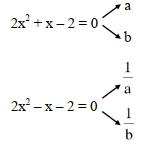
Let $\mathrm{a}>0$ be a root of the equation $2 \mathrm{x}^2+\mathrm{x}-2=0$.
If $\lim _{x \rightarrow \frac{1}{a}} \frac{16\left(1-\cos \left(2+x-2 x^2\right)\right)}{\left(1-a x^2\right)}=\alpha+\beta \sqrt{17}$, where $\alpha, \beta \in Z$ then $\alpha+\beta$ is equal to....................
Answerb
$\lim _{x \rightarrow \frac{1}{a}} 16 \cdot \frac{\left(1-\cos 2\left(x-\frac{1}{a}\right)\left(x-\frac{1}{b}\right)\right)}{4\left(x-\frac{1}{b}\right)^2} \times \frac{4\left(x-\frac{1}{b}\right)^2}{a^2\left(x-\frac{1}{a}\right)^2}$
$ =16 \times \frac{2}{\mathrm{a}^2}\left(\frac{1}{\mathrm{a}}-\frac{1}{\mathrm{~b}}\right)^2 $
$ =\frac{32}{\mathrm{a}^2}\left(\frac{17}{4}\right)=\frac{17.8}{\mathrm{a}^2}=\frac{17 \times 8 \times 16}{(-1+\sqrt{117})^2} $
$ =\frac{136.16}{18.2 \sqrt{7}} \times \frac{18+2 \sqrt{7}}{18+2 \sqrt{7}} $
$ =\frac{136}{256}(18+2 \sqrt{7}) \cdot 16 $
$ =153+17 \sqrt{17}=\alpha+\beta \sqrt{17} $
$ \alpha+\beta=153+17=170$
View full question & answer→MCQ 901 Mark
$\lim _{n \rightarrow \infty} \frac{\left(1^2-1\right)(n-1)+\left(2^2-2\right)(n-2)+\ldots .+\left((n-1)^2-(n-1)\right) \cdot 1}{\left(1^3+2^3+\ldots .+n^3\right)-\left(1^2+2^2+\ldots . .+n^2\right)}$ is equal to:
- A
$\frac{2}{3}$
- ✓
$\frac{1}{3}$
- C
$\frac{3}{4}$
- D
$\frac{1}{2}$
AnswerCorrect option: B. $\frac{1}{3}$
b
$ \lim _{n \rightarrow \infty} \frac{\sum_{r=1}^{n-1}\left(r^2-r\right)(n-r)}{\sum_{r=1}^n r^3-\sum_{r=1}^n r^2} $
$ \lim _{n \rightarrow \infty} \frac{\sum_{r=1}^{n-1}\left(-r^3+r^2(n+1)-n r\right)}{\left(\frac{n(n+1)}{2}\right)^2-\frac{n(n+1)(2 n+1)}{6}} $
$ \lim _{n \rightarrow \infty} \frac{\left(\frac{((n-1) n)}{2}\right)^2+\frac{(n+1)(n-1) n(2 n-1)}{6}-\frac{n^2(n-1)}{2}}{\frac{n(n+1)}{2}\left(\frac{n(n+1)}{2}-\frac{2 n+1}{3}\right)} $
$ \lim _{n \rightarrow \infty} \frac{n(n-1)\left(\frac{-n(n-1)}{2}+\frac{(n+1)(2 n-1)}{3}-n\right)}{\frac{n(n+1)}{2} \frac{3 n^2+3 n-4 n-2}{6}} $
$ \lim _{n \rightarrow \infty} \frac{(n-1)\left(-3 n^2+3 n+2\left(2 n^2+n-1\right)-6\right)}{(n+1)\left(3 n^2-n-2\right)} $
$ \lim _{n \rightarrow \infty} \frac{(n-1)\left(n^2+5 n-8\right)}{(n+1)\left(3 n^2-n-2\right)}=\frac{1}{3}$
View full question & answer→MCQ 911 Mark
The value of $\lim _{x \rightarrow 0} 2\left(\frac{1-\cos x \sqrt{\cos 2 x} \sqrt[3]{\cos 3 x} \ldots . . \sqrt[10]{\cos 10 x}}{x^2}\right)$ is ............
Answerb
$\lim _{x \rightarrow 0} 2\left(\frac{1-\left(1-\frac{x^2}{2 !}\right)\left(1-\frac{4 x^2}{2 !}\right)\left(1-\frac{9 x^2}{2 !}\right) \ldots . .\left(1-\frac{100 x^2}{2 !}\right)}{x^2}\right)$
By expansion
$\lim _{x \rightarrow 0} \frac{2\left(1-\left(1-\frac{x^2}{2}\right)\right)\left(1-\frac{1}{2} \cdot \frac{4 x^2}{2}\right)\left(1-\frac{1}{3} \cdot \frac{9 x^2}{2}\right) \ldots \ldots\left(1-\frac{1}{10} \cdot \frac{100 x^2}{2}\right)}{x^2}$
$\lim _{x \rightarrow 0} 2\left(\frac{1-\left(1-\frac{x^2}{2}\right)\left(1-\frac{2 x^2}{2}\right)\left(1-\frac{3 x^2}{2}\right) \ldots\left(1-\frac{10 x^2}{2}\right)}{x^2}\right)$
$\lim _{x \rightarrow 0} \frac{2\left(1-1+x^2\left(\frac{1}{2}+\frac{2}{2}+\frac{3}{2}+\ldots .+\frac{10}{2}\right)\right)}{x^2}$
$ 2\left(\frac{1}{2}+\frac{2}{2}+\frac{3}{2}+\ldots . .+\frac{10}{2}\right) $
$ 1+2+\ldots \ldots+10=\frac{10 \times 11}{2}=55$
View full question & answer→MCQ 921 Mark
If $\alpha=\lim _{x \rightarrow 0^{+}}\left(\frac{e^{\sqrt{\tan x}}-e^{\sqrt{x}}}{\sqrt{\tan x}-\sqrt{x}}\right)$ and $\beta=\lim _{x \rightarrow 0}(1+\sin x)^{\frac{1}{2} \cot x}$ are the roots of the quadratic equation $a x^2+b x-\sqrt{e}=0$, then 12 $\log _e(a+b)$ is equal to.............
Answerb
$ \alpha=\lim _{x \rightarrow 0^{+}} e^{\sqrt{x}} \frac{\left(e^{\sqrt{\tan x}-\sqrt{x}}-1\right)}{\sqrt{\tan x}-\sqrt{x}} $
$ =1 $
$ \beta=\lim _{x \rightarrow 0}(1+\sin x)^{\frac{1}{2} \cot x} $
$ =e^{1 / 2} $
$ x^2-(1+\sqrt{e})+\sqrt{e}=0 $
$ a x^2+b x-\sqrt{e}=0$
On comparing
$ a=-1, b=\sqrt{e}+1 $
$ 12 \ln (a+b)=12 \times \frac{1}{2}=6$
View full question & answer→MCQ 931 Mark
Let a circle passing through $(2,0)$ have its centre at the point $(\mathrm{h}, \mathrm{k})$. Let $\left(\mathrm{x}_{\mathrm{c}}, \mathrm{y}_{\mathrm{c}}\right)$ be the point of intersection of the lines $3 x+5 y=1$ and $(2+c) x+$ $5 c^2 y=1$. If $h=\lim _{c \rightarrow 1} x_c$ and $k=\lim _{c \rightarrow 1} y_c$, then the equation of the circle is :
- ✓
$25 x^2+25 y^2-20 x+2 y-60=0$
- B
$5 x^2+5 y^2-4 x-2 y-12=0$
- C
$25 x^2+25 y^2-2 x+2 y-60=0$
- D
$5 x^2+5 y^2-4 x+2 y-12=0$
AnswerCorrect option: A. $25 x^2+25 y^2-20 x+2 y-60=0$
a
$ (2+c) x+5 c^2\left(\frac{1-3 x}{5}\right)=1 $
$ \mathrm{x}=\frac{1-\mathrm{c}^2}{2+\mathrm{c}-3 \mathrm{c}^2}, \mathrm{y}=\frac{1-3 \mathrm{x}}{5}=\frac{\mathrm{c}-1}{5\left(2+\mathrm{c}-3 \mathrm{c}^2\right)} $
$ \mathrm{h}=\lim _{\mathrm{c} \rightarrow 1} \frac{(1-\mathrm{c})(1+\mathrm{c})}{(1-\mathrm{c})(2+3 \mathrm{c})}=\frac{2}{5} $
$ \mathrm{~K}=\lim _{\mathrm{c} \rightarrow 1} \frac{\mathrm{c}-1}{-5(\mathrm{c}-1)(3 \mathrm{c}+2)}=-\frac{1}{25} $
$ \text { Centre }\left(\frac{2}{25},-\frac{1}{25}\right), $
$ \mathrm{r}=\sqrt{\left(2-\frac{2}{5}\right)^2+\left(0-\frac{1}{25}\right)^2}=\sqrt{\frac{64}{25}+\frac{1}{625}} $
$ \mathrm{r}=\frac{\sqrt{161}}{25} $
$ \left(\mathrm{x}-\frac{2}{5}\right)^2+\left(\mathrm{y}+\frac{1}{25}\right)^2=\frac{161}{125} $
$ \Rightarrow 25 \mathrm{x}^2+25 \mathrm{y}^2-20 \mathrm{x}+2 \mathrm{y}-60=0$
View full question & answer→MCQ 941 Mark
$\operatorname{Lim}_{x \rightarrow 0} \frac{e-(1+2 x)^{\frac{1}{2 x}}}{x}$ is equal to :
- ✓
$e$
- B
$\frac{-2}{\mathrm{e}}$
- C
$0$
- D
$e-e^2$
Answera
$ \operatorname{Lim}_{x \rightarrow 0} \frac{e-e^{\frac{1}{2 x} \ln (1+2 x)}}{x} $
$ =\operatorname{Lim}_{x \rightarrow 0}(-e) \frac{\left(e^{\frac{\ln (1+2 x)}{2 x}-1}-1\right)}{x} $
$ =\operatorname{Lim}_{x \rightarrow 0}(-e) \frac{\ln (1+2 x)-2 x}{2 x^2} $
$ =(-e) \times(-1) \frac{4}{2 \times 2}=e$
View full question & answer→MCQ 951 Mark
$\lim _{x \rightarrow \frac{\pi}{2}}\left(\frac{\int_{x^3}^{(\pi / 2)^3}\left(\sin \left(2 t^{1 / 3}\right)+\cos \left(t^{1 / 3}\right)\right) d t}{\left(x-\frac{\pi}{2}\right)^2}\right)$ is equal to:
- ✓
$\frac{9 \pi^2}{8}$
- B
$\frac{11 \pi^2}{10}$
- C
$\frac{3 \pi^2}{2}$
- D
$\frac{5 \pi^2}{9}$
AnswerCorrect option: A. $\frac{9 \pi^2}{8}$
a
$ \lim _{x \rightarrow \frac{\pi}{2}} \frac{0-\{\sin (2 x)+\cos (x)\} \cdot 3 x^2}{2\left(x-\frac{\pi}{2}\right)} $
$ =\lim _{x \rightarrow \frac{\pi}{2}} \frac{-\{2 \sin x \cos x+\cos x\} 3 x^2}{2\left(x-\frac{\pi}{2}\right)} $
$ =\lim _{x \rightarrow \frac{\pi}{2}}\left\{\frac{2 \sin x \sin \left(\frac{\pi}{2}-x\right)}{2\left(x-\frac{\pi}{2}\right)}+\frac{\sin \left(\frac{\pi}{2}-x\right)}{2\left(\frac{\pi}{2}-x\right)}\right\} 3 x^2 $
$ =\left(1(1)+\frac{1}{2}\right) 3\left(\frac{\pi}{2}\right)^2 $
$ =\frac{9 \pi^2}{8}$
View full question & answer→MCQ 961 Mark
$\lim _{t \rightarrow 0}\left(1^{\frac{1}{\sin ^2 t}}+2^{\frac{1}{\sin ^2 t}}+\ldots .+n^{\frac{1}{\sin ^2 t}}\right)^{\sin ^2 t}$ is equal to $.......$
- A
$n^2+n$
- ✓
$n$
- C
$\frac{ n ( n +1)}{2}$
- D
$n^2$
Answerb
$\begin{array}{l}\lim _{t \rightarrow 0}\left(1^{\operatorname{cosec}^2 t}+2^{\operatorname{cosec}^2 t}+\ldots \ldots . .+n^{\operatorname{cosec}^2 t}\right)^{\sin ^2 t} \\ =\lim _{t \rightarrow 0} n \left(\left(\frac{1}{n}\right)^{\operatorname{cosec}^2 t}+\left(\frac{2}{n}\right)^{\operatorname{cosec}^2 t}+\ldots \ldots . .+1\right)^{\sin ^2 t} \\ = n \end{array}$
View full question & answer→MCQ 971 Mark
The set of all values of $a$ for which $\operatorname{Lim}_{x \rightarrow a}([x-5]-[2 x+2])=0$, where $[\propto]$ denotes the greater integer less than or equal to $\propto$ is equal to
- ✓
$(-7.5,-6.5)$
- B
$(-7.5,-6.5]$
- C
$[-7.5,-6.5]$
- D
$[-7.5,-6.5)$
AnswerCorrect option: A. $(-7.5,-6.5)$
a
$\lim _{x \rightarrow a}(\lfloor x-5]-\lfloor 2 x+2\rfloor)=0$
$\lim _{x \rightarrow a}([x]-5-[2 x]-2)=0$
$\lim _{x \rightarrow a}([x]-[2 x])=7$
${[a]-[2 a]=7}$
$a \in I, \quad a=-7$
$a \notin I, \quad a=I+f$
$\text { Now, }[a]-[2 a]=7$
$\quad-I-[2 f]=7$
$\text { Case-I: f } \in\left(0, \frac{1}{2}\right)$
$2 f \in(0,1)$
$-I=7$
$I=-7 \Rightarrow a \in(-7,-6.5)$
Case$-II:$ $f \in\left(\frac{1}{2}, 1\right)$
$2 f \in(1,2)$
$- I -1=7$
$I =-8 \Rightarrow a \in(-7.5,-7)$
Hence, $a \in(-7.5,-6.5)$
View full question & answer→MCQ 981 Mark
The value of $\operatorname{Lim}_{n \rightarrow \infty} \frac{1+2-3+4+5-6+\ldots+(3 n-2)+(3 n-1)-3 n}{\sqrt{2 n^4+4 n+3-} \sqrt{n^4+5 n+4}}$ is :
AnswerCorrect option: C. $\frac{3}{2}(\sqrt{2}+1)$
c
$\operatorname{Lim}_{n \rightarrow \infty} \frac{0+3+6+9+\ldots . n \text { terms }}{\sqrt{2 n^4+4 n+3}-\sqrt{n^4+5 n+4}}$
$\operatorname{Lim}_{n \rightarrow \infty} \frac{3 n(n-1)}{2\left(\sqrt{2 n^4+4 n+3}-\sqrt{n^4+5 n+4}\right)}$
$=\frac{3}{2(\sqrt{2}-1)}=\frac{3}{2}(\sqrt{2}+1)$
View full question & answer→MCQ 991 Mark
Let $x=2$ be a root of the equation $x^2+p x+q=0$ and $f(x)=\left\{\begin{array}{cc}\frac{1-\cos \left(x^2-4 p x+q^2+8 q+16\right)}{(x-2 p)^4}, & x \neq 2 p \\ 0, & x=2 p\end{array}\right.$ Then $\lim _{x \rightarrow 22^{+}}[f(x)]$ where [. ] denotes greatest integer function, is $........$
Answerc
$\lim _{x \rightarrow 2 p^{+}}\left(\frac{1-\cos \left(x^2-4 p x+q^2+8 q+16\right)}{\left(x^2-4 p x+q^2+8 q+16\right)^2}\right)\left(\frac{\left(x^2-4 p x+q^2+8 q+16\right)^2}{(x-2 p)^2}\right)$
$\lim _{h \rightarrow 0} \frac{1}{2}\left(\frac{(2 p+h)^2-4 p(2 p+h)+q^2+82+16}{h^2}\right)^2=\frac{1}{2}$
Using L'Hospital's
$\lim _{x \rightarrow 2 p^{+}}[f(x)]=0$
View full question & answer→MCQ 1001 Mark
$\lim _{x \rightarrow 0} \frac{48}{x^4} \int \limits_0^x \frac{t^3}{t^6+1} d t$ is equal to $.......$.
Answerd
$48 \lim _{x \rightarrow 0} \frac{\int_0^x \frac{t^3}{t^6+1} d t}{x^4}\left(\frac{0}{0}\right)$
Applying L'Hospitals Rule
$48 \lim _{x \rightarrow 0} \frac{x^3}{x^6+1} \times \frac{1}{4 x^3}$
$=12$
View full question & answer→