MCQ 1011 Mark
The sum of all the products of the first $n$ natural numbers taken two at a time is
- ✓
$\frac{1}{{24}}n(n - 1)(n + 1)(3n + 2)$
- B
$\frac{{{n^2}}}{{48}}(n - 1)(n - 2)$
- C
$\frac{1}{6}n(n + 1)(n + 2)(n + 5)$
- D
AnswerCorrect option: A. $\frac{1}{{24}}n(n - 1)(n + 1)(3n + 2)$
a
(a) We know that
${\left\{ {\frac{n}{2}(n + 1)} \right\}^2} = {(1 + 2 + ...... + n)^2} = \sum\limits_1^n {{r^2}} + 2\sum\limits_{s < t} {st} $
$ \Rightarrow $$\sum\limits_{s < t} {st} = \frac{1}{2}\left\{ {\frac{{{n^2}{{(n + 1)}^2}}}{4} - \frac{{n(n + 1)(2n + 1)}}{6}} \right\}$
$ = \frac{n}{{24}}(n - 1)(n + 1)(3n + 2)$.
Trick : ${S_n} = 1\;.\;2 + 2\;.\;3 + 3\;.\;4 + ........ + (n - 1)\;.\;n$
Check by putting $(n - 1) = 1,\;2\;$
$i.e.,\;n = 2,\;3$ in the options.
View full question & answer→MCQ 1021 Mark
The ${n^{th}}$ term of series $\frac{1}{1} + \frac{{1 + 2}}{2} + \frac{{1 + 2 + 3}}{3} + .......$ will be
- ✓
$\frac{{n + 1}}{2}$
- B
$\frac{{n - 1}}{2}$
- C
$\frac{{{n^2} + 1}}{2}$
- D
$\frac{{{n^2} - 1}}{2}$
AnswerCorrect option: A. $\frac{{n + 1}}{2}$
a
(a) Given series $\frac{1}{1} + \frac{{1 + 2}}{2} + \frac{{1 + 2 + 3}}{3} + ......$
So ${n^{th}}$ term of series is given by
${T_n} = \frac{{1 + 2 + 3 + ....... + n}}{n} = \frac{{\frac{1}{2}n(n + 1)}}{n} = \frac{{n + 1}}{2}$
View full question & answer→MCQ 1031 Mark
The sum of the series $1.2.3 + 2.3.4 + 3.4.5 + .......$ to $n$ terms is
AnswerCorrect option: C. $\frac{1}{4}n(n + 1)(n + 2)(n + 3)$
c
(c) ${T_n} = n\,(n + 1)\,(n + 2)$ $ = n\,({n^2} + 3n + 2) = {n^3} + 3{n^2} + 2n$
$\therefore $${S_n} = \Sigma ({n^3}) + \Sigma (3{n^2}) + \Sigma (2n)$
${S_n} = {\left[ {\frac{{n\,(n + 1)}}{2}} \right]^2} + \frac{{3.n\,(n + 1)(2n + 1)}}{6} + \frac{{2.n\,(n + 1)}}{2}$
${S_n} = \frac{1}{4}n\,(n + 1)\,(n + 2)(n + 3)$.
View full question & answer→MCQ 1041 Mark
If $\sum\limits_{i = 1}^n {i = \frac{{n(n + 1)}}{2}} $, then $\sum\limits_{i = 1}^n {(3i - 2) = } $
- ✓
$\frac{{n(3n - 1)}}{2}$
- B
$\frac{{n(3n + 1)}}{2}$
- C
$n(3n + 2)$
- D
$\frac{{n(3n + 1)}}{4}$
AnswerCorrect option: A. $\frac{{n(3n - 1)}}{2}$
a
(a) $\sum\limits_{i = 1}^n {} = 3\sum\limits_{i = 1}^n i - 2\sum\limits_{i = 1}^n 1 = 3\frac{{n\,(n + 1)}}{2} - 2n = \frac{{n\,(3n - 1)}}{2}$.
View full question & answer→MCQ 1051 Mark
The sum of the series $3.6 + 4.7 + 5.8 + ........$ upto $(n - 2)$ terms
AnswerCorrect option: B. $\frac{1}{6}(2{n^3} + 12{n^2} + 10n - 84)$
b
(b) $S = 3\;.\;6 + 4\;.\;7 + .......$ upto $n - 2$ terms
$ = (1\;.\;4 + 2\;.\;5 + 3\;.\;6 + 4\;.\;7 + .........$upto $n$ terms) $-14$
$ = \Sigma n(n + 3) - 14 = \frac{1}{6}(2{n^3} + 12{n^2} + 10n) - 14$
$ = \left( {\frac{{2{n^3} + 12{n^2} + 10n - 84}}{6}} \right),\;$
where $n = 3,\;4,\;5.......$
Trick : ${S_1} = 18,\;{S_2} = 46$
Now put in options $(n - 2) = 1,\;2\;\;i.e.\;\;n = 3,\;4$
Obviously $(b)$ gives the values.
View full question & answer→MCQ 1061 Mark
$\frac{1}{{1.2}} + \frac{1}{{2.3}} + \frac{1}{{3.4}} + ........ + .......\frac{1}{{n.(n + 1)}}$ equals
- A
$\frac{1}{{n(n + 1)}}$
- ✓
$\frac{n}{{n + 1}}$
- C
$\frac{{2n}}{{n + 1}}$
- D
$\frac{2}{{n(n + 1)}}$
AnswerCorrect option: B. $\frac{n}{{n + 1}}$
b
(b) $\left( {\frac{1}{1} - \frac{1}{2}} \right) + \left( {\frac{1}{2} - \frac{1}{3}} \right) + \left( {\frac{1}{3} - \frac{1}{4}} \right) + ......... + \left( {\frac{1}{n} - \frac{1}{{n + 1}}} \right)$
$ = 1 - \frac{1}{{n + 1}} = \frac{n}{{n + 1}}$.
View full question & answer→MCQ 1071 Mark
The sum of the series $1 + (1 + 2) + (1 + 2 + 3) + ............$ upto $n$ terms, will be
AnswerCorrect option: D. $\frac{{n(n + 1)(n + 2)}}{6}$
d
(d) Here ${T_n} = \frac{{n(n + 1)}}{2}$
Therefore ${S_n} = \frac{1}{2}\left\{ {\Sigma {n^2} + \Sigma n} \right\}$
$ = \frac{{n(n + 1)(n + 2)}}{6}$.
View full question & answer→MCQ 1081 Mark
The sum to $n$ terms of the series ${2^2} + {4^2} + {6^2} + ...........$ is
- A
$\frac{{n(n + 1)(2n + 1)}}{3}$
- ✓
$\frac{{2n(n + 1)(2n + 1)}}{3}$
- C
$\frac{{n(n + 1)(2n + 1)}}{6}$
- D
$\frac{{n(n + 1)(2n + 1)}}{9}$
AnswerCorrect option: B. $\frac{{2n(n + 1)(2n + 1)}}{3}$
b
(b) ${2^2} + {4^2} + {6^2} + ........ + {(2n)^2}$
$ = {2^2}({1^2} + {2^2} + {3^2} + ....... + {n^2})$
$ = \frac{{4n(n + 1)(2n + 1)}}{6} = \frac{{2n(n + 1)(2n + 1)}}{3}$.
View full question & answer→MCQ 1091 Mark
The sum of $(n - 1)$ terms of $1 + (1 + 3) + $ $(1 + 3 + 5) + .......$ is
- A
$\frac{{n\,(n + 1)\,(2n + 1)}}{6}$
- B
$\frac{{{n^2}(n + 1)}}{4}$
- ✓
$\frac{{n\,(n - 1)\,(2n - 1)}}{6}$
- D
${n^2}$
AnswerCorrect option: C. $\frac{{n\,(n - 1)\,(2n - 1)}}{6}$
c
(c) Let ${T_n}$ be the $n^{th}$ term of the series ${T_n} = 2\sum n - \sum 1 $
==> ${T_n} = \frac{{2n(n + 1)}}{2} - n = {n^2}$
$\therefore {S_n} = \sum\limits_{k = 1}^n {({k^2})} = \frac{{n(n + 1)(2n + 1)}}{6}$
Hence sum of $(n - 1)$ terms ${S_{n - 1}} = \frac{{(n - 1)\,n\,(2n - 1)}}{6}$.
View full question & answer→MCQ 1101 Mark
The sum of $(n + 1)$ terms of $\frac{1}{1} + \frac{1}{{1 + 2}} + \frac{1}{{1 + 2 + 3}} + ......\,\,{\rm{is }}$
AnswerCorrect option: D. $\frac{{2\,(n + 1)}}{{n + 2}}$
d
(d) ${T_n} = \frac{1}{{\left[ {\frac{{n(n + 1)}}{2}} \right]}} = 2\left[ {\frac{1}{n} - \frac{1}{{n + 1}}} \right]$
Put $n = 1,\,2,\,3,....,(n + 1)$
${T_1} = 2\,\left[ {\frac{1}{1} - \frac{1}{2}} \right]\,,\,\,{T_2} = 2\,\left[ {\frac{1}{2} - \frac{1}{3}} \right]\,,........,$
${T_{n + 1}} = 2\left[ {\frac{1}{{n + 1}} - \frac{1}{{n + 2}}} \right]$
Hence sum of $(n + 1)$ terms $ = \sum\limits_{k = 1}^{n + 1} {{T_k}} $
$ \Rightarrow {S_{n + 1}} = 2\left[ {1 - \frac{1}{{n + 2}}} \right]$
$ \Rightarrow {S_{n + 1\,}}\, = \frac{{2(n + 1)}}{{(n + 2)}}$.
View full question & answer→MCQ 1111 Mark
If $\cos 2B = \frac{{\cos (A + C)}}{{\cos (A - C)}}$, then $\tan A,\;\tan B,\;\tan C$ are in
AnswerCorrect option: B. $G.P.$
b
(b) $\cos 2B = \frac{{\cos (A + C)}}{{\cos (A - C)}}$
$= \frac{{\cos A\cos C - \sin A\sin C}}{{\cos A\cos C + \sin A\sin C}}$
==> $\frac{{1 - {{\tan }^2}B}}{{1 + {{\tan }^2}B}} $
$= \frac{{1 - \tan A\tan C}}{{1 + \tan A\tan C}}$
==> $1 + {\tan ^2}B - \tan A\tan C - \tan A\tan C{\tan ^2}B$
$ = 1 - {\tan ^2}B + \tan A\tan C - \tan A\tan C{\tan ^2}B$
==> $2{\tan ^2}B = 2\tan A\tan C $
$\Rightarrow {\tan ^2}B = \tan A\tan C$
Hence, $\tan A, \tan B$ and $\tan C$ will be in $G.P.$
View full question & answer→MCQ 1121 Mark
Suppose we have an arithmetic progression $a_1, a_2, \ldots a_n, \ldots$ with $a_1=1, a_2-a_1=5$. The median of the finite sequence $a_1, a_2, \ldots, a_k$, where $a_k \leq 2021$ and $a_{k+1} > 2021$ is
- ✓
$1011$
- B
$1011.5$
- C
$1013.5$
- D
$1016$
AnswerCorrect option: A. $1011$
a
(a)
$a_1, a_2, a_3, \ldots a_n$ are in A.P.
$a_1=2, a_2-a_1=5=d$
$a_k \leq 2021$
$a_1+(k-1) d \leq 2021$
$k \leq 405$
median of $a_1, a_2, \ldots, a_{405}$
is $a_{203}=a_1+(203-1) d=1011$
View full question & answer→MCQ 1131 Mark
A contractors has two teams of workers, team $A$ and team B. Team $A$ can complete a project $P$ in $12$ days and team $B$ can complete $P$ in $36$ days. Team $A$ starts working on $P$ and team $B$ joins team $A$ after four days. Team $A$ is withdrawn after another two days and team $B$ is asked to double its efficiency. The number of additional days required for team $B$ to complete $P$ is
Answerb
(b)
Work done by Team A in one day $=\frac{1}{12}$
work done by Team $B$ in one day $=\frac{1}{36}$
$\left(\frac{4}{12}\right)+2\left(\frac{1}{12}+\frac{1}{36}\right)+ n \times \frac{2}{36}=1$ $\frac{4}{12}+\frac{2}{12}+\frac{2}{36}+\frac{ n }{18}=1$
$\frac{1}{2}+\frac{2}{36}+\frac{ n }{18}=1$
$\frac{ n }{18}=1-\frac{20}{36}=\frac{16}{36}$
$n=8$
View full question & answer→MCQ 1141 Mark
Suppose that the sides $a,b, c$ of a triangle $A B C$ satisfy $b^2=a c$. Then the set of all possible values of $\frac{\sin A \cot C+\cos A}{\sin B \cot C+\cos B}$ is
- A
$(0, \infty)$
- B
$\left(0, \frac{\sqrt{5}+1}{2}\right)$
- ✓
$\left(\frac{\sqrt{5}-1}{2}, \frac{\sqrt{5}+1}{2}\right)$
- D
$\left(\frac{\sqrt{5}-1}{2}, \infty\right)$
AnswerCorrect option: C. $\left(\frac{\sqrt{5}-1}{2}, \frac{\sqrt{5}+1}{2}\right)$
c
(c)
$\frac{\sin A \frac{\cos C}{\sin C}+\cos A}{\sin B \frac{\cos C}{\sin C}+\cos B}=\frac{\frac{\sin A \cos C+\sin C \cos A}{\sin C}}{\frac{\sin B \operatorname{Cos} C+\cos B \sin C}{\sin C}}$
$=\frac{\sin (A+C)}{\sin (B+C)}=\frac{b}{a}$
a, b, c $\rightarrow$ G.P.
$b =a r ; c =a r ^2$
$C-I$ If $r > 1$ then
$a+a r > a r^2 \Rightarrow r^2-r-1 < 0$
$r \in\left(\frac{1-\sqrt{5}}{2}, \frac{1+\sqrt{5}}{2}\right)$ but $r > 1$
Hence $r \in\left(1, \frac{1+\sqrt{5}}{2}\right) \quad \ldots .( I ) \ldots$
$C-II$ $0 < r < 1$
$a r+a r^2 > a \Rightarrow r^2+r-1 > 0$
$r \in\left(-\infty, \frac{-1-\sqrt{5}}{2}\right) \cup\left(\frac{-1+\sqrt{5}}{2}, \infty\right)$
but $r \in(0,1)$
$r \in\left(\frac{\sqrt{5}-1}{2}, 1\right) \quad \ldots (II) ....$
$C-III$ when $r=1$ then $\Delta$ is equilateral
Hence $r \in\left(\frac{\sqrt{5}-1}{2}, \frac{\sqrt{5}+1}{2}\right)$
View full question & answer→MCQ 1151 Mark
Let $p =99$ and $q =101$. Define $p _1=\log \left(\frac{ p + q }{2}\right)$ and $q _1=\frac{1}{2}(\log p+\log q)$ and $p _2=\log \left(\frac{ p _1+ q _1}{2}\right), \quad q _2=\frac{1}{2}\left(\log p _1+\log q _1\right).$ Where all logarithms have base $10$ . Then
- ✓
$\log p _1 > p _2 > q _2 > \log q _1$
- B
$\log p _1 > q _2 > p _2 > \log q _1$
- C
$\log q _1 > p _2 > q _2 > \log p _1$
- D
$\log q _1 > q _2 > p _2 > \log p _1$
AnswerCorrect option: A. $\log p _1 > p _2 > q _2 > \log q _1$
a
(a)
$p =99 \quad q =101$
$p _1=\log \left(\frac{ p + q }{2}\right)=\log _{10} 100=2$
$q _1=\frac{1}{2}(\log p +\log q )=\frac{1}{2} \log 99 \times 101$
$=\log \sqrt{ pq }$
$\frac{ p + q }{2} \geq \sqrt{ pq }$
$\log _{10}\left(\frac{p+q}{2}\right) > \frac{1}{2} \log (p q)$
$p _1 > q _1 \quad \ldots . .( a )$
$\frac{ p _1+ q _1}{2}>\sqrt{ p _1 q _1}$
$\log \left(\frac{ p _1+ q _1}{2}\right) > \log \sqrt{ p _1 q _1}$
$p _2 > q _2$
so option $A$ is correct.
View full question & answer→MCQ 1161 Mark
Integers $1,2,3, \ldots \ldots, n,(n \geq 3)$ are written on a black board and an integer $k (1 < k < n )$ is erased. The average of the remaining numbers is $16$ . Then $n + k$ is
Answerc
(c)
$1,2,3, \ldots . n$
$\frac{\frac{ n ( n +1)}{2}- k }{ n -1}=16$
$n ( n +1)-2 k =32( n -1)$
$n ^2+ n -2 k =32 n -32$
$n^2-31 n-2 k=-32$
$n ^2-31 n +32=2 k$
$k =\frac{ n ^2-31 n +32}{2}$
$1 \leq \frac{ n ^2-31 n +32}{2} \leq n$
$n ^2-31 n +30 \geq 0 \quad \quad n ^2-33 n +32 \leq 0$
$( n -30)( n -1) \geq 0 \quad \quad ( n -32)( n -1) \leq 0$
$n =31$
$k =\frac{ n ^2-31 n +32}{2}$
$k =\frac{(31)^2-(31)^2+32}{2}=16$
$k =16, n =31$
$n + k =47$
View full question & answer→MCQ 1171 Mark
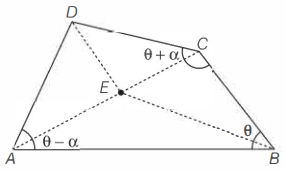
Let $A B C D$ be a quadrilateral such that there exists a point $E$ inside the quadrilateral satisfying $A E=B E=C E=D E$. Suppose $\angle D A B, \angle A B C, \angle B C D$ is an arithmetic progression. Then the median of the set $\{\angle D A B, \angle A B C, \angle B C D\}$ is
- A
$\frac{\pi}{6}$
- B
$\frac{\pi}{4}$
- C
$\frac{\pi}{3}$
- ✓
$\frac{\pi}{2}$
AnswerCorrect option: D. $\frac{\pi}{2}$
d
(d)
Since, $\angle D A B, \angle A B C$ and $\angle B C D$ are in $AP \therefore$ Let $\angle D A B=\theta-\alpha, \angle A B C=\theta$ and $\angle B C D=\theta+\alpha$
$\therefore$ Median of $\angle D A B, \angle A B C$ and $\angle B C D=\theta$
From point $E$ all the vertices are at equal distance.
$\therefore A B C D$ is cyclic.
and $\angle A D C=2 \pi-(\theta-\alpha+\theta+\theta+\alpha)$
$\quad=2 \pi-3 \theta$
and $\angle A D C+\angle A B C=\pi$
$\Rightarrow 2 \pi-3 \theta+\theta=\pi$
$\therefore \quad \theta=\frac{\pi}{2}$
View full question & answer→MCQ 1181 Mark
Let $M=2^{30}-2^{15}+1$, and $M^2$ be expressed in base $2$.The number of $1$'s in this base $2$ representation of $M^2$ is
Answerb
(b)
Given,
$\begin{aligned} M^2=& 2^{66}-2^{46}+2^{32}+2^{30}-2^{16}+1 \\ M^2=& 2^{46}\left[\frac{2^{14}-1}{2-1}\right]+2^{32}+2^{16}\left[\frac{2^{14}-1}{2-1}\right]+1 \\ M^2=& 2^{46}\left[1+2+2^2+\ldots+2^{13}\right] \\ & \quad+2^{32}+2^{16}\left[1+2+2^2+\ldots+2^{13}\right]+1 \\ M^2=& \frac{2^{59}+2^{58}+\ldots+2^{46}}{14 \text { terms }}+2^{32} \end{aligned}$
$\underbrace{+2^{29}+2^{28}+\ldots+2^{16}}_{14 \text { terms }}+2^0$
Therefore, on base $2$ representation of $M^2$, there will be $30$ times digit $1$ .
View full question & answer→MCQ 1191 Mark
$\left[\frac{2^{2020}+1}{2^{2018}+1}\right]+\left[\frac{3^{2020}+1}{3^{2018}+1}\right]+\left[\frac{4^{2020}+1}{4^{2018}+1}\right] +\left[\frac{5^{2020}+1}{5^{2018}+1}\right] + \left[\frac{6^{2020}+1}{6^{2018}+1}\right]$ is
Answerb
(b)
$\frac{1+x^{2020}}{1+x^{2018}}=\frac{x^2\left(1+x^{2018}\right)+1-x^2}{1+x^{2018}}$
$=x^2+\frac{1-x^2}{1+x^{2018}}$
Put $x=2 \therefore\left[4+\frac{(-3)}{1+2^{2018}}\right]=3$
Put $x=3 \therefore\left[9-\frac{8}{1+3^{2018}}\right]=8$
Similarly for $x=4,\left[16-\frac{15}{1+4^{2018}}\right]=15$
For $x=5,\left[25-\frac{24}{1+5^{2018}}\right]=24$
For $x=6,\left[36-\frac{35}{1+6^{2018}}\right]=35$
$\therefore$ Required sum
$=3+8+15+24+35=85$
View full question & answer→MCQ 1201 Mark
Let $\alpha =\sum_{n=101}^{200} 2^n \sum_{k=101}^n \frac{1}{k !}$ and $b=\sum_{n=101}^{200} \frac{2^{201}-2^n}{n !}$ Then, $\frac{a}{b}$ is
- ✓
$1$
- B
$\frac{3}{2}$
- C
$2$
- D
$\frac{5}{2}$
Answera
(a)
Given,
$a= 2^{101}\left(\frac{1}{101 !}\right)+2^{102}\left(\frac{1}{101 !}+\frac{1}{102 !}\right)$ $+2^{103}\left(\frac{1}{101 !}+\frac{1}{102 !}+\frac{1}{103 !}\right)$
$\quad\quad\quad\quad\quad\quad\quad+ \ldots+2^{200}\left(\frac{1}{101 !}+\frac{1}{102 !}+\ldots+\frac{1}{200 !}\right)$
$a= \frac{1}{101 !}\left(2^{101}+2^{102}+\ldots+2^{200}\right)$
$\quad\quad\quad\quad\quad\quad+\frac{1}{102 !}\left(2^{102}+2^{103}+\ldots+2^{200}\right)$
$\quad\quad\quad\quad\quad\quad\quad\quad\quad\quad\quad+\ldots+\frac{1}{200 !}\left(2^{200}\right)$
$a=\sum_{n=101}^{200} \frac{1}{n !}\left(2^n+2^{n+1}+\ldots \ldots+2^{200}\right)$
$a= \sum_{n=101}^{200} \frac{1}{n !}\left(\frac{2^n\left(2^{201-n}-1\right)}{2-1}\right)$
$= \sum_{n=101}^{200} \frac{2^{201}-2^n}{n !}$
$a= b \Rightarrow \frac{ a }{b}=1$
View full question & answer→MCQ 1211 Mark
Let $a_n, n \geq 1$, be an arithmetic progression with first term $2$ and common difference $4$ . Let $M_n$ be the average of the first $n$ terms. Then the sum $\sum \limits_{n=1}^{10} M_n$ is
- ✓
$110$
- B
$335$
- C
$770$
- D
$1100$
Answera
(a)
The sum of first $n, n \geq 1$ terms of arithmetic progression with first term $2$ and common difference $4$, is
$S_n=\frac{n}{2}[4+(n-1) 4]=2 n^2$
So, the average of the first $n$ terms
$M_n=\frac{S_n}{n}=2 n$
Now, $\sum\limits_{n=1}^{10} M_n=2 \sum\limits_{n=1}^{10} n$
$=2 \times\left(\frac{10 \times 11}{2}\right)=110$
View full question & answer→MCQ 1221 Mark
Suppose the sum of the first $m$ terms of an arithmetic progression is $n$ and the sum of its first $n$ terms is $m$, where $m \neq n$. Then, the sum of the first $(m+n)$ terms of the arithmetic progression is
- A
$1-m n$
- B
$m n-5$
- ✓
$-(m+n)$
- D
$m+n$
AnswerCorrect option: C. $-(m+n)$
c
(c)
Given, $S_m=n$ and $S_n=m$
$S_m=\frac{m}{2}[2 a+(m-1) d]=n$
$S_n=\frac{n}{2}(2 a+(n-1) d)=m \text { (i) }$
On subtracting Eq.$(ii)$ from Eq.$(i)$, we get
$(m-n) a+(m-n)(m+n-1) \frac{d}{2}$
$=-(m-n)$
$2 a+(m+n-1) d=-2 \quad[m \neq n]$
$S_{m+n}=\frac{m+n}{2}(2 a+(m+n-1) d)$
$=\frac{m+n}{2}(-2)=-(m+n)$
View full question & answer→MCQ 1231 Mark
The number of different possible values for the sum $x+y+z$, where $x, y, z$ are real number such that $x^4+4 y^4+16 z^4+64=32 x y z$ is
Answerc
(c)
We have,
$x^4+4 y^4+16 z^4+64=32 x y z$
We know $\quad AM \geq GM$
$\Rightarrow \frac{x^4+4 y^4+16 z^4+64}{4}$
$\geq\left(x^4 \times 4 y^4 \times 16 z^4 \times 64\right)^{1 / 4}$
$\Rightarrow \quad x^4+4 y^4+16 z^4+64 \geq 32 x y z$
$\Rightarrow \quad x=\pm 2 \sqrt{2}, y=\pm 2, z=\pm \sqrt{2}$
For $x, y, z$
For $x^4+4 y^4+16 z^4+64=32 x y z$
Either each of $x, y, z$ is positive $\rightarrow 1$ case
or two of $x, y, z$ are negative $\rightarrow 3$ cases
$\therefore 4$ cases of different $(x, y, z)$ triplets
$4$ possible $x+y+z$ values $(x \neq y \neq z)$.
View full question & answer→MCQ 1241 Mark
Let $x_k$ be real numbers such that $x_k \geq k^4+k^2+1$ for $1 \leq k \leq$ 2018. Denote $N=\sum_{k=1}^{2018} k$. Consider the following inequalities.
$I$. $\left(\sum_{k=1}^{2018} k x_k\right)^2 \leq N\left(\sum_{k=1}^{2018} k x_k^2\right)$
$II$. $\left(\sum_{k=1}^{2018} k x_k\right)^2 \leq N\left(\sum_{k=1}^{2018} k^2 x_k^2\right)$ Then,
- ✓
both $I$ and $Il$ are true
- B
$I$ is true and $II$ is false
- C
$I$ is false and $II$ is true
- D
both $I$ and $II$ are false
AnswerCorrect option: A. both $I$ and $Il$ are true
a
(a)
We have,
$x_k \geq k^4+k^2+1, \forall k \in[1,2018]$
$N \sum \limits_{k=1}^{2018} k$
I. I $\left(\sum \limits_{k=1}^{2018} k x_k\right)^2 \leq N\left(\sum \limits_{k=1}^{2018} k x_k^2\right)$
We know
$\left(\frac{x_1+x_2+x_3+\ldots+x_n}{n}\right) \leq \frac{x_1^2+x_2^2+x_3^2+\ldots+x_n^2}{n}$
$\therefore\left[\begin{array}{c}x_1+\left(x_2+x_2\right)+\left(x_3+x_3+x_3\right) \\ +\ldots\left(x_{2018}+x_{2018 \ldots \ldots} 2018 \text { times }\right) \\ \hline 1+2+3+4+\ldots+2018\end{array}\right]^2$
$\leq \frac{x_1^2+\left(x_2^2+x_2^2\right)+\left(x_3^2+x_3^2+x_3^2\right) \ldots}{1+2+3+4+\ldots+2018}$
$\Rightarrow\left(\frac{x_1+2 x_2+3 x_3+\ldots+2018 x_{2018}}{1+2+3+4+\ldots+2018}\right)$
$\leq \frac{x_1^2+2 x_2^2+\ldots+2018 x_{2018}^2}{1+2+3+\ldots+2018}$
$\Rightarrow \frac{\left(\sum \limits_{k=1}^{2018} k x_k\right)^2}{\left(\sum \limits_{k=1}^{2018} k\right)^2} \leq \frac{\sum \limits_{k=1}^{2018} k x_k^2}{\sum \limits_{k=1}^{2018} k}=\left(\sum_{k=1}^{2018} k x_k\right)^2 \leq N \sum_{k=1}^{2018} k x_k^2$
Hence, $I$ is true.
II. $\left(\sum \limits_{k=1}^{2018} k x_k\right)^2 \leq N\left(\sum \limits_{k=1}^{2018} k^2 x_k^2\right)$
Similarly for $1$
$\left(\frac{x_1+2 x_2+3 x_3+\ldots+2018 x_{2018}}{2018}\right)^2$
$\leq\left(\frac{x_1^2+\left(2 x_1\right)+\ldots\left(2018 x_{2018}\right)}{2018}\right)$
$\Rightarrow \frac{\left(\sum \limits_{k=1}^{2018} k x_k\right)^2}{(2018)^2} \leq \frac{\sum \limits_{k=1}^{2018} k^2 x_k 2}{2018}$
$=\left(\sum \limits_{k=1}^{2018} k x_k\right)^2 \leq 2018 \sum \limits_{k=1}^{2018} k^2 x_k$
$N=\sum \limits_{k=1}^{2018} k=\frac{2018 \times 2019}{2}$
$\because\left(\sum \limits_{k=1}^{2018} k x_k\right)^2$ is always less than or equal to
$2018 \sum \limits_{k=1}^{2018} k^2 x_k^2$
$\therefore$ It will always be less than $N\left(\sum \limits_{h=1}^{2018} k^2 x_k\right)$ Hence,$I$ and $II$ both are true.
View full question & answer→MCQ 1251 Mark
The number of $5 -$tuples $(a, b, c, d, e)$ of positive integers such that
$I.$ $a, b, c, d, e$ are the measures of angles of a convex pentagon in degrees
$II$. $a \leq b \leq c \leq d \leq e$
$III.$ $a, b, c, d, e$ are in arithmetic progression is
Answerb
(b)
We have,
$I$. $a, b,, c, d, e$ are angle of convex pentagon in degree.
$II$. $a \leq b \leq c \leq d \leq e$
$IIl$. $a, b, c, d, e$ are in $AP$
$a + b + c + d + e=540^{\circ}$
Let $a=\alpha$, common difference $=D$
$\therefore \quad \frac{5}{2}(2 a+4 D)=540^{\circ}$
$a+2 D=108$ and $a+4 D<180^{\circ}$
$[\because$ interior angle of polygon is
less than $\left.180^{\circ}\right]$
$\therefore \quad 108^{\circ}-2 D+4 D < 180^{\circ}$
$2 D < 180^{\circ}-108^{\circ}$
$0 < D < 36$
$\therefore$ Total 36 types are possible.
View full question & answer→MCQ 1261 Mark
Let $a_1, a_2, a_3, a_4$ be real numbers such that $a_1+a_2+a_3+a_4=0$ and $a_1^2+a_2^2+a_3^2+a_4^2=1$. Then, the smallest possible value of the expression $\left(a_1-a_2\right)^2+\left(a_2-a_3\right)^2+\left(a_3-a_4\right)+\left(a_4-a_1\right)^2$ lies in the interval
- A
$(0,1.5)$
- ✓
$(1.5,2.5)$
- C
$(2.5,3)$
- D
$(3,3.5)$
AnswerCorrect option: B. $(1.5,2.5)$
b
(b)
Given, $a_1+a_2+a_3+a_4=0$ and $\quad a_1^2+a_2^2+a_3^2+a_4^2=1$
It is possible only
when, $a_1=a_2=\frac{1}{2}$ and $a_3=a_4=-\frac{1}{2}$ $\therefore\left(a_1-a_2\right)^2+\left(a_2-a_3\right)^2+\left(a_3-a_4\right)^2 +\left(a_4-a_1\right)^2$
$\left(\frac{1}{2}-\frac{1}{2}\right)^2+\left(\frac{1}{2}+\frac{1}{2}\right)^2+\left(-\frac{1}{2}+\frac{1}{2}\right)^2+\left(-\frac{1}{2}-\frac{1}{2}\right)^2$
$0+1+0+1=2$
The value lies between $(1.5,2.5)$.
View full question & answer→MCQ 1271 Mark
Let $a_1=i+\frac{1}{i}$ for $i=1,2, \ldots, 20$. Put $p=\frac{1}{20}\left(a_1+a_2+\ldots+a_{20}\right)$ and $q=\frac{1}{20}\left(\frac{1}{a_1}+\frac{1}{a_2}+\ldots+\frac{1}{a_{20}}\right)$ Then,
- ✓
$q \in\left(0, \frac{22-p}{21}\right) \quad$
- B
$q \in \frac{22-p}{21},\frac{2(22-p)}{21}$
- C
$q \in \frac{2(22-p)}{21},\frac{22-p}{7}$
- D
$q \in \frac{22-p}{7},\frac{4(22-p)}{21}$
AnswerCorrect option: A. $q \in\left(0, \frac{22-p}{21}\right) \quad$
a
(a)
Given $a_1=i+\frac{1}{i}$ for $i=1,2,3, \ldots, 20$
$p=\frac{1}{20}\left(a_1+a_2+a_3+\ldots+a_{20}\right)$
$q=\frac{1}{20}\left(\frac{1}{a_1}+\frac{1}{a_2}+\frac{1}{a_3} \ldots+\frac{1}{a_{20}}\right)$
Clearly, $q > 0$.
Let $\quad q < \frac{22-p}{21}$
To prove $q+\frac{p}{21}<\frac{22}{21}$
$\therefore q+\frac{p}{21}=\frac{1}{20}\left[\frac{1}{\alpha_1}+\frac{1}{a_2}+\frac{1}{\alpha_3} \ldots \frac{1}{a_2}\right] +\frac{1}{20} \frac{1}{21}\left[a_1+a_2+a_3 \ldots a_{20}\right]$
$=\frac{1}{20}\left[\sum \frac{i}{i^2+1}+\frac{1}{21}\left(\sum i+\sum \frac{1}{i}\right)\right]$
$=\frac{1}{20}\left[\frac{1}{2}+\sum \limits_{i=2}^{20} \frac{i}{i+1}+\frac{20 \times 21}{2}+\sum \limits_{i=1}^{20} \frac{1}{21}\right]$
$=\frac{1}{2}+\frac{1}{20}\left[\frac{1}{2}+\sum_{i=2}^{20} \frac{i}{i^2+1}+\frac{1}{21}+\sum \limits_{i=1}^{20} \frac{1}{i}\right]$
$ < \frac{1}{2}+\frac{1}{20}\left[\frac{1}{2}+\frac{2}{5} \sum \limits_{i=2}^{20} 1+\frac{1}{21} \sum \limits_{i=1}^{20}\right]$
$ < \frac{1}{2}+\frac{1}{20}\left[\frac{1}{2}+\frac{2}{5} \times 19+\frac{1}{21} \times 20\right]$
$ < \frac{1}{2}+\frac{1}{20}[1+8+1] < \frac{1}{2}+\frac{1}{2} < 1 < \frac{22}{21}$
$\because q \in\left(0, \frac{22-p}{21}\right)$
View full question & answer→MCQ 1281 Mark
Let $S$ be the infinite sum given by $S=\sum \limits_{n=0}^{\infty} \frac{a_n}{10^{2 n}}$ where $\left(a_n\right)_{n \geq 0}$ is a sequence defined by $a_0=a_1=1$ and $a_j=20 a_{j-1}-108 a_{j-2}$ for $j \geq 2$. If $S$ is expressed in the form $\frac{a}{b}$, where $a, b$ are coprime positive integers, then $a$ equals
- A
$2017$
- B
$2020$
- C
$2023$
- ✓
$2025$
AnswerCorrect option: D. $2025$
d
(d)
We have, $S=\sum \limits_{n=0}^{\infty} \frac{ c _n}{10^{2 n}}$
$a_{0}=a_1=1$ and $a_j=20 a_{j-1}-108 a_{j-2}, j \geq 2$
$a_n=20 a_{n-1}-108 a_{n-2}$
$\frac{a_n}{10^{2 n}}=\frac{20 a_{n-1}}{10^{2 n}}-\frac{108 a_{n-2}}{10^{2 n}}$
$=\frac{20}{100} \frac{a_{n-1}}{10^{2(n-1)}}-\frac{108}{10^4}-\frac{a_{n-2}}{10^{2(n-2)}}$
$\sum \limits_{n=2}^{\infty} \frac{a_n}{10^{2 n}}=\frac{1}{51 a_{n-1}^{2(n-1)}}-\frac{27}{2500}-\frac{\Sigma a_{n-2}}{10^{2(n-2)}}$
$S-1-\frac{1}{10}=\frac{1}{5}(S-1)-\frac{27}{2500} S$
$S\left(1-\frac{1}{5}+\frac{27}{2500}\right)=1+\frac{1}{100}-\frac{1}{5}$
$S\left(\frac{2500-500+27}{2500}\right)=\frac{100+1-20}{100}$
$S=\frac{81 \times 25}{2027}$
$S=\frac{2025}{2027}$
$a=2025$
View full question & answer→MCQ 1291 Mark
The number of triples $(x, y, z)$ of real numbers satisfying the equation $x^4+y^4+z^4+1=4 x y z$ is
- A
$0$
- ✓
$4$
- C
$8$
- D
more than $8$
Answerb
(b)
We have,
$x^4+y^4+z^4+1=4 x y z$
$AM \geq GM$
$\therefore \frac{x^4+y^4+z^4+1}{4} \geq\left(x^4 \cdot y^4 \cdot z^4 \cdot 1\right)^{1 / 4}$
$\Rightarrow \quad \frac{4 x y z}{4} \geq|x y z| \Rightarrow x y z > 0$
$\text { It is possible }(1,1,1)(-1,-1,1)(-1,1,-1)$
$(1,-1,-1)$
So number of triplet $(x, y, z)=4$
View full question & answer→MCQ 1301 Mark
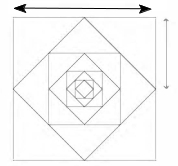
Let $S_1$ be the sum of areas of the squares whose sides are parallel to coordinate axes. Let $S_2$ be the sum of areas of the slanted squares as shown in the figure. Then, $\frac{S_1}{S_2}$ is equal to
- ✓
$2$
- B
$\sqrt{2}$
- C
$1$
- D
$\frac{1}{\sqrt{2}}$
Answera
(a)
Here,
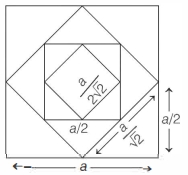
$S_1=a^2+\left(\frac{a}{2}\right)^2+\left(\frac{a}{4}\right)^2+\ldots$
$S_2=\left(\frac{a}{\sqrt{2}}\right)^2+\left(\frac{a}{2 \sqrt{2}}\right)^2+\ldots$
$S_1=a^2+\frac{a^2}{4}+\frac{a^2}{16}+\ldots=\frac{a^2}{1-\frac{1}{4}}=\frac{4 a^2}{3}$
$S_2=\frac{a^2}{2}+\frac{a^2}{8}+\frac{a^2}{32}+\ldots=\frac{a^2 / 2}{1-\frac{1}{4}}=\frac{4 a^2}{6}$
$\therefore \quad \frac{S_1}{S_2}=\frac{\frac{4 a^2}{3}}{4 a^2 / 6}=2$
View full question & answer→MCQ 1311 Mark
The remainder when the polynomial $1+x^2+x^4+x^6+\ldots+x^{22}$ is divided by $1+x+x^2+x^3+\ldots+x^{11}$ is
AnswerCorrect option: D. $2\left(1+x^2+x^4+\ldots+x^{10}\right)$
d
(d)
Let,$P(x)=1+x^2+x^4+x^6+\ldots+x^{22}$
$Q(x)=1+x+x^2+x^3+\ldots+x^{11}$
$P(x)=\frac{x^{24}-1}{x^2-1}$
$\left[\because a+a r+a r^2+\ldots+a r^{n-1}=\frac{a\left(r^n-1\right)}{r-1}\right]$
Similarly, $Q(x)=\frac{x^{12}-1}{x-1}$
$\therefore \quad \frac{P(x)}{Q(x)}=\left(\frac{x^{24}-1}{x^2-1}\right)\left(\frac{x-1}{x^{12}-1}\right)=\frac{x^{12}+1}{x+1}$
Now, $\left(1+x^{12}\right)$ is divided by $(x+1)$, then by remainder theorem remainder is $2$
Now, $P(x)$ is divided by $Q(x)$, then
remainder $=2\left(1+x^2\right)\left(1+x^4+x^8\right)$
$=2\left(1+x^2+x^4+\ldots+x^{10}\right)$
View full question & answer→MCQ 1321 Mark
Let $a_1, a_2, \ldots, a_{100}$ be non-zero real numbers such that $a_1+a_2+\ldots+a_{100}=0$ Then,
- ✓
$\sum \limits_{i=1}^{100} a_i 2^{a_i} > 0$ and $\sum \limits_{i=1}^{100} a_i 2^{-a_i} < 0$
- B
$\sum \limits_{i=1}^{100} a_i 2^{a_i} \geq 0$ and $\sum \limits_{i=1}^{100} a_i 2^{-a_i} \geq 0$
- C
$\sum \limits_{i=1}^{100} a_i 2^{a_i} \leq 0$ and $\sum \limits_{i=1}^{100} a_i 2^{-a i} \leq 0$
- D
The sign of $\sum \limits_{i=1}^{100} a_i 2^{a_i}$ or $\sum \limits_{i=1}^{100} a_i 2^{-a_i}$ depends on the choice of $a_i^{\prime} s$
AnswerCorrect option: A. $\sum \limits_{i=1}^{100} a_i 2^{a_i} > 0$ and $\sum \limits_{i=1}^{100} a_i 2^{-a_i} < 0$
a
(a)
We have, $a_1, a_2, a_3, \ldots, a_{100}$ be non-zero real number and
$a_1+a_2+a_3+\ldots+a_{100}=0$
$a_i \cdot 2^{a_i} > a_i$ and $a_i \cdot 2^{-a_i} < a_i$
$\therefore \sum \limits_{i=1}^{100} a_1 \cdot 2^{a i} > \sum \limits_{i=1}^{100} a_i \text { and } \sum \limits_{i=1}^{100} a_1 \cdot 2^{-a_i} < \sum \limits_{i=1}^{100} a_i$
$\Rightarrow \sum \limits_{i=1}^{100} a_1 \cdot 2^{a_i} > 0 \text { and } \sum \limits_{i=1}^{100} a_1 \cdot 2^{-a_i} < 0$
Hence, option $(a)$ is correct.
View full question & answer→MCQ 1331 Mark
If $n$ is the smallest natural number such that $n+2 n+3 n+\ldots+99 n$ is a perfect square, then the number of digits of $n^2$ is
- A
$1$
- B
$2$
- ✓
$3$
- D
more than $3$
Answerc
(c)
We have,
$n+2 n+3 n+\ldots+99 n$ is a perfect square
$n(1+2+\ldots+99), \frac{n \times 99 \times 100}{2}$
$n \times 11 \times 9 \times 2 \times 25$
$=(3)^2 \times(5)^2 \times 2 \times 11 \times n$ is a perfect square
$\therefore n$ must be 22 .
$\therefore \quad n^2=(22)^2=484$
Number of digit of $n^2$ is $3 .$
View full question & answer→MCQ 1341 Mark
The houses on one side of a road are numbered using consecutive even numbers. The sum of the numbers of all the houses in that row is $170$ . If there are at least $6$ houses in that row and $a$ is the number of the sixth house, then
- A
$2 \leq a \leq 6$
- B
$8 \leq a \leq 12$
- ✓
$14 \leq a \leq 20$
- D
$22 < a \leq 30$
AnswerCorrect option: C. $14 \leq a \leq 20$
c
(c)
Let the number of houses be $x, x+2, x+4, x+6, x+8, x+10, \ldots$ 6 th number of house is $a$.
$\because x+10=a \Rightarrow x=a-10$
$\therefore x > 10$
Now, $\quad S_n=\frac{n}{2}(2 x+(n-1) 2)$
$S_n=n(x+n-1)$
$\Rightarrow 170=n(a-10+n-1)$
$\Rightarrow n^2+(a-11) n-170=0$
$\Rightarrow n=-(a-11) \pm \sqrt{(a-11)^2+680}$
$\Rightarrow \quad n=\frac{(11-a) \pm \sqrt{(a-11)^2+680}}{2}$
$n \geq 6$
$\Rightarrow \quad n=\frac{(11-a) \pm \sqrt{(a-11)^2+680}}{2} \geq 6$
$\Rightarrow \quad a \leq \frac{800}{24} \leq 33.33$
$\because \quad 12 \leq a \leq 32$
$a=12,14,16,18, \ldots$
When, $a=18, n=10$, then $S_n=170$ $\because \quad a=18$
View full question & answer→MCQ 1351 Mark
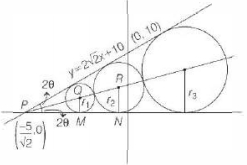
Let $n \geq 3$ and let $C_1, C_2, \ldots, C_n$, be circles with radii $r_1, r_2, \ldots, r_n$, respectively. Assume that $C_i$ and $C_{i+1}$ touch externally for $1 \leq i \leq n-1$. It is also given that the $X$-axis and the line $y=2 \sqrt{2} x+10$ are tangential to each of the circles. Then, $r_1, r_2, \ldots, r_n$ are in
- A
an arithmetic progression with common difference $3+\sqrt{2}$
- B
a geometric progression with common ratio $3+\sqrt{2}$
- C
an arithmetic progression with common difference $2+\sqrt{3}$
- ✓
a geometric progression with common ratio $2+\sqrt{3}$
AnswerCorrect option: D. a geometric progression with common ratio $2+\sqrt{3}$
d
(d)
We have,
$C_1, C_2, C_3, \ldots, C_n$ be circle with radii
$r_1, r_2, \ldots, r_n$ respectively. $C_i$ and $C_{i+1}$ touch externally $X$-axis and $y=2 \sqrt{2} x+10$ are tangent of each circle.
Slope of line $y=2 \sqrt{2} x+10$ is $2 \sqrt{2}$
$\therefore \quad \tan 2 \theta =2 \sqrt{2}$
$\frac{2 \tan \theta}{1-\tan ^2 \theta} =2 \sqrt{2}$
$\sqrt{2} \tan ^2 \theta+\tan \theta-\sqrt{2}=0$
$(\sqrt{2} \tan \theta-1)(\tan \theta+\sqrt{2}) =0$
$\tan \theta=\frac{1}{\sqrt{2}} \tan \theta \neq-\sqrt{2}$
$\sin \theta=\frac{1}{\sqrt{3}}$
$\operatorname{In} \Delta P Q M, \sin \theta=\frac{Q M}{P Q}$
$\Rightarrow \quad P Q=\sqrt{3} Q M \Rightarrow P Q=\sqrt{3} r_1$
$\operatorname{In} \triangle P R N$,
$\sin \theta=\frac{R N}{P R}=\frac{r_2}{P Q+r_1+r_2}=\frac{r_2}{\sqrt{3} r_1+r_1+r_2}$
$\Rightarrow \quad \frac{1}{\sqrt{3}}=\frac{r_2}{(\sqrt{3}+1) r_1+r_2}$
$\Rightarrow r_2+(\sqrt{3}+1) r_1=\sqrt{3}-r_2$
$\Rightarrow \quad \frac{r_2}{r_1}=\frac{\sqrt{3}+1}{\sqrt{3}-1}$
$r_1, r_2, r_3$ a geometric progression with common ratio $2+\sqrt{3}$.
View full question & answer→MCQ 1361 Mark
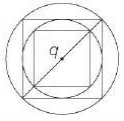
Let $C_0$ be a circle of radius $I$ . For $n \geq 1$, let $C_n$ be a circle whose area equals the area of a square inscribed in $C_{n-1} .$ Then, $\sum \limits_{i=0}^{\infty}$ Area $\left(C_i\right)$ equals
- A
$\pi^2$
- B
$\frac{\pi-2}{\pi^2}$
- C
$\frac{1}{\pi^2}$
- ✓
$\frac{\pi^2}{\pi-2}$
AnswerCorrect option: D. $\frac{\pi^2}{\pi-2}$
d
(d)
We have, $C_0$ be a circle of radius $1.$ $C_n$ be a circle whose area equals the area of a square inscribed in $C_{n-1}$.
Let $a_0, a_1, a_2, a_3, \ldots, a_n$ be the length of sides of square inscribed in circle $C_0, C_1, C_2, \ldots, C_n$ and $r_0, r_1, r_2, \ldots, r_n$ be radius of circle.
$2 a_0^2 =4$
$a _0^2 =2$
$\pi r_1^2 =a_0^2$
$r_1^2 =\frac{2}{\pi}$
$2 a _1^2 =\left(2 r_1\right)^2=4 r_1^2$
$a _1^2 =\frac{4}{\pi}$
$\pi r_2^2 = c _1^2$
$\Rightarrow r_2^2=\frac{4}{\pi^2}$
Similarly, $r_n^2=\frac{2^2}{\pi^n}$
Now, $\sum \limits_{i=0}^{\infty}$ Area $\left(C_{i j}\right)$
$=\pi\left(-1+\frac{2}{\pi}+\frac{2^2}{\pi^2}+\frac{2^3}{\pi^3}+\ldots\right)$
$=\pi\left(\frac{1}{1-\frac{2}{\pi}}\right)$
$\left[S_{\infty}=1+r+r^2+\ldots=\frac{1}{1-r}\right]$
$=\frac{\pi^2}{\pi-2}$
View full question & answer→MCQ 1371 Mark
Let $n \geq 3$ be an integer. For a permutation $\sigma=\left(a_1, a_2, \ldots, a_n\right)$ of $(1,2, \ldots, n)$ we let $f_\sigma(x)=a_n x^{n-1}+a_{n-1} x^{n-2}+\ldots a_2 x+a_1$. Let $S_\sigma$ be the sum of the roots of $f_\sigma(x)=0$ and let $S$ denote the sum over all permutations $\sigma$ of $(1,2, \ldots, n)$ of the numbers $S_\sigma$. Then,
- ✓
$S < -n !$
- B
$-n$ ! $ < S < 0$
- C
$0 < S < n !$
- D
$n ! < S$
AnswerCorrect option: A. $S < -n !$
a
(a)
We have,
$f_\sigma(x) =a_n x^{n-1}+a_{n-1} x^{n-2}+\ldots+a_2 x+a_1$
$\sigma =\left(a_1, a_2, a_3, \ldots, a_n\right) \text { of }(1,2,3, \ldots, n)$
$S_\sigma=$ Sum of roots of $f_\sigma(x)=0$
$S=\Sigma S_\sigma$
$S=-\left[\frac{\lambda-a_n}{a_n}+\frac{\lambda-a_{n-1}}{a_{n-1}}+\ldots+\frac{\lambda- a _1}{ \alpha _1}\right]$
$\forall \lambda=a_1+a_2+a_3+\ldots+a_n$
$S=-\left[\left(a_1+a_2+a_3+\ldots+a_n\right)\right.$
$\left.\left(\frac{1}{a_1}+\frac{1}{a_2}+\ldots+\frac{1}{a_n}\right)-n\right]$
$S=n-\left[\begin{array}{r}\left(a_1+a_2+a_3+\ldots+a_n\right) \\ \left.\left(\frac{1}{a_1}+\frac{1}{a_2}+\ldots+\frac{1}{a_n}\right)\right]\end{array}\right.$
From $AM \geq HM$
$\frac{ a _1+a_2+ a _3+\ldots+a_n}{n} \geq \frac{n}{\frac{1}{a_1}+\frac{1}{a_2}+\ldots+\frac{1}{a_n}}$
$\Rightarrow\left(a_1+a_2+a_3+\ldots+a_n\right)$
$\left(\frac{1}{a_1}+\frac{1}{a_2}+\ldots+\frac{1}{a_n}\right) \geq n^2$
$S \leq-n(n-1)$
$\therefore \quad S \leq-n !$
View full question & answer→MCQ 1381 Mark
The sum of all positive integers $n$ for which $\frac{1^3+2^3+\ldots+(2 n)^3}{1^2+2^2+\ldots+n^2}$ is also an integers is
Answera
(a)
Given, $\frac{1^3+2^3+3^3+\ldots+(2 n)^3}{1^2+2^2+3^2+\ldots+n^2}$
$=\frac{\frac{4 n^2(2 n+1)^2}{n(n+1)(2 n+1)}}{6}=\frac{6 n(2 n+1)}{n+1}$
$=\frac{12 n^2+6 n}{n+1}=(12 n-6)+\frac{6}{n+1}$
$\because \frac{6}{n+1} \text { is an integer if } n+1 \text { is factor of } 6$
$\because n+1=1,2,3,6 \Rightarrow n=1,2,5$
Sum of $n=1+2+5=8$
View full question & answer→MCQ 1391 Mark
If $a, b$ are positive real numbers such that the lines $a x+9 y=5$ and $4 x+b y=3$ are parallel, then the least possible value of $a +b$ is
Answerb
(b)
We have, $a x+9 y=5$ and $4 x+b y=3$ are parallel. $\therefore \quad \frac{a}{4}=\frac{9}{b} \Rightarrow a b=36$
$AM \geq GM$
$\therefore \quad \frac{a+b}{2} \geq \sqrt{a b}$
$a+b \geq 2 \sqrt{36}$
$a+b \geq 12$
Hence, least possible value of $a+b=12$.
View full question & answer→MCQ 1401 Mark
Let $a, b, c, d, e$ be natural numbers in an arithmetic progression such that $a+b+c+d+e$ is the cube of an integer and $b+c+d$ is square of an integer. The least possible value of the number of digits of $c$ is
Answerb
(b)
We have,
$a, b, c, d, e$ are natural number and in AP.
Let $D$ is common difference of $AP$.
$\therefore$ Let $c=C$
$a =C-2 D$
$b =C-D$
$d =C+D$
$e =C+2 D$
$a+b+c+d+e=5 C$
and $b+c+d=3 C$
Given, $a+b+c+d+e$ is a cube of number
$\therefore 5 C=\lambda^3$
and $b+c+d$ is a square of number
$\therefore 3 C=u^2$
From Eqs.$(i)$ and $(ii)$, we get
$\frac{\lambda^3}{5}=\frac{u^2}{3}$
$\lambda^3$ and $u^2$ is a multiple of 15
$\therefore$ Smallest possible value of $\lambda=15$ and $u=45$
$\therefore \quad c=\frac{u^2}{3}=\frac{(45)^2}{3}=675$
$\therefore$ Number of digits $=3$
View full question & answer→MCQ 1411 Mark
Let $x, y, z$ be three non-negative integers such that $x+y+z=10$. The maximum possible value of $x y z+x y+y z+z x$ is
Answerc
(c)
We have, $x+y+z=10$
Let three number $x+1, y+1, z+1$
$AM \geq GM$
$\quad \frac{(x+1)+(y+1)+(z+1)}{3} \geq [(x+1)(y+1)(z+1)]^{1 / 3}$
$\Rightarrow \frac{x+y+z+3}{3} \geq (x y z+x y+y z+x z+x+y+z+1)^{1 / 3}$
$\Rightarrow \quad\left(\frac{13}{3}\right)^3 \geq x y z+x y+y z+x z+11$
$\Rightarrow \quad \quad(y+1)(z+1)]^{1 / 3}$
Now, $x, y, z$ are integer.
$\therefore x y z+x y+y z+x z+11$ is also integer.
$\therefore\left(\frac{13}{3}\right)^3$ is also integer.
$\therefore \quad\left[\left(\frac{13}{3}\right)^3\right]=81\left[\because\left(\frac{13}{3}\right)^3=8137\right]$
$\therefore x y z+x y+y z+x z+11 \leq 81$
$\Rightarrow \quad x y z+x y+y z+x z \leq 70$
$\therefore$ Maximum value of $x y z+x y+y z+x z$ is
View full question & answer→MCQ 1421 Mark
Let $a, b, c, d$ be real numbers such that $\sum \limits_{k=1}^n\left(a k^3+b k^2+c k+d\right)=n^4$, for every natural number $n$. Then, $|a|+|b|+|c|+|d|$ is equal to
Answera
(a)
We have,
$\sum \limits_{k=1}^n\left(a k^3+b k^2+d k+d\right)=n^4, n \in N$
$a\left(\frac{n(n+1)}{2}\right)^2+b \frac{n(n+1)(2 n+1)}{6}$
$+c \frac{n(n+1)}{2}+d n=n^4$
$\Rightarrow \frac{a}{4} n^4+\left(\frac{2 a}{4}+\frac{2 b}{6}\right) n^3+\left(\frac{a}{4}+\frac{3 b}{6}+\frac{c}{2}\right)$
$n^2+\left(\frac{b}{6}+\frac{c}{2}+d\right) n=n^4$
$\therefore \frac{a}{4}=1, \frac{2 a}{4}+\frac{2 b}{6}=0, \frac{a}{4}+\frac{3 b}{6}+\frac{c}{2}=0$
$\frac{b}{6}+\frac{c}{2}+d=0$
On solving these equations, we get
$a=4, b=-6, c=4, d=-1$
$\therefore|a|+|b|+|d|+|d|=4+6+4+1=15$
View full question & answer→MCQ 1431 Mark
The sides of a triangle are distinct positive integers in an arithmetic progression. If the smallest side is $10$, the number of such triangles is
Answerb
(b)
Let the sides be $a, b, c$ which are in A.P. with $c$ as the smallest.
$\therefore c =10$
$\therefore a , b > 10$
$\therefore 2 b = a + c = a +10$
$\therefore b + c > a$
$\Rightarrow b +10 > a$
From eq $(1)$ and $(2)$:
$\Rightarrow b +10 > 2 b -10$
$\Rightarrow b < 20$
$\therefore 10 < b < 20$
$\therefore$ No. of possible values of $b=9$
$\therefore$ No. of triangles possible $=9$
View full question & answer→MCQ 1441 Mark
For $\frac{2^2+4^2+6^2+\ldots+(2 n)^2}{1^2+3^2+5^2+\ldots+(2 n-1)^2}$ to exceed $1.01$, the maximum value of $n$ is
Answerd
(d)
We have,
$\frac{2^2+4^2+6^2+\ldots+(2 n)^2}{1^2+3^2+5^2+\ldots+(2 n-1)^2} > 101$
$\frac{\Sigma(2 n)^2}{\Sigma(2 n-1)^2}>\frac{101}{100}$
$\frac{4 \Sigma n^2}{\Sigma\left(4 n^2-4 n+1\right)} > \frac{101}{100}$
$\frac{4 \Sigma n^2}{4 \Sigma n^2-4 \Sigma n+\Sigma 1} > \frac{101}{100}$
$\frac{\frac{4(n)(n+1)(2 n+1)}{6}}{\frac{4 n(n+1)(2 n+1)}{6}-\frac{4 n(n+1)}{2}+n} > \frac{101}{100}$
$\frac{4 n(n+1)(2 n+1)}{n\left[4\left(2 n^2+3 n+1\right)-12 n-12+6\right]} > \frac{101}{100}$
$\frac{4(n+1)(2 n+1)}{8 n^2-2} > \frac{101}{100}$
$\frac{4(2 n+1)(n+1)}{2(2 n+1)(2 n-1)} > \frac{101}{100}$
$\frac{2 n+2}{2 n-1} > \frac{101}{100}$
$200 n+200 > 202 n-101$
$2 n < 301$
$n < \frac{301}{2}$
$\therefore$ Maximum value of $n=150$
View full question & answer→MCQ 1451 Mark
Suppose $a_1, a_2, a_3, \ldots, a_{2012}$ are integers arranged on a circle. Each number is equal to the average of its two adjacent numbers. If the sum of all even indexed numbers is $3018$ , what is the sum of all numbers?
- A
$0$
- B
$1509$
- C
$3018$
- ✓
$6036$
AnswerCorrect option: D. $6036$
d
(d)
Given,
$a_2=\frac{ a _1+ a _i}{2}$
$a_3=\frac{a_2+a_4}{2}$
$a_4=\frac{a_3+u_5}{2}$
$a_{2012}=\frac{a_{2011}+a_1}{2}$
$a_2+a_4+a_6+\ldots+a_{2012}=3018 \ldots$ (i)
$2 a_2+2 a_4+2 a_6+\ldots+2 a_{2012}=6036$
$\left(a_1+a_3\right)+\left(a_3+ a _5\right)+\left( a _5+a_7\right)+\ldots$
$+\left(a_{2011}+a_1\right)=6036$
$2\left(a_1+a_3+a_5+\ldots+a_{2011}\right)=6036$
$a_1+a_3+a_5+\ldots+a_{2011}=3018$
On adding Eqs.$(i)$ and $(ii)$,
$a_1+a_2+a_3+a_4+\ldots+a_{2011}+a_{2012}$
$=6036$
View full question & answer→MCQ 1461 Mark
Suppose $\log _a b+\log _b a=c$. The smallest possible integer value of $c$ for all $a, b>1$ is
Answerc
(c)
We have,
$\log _a b+\log _b a =c$
$AM \geq GM$
$\therefore \quad \frac{\log _a b+\log _b a}{2} \geq \sqrt{\log _a b \log _b a}$
$\Rightarrow \frac{c}{2} \geq \sqrt{\frac{\log b}{\log a} \times \frac{\log a}{\log b}} \Rightarrow \frac{c}{2} \geq 1 \Rightarrow c \geq 2$
$\therefore$ Smallest positive integer value of $c=2$.
View full question & answer→MCQ 1471 Mark
The arithmetic mean and the geometric mean of two distinct 2-digit numbers $x$ and $y$ are two integers one of which can be obtained by reversing the digits of the other (in base 10 representation). Then, $x+y$ equals
Answerc
(c)
We have,
Let two-digits numbers are $10 a+b$.
Given, $10 a+b$ is AM of $x$ and $y$
and $10 b+a$ is GM of $x$ and $y$.
$\therefore \quad \frac{x+y}{2}=10 a+b$
$\Rightarrow \quad \sqrt{x y}=10 b+a$
$\Rightarrow \quad x y=(10 b+a)^2$
$\Rightarrow(x+y)^2-(x-y)^2=4 x y$
$\therefore \quad(x-y)^2=(x+y)^2-4 x y$
$\Rightarrow \quad(x-y)^2=4(10 a+b)^2-4(10 b+a)^2$
$\Rightarrow \quad(x-y)^2=4(10 a+b+10 b+a)$
$(10 a+b-10 b-a)$
$\Rightarrow \quad(x-y)^2=4(11)(a+b) \cdot 9(a-b)$
$\Rightarrow \quad(x-y)^2=4 \times 11 \cdot(a+b) \cdot 9(a-b)$
$4 \times 11(a+b) \times 9(a-b)$ must be a perfect
square.
$\therefore \quad a+b=11, a-b=1$
On solving these equations, we get
$\therefore a=6, b=5$
$\therefore \quad x+y=2(10 a+b)$
$\Rightarrow \quad x+y=2(60+5)$
$\Rightarrow \quad x+y=130$
View full question & answer→MCQ 1481 Mark
Suppose $n$ is a natural number such that $\left|i+2 i^2+3 i^3+\ldots n i^n\right|=18 \sqrt{2}$, where $i$ is the square root of $-1$. Then, $n$ is
Answerc
(c)
Let $S_n=i+2 i^2+3 i^3+\ldots+n i^n \ldots$ (i) $i S_n=i^2+2 i^2+\ldots(n-1) i^n+n i^{n+1} \ldots$ (ii)
On subtracting Eq. (ii) from Eq. (i), we get
$S_n(1-i)=i+i^2+i^3+\ldots+i^n-n i^{n+1}$
$\Rightarrow S_n(1-i)=\frac{i\left(1-i^n\right)}{1-i}-n i^{n+1}$
$\Rightarrow \quad S_n=\frac{i\left(1-i^n\right)}{-2 i}-\frac{n i^{n+1}}{1-i}$
$\Rightarrow \quad S_n=\frac{1-i^n}{-2}-\frac{n i^{n+i}(1+i)}{2}$.
Let $Z_1=\frac{1-i^n}{-2}$ and $Z_2=\frac{n i^{n+1}(1+i)}{2}$
$\therefore \quad\left|Z_1\right|=\frac{1}{\sqrt{2}}$ or 0 and $\left|Z_2\right|=\frac{n}{2} \sqrt{2}$
$\therefore \quad \frac{n}{2} \sqrt{2}=18 \sqrt{2} \Rightarrow n=36$
View full question & answer→MCQ 1491 Mark
The expression $\frac{2^2+1}{2^2-1}+\frac{3^2+1}{3^2-1}+\frac{4^2+1}{4^2-1}+\ldots+\frac{(2011)^2+1}{(2011)^2-1}$ lies in the interval
- A
$\left(2010,2010 \frac{1}{2}\right)$
- B
$\left(2011-\frac{1}{2011}, 2011-\frac{1}{2012}\right)$
- ✓
$\left(2011,2011 \frac{1}{2}\right)$
- D
$\left(2012,2012 \frac{1}{2}\right)$
AnswerCorrect option: C. $\left(2011,2011 \frac{1}{2}\right)$
c
(c)
Let
$S=\frac{2^2+1}{2^2-1}+\frac{3^2+1}{3^2-1}+\frac{4^2+1}{4^2-1}+\ldots+\frac{(2011)^2+1}{(2011)^2-1}$
Here, $\quad T_r=\frac{r^2+1}{r^2-1}$
$T_r =\frac{r^2-1+2}{r^2-1}$
$=1+\frac{2}{r^2-1}=1+\frac{2}{(r-1)(r+1)}$
$T_r =1+\frac{1}{r-1}-\frac{1}{r+1}$
$S =\sum \limits_{r=2}^{2011} T_r$
$=\sum \limits_{r=2}^{2011}\left[1+\frac{1}{r-1}-\frac{1}{r+1}\right]$
$S=T_2+T_3+T_4+\ldots+T_{2011}$
$S =\left(1+\frac{1}{1}-\frac{1}{3}\right)+\left(1+\frac{1}{2}-\frac{1}{4}\right)$
$+\left(1+\frac{1}{3}-\frac{1}{5}\right)+\ldots+\left(1+\frac{1}{2010}-\frac{1}{2012}\right)$
$S =2010+1+\frac{1}{2}-\frac{1}{2012}-\frac{1}{2011}$
$S =2011+\frac{1}{2}-\left[\frac{1}{2011}+\frac{1}{2012}\right]$
$S$ is lie between $\left(2011,2011 \frac{1}{2}\right)$
View full question & answer→MCQ 1501 Mark
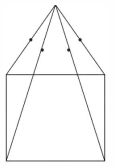
Consider an incomplete pyramid of balls on a square base having $18$ layers, and having $13$ balls on each side of the top layer. Then, the total number $N$ of balls in that pyramid satisfies
- A
$9000 < N < 10000$
- ✓
$8000 < N < 9000$
- C
$7000 < N < 8000$
- D
$10000 < N < 12000$
AnswerCorrect option: B. $8000 < N < 9000$
b
(b)
Given, square base pyramid is incomplete.
The top layer $=13$ balls
There are $18$ layer completed.
So, total number of balls
$N=13^2+14^2+15^2+16^2+\ldots+30^2$
$N=\left(1^2+2^2+3^2+4^2+\ldots+30^2\right)$
$\Rightarrow N=5 \times 31 \times 61-2 \times 13 \times 25$
$=9455-650$
$=8805$
$\therefore \quad 8000 < N < 9000$
View full question & answer→