MCQ 511 Mark
Period of $|2\sin 3\theta + 4\cos 3\theta |$ is
- A
$\frac{{2\pi }}{3}$
- B
$\pi $
- C
$\frac{\pi }{2}$
- ✓
$\frac{\pi }{3}$
AnswerCorrect option: D. $\frac{\pi }{3}$
d
(d) Period of $2\sin 3\theta $ is $\frac{{2\pi }}{3}$ and period of $4\cos 3\theta $ is $\frac{{2\pi }}{3}$.
Therefore period of the expression is $\frac{\pi }{3}$.
View full question & answer→MCQ 521 Mark
The period of ${\sin ^4}x + {\cos ^4}x $ is
- ✓
$\pi /2$
- B
$\pi $
- C
$2\pi $
- D
$3\pi /2$
AnswerCorrect option: A. $\pi /2$
a
(a) Let $f(x) = {\sin ^4}x + {\cos ^4}x$
$= {({\sin ^2}x + {\cos ^2}x)^2} - 2{\sin ^2}x{\cos ^2}x$
$= 1 - \frac{{4{{\sin }^2}x{{\cos }^2}x}}{2} = 1 - \frac{{{{\sin }^2}2x}}{2}$
$=1 - \frac{1}{4}(2{\sin ^2}2x) = 1 - \left( {\frac{{1 - \cos x}}{4}} \right)$
$ = \frac{3}{4} + \frac{1}{4}\cos 4x$
Hence the period of function = $\frac{{2\pi }}{4} = \frac{\pi }{2}$.
View full question & answer→MCQ 531 Mark
The period of the function $f(\theta ) = \sin \frac{\theta }{3} + \cos \frac{\theta }{2}$ is
- A
$3\pi $
- B
$6\pi $
- C
$9\pi $
- ✓
$12\pi $
AnswerCorrect option: D. $12\pi $
d
(d) Period of $\sin (\theta /3) = 6\pi $ and period of $\cos (\theta /2) = 4\pi $
$L.C.M.$ of $6\pi $ and $4\pi = 12\pi $.
View full question & answer→MCQ 541 Mark
The period of the function $\sin \left( {\frac{{2x}}{3}} \right) + \sin \left( {\frac{{3x}}{2}} \right)$ is
- A
$2\pi $
- B
$10\pi $
- C
$6\pi $
- ✓
$12\pi $
AnswerCorrect option: D. $12\pi $
d
(d) Period of $\sin \left( {\frac{{2x}}{3}} \right)\, = \frac{{2\pi }}{{2/3}} = 3\pi $
Period of $\sin \,\left( {\frac{{3x}}{2}} \right) = \frac{{2\pi }}{{3/2}} = \frac{{4\pi }}{3}$
$L.C.M.$ of $3\pi $ and $\frac{{4\pi }}{3}$= $12\pi $.
Hence period is $12\pi $.
View full question & answer→MCQ 551 Mark
The function $f(x) = \sin \frac{{\pi x}}{2} + 2\cos \frac{{\pi x}}{3} - \tan \frac{{\pi x}}{4}$ is period with period
Answerd
(d) Period of $\sin \frac{{\pi x}}{2} = \frac{{2\pi }}{{\pi /2}} = 4$
Period of $\cos \frac{{\pi x}}{3} = \frac{{2\pi }}{{\pi /3}} = 6$
Period of $\tan \frac{{\pi x}}{4} = \frac{\pi }{{\pi /4}} = 4$
$\therefore $Period of $f(x) = L.C.M.$ of $(4, 6, 4) = 12.$
View full question & answer→MCQ 561 Mark
The period of the function $\left| {\,\sin \pi \,x\,} \right| $ is
- A
${\pi ^2}$
- B
$2\pi $
- C
$2$
- ✓
$1$
Answerd
(d) Period of $\left| {\,\sin \pi \,x\,} \right| = \frac{\pi }{\pi } = 1.$
View full question & answer→MCQ 571 Mark
The period of $f(x) = \sin \left( {\frac{{\pi x}}{{n - 1}}} \right) + \cos \,\left( {\frac{{\pi x}}{n}} \right)\,\,,\,n \in Z$, $n > 2$ is
- A
$2\pi n(n - 1)$
- B
$4n\,(n - 1)$
- ✓
$2n\,(n - 1)$
- D
AnswerCorrect option: C. $2n\,(n - 1)$
c
(c) $f(x) = \sin \left( {\frac{{\pi x}}{{n - 1}}} \right) + \cos \left( {\frac{{\pi x}}{n}} \right)$
Period of $\sin \left( {\frac{{\pi x}}{{n - 1}}} \right) = \frac{{2\pi }}{{\left( {\frac{\pi }{{n - 1}}} \right)}} = 2\left( {n - 1} \right)$
and period of $\cos \left( {\frac{{\pi x}}{n}} \right) = \frac{{2\pi }}{{\left( {\frac{\pi }{n}} \right)}} = 2n$
Hence period of $f(x)$ is $L.C.M.$ of $2\,n$ and $2(n - 1)$
$ \Rightarrow 2n(n - 1)$.
View full question & answer→MCQ 581 Mark
Let $\theta, 0 < \theta < \pi / 2$, be an angle such that the equation $x ^2+4 x \cos \theta+\cot \theta=0$ has equal roots for $x$. Then $\theta$ in radians is
AnswerCorrect option: B. $\frac{\pi}{12}$ or $\frac{5 \pi}{12}$
b
(b)
$x^2+4 x \cos \theta+\cot \theta=0$
$D =0 \Rightarrow 16 \cos ^2 \theta=4 \cot \theta$
$\Rightarrow 4 \cos ^2 \theta=\frac{\cos \theta}{\sin \theta}$
$\Rightarrow \sin 2 \theta=\frac{1}{2}$
$\Rightarrow 2 \theta=\frac{\pi}{6}, \frac{5 \pi}{6}$
$\Rightarrow \theta=\frac{\pi}{12}, \frac{5 \pi}{12}$
View full question & answer→MCQ 591 Mark
Let $A=\left\{\theta \in R:\left(\frac{1}{3} \sin \theta+\frac{2}{3} \cos \theta\right)^2=\frac{1}{3} \sin ^2 \theta+\frac{2}{3} \cos ^2 \theta\right\}$.Then
- A
$A \cap[0, \pi]$ is an empty set
- ✓
$A \cap[0, \pi]$ has exactly one point
- C
$A \cap[0, \pi]$ has exactly two points
- D
$A \cap[0, \pi]$ has more than two points.
AnswerCorrect option: B. $A \cap[0, \pi]$ has exactly one point
b
(b)
Given trigonometric relation is
$\left(\frac{1}{3} \sin \theta+\frac{2}{3} \cos \theta\right)^2=\frac{1}{3} \sin ^2 \theta+\frac{2}{3} \cos ^2 \theta$
$\Rightarrow \quad \frac{1}{9} \sin ^2 \theta+\frac{4}{9} \cos ^2 \theta+\frac{4}{9} \sin \theta \cos \theta$
$=\frac{1}{3} \sin ^2 \theta+\frac{2}{3} \cos ^2 \theta$
$\Rightarrow \quad \frac{2}{9} \sin ^2 \theta+\frac{2}{9} \cos ^2 \theta-\frac{4}{9} \sin \theta \cos \theta=0$
$\Rightarrow \quad \sin ^2 \theta+\cos ^2 \theta-2 \sin \theta \cos \theta=0$
$\Rightarrow \quad \quad \sin 2 \theta=1$
$\Rightarrow \quad 2 \theta=2 n \pi+\frac{\pi}{2}, n \in I$
$\Rightarrow \quad \theta=n \pi+\frac{\pi}{4}, n \in I$
$\therefore \quad A=\left\{\theta \in R: \theta=n \pi+\frac{\pi}{4}, n \in I\right\}$
$\therefore A \cap[0, \pi]=\left\{\frac{\pi}{4}\right\}$
$\therefore \quad A \cap[0, \pi]$ has exactly one point.
View full question & answer→MCQ 601 Mark
The number of solutions of the equation $\sin (9 x)+\sin (3 x)=0$ in the closed interval $[0,2 \pi]$ is
Answerb
(b)
Given trigonometric equation is
$\sin (9 x)+\sin (3 x)=0$
$\Rightarrow \quad 2 \sin 6 x \cos 3 x=0$
$\therefore \quad$ either $\sin 6 x=0$
or $\quad \cos 3 x=0$
for $x \in[0,2 \pi]$
$\sin 6 x=0$
$\Rightarrow \quad x=0, \frac{\pi}{6}, \frac{\pi}{3}, \frac{\pi}{2}, \frac{2 \pi}{3}, \frac{5 \pi}{6}$,
and $3 x=0$
$\Rightarrow \quad x=\frac{\pi}{6}, \frac{\pi}{2}, \frac{5 \pi}{6}, \frac{7 \pi}{6}, \frac{3 \pi}{2}, \frac{11 \pi}{6}$
So, number of solution of given equation is $13$
View full question & answer→MCQ 611 Mark
The number of solutions to $\sin \left(\pi \sin ^2 \theta\right)+\sin \left(\pi \cos ^2 \theta\right)=2 \cos \left(\frac{\pi}{2} \cos \theta\right)$ satisfying $0 \leq \theta \leq 2 \pi$ is
Answerd
(d)
The given equation
$\sin \left(\pi \sin ^2 \theta\right)+\sin \left(\pi \cos ^2 \theta\right)=2 \cos \left(\frac{\pi}{2} \cos \theta\right)$
$\Rightarrow 2 \sin \left(\frac{\pi\left(\sin ^2 \theta+\cos ^2 \theta\right)}{2}\right)$ $\cos \left(\frac{\pi\left(\sin ^2 \theta-\cos ^2 \theta\right)}{2}\right)=2 \cos \left(\frac{\pi}{2} \cos \theta\right)$
$\Rightarrow \cos \left(\frac{\pi}{2} \cos 2 \theta\right)=\cos \left(\frac{\pi}{2} \cos \theta\right)$
$\Rightarrow \frac{\pi}{2} \cos 2 \theta=2 n \pi \pm \frac{\pi}{2} \cos \theta, n \in \text { Integers }$
$\Rightarrow \cos 2 \theta=4 n \pm \cos \theta, n \in I$ \\
$\text { Case I }$
$\text { If } \cos 2 \theta=4 n+\cos \theta \Rightarrow \cos 2 \theta-\cos \theta=4 n$
$\text { The above equation will hold only if } n=0$
$\text { so }$
$\Rightarrow 2 \cos 2 \theta-\cos \theta-1=0 \Rightarrow \cos \theta=1,-\frac{1}{2}$
$\Rightarrow \quad \theta=2 k \pi, 2 k \pi \pm \frac{2 \pi}{3}, k \in I$
$\because \quad \theta \in[0,2 \pi]$
So, $\quad \theta=0,2 \pi, \frac{2 \pi}{3}, \frac{4 \pi}{3}$
Case $II$
$\text { If } \cos 2 \theta=4 n-\cos \theta$
$\Rightarrow \quad \cos 2 \theta+\cos \theta=4 n$
The above equation will hold only if $n=0$,
$\text { so } \quad \cos 2 \theta+\cos \theta=0$
$\Rightarrow 2 \cos ^2 \theta+\cos \theta-1=0$
$\Rightarrow \quad \cos \theta=-1, \frac{1}{2}$
$\Rightarrow \quad \theta=(2 m+1) \pi, 2 m \pi \pm \frac{\pi}{3}, m \in I$
$\therefore$ There are total $7$ solutions.
View full question & answer→MCQ 621 Mark
Let $S=\{x \in R: \cos (x)+\cos (\sqrt{2} x)<2\}$, then
AnswerCorrect option: D. $S=R-\{0\}$
d
(d)
We have,
$S=\{x \in R: \cos x+\cos \sqrt{2} x<2\}$
Maximum value of $\cos x$ and $\cos \sqrt{2} x$ is 1 at
$x=0$
$\therefore \quad \cos x+\cos \sqrt{2} x=2 \text { at } x=0$
$\text { Hence, } \quad S=R-\{0\}$
View full question & answer→MCQ 631 Mark
The number of real solutions $x$ of the equation $\cos ^2(x \sin (2 x))+\frac{1}{1+x^2}=\cos ^2 x+\sec ^2 x$ is
Answerb
(b)
We have,
$\cos ^2(x \sin (2 x))+\frac{1}{1+x^2}=\cos ^2 x+\sec ^2 x$
$\text { LHS }=\cos ^2(x \sin 2 x)+\frac{1}{1+x^2}$
$\cos ^2(x \sin 2 x)+\frac{1}{1+x^2} \leq 2$
$\text { RHS }=\cos ^2 x+\sec ^2 x \geq 2$
$\qquad \quad \operatorname{LHS}^2 x+\sec ^2 x=2 \text { at } x=0$
Hence, only one solution.
View full question & answer→MCQ 641 Mark
The number of solutions $x$ of the equation $\sin \left(x+x^2\right)-\sin \left(x^2\right)=\sin x$ in the interval $[2,3]$ is
Answerc
(c)
Given,
$\sin \left(x+x^2\right)-\sin \left(x^2\right)=\sin x$
$\Rightarrow \quad \sin \left(x+x^2\right)=\sin \left(x^2\right)+\sin x$
$\Rightarrow 2 \sin \left(\frac{x+x^2}{2}\right) \cos \left(\frac{x+x^2}{2}\right)$
$=2 \sin \left(\frac{x^2+x}{2}\right) \cos \left(\frac{x^2-x}{2}\right)$
$\sin \left(\frac{x+x^2}{2}\right)=0$
or $\cos \left(\frac{x^2+x}{2}\right)-\cos \left(\frac{x^2-x}{2}\right)=0$
$\frac{x^2+x}{2}=x \pi$ or $2 \sin \frac{x^2}{2} \sin \frac{x}{2}=0$
$\Rightarrow \frac{x^2+x}{2}=0, \pi, 2 \pi$ or $\frac{x^2}{2}=0, \pi, \frac{n}{2}=0, \pi, 2 \pi$
$\Rightarrow x^2+x=2 \pi$ or $x^2=2 \pi$
$\Rightarrow x^2+x-2 \pi=0$ or $x=\sqrt{2 \pi}$
$x=\frac{-1 \pm \sqrt{1+8 \pi}}{2}$ or $2<\sqrt{2} \pi<3$
$\sqrt{1+8 \pi} \approx \sqrt{25.14}$
$x=\frac{5.2-1-4.2-2.1}{2}$
$\because$ 'Total numbers of solution lies between
$(2,3)=2$
View full question & answer→MCQ 651 Mark
The number of real solutions of the equation $2 \sin 3 x+\sin 7 x-3=0$, which lie in the interval $[-2 \pi, 2 \pi]$ is
Answerb
(b)
Given, $2 \sin 3 x+\sin 7 x-3=0$
$\Rightarrow \quad 2 \sin 3 x+\sin 7 x=3$
lt is possible only $\sin 3 x=1$ and $\sin 7 x=1$
$\therefore \quad \sin 3 x =1$
$\therefore \quad x =n \pi+(-1)^n \frac{\pi}{2}$
$x =\frac{n \pi}{3}+(-1)^n \frac{\pi}{6}$
$\because \quad \sin 7 x =1$
$\therefore \quad 7 x =m \pi+(-1)^m \frac{\pi}{2}$
$x =\frac{m \pi}{7}+(-1)^m \frac{\pi}{14}$
Hence, only two solution exists.
View full question & answer→MCQ 661 Mark
The number of solutions of the equation $\sin \theta+\cos \theta=\sin 2 \theta$ in the interval $[-\pi, \pi]$ is
Answerb
(b)
We have, $\sin \theta+\cos \theta=\sin 2 \theta$ On squaring both sides, we get $\sin ^2 \theta+\cos ^2 \theta+\sin 2 \theta=\sin ^2 2 \theta$ $\Rightarrow \sin ^2 2 \theta-\sin 2 \theta-1=0$
$\Rightarrow \quad \sin 2 \theta=\frac{1 \pm \sqrt{5}}{2}$
$\Rightarrow \sin 2 \theta=\frac{1-\sqrt{5}}{2} \Rightarrow \sin 2 \theta \neq \frac{\sqrt{5}+1}{2}$
$\therefore$ Two solutions exist interval $[-\pi, \pi]$.
View full question & answer→MCQ 671 Mark
One of the solutions of the equation $8 \sin ^3 \theta-7 \sin \theta+\sqrt{3} \cos \theta=0$ lies in the interval
- A
$\left(0^{\circ}, 10^{\circ}\right]$
- ✓
$\left(10^{\circ}, 20^{\circ}\right)$
- C
$\left(20^{\circ}, 30^{\circ}\right)$
- D
$\left(30^{\circ}, 40^{\circ}\right]$
AnswerCorrect option: B. $\left(10^{\circ}, 20^{\circ}\right)$
b
(b)
Given,
$8 \sin ^3 \theta-7 \sin \theta+\sqrt{3} \cos \theta =0$
$2\left(4 \sin ^3 \theta\right)-7 \sin \theta+\sqrt{3} \cos \theta =0$
$2(3 \sin \theta-\sin 3 \theta)-7 \sin \theta$
$+\sqrt{3} \cos \theta =0$
$6 \sin \theta-2 \sin 3 \theta-7 \sin \theta$
$+\sqrt{3} \cos \theta =0$
$\sqrt{3} \cos \theta-\sin \theta-2 \sin 3 \theta =0$
$\frac{\sqrt{3}}{2} \cos \theta-\frac{1}{2} \sin \theta =\sin 3 \theta$
$\sin \left(\frac{\pi}{3}-\theta\right) =\sin 3 \theta$
$\frac{\pi}{3}-\theta=3 \theta \Rightarrow 4 \theta=60^{\circ} \Rightarrow \theta =15^{\circ}$
$\theta \in\left(10^{\circ}, 20^{\circ}\right]$
View full question & answer→MCQ 681 Mark
Let $X=\{x \in R: \cos (\sin x)=\sin (\cos x)\} .$ The number of elements in $X$ is
Answera
(a)
We have,
$X=\{x \in R: \cos (\sin x)=\sin (\cos x)\}$
$\cos (\sin x)=\sin (\cos x)$
$\quad \sin \left(\frac{\pi}{2} \pm \sin x\right)=\sin (\cos x)$
$\Rightarrow \quad \cos x=\frac{\pi}{2} \pm \sin x$
$\Rightarrow \cos x=n \pi+(-1)^n\left(\frac{\pi}{2}+\sin x\right), n \in I$
$\Rightarrow \cos x \pm \sin x=n \pi+(-1)^n \frac{\pi}{2}, n \in I$
As $L H S \in[-\sqrt{2}, \sqrt{2}]$ and it does not satisfy the RHS.
$\therefore$ No solution exists.
View full question & answer→MCQ 691 Mark
For each positive real number $\lambda$. Let $A_\lambda$ be the set of all natural numbers $n$ such that $|\sin (\sqrt{n+1})-\sin (\sqrt{n})|<\lambda$. Let $A_\lambda^c$ be the complement of $A_\lambda$ in the set of all natural numbers. Then,
- A
$A_{1 / 2}, A_{1 / 3}, A_{25}$ are all finite sets
- B
$A_{1 / 3}$ is a finite set but $A_{1 / 2}, A_{25}$ are infi,nite sets
- ✓
$A_{12}^c, A_{13}^c, A_{25}^c$ are all finites sets
- D
$A_{1 / 3}, A_{2 / 5}$ are finite sets and $A_{1 / 2}$ is an infinite set
AnswerCorrect option: C. $A_{12}^c, A_{13}^c, A_{25}^c$ are all finites sets
c
(c)
We have,
$|\sin \sqrt{n+1}-\sin \sqrt{n}| < \lambda, \lambda \in R$
When $n \rightarrow$
$|\sin \sqrt{n+1}-\sin \sqrt{n}| \rightarrow 0$
$\therefore$ There exist infinite natural number for which $|\sin \sqrt{n+1}-\sin \sqrt{n}| < \lambda, \forall \gamma \lambda \in 0$
Hence, $A_{1 / 2}, A_{1 / 3}, A_{2 / 5}$ are infinite sets. $\therefore A_{1 / 2}^e, A_{1 / 3}^e, A_{2 / 5}^e$ are finite sets.
View full question & answer→MCQ 701 Mark
The number of real numbers $\lambda$ for which the equality $\frac{\sin (\lambda \alpha) \quad \cos (\lambda \alpha)}{\sin \alpha}=\lambda-1$,holds for all real $\alpha$ which are not integral multiples of $\pi / 2$ is
Answerb
(b)
We have,
$\frac{\sin (\lambda, \alpha) \cos (\lambda \alpha)}{\sin \alpha \quad \cos \alpha}=\lambda-1$
$\Rightarrow \cos \alpha \sin \lambda \alpha-\cos (\lambda \alpha)$
$\Rightarrow \sin (\lambda-1) \alpha=\frac{\lambda-1}{2} \sin 2 \alpha$
$\therefore \quad \lambda-1=2 \text { or } \lambda-1=0$
$\therefore \quad \lambda=3 \text { or } \lambda=1$
Hence, $\lambda$ has two values.
View full question & answer→MCQ 711 Mark
The number of solutions to the equation $\cos ^4 x+\frac{1}{\cos ^2 x}=\sin ^4 x+\frac{1}{\sin ^2 x}$ in the interval $[0,2 \pi]$ is
Answerb
(b)
We have,
$\cos ^4 x+\frac{1}{\cos ^2 x}=\sin ^4 x+\frac{1}{\sin ^2 x}$
$\Rightarrow \quad \cos ^4 x-\sin ^4 x=\frac{1}{\sin ^2 x}-\frac{1}{\cos ^2 x}$
$\Rightarrow \quad\left(\cos ^2 x-\sin ^2 x\right)\left(\cos ^2 x+\sin ^2 x\right)$
$=\frac{\cos ^2 x-\sin ^2 x}{\sin ^2 x \cos ^2 x}$
$\Rightarrow \quad \cos ^2 x-\sin ^2 x=\frac{\cos ^2 x-\sin ^2 x}{\sin ^2 x \cos ^2 x}$
$\Rightarrow \quad \cos 2 x\left(1-\frac{4}{\sin ^2 2 x}\right)=0$
$\Rightarrow \quad \cos 2 x=0$ or $\sin ^2 2 x=4$
$\therefore \quad \cos 2 x=0$ or $\sin ^2 2 x \neq 4$
$\Rightarrow \quad 2 x=(2 n+1) \frac{\pi}{2}$
$\Rightarrow \quad x=(2 n+1) \frac{\pi}{4}$
$\ln x \in(0,2 \pi)$
$x=\frac{\pi}{4}, \frac{3 \pi}{4}, \frac{5 \pi}{4}, \frac{7 \pi}{4}$
$\therefore$ Total number of solution $=4$
View full question & answer→MCQ 721 Mark
The angles $\alpha, \beta, \gamma$ of a triangle satisfy the equations $2 \sin \alpha+3 \cos \beta=3 \sqrt{2}$ and $3 \sin \beta+2 \cos \alpha=1$. Then, angle $\gamma$ equals
- A
$150^{\circ}$
- B
$120^{\circ}$
- C
$60^{\circ}$
- ✓
$30^{\circ}$
AnswerCorrect option: D. $30^{\circ}$
d
(d)
We have,
$\alpha, \beta, \gamma$ are angle of triangle.
$\therefore \quad \alpha+\beta+\gamma=180^{\circ}$
Given, $\quad 2 \sin \alpha+3 \cos \beta=3 \sqrt{2}$
and $\quad 3 \sin \beta+2 \cos \alpha=1$
On squaring and adding Eqs. $(i)$ and $(ii)$
we get
$4 \sin ^2 \alpha+9 \cos ^2 \beta+12 \sin \alpha \cos \beta$
$+9 \sin ^2 \beta+4 \cos ^2 \alpha$
$+12 \cos \alpha \sin \beta=18+1$
$\Rightarrow 4\left(\sin ^2 \alpha+\cos ^2 \alpha\right)+9\left(\cos ^2 \beta+\sin ^2 \beta\right)$
$+12(\sin \alpha \cos \beta+\cos \alpha \sin \beta)=19$
$\Rightarrow \quad 4+9+12 \sin (\alpha+\beta)=19$
$\Rightarrow \quad 12 \sin (\alpha+\beta)=19-9-4$
$\Rightarrow \sin (\alpha+\beta) =\frac{1}{2}$
$\Rightarrow \alpha+\beta =150^{\circ}$
$\therefore \gamma =30^{\circ}$
View full question & answer→MCQ 731 Mark
The sum of all $x \in[0, \pi]$ which satisfy the equation $\sin x+\frac{1}{2} \cos x=\sin ^2\left(x+\frac{\pi}{4}\right)$ is
- A
$\frac{\pi}{6}$
- B
$\frac{5 \pi}{6}$
- ✓
$\pi$
- D
$2 \pi$
Answerc
(c)
We have,
$\quad \sin x+\frac{1}{2} \cos x=\sin ^2\left(x+\frac{\pi}{4}\right)$
$\Rightarrow \quad 2 \sin x+\cos x=2\left[\sin \left(x+\frac{\pi}{4}\right)\right]^2$
$\Rightarrow 2 \sin x+\cos x$
$\qquad=2\left[\sin x \sin \frac{\pi}{4}+\cos x \cos \frac{\pi}{4}\right]^2$
$\Rightarrow \quad 2 \sin x+\cos x=2 \times \frac{1}{2}(\sin x+\cos x)^2$
$\Rightarrow \quad 2 \sin x+\cos x=\sin ^2 x+\cos ^2 x+2 \sin x$
$\Rightarrow \quad 2 \sin x+\cos x=1+2 \sin x \cos x$
$\Rightarrow \quad 2 \sin x-2 \sin x \cos x+\cos x-1=0$
$\Rightarrow \quad 2 \sin x(1-\cos x)-1(1-\cos x)=0$
$\Rightarrow \quad \quad(2 \sin x-1)(1-\cos x)=0$
$\Rightarrow \quad \sin x=\frac{1}{2} \text { and } \cos x=1$
$=x=\frac{\pi}{6}, \frac{5 \pi}{6} \text { and } x=0[\because x \in[0, \pi]]$
Sum of all $x$ is $\frac{\pi}{6}+\frac{5 \pi}{6}+0=\pi$
View full question & answer→MCQ 741 Mark
Let $f(x)=\cos 5 x+A \cos 4 x+B \cos 3 x$ $+C \cos 2 x+D \cos x+E$, and
$T=f(0)-f\left(\frac{\pi}{5}\right)+f\left(\frac{2 \pi}{5}\right)-f\left(\frac{3 \pi}{5}\right)+\ldots+f\left(\frac{8 \pi}{5}\right)-f\left(\frac{9 \pi}{5}\right) \text {. }$Then, $T$
- A
depends on $A, B, C, D, E$
- B
depends on $A, C, E$, but independent of $B$ and $D$
- ✓
depends on $B, D$, but independent of $A, C, E$
- D
is independent of $A, B, C, D, E$
AnswerCorrect option: C. depends on $B, D$, but independent of $A, C, E$
c
(c)
We have,
$f(x)=\cos 5 x+A \cos 4 x+B \cos 3 x $
$+C \cos 2 x+D \cos x+E $
We know that,
$\cos x =\cos (2 \pi-x) f(x) =f(2 \pi-x)$
$[\because f(x)$ contains only cosines terms]
$f\left(\frac{\pi}{5}\right)=f\left(2 \pi-\frac{\pi}{5}\right)=f\left(\frac{9 \pi}{5}\right)$
Similarly, $f\left(\frac{2 \pi}{5}\right)=f\left(\frac{8 \pi}{5}\right), f\left(\frac{3 \pi}{5}\right)=f\left(\frac{7 \pi}{5}\right)$
$f\left(\frac{4 \pi}{5}\right)=f\left(\frac{6 \pi}{5}\right)$
Let $T=f(0)-f\left(\frac{\pi}{5}\right)+f\left(\frac{2 \pi}{5}\right)-f\left(\frac{3 \pi}{5}\right)$
$T=f(0)-2\left[f\left(\frac{\pi}{5}\right)+f\left(\frac{3 \pi}{5}\right)\right]$
$\quad+2\left[f\left(\frac{2 \pi}{5}\right)+f\left(\frac{4 \pi}{5}\right)\right]-f(\pi)$
Now, $f(0)=1+A+B+C+D+E$
$f(\pi)=-1+A-B+C-D+E$
$\because f(0)-f(\pi)=2(1+B+D)$
$f\left(\frac{\pi}{5}\right) +f\left(\frac{3 \pi}{5}\right)$
$=2\left(1+B \cos \frac{3 \pi}{5}+D \cos \frac{\pi}{5}\right)$
$f\left(\frac{2 \pi}{5}\right) +f\left(\frac{4 \pi}{5}\right)$
$=2\left(1+B \cos \frac{6 \pi}{5}+D \cos \frac{2 \pi}{5}\right)$
Clearly, $T$ contains only $B$ and $D$ terms.
View full question & answer→MCQ 751 Mark
Let $A=\left\{\theta \in R \mid \cos ^2(\sin \theta)+\sin ^2(\cos \theta)=1\right\}$ and $B=\{\theta \in R \mid \cos (\sin \theta) \sin (\cos \theta)=0\}$. Then, $A \cap B$
- ✓
- B
- C
has more than one but finitely many elements
- D
has infinitely many elements
Answera
(a)
We have,
$A=\left\{\theta \in R \mid \cos ^2(\sin \theta)+\sin ^2(\cos \theta)=1\right\}$
$\therefore \cos ^2(\sin \theta)+\sin ^2(\cos \theta)=1$
$\therefore \quad \sin \theta=\cos \theta \Rightarrow \tan \theta=1$
$\Rightarrow \quad \theta=n \pi+\frac{\pi}{4}$
$\quad B=\{\theta \in R \mid \cos (\sin \theta) \sin (\cos \theta)=0$
$\quad \cos (\sin \theta) \sin (\cos \theta)=0$
$\quad \cos (\sin \theta)=0 \text { or } \sin (\cos \theta)=0$
$\quad \sin \theta=(2 n+1) \frac{\pi}{2} \text { or } \cos \theta=2 n \pi$
$\therefore \text { Clearly } A \cap B=0$
$\therefore A \cap B \text { is an empty set. }$
View full question & answer→MCQ 761 Mark
The number of roots of the equation $\cos ^7 \theta-\sin ^4 \theta=1$ that lie in the interval $[0,2 \pi]$ is
Answera
(a)
We have, $\cos ^7 \theta-\sin ^4 \theta=1$
$\Rightarrow \quad \cos ^7 \theta=1+\sin ^4 \theta$
LHS $\cos ^7 \theta \in[-1,1]$
$RHS \geq 1$
Hence, $\cos ^7 \theta=1$ and $\sin ^4 \theta=0$ $\therefore \theta=0,2 \pi$ in $[0,2 \pi]$
View full question & answer→MCQ 771 Mark
If $\operatorname{cosec}^2(\alpha+\beta)-\sin ^2(\beta-\alpha)+\sin ^2(2 \alpha-\beta)=\cos ^2(\alpha-\beta)$ where $\alpha, \beta \in\left(0, \frac{\pi}{2}\right)$, then $\sin (\alpha-\beta)$ is equal to
- ✓
$-\frac{1}{2}$
- B
$\frac{1}{2}$
- C
$\frac{-\sqrt{3}}{2}$
- D
$\frac{\sqrt{3}}{2}$
AnswerCorrect option: A. $-\frac{1}{2}$
a
(a)
$\operatorname{cosec}^2(\alpha+\beta)-\sin ^2(\beta-\alpha)$
$+\sin ^2(2 \alpha-\beta)=\cos ^2(\alpha-\beta)$
$\Rightarrow \operatorname{cosec}^2(\alpha+\beta)+\sin ^2(2 \alpha-\beta)$
$=\cos ^2(\alpha-\beta)+\sin ^2(\alpha-\beta)$
$\Rightarrow \operatorname{cosec}^2(\alpha+\beta)+\sin ^2(2 \alpha-\beta)=1$
lt is possible only $\operatorname{cosec}^2(\alpha+\beta)=1$ and $\sin ^2(2 \alpha-\beta)=0$
$\therefore \quad \alpha+\beta=\frac{\pi}{2}$ and $2 \alpha-\beta=0$
On solving these equations, we get
$\alpha=\frac{\pi}{6} \text { and } \beta=\frac{\pi}{3}$
$\therefore \sin (\alpha-\beta)=\sin \left(\frac{\pi}{6}-\frac{\pi}{3}\right)=\sin \left(-\frac{\pi}{6}\right)=-\frac{1}{2}$
View full question & answer→MCQ 781 Mark
The number of solutions to $\sin x=\frac{6}{x}$ with $0 \leq x \leq 12 \pi$ is
Answerc
(c)
We have, $\sin x=\frac{6}{x}, x \in[0,12 \pi]$
Clearly, from graph total number of solution $=10$
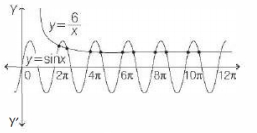
View full question & answer→MCQ 791 Mark
If $\alpha,-\frac{\pi}{2}<\alpha<\frac{\pi}{2}$ is the solution of $4 \cos \theta+5 \sin \theta=1$, then the value of $\tan \alpha$ is
AnswerCorrect option: C. $\frac{\sqrt{10}-10}{12}$
c
$4+5 \tan \theta=\sec \theta$
Squaring : $24 \tan ^2 \theta+40 \tan \theta+15=0$
$\tan \theta=\frac{-10 \pm \sqrt{10}}{12}$
and $\tan \theta=-\left(\frac{10+\sqrt{10}}{12}\right)$ is Rejected.
$(3)$ is correct.
View full question & answer→MCQ 801 Mark
The number of solutions of the equation $4 \sin ^2 x-4$ $\cos ^3 \mathrm{x}+9-4 \cos \mathrm{x}=0 ; \mathrm{x} \in[-2 \pi, 2 \pi]$ is :
Answerd
$ 4 \sin ^2 x-4 \cos ^3 x+9-4 \cos x=0 ; x \in[-2 \pi, 2 \pi] $
$ 4-4 \cos ^2 x-4 \cos ^3 x+9-4 \cos x=0 $
$ 4 \cos ^3 x+4 \cos ^2 x+4 \cos x-13=0 $
$ 4 \cos ^3 x+4 \cos ^2 x+4 \cos x=13 $
$ \text { L.H.S. } \leq 12 \text { can't be equal to } 13 .$
View full question & answer→MCQ 811 Mark
Let $S=\{\theta \in[0,2 \pi): \tan (\pi \cos \theta)+\tan (\pi \sin \theta)=0\}$.
Then $\sum_{\theta \in S } \sin ^2\left(\theta+\frac{\pi}{4}\right)$ is equal to
Answerd
$\tan (\pi \cos \theta)+\tan (\pi \sin \theta)=0$
$\tan (\pi \cos \theta)=-\tan (\pi \sin \theta)$
$\tan (\pi \cos \theta)=\tan (-\pi \sin \theta)$
$\pi \cos \theta=n \pi-\pi \sin \theta$
$\sin \theta+\cos \theta= n \text { where } n \in I$
possible values are $n =0,1$ and $-1$ because
$-\sqrt{2} \leq \sin \theta+\cos \theta \leq \sqrt{2}$
Now it gives $\theta \in\left\{0, \frac{\pi}{2}, \frac{3 \pi}{4}, \frac{7 \pi}{4}, \frac{3 \pi}{2}, \pi\right\}$
So $\sum_{\theta \in S} \sin ^2\left(\theta+\frac{\pi}{4}\right)=2(0)+4\left(\frac{1}{2}\right)=2$
View full question & answer→MCQ 821 Mark
If $m$ and $n$ respectively are the numbers of positive and negative value of $\theta$ in the interval $[-\pi, \pi]$ that satisfy the equation $\cos 2 \theta \cos \frac{\theta}{2}=\cos 3 \theta \cos \frac{9 \theta}{2}$, then $mn$ is equal to $.............$.
Answera
$\cos 2 \theta \cdot \cos \frac{\theta}{2}=\cos 3 \theta \cdot \cos \frac{9 \theta}{2}$
$\Rightarrow 2 \cos 2 \theta \cdot \cos \frac{\theta}{2}=2 \cos \frac{9 \theta}{2} \cdot \cos 3 \theta$
$\Rightarrow \cos \frac{5 \theta}{2}+\cos \frac{3 \theta}{2}=\cos \frac{15 \theta}{2}+\cos \frac{3 \theta}{2}$
$\Rightarrow \cos \frac{15 \theta}{2}=\cos \frac{5 \theta}{2}$
$\Rightarrow \frac{15 \theta}{2}=2 k \pi \pm \frac{5 \theta}{2}$
$5 \theta=2 k \pi \text { or } 10 \theta=2 k \pi$
$\theta=\frac{2 k \pi}{5}$
$\therefore \theta=\left\{-\pi, \frac{-4 \pi}{5}, \frac{-3 \pi}{5}, \frac{-2 \pi}{5}, \frac{-\pi}{5}, 0, \frac{\pi}{5}, \frac{2 \pi}{5}, \frac{3 \pi}{5}, \frac{4 \pi}{5}, \pi\right\}$
$m =5, n =5$
$\therefore m n=25$
View full question & answer→MCQ 831 Mark
The set of all values of $\lambda$ for which the equation $\cos ^2 2 x-2 \sin ^4 x-2 \cos ^2 x=\lambda$
- A
$[-2,-1]$
- B
$\left[-2,-\frac{3}{2}\right]$
- C
$\left[-1,-\frac{1}{2}\right]$
- ✓
$\left[-\frac{3}{2},-1\right]$
AnswerCorrect option: D. $\left[-\frac{3}{2},-1\right]$
d
$\lambda=\cos ^2 2 x-2 \sin ^4 x-2 \cos ^2 x$
$\text { convert all in to } \cos x \text {. }$
$\lambda=\left(2 \cos ^2 x-1\right)^2-2\left(1-\cos ^2 x\right)^2-2 \cos ^2 x$
$=4 \cos ^4 x-4 \cos ^2 x+1-2\left(1-2 \cos ^2 x+\cos ^4 x\right)-$
$2 \cos ^2 x$
$=2 \cos ^4 x-2 \cos ^2 x+1-2$
$=2 \cos ^4 x-2 \cos ^2 x-1$
$=2\left[\cos ^4 x-\cos ^2 x-\frac{1}{2}\right]$
$=2\left[\left(\cos ^2 x-\frac{1}{2}\right)^2-\frac{3}{4}\right]$
$\left.\lambda_{\max }=2\left[\frac{1}{4}-\frac{3}{4}\right]=2 \times\left(-\frac{2}{4}\right)=-1 \text { (max Value }\right)$
$\left.\lambda_{\min }=2\left[0-\frac{3}{4}\right]=-\frac{3}{2} \text { (MinimumValue }\right)$
$\text { So, Range }=\left[-\frac{3}{2},-1\right]$
View full question & answer→MCQ 841 Mark
If the solution of the equation $\log _{\cos x} \cot x+4 \log _{\sin x} \tan x=1, x \in\left(0, \frac{\pi}{2}\right), \quad$ is $\sin ^{-1}\left(\frac{\alpha+\sqrt{\beta}}{2}\right)$, where $\alpha, \beta$ are integers, then $\alpha+\beta$ is equal to:
Answerd
$\log _{\cos x} \cot x+4 \log _{\sin x} \tan x=1$
$\Rightarrow \frac{\ln \cos x-\ln \sin x}{\ln \cos x}+4 \frac{\ln \sin x-\ln \cos x}{\ln \sin x}=1$
$\Rightarrow(\ln \sin x)^2-4(\ln \sin x)(\ln \cos x)+4(\ln \cos x)^2=1$
$\Rightarrow \ln \sin x=2 \ln \cos x$
$\Rightarrow \sin ^2 x+\sin x-1=0 \Rightarrow \sin x=\frac{-1+\sqrt{5}}{2}$
$\therefore \alpha+\beta=4$
View full question & answer→MCQ 851 Mark
The number of elements in the set $S =\left\{\theta \in[0,2 \pi]: 3 \cos ^4 \theta-5 \cos ^2 \theta-2 \sin ^2 \theta+2=0\right\}$ is $...........$.
Answerc
Sol. $3 \cos ^4 \theta-5 \cos ^2 \theta-2 \sin ^6 \theta+2=0$
$\Rightarrow \quad 3 \cos ^4 \theta-3 \cos ^2 \theta-2 \cos ^2 \theta-2 \sin ^6 \theta+2=0$
$\Rightarrow \quad 3 \cos ^4 \theta-3 \cos ^2 \theta+2 \sin ^2 \theta-2 \sin ^6 \theta=0$
$\Rightarrow \quad 3 \cos ^2 \theta\left(\cos ^2 \theta-1\right)+2 \sin ^2 \theta\left(\sin ^4 \theta-1\right)=0$
$\Rightarrow \quad-3 \cos ^2 \theta \sin ^2 \theta+2 \sin ^2 \theta\left(1+\sin ^2 \theta\right) \cos ^2 \theta-1$
$\Rightarrow \quad \sin ^2 \theta \cos ^2 \theta\left(2+2 \sin ^2 \theta-3\right)=0$
$\Rightarrow \quad \sin ^2 \theta \cos ^2 \theta\left(2 \sin ^2 \theta-1\right)=0$
$(C1)$ $\sin ^2 \theta=0 \rightarrow 3$ solution ; $\theta=\{0, \pi, 2 \pi\}$
$(C2)$ $\cos ^2 \theta=0 \rightarrow 2$ solution $; \theta=\left\{\frac{\pi}{2}, \frac{3 \pi}{2}\right\}$
(C) $\sin ^2 \theta=\frac{1}{2} \rightarrow 4$ solution; $\theta=\left\{\frac{\pi}{4}, \frac{3 \pi}{4}, \frac{5 \pi}{4}, \frac{7 \pi}{4}\right\}$
No. of solution $=9$
View full question & answer→MCQ 861 Mark
Let $S=\left\{x \in\left(-\frac{\pi}{2}, \frac{\pi}{2}\right): 9^{1-\tan ^2 x}+9^{\tan ^2 x}=10\right\}$ and $\beta=\sum_{x \in S} \tan ^2\left(\frac{x}{3}\right)$, then $\frac{1}{6}(\beta-14)^2$ is equal to
Answera
Let $9^{\tan ^2 x}= P$
$\frac{9}{ P }+ P =10$
$P^2-10 P+9=0$
$(P-9)(P-1)=0$
$P=1,9$
$9^{\tan ^2 x}=1,9^{\tan ^2 x}=9$
$\tan ^2 x =0, \tan ^2 x =1$
$x =0, \pm \frac{\pi}{4} \quad \therefore x \in\left(-\frac{\pi}{2}, \frac{ p }{2}\right)$
$\beta=\tan ^2(0)+\tan ^2\left(+\frac{\pi}{12}\right)+\tan ^2\left(-\frac{\pi}{12}\right)$
$=0+2\left(\tan 15^{\circ}\right)^2$
$2(2-\sqrt{3})^2$
$2(7-4 \sqrt{3})$
Than $\frac{1}{6}(14-8 \sqrt{3}-14)^2=32$
View full question & answer→MCQ 871 Mark
$\alpha=\sin 36^{\circ}$ is a root of which of the following equation
- A
$10 x^{4}-10 x^{2}-5=0$
- B
$16 x^{4}+20 x^{2}-5=0$
- ✓
$16 x^{4}-20 x^{2}+5=0$
- D
$16 x^{4}-10 x^{2}+5=0$
AnswerCorrect option: C. $16 x^{4}-20 x^{2}+5=0$
c
$\cos 72^{\circ}=\frac{\sqrt{5}-1}{4}$
$\Rightarrow 1-2 \sin ^{2} 36^{\circ}=\frac{\sqrt{5}-1}{4}$
$\Rightarrow 4-8 \alpha^{2}=\sqrt{5}-1$4
$\Rightarrow 5-8 \alpha^{2}=\sqrt{5}$
$\Rightarrow\left(5-8 \alpha^{2}\right)^{2}=5$
$\Rightarrow 25+64 \alpha^{4}-80 \alpha^{2}=5$
$\Rightarrow 64 \alpha^{4}-80 \alpha^{2}+20=0$
$\Rightarrow 16 \alpha^{4}-20 \alpha^{2}+5=0$
View full question & answer→MCQ 881 Mark
The number of solutions of the equation $\sin x=$ $\cos ^{2} x$ in the interval $(0,10)$ is
Answerb
$\sin ^{2} x+\sin x-1=0$
$\sin x=\frac{-1+\sqrt{5}}{2}=+v e$
Only $4$ roots
View full question & answer→MCQ 891 Mark
The number of solutions of $|\cos x|=\sin x$, such that $-4 \pi \leq x \leq 4 \pi$ is.
Answerc
$2$ solutions in $(0,2 \pi)$
So, $8$ solutions in $[-4 \pi, 4 \pi]$
View full question & answer→MCQ 901 Mark
The number of elements in the set $S=\left\{x \in R : 2 \cos \left(\frac{x^{2}+x}{6}\right)=4^{x}+4^{-x}\right\}$ is$.....$
Answera
$2 \cos \left(\frac{x^{2}+x}{6}\right)=4^{x}+4^{-x}$
L.H.S $\leq 2 . \&$ R.H.S. $\geq 2$
Hence L.H.S $=2$ \& R.H.S $=2$
$2 \cos \left(\frac{x^{2}+x}{6}\right)=2 \quad 4^{x}+4^{-x}=2$
Check $x=0$ Possible hence only one solution.
View full question & answer→MCQ 911 Mark
The number of solutions of the equation $\cos \left(x+\frac{\pi}{3}\right) \cos \left(\frac{\pi}{3}-x\right)=\frac{1}{4} \cos ^{2} 2 x, x \in[-3 \pi$ $3 \pi]$ is
Answerd
$\cos \left(\frac{\pi}{3}+x\right) \cos \left(\frac{\pi}{3}-x\right)=\frac{1}{4} \cos ^{2} 2 x$
$x \in[-3 \pi, 3 \pi]$
$4\left(\cos ^{2}\left(\frac{\pi}{3}\right)-\sin ^{2} x\right)=\cos ^{2} 2 x$
$4\left(\frac{1}{4}-\sin ^{2} x\right)=\cos ^{2} 2 x$
$1-4 \sin ^{2} x=\cos ^{2} 2 x$
$1-2(1-\cos 2 x)=\cos ^{2} 2 x$
let $\cos 2 x = t$
$-1+2 \cos 2 x=\cos ^{2} 2 x$
$t ^{2}-2 t +1=0$
$( t -1)^{2}=0$
$t =1 \quad \cos 2 x =1$
$2 x =2 n \pi$
$x = n \pi$
$n =-3,-2,-1,0,1,2,3$
View full question & answer→MCQ 921 Mark
Let $S=\left\{\theta \in[-\pi, \pi]-\left\{\pm \frac{\pi}{2}\right\}: \sin \theta \tan \theta+\tan \theta=\sin 2 \theta\right\} \text {. }$ If $T =\sum_{\theta \in S } \cos 2 \theta$, then $T + n ( S )$ is equal
- A
$7+\sqrt{3}$
- ✓
$9$
- C
$8+\sqrt{3}$
- D
$10$
Answerb
$\sin \theta \tan \theta+\tan \theta=\sin 2 \theta$
$\tan \theta(\sin \theta+1)=\frac{2 \tan \theta}{1+\tan ^{2} \theta}$
$\tan \theta=0 \Rightarrow \theta=-\pi, 0, \pi$
$(\sin \theta+1)=2 \cdot \cos ^{2} \theta=2(1+\sin \theta)(1-\sin \theta)$
$\sin \theta=-1$ which is not possible
$\sin \theta=\frac{1}{2} \quad \theta=\frac{\pi}{6}, \frac{5 \pi}{6}$
$n ( s )=5$
$T =\cos 0+\cos 2 \pi+\cos 2 \pi+\cos \frac{\pi}{3}+\cos \frac{5 \pi}{3}$
$T =4$
$T + n ( s )=9$
View full question & answer→MCQ 931 Mark
The number of values of $x$ in the interval $\left(\frac{\pi}{4}, \frac{7 \pi}{4}\right)$ for which $14 \operatorname{cosec}^{2} x-2 \sin ^{2} x=21$ $-4 \cos ^{2} x$ holds, is
Answerd
$x \in\left(\frac{\pi}{4}, \frac{7 \pi}{4}\right)$
$14 \operatorname{cosec}^{2} x-2 \sin ^{2} x=21-4 \cos ^{2} x$
$=21-4\left(1-\sin ^{2} x\right)$
$=17+4 \sin ^{2} x$
$14 \operatorname{cosec} x-6 \sin ^{2} x=17$
let $\sin ^{2} x=p$
$\frac{14}{p}-6 p=17 \Rightarrow 14-6 p^{2}=17 p$
$6 p^{2}+17 p-14=0$
$p=-3.5, \frac{2}{3} \Rightarrow \sin ^{2} x=\frac{2}{3}$
$\Rightarrow \sin x=\pm \sqrt{\frac{2}{3}}$
$\therefore$ Total $4$ solutions
View full question & answer→MCQ 941 Mark
The number of elements in the set $S=$ $\left\{\theta \in[-4 \pi, 4 \pi]: 3 \cos ^{2} 2 \theta+6 \cos 2 \theta-\right.$ $\left.10 \cos ^{2} \theta+5=0\right\}$ is
Answera
$3 \cos ^{2} 2 \theta+6 \cos 2 \theta-10 \cos ^{2} \theta+5=0$
$3 \cos ^{2} 2 \theta+6 \cos 2 \theta-5(1+\cos 2 \theta)+5=0$
$3 \cos ^{2} 2 \theta+\cos 2 \theta=0$
$\operatorname{Cos} 2 \theta=0$ OR $\cos 2 \theta=-1 / 3$
$\theta \in[-4 \pi, 4 \pi]$
$2 \theta=(2 n +1) \cdot \frac{\pi}{2}$
$\therefore \quad \theta=\pm \pi / 4 . \pm 3 \pi / 4 \ldots \ldots \pm 15 \pi / 4$
Similarly $\cos 2 \theta=-1 / 3$ gives $16$ solution
View full question & answer→MCQ 951 Mark
The number of solutions of the equation $2 \theta-\cos ^{2} \theta+\sqrt{2}=0$ is $R$ is equal to
Answera
$2 \theta-\cos ^{2} \theta+\sqrt{2}=0$
$\Rightarrow \cos ^{2} \theta=2 \theta+\sqrt{2}$
$y=2 \theta+\sqrt{2}$
Both graphs intersect at one point.
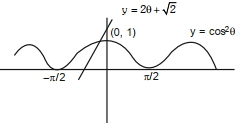
View full question & answer→MCQ 961 Mark
If the sum of solutions of the system of equations $2 \sin ^{2} \theta-\cos 2 \theta=0$ and $2 \cos ^{2} \theta+3 \sin \theta=0$ in the interval $[0,2 \pi]$ is $k \pi$, then $k$ is equal to.
Answera
$2 \sin ^{2} \theta-\cos 2 \theta=0$
$2 \sin ^{2} \theta-\left(1-2 \sin ^{2} \theta\right)=0$
$\sin ^{2} \theta=\left(\frac{1}{2}\right)^{2}$
$\theta=\frac{\pi}{6}, \frac{5 \pi}{6}, \frac{7 \pi}{6}, \frac{11 \pi}{6}$
$2 \cos ^{2} \theta+3 \sin \theta=0$
$2 \sin ^{2} \theta-3 \sin \theta-2=0$
$\therefore \sin \theta=-\frac{1}{2}$
$\theta=\frac{7 \pi}{6}, \frac{11 \pi}{6}$
So, the common solution is
$\theta=\frac{7 \pi}{6}, \frac{11 \pi}{6}$
$\text { Sum }=\frac{7 \pi+11 \pi}{6}=3 \pi= k \pi$
$K =3$
View full question & answer→MCQ 971 Mark
Let,$S=\left\{\theta \in[0,2 \pi]: 8^{2 \sin ^{2} \theta}+8^{2 \cos ^{2} \theta}=16\right\}$. Then $n ( S )+\sum_{\theta \in S}\left(\sec \left(\frac{\pi}{4}+2 \theta\right) \operatorname{cosec}\left(\frac{\pi}{4}+2 \theta\right)\right)$ is equal to.
Answerc
$8^{2 \sin ^{2} \theta}+8^{2-2 \sin ^{2} \theta}=16$
$y+\frac{64}{y}=16$
$\Rightarrow y =8$
$\Rightarrow \sin ^{2} \theta=1 / 2$
$n ( S )+\sum_{\theta \in S} \frac{1}{\cos (\pi / 4+2 \theta) \sin (\pi / 4+2 \theta)}$
$=4+(-2) \times 4=-4$
View full question & answer→MCQ 981 Mark
Let $S={\theta \in\left(0, \frac{\pi}{2}\right): \sum_{m=1}^{9}}$
$\sec \left(\theta+(m-1) \frac{\pi}{6}\right) \sec \left(\theta+\frac{m \pi}{6}\right)=-\frac{8}{\sqrt{3}}$ Then.
- A
$S =\left\{\frac{\pi}{12}\right\}$
- B
$S =\left\{\frac{2 \pi}{3}\right\}$
- ✓
$\sum_{\theta \in S} \theta=\frac{\pi}{2}$
- D
$\sum_{\theta \in S} \theta=\frac{3 \pi}{4}$
AnswerCorrect option: C. $\sum_{\theta \in S} \theta=\frac{\pi}{2}$
c
Let $\alpha=\theta+(m-1) \frac{\pi}{6}$
$\beta=\theta+m \frac{\pi}{6}$
So, $\beta-\alpha=\frac{\pi}{6}$
Here,$\sum_{m=1}^{9} \sec \alpha \cdot \sec \beta=\sum_{m=1}^{9} \frac{1}{\cos \alpha \cdot \cos \beta}$
$= 2 \sum_{m=1}^{9} \frac{\sin (\beta-\alpha)}{\cos \alpha \cdot \cos \beta}=2 \sum_{m=1}^{9}(\tan \beta-\tan \alpha)$
$= 2 \sum_{m=1}^{9}\left(\tan \left(\theta+m \frac{\pi}{6}\right)-\tan \left(\theta+(m-1) \frac{\pi}{6}\right)\right)$
$=2\left(\tan \left(\theta+\frac{9 \pi}{6}\right)-\tan \theta\right)=2(-\cot \theta-\tan \theta)=-\frac{8}{\sqrt{3}}$
(Given)
$\therefore \quad \tan \theta+\cot \theta=\frac{4}{\sqrt{3}}$
$\tan \theta=\frac{1}{\sqrt{3}}$ or $\sqrt{3}$
So, $S=\left\{\frac{\pi}{6}, \frac{\pi}{3}\right\}$
$\sum_{\theta \in S} \theta=\frac{\pi}{6}+\frac{\pi}{3}=\frac{\pi}{2}$
View full question & answer→MCQ 991 Mark
Let $S=\left[-\pi, \frac{\pi}{2}\right)-\left\{-\frac{\pi}{2},-\frac{\pi}{4},-\frac{3 \pi}{4}, \frac{\pi}{4}\right\}$. Then the number of elements in the set $=\{\theta \in S : \tan \theta(1+\sqrt{5} \tan (2 \theta))=\sqrt{5}-\tan (2 \theta)\}$ is $...$
Answerb
$\tan \theta+\sqrt{5} \tan 2 \theta \tan \theta=\sqrt{5}-\tan 2 \theta$ $\tan 3 \theta=\sqrt{5}$
$\theta=\frac{ n \pi}{3}+\frac{\alpha}{3} ; \quad \tan \alpha=\sqrt{5}$
Five solution
View full question & answer→MCQ 1001 Mark
Let $S=\left\{\theta \in(0,2 \pi): 7 \cos ^{2} \theta-3 \sin ^{2} \theta-2\right.$ $\left.\cos ^{2} 2 \theta=2\right\}$. Then, the sum of roots of all the equations $x ^{2}-2\left(\tan ^{2} \theta+\cot ^{2} \theta\right) x +6 \sin ^{2} \theta=0$ $\theta \in S$, is$...$
Answerd
$7 \cos ^{2} \theta-3 \sin ^{2} \theta-2 \cos ^{2} 2 \theta=2$
$4 \cos ^{2} \theta+3 \cos 2 \theta-2 \cos ^{2} 2 \theta=2$
$2(1+\cos 2 \theta)+3 \cos 2 \theta-2 \cos ^{2} 2 \theta=2$
$2 \cos ^{2} 2 \theta-5 \cos 2 \theta=0$
$\cos 2 \theta(2 \cos 2 \theta-5)=0$
$\cos 2 \theta=0$
$2 \theta=(2 n+1) \frac{\pi}{2}$
$\theta=(2 n+1) \frac{\pi}{4}$
$S=\left\{\frac{\pi}{4}, \frac{3 \pi}{4}, \frac{5 \pi}{4}, \frac{7 \pi}{4}\right\}$
For all four values of $\theta$
$X^{2}-2\left(\tan ^{2} \theta+\cot ^{2} \theta\right) x+6 \sin ^{2} \theta=0$
$x^{2}-4 x+3=0$
Sum of roots of all four equations $=4 \times 4=16$.
View full question & answer→