- ✓$1$
- B$2$
- C$3$
- D$4$
$\sqrt{3}(\cos x)^{2}-\sqrt{3} \cos x+\cos x-1=0$
$\Rightarrow(\sqrt{3} \cos x+1)(\cos x-1)=0$
$\Rightarrow \cos x=1$ or $\cos x=-\frac{1}{\sqrt{3}}$ (reject)
$\Rightarrow x=0$ only
$\Rightarrow(\sqrt{3} \cos x+1)(\cos x-1)=0$
$\Rightarrow \cos x=1$ or $\cos x=-\frac{1}{\sqrt{3}}$ (reject)
$\Rightarrow x=0$ only
$\Rightarrow \frac{\cos ^{2} x / 2-\sin ^{2} x / 2}{(\cos x / 2+\sin x / 2)}=|\tan 2 x|$
$\Rightarrow \tan ^{2}\left(\frac{\pi}{4}-\frac{x}{2}\right)=\tan ^{2} 2 x$
$\Rightarrow 2 x=n \pi \pm\left(\frac{\pi}{4}-\frac{x}{2}\right)$
$\Rightarrow x=\frac{-3 \pi}{10}, \frac{-\pi}{6}, \frac{\pi}{10}$
$\text { or sum }=\frac{-11 \pi}{30}$
Now check by options, put $x = \frac{\pi }{6}$
then ${(81)^{{{\sin }^2}\pi /6}} + {(81)^{{{\cos }^2}\pi /6}} = 30$
==> ${(81)^{1/4}} + {(81)^{3/4}} = 30$
Hence $(a)$ is the correct answer.
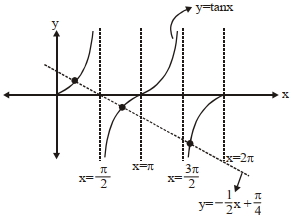
If $\operatorname{cotx}<0 \Rightarrow 2 \cot x+\frac{1}{\sin x}=0$
$\Rightarrow 2 \cos x=-1$
$\Rightarrow x =\frac{2 \pi}{3}$ or $\frac{4 \pi}{3}( reject )$
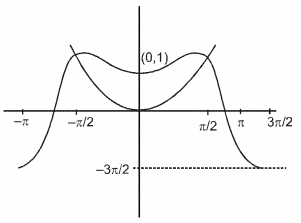
$\Rightarrow 2 \tan x=\frac{\pi}{2}-x$
$\Rightarrow \tan x=-\frac{1}{2} x+\frac{\pi}{4}$
Number of soluitons of the given eauation is $'3'.$
$=2^{\cot ^{2} \theta}$
Now $t^{2}-9 t+9=0 \Rightarrow t=1,8$
$\Rightarrow \quad 2^{\cot ^{2} \theta}=1,8 \Rightarrow \cot ^{2} \theta=0,3$
$0<\theta<\frac{\pi}{2} \Rightarrow \cot \theta=\sqrt{3}$
$\Rightarrow \quad \frac{2 \sin \theta}{\sin \theta+\sqrt{3} \sin \theta}=\frac{2}{1+\sqrt{3} \cot \theta}=\frac{2}{4}=\frac{1}{2}$
$\Rightarrow \sin 2 \theta+\frac{\sin 2 \theta}{\cos 2 \theta}>0$
$\Rightarrow \sin 2 \theta \frac{(\cos 2 \theta+1)}{\cos 2 \theta}>0 \Rightarrow \tan 2 \theta\left(2 \cos ^{2} \theta\right)>0$
Note : $\cos 2 \theta \neq 0$
$\Rightarrow 1-2 \sin ^{2} \theta \neq 0 \Rightarrow \sin \theta \neq \pm \frac{1}{\sqrt{2}}$
Now, $\tan 2 \theta(1+\cos 2 \theta)>0$
$\Rightarrow \tan 2 \theta>0 \quad($ as $\cos 2 \theta+1>0)$
$\Rightarrow 2 \theta \in\left(0, \frac{\pi}{2}\right) \cup\left(\pi, \frac{3 \pi}{2}\right) \cup\left(2 \pi, \frac{5 \pi}{2}\right) \cup\left(3 \pi, \frac{7 \pi}{2}\right)$
$\Rightarrow \theta \in\left(0, \frac{\pi}{4}\right) \cup\left(\frac{\pi}{2}, \frac{3 \pi}{4}\right) \cup\left(\pi, \frac{5 \pi}{4}\right) \cup\left(\frac{3 \pi}{2}, \frac{7 \pi}{4}\right)$
As $\sin \theta \neq \pm \frac{1}{\sqrt{2}} ;$ which has been already considered
$\sin ^{4} \theta+\cos ^{4} \theta-\sin \theta \cos \theta=0$
$\Rightarrow 1-\sin ^{2} \theta \cos ^{2} \theta-\sin \theta \cos \theta=0$
$\Rightarrow 2-(\sin 2 \theta)^{2}-\sin 2 \theta=0$
$\Rightarrow(\sin 2 \theta)^{2}+(\sin 2 \theta)-2=0$
$\Rightarrow(\sin 2 \theta+2)(\sin 2 \theta-1)=0$
$\Rightarrow \sin 2 \theta=1 \text { or } \sin 2 \theta=-2$ $\rightarrow$ not possible
$\Rightarrow \quad 2 \theta=\frac{\pi}{2}, \frac{5 \pi}{2}, \frac{9 \pi}{2}, \frac{13 \pi}{2}$
$\Rightarrow \quad \theta=\frac{\pi}{4}, \frac{5 \pi}{4}, \frac{9 \pi}{4}, \frac{13 \pi}{4}$
$\Rightarrow \frac{8 S}{\pi}=\frac{8 \times 7 \pi}{\pi}=56.00$
$\Rightarrow(32)^{\tan ^{2} x}+(32)^{1+\tan ^{2} x}=81$
$\Rightarrow(32)^{\tan ^{2} x}=\frac{81}{33}$
In interval $\left[0, \frac{\pi}{4}\right]$ only one solution
$2 \cos x\left(4 \sin \left(\frac{\pi}{4}+x\right) \sin \left(\frac{\pi}{4}-x\right)-1\right)=1, x \in[0, \pi]$
and $S$ is the sum of all these solutions, then the ordered pair $(\mathrm{n}, \mathrm{S})$ is :
$2 \cos x\left(4\left(\sin ^{2} \frac{\pi}{4}-\sin ^{2} x\right)-1\right)=1$
$2 \cos x\left(4\left(\frac{1}{2}-\sin ^{2} x\right)-1\right)=1$
$2 \cos x\left(2-4 \sin ^{2} x-1\right)=1$
$2 \cos x\left(1-4 \sin ^{2} x\right)=1$
$2 \cos x\left(4 \cos ^{2} x-3\right)=1$
$4 \cos ^{3} x-3 \cos x=\frac{1}{2}$
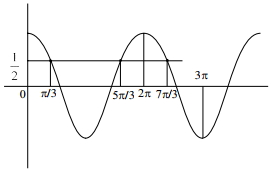
$\cos 3 x=\frac{1}{2}$
$\mathrm{x} \in[0, \pi] \therefore 3 \mathrm{x} \in[0,3 \pi]$
$\text { and } \cos ^{7} x \leq \cos ^{2} x \leq 1....(2)$
$\text { also } \sin ^{2} x+\cos ^{2} x=1$
$\Rightarrow \text { equality must hold for }(1) \,\,(2)$
$\Rightarrow \sin ^{7} x=\sin ^{2} x \,\, \cos ^{7}=\cos ^{2} x$
$\Rightarrow \sin x=0\, \, \cos x=1 \text { or }$
$\cos x=0\, \,\sin x=1$
$\Rightarrow x=0,2 \pi, 4 \pi, \frac{\pi}{2}, \frac{5 \pi}{2}$
$\Rightarrow 5 \text { solutions }$
$\Rightarrow 2 \sin \frac{5 x}{2}\left\{\cos \frac{3 x}{2}+\cos \frac{x}{2}\right\}=0$
$\Rightarrow 2 \sin \frac{5 x}{2}\left\{2 \cos x \cos \frac{x}{2}\right\}=0$
$2 \sin \frac{5 x}{2}=0 \Rightarrow \frac{5 x}{2}=0, p, 2 \pi, 3 \pi, 4 \pi, 5 \pi$
$\Rightarrow x=0, \frac{2 \pi}{5}, \frac{4 \pi}{5}, \frac{6 \pi}{5}, \frac{8 \pi}{5}, 2 \pi$
$\cos \frac{x}{2}=0 \Rightarrow \frac{x}{2}=\frac{x}{2} \Rightarrow x=\pi$
$\cos x=0 \Rightarrow x=\frac{\pi}{2}, \frac{3 \pi}{2}$
So cum $=6 \pi+\pi+2 \pi=9 \pi$
$\lambda=-\left(\sin ^{2} \theta+\cos ^{2} \theta\right)^{2}-2 \sin ^{2} \theta \cos ^{2} \theta$
$\lambda=\frac{\sin ^{2} 2 \theta}{2}-1$
$\lambda \in\left[-1,-\frac{1}{2}\right]$
$\frac{\sin ^{2} 2 \theta}{2} \in\left[0, \frac{1}{2}\right]$
$\left(\because \sin ^{2} \theta=\frac{1-\cos 2 \theta}{2}\right)$
$\Rightarrow L =\left(\frac{1-\cos (\pi / 8)}{2}\right)-\left(\frac{1-\cos (\pi / 4)}{2}\right)$
$L =\frac{1}{2}\left[\cos \left(\frac{\pi}{4}\right)-\cos \left(\frac{\pi}{8}\right)\right]$
$L =\frac{1}{2 \sqrt{2}}-\frac{1}{2} \cos \left(\frac{\pi}{8}\right)$
$M =\cos ^{2}\left(\frac{\pi}{16}\right)-\sin ^{2}\left(\frac{\pi}{8}\right)$
$M =\frac{1+\cos (\pi / 8)}{2}-\frac{1-\cos (\pi / 4)}{2}$
$M =\frac{1}{2} \cos \left(\frac{\pi}{8}\right)+\frac{1}{2 \sqrt{2}}$
$\Rightarrow \quad \log _{1 / 2}|\sin x|+\log _{1 / 2}|\cos x|=2$
$\Rightarrow \log _{1 / 2}(|\sin x \cos x|)=2$
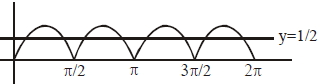
$\Rightarrow \quad|\sin x \cos x|=\frac{1}{4} \quad \Rightarrow|\sin 2 x|=\frac{1}{2}$
$=8$ Solutions
$ \Rightarrow \,(\sin \,x + \,\sin \,3x)\, - \,\sin \,2x\, = \,0$
$ \Rightarrow \,2\,\sin x.\,\cos \,x\, - \,\sin \,2x\, = \,0$
$ \Rightarrow \,\sin \,2x\,(2\cos x\, - \,1)\, = \,0$
$ \Rightarrow \,\sin \,2x\, = \,0$ or $\cos \,x\, = \frac{1}{2}\,\, \Rightarrow \,x\, = 0\,,\,\frac{\pi }{3}$
$\frac{\sin ^{4} \alpha+4 \cos ^{4} \beta+1+1}{4} \geq\left(\sin ^{4} \alpha \cdot 4 \cos ^{4} \beta .1 .1\right)^{\frac{1}{4}}$
$\sin ^{4} \alpha+4 \cos ^{2} \beta+$ $2 \geq 4 \sqrt{2} \sin \alpha \cos \beta$ given that $\sin ^{4} \alpha+4 \cos ^{4} \beta+2$ $=4 \sqrt{2} \sin \alpha \cos \beta$
$\Rightarrow \mathrm{AM}=\mathrm{GM} \Rightarrow \sin ^{4} \alpha=1=4 \cos ^{4} \beta$
$\sin \alpha=\pm 1, \cos \beta=\pm \frac{1}{\sqrt{2}},$ As $\alpha, \beta \in[0, \pi]$
$\Rightarrow \sin \alpha=1, \cos \beta=\pm \frac{1}{\sqrt{2}}$
$\Rightarrow \sin \beta=\frac{1}{\sqrt{2}}$ as $\beta \in[0, \pi]$
$\cos (\alpha+\beta)-\cos (\alpha-\beta)=-2 \sin \alpha \sin \beta$
$=-\sqrt{2}$
$ \Rightarrow {\kern 1pt} 2\,{\sin ^2}\theta \, - \,3\sin \,\theta \, - \,2\, = \,0$
$ \Rightarrow (2\,\sin \theta + 1)(\sin \theta - 2) = 0$
$ \Rightarrow \sin \theta \, = \, - \frac{1}{2};\,\,\,\sin \theta = 2$ (reject)
roots : $\pi \, + \,\frac{\pi }{6}\,,\,2\pi - \frac{\pi }{6},\, - \frac{\pi }{6},\, - \pi + \frac{\pi }{6}$
$\Rightarrow $ Sum off values $=\,2\pi $
$ \Rightarrow \,{2^{\sqrt {{{(\sin \,x - 1)}^2} + 4} }}\, \leqslant {4^{{{\sin }^2}y}}$
$\sqrt {\frac{{\underbrace {{{(\sin \,x - 1)}^2}}_{ \geqslant 0} + 4}}{{ \geqslant 2}}} \leqslant \underbrace {2\,{{\sin }^2}\,y}_{ \leqslant 2}$
this is possible only if $\sin x=1$ and $|\sin y|=1$
$\sin \,x\, = \,0$ and $\cos \,3x\, = 1$
$0,\,\,2\pi ,\, - \,2\pi ,\, - \,\pi ,\pi $
$\Rightarrow 4 \cos x\left\{2 \cos \left(\frac{\pi}{6}+x\right) \cos \left(\frac{\pi}{6}-x\right)-1\right\}=1$
$\Rightarrow 4 \cos x\left\{\cos 2 x+\cos \frac{\pi}{3}-1\right\}=1$
$\Rightarrow 4 \cos x\left\{\cos 2 x-\frac{1}{2}\right\}=1$
$\Rightarrow 4 \cos x\left\{2 \cos ^{2} x-1-\frac{1}{2}\right\}=1$
$\Rightarrow 8 \cos ^{3} x-6 \cos x=1$
$\Rightarrow 2\left(4 \cos ^{3} x-3 \cos x\right)=1$
$ \cos 3 x=\frac{1}{2}$
$\cos 3x = \cos {60^\circ },\cos {30^\circ },\cos {420^\circ }$
$x{\text{ }} = {20^\circ },{100^\circ },{140^\circ }$
${20^\circ } + {100^\circ } + {140^\circ }{\text{ }} = k\pi $
$ \Rightarrow {260^\circ } = k\left( {{{180}^\circ }} \right)$
$ \Rightarrow k = \frac{{{{260}^\circ }}}{{{{180}^\circ }}} = \frac{{13}}{9}$
$ \Rightarrow {\kern 1pt} \sin \,3x\, = \,\sin \,(\pi /2 - 2x)$
We now that $\sin A = \sin B$
$ \Rightarrow \,A\, = \,n\pi + {( - )^n}B,$ where $n$ is an integer
Using the above identity , we get
$3x = n\pi \, + \,{( - 1)^n}(\pi /2 - 2x)$
$n = 1,\,\,x = \pi - \pi /2\, \Rightarrow \,x\, = \,\pi /2 \notin \,(\pi /2,\pi )$
$n = 2,\,\,x = \pi /2\, \notin \,\,(\pi /2,\pi )$
$n = 3,\,\,x = 5\pi /2\, \notin \,\,(\pi /2,\pi )$
$n = 4,\,\,x = 9\pi /10\, \notin \,\,(\pi /2,\pi )$
$n = 5,\,\,x = 9\pi /2 = \pi \, \notin \,\,(\pi /2,\pi )$
Now, for all negative integers $x$ would be negative.
For all value of $n > 5$ , solution $> \pi $
Hence the only possible solution is for $n=4$
and $x=9\pi /10$.
$\Rightarrow 0(0-\cos x \sin x)-\cos x\left(0-\cos ^{2} x\right)$
$-\sin x\left(\sin ^{2} x-0\right)=0$
$\Rightarrow \cos ^{3} x-\sin ^{3} x=0$
$\Rightarrow \tan ^{3}=1 \Rightarrow \tan x=1$
$\therefore \quad \sum_{x \in s} \tan \left(\frac{\pi}{3}+x\right)=\sum_{x \in s} \frac{\tan \pi / 3+\tan x}{1-\tan \pi / 3 \cdot \tan x}$
${ = \sum\limits_{x\, \in \,s} {\frac{{\sqrt 3 \, + \,1}}{{1\, - \,\sqrt 3 }}\, = \sum\limits_{x\, \in \,s} {\frac{{\sqrt 3 \, + \,1}}{{1\, - \,\sqrt 3 }}\, \times \,\frac{{1 + \sqrt 3 }}{{1 + \sqrt 3 }}} \,} }$
${ \Rightarrow \sum\limits_{x \in s} {\frac{{1 + 3 + 2\sqrt 3 }}{{ - 2}}} = - 2 - \sqrt 3 }$
$\Rightarrow 2 \cos \left(\frac{5 x}{2}\right) \cos \left(\frac{3 x}{2}\right)+2 \cos \left(\frac{5 x}{2}\right) \cos \left(\frac{x}{2}\right)=0$
$\Rightarrow 2 \cos \left(\frac{5 x}{2}\right) 2 \cos x \cos \left(\frac{x}{2}\right)=0$
$\cos x=0 \Rightarrow x=\frac{\pi}{2}, \frac{3 \pi}{2}$
$\cos \frac{x}{2}=0 \Rightarrow x=\pi$
$\frac{5 x}{2}=0 \Rightarrow x=\frac{\pi}{5}, \frac{3 \pi}{5}, \frac{7 \pi}{5}, \frac{9 \pi}{5}$
$\sqrt{2 \sin ^{4} x+18 \cos ^{2} x}-\sqrt{2} \cos ^{4} x+18 \sin ^{2} x=\pm 1$
$\sqrt{2 \sin ^{4} x+18 \cos ^{2} x}=\pm 1+\sqrt{2 \cos ^{4} x+18 \sin ^{2} x}$
by squaring both the sides we will get $8$ solutions
$ \Rightarrow \,\sin \,\theta \, = \,\cos \,\theta \,\, + \,\,\sqrt 2 \,\cos \,\theta $
$ = \,(\sqrt 2 \, + \,1)\cos \,\theta \, = \,\left( {\frac{{2\, - \,1}}{{\sqrt 2 \, - \,1}}} \right)\,\cos \,\theta $
$ \Rightarrow \,(\sqrt 2 \, - \,1)\sin \,\theta = \,\cos \,\theta $
$ \Rightarrow \,\sin \,\theta \, + \,\cos \,\theta \,\, = \,\,\sqrt 2 \,\cos \,\theta $
$\therefore \,\,P\, = \,Q$
$\Rightarrow 2 \cos \frac{\alpha+\beta}{2} \cos \frac{\alpha-\beta}{2}=\frac{3}{2}$ ..... $(i)$
and $\sin \alpha+\sin \beta=\frac{1}{2}$
$\Rightarrow 2 \sin \frac{\alpha+\beta}{2} \cos \frac{\alpha-\beta}{2}=\frac{1}{2}$ ..... $(ii)$
On dividing $(ii)$ by $( i)$, we get
$\tan \left(\frac{\alpha+\beta}{2}\right)=\frac{1}{3}$
Given $: \theta=\frac{\alpha+\beta}{2} \Rightarrow 2 \theta=\alpha+\beta$
Consider $\sin 2 \theta+\cos 2 \theta=\sin (\alpha+\beta)+\cos$
$(\alpha+\beta)$
$=\frac{\frac{2}{3}}{1+\frac{1}{9}}+\frac{1-\frac{1}{9}}{1+\frac{1}{9}}=\frac{6}{10}+\frac{8}{10}=\frac{7}{5}$
$\Rightarrow 2 \sin ^{2} \alpha(\sin \alpha-1)-5 \sin \alpha$
$(\sin \alpha-1)+2(\sin \alpha-1)=0$
$\Rightarrow(\sin \alpha-1)\left(2 \sin ^{2} \alpha-5 \sin \alpha+2\right)$ $=0$
$\Rightarrow \sin \alpha-1=0$ or $2 \sin ^{2} \alpha-5 \sin \alpha+$ $2=0$
$\sin \alpha=1$ or $\sin \alpha=\frac {5 \pm \sqrt{25-16}} {4}=\frac{5 \pm 3}{4}$
$\alpha=\frac{\pi}{2}$
or $\sin \alpha=\frac{1}{2}, 2$
Now, $\sin \alpha \neq 2$
for, $\sin \alpha=\frac{1}{2}$
$\alpha=\frac{\pi}{3}, \frac{2 \pi}{3}$
There are three values of $\alpha$ between $[0,2 \pi]$
$\cos \theta$
$=\pm \sqrt{1-\sin ^{2} \theta}=\sqrt{1-\left(\frac{p-q}{p+q}\right)^{2}}=\frac{2 \sqrt{p q}}{(p+q)}$
$\left|\cot \left(\frac{\pi}{4}+\frac{\theta}{2}\right)\right|=\frac{\cot \frac{\pi}{4} \cot \frac{\theta}{2}-1}{\cot \frac{\pi}{4}+\cot \frac{\theta}{2}}$
$=\frac{\cot \frac{\theta}{2}-1}{\cot \frac{\theta}{2}+1}=\frac{\cos \frac{\theta}{2}-\sin \frac{\theta}{2}}{\cos \frac{\theta}{2}+\sin \frac{\theta}{2}}$
On rationalizing denominator, we get
${\left( {\frac{{\cos \frac{\theta }{2} - \sin \frac{\theta }{2}}}{{\cos \frac{\theta }{2} + \sin \frac{\theta }{2}}}} \right)}$ ${\left( {\frac{{\cos \frac{\theta }{2} + \sin \frac{\theta }{2}}}{{\cos \frac{\theta }{2} + \sin \frac{\theta }{2}}}} \right)}$
$ = \,\frac{{\cos \,\theta }}{{{{\sin }^2}\frac{\theta }{2} + {{\cos }^2}\frac{\theta }{2} + 2\sin \frac{\theta }{2}\cos \frac{\theta }{2}}}$
$ = \left| {\frac{{\cos \theta }}{{1 + \sin \theta }}} \right|\, = \,\frac{{2\sqrt {pq} /(p + q)}}{{1 + \,\frac{{(p - q)}}{{(p + q)}}}}$
$=\frac{\sqrt{p q}}{p}=\sqrt{\frac{q}{p}}$
Squaring both sides, we get $(2 \cos \theta+\sin \theta)^{2}=1^{2}$
$\Rightarrow 4 \cos ^{2} \theta+\sin ^{2} \theta+4 \sin \theta \cos \theta=1$
$\Rightarrow 3 \cos ^{2} \theta+\left(\cos ^{2} \theta+\sin ^{2} \theta\right)+4 \sin \theta \cos \theta$ $=1$
$\Rightarrow 3 \cos ^{2} \theta+1+4 \sin \theta \cos \theta=1$
$\Rightarrow 3 \cos ^{2} \theta+4 \sin \theta \cos \theta=0$
$\Rightarrow \cos \theta(3 \cos \theta+4 \sin \theta)=0$
$\Rightarrow 3 \cos \theta+4 \sin \theta=0$
$\Rightarrow 3 \cos \theta=-4 \sin \theta$
$\Rightarrow \frac{-3}{4}=\tan \theta=\sqrt{\sec ^{2} \theta-1}=\frac{-3}{4}$
$(\because \tan \theta=\sqrt{\sec ^{2} \theta-1})$
$\Rightarrow \sec ^{2} \theta-1=$ $\left(\frac{-3}{4}\right)^{2}=\frac{9}{16}$
$\Rightarrow \sec ^{2} \theta=\frac{9}{16}+1=$ $\frac{25}{16} \Rightarrow \sec \theta=\frac{5}{4}$
or ${\cos \theta=\frac{4}{5}}$ ....... $(1)$
Now, $\sin ^{2} \theta+\cos ^{2} \theta=1$
$\Rightarrow \sin ^{2} \theta+\left(\frac{4}{5}\right)^{2}=1$
$\sin ^{2} \theta+\frac{4}{5}=1 \Rightarrow \sin ^{2} \theta=1-\frac{16}{25}=\frac{9}{25}$
$\sin \theta=\pm \frac{3}{5}$ ........ $(2)$
Taking $\quad\left(\sin \theta=-\frac{3}{5}\right) \quad$ because $\left(\sin \theta=\frac{3}{5}\right)$ cannot satisfy the given equation.
Therefore; $7 \cos \theta+6 \sin \theta$
$=7 \times \frac{4}{5}+6 \times \frac{3}{5}=\frac{28}{5}-\frac{18}{5}=2$
Statement $-2:$ The number of solutions of the equation, $2\,cos^2\,\theta - 3\,sin\,\theta = 0$ in the interval $[0, \pi ]$ is two.
$ \Rightarrow \,2\,{\sin ^2}\theta \, - \,(1 - 2\,{\sin ^2}\theta )\, = \,0$
$ \Rightarrow \,2\,{\sin ^2}\theta \, - \,1 + 2\,{\sin ^2}\theta \, = \,0$
$ \Rightarrow \,4\,{\sin ^2}\theta \, = 1 \Rightarrow \,\sin \theta \, = \, \pm \,\frac{1}{2}$
$\therefore \,\,\theta \, = \,\frac{\pi }{4},\frac{{3\pi }}{4},\frac{{5\pi }}{4},\frac{{7\pi }}{4},\,\theta \in \,\,[0\,,\,2\,\pi ]$
$\therefore \,\,\theta \, = \,\frac{\pi }{6},\frac{{5\pi }}{6},\frac{{7\pi }}{6},\frac{{11\pi }}{6}$
Now $2\,{\cos ^2}\,\theta \, - \,3\,\sin \,\theta = 0$
$ \Rightarrow \,\,2(1 - \,{\sin ^2}\,\theta )\, - \,3\,\sin \,\theta = 0$
$ \Rightarrow \, - \,2\,{\sin ^2}\,\theta \, - \,3\,\sin \,\theta \, + \,2 = 0$
$ \Rightarrow \, - \,2\,{\sin ^2}\,\theta \, - \,4\,\sin \,\theta + \sin \,\theta \, + \,2 = 0$
$ \Rightarrow \,2\,{\sin ^2}\,\theta \, - \,\,\sin \,\theta + 4\sin \,\theta \, - \,2 = 0$
$ \Rightarrow \sin \,\theta (\,2\,\sin \,\theta \, - 1) + 2(\,2\,\sin \,\theta \, - 1) = 0\,$
$ \Rightarrow \sin \,\theta \, = \frac{1}{2}\,,\, - \,2$
But $\sin \,\theta \, = \, - \,2\,$ , is not possible
$\therefore \,\,\sin \,\theta \, = \,\frac{1}{2},\,$ $ \Rightarrow \,\,\theta \, = \,\frac{\pi }{6},\frac{{5\pi }}{6}$
Hence, there are two common solution, there each of the statement $-1$ and $2$ are true but statement $-\,2$ is not a correct explanation for statment $-\,1$.
$ \Rightarrow \,2\,\sin \,x.\,\cos \,x - 2\,\cos \,x\, + \,4\,\sin \,x - 4 = 0$
$ \Rightarrow \,(\sin \,x - 1)(\cos \,x - 2)\, = \,0$
$\because \,\cos \,x\, - \,2\, \ne \,0\,,$ $\therefore \,\sin \,x\, = 1$
$\therefore \,\,x\, = \frac{\pi }{2},\frac{{5\pi }}{2},\frac{{9\pi }}{2}$
and $B = \left\{ {\theta \,:\,\cos \, \theta = 1} \right\}$
Now, $A\, = \,\left\{ {\theta \,\,:\,\,\sin \,\,\theta \, = \,\frac{{\sin \,\theta }}{{\cos \,\theta }}} \right\}$
$ = \,\{ \theta \,:\,\sin \,\theta \,\,(\cos \,\theta \,\, - \,1)\, = \,0\} $
$ = \,\{ \theta \, = \,0\,,\,\pi \,,\,2\pi \,,\,3\pi ,\,.....\} $
For $B{\mkern 1mu} \,:\,\cos \,\theta \, = \,1\,\, \Rightarrow \,\theta \, = \,\pi \,,\,2\pi \,,\,4\pi \,,.....{\mkern 1mu} $
This showns that $A$ is not contained in $B$ i.e.
$A\, \not\subset \,B$ but $B\, \subset \,A$.
$f ( x )=(3-\sin (2 \pi x )) \sin \left(\pi x -\frac{\pi}{4}\right)-\sin \left(3 \pi x +\frac{\pi}{4}\right)$
If $\alpha, \beta \in[0,2]$ are such that $\{x \in[0,2]: f(x) \geq 0\}=[\alpha, \beta]$, then the value of $\beta-\alpha$ is. . . . . . . . .
$\text { So, } \quad\left(3-\sin \left(\frac{\pi}{2}+2 \theta\right)\right) \sin \theta \geq \sin (\pi+3 \theta)$
$\Rightarrow \quad(3-\cos 2 \theta) \sin \theta \geq-\sin 3 \theta$
$\Rightarrow \quad \sin \theta\left[3-4 \sin ^2 \theta+3-\cos 2 \theta\right] \geq 0$
$\Rightarrow \quad \sin \theta(6-2(1-\cos 2 \theta)-\cos 2 \theta) \geq 0$
$\Rightarrow \quad \sin \theta(4+\cos 2 \theta) \geq 0$
$\Rightarrow \quad \sin \theta \geq 0$
$\Rightarrow \quad \theta \in[0, \pi] \Rightarrow 0 \leq \pi x-\frac{\pi}{4} \leq \pi$
$\Rightarrow \quad x \in\left[\frac{1}{4}, \frac{5}{4}\right]$
$\Rightarrow \quad \beta-\alpha=1$
$\Rightarrow \frac{5}{4} \cos ^2 2 x-5 \cos ^2 x \sin ^2 x=0$
$\Rightarrow \tan ^2 2 x=1, \text { where } 2 x \in[0,4 \pi]$
$\text { Number of solutions }=8$
$\sin x\left(1+2 \cos x-3+4 \sin ^2 x\right)=3 $
$\left(4 \sin ^2 x+2 \cos x-2\right)=\frac{3}{\sin x} $
$2-4 \cos ^2 x+2 \cos x=\frac{3}{\sin x} $
$\frac{9}{4}-\left(2 \cos x-\frac{1}{2}\right)^2=\frac{3}{\sin x} $
$\text { L.H.S. } \leq \frac{9}{4} \quad \quad \text { R.H.S. } \geq 3$
No solution.
$f(x)=x^2 $
$g(x)=x \sin x+\cos x $
$g^{\prime}(x)=\sin x+x \cos x-\sin x $
$g^{\prime}(x)=x \cos x$
$(A)$ $16$ $(B)$ $18$ $(C)$ $24$ $(D)$ $22$
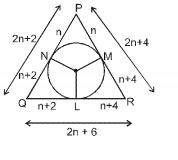
$\Rightarrow \frac{4 n^2-16}{8(n+1)(n+2)}=\frac{1}{3} $
$=\frac{n^2-4}{2(n+1)(n+2)}=\frac{1}{3} \quad \Rightarrow \quad \frac{n-2}{2(n+1)}=\frac{1}{3} $
$=3 n-6=2 n+2 $
$\Rightarrow n=8 $
$\Rightarrow 2 n+2=18 $
$\Rightarrow 2 n+4=20 $
$\Rightarrow 2 n+6=22$
$(A)$ $0 < \phi<\frac{\pi}{2}$ $(B)$ $\frac{\pi}{2} < \phi<\frac{4 \pi}{3}$
$(C)$ $\frac{4 \pi}{3} < \phi<\frac{3 \pi}{2}$ $(D)$ $\frac{3 \pi}{2} < \phi < 2 \pi$
$\Rightarrow \frac{3 \pi}{2}<\theta<\frac{5 \pi}{3}$
Now $2 \cos \theta(1-\sin \phi)=\sin ^2 \theta(\tan \theta / 2+\cot \theta / 2) \cos \phi-1$
$\Rightarrow 2 \cos \theta(1-\sin \phi)=2 \sin \theta \cos \phi-1$
$\Rightarrow 2 \cos \theta+1=2 \sin (\theta+\phi)$
As $\theta \in\left(\frac{3 \pi}{2}, \frac{5 \pi}{3}\right) \Rightarrow 2 \cos \theta+1 \in(1,2)$
$\Rightarrow 1<2 \sin (\theta+\phi)<2$
$\Rightarrow \frac{1}{2}<\sin (\theta+\phi)<1$
As $\theta+\phi \in[0,4 \pi]$
$\Rightarrow \theta+\phi \in\left(\frac{\pi}{6}, \frac{5 \pi}{6}\right)$ or $\theta+\phi \in\left(\frac{13 \pi}{6}, \frac{17 \pi}{6}\right)$
$\Rightarrow \frac{\pi}{6}-\theta<\phi<\frac{5 \pi}{6}-\theta$ or $\frac{13 \pi}{6}-\theta<\phi<\frac{17 \pi}{6}-\theta$
$\Rightarrow \phi \in\left(-\frac{3 \pi}{2}, \frac{-2 \pi}{3}\right) \cup\left(\frac{2 \pi}{3}, \frac{7 \pi}{6}\right)$
$\left(\because \theta \in\left(\frac{3 \pi}{2}, \frac{5 \pi}{3}\right)\right)$
$\frac{1}{\sin \frac{\pi}{n}}=\frac{1}{\sin \frac{2 \pi}{n}}+\frac{1}{\sin \frac{3 \pi}{n}}$
$\Rightarrow \frac{1}{\sin \frac{\pi}{n}}-\frac{1}{\sin \frac{3 \pi}{n}}=\frac{1}{\sin \frac{2 \pi}{n}}$
$\Rightarrow \frac{\sin \frac{3 \pi}{n}-\sin \frac{\pi}{n}}{\sin \left(\frac{\pi}{n}\right) \cdot \sin \frac{3 \pi}{n}}=\frac{1}{\sin \frac{2 \pi}{n}}$
$\Rightarrow \frac{2 \cos \frac{2 \pi}{n} \sin \frac{\pi}{n}}{\sin \frac{\pi}{n} \sin \frac{3 \pi}{n}}=\frac{1}{\sin \frac{2 \pi}{n}}$
$\Rightarrow 2 \cos \frac{2 \pi}{n} \sin \frac{2 \pi}{n}=\sin \frac{3 \pi}{n}$
$\Rightarrow \sin \frac{4 \pi}{n}+\sin (0)=\sin \frac{3 \pi}{n}$
$\Rightarrow \frac{4 \pi}{n}+\frac{3 \pi}{n}=\pi$
$\Rightarrow 7 \pi= n \pi$
$n =7$
Hence, this is the answer.
$ (y+z) \cos 3 \theta=(x y z) \sin 3 \theta $
$ x \sin 3 \theta=\frac{2 \cos 3 \theta}{y}+\frac{2 \sin 3 \theta}{z} $
$ (x y z) \sin 3 \theta=(y+2 z) \cos 3 \theta+y \sin 3 \theta$ have a solution $\left(\mathrm{x}_0, \mathrm{y}_0, \mathrm{z}_0\right)$ with $\mathrm{y}_0 \mathrm{z}_0 \neq 0$, is
$ x y z \sin 3 \theta=(2 \cos 3 \theta) z+(2 \sin 3 \theta) y $
$ \therefore(y+z) \cos 3 \theta=(2 \cos 3 \theta) z+(2 \sin 3 \theta) y=(y+2 z) \cos 3 \theta+y \sin 3 \theta $
$ y(\cos 3 \theta-2 \sin 3 \theta)=z \cos 3 \theta \text { and } $
$ y(\sin 3 \theta-\cos 3 \theta)=0 \Rightarrow \sin 3 \theta-\cos 3 \theta=0 \Rightarrow \sin 3 \theta=\cos 3 \theta $
$ \therefore 3 \theta=n \pi+\pi / 4$
$ \Rightarrow \cos 6 \theta=0 $
$ 4 \cos ^3 2 \theta-3 \cos 2 \theta=0 $
$ \Rightarrow \cos 2 \theta=0 \text { or } \pm \frac{\sqrt{3}}{2} $
$ \sin 2 \theta=\cos 4 \theta $
$ \Rightarrow 2 \sin ^2 2 \theta+\sin 2 \theta-1=0 $
$ 2 \sin ^2 2 \theta+2 \sin 2 \theta-\sin 2 \theta-1=0 $
$ \sin 2 \theta=-1 \text { or } \sin 2 \theta=\frac{1}{2} $
$ \cos 2 \theta=0 \text { and } \sin 2 \theta=-1 $
$ \Rightarrow 2 \theta=-\frac{\pi}{2} \Rightarrow \theta=-\frac{\pi}{4} $
$ \cos 2 \theta= \pm \frac{\sqrt{3}}{2}, \sin 2 \theta=\frac{1}{2} $
$ \Rightarrow 2 \theta=\frac{\pi}{6}, \frac{5 \pi}{6} \Rightarrow \theta=\frac{\pi}{12}, \frac{5 \pi}{12} $
$ \therefore \theta=-\frac{\pi}{4}, \frac{\pi}{12}, \frac{5 \pi}{12}$
$(A)$ $\frac{\pi}{4}$ $(B)$ $\frac{\pi}{6}$ $(C)$ $\frac{\pi}{12}$ $(D)$ $\frac{5 \pi}{12}$
$\sum_{m=1}^6 \operatorname{cosec}\left(\theta+\frac{(m-1) \pi}{4}\right) \operatorname{cosec}\left(\theta+\frac{m \pi}{4}\right)=4 \sqrt{2}$
$\Rightarrow \sum_{m=1}^6 \frac{1}{\sin \left(\theta+\frac{(m-1) \pi}{4}\right) \sin \left(\theta+\frac{m \pi}{4}\right)}=4 \sqrt{2}$
$\Rightarrow \sum_{m=1}^6 \frac{\sin \left[\theta+\frac{m \pi}{4}-\left(\theta+\frac{(m-1) \pi}{4}\right)\right]}{\sin \frac{\pi}{4}\left\{\sin \left(\theta+\frac{(m-1) \pi}{4}\right) \sin \left(\theta+\frac{m \pi}{4}\right)\right\}}=4 \sqrt{2}$
$\Rightarrow \sum_{m=1}^6 \frac{\cot \left(\theta+\frac{(m-1) \pi}{4}\right)-\cot \left(\theta+\frac{m \pi}{4}\right)}{1 / \sqrt{2}}=4 \sqrt{2}$
$\Rightarrow \sum_{m=1}^6\left[\cot \left(\theta+\frac{(m-1) \pi}{4}\right)-\cot \left(\theta+\frac{m \pi}{4}\right)\right]=4$
$\Rightarrow \cot (\theta)-\cot \left(\theta+\frac{\pi}{4}\right)+\cot \left(\theta+\frac{\pi}{4}\right)-\cot \left(\theta+\frac{2 \pi}{4}\right)+$
$\cdots+\cot \left(\theta+\frac{5 \pi}{4}\right)-\cot \left(\theta+\frac{6 \pi}{4}\right)=4$
$\Rightarrow $$ \cot \theta-\cot \left(\frac{3 \pi}{2}+\theta\right)=4$
$\Rightarrow $$ \cot \theta+\tan \theta=4 \quad \Rightarrow \quad \tan ^2 \theta-4 \tan \theta+1=0$
$\Rightarrow $$ (\tan \theta-2)^2-3=0$
$\Rightarrow $$ (\tan \theta-2+\sqrt{3})(\tan \theta-2-\sqrt{3})=0$
$\Rightarrow $$ \tan \theta=2-\sqrt{3} \text { or } \tan \theta=2+\sqrt{3}$
$\Rightarrow $$ \theta=\frac{\pi}{12} ; \theta=\frac{5 \pi}{12}$
$\because $$ \theta \in\left(0, \frac{\pi}{2}\right) .$
$ \text { also } 2 \cos ^2 \theta=3 \sin \theta \Rightarrow \sin \theta=\frac{1}{2} $
$ \Rightarrow \text { two solutions in }[0,2 \pi]$.
Thus, $\frac{\pi }{2} < (\theta + \phi ) < \frac{{2\pi }}{3}$.
$ \Rightarrow $ $3{\sin ^2}x - 6\sin x - \sin x + 2 = 0$
$ \Rightarrow $ $3\sin (\sin x - 2) - (\sin x - 2) = 0$
$ \Rightarrow $ $(3\sin x - 1)\,(\sin x - 2) = 0$
$ \Rightarrow $ $\sin x = \frac{1}{3}{\rm{ or 2}}$
$ \Rightarrow $ $\sin x = \frac{1}{3}$, ($ \because \,\,\sin x \ne 2$)
Let ${\sin ^{ - 1}}\frac{1}{3} = \alpha $,
$0 < \alpha < \frac{\pi }{2}$ are the solutions in $[0,{\rm{ }}5\pi ]$.
Then $\alpha ,$$\pi - \alpha ,\,$$2\pi + \alpha ,$ $\,3\pi - \alpha ,$ $\,4\pi + \alpha $, $5\pi - \alpha $ are the solutions in $[0,\,5\pi ]$.
$\therefore $ Required number of solutions $= 6$.
we can write the given equation as ${\tan ^2}\theta + \frac{{1 + {{\tan }^2}\theta }}{{1 - {{\tan }^2}\theta }} = 1$.
$ \Rightarrow $ ${\tan ^2}\theta (1 - {\tan ^2}\theta ) + 1 + {\tan ^2}\theta = 1 - {\tan ^2}\theta $
$ \Rightarrow $ $3{\tan ^2}\theta - {\tan ^4}\theta = 0 \Rightarrow {\tan ^2}\theta (3 - {\tan ^2}\theta ) = 0$
$ \Rightarrow $ $\tan \theta = 0$ or $\tan \theta = \pm \sqrt 3 $
Now $\tan \theta = 0 \Rightarrow \theta = m\pi $, where $m$ is an integer and
$\tan \theta = \pm \sqrt 3 = \tan ( \pm \pi /3) \Rightarrow \theta = n\pi \pm \frac{\pi }{3}$, where $n$ is an integer.
Thus $\theta = m\pi ,\,n\pi \pm \frac{\pi }{3}$, where $m$ and $n$ are integers.
==> $1 - {\sin ^2}\theta + \sin \theta + 1 = 0$
==> ${\sin ^2}\theta - \sin \theta - 2 = 0$
==> $(\sin \theta + 1)\,(\sin \theta - 2) = 0$
$\sin \theta = 2$, which is not possible and $\sin \theta = - 1$.
Therefore, solution of given equation lies in the interval $\left( {\frac{{5\pi }}{4},\,\frac{{7\pi }}{4}} \right)$.
But since ${\rm{cos}}\,({e^x}) \le 1,$
So, there does not exist any solution.