Questions · Page 1 of 2

1 Marks Question

🎯

Test yourself on this topic

50 questions · timed · auto-graded

Question 11 Mark
Read statement below carefully, and state, with reasons, if it is true or false: During rolling, the force of friction acts in the same direction as the direction of motion of the CM of the body.
Answer
False. Explanation: Frictional force acts opposite to the direction of motion of the centre of mass of a body. In the case of rolling, the direction of motion of the centre of mass is backward. Hence, frictional force acts in the forward direction.
View full question & answer
Question 21 Mark
Read statement below carefully, and state, with reasons, if it is true or false: For perfect rolling motion, work done against friction is zero.
Answer
True. Explanation: When perfect rolling begins, the frictional force acting at the lowermost point becomes zero. Hence, the work done against friction is also zero.
View full question & answer
Question 31 Mark
Read statement below carefully, and state, with reasons, if it is true or false: A wheel moving down a perfectly frictionless inclined plane will undergo slipping (not rolling) motion.
Answer
True.Explanation:
The rolling of a body occurs when a frictional force acts between the body and the surface. This frictional force provides the torque necessary for rolling. In the absence of a frictional force, the body slips from the inclined plane under the effect of its own weight.
View full question & answer
Question 41 Mark
Read statement below carefully, and state, with reasons, if it is true or false: The instantaneous acceleration of the point of contact during rolling is zero.
Answer
False. Explanation: When a body is rolling, its instantaneous acceleration is not equal to zero. It has some value.
View full question & answer
Question 51 Mark
Read statement below carefully, and state, with reasons, if it is true or false: The instantaneous speed of the point of contact during rolling is zero.
Answer
True. Explanation: Rolling can be considered as the rotation of a body about an axis passing through the point of contact of the body with the ground. Hence, its instantaneous speed is zero.
View full question & answer
Question 61 Mark
A cylinder of mass $10\ kg$ and radius $15\ cm$ is rolling perfectly on a plane of inclination $30^\circ$ . The coefficient of static friction $\mu_\text{s}= 0.25$
  1. How much is the force of friction acting on the cylinder?
  2. What is the work done against friction during rolling?
  3. If the inclination $\theta$ of the plane is increased, at what value of $\theta$ does the cylinder begin to skid, and not roll perfectly?
Answer
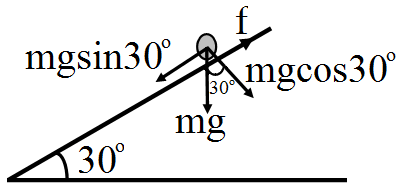
Mass of the cylinder, $m = 10\ kg$ Radius of the cylinder, $r = 15\ cm = 0.15m$ Co$-$efficient of kinetic friction, $\mu_\text{k}= 0.25$ Angle of inclination, $\theta=30^\circ$ Moment of inertia of a solid cylinder about its geometric axis, $\text{I}=\Big(\frac{1}{2}\Big)\text{mr}^2$ The various forces acting on the cylinder are shown in the following figure: The acceleration of the cylinder is given as, $\text{a}=\frac{\text{mg}\sin\theta}{\Big[\text{m}+\big(\frac{\text{I}}{\text{r}^2}\big)\Big]}$
$=\frac{\text{mg}\sin\theta}{\Bigg[\text{m}+\Bigg\{\Bigg(\frac{\frac{1}{2}\text{mr}^2}{\text{r}^2}\Bigg)\Bigg\}\Bigg]}$
$=\Big(\frac{2}{3}\Big)\text{g}\sin30^\circ$
$=\Big(\frac{2}{3}\Big)\times9.8\times0.5=3.27\text{ms}^{-2}$ Using Newton’s second law of motion, we can write net force as, $\text{f}_\text{net}=\text{ma}$
$\text{mg}\sin30^{\circ}-\text{f}=\text{ma}$
$\text{f}=\text{mg}\sin30^{\circ}-\text{ma}$
$=10\times9.8\times0.5-10\times3.27$
$49-32.7=16.3\text{N}$ During rolling, the instantaneous point of contact with the plane comes to rest. Hence, the work done against frictional force is zero. For rolling without skid, we have the relation, $\mu=\Big(\frac{1}{3}\Big)\tan\theta$
$\tan\theta=3\mu=3\times0.25$
$\therefore\ \theta=\tan^{-1}(0.75)=36.87^\circ$
View full question & answer
Question 71 Mark
Two masses M, and M, separated by distance r start moving towards each other due to their own force of attraction. What will be the change in centre of mass?
Answer
Since no external force acts, the centre of mass will stay where it is.
View full question & answer
Question 81 Mark
In a fly wheel, most of the mass is concentrated at the rim. Explain why?
Answer
Concentration of mass at the rim increases the moment of inertia and thereby brings uniform motion.
View full question & answer
Question 91 Mark
Moment of inertia of uniform circular disc about a diameter is I. What is the moment of inertia about an axis perpendicular to its plane and passing through a point on its rim?
Answer
Applying theorem of parallel axes, MI about the given axis $=\frac{1}{2}\text{MR}^2+\text{MR}^2=\frac{3}{2}\text{MR}^2$ $=6\times\frac{1}{4}\text{MR}^2=61$
View full question & answer
Question 101 Mark
When the earth shrinks, without reducing its mass, what change will be there in the duration of a day?
Answer
L is conserved. If the earth shrinks, duration of the day decreases.
View full question & answer
Question 111 Mark
Does the radius of gyration depend upon the speed of rotation of the body?
Answer
No, it depends only on the distribution of mass of the body.
View full question & answer
Question 121 Mark
A rectangular brick is kept on a table with a part of its length projecting out. It remains at rest if the length projected is slightly less than half the total length but it falls down if the length projected is slightly more than half the total length. Give reason.
Answer
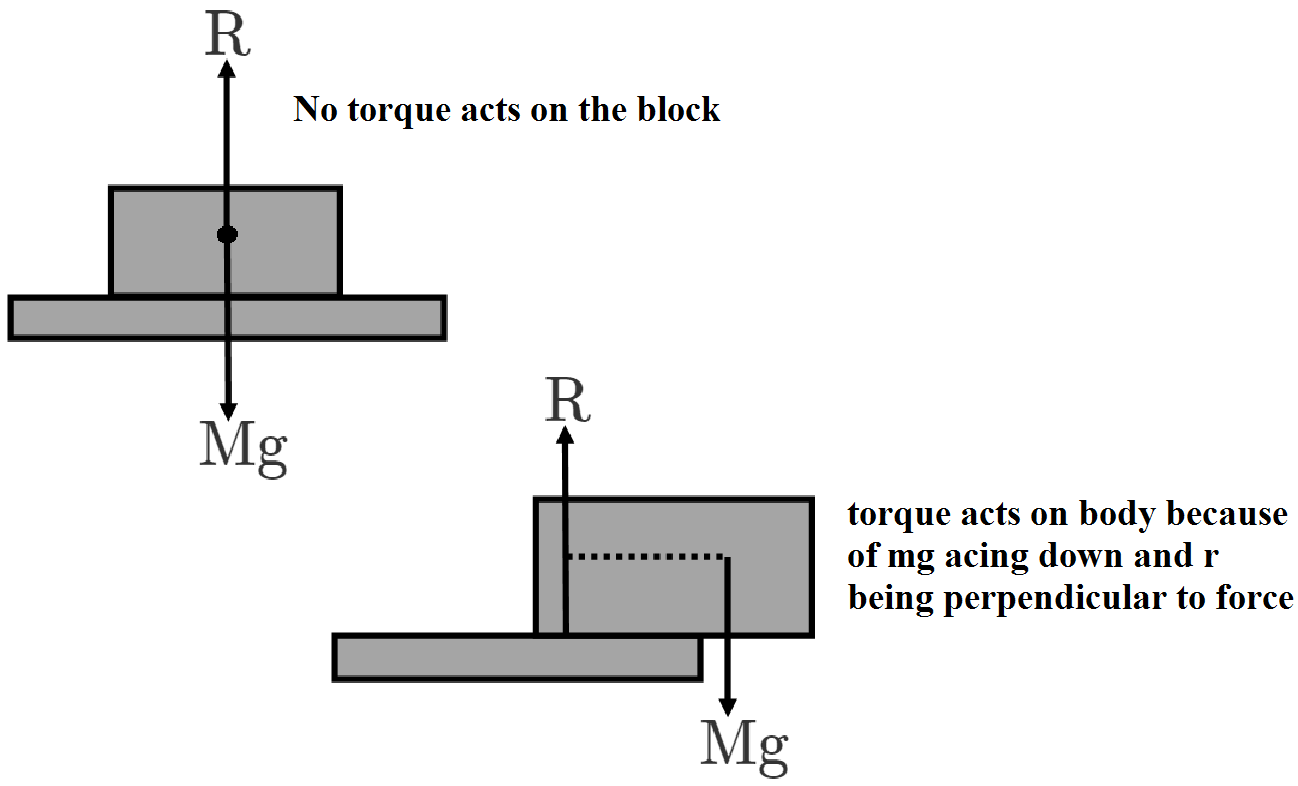
The centre of mass (CM) of a rectangular block lies in the middle of the block. When the block is projected less than half of its length (CM being over the table), no net force acts on it. Thus, no net torque acts upon the body.But if the block is projected more than half of its length outside the table (CM being outside the table), gravitational force acts along the CM of the block. This force produces a moment along the edge of the table. This rotates the block, and as a result, it falls down.
View full question & answer
Question 131 Mark
Explain how a cat is able to land on its feet after a fall taking advantage of the principle of conservation of angular momentum.
Answer
While falling a cat stretches its body along with the tail so that its moment of inertia (I) increases. As no external torque acts, L = Iw = constant. As I increases, w decreases and it lands gently on its feet.
View full question & answer
Question 141 Mark
Why is the head of screw made wide?
Answer
The head of a screw is made wide so as to have a greater torque for the applied force.
View full question & answer
Question 151 Mark
How will you distinguish between a hard boiled egg and a raw egg by spinning each on a table top?
Answer
To distinguish between a hard boiled egg and a raw egg, we spin each on a table top. The egg which spins at a slower rate shall be a raw egg. This is because in a raw egg, liquid matter inside tries to get away from the axis of rotation. Therefore, its moment of inertia I increases. As $\tau=\text{I }\alpha=$ constant, therefore, a decreases, i.e., raw egg will spin with smaller angular acceleration. The reverse is true for a hard boiled egg which will rotate more or less like a rigid body.
View full question & answer
Question 161 Mark
A ring and a circular disc of different materials have equal masses and equal radii. Which one will have a larger moment of inertia about an axis passing through its centre of mass perpendicular to its plane?
Answer
A ring has a larger moment of inertia because its entire mass is concentrated at the rim at the maximum distance from the axis.
View full question & answer
Question 171 Mark
If the angular momentum of a body is found to be zero about a point, is it necessary that it will also be zero about a different point?
Answer
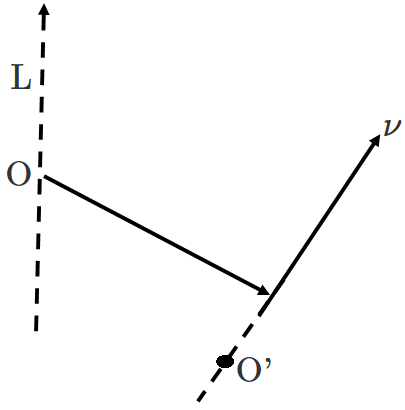
No, angular momentum is dependent on the position vector of the particle, angle between the radius vector and the linear velocity of the particle. So, there may be finite angular momentum along any different point even if it is zero at a particular point. If angular momentum is zero along O but finite along O.
View full question & answer
Question 181 Mark
Two satellites of equal masses, which can be considered as particles, are orbiting the earth at different heights. Will their moments of inertia be same or different?
Answer
Different. The satellite at larger height has more moment of inertia. Since $I = mass \times (distance)^2$.
View full question & answer
Question 191 Mark
What are the factors on which moment of inertia of a body depend?
Answer
Moment of inertia of a body depends upon:
  1. Mass of the body.
  2. Shape and size of body.
  3. Position of the axis of rotation.
  4. Distribution of mass in the body about the axis of rotation.
View full question & answer
Question 201 Mark
What are the units and dimensions of moment of inertia? Is it a vector quantity?
Answer
The units of moment of inertia are $\mathrm{kgm}^2$ and its dimensional formula is $[\mathrm{M}^{'} \mathrm{L}^2\mathrm{T}^0]$. No, it is not a vector quantity.
View full question & answer
Question 211 Mark
Where does the centre of mass of a uniform triangular lamina lie?
Answer
It lies at the centroid of the triangular lamina, i.e., where the three medians of the triangular lamina intersects.
View full question & answer
Question 231 Mark
Find the torque of a force $7\hat{\text{i}}-3\hat{\text{j}}-5\text{k}$ about the origin which acts on a particle whose position vector is $\hat{\text{i}}+\hat{\text{j}}-\hat{\text{E}}.$
Answer
$\vec{\text{F}}=7\hat{\text{i}}-3\hat{\text{j}}-5\hat{\text{k}}$ $\vec{\text{r}}=\hat{\text{r}}+\hat{\text{j}}-\hat{\text{k}}$ $\vec{\tau}=\vec{\text{r}}\times\vec{\text{F}}=(\hat{\text{i}}+\hat{\text{j}}-\hat{\text{k}})\times(7\hat{\text{i}}-3\hat{\text{j}}-5\hat{\text{k}})$ $=-8\hat{\text{i}}-2\hat{\text{j}}-10\hat{\text{k}}$
View full question & answer
Question 241 Mark
If the ice on the polar caps of the earth melts, how will it affect the duration of the day? Explain.
Answer
Earth rotates about its polar axis. When ice of polar caps of earth melts, mass concentrated near the axis of rotation spreads out. Therefore, moment of inertia I increases. As no external torque acts, $\therefore\text{L}=\text{I}\omega=\text{I}\Big(\frac{2\pi}{\text{T}}\Big)$ = Constant. With increase of I, T will increase, i.e., length of the day will increase.
View full question & answer
Question 261 Mark
Write an expression for the work done in rotator motion.
Answer
Work done $=\int_\limits{\theta\text{i}}^\limits{\theta\text{f}}\tau\text{ d}\theta$
View full question & answer
Question 271 Mark
Write an expression for the velocity of the centre of mass of particles.
Answer
Velocity of centre of mass of all body system is $\text{V}_{\text{cm}}=\frac{\text{m}_1\text{v}_1+\text{m}_2\text{v}_2+\dots+\text{m}_{\text{n}}\text{v}_{\text{n}}}{\text{m}_1+\text{m}_2+\dots+\text{m}_{\text{n}}}$ $=\frac{\sum^\limits{\text{n}}_\limits{\text{i}=1}\text{m}_{\text{i}}\text{v}_{\text{i}}}{\sum^\limits{\text{n}}_\limits{\text{i}=1}\text{m}_{\text{i}}}$
View full question & answer
Question 281 Mark
State the condition for translational equilibrium of a body.
Answer
For translational equilibrium of a body net force acting on it i.e., the vector sum of all the forces acting on the body must be zero.
View full question & answer
Question 291 Mark
If a cube is melted and is casted into a sphere, does moment of inertia about an axis through centre of mass increases or decreases.
Answer
Moment of inertia of a sphere is less than that of a cube of same mass.
View full question & answer
Question 301 Mark
Why are we not able to rotate a wheel by pulling or pushing along its radius?
Answer
Torque to rotate is not created by pushing or pulling along its radius.
View full question & answer
Question 311 Mark
State the condition for rotational equilibrium of a body.
Answer
For rotational equilibrium of a body the vector sum of torques of all the forces acting on the body about the reference point must be zero.
View full question & answer
Question 321 Mark
If earth were to shrink suddenly, what would happen to the length of the day?
Answer
Length of the day reduces as earth shrinks.
View full question & answer
Question 331 Mark
What are the factors on which moment of inertia of a body depends?
Answer
Moment of inertia of a body depends on position and orientation of axis of rotation. It also depends on shape, size of the body and also on the distribution of mass of the body about the given axis.
View full question & answer
Question 341 Mark
Which component of a force does not contribute towards torque?
Answer
The radial component of a force does not contribute towards torque.
View full question & answer
Question 351 Mark
Does the moment of inertia of a rigid body change with the speed of rotation?
Answer
No, because the moment of inertia depends upon the axis of rotation and distribution of mass.
View full question & answer
Question 361 Mark
Why is it easier to balance a bicycle in motion?
Answer
The wheel does not fall as long as the angular momentum remains constant. Due to friction angular momentum changes and when the wheel stops, it comes to unstable equilibrium.
View full question & answer
MCQ 371 Mark
A sphere can roll on a surface inclined at an angle $\theta$ if the friction coefficient is more than $\frac{2}{7}\text{g}\sin\theta$ Suppose the friction coefficient is $\frac{1}{2}\text{g}\sin\theta$ and a sphere is released from rest on the incline,
  • A
    It will stay at rest.
  • It will translate and rotate about the centre.
  • C
    It will make pure translational motion.
  • D
    The angular momentum of the sphere about its centre will remain constant.
Answer
Correct option: B.
It will translate and rotate about the centre.
As coefficient of friction is less than the one required for rolling, therefore the sphere will slip i.e., ii will translate and rotate about the centre.
View full question & answer
Question 381 Mark
What is moment of inertia of a solid sphere about its diameter?
Answer
$\text{I}=\frac{2}{5}\text{MR}^2,$ where M is the mass and R is radius of the solid sphere.
View full question & answer
Question 391 Mark
Why is moment of inertia also called rotationa inertia?
Answer
The moment of inertia gives a measure of inertia in rotational motion. So, it is also called rotational inertia.
View full question & answer
Question 401 Mark
Does the radius of gyration depend on the angular velocity of the body?
Answer
$\text{No. K}=\sqrt{\frac{\text{I}}{\text{M}}}$
View full question & answer
Question 421 Mark
Does the centre of mass of a solid necessarily lie within the body? If not, give an example.
Answer
No, the centre of mass of L-shaped rod lies in the region outside of rod.
View full question & answer
Question 431 Mark
Can a body in translatory motion have angular momentum?
Answer
Yes, A particle in translatory motion always has an angular momentum, unless the point (about which angular momentum is calculated) lies on the line of motion.
View full question & answer
Question 441 Mark
What is moment of inertia of a hollow sphere about an axis passing through its centre?
Answer
$\text{I}=\frac{2}{5}\text{MR}^2,$ where M is the mass and R is radius of the hollow sphere.
View full question & answer
Question 451 Mark
Write two factors on which center of mass of a body does not depend.
Answer
Two factors on which centre of mass of a body does not depend.
  1. Choice of coordinate system.
  2. Rotatory motion of a body.
View full question & answer
Question 461 Mark
Why does a pilot not fall down when his aeroplane takes a vertical loop?
Answer
Weight provides necessary centripetal force at the highest point.
View full question & answer
Question 471 Mark
A labourer standing near the top of an old wooden step ladder feels unstable. Why?
Answer
The point of contact of the ladder with the ground is the point about which the ladder can rotate. When the labourer is at the top of the ladder, the lever arm of force is large. So, the turning effect can be large.
View full question & answer
Question 491 Mark
If all the particle of a system lie in a cube, is it neccesary that the centre of mass be in the cube?
Answer
Yes in case cube is uniform in that case center of mass should be inside cube.
View full question & answer
Question 501 Mark
If no external torque act on a body, will its angular velocity remain conserved?
Answer
No, Angular velocity is not conserved but angular momentum is conserved.
View full question & answer
1 Marks Question - Physics STD 11 Science Questions - Vidyadip