Questions

4 Marks Question

🎯

Test yourself on this topic

26 questions · timed · auto-graded

Question 14 Marks
Give the meaning of ‘Investment’ and ‘Financing’ decisions of financial management.
Answer
Investment Decision: A firm’s resources are scarce in comparison to the uses to which they can be put. A firm, therefore, has to choose where to invest these resources, so that they are able to earn the highest possible return for their investors. The investment decision, therefore, relates to how the firm’s funds are invested in different assets. Investment decision can be long term or short-term.
  1. A long-term investment decision is also called a Capital Budgeting decision. It involves committing the finance on a long-term basis.
  2. Short term investment decisions (also called working capital decisions) are concerned with the decisions about the levels of cash, inventories and debtors.
These decisions affect the day to day working of a business. Efficient cash management, inventory management and receivables management are essential ingredients of sound working capital management.
Financing Decision: This decision is about the quantum of finance to be raised from various long-term sources (short-term sources are studied in working capital management). It involves identification of various available sources. The main sources of funds for a firm are shareholders funds and borrowed funds.
  1. shareholders funds refer to equity capital and retained earnings.
  2. Borrowed funds refer to finance raised as debentures or other forms of debt.
A firm has to decide the proportion of funds to be raised from either source based on their basic characteristics. Interest on borrowed funds have to be paid regardless of whether or not a firm has made a profit. Likewise, borrowed funds have to be repaid at a fixed time. The risk of default on payment is known as financial risk which has to be considered by a firm likely to have insufficient shareholders to make these fixed payments. Shareholders funds on the other hand involve no commitment regarding payment of returns or repayment of capital. The cost of each type of finance is estimated. Some sources may be cheaper than others.
View full question & answer
Question 24 Marks
What is meant by ‘Investment Decision’? State any three factors which affect the ‘Investment Decision’.
Answer
Investment decision decides how the firm’s funds are to be invested in different assets. It is the allocation of financial resources to different investment proposals.Investment decision can be of two types:
  1. Capital budgeting decision or Long-term investment decision (relating to the fixed assets).
  2. Short term investment decision or Working capital decision (relating to current assets).
Factors affecting Long-term Investment Decision:
  1. Cash flows of the project: When a company invests huge funds in an investment proposal it expects to generate reasonable and regular cash flows the project. Such cash flows should be carefully analysed before taking a capital budgeting decision.
  2. Rate of return: The most important criterion for the capital budgeting decisions is the expected rate of return from a project. Other things being equal, the project that is expected to generate the highest rate of return is the best.
  3. Investment criteria: There are different techniques available to evaluate investment proposals which are known as capital budgeting techniques. These techniques are applied to each proposals before selecting a particular proposal.
View full question & answer
Question 34 Marks
Explain the concept and the objective of Financial Management.
Answer
Financial Management is concerned with the efficient acquisition and allocation of funds. In other words, financial management is concerned with management of flow of funds and involves decisions relating to procurement of funds, investment of funds and distribution of earnings.Objective of Financial Management:
The main objective of the financial management is to maximize the share holders wealth i.e. to maximize the market price of equity share of the company. This is because a company’s funds belong to the shareholders and the manner in which these are invested and the return earned on them determines the market price of shares. fulfills many other objective.
View full question & answer
Question 44 Marks
Explain any four factors which affect the ‘Fixed Capital’ requirements of a company.
Answer
Factors affecting requirements of Fixed Capital:
  1. Nature of business: Fixed assets requirement would much depend on the nature of business i.e. whether it is of manufacturing type or trading type or service organization. Manufacturing enterprises require heavy investment in fixed assets; trading organization require a little investment in fixed assets.
  2. Scale of operations: A large scale business enterprise more investment in fixed assets that a small scale business.
  3. Choice of technique: In case, the technique of production is capital intensive, fixed assets requirements are quite high than in case labour - intensive technique of production.
  4. Technology upgradation: Higher fixed capital is required in those indrusties, where fixed assets become obsolete sooner, like computers.
  5. Financing Alternatives: If fixed assets are available on lease, then a firm will need lower investment in fixed assets.
View full question & answer
Question 54 Marks
Investment decision can be long-term or short-term. Explain longterm investment decision and state any two factors affecting this decision.
Answer
The long-term investment decision involves committing the finance on a longterm basis on fixed assets or various projects of an organisation. These decisions involve huge amount of investment, affect the earning capacity and are irreversible except at a huge cost. A long-term investment decision is also called a Capital Budgeting decision. It involves committing the finance on a long-term basis.The following are the factors affecting the long term investment decision:
  1. Cash flows of the project: When a company takes an investment decision involving huge amount it expects to generate some cash flows over a period. These cash flows are in the form of a series of cash receipts and payments over the life of an investment. The amount of these cash flows should be carefully analysed before considering a capital budgeting decision. which are known as capital budgeting techniques. These techniques are applied to each proposal before selecting a particular project.
  2. The rate of return: The most important criterion is the rate of return of the project. These calculations are based on the expected returns from each proposal and the assessment of risk involved.
View full question & answer
Question 64 Marks
Explain the meaning of Financial Planning. Why is it important? Give any two reasons.
Answer
The process of estimating the fund requirements of a business and specifying the sources of funds is called financial planning.
Alternate Answer
Financial planning is the preparation of a financial blueprint of an organisation’s future operations.
Financial planning is important because:
  1. It helps the company to prepare for the future.
  2. It helps in avoiding business shocks and surprises,
  3. It helps in co-ordinating various business functions.
  4. It helps in reducing waste, duplication of efforts, gaps in planning and confusion.
  5. It links the present with the future.
  6. It provides a link between investment and financing decisions.
  7. Financial plan serves as a control technique.
  8. It serves as a guide in developing a sound capital structure so as to maximise returns to the shareholders.
View full question & answer
Question 74 Marks
To avoid the problem of shortage and surplus of funds what is required in financial management? Name the concept and explain its any three points of importance.
Answer
The concept discussed above is Financial planning.Importance of financial planning:
Forecast future: It tries to forecast what may happen in future under different business situations. By doing so, it helps the firms to face the eventual situation in a better way. In other words, it makes the firm better prepared to face the future. For example, a growth of 20% in sales is predicted. However, it may happen that the growth rate eventually turns out to be 10% or 30%. Many items of expenses shall be different in these three situations. By preparing a blueprint of these three situations the management may decide what must be done in each of these situations. This preparation of alternative financial plans to meet different situations is clearly of immense help in running the business smoothly.
Encourage coordination: It helps in co-ordinating various business functions e.g., sales and production functions, by providing clear policies and procedures.
View full question & answer
Question 84 Marks
Explain ‘Customer-Focus’ and ‘Technology’ as managerial responses to changes in Business Environment.
Answer
Customer Focus - Increasing attention to customer needs and their satisfaction has brought a tremendous change in nature and quality of products offered to customers today. Better quality, packaging and performance of products provide products exceeding consumer expectation.Technology - Use of latest technology is a key factor in the success of companies. Manufacturers strive to upgrade quality and reduce cost through technology.
View full question & answer
Question 94 Marks
Explain any four points that highlight the importance of financial planning.
Answer
The objective of financial planning is to ensure that enough funds are available at right time.Importance of financial planning:
  1. It tries to forecast what may happen in future under different business situations. By doing so, it helps the firms to face the eventual situation in a better way. In other words, it makes the firm better prepared to face the future.
  2. It helps in avoiding business shocks and surprises and helps the company in preparing for the future.
  3. If helps in co-ordinating various business functions e.g., sales and production functions, by providing clear policies and procedures.
  4. Detailed plans of action prepared under financial planning reduce waste, duplication of efforts, and gaps in planning.
View full question & answer
Question 104 Marks
What is meant by ‘Long-term Investment Decision'? State any three factors which affect the long-term investment Decision’?
Answer
The long term investment decision means committing the funds on a long-term bases on fixed assets or various projects of an organization.Factors which affect the long term investment dicision are:
  1. Cash flows: Investment decisions are taken so as to earn returns for the firm. Series of cash receipts and payments (i.e. inflow and outflow of cash) over the life of an investment have to be carefully analysed before taking a long term investment decision.
  2. Rate of Returns: Expected rate of return from each proposal should be compared with the risks associated with the projects before taking an investment decision for example, if there are two investment proposals x and y, with a rate of return of 10% and 15% respectively the project y should be selected.
  3. Investment criteria: There, are various capital budgeting techniques available to a business that can be used to evaluate various investment proposals. These are based on calculation of amount of investment, interest rates, cash flow and rate of returns associated with proposals. These techniques are applied to the investment proposals for selecting the best proposals.
View full question & answer
Question 114 Marks
Explain the following as factors affecting financing decision:
  1. Cost.
  2. Cash flow position of the business.
  3. Level of fixed operating costs.
  4. Control considerations.
Answer
  1. Cost: The cost of raising funds through different sources are different. A prudent financial manager would normally opt for a source which is the cheapest.
  2. Cash Flow Position of the Business: A stronger cash flow position may make debt financing more viable than funding through equity.
  3. Level of Fixed Operating Costs: If a business has high level of fixed operating costs (e.g., building rent, Insurance premium, Salaries etc.), It must opt for lower fixed financing costs. Hence, lower debt financing is better. Similarly, if fixed operating cost is less, more of debt financing may be preferred.
  4. Control Considerations: Issues of more equity may lead to dilution of management’s control over the business. Debt financing has no such implication. Companies afraid of a takeover bid may consequently prefer debt to equity.
View full question & answer
Question 124 Marks
Explain the meaning and the objective of Financial Management.
Answer
Financial Management is concerned with management of flow of funds and involves decisions relating to procurement of funds, investment of funds and distribution of earnings.
Alternate Answer
Financial Management may be defined as planning, organising, directing and controlling the financial activities of an organisation.
Objective of Financial Management:
The objective of financial management is to maximize shareholders wealth i.e. to maximize the market price of equity shares of the company This is because a company’s funds belong to the shareholders and the manner in which these are invested and the return earned on them determines the market value or price of shares.
View full question & answer
Question 134 Marks
What is required to tackle the uncertainty in respect of availability and timings of funds? Name the concept involved and explain any three points of its importance.
Answer
The concept involved is Financial planning.Importance of financial planning:
Forecast future: It tries to forecast what may happen in future under different business situations. By doing so, it helps the firms to face the eventual situation in a better way. In other words, it makes the firm better prepared to face the future. For example, a growth of 20% in sales is predicted. However, it may happen that the growth rate eventually turns out to be 10% or 30%. Many items of expenses shall be different in these three situations. By preparing a blueprint of these three situations the management may decide what must be done in each of these situations. This preparation of alternative financial plans to meet different situations is clearly of immense help in running the business smoothly. Encourage coordination: It helps in co-ordinating various business functions e.g., sales and production functions, by providing clear policies and procedures.
View full question & answer
Question 144 Marks
To avoid the problem of shortage and surplus of funds what is required in financial management? Name the concept and explain its any three points of importance.
Answer
It is financial planning.
Importance: Main points of the importance of financial planning are as under:
  1. Helps to Face the Eventualities: It tries to forecast various business situations. On this basis, alternative financial plans are prepared. By doing so, it helps to face the eventual situations in a better way.
  2. Helps in Avoiding Business Shocks and Surprises: Proper provision regarding shortage or surplus of funds is made by anticipating future receipts and payments. Hence, it helps in avoiding business shocks and surprises.
  3. Helps in Coordination: It helps in coordinating various business activities, such as, sales, purchase, production, finance, etc.
View full question & answer
Question 154 Marks
Financial management is based on three broad financial decisions. What are these?
Answer
Financial management refers to the efficient acquisition, allocation and usage of funds of the company. It deals in three main dimensions of financial decisions namely, Investment decisions, Financial decisions and Dividend decisions.Investment Decisions:
Investment decisions refer to the decisions regarding where to invest so as to earn the highest possible returns on investment. Investment decisions can be taken for both long term as well as short term.
Long term investment decisions also known as Capital Budgeting decisions affect a business’ long term earning capacity and profitability. For example, investment in a new machine, purchase of a new building, etc. are long term investment decisions.
Short term investment decisions also known as working capital decisions affect a business’ day to day working operations. For example, decisions regarding cash or bill receivables are short term investment decisions.
Financial Decisions:
Such decisions involve identifying various sources of funds and deciding the best combination for raising the funds. The main sources for raising funds are shareholders’ funds (referred as equity) and borrowed funds (referred as debt). Based on the cost involved, risk and profitability a company must judiciously decide the combination of debt and equity to be used. For example, while debt is considered to be the cheapest source of finance, higher debt increases the financial risk. Financial decisions taken by a company affects its overall cost of capital and the financial risk.
Dividend Decisions:
The decision involves the decision regarding the distribution of profit or surplus of the company. A company can distribute its profit to the equity share holders in the form of dividends or retain it with itself. Under dividend decision, a company decides what proportion of the surplus to distribute as dividends and what proportion to keep as retained earnings. It is aimed at maximising the shareholders’ wealth while keeping in view the requirement of retained earnings that are needed for re-investment.
View full question & answer
Question 164 Marks
Discuss the two objectives of financial planning.
Answer
Financial Planning involves designing the blueprint of the financial operations of a firm. It ensures that just the right amount of funds are available for the organisational operations at the right time. Thereby, it ensures smooth functioning. Taking into consideration the growth and performance, through financial planning, firms tend to forecast what amount of fund would be required at what time.The following are the two highlighted objectives of financial planning.
  1. Ensure Availability of Funds:
Ensuring that the right amount of funds are available at the right time is one of the main objectives of financial planning. It involves estimating the right amount of funds that are required for various business operations in the long term as well for day to day operations. In addition, it also involves estimating the time at which the funds would be required. Thus, financial planning ensures that right amount of funds are available at the right time. Financial planning also points out the probable sources of funds.
  1. Proper Utilisation of Funds:
Financial Planning aims at full utilisation of funds. It ensures that both inadequate funds as well as excess funds are avoided. Inadequate funds hinders the smooth operations and the firm is unable to carry its commitments. On the other hand, excess funds add to the cost of business and encourage unnecessary wasteful expenditure. Thus, financial planning ensures that the funds are properly and optimally utilised.
View full question & answer
Question 174 Marks
What do you mean by management of fixed capital? Why is it important?
Answer
Management of fixed capital involves allocation of firm's capital to different projects or assets with long-term implications for the business. These decisions are called investment decisions or capital budgeting decisions and affect the growth, profitability and risk of the business in the long run.The management of fixed capital is important for the following reasons:
  1. Long-term growth and effects: These decisions have bearing on the long-term growth. The funds invested in long-term assets are likely to yield returns in the future. These affect future possibilities and prospects of the business.
  2. Large amount of funds involved: These decisions result in a substantial portion of capital funds being blocked in long-term projects. Therefore, these investment programmes are planned after a detailed analysis is undertaken. This may involve decisions like where to procure funds from and at what rate of interest.
  3. Risk involved: Fixed capital involves investment of huge amounts. It affects the returns of the firm as whole in the long-term. Therefore, investment decisions involving fixed capital influence the overall business risk complexion of the firm.
View full question & answer
Question 184 Marks
"The overall financial health of a business is determined by the quality of its financial management'. In the light of above statement, discuss some of the aspects which affect the financial health of a business.
Answer
Some of the factors which affect the financial health of a business are as follows:
  1. Size and composition of fixed assets: For instance, if a decision is taken to invest 200 crore in establishing plant and machinery, then this decision would raise the size of fixed assets blocked by this amount.
  2. Size and composition of current assets: A decision to increase the term of credit to customers would increase the amount of debtors and current assets.
  3. The amount of long-term and short term funds to be raised: Financial management involves decision related to the proportion of long-term and short-term funds. For example, if an organisation wishes to have more liquid assets, it would raise relatively more amount on a long-term basis. Such cases create problem in choosing liquidity or profitability.
View full question & answer
Question 194 Marks
What is meant by working capital?
Answer
The capital invested in current or working assets such as stock of materials and finished goods, accounts receivable, bills receivable, short-term securities and cash or bank balance for meeting day-to-day expenses is known as working capital or current capital. It represents investment for a short period. The term 'working capital' is used in two senses, namely gross working capital and net working capital.
  1. Gross working capital: It is the total value of current assets. The amount of gross working capital indicates the total funds available for financing the current assets. It is a quantitative concept, which fails to reveal the true financial position of a company.
  2. Net working capital: It represents the excess of current assets over current liabilities. Net working capital is a qualitative concept and it reveals the soundness of current financial position. It shows a firm's ability to meet its current obligations as they fall due for payment.
View full question & answer
Question 204 Marks
Distinguish between fixed capital and working capital.
Answer
Difference between fixed and working capital:
S. No
Basis
Fixed capital
Working capital
(i)
Time period
Required for long-term.
Required for short-term.
(ii)
Purpose
Money needed to buy fixed assets.
Money needed to buy current assets.
(iii)
Nature
Remains sunk in business.
Revolves in business.
(iv)
Source
Raised through shares debentures and term loans.
Raised through banks, trade credit, shares and debentures.
View full question & answer
Question 214 Marks
The directors of Lavanya Ltd. have decided to expand the business activities by increasing the stock of raw materials and finished goods at an estimated cost of ₹ 50 lakhs. As a finance manager of the company, advise the directors about the methods open to the company to raise necessary finance for this purpose.
Answer
Finance could be raised through following methods:
  1. Issue of shares: A share is a unit of measure of a shareholder's interest in the company. The share of a company is a movable property transferrable in the manner provided by the Companies Act. A shareholder is entitled to the dividend. Shares may be either equity or preference. Share capital of a company is regarded as owned capital. It is a permanent source of finance and is non-returnable. Shareholders are the owners of the company and therefore, bear the risk of loss and profit.
  2. Issue of debentures: Debentures are creditorship securities which provide funds to the company on loan basis. Debenture capital is a loan capital, usually repayable during the lifetime of the company A debenture holder is a creditor of the company. He gets interest at a fixed rate irrespective of annual profit or loss. Debentures are liked by the investors who give weightage to safety of principle and continuous fixed rate of income on the principle.
  3. Loans from banks and financial institutions: Banks and financial institutions like IFCI, ICICI, UTI, etc. also provide term loans to various business concerns.
  4. Retained earnings: Sometimes companies retain some profits to finance their requirements. It is an internal source of finance. Normally, companies do not distribute its entire earnings in the form of dividend. Such a practice helps the company to build up reserves which can be used for financing long-term requirements.
View full question & answer
Question 224 Marks
What is fixed capital? Enumerate any two of the factors determining the fixed capital requirements of an enterprise.
Answer
The capital invested in fixed assets like land and buildings, plant and machinery, furniture and fixtures, etc, is known as fixed capital. Fixed capital is that portion of the total capital which is represented by fixed assets. It is known as 'block capital' because it is blocked up in fixed assets for the life of the company. Fixed capital represents the permanent or long-term capital of an enterprise. Therefore, it is raised through long-term sources, like shares, debentures, long-term loans and retained earnings.Factors determining fixed capital requirements are:
  1. Nature of business: A manufacturing enterprise requires a large amount of fixed capital as compared to a trading or commercial concern.
  2. Scale of operations: A large scale enterprise generally requires greater fixed capital than a small scale enterprise. e.g. a large scale steel enterprise like Tata Iron and Steel Company requires huge investment in fixed assets in comparison with a toy manufacturing unit.
View full question & answer
Question 234 Marks
Explain the link between operating cycle and working capital.
Answer
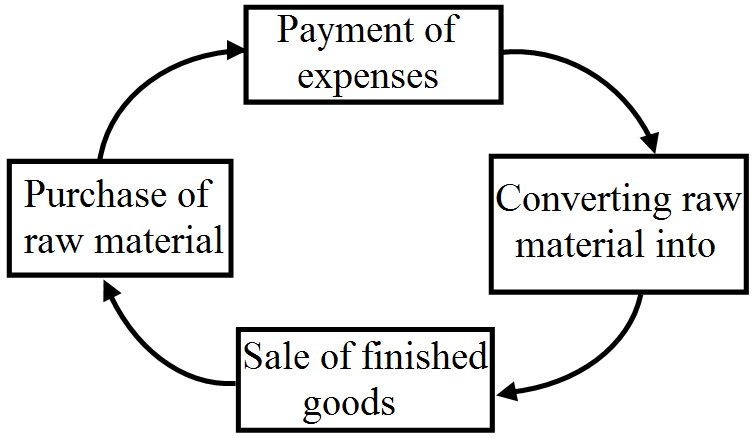
Operating cycle is the duration of time between acquisition of supplies and the collection of cash from receivables. In a trading concern, operating cycle begins with procuring goods to be sold in the market and ends with realising cash from creditors after the sale of these goods. In a manufacturing concern, there are some more activities to be performed, like procurement of raw materials, putting the raw materials into work in progress and converting these ultimately into finished goods, sale of finished goods on credit or cash and realising cash from creditors. In both the cases, there is a time gap between the first stage of procuring goods or raw materials and the last stage of realising cash. This time duration is called operating cycle and working capital is required to finance operations during operating cycle for the business to run smoothly. Working capital requirement is higher in firms with longer operating cycle and lower in firms with shorter processing cycle.
View full question & answer
Question 244 Marks
"Sound Financial Management is the key to the prosperity of business." Explain.
Answer
Financial management plays an important role in overall financial position of the organisation. Decisions taken during financial managements are the main cause behind items appearing in financial statements, Profit and Loss Account and Balance Sheet.Its role can be understood through the following points:
  1. It determines what amount will be invested in various types of fixed and current assets. Composition of current assets is also affected by it.
  2. It determines the requirement of long-term and short-term finance for the organisation. Various factors are taken into consideration before reaching the conclusion.
  3. It determines the composition of capital structure, i.e., the ratio of debt and equity after considering all the factors.
  4. Use of debt and equity as a source of financing will involve the payments in terms of interest and dividends respectively which are the items of Profit and Loss Account.
Thus, the overall financial health of a business is determined by the quality of its financial management.
View full question & answer
Question 254 Marks
You are a financial expert and your company starts a business of manufacturing baby toys. Suggest the working capital requirement and phases of operating cycle.
Answer
It is a manufacturing company thus, the requirement of working capital is large as these companies require to maintain stock of raw materials, semi-finished and finished goods.Phases of operating cycle of a manufacturing company are:
  1. Purchase of raw material.
  2. Payment of labour, power, fuel and other expenses.
  3. Converting raw material into finished goods.
  4. Sale of finished goods.
View full question & answer
Question 264 Marks
State the merits and demerits of issuing equity shares for the company.
Answer
Merits of issuing equity share capital:
  1. Equity share capital does not have to be repaid (except at the time of liquidation), so, it is like permanent capital.
  2. Dividends have to be paid only out of profits. Hence, there is no fixed obligation.
  3. The company enjoys a better reputation as it has more equity capital and it is able to obtain credit on the basis of its equity capital.
Demerits of issuing equity share capital:
  1. Equity shareholders expect a higher rate of return than others since the risk involved is also high. Hence, the cost of capital to the company is highest.
  2. Dividends to be paid are not allowed to be deducted from the profits for calculating taxes, i.e., they are not tax deductible.
  3. The floatation costs of equity capital is higher than other types of capital. Underwriting and brokerage commissions are high for equity capital.
  4. Sale of equity shares to others will result in changing the existing control and ownership. The remaining shareholders may not be able to control the company.
View full question & answer
4 Marks Question - Business Studies STD 12 Commerce Questions - Vidyadip