Questions · Page 1 of 2

6 Marks Question

🎯

Test yourself on this topic

50 questions · timed · auto-graded

Question 16 Marks
Give the meaning of ‘divisional structure’ of organizing. State its any four advantages.
Answer
Meaning of divisional structure:In a divisional structure, the organisation structure comprises of separate business units or divisions. Each unit has a divisional manager responsible for performance and who has authority over the unit. Generally, manpower is grouped on the basis of different products manufactured. Each division is multifunctional because within each division functions like production, marketing, finance, purchase etc, are performed together to achieve a common goal.
Advantage of divisional structure:
The divisional structure offers many benefits. Prominent among these are as follows:
  1. Product specialisation helps in the development of varied skills in a divisional head and this prepares him for higher positions. This is because he gains experience in all functions related to a particular product.
  2. Divisional heads are accountable for profits, as revenues and costs related to different departments can be easily identified and assigned to them. This provides a proper basis for performance measurement. It also helps in fixation of responsibility in cases of poor performance of the division and appropriate remedial action can be taken.
  3. It promotes flexibility and initiative because each division functions as an autonomous unit which leads to faster decision making.
  4. It facilitates expansion and growth as new divisions can be added without interrupting the existing operations by merely adding another divisional head and staff for the new product line.
View full question & answer
Question 26 Marks
Explain the concept of ‘Functional Structure’ of an organization. Also, explain any four disadvantages of functional structure.
Answer
Functional structure is an organisational structure formed by grouping of jobs of similar nature under various functional departments where all departments report to a coordinating head.Disadvantages of Functional organisational structure are:
  1. A functional structure places less emphasis on overall enterprise objectives than the objectives pursued by a functional head. Such practices may lead to functional empires wherein the importance of a particular function may be over emphasised. Pursuing departmental interests at the cost of organizational interests can also hinder the interaction between two or more departments.
  2. It may lead to problems in coordination as information has tobe exchanged across functionally differentiated departments.
  3. A conflict of interests may arise when the interests of two or more departments are not compatible. For example, the sales department insisting on a customer friendly design may cause difficulties in production. Such dissension can prove to be harmful in terms of fulfillment of organisational interest. Inter-departmental conflicts can also arise in the absence of clear separation of responsibility.
  4. It may lead to inflexibility as people with same skills and knowledge base may develop a narrow perspective and thus, have difficulty in appreciating any other point of view. Functional heads do not get training for top management positions because they are unable to gather experience in diverse areas.
View full question & answer
Question 36 Marks
With the help of any four points, explain the crucial role that organizing plays in an enterprise.
Answer
Role of organising:
  1. Benefits of specialisation: Organising leads to a systematic allocation of jobs amongst the work force. This reduces the workload as well as enhances productivity because of the specific workers performing a specific job on a regular basis. Repetitive performance of a particular task allows a worker to gain experience in that area and leads to specialisation.
  2. Clarity in working relationships: The establishment of working relationships clarifies lines of communication and specifies who is to report to whom. This removes ambiguity in transfer of information and instructions. It helps in creating a hierarchical order thereby enabling the fixation of responsibility and specification of the extent of authority to be exercised by an individual.
  3. Optimum utilization of resources: Organising leads to the proper usage of all material, financial and human resources. The proper assignment of jobs avoids overlapping of work and also makes possible the best use of resources. Avoidance of duplication of work helps in preventing confusion and minimising the wastage of resources and efforts.
  4. Effective administration: Organising provides a clear description of jobs and related duties. This helps to avoid confusion and duplication. Clarity in working relationships enables proper execution of work. Management of an enterprise thereby becomes easy and this brings effectiveness in administration.
View full question & answer
Question 46 Marks
What is meant by ‘Delegation’? State any four points which highlight the importance of delegation in an organisation.
Answer
Delegation is the transfer of authority from superior to subordinate. It has three elements: Authority, Responsibility and Accountability.Importance of Delegation:
  1. Effective management: By empowering the employees, the managers are able to function more efficiently as they get more time to concentrate on important matters.
  2. Employee development: As a result of delegation, employees get more opportunities to utilize their talent and this may give rise to latent abilities in them.
  3. Motivation of employees: Delegation helps in developing the talents of the employees. It also has psychological benefits.
  4. Facilitation of growth: Delegation helps in the expansion of an organisation by providing a ready workforce to take up leading positions in new ventures.
  5. Better coordination: The elements of delegation, namely authority, responsibility and accountability help to define the powers, duties and answerability related to the various positions in an organisation.
View full question & answer
Question 56 Marks
‘Organizing involves a series of steps in order to achieve the desired goals.’ Explain these steps.
Answer
Organising is the process of defining and grouping activities and establishing authority relationships among them.Steps involved in organizing are:
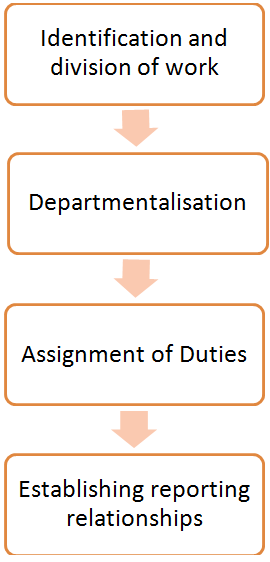
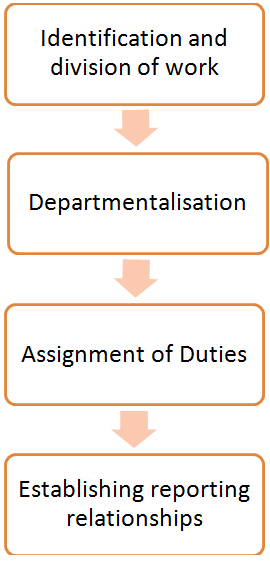
  1. Identification and division of work: The first step in the process of organising involves identifying and dividing the work that has to be done in accordance with previously determined plans. The work is divided into manageable activities so that duplication canbe avoided and the burden of work can be shared among the employees.
  2. Departmentalisation: Once work has been divided into small and manageable activities then those activities which are similar in nature are grouped together. Such sets facilitate specialisation. This grouping process is called departmentalisation. Departments can be created using several criteria as a basis. Examples of some of the most popularly used basis are territory (north, south, west etc.) and products (appliances, clothes, cosmetics etc).
  3. Assignment of duties: It is necessary to define the work of different job positions and accordingly allocate work to various employees. Once departments have been formed, each of them is placed under the charge of an individual. Jobs are then allocated to the members of each department in accordance to their skills and competencies. It is essential for effective performance that a proper match is made between the nature of a job and the ability of an individual. The work must be assigned to those who are best fitted to perform it well.
  4. Establishing reporting relationships: Merely allocating work is not enough. Each individual should also know who he has to take orders from and to whom he is accountable. The establishment of such clear relationships helps to create a hierarchal structure and helps in coordination amongst various departments.
​​​​​​​
View full question & answer
Question 66 Marks
Explain, with the help of any four points, the importance of ‘Delegation’ in an organization.
Answer
Delegation is the transfer of authority from superior to subordinate. It has three elements: Authority, Responsibility and Accountability.Importance of Delegation:
  1. Effective management: By empowering the employees, the managers are able to function more efficiently as they get more time to concentrate on important matters.
  2. Employee development: As a result of delegation, employees get more opportunities to utilize their talent and this may give rise to latent abilities in them.
  3. Motivation of employees: Delegation helps in developing the talents of the employees. It also has psychological benefits.
  4. Facilitation of growth: Delegation helps in the expansion of an organisation by providing a ready workforce to take up leading positions in new ventures.
  5. Better coordination: The elements of delegation, namely authority, responsibility and accountability help to define the powers, duties and answerability related to the various positions in an organization.
View full question & answer
Question 76 Marks
Give the meaning of 'organising'. State the steps in the process of organising.
Answer
Organising can be defined as a process that initiates implementation of plans by clarifying jobs and working relationships and effectively deploying resources for attainment of identified and desired results (goals).Steps in process of organizing:
Step - 1 Identification and division of work: The first step in the process of organising involves identifying and dividing the work that has to be done in accordance with previously determined plans Step - 2 Departmentalisation: Once work has been divided into small and manageable activities then those activities which are similar in nature are grouped together. Such sets facilitate specialisation. Step - 3 Assignment of duties: It is necessary to define the work of different job positions and accordingly allocate work to various employees. Once departments have been formed, each of them is placed under the charge of an individual. Jobs are then allocated to the members of each department in accordance to their skills and competencies. Step - 4 Establishing reporting relationships: Merely allocating work is not enough. Each individual should also know who he has to take orders from and to whom he is accountable. The establishment of such clear relationships helps to create a hierarchal structure and helps in coordination amongst various departments.
View full question & answer
Question 86 Marks
With the help of any four points, explain the importance of ‘Decentralization’ in an organization.
Answer
Importance of Decentralisation:
  1. Develops initiative among subordinates: Decentralisation helps to promote self-reliance and confidence amongst the subordinates. This is because when lower managerial levels are given freedom to take their own decisions they learn to depend on their own judgment. It also keeps them in a state wherein they are constantly challenged and have to develop solutions for the various problems they encounter.
  2. Develops managerial talent for the future: Formal training plays an important part in equipping subordinates with skills that help them rise in the organisation but equally important is the experience gained by handling assignments independently. Decentralisation gives them a chance to prove their abilities and creates a reservoir of qualified manpower who can be considered to fill up more challenging positions through promotions.
  3. Quick decision making: The be looked upon as a chain of communication. In centralized organisation because every decision is taken by the top management the flow of information is slow as it has to traverse many levels.
  4. Facilitates growth: Decentralisation awards greater autonomy to the lower levels of management as well as divisional or departmental heads. This allows them to function in a manner best suited to their department and fosters a sense of competition amongst the departments.
View full question & answer
Question 96 Marks
Differentiate between formal and informal organization on the basis of the following:
  1. Meaning.
  2. Origin.
  3. Authority.
  4. Behaviour.
  5. Flow of communication.
  6. Nature.
Answer
DIFFERENCE BETWEEN FORMAL AND INFORMAL ORGANIZATION:
Basis
Formal Organisation
Informal Organisation
Meaning
Formal organisation refers to the organisation structure which is designed by the management to accomplish a particular task.
Informal organisation is a network of personal and social relations arising spontaneously as people associate with one another.
Origin
It arises as a result of company’s rules and policies.
It arises as a result of social interaction.
Authority
It arises by virtue of position in management.
It arises out of personal qualities.
Behaviour
It is directed by rules.
There is no set behaviour pattern.
Flow of communication
Communication takes place through the scalar
chain.
Communication can take place in any direction.
Nature
Its structure is rigid in nature.
Its structure is flexible in nature.
View full question & answer
Question 106 Marks
Give the meaning of essential elements of ‘Delegation’
Answer
Delegation implies transfer of authority and responsibility by a superior official to subordinates.The following are the basic elements of delegation:
  1. Authority: Authority means the power given to an individual to command and direct the subordinates. It endows the right to make decisions regarding what is to be done and by whom it is to be done. In a formal organisation, the scalar chain gives rise to authority. Authority flows downwards—that is, the superior official commands authority over the subordinates. The extent of authority becomes less and less as one goes down the hierarchy. That is, the top-level management commands the highest authority. Authority is less at the middle level and is the lowest at the lower level management. Assigning appropriate authority to individuals helps in maintaining obedience and compliance in an organisation.
  2. Responsibility: Responsibility is the adherence of the subordinate to complete a given task. Once a task has been assigned to a subordinate, it becomes his/her official's responsibility to get the task done. The subordinate should perform the duty assigned obediently and loyally. As against authority, responsibility moves up the hierarchy—that is, the subordinate is accountable to his superior. However, along with assigning responsibility to a subordinate, this official should also be given a certain degree of authority. This is because authority without responsibility may lead to the misapplication of power. On the other hand, responsibility without authority may lead to inefficiency. Thus, there should be a fine balance between authority and responsibility.
  3. Accountability: Accountability implies the answerability of the superior for the final outcome of the work the official is assigned. Though the superior official delegates the work to a subordinate, this higher official will continue to be responsible for the final outcome. For this the superior, provides regular feedback and improvement ideas to the subordinate so as to ensure that the subordinate performs the tasks satisfactorily. One can say that the concept of being accountable arises out of responsibility itself. We may say that while responsibility is assumed, accountability is imposed.
View full question & answer
Question 116 Marks
Give the meaning of ‘Informal Organisation’ and state any five features of it.
Answer
Informal organisation refers to a network of social relationships that forms spontaneously owing to personal interactions among the employees of an organisation. The system originates from within a formal organisation when employees interact beyond their officially defined roles and positions. In other words, when employees with different job profiles and positions in a formal organisation interact with one another beyond their boundaries of authority, informal relationships are created. These relations are based on the friendship that develops among the employees with similar nature, and they lead to the formation of an informal organisation.
The following are the features of an informal organisation:
  1. Informal organisation evolves from within a formal organisation as a result of personal interactions among employees.
  2. The behaviour of individuals in an informal organisation is governed by the norms of particular groups and is not dictated by official rules.
  3. Informal organisation emerges spontaneously.
  4. Informal organisation facilitates the free flow of communication.
  5. Informal organisation does not have a definite structure; it is quite complex.
View full question & answer
Question 126 Marks
‘Delegation is the entrustment of responsibility and authority to another and the creation of accountability for performance.’ In the light of this statement identify and explain the essential elements of delegation.
Answer
Delegation is the entrustment of responsibility and authority to another and the creation of accountability for performance.
The essential elements of delegation are:
  1. Authority:
  1. It refers to the right of an individual to command his subordinates and to take action within the scope of his position.
  2. It arises from the established scalar chain which links the various job positions and levels of an organisation.
  3. Authority flows from top to bottom.
  1. Responsibility:
  1. It is the obligation of a subordinate to properly perform the assigned duty.
  2. It arises from a superior-subordinate relationship.
  3. It flows upwards.
  1. Accountability:
  1. It implies being answerable for the final outcome.
  2. It cannot be delegated.
  3. It flows upwards.
View full question & answer
Question 136 Marks
What is meant by ‘Formal Organisation’? State any three advantages and any two limitations of ‘Formal Organisation’.
Answer
Formal organisation refers to the organisation structure which is designed by the management to accomplish its objectives.
Advantages:
  1. It is easier to fix responsibility since mutual relationships are clearly defined.
  2. It avoids duplication of effort since there is no ambiguity in the role that each member has to play.
  3. It maintains unity of command through an established chain of command.
  4. It leads to accomplishment of goals by providing a framework for the operations to be performed.
  5. It provides stability to the organisation because there are specific rules to guide behaviour of employees.
Limitations:
  1. It may lead to procedural delays as the established chain of command has to be followed which increases the time taken for decision making.
  2. Poor organisation practices may not provide adequate recognition to reative talent, since it does not allow any deviations from rigidly laid down policies.
  3. It is difficult to understand all human relationships in an enterprise as it places more emphasis on structure and work.
View full question & answer
Question 146 Marks
What is meant by "Informal organisation"? State any three advantages and any two disadvantages of this form of organisation.
Answer
Informal organisation emerges from within the formal organization when people interact beyond their officially defined roles. When people have frequent contacts they cannot be forced into a rigid formal structure.
Advantages: The informal organization offers many benefits. Important among them are given below:
  1. Prescribed lines of communication are not followed. Thus, the informal organisation leads to faster spread of information as well as quick feedback.
  2. It helps to fulfill the social needs of the members and allows them to find like minded people. This enhances their job satisfaction since it gives them a sense of belongingness in the organisation.
Disadvanrages: The informal organization has certain disadvantages. Some of them are as follows:
  1. When an informal organization spreads rumours, it becomes a destructive force and goes against the interest of the formal organisation.
  2. The management may not be successful in implementing changes if the informal organization opposes them. Such resistance to change may delay or restrict growth.
View full question & answer
Question 156 Marks
What is meant by "Divisional structure" of an organisation? For which type of business enterprise is this structure most suitable? State any four advantages of this form of organisational structure.
Answer
Divisional organisation structure comprises of separate business units or divisions. Each unit has a divisional manager responsible for performance and who has authority over the unit. Generally, manpower is grouped on the basis of different products manufactured. Each division is multifunctional because within each division functions like production, marketing, finance, purchase etc, are performed together to achieve a common goal.
Divisional structure is suitable for those business enterprises where a large variety of products are manufactured using different productive resources. When an organisation grows and needs to add more employees, create more departments and introduce new levels of management, it will decide to adopt a divisional structure.
Advantages: The divisional structure offers many benefits. Prominent among these are as follows:
  1. Product specialisation helps in the development of varied skills in a divisional head and this prepares him for higher positions. This is because he gains experience in all functions related to a particular product.
  2. Divisional heads are accountable for profits, as revenues and costs related to different departments can be easily identified and assigned to them. This provides a proper basis for performance measurement. It also helps in fixation of responsibility in cases of poor performance of the division and appropriate remedial action can be taken.
  3. It promotes flexibility and initiative because each division functions as an autonomous unit which leads to faster decision making.
  4. It facilitates expansion and growth as new divisions can be added without interrupting the existing operations by merely adding another divisional head and staff for the new product line.
View full question & answer
Question 166 Marks
What is meant by ‘Formal Organisation’? Explain any five features of Formal Organisation.
Answer
Formal organisation refers to the organisation structure which is designed by the management o accomplish a particular task. It specifies clearly the boundaries of authority and responsibility and there is a systematic coordination among the various activities to achieve organisational goals.Features of formal organization:
  1. It specifies the relationships among various job positions and the nature of their interrelationship. This clarifies who has to report to whom.
  2. It is a means to achieve the objectives specified in the plans, as it lays down rules and procedures essential for their achievement.
  3. Efforts of various departments are coordinated, interlinked and integrated through the formal organisation.
  4. It is deliberately designed by the top management to facilitate the smooth functioning of the organisation.
  5. It places more emphasis on work to be performed than interpersonal relationships among the employees.
View full question & answer
Question 176 Marks
What is meant by ‘Divisional Structure’ of an organisation? Explain any two advantages and any two limitations of it.
Answer
Divisional organisation structure comprises of separate business units or divisions. Each unit has a divisional manager responsible for performance and who has authority over the unit. Generally, manpower is grouped on the basis of different products manufactured. Each division is multifunctional because within each division functions like production, marketing, finance, purchase etc, are performed together to achieve a common goalAdvantages:
  1. Product specialisation helps in the development of varied skills in a divisional head and this prepares him for higher positions. This is because he gains experience in all functions related to a particular product.
  2. Divisional heads are accountable for profits, as revenues and costs related to different departments can be easily identified and assigned to them. This provides a proper basis for performance measurement. It also helps in fixation of responsibility in cases of poor performance of the division and appropriate remedial action can be taken
Disadvantages:
  1. Conflict may arise among different divisions with reference to allocation of funds and further a particular division may seek to maximise its profits at the cost of other divisions.
  2. It may lead to increase in costs since there may be a duplication of activities across products. Providing each division with separate set of similar functions increases expenditure.
View full question & answer
Question 186 Marks
What is meant by ‘Divisional-Structure’ of an organisation? Explain any two advantages and any two limitations of this structure.
Answer
In a divisional structure, the organisation structure comprises of separate business units or divisions. Each unit has a divisional manager responsible for performance and who has authority over the unit Each division is multifunctional because within each division functions like production, marketing, finance, purchase etc, are performed together to achieve a common goal.Advantages
  1. Product specialisation helps in the development of varied skills in a divisional head and this prepares him for higher positions. This is because he gains experience in all functions related to a particular product.
  2. Divisional heads are accountable for profits, as revenues and costs related to different departments can be easily identified and assigned to them. This provides a proper basis for performance measurement. It also helps in fixation of responsibility in cases of poor performance of the division and appropriate remedial action can be taken.
  3. It promotes flexibility and initiative because each division functions as an autonomous unit which leads to faster decision making.
Disadvantages:
  1. Conflict may arise among different divisions with reference to allocation of funds and further a particular division may seek to maximise its profits at the cost of other divisions.
  2. It may lead to increase in costs since there may be a duplication of activities across products. Providing each division with separate set of similar functions increases expenditure.
View full question & answer
Question 196 Marks
What is meant by ‘Delegation’? Explain any four points which highlight the importance of delegation in an organisation.
Answer
Delegation is the transfer of authority from superior to subordinate. It has three elements: Authority, Responsibility and AccountabilityImportance of delegation
  1. Effective management: By empowering the employees, the managers are able to function more efficiently as they get more time to concentrate on important matters. Freedom from doing routine work provides them with opportunities to excel in new areas.
  2. Employee development: As a result of delegation, employees get more opportunities to utilize their talent and this may give rise to latent abilities in them. It allows them to develop those skills which will enable them to perform complex tasks and assume those responsibilities which will improve their career prospects.
  3. Motivation of employees: Delegation helps in developing the talents of the employees. It also has psychological benefits.
  4. Facilitation of growth: Delegation helps in the expansion of an organisation by providing a ready workforce to take up leading positions in new ventures. Trained and experienced employees are able to play significant roles in the launch of new projects by replicating the work ethos they have absorbed from existing units, in the newly set up branches.
View full question & answer
Question 206 Marks
Define the term ‘decentralisation’. Outline any four points of its importance for organisations.
Answer
Decentralisation is delegation of authority throughout the organization. Decentralisation refers to systematic effort to delegate to the lowest level all authority except that which can be exercised at central points.Importance of decentralization:
  1. Develops initiative among subordinates: Decentralisation helps to promote self-reliance and confidence amongst the subordinates. A decentralisation policy helps to identify those executives who have the necessary potential to become dynamic leaders.
  2. Develops managerial talent for the future: Formal training plays an important part in equipping subordinates with skills that help them rise in the organisation but equally important is the experience gained by handling assignments independently.
  3. Facilitates growth: Decentralisation awards greater autonomy to the lower levels of management as well as divisional or departmental heads. This allows them to function in a manner best suited to their department and fosters a sense of competition amongst the departments.
  4. Better control: Decentralisation makes it possible to evaluate performance at each level and the departments can be individually held accountable for their results. The extent of achievement of organisational objectives as well as the contribution of each department in meeting the overall objectives can be ascertained. Feedback from all levels helps to analyse variances and improve operations.
View full question & answer
Question 216 Marks
What is meant by ‘delegation of authority’? Explain any three elements of delegation of authority.
Answer
Delegation of authority means entrusting responsibility and authority and creating accountability of the person to whom the responsibility has been given. The three elements of delegation are:Elements of delegation of authority are:
Elements of Delegation According to Louis Allen, delegation is the entrustment of responsibility and authority to another and the creation of accountability for performance.
  1. Authority: Authority refers to the right of an individual to command his subordinates and to take action within the scope of his position. The concept of authority arises from the established scalar chain which links the various job positions and levels of an organisation. Authority also refers to the right to take decisions inherent in a managerial position to tell people what to do and expect them to do it.
  2. Responsibility: Responsibility is the obligation of a subordinate to properly perform the assigned duty. It arises from a superior–subordinate relationship because the subordinate is bound to perform the duty assigned to him by his superior. Thus, responsibility flows upwards i.e., a Subordinate will always be responsible to his superior.
  3. Accountability: Delegation of authority, undoubtedly empowers an employee to act for his superior but the superior would still be accountable for the outcome: Accountability implies being answerable for the final outcome. Once authority has been delegated and responsibility accepted, one cannot deny accountability. It cannot be delegated and flows upwards i.e., a subordinate will be accountable to a superior for satisfactory performance of work. It indicates that the manager has to ensure the proper discharge of duties by his subordinates.
View full question & answer
Question 226 Marks
Explain the concept of ‘Divisional Structure’. Also, explain any four advantages of divisional astructur.
Answer
Divisional structure is an organisation structure comprising of separate business units or divisions. Each division is multifunctional because within each division, functions like production, marketing etc, are performed to achieve a common goal.Advantages of Divisional structure:
  1. Product specialisation helps in the development of varied skills in a divisional head and this prepares him for higher positions. This is because he gains experience in all functions related to a particular product.
  2. Divisional heads are accountable for profits, as revenues and costs related to different departments can be easily identified and assigned to them. This provides a proper basis for performance measurement. It also helps in fixation of responsibility in cases of poor performance of the division and appropriate remedial action can be taken.
  3. It promotes flexibility and initiative because each division functions as an autonomous unit which leads to faster decision making.
  4. It facilitates expansion and growth as new divisions can be added without interrupting the existing operations by merely adding another divisional head and staff for the new product line.
View full question & answer
Question 236 Marks
With the help of any four points, explain the importance of ‘Decentralisation’ in an organisation.
Answer
Importance of Decentralisation:
  1. Develops initiative among subordinates: Decentralisation helps to promote self-reliance and confidence amongst the subordinates. This is because when lower managerial levels are given freedom to take their own decisions they learn to depend on their own judgment. It also keeps them in a state wherein they are constantly challenged and have to develop solutions for the various problems they encounter.
  2. Develops managerial talent for the future: Formal training plays an important part in equipping subordinates with skills that help them rise in the organisation but equally important is the experience gained by handling assignments independently. Decentralisation gives them a chance to prove their abilities and creates a reservoir of qualified manpower who can be considered to fill up more challenging positions through promotions.
  3. Quick decision making: The be looked upon as a chain of communication. In centralized organisation because every decision is taken by the top management the flow of information is slow as it has to traverse many levels
  4. Facilitates growth: Decentralisation awards greater autonomy to the lower levels of management as well as divisional or departmental heads. This allows them to function in a manner best suited to their department and fosters a sense of competition amongst the departments.
View full question & answer
Question 246 Marks
State any five points which highlight the importance of delegation of authority.
Answer
Delegation is the transfer of authority from superior to subordinate. It has three elements: Authority, Responsibility and Accountability.Importance of Delegation:
  1. Effective management: By empowering the employees, the managers are able to function more efficiently as they get more time to concentrate on important matters.
  2. Employee development: As a result of delegation, employees get more opportunities to utilize their talent and this may give rise to latent abilities in them.
  3. Motivation of employees: Delegation helps in developing the talents of the employees. It also has psychological benefits.
  4. Facilitation of growth: Delegation helps in the expansion of an organisation by providing a ready workforce to take up leading positions in new ventures.
  5. Better coordination: The elements of delegation, namely authority, responsibility and accountability help to define the powers, duties and answerability related to the various positions in an organisation.
View full question & answer
Question 256 Marks
With the help of any four points, explain the importance of ‘delegation’ in an organisation.
Answer
Delegation is the transfer of authority from superior to subordinate. It has three elements: Authority, Responsibility and Accountability.Importance of Delegation:
  1. Effective management: By empowering the employees, the managers are able to function more efficiently as they get more time to concentrate on important matters.
  2. Employee development: As a result of delegation, employees get more opportunities to utilize their talent and this may give rise to latent abilities in them.
  3. Motivation of employees: Delegation helps in developing the talents of the employees. It also has psychological benefits.
  4. Facilitation of growth: Delegation helps in the expansion of an organisation by providing a ready workforce to take up leading positions in new ventures.
  5. Better coordination: The elements of delegation, namely authority, responsibility and accountability help to define the powers, duties and answerability related to the various positions in an organization.
View full question & answer
Question 266 Marks
Explain the concept of ‘Functional Structure’. Also, explain any four disadvantages of functional structure.
Answer
Functional structure is an organisational structure formed by grouping of jobs of similar nature under various functional departments where all departments report to a coordinating head.Disadvantages of Functional organisational structure are:
  1. A functional structure places less emphasis on overall enterprise objectives than the objectives pursued by a functional head. Such practices may lead to functional empires wherein the importance of a particular function may be over emphasised. Pursuing departmental interests at the cost of organizational interests can also hinder the interaction between two or more departments.
  2. It may lead to problems in coordination as information has tobe exchanged across functionally differentiated departments.
  3. A conflict of interests may arise when the interests of two or more departments are not compatible. For example, the sales department insisting on a customer friendly design may cause difficulties in production. Such dissension can prove to be harmful in terms of fulfillment of organisational interest. Inter-departmental conflicts can also arise in the absence of clear separation of responsibility.
  4. It may lead to inflexibility as people with same skills and knowledge base may develop a narrow perspective and thus, have difficulty in appreciating any other point of view. Functional heads do not get training for top management positions because they are unable to gather experience in diverse areas.
View full question & answer
Question 276 Marks
’Organising involves a series of steps in order to achieve the desired goals.” Explain these steps.
Answer
Organising is the process of defining and grouping activities and establishing authority relationships among them.Steps involved in organizing are:
  1. Identification and division of work: The first step in the process of organising involves identifying and dividing the work that has to be done in accordance with previously determined plans. The work is divided into manageable activities so that duplication canbe avoided and the burden of work can be shared among the employees.
  2. Departmentalisation: Once work has been divided into small and manageable activities then those activities which are similar in nature are grouped together. Such sets facilitate specialisation. This grouping process is called departmentalisation. Departments can be created using several criteria as a basis. Examples of some of the most popularly used basis are territory (north, south, west etc.) and products (appliances, clothes, cosmetics etc).
  3. Assignment of duties: It is necessary to define the work of different job positions and accordingly allocate work to various employees. Once departments have been formed, each of them is placed under the charge of an individual. Jobs are then allocated to the members of each department in accordance to their skills and competencies. It is essential for effective performance that a proper match is made between the nature of a job and the ability of an individual. The work must be assigned to those who are best fitted to perform it well.
  4. Establishing reporting relationships: Merely allocating work is not enough. Each individual should also know who he has to take orders from and to whom he is accountable. The establishment of such clear relationships helps to create a hierarchal structure and helps in coordination amongst various departments.
​​​​​​​
View full question & answer
Question 286 Marks
With the help of any four points, explain the crucial role that organising plays in an enterprise.
Answer
Role of organising:
  1. Benefits of specialisation: Organising leads to a systematic allocation of jobs amongst the work force. This reduces the workload as well as enhances productivity because of the specific workers performing a specific job on a regular basis. Repetitive performance of a particular task allows a worker to gain experience in that area and leads to specialisation.
  2. Clarity in working relationships: The establishment of working relationships clarifies lines of communication and specifies who is to report to whom. This removes ambiguity in transfer of information and instructions. It helps in creating a hierarchical order thereby enabling the fixation of responsibility and specification of the extent of authority to be exercised by an individual.
  3. Optimum utilization of resources: Organising leads to the proper usage of all material, financial and human resources. The proper assignment of jobs avoids overlapping of work and also makes possible the best use of resources. Avoidance of duplication of work helps in preventing confusion and minimising the wastage of resources and efforts.
  4. Effective administration: Organising provides a clear description of jobs and related duties. This helps to avoid confusion and duplication. Clarity in working relationships enables proper execution of work. Management of an enterprise thereby becomes easy and this brings effectiveness in administration.
View full question & answer
Question 296 Marks
What is meant by 'Informal Organisation'? State the features of Informal Organisation.
Answer
Interaction among people at work gives rise to a 'network of social relationships among employees' called the informal organisation. Informal organisation is a network of personal and social relations not established by the formal organisation but arising spontaneously as people associate themselves with one another.Features of Informal Organisation are:
  1. An informal organisation originates from within the formal organization as a result of personal interaction among employees.
  2. The standards of behavior evolve from group norms rather than officially laid down rules and regulations.
  3. Independent channels of communication without specified direction of flow of information are developed by group members.
  4. It emerges spontaneously and is not deliberately created by the management It has no definite strucure or form because it is a complex network of social relationships among members.
View full question & answer
Question 306 Marks
What is meant by 'Decentralisation'? State any four points of importance of decentralisation.
Answer
Decentralisation is delegation of authority throughout the organization.Importance of decentralization:
  1. Develops initiative among subordinates: Decentralisation helps to promote self-reliance and confidence amongst the subordinates. A decentralisation policy helps to identify those executives who have the necessary potential to become dynamic leaders.
  2. Develops managerial talent for the future: Formal training plays an important part in equipping subordinates with skills that help them rise in the organisation but equally important is the experience gained by handling assignments independently.
  3. Facilitates growth: Decentralisation awards greater autonomy to the lower levels of management as well as divisional or departmental heads. This allows them to function in a manner best suited to their department and fosters a sense of competition amongst the departments.
View full question & answer
Question 316 Marks
What is meant by 'Functional Structure' of an organization? State any five advantages of this form of organizational structure.
Answer
Functional structure: Grouping of jobs of similar nature under functional and organizing these major functions as separate departments creates a functional 2018 - structure. All departments report to a coordinating head. Advantages:The functional structure has many advantages to offer. Important among them are as follows:
  1. A functional structure leads to occupational specialisation since emphasis is placed on specific functions. This promotes efficiency in utilisation of manpower as employees perform similar tasks within a department and are able to improve performance.
  2. It promotes control and coordination within a department because of similarity in the tasks being performed.
  3. It helps in increasing managerial and operational efficiency and this results in increased profit. It leads to minimal duplication of effort which results in economies of scale and this lowers cost.
  4. It makes training of employees easier as the focus is only on a limited range of skills.
  5. It ensures that different functions get due attention.
View full question & answer
Question 326 Marks
What is meant by 'Formal Organisation' State any five advantages of this form of organization.
Answer
Formal organisation refers to the organisation structure which is designed by the management to accomplish a particular task. It specifies clearly the boundaries of authority and responsibility and there is a systematic coordination among the various activities to achieve organisational goals. The structure in a formal organization can be functional or divisional.Formal organization offers many advantages. Some of the important ones are:
  1. It is easier to fix responsibility since mutual relationships are clearly defined.
  2. There is no ambiguity in the role that each member has to play as duties are specified. This also helps in avoiding duplication of effort.
  3. Unity of command is maintained through an established chain of command.
  4. It leads to effective accomplishment of goals by providing a framework for the operations to be performed and ensuring that each employee knows the role he has to play.
  5. It provides stability to the organisation. This is because behavior of employees can be fairly predicted since there are specific rules to guide them.
View full question & answer
Question 336 Marks
Explain elements of delegation of authority.
Answer
Elements of delegation of authority are:Elements of Delegation According to Louis Allen, delegation is the entrustment of responsibility and authority to another and the creation of accountability for performance.
  1. Authority: Authority refers to the right of an individual to command his subordinates and to take action within the scope of his position. The concept of authority arises from the established scalar chain which links the various job positions and levels of an organisation. Authority also refers to the right to take decisions inherent in a managerial position to tell people what to do and expect them to do it.
  2. Responsibility: Responsibility is the obligation of a subordinate to properly perform the assigned duty. It arises from a superior–subordinate relationship because the subordinate is bound to perform the duty assigned to him by his superior. Thus, responsibility flows upwards i.e., a Subordinate will always be responsible to his superior.
  3. Accountability: Delegation of authority, undoubtedly empowers an employee to act for his superior but the superior would still be accountable for the outcome: Accountability implies being answerable for the final outcome. Once authority has been delegated and responsibility accepted, one cannot deny accountability. It cannot be delegated and flows upwards i.e., a subordinate will be accountable to a superior for satisfactory performance of work. It indicates that the manager has to ensure the proper discharge of duties by his subordinates.
View full question & answer
Question 346 Marks
What is meant by ‘functional structure’ of an organisation? Explain any two advantages and limitations of it.
Answer
Functional structure is an organisational structure formed by grouping of jobs of similar nature under various functional departments.
Grouping of jobs of similar nature under functional and organizing these major functions as separate departments creates a functionalstructure. All departments report to a coordinating head.
Advantages: The functional structure has many advantages to offer. Important among them are as follows:
  1. A functional structure leads to occupational specialisation since emphasis is placed on specific functions. This promotes efficiency in utilisation of manpower as employees perform similar tasks within a department and are able to improve performance.
  2. It promotes control and coordination within a department because of similarity in the tasks being performed.
Disadvantages: The functional structure has certain disadvantages which an organisation must take into consideration before it adopts it. Some of them are as follows:
  1. A functional structure places less emphasis on overall enterprise objectives than the objectives pursued by a functional head. Such practices may lead to functional empires wherein the importance of a particular function may be overemphasised. Pursuing departmental interests at the cost of organizational interests can also hinder the interaction between two or more departments.
  2. It may lead to problems in coordination as information has tobe exchanged across functionally differentiated departments.
View full question & answer
Question 356 Marks
What is meant by ‘functional structure’ of an organisation? Explain any two advantages and any two limitations of this structure.
Answer
Functional structure is an organisational structure formed by grouping of jobs of similar nature under various functional departments.Grouping of jobs of similar nature under functional and organizing these major functions as separate departments creates a functionalstructure. All departments report to a coordinating head.
Advantages: The functional structure has many advantages to offer. Important among them are as follows:
  1. A functional structure leads to occupational specialisation since emphasis is placed on specific functions. This promotes efficiency in utilisation of manpower as employees perform similar tasks within a department and are able to improve performance.
  2. It promotes control and coordination within a department because of similarity in the tasks being performed.
Disadvantages: The functional structure has certain disadvantages which an organisation must take into consideration before it adopts it. Some of them are as follows:
  1. A functional structure places less emphasis on overall enterprise objectives than the objectives pursued by a functional head. Such practices may lead to functional empires wherein the importance of a particular function may be overemphasised. Pursuing departmental interests at the cost of organizational interests can also hinder the interaction between two or more departments.
  2. It may lead to problems in coordination as information has tobe exchanged across functionally differentiated departments.
View full question & answer
Question 366 Marks
What is meant by ‘decentralisation’? Explain any four points which highlight the importance of decentralisation in an organisation.
Answer
  1. Decentralisation is delegation of authority throughout the organization. Decentralisation refers to systematic delegation of authority through all the levels of management and in all the departments except that which can be exercised only at central points.
  2. Importance of decentralization,
  1. Develops initiative among subordinates: Decentralisation helps to promote self-reliance and confidence amongst the subordinates. A decentralisation policy helps to identify those executives who have the necessary potential to become dynamic leaders.
  2. Develops managerial talent for the future: Formal training plays an important part in equipping subordinates with skills that help them rise in the organisation but equally important is the experience gained by handling assignments independently.
  3. Facilitates growth: Decentralisation awards greater autonomy to the lower levels of management as well as divisional or departmental heads. This allows them to function in a manner best suited to their department and fosters a sense of competition amongst the departments.
View full question & answer
Question 376 Marks
Explain the steps involved in the process of organisation.
Answer
Steps in the process of organising:Identification and division of work: The first step in the process of organising involves identifying and dividing the work that has to be done in accordance with previously determined plans
Departmentalisation: Once work has been divided into small and manageable activities then those activities which are similar in nature are grouped together. Such sets facilitate specialisation. This grouping process is called departmentalisation.
Assignment of duties: It is necessary to define the work of different job positions and accordingly allocate work to various employees. Once departments have been formed, each of them is placed under the charge of an individual.
Establishing reporting relationships: Merely allocating work is not enough. Each individual should also know who he has to take orders from and to whom he is accountable. The establishment of such clear relationships helps to create a hierarchal structure and helps in coordination amongst various departments.
View full question & answer
Question 386 Marks
Briefly explain the considerations that need to be kept in mind while designing the organisational structure of a company.
Answer
The organisation structure can be defined as the framework within which managerial and operating tasks are performed. It specifies the relationships between people, work and resources.Following factors need to be considered while designing the organizational structure:
  1. Organization size: The larger the organisaton the more complicated its structure. When the organization is is small its flow of communication and direction becomes simple and faster.
  2. Job Design: The bricks that develop an organisation structure are jobs. What are the jobs to be done in an organisation has to be decided by the top brass. Job design is the first managerial decision of the organisation structure. Jobs in a task have to be specified as one person cannot perform a task. It is a team work. Job in each task is to be specified and assigned. What an individual has to do to contribute to the overall tasks and objectives has to be decided. Therefore the fundamental factor, which determines the organisation structure is "Job designing" and "numbering" them. These numbers decide the size of the organisation.
  3. Grouping of Activities: The designed jobs have to be formed into groups according to the nature of activity. Grouping of activities are essential to achieve coordination. Each group is termed as "DEPARTMENT." Departmentation is another factor which determines the organisation structure. Thus in each business organisation we observe departments like Marketing Department, Production Department, Finance Department etc which discharge their functions. In each department we find authority relationships like Finance
  4. Span of Control: Another factor that determines the organisation structure is the number of persons to be managed by each manager. This is called "Span of management." Depending upon the nature of organisation some departments will be big in size and some will be small. Therefore, each manager should be assigned with manageable tasks and personnel.
  5. Delegation of Authority: Authority relationship also decides the organisation structure. If the span is more, there will be more authority levels and top management has to delegate authority to each level. Authority, means "the right to make decisions without having to obtain approval from a higher up." In an organisation structure, if the span and levels of management are more, the delegation of authority will be more and there will be decentralisation of authority for smooth functioning of tasks. If the span is narrow, less levels and more centralisation of authority. Thus delegation of authority decides the organisation structure.
View full question & answer
Question 396 Marks
Voltage fluctuations have been common and quite high in India. They harm our electrical appliances like televisions, refrigerators and air conditioners, often leaving them in a permanently damaged condition. N-Guard Company decided to manufacture stabilizers for North India where the voltage fluctuation ranges from 220 V to 230 V. Once the demand for North India was taken care of, they decided to launch stabilizers of varying voltages from 90 V - 260 V for meeting the requirements of voltage fluctuations in other regions of India also. Three engineers were appointed for South, West and East regions of India, as the voltage was different in all the three regions. Though all the engineers were appointed to manufacture stabilizers but the product differed from region to region.
  1. Identify the organisational structure of N-Guard Company.
  2. State any two advantages and two limitations of the structure identified in the above para.
Answer
Advantages of Functional structure:
  1. It leads to occupational specialisation since emphasis is placed on specific functions.
  2. It promotes control and coordination within a department because of similarity in the tasks being performed.
  3. It increases managerial and operational efficiency resulting in increased profit.
  4. It lowers cost as it reduces duplication of effort.
  5. It makes training of employees easier as it focuses on a limited range of skills.
  6. It ensures that different functions get due attention.
Two limitations of Functional structure are:
  1. Creation of functional empires where less emphasis is placed on overall objectives of the enterprise and more on the objectives pursued by a functional head.
  2. Problems in coordination as information has to be exchanged across functionally differentiated departments.
  3. Inter-departmental conflicts may arise when the interest of two or more departments are not compatible.
  4. Inflexibility as people with the same skills and knowledge may develop a narrow perspective.
View full question & answer
Question 406 Marks
How does informal organisation support the formal organisation?
Answer
The informal organisation offers many benefits important among them are given as follows:
  1. Quick Feedback: Prescribed lines of communication are not followed. Thus, the informal organisation leads to faster spread of Information as well as quick feedback.
  2. Social Needs: It helps to fulfill social needs of the members and allows them to find like minded people. This enhances their job satisfaction, since it gives them a sense of belongingness in the organisation.
  3. Organisational Objectives: It contributes towards fulfilment of organisational objectives by compensating for inadequacies in the formal organisation e.g., feedbacks on new policies etc can be tested through Informal network.
View full question & answer
Question 416 Marks
What is meant by ‘Informal Organisation’? Explain any four features of informal organisation.
Answer
Meaning: It refers to the natural groupings of people in the work situation to meet personal needs.
Features:
  1. Based on Formal Organisation: This is based on formal organisation where people also have informal relations. (It means first of all the formal organisation is established and then informal organisation is created out of it).
  2. It has no Written Rules and Procedures: In this organisation, there are no written rules and procedures to govern inter-relationship. But there are group norms which have to be observed.
  3. Independent Channels of Communication: In this organisation relations among different people are not defined because a person at the lowest rank can have direct contact with the person at the highest level. The flow of communication cannot be specified.
  4. It is not Deliberately Created: Informal organisation is not deliberately created. It emerges out of mutual relationship and tastes.
View full question & answer
Question 426 Marks
Explain by giving any three reasons why decentralisation is important in an organisation.
Or
It refers to systematic effort to delegate all authority to the lowest level except that which can be exercised at central points. Name it and explain its two importance.
Answer
The concept referred here is decentralisation.Importance of decentralisation is as follows:
  1. Relief to top management: In a decentralised organisation, the top executives are not burdened by the problems and complexities of administrative details. Therefore, they have enough time to plan ahead, develop new strategies and concentrate on coordination and control.
  2. Improved team work: In a decentralised organisation, managers make special efforts to seek the participation of subordinates in decision-making, open communication and take personal interest in their welfare. These factors lead to superior team work.
  3. Develops managerial talent for the future: When there is decentralisation of authority, the subordinates get an opportunity to take decisions and develop themselves for getting promotion to higher positions in the organisation. This leads to development of future executives.
  4. Quick decision-making: Since decision making authority is entrusted nearest to the point of action, quick decision-making is facilitated. It provides competitive edge to the company.
  5. Develops initiative among subordinates: Managers with greater degree of autonomy take initiative, develop better ingenious ways of doing work thereby creativity and experimentation are encouraged.
  6. Better control: In decentralistion, employees working at different levels take their own decisions and they are personally accountable for their decisions. They cannot pass the blame to their superiors.
  7. Motivation of employees: A decentralised organisation improves motivation of employees because it encourages lower levels to take decisions without seeking approval from higher levels. It gives employees a sense of importance, recognition and responsibility.
View full question & answer
Question 436 Marks
Distinguish between decentralisation and delegation on the basis of nature, control, scope and status.
Or
How is decentralisation of authority different from delegation of authority?
Answer
Difference between delegation and decentralisation of authority:
S.No.
Basis
Delegation of authority
Decentralisation of authority
1.
Nature
It is compulsory in every organisation at every level.
It may not be present in the organisation. It is the top level management, which decides introduction of decentralisation in the organization.
2.
Level of control
There is more control of top level executive over the medium and lower level executives.
There is lesser control over lower level executives.
3.
Status
It is a process to share tasks.
It is not a process, it is a result of the policy decision of the organisation.
4.
Scope
It is restricted to different superiors and their subordinates, when we delegate, we multiply it by two.
It covers entire organisation. The authority is spread and entrusted to all executives according to their level. When we decentralise, we multiply it by many.
5.
Purpose
Its purpose is to lessen the burden of the manager.
Its purpose is to increase the role of the subordinates in the organisation by giving them more autonomy.
View full question & answer
Question 446 Marks
What is meant by ‘Formal Organisation’? State any four advantages of this form of organisation.
Answer
Meaning: It refers to the organisation structure which is designed by the management to accomplish a particular task.
Advantages of Formal Organisation:
  1. Easy to Fix Accountability: Since the authority and responsibility of all the employees have been already fixed, inefficient employees can easily be apprehended and in this way their accountability can be fixed.
  2. No Overlapping of Works: In the formal organisation, everything moves in an orderly manner. Therefore, there is no possibility of any work being left out or unnecessarily duplicated.
  3. Unity of Command Possible: It is possible to observe the principles of unity of command in view of the presence of scalar chain of authority.
  4. Easy to Get Goals: Under the formal organisation, it is easy to achieve the goals of the organisation because there is an optimum use of all the material and human resources.
View full question & answer
Question 456 Marks
What is meant by ‘Formal Organisation’? State any two advantages and any two limitations of ‘Formal Organisation’.
Answer
Meaning: It refers to the organisation structure which is designed by the management to accomplish a particular task.
Advantages:
  1. Easy to Fix Accountability: Since the authority and responsibility of all the employees have been already fixed, inefficient employees can easily be apprehended and in this way their accountability can be fixed.
  2. No Overlapping of Works: In the formal organisation, everything moves in an orderly manner. Therefore, there is no possibility of any work being left out or unnecessarily duplicated.
Limitations:
  1. Delay in Work: Every activity is bound by rules which causes unnecessary delay in the completion of work.
  2. Lack of Initiative: In this organisation, the employees have to do what they are asked to do and they do not have a chance of some independent thinking. This, therefore, kills initiative.
View full question & answer
Question 466 Marks
Distinguish between centralisation and decentralisation.
Answer
Centralization: An organisation is centralized when decision-making authority is retained by higher management. levels
Decentralization: Decentralisation refers to systematic effort to delegate to the lowest level all authority except that which can be exercised at central points.
Basis Centralisation Decentralisation
Meaning It refers to the concentration of powers at higher level only. It refers to the distribution of powers at every level of management.
Authority Top management retains maximum authority. Middle and bottom level are having low authorities. Authority is systematically divided at every level.
Suitable It is suitable for small size organisation. It is suitable for large scale organisation.
Freedom Managers have less freedom of actions. Managers have more freedom of actions.
View full question & answer
Question 476 Marks
“Authority can be delegated but accountability cannot”. Explain this statement.
Answer
Meaning: The basic principle of delegation of authority is the principle of ‘Absoluteness of responsibility’ (here by responsibility we mean Responsibility to/Ultimate Responsibility/ Accountability). As per this principle, authority can be delegated but accountability is absolute and cannot be delegated. The person who delegates authority remains accountable to his own boss for the work performance of his subordinates.
Example: A Chief Manager assigns jobs to a Departmental Manager who in turn assigns it to his subordinate. Departmental manager along with assigning the job, will also delegate authority but this will not terminate his accountability. He will always be answerable to his boss for the work-performance of his subordinates. On the basis of this, there would be no anomaly to say that just authority can be delegated but not accountability. Thus, accountability is always of the person who delegates authority.
View full question & answer
Question 486 Marks
What is meant by ‘Functional Structure’ of an organisation? State any four advantages of this form of organisational structure.
Answer
Meaning: Functional structure refers to the division of whole organisation according to major functions to be performed by it.
Advantages of Functional Structure:
  1. Benefits of Specialisation: The whole company is divided into many departments on the basis of major activities to be performed. Each department is headed by an expert manager. This results in more and better work being accomplished in much lesser time. Hence, the benefits of specialisation become available.
  2. Coordination is Established: All the persons working within a department are specialists of their respective jobs. It makes the coordination easier at department level.
  3. Managerial Efficiency is Increased: It helps in increasing managerial efficiency because of performing the same work once and again. Further, this results in increased profit.
  4. Minimal Duplication of Efforts: In this type of organisation unnecessary duplication of efforts is eliminated. For example, the function of finance is only carried out by the finance department. There is no need to establish two or more departments. It makes it possible to utilise the human and other resources effectively.
View full question & answer
Question 496 Marks
Aman, Avneesh and Amrish have decided to start a business of manufacturing toys. They identified the following main activities which they have to perform:
  1. Purchase of raw materials.
  2. Purchase of machinery.
  3. Production of toys.
  4. Arrangement of finance.
  5. Sale of toys.
  6. Identifying the areas where they can sell their toys.
  7. Selection of employees
In order to facilitate the work they thought that four managers should be appointed to look after:
  1. Production.
  2. Finance.
  3. Marketing.
  4. Personnel.
  1. Identify the function of management involved in the above mentioned para.
  2. Quote the lines from the above para which help you in identifying this function.
  3. State the steps followed in the process of this function of management.
Answer
  1. Organising.
  2. ‘They identified the following main activities which they have to perform.
  3. Steps in the process of organising:
  1. Identification and division of work.
  2. Departmentalisation.
  3. Assignment of duties.
  4. Establishing reporting relations.
View full question & answer
Question 506 Marks
Explain the meaning and process of delegation of authority.
Answer
Meaning: Delegation of authority is the process of entrusting responsibility and authority, and creating accountability of the person to whom work or responsibility has been handed over.
Process: The three elements, i.e., responsibility, authority and accountability of delegation process are completed in the following serial order:
Assigning Responsibility - Granting Authority - Fixing Accountability
  1. Assigning Responsibility: The first step in the delegation process is assigning responsibility. Often, no officer is capable to the extent that he can perform all activities on his own. For his successful work performance he divides the whole job. In this way, he keeps critical/ crucial/ significant jobs for himself and delegates the rest to his subordinates. While assigning job/ responsibility to the subordinates, their capability and skill are kept in mind. For example, a finance manager keeps the job of financing for himself and delegates rest of the jobs like Accounting, Data Collection, etc. to his subordinates.
  2. Granting Authority: The second step in the delegation process is granting authority for successful work performance. Assigning responsibility sans authority to the subordinates is meaningless. Thus, all needed authorities should be delegated for the fulfilment of a responsibility. For example, when a chief manager delegates responsibility of Purchase Department to the Purchase Manager, then he gives authority to the purchase manager like purchasing raw-material, stocking inventory, division of work among his subordinates, etc.
  3. Fixing Accountability: The last step in the delegation process is to hold subordinates accountable for their work performance. Every subordinate is just accountable to that officer who delegates authority for the fulfilment of job/ responsibility. Accountability means, justification demanded by the superior for the work performance.
View full question & answer
6 Marks Question - Business Studies STD 12 Commerce Questions - Vidyadip