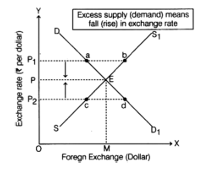
- AEquilibrium
- BEither Excess demand and Excess supply
- CExcess demand
- DExcess supply
Question types
Model Paper 1 question types
40 questions across 8 question groups — pick any mix to generate a Economics paper with step-by-step answer keys.
40
Questions
8
Question groups
5
Question types
01
M.C.Q (1 Marks)
10 Q→023 Marks Question
3 Q→034 Marks Question
4 Q→046 Marks Question
3 Q→05M.C.Q (1 Marks)
10 Q→063 Marks Question
3 Q→074 Marks Question
4 Q→086 Marks Question
3 Q→Sample Questions
Model Paper 1 questions
One sample from each question group in this chapter. Select any group above to see the full set with answer keys.
Credit creation depends on amount of initial deposit and___________.
- Amargin requirement
- Blegal reserve ratio
- Call of these
- Dbank rate
Food processor used by the households in their kitchen is an example of:
- Aconsumption goods
- Bintermediate goods
- CInvestment goods
- Dcapital goods
Complete the flow $\Delta I \rightarrow \Delta Y \rightarrow \Delta C \rightarrow$___________.
- A$\Delta D$
- B$\Delta C$
- C$\Delta S$
- D$\Delta Y$
Deficient demand leads to:
- Alow level of employment
- Bdeflationary gap
- Cexcess capacity
- Dall of these
Explain why there is a rise in demand for foreign exchange when its price falls.
What is meant by economic transactions? How can they be categorised?
Discuss briefly the three components of operating surplus.
Explain, using a numerical example, how an increase in reserve deposit ratio affects the credit creation power of the banking system.
In an economy, an increase in investment leads to doubling of the national income. Calculate the Marginal Propensity to Consume $\ce{(MPC)}$ for the given economy.
View full solution →Does an excess of AD over AS always imply a situation of inflationary gap? Explain.
State briefly the effect of excess demand on output, employment and price?
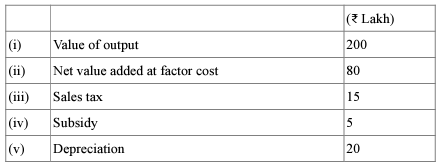
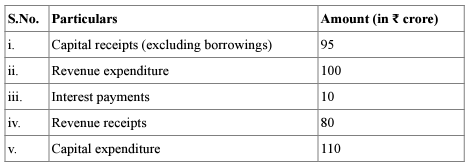
$i$. Calculate National Income from the following data.
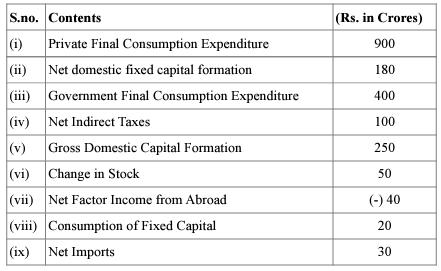
$ii. a$ .Define value of output How is it dirrent from value addition?
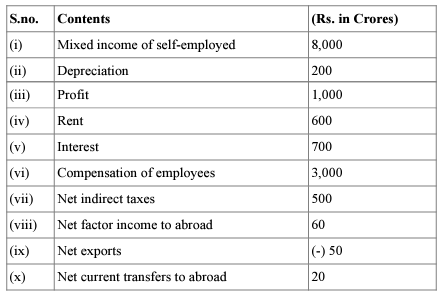
$b$ . Calculate the value of Mixed income of self $-$ Employrd from the following data.
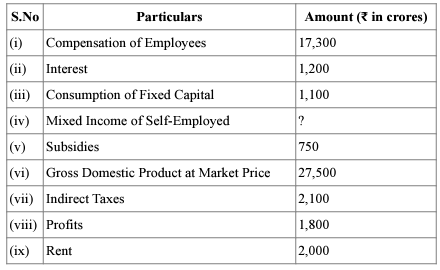
View full solution →$ii. a$ .Define value of output How is it dirrent from value addition?
$b$ . Calculate the value of Mixed income of self $-$ Employrd from the following data.
Write the correct sequence of alternatives given in Column II by matching them with respective terms in Column I:
| Column I | Column II |
| (a) Growth | (i) Adoption of new technology to increase the production of goods and services. |
| (b) Modernisation | (ii) Avoiding imports of those goods which could be produced in India itself. |
| (c) Self-reliance | (iii) Every Indian should be able to meet his/her basic needs such as food, a decent house, education and health, and inequality in the distribution of wealth should be reduced. |
| (d) Equity | (iv) Increase in the country’s capacity to produce the output of goods and services within the country. |
- A(a) - (ii), (b) - (iv), (c) - (i), (d) - (iii)
- B(a) - (iii), (b) - (iv), (c) - (i), (d) - (ii)
- C(a) - (iii), (b) - (i), (c) - (iv), (d) - (ii)
- D(a) - (iv), (b) - (i), (c) - (ii), (d) - (iii)
Statement I: More than Half of India's Foreign trade was restricted to Britain.
Statement II: Britain maintained Monopoly control on India's Import and Export.
Statement II: Britain maintained Monopoly control on India's Import and Export.
- ABoth the statements are true.
- BStatement I is true, but statement II is false.
- CStatement II is true, but statement I is false
- DBoth the statements are false.
Environment and economy are ________ and need of each other.
- Ainterdependent
- Bdependent
- Cindependent
- Dcomplimentary
Mixed economic system is followed in ________.
- APakistan
- BIndia
- CChina
- DIndia as well as Pakistan
The Government of India enacted the Right to Education as a fundamental right for all children in the age group of ________ years.
- A5 - 13
- B6 - 12
- C7 - 14
- D8 - 14
Discuss the two main forms of wage employment.
How population growth is the cause of depletion of natural resources?
State any two advantages of sustainable development.
Explain how health and expenditure on information are a source of human capital formation.
i. The real motive behind infrastructural development in India was to strengthen the British interests.
Do you agree with the given statement? Justify your answer with valid arguments.
ii. Navratna policy has facilitated the maintenance, promotion and disinvestment of Public Sector Undertakings (PSUs). Justify the given statement with valid explanation.
Do you agree with the given statement? Justify your answer with valid arguments.
ii. Navratna policy has facilitated the maintenance, promotion and disinvestment of Public Sector Undertakings (PSUs). Justify the given statement with valid explanation.
Explain the changing role of state in Indian economy since introduction of reforms.
Explain briefly the common goals of five year plans in India.
SINO-PAK FRIENDSHIP CORRIDOR
The China-Pakistan Economic Corridor (CPEC) relationship between the two nations. But it has also sparked criticism for burdening Pakistan with mountains of debt and allowing China to use its debt strategic assets of Pakistan.
The foundations of CPEC, part of China’s Belt and Road Initiative, were laid in May 2013. At the time, Pakistan was reeling under weak economic growth. China committed to play an integral role in supporting Pakistan’s economy.
Pakistan and China have a strategic relationship that goes back decades. Pakistan turned to China at a time when it needed a rapid increase in external financing to meet critical investments in hard infrastructure, particularly power plants and highways.
CPEC’s early harvest projects met this need, leading to a dramatic increase in Pakistan’s power generation capacity, bringing an end to supply-side constraints that had made rolling blackouts a regular occurrence across the country.
Pakistan leaned into CPEC, leveraging Chinese financing and technical assistance in an attempt to end power shortages that had paralyzed its country’s economy. Years later, China’s influence in Pakistan has increased at an unimaginable pace.
China As Pakistan’s Largest Bilateral Creditor: China’s ability to exert influence on Pakistan’s economy has grown substantially in recent years, mainly due to the fact that Beijing is now Islamabad’s largest creditor. According to documents released by Pakistan’s finance ministry, Pakistan’s total public and publicly guaranteed external debt stood at USD 44.35 billion in June 2013, just 9.3 percent of which was owed to China. By April 2021, this external debt had ballooned to USD 90.12 billion, with Pakistan owing 27.4 percent —USD 24.7 billion — of its total external debt to China, according to the International Monetary Fund (IMF).
Additionally, China provided financial and technical expertise to help Pakistan build its road infrastructure, expanding north-south connectivity to improve the efficiency of moving goods from Karachi all the way to Gilgit-Baltistan (POK). These investments were critical in better integrating the country’s ports, especially Karachi, with urban centers in Punjab and KhyberPakhtunkhwa provinces.
Despite power asymmetries between China and Pakistan, the latter still has tremendous agency in determining its own policies, even if such policies come at the expense of the longterm socioeconomic welfare of Pakistani citizens.
Questions:
i. Outline and discuss any two economic advantages of China Pakistan Economic Corridor (CPEC) accruing to the economy of Pakistan.
ii. Analyse the implication of bilateral ‘debt-trap’ situation of Pakistan vis-à-vis the Chinese Economy.
i. The debate over farm subsidies in India is enraged at different platforms. Discuss any two arguments in against farm subsidies.
ii. Discuss the problems of fishing community and give some suggestions.
ii. Discuss the problems of fishing community and give some suggestions.
i. Write a short note on ‘Operation Flood’.
ii. Why is it being considered necessary to replace the private moneylenders by institutional sources of credit?
ii. Why is it being considered necessary to replace the private moneylenders by institutional sources of credit?
Generate a Model Paper 1 paper free
Pick question groups from the list above, set marks and difficulty, and export a branded PDF with step-by-step answer keys. First 3 chapters free — no signup.