Questions

4 Marks Question

🎯

Test yourself on this topic

4 questions · timed · auto-graded

Question 14 Marks
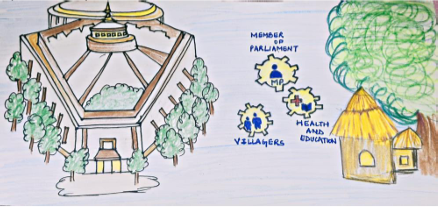
(i) Interpret the given picture based on the Saansad Adarsh Gram Yojana (SAGY) initiated by the Government of India.
Image
(II) State any two examples of allied activities.
Answer
(1) Under the Saansad Adarsh Gram Yojana (SAGY), introduced by the Government of India, Members of Parliament (MPs) need to identify and develop one village from their constituencies. MPs were to develop three villages as model villages, covering over 2,500 villages. MPs were expected to facilitate a village development plan, motivate villagers to take up activities and build infrastructure in the areas of health, nutrition, and education.
(II) Two examples of allied activities are:
  • Livestock
  • Fisheries
View full question & answer
Question 24 Marks
‘It would be unclear to say that, the growth of human capital lays the ground for economic growth of a nation.’
Do you agree with the given statement? Support your answer with valid illustrations.
Answer
An increase in human capital causes economic growth is unclear, owing to the problems pertaining to the estimation of quantifiable relation between the two. Educational yardsticks like years of schooling, teacher-pupil ratio, enrolment rates etc. may not reflect educational quality accurately. Whereas, human capital measures may show convergence between developing and developed nations, however, there's no empirical evidence to prove income per capita convergence.
Hence, education may improve, but cannot guarantee similar progress in real income across different countries.
View full question & answer
Question 34 Marks
‘Under the Delhi Declaration, the G-20 nations pledged to reach global net zero emissions approximately by mid-century and to triple global renewable energy capacity by 2030.’
Discuss briefly the rationale behind the commitment by G-20 nations in the direction of achieving sustainable development.
Answer
Under the Delhi Declaration, the G-20 member countries have agreed to elevate efforts to limit Global Warming. To achieve this, these nations have decided to reduce greenhouse gas emissions.
It has been agreed to devise an effective approach to transitioning from conventional sources of energy to non-conventional sources of energy. Wind energy and solar power serve as good illustrations of environmental friendly sources of energy that contribute to achieving sustainable development
View full question & answer
Question 44 Marks
‘The reform process implemented in the late 1970s, commonly known as China’s open door policy, encompassed a wide range of reforms across sectors like agriculture, investment, industry etc. These reforms played a pivotal role in driving the rapid growth of the Chinese economy over subsequent decades.’
In the light of the given text, discuss any two reforms responsible for the rapid economic growth of China.
Answer
The fast-paced economic growth in China can be traced back to the following reforms introduced in 1978:
• In the initial phase, reforms were initiated in agriculture, foreign trade and investment sectors. For instance, in agriculture commune lands were divided into small plots, which were allocated to individual households. They were allowed to keep all income from the land after paying stipulated taxes.
• In the subsequent phase, reforms were initiated in the industrial sector. Private sector firms, in general, and township and village enterprises, in particular, were allowed to produce goods. At this stage, State Owned Enterprises were made to face competition.
View full question & answer
4 Marks Question - Economics STD 12 Commerce Questions - Vidyadip