Question types

MODEL PAPER 2025 question types

40 questions across 8 question groups — pick any mix to generate a Economics paper with step-by-step answer keys.

40
Questions
8
Question groups
5
Question types
Sample Questions

MODEL PAPER 2025 questions

One sample from each question group in this chapter. Select any group above to see the full set with answer keys.

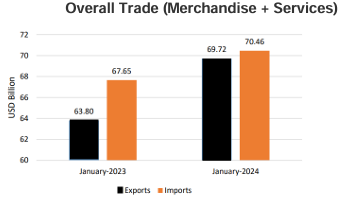
Based on the given diagram: The trade under current account during January 2024 reflects a ___________of USD ___________ billion.
Image
  • A
    surplus, 0.74
  • B
    surplus, 3.85
  • C
    deficit, 0.74
  • D
    deficit, 3.85
View full solution
Read the following statements carefully:
Statement 1: Foreign grants-in-aid receipts do not lead to any claim on the government.
Statement 2: Disposal of equity by the Public Sector Undertakings in the market may lead to a decrease in the assets of the government.
In light of the given statements, choose the correct option from the following:
  • A
    Statement 1 is true and Statement 2 is false.
  • B
    Statement 1 is false and Statement 2 is true.
  • C
    Both Statements 1 and 2 are true.
  • D
    Both Statements 1 and 2 are false.
View full solution
In a two-sector economy, Aggregate Demand can be determined by adding ___________.
  • A
    Autonomous Consumption, Induced Consumption and Induced Investment
  • B
    Autonomous Consumption, Autonomous Investment and Induced Investment
  • C
    Autonomous Consumption and Autonomous Investment
  • D
    Autonomous Consumption, Induced Consumption and Autonomous Investment
View full solution
Read the following statements carefully:
Statement 1: The maximum value of Marginal Propensity to Consume (MPC) can be unity.
Statement 2: As the income of an economy increases, the proportionate increase in the level of consumption is always more than the increase in the level of income.
In light of the given statements, choose the correct option from the following:
  • A
    Statement 1 is true and Statement 2 is false.
  • B
    Statement 1 is false and Statement 2 is true.
  • C
    Both Statements 1 and 2 are true.
  • D
    Both Statements 1 and 2 are false.
View full solution
As per the data presented in the Union Budget 2023-24, the total receipts of the government other than borrowings and the total expenditure are estimated at ₹ 27.2 lakh crore and ₹ 45 lakh crore respectively. The value of the ___________ deficit would be ₹ 17.8 lakh crore.
  • A
    revenue
  • fiscal
  • C
    budgetary
  • D
    primary

Answer: B.

View full solution
On the basis of the given data, estimate the value of Domestic Income (NDPFC):
S. NoItemsAmount (₹ in crore)
iHousehold Consumption Expenditure800
IiGross Business Fixed Capital Formation150
IiiGross Residential Construction Investment120
ivGovernment Final Consumption Expenditure170
vExcess of Imports over Exports20
ViInventory Investment140
viiGross Public Investment500
viiiNet Indirect Taxes70
ixNet Factor Income From Abroad(-)50
xConsumption of Fixed Capital40
View full solution
Read the following text carefully:
“Union Finance Minister stated, that investments in infrastructure and productive capacity have a large multiplier impact on growth and employment and in view of this, capital investment outlay is being proposed to increase steeply in the Budget 2023-24 by 1,000 crore”.
Based on the given text and common understanding, explain the working process of the increase in investment on the National Income, assuming the Marginal Propensity to Save (MPS) as 20%.
View full solution
Q 104 Marks Question4 Marks
For two hypothetical economies A and B, the value of Marginal Propensity to Consume (MPC) stands at 0.6 and 0.8 respectively. Assuming for both the economies, Autonomous Consumption $(\overline{ c })$ to be ₹ 40 crore and Investment Expenditure (I) to be ₹ 100 crore.
Calculate:
(i) Break-even level of income for Economy A
(ii) Equilibrium level of income for Economy B
View full solution
Q 114 Marks Question4 Marks
“Saving curve can be derived from the consumption curve” Justify the statement, citing valid steps with the help of a well-labelled diagram.
View full solution
Q 124 Marks Question4 Marks
(i) ‘Foreign Portfolio Investment (FPI) witnessed a sharp turnaround during 2023-24 with net FPI inflows of US$ 32.4 billion.’
In which sub-account and on which side of the Balance of Payments account the above transaction will be recorded? Give reasons in support of your answer.
(ii) State the meaning of ‘Balance of Payments Deficit’.
View full solution
Q 136 Marks Question6 Marks
(i) “Basis of classification of final goods into consumption and capital goods depend on the economic nature of its use.”
Defend or refute the statement, with the help of a suitable example.
(ii) ‘Natural calamities in the hill states of India have led to massive destruction of capital assets.’ Identify the type of loss (depreciation or capital loss) indicated in the aforesaid statement. Give valid reasons in support of your answer.
View full solution
Q 146 Marks Question6 Marks
(i) On the basis of the following hypothetical data: (all figures in ₹ crore)

YearNominalNominal GDP adjusted to base year
20203,0004,000
20234,0004,500

Calculate the percentage change in Real Gross Domestic Product in the year 2023 using 2020 as the base year.
(ii) “The public investment on the construction of a multi-lane flyover may reduce traffic congestion.” On the basis of the above statement, discuss its likely impact on Gross Domestic Product (GDP) and welfare in an economy.

View full solution
Q 156 Marks Question6 Marks
Read the following text carefully:
As societies developed from hunters and gatherers, the material needs of human beings increased – to build a house, wear clothes, make weapons and implements etc. Since these needs could not be produced individually, people had to purchase them from others. These purchases, for example, were paid initially by barter – a leather skin cloak for a spear. As barter had its limits – how many cloaks for a spear – barter got standardized in terms of metals or cowrie shells. Now people knew the value of both the cloak and the spear in terms of bronze or cowrie shells. This was still barter, as both bronze and shells had intrinsic value (shells were desired for their beauty). This system evolved over time into metal currencies. Gold and silver coinage were the offshoot of this system where they had features of barter (both gold and silver had intrinsic value) as well as money (they were standardized representation of value).
In respect of money two facts emerge historically:
  • Money has taken the form of either commodities (which have intrinsic value) or in terms of debt instruments.
  • Money is usually issued by a sovereign (or a Central Bank as its representative).
In modern economies, currency is a form of money that is issued exclusively by some competent authority (Central Bank). It is a liability of the issuing Central Bank and an asset of the holding public. Currency is usually issued in paper (or polymer) form, but the form of currency is not its defining characteristic.
n the recent past, the Reserve Bank of India, issued Central Bank Digital Currency (CBDC). A CBDC is the currency issued by a central bank in a digital form. It serves all the purposes of a paper currency in a different form. The introduction of CBDC has the potential to provide significant benefits, such as reduced dependency on cash, lower transaction costs, reduced settlement risk. Introduction of CBDC would possibly lead to a more robust, efficient, trusted, regulated payments option. There are associated risks such as cyber-attacks and technology preparedness, but they need to be carefully evaluated against the potential benefits.
On the basis of the given text and common understanding, answer the following questions:
(i) “Over the centuries, money has evolved in various forms.” In the light of the given statement, state and discuss briefly any two forms of money.
(ii) “Various economists have formed a strong opinion that, in the modern times digital currency (like CBDC) is quite essential. However, it comes with its own benefits and potential risks.”
Do you agree with the given statement, giving valid arguments in support of your answer.
View full solution
Q 16M.C.Q (1 Marks)1 Mark
During the period 1951-2016, __________ led to an increase in the milk production in India by about ten times.
  • A
    Green Revolution
  • B
    Golden Revolution
  • Golden Revolution
  • D
    Industrial Revolution

Answer: C.

View full solution
Q 17M.C.Q (1 Marks)1 Mark
“Assuming in a hypothetical economy, Real Gross Domestic Product recorded a growth rate of 9% during a fiscal year. However, the economy faced a significant challenge in terms of creating an adequate number of employment opportunities.”
Identify the situation indicated in the given statement and choose the correct option.
  • A
    Casualisation of workforce
  • B
    Informalisation of workforce
  • C
    Formalisation of workforce
  • D
    Jobless growth
View full solution
Q 18M.C.Q (1 Marks)1 Mark
___________ was setup in 1974 by the Indian government to address two major environmental concerns viz. water and air pollution.
  • A
    State Pollution Control Board
  • B
    Central Pollution Control Board
  • C
    Brundtland Commission
  • D
    Montreal Protocol
View full solution
Q 19M.C.Q (1 Marks)1 Mark
China's demographic problem of 4-2-1, resulted in a higher proportion of elderly individuals compared to the younger population. This was primarily due to the implementation of ___________.
  • A
    Great Leap Forward Campaign
  • B
    Great Proletarian Cultural Revolution
  • C
    One Child Norm
  • D
    Special Economic Zones
View full solution
Q 20M.C.Q (1 Marks)1 Mark
Identify, which of the following statement is incorrect about the financial sector reform introduced in 1991?
  • A
    Enabled the establishment of private sector banks, Indian as well as foreign
  • B
    Foreign investment limit in banks was raised to around 74%
  • C
    Foreign Institutional Investors were allowed to invest in Indian financial markets
  • D
    Change in the role of the Reserve Bank of India from facilitator to regulator
View full solution
Q 213 Marks Question3 Marks
‘To measure the extent of development in an economy, liberty indicators should be considered along with other socio-economic parameters.’ Do you agree with the given statement? Give valid reasons in support of your answer.
View full solution
Q 244 Marks Question4 Marks
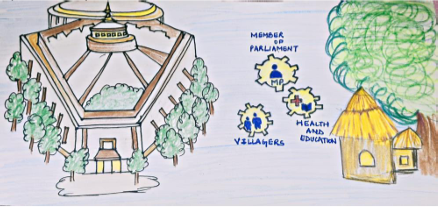
(i) Interpret the given picture based on the Saansad Adarsh Gram Yojana (SAGY) initiated by the Government of India.
Image
(II) State any two examples of allied activities.
View full solution
Q 254 Marks Question4 Marks
‘It would be unclear to say that, the growth of human capital lays the ground for economic growth of a nation.’
Do you agree with the given statement? Support your answer with valid illustrations.
View full solution
Q 264 Marks Question4 Marks
‘Under the Delhi Declaration, the G-20 nations pledged to reach global net zero emissions approximately by mid-century and to triple global renewable energy capacity by 2030.’
Discuss briefly the rationale behind the commitment by G-20 nations in the direction of achieving sustainable development.
View full solution
Q 274 Marks Question4 Marks
‘The reform process implemented in the late 1970s, commonly known as China’s open door policy, encompassed a wide range of reforms across sectors like agriculture, investment, industry etc. These reforms played a pivotal role in driving the rapid growth of the Chinese economy over subsequent decades.’
In the light of the given text, discuss any two reforms responsible for the rapid economic growth of China.
View full solution
Q 286 Marks Question6 Marks
(i) ‘During the colonial period, India’s foreign trade was characterized by a large export surplus, however, this did not result in any flow of gold or silver into India.’
Justify the given statement with valid arguments.
(ii) Explain the rationale behind choosing 'Self-reliance' as a central planning objective in India's development strategy.
View full solution
Q 296 Marks Question6 Marks
(i) ‘Under the Industrial Policy Resolution (IPR) 1956 in India, the system of industrial licensing was introduced to promote regional equality.’ Justify the given statement with valid arguments.
(ii) Discuss briefly the estimates made by notable scholars regarding the national income and per capita income during the colonial rule in India.
View full solution
Q 306 Marks Question6 Marks
Read the following text carefully: Employment generation has remained one of the top challenges of Indian policymakers, and over the years, this has only become more complex. India has experienced more or less consistent growth in the structure of the output of the economy, especially after the economic reforms which is measured by gross value added. However, the trend in employment did not reveal a consistent and clear pattern.
These complexities have led to a wide variation in the conclusions drawn by experts and various studies on workforce and employm.
Two major sources of data on the workforce and employment have been the
(i) decennial population census and
(ii) nationwide quinquennial surveys on employment and unemployment by the erstwhile NSSO under the Ministry of Statistics and Programme Implementation (MoSPI), Government of India.
The nationwide Employment and Unemployment (E&U) surveys have been replaced by the Periodic Labour Force Survey (PLFS) conducted by the National Statistical Office (NSO) of MoSPI, which started in the year 2017–18.
According to NSO, the PLFS data measure the dynamics in labour force participation, workers to population ratio and the employment status along with related, important parameters for both rural and urban areas.
Labour force includes persons who were either working (or employed) or those available for work (or unemployed). Some persons in the labour force are abstained from work for various reasons. Deducting that number from the labour force gives the number of actual workers. These workers are further categorised as persons who are engaged in any economic activity as selfemployed or regular wage/salaried and casual labour. The difference between the labour force and the workforce gives the number of unemployed persons.
The size of the labour force in the country has increased from 485.3 million in the year 2017–18 to 497.4 million in the year 2018–19. The next year, the labour force increased by 8 per cent and reached 537.9 million. This increase was witnessed across male and female populations as well as rural and urban households.
On the basis of the given text and common understanding, answer the following questions:
(i) State any two major sources of data on the workforce and employment.
(ii) ‘The labour force encompasses a broader category than the workforce.’ Defend or refute the statement, giving valid reasons in support of your answer.
(iii) ‘Workers can be categorized into different types depending on their status.’ In the light of the given statement, state any one type of employment.
View full solution

Generate a MODEL PAPER 2025 paper free

Pick question groups from the list above, set marks and difficulty, and export a branded PDF with step-by-step answer keys. First 3 chapters free — no signup.

Download App