Question types

Model Paper 2 question types

40 questions across 8 question groups — pick any mix to generate a Economics paper with step-by-step answer keys.

40
Questions
8
Question groups
5
Question types
Sample Questions

Model Paper 2 questions

One sample from each question group in this chapter. Select any group above to see the full set with answer keys.

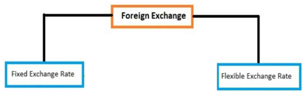
Flexible exchange rate system has the advantage:
Image

  • A
    Automatic adjustmen of balance of payments
  • B
    Encourages imports
  • C
    Easy to borrow world bank
  • D
    Encourage exports
View full solution
Demand deposits include ________.
  • A
    current account deposits and fixed deposits
  • B
    all types of deposits
  • C
    saving account deposits and current account deposits
  • D
    saving account deposits and fixed deposits
View full solution
Flow is a concept which is:
  • A
    is measured over a specified period of time
  • B
    is not time dimensional
  • C
    Cannot be measured at a particular point of time
  • D
    is measured at a particular point of time
View full solution
________ is equal to the difference between AD beyond full employment and AD at full employment.
  • A
    Deflation
  • B
    Recession
  • C
    Inflationary gap
  • D
    deflationary gap
View full solution
The central bank needs to intervene under the managed floating system. Do you agree with the given statement? Support your answer with valid reasons.
View full solution
Q 114 Marks Question4 Marks
It is planned to increase National Income by $₹ . 1,000$ crores. How much increase in investment is required to achieve this goal? Assume that the marginal propensity to consume is $0.6.$ Calculate.
View full solution
Q 124 Marks Question4 Marks
India’s GDP contracted 23.9% in the April-June quarter of 2020-21 as compared to same period of 2019-20, suggesting that the lockdown has hit the economy hard.
State and discuss any two fiscal measures that may be taken by the Government of India to correct the situation indicated in the above news report.
View full solution
Q 136 Marks Question6 Marks
(i)Giving reason, state whether the following is a revenue expenditure or a capital expenditure in a government budget
i. Expenditure on scholarships
ii. Expenditure on building a bridge
(ii). The government food subsidy given to run the Public Distribution System is more than Rs.75,000 crore. Why the government provide subsidy on food.
View full solution
Q 146 Marks Question6 Marks
i.Given the following data, find the values of Government Final Consumption Expenditure and Mixed Income of Self-Employed:
S.no.ContentsAmount (in ₹ Crores)
 (i) National Income 7,100
 (ii) Government Final Consumption Expenditure ?
 (iii) Gross Domestic Capital Formation 1,000
 (iv) Mixed-Income of Self-Employed ?
 (v) Net Indirect Taxes 200
 (vi) Net Factor Income from Abroad 100
 (vii) Private Final Consumption Expenditure 4,000
 (viii) Consumption of Fixed Capital 300
 (ix) Profits 120 
 (x) Wages and Salaries 1,500
 (xi) Net Exports 500
 (xii) Operating Surplus  3,000

ii.How are the following treated while estimating private final consumption expenditure? Give reasons for your answer.
i. Exports.
ii. Direct purchases made abroad by resident households.
iii. Final consumption expenditure of non-profit institutions serving households.
iv. Change in stocks.

View full solution
Q 156 Marks Question6 Marks
i.Find Net Domestic Product at Factor Cost from the given details.
S.no. Contents $(Rs$. in Crores$)$
$ (i)$  Rent $ 200$
$ (ii)$  Net Current Transfers to Abroad $ 10$
$ (iii)$  National Debt Interest $ 60$
$ (iv)$  Corporate Tax $ 100$
$ (v)$  Compensation of Employees $ 900$
$ (vi)$  Current Transfers by Government $ 150$
$ (vii)$  Interest $ 400$
$ (viii)$  Undistributed Profits $ 50 $
$ (ix)$  Dividend $ 250 $
$ (x)$  Net Factor Income to Abroad $ (-)10$
$ (xi)$  Income Accruing to Government $ 120$
ii. Calculate National Income.
S.no. Contents $(Rs$. in Crores$)$
$ (i)$  Personal Tax $ 80$
$ (ii)$  Private Final Consumption Expenditure $ 600$
$ (iii)$  Undistributed Profits $ 30$
$ (iv)$  Private Income $ 650$
$ (v)$  Government Final Consumption Expenditure $ 100$
$ (vi)$  Corporate Tax $ 50$
$ (vii)$  Net Domestic Fixed Capital Formation $ 70$
$ (viii)$  Net Indirect Tax $ 60$
$ (ix)$  Net Indirect Tax $ 14$
$ (x)$  Change in Stocks $ (-10)$
$ (xi)$  Net Imports $ 20$
$ (xii)$  Net Factor Income to Abroad $ 10$
View full solution
Q 16M.C.Q (1 Marks)1 Mark
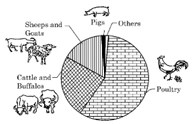
Study the following picture:
Image

Identify the kind of activities, which may be envisaged under_____as diversification activity.
  • A
    Fisheries
  • B
    Animal Husbandry
  • C
    Organic farming
  • D
    Horticulture
View full solution
Q 17M.C.Q (1 Marks)1 Mark
Identify the correct sequence of alternatives given in Column II by matching them with respective terms in Column I:
Column IColumn II
 (a) Land Ceiling (i) Increase in production of food grain using high yielding variety seeds
 (b) Land reforms  (ii) Portion of agricultural produce sold in the market
 (c) Green Revolution (iii) Fixing the maximum limit of land holding for an individual.
 (d) Marketed Surplus (iv) Change in the ownership of land (land to tillers)
  • A
    (a) - (ii), (b) - (iv), (c) - (i), (d) - (iii)
  • B
    (a) - (i), (b) - (ii), (c) - (iii), (d) - (iv)
  • C
    (a) - (iii), (b) - (i), (c) - (iv), (d) - (ii)
  • D
    (a) - (iii), (b) - (iv), (c) - (i), (d) - (ii)
View full solution
Q 18M.C.Q (1 Marks)1 Mark
Statement 1: Agriculture was commercialised during the British rule to cater to the needs of British industries for necessary raw materials.
Statement 2: The fall in production of food crops was responsible for frequent famines in India during the British days
  • A
    Statement 1 is true and Statement 2 is false
  • B
    Both the statements are false
  • C
    Both the statements are true.
  • D
    Statement 2 is true and Statement 1 is false.
View full solution
Q 19M.C.Q (1 Marks)1 Mark
The ________ of the environment implies that the resource extraction rate is not above the rate of resources regeneration.
  • A
    Opportunity cost
  • B
    Absorptive capacity
  • C
    Absorptive capacity
  • D
    Absorptive capacity
View full solution
Q 223 Marks Question3 Marks
Green revolution has led to increase in the use of chemical pesticides which in turn pollutes the environment. What measures can be taken to resolve this problem?
View full solution
Q 286 Marks Question6 Marks
Read the following text carefully and answer the questions given below:
India and China: so close yet so far
Given the good economic growth figures for India and the Chinese economic slowdown, it is worth wondering about the capacity of the former to replace the impetus lost by the latter. In fact, India, with a population close to 1,300 million, is the only emerging economy that could possibly follow in the footsteps of the Asian giant. However, in spite of them sharing notable features such as powerful demographics and a reduction in poverty, affecting hundreds of millions of people in both countries, India's growth is still far from the two-digit figures we had come to expect from China until very recently.
Throughout the last 35 years, both countries have gradually moved apart in economic terms. While China grew at an average rate of 10% for three decades, India advanced at a rate of just over 6% and, although these figures seem to be reversing at present (China grew by 6.9% in 2015 Q3 compared with India's 7.4%), India still has a long way to go. At the end of the 1970s, both economies were similar in size: India's share in the global economy was close to 3.0% and even exceeded China's share of 2.4%, but just over three decades later China accounts for 17.2% of the world economy in economic terms while India's share is less than half its neighbor's (7.1%). A dichotomy that can also be seen in other economic variables such as GDP per capita which, in India, has scarcely increased fourfold (from 1,000 dollars in 1980 to 3,780 currently) while in China it is now 14 times bigger (from close to 750 dollars to 10,538).
The contrast between the two countries is also evident in terms of international trade. Whereas exports of goods from China and India represented just 1% and 0.5% respectively of the world's exports in 1980, by 2014 China was exporting close to 13% of all global exports compared with 1.7% by India. By 2009 China had already become the world leader in exports, taking over from Germany, while India has been and continues to be a much more closed economy (19th in the world export ranking).
In summary, the gap separating India from China is considerable and has been widening for more than three decades, so it is not logical to assume that India can become the world's new China overnight. However, the country has huge potential for growth, especially if we take into account the reforms it is starting to implement: whether India prospers as much as its neighbour will depend on the success of those reforms.
Questions:
i. Analyse the contrasting features of India and China in terms of their economic growth.
ii. Examine the proposition that 'India can become the world's new China overnight'.
View full solution
Q 296 Marks Question6 Marks
i. What are the emerging alternate marketing channels (or agricultural products? Explain their benefits.
ii.Self-Help Groups provide stimulus for institutionalised lending, employment generation and women empowerment in the rural areas. Justify the given statement with valid explanation.
View full solution
Q 306 Marks Question6 Marks
i. State the sources of agricultural credit in India.
ii.Discuss the Different Policy Instruments initiated by the government to improve Agricultural Marketing.
View full solution

Generate a Model Paper 2 paper free

Pick question groups from the list above, set marks and difficulty, and export a branded PDF with step-by-step answer keys. First 3 chapters free — no signup.

Download App